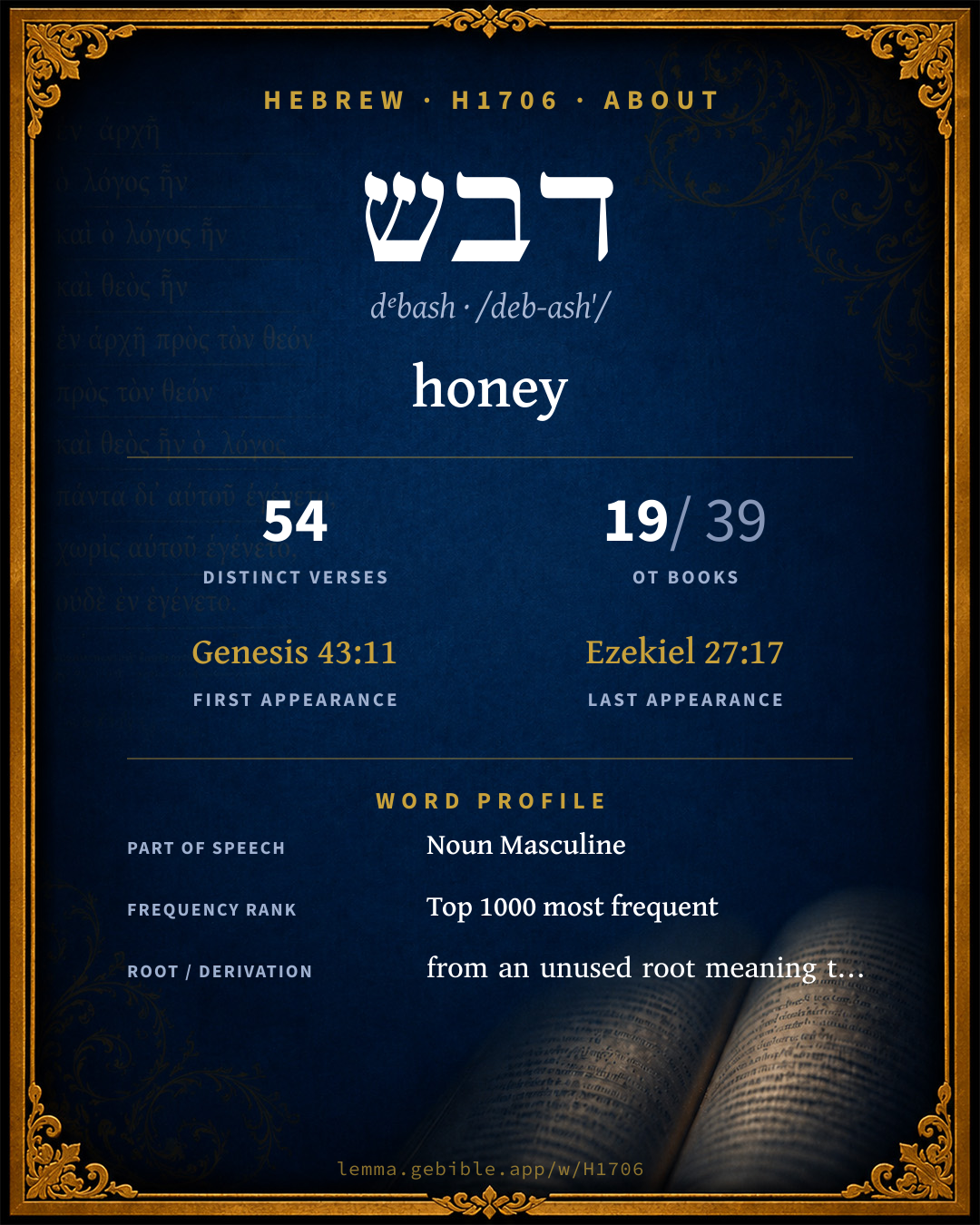
דְּבַשׁ
honey
Full lexicon entry — Brown-Driver-Briggs (BDB)
From Brown-Driver-Briggs (BDB)
Where this word appears
Grammar key — what these labels mean
Part of speech
- Noun
- A naming word — a person, place, thing, or idea.
Noun type
- Common
- A common noun — a general class of person, place, or thing (“king,” “city,” “water”), not a specific name.
State
- Absolute
- The independent form of a noun, not bound to a following word.
- Construct
- A noun bound to a following noun in a possessive / “of” relationship (the construct chain).
Gender
- Masculine
- Grammatically masculine.
Number
- Singular
- One.
Every verse where H1706 appears in the Book of Psalms — 3 distinct verses. Click any verse to open its interlinear word-by-word view. Verse text shown in the World English Bible for context — . Each verse’s Hebrew form is shown with its reference; the English is not keyword-highlighted, since the data carries no word-level English alignment. Use “Compare translations” on any verse to read it across multiple English versions. This concordance covers the Hebrew Bible; Septuagint (Greek Old Testament) occurrences are not indexed here.
Psalms
- Psalms 19:10 מִ֝/דְּבַ֗שׁ prep + n c ms More to be desired are they than gold, yes, than much fine gold; Sweeter also than honey and the extract of the honeycomb.
- Psalms 81:16 דְּבַ֣שׁ n c ms But he would have also fed them with the finest of the wheat. I will satisfy you with honey out of the rock."
- Psalms 119:103 מִ/דְּבַ֥שׁ prep + n c ms How sweet are your promises to my taste, More than honey to my mouth!
About this entry
At a glance — auto-summarized from this page’s data, not written by a person. Every figure links to its source below. This summary describes the numbers; it doesn’t interpret them.
דבש (dᵉbash) is a Hebrew noun most often rendered “honey.” It first appears in Genesis 43:11. The Hebrew Bible uses it across 54 verses — moderately common. Sharing its root, it stands alongside דבשת and ידבש. The sections below give every sense, occurrence, and version rendering.
Gloss history
Strong's 1890 vs modern scholarship
About this word
Strong's H1706 catalogs a Hebrew word from the Hebrew Old Testament.
These counts are not copied from any lexicon or concordance. They are computed here, from the morphology-tagged Hebrew Old Testament. What Lemma adds →
- 54
- distinct verses
- The word appears in 54 distinct verses.
- 19 / 39
- OT books
- The word appears in 19 of 39 Old Testament books.
- #696
- by frequency
- Top 1000 most frequent Hebrew words (rank 696 of 8,640 Hebrew words by occurrence).
View all 54 occurrences in the concordance →
Most concentrated in
- Deuteronomy 8 verses 15%
- Ezekiel 6 verses 11%
- Exodus 5 verses 9%
By section of the Old Testament
By traditional corpus
Conventional, traditional groupings — biblical authorship is debated, so this is a traditional corpus grouping, not an authorship claim. Each share is this word’s portion of its verses in that division of the Hebrew canon. Each figure is a share of the word’s 54 distinct verses.
- Prophets (Nevi'im) 23 verses · 43%
- Torah (Pentateuch) 20 verses · 37%
- Writings (Ketuvim) 11 verses · 20%
How translations render this word
Counts come from each version’s own published word-to-Strong’s tagging or interlinear alignment — an approximate guide to how each version renders this word, not a word-level alignment the data otherwise carries. Because each total is that version’s own tagged count, the per-version totals vary from one another and need not match the appearance or distinct-verse counts above. These counts may also differ from a printed concordance because Lemma counts each distinctly tagged rendering and does not collapse phrase taggings into a single head-word total. This is a fixed set of word-tagged versions (KJV, ASV, BSB, ULT) and does not change with the reading translation you choose elsewhere. Each version’s license is shown beside its name below (and on Sources).
- King James Version: Honey 44×, Than honey 2×
- American Standard Version: Honey 43×, Than honey 2×
- Berean Standard Bible: Honey 47×, Than honey 2×
- unfoldingWord Literal Text: Honey 49×, Than honey 2×
King James Version Public Domain
Renders H1706 across 52 tagged occurrences — most commonly:
Plus 6 renderings that appear only once — usually multi-word phrases or single function words the recovered tagging swept in, not distinct renderings. Not rendered by a distinct English word in 2 further occurrences.
American Standard Version Public Domain
Renders H1706 across 52 tagged occurrences — most commonly:
Plus 7 renderings that appear only once — usually multi-word phrases or single function words the recovered tagging swept in, not distinct renderings.
Berean Standard Bible Public Domain
Renders H1706 across 52 tagged occurrences — most commonly:
Plus 3 renderings that appear only once — usually multi-word phrases or single function words the recovered tagging swept in, not distinct renderings. Not rendered by a distinct English word in 2 further occurrences.
unfoldingWord Literal Text CC BY-SA 4.0
Renders H1706 across 54 tagged occurrences — most commonly:
Plus 3 renderings that appear only once — usually multi-word phrases or single function words the recovered tagging swept in, not distinct renderings.
Senses in BDB
The 1 sense BDB distinguishes for this word, in lexicon order (not ranked by frequency or importance). The full entry — with sub-senses — is in the Lexicon Entry tab.
- honey
Word origin
n.m. 1 S 14:29 honey (named from colour according to Fl NHWBi. 439; Arabic دِبْسٌ (دُبْسٌ, دِبِسٌ) date-honey; NH דְּבַשׁ, Aramaic דּובשא, ܕܒܰܫ, ܕܶܒܫܳܐ, honey both of fruits and of bees; cf. also Assyrian dišpu COTGloss. ZimBP 84 DlPr 70)—abs. ד׳ Gn 43:11 + 33 times; דְּבָ֑שׁ Ex 3:8 + 18 times; sf. דִּבְשִׁי Ct 5:1;—honey, product of bees, used as food Ju 14:8, 9, 18 (in lion’s carcass); found in (clefts of) rock Dt 32:13 (ד׳ מִסֶּלַע, in song, JE), ψ 81:17 (מִצּוּר ד׳); in forest, on ground 1 S 14:25 (על־פני השׂדה) v 26 (הֵלֶךְ ד׳; but read rather הָלַךְ דְּבֹרוֹ its bees had departed, We Dr after 𝔊) v 29, 43; transported in jar or bottle בַּקְבֻּק ד׳ 1 K 14:3; contrib. to priests and Levites 2 Ch 31:5; ‖ חֶמְאָה 2 S 17:29 Is 7:15, 22 (in last two the being limited to such food is apparently token of destitution); kept in store Je 41:8; a choice gift Gn 43:11 (J); article of trade Ez 27:17 (in these two perhaps = grape syrup, mod. dibs, cf. Di Gn 43:11 v. RobBR ii. 81); forbidden as burnt offering Lv 2:11 (‖ שְׂאֹר); honey comb = יַעְרַת הַדּ׳ 1 S 14:27 (cf. יַעְרִי Ct 5:1); also צוּף ד׳ Pr 16:24 (cf. נֹפֶת צופים ψ 19:11); most often in phrase describing abundance in land of Canaan אֶרֶץ זָבַת חָלָב וּד׳ Ex 3:8, 17; 13:5; 33:3 (all JE) Lv 20:24 (H) Nu 13:27; 14:8; 16:14 (all JE) Dt 6:3; 11:9; 26:9, 15; 27:3; 31:20 (all D) Jos 5:6 (D) Je 11:5; 32:22 Ez 20:6, 15; cf. Dt 8:8 2 K 18:32 (of land of captivity), of Egypt Nu 16:13 (JE); v. also Ez 16:13, 19 Jb 20:17 נַחֲלֵי ד׳ וְחֶמְאָה; honey, used to illustrate moral teachings Pr 24:13 (‖ נֹפֶת), 25:16, 27 (danger of surfeit); sim. of sweetness of taste Ez 3:3 (the roll), cf. כְּצַפִּיחִת בִּד׳ Ex 16:31 (P; description of manna); of sweetness of the law ψ 19:11 (‖ נֹפֶת צוּפִים) cf. 119:103; (of pleasant words Pr 16:24 cf. supr.); sweetness of lips ד׳ וְחָלָב Ct 4:11; fig. of love דִּבְשִׁי Ct 5:1 (‖ יַעְרִי, יֵינִי, חֲלָבִי).
— Brown-Driver-Briggs (Oxford 1906, public domain), digitized via Sefaria, supplemented by the OpenScriptures HebrewLexicon (CC BY 4.0). See Sources.
Origin: from an unused root meaning to be gummy
Jastrow Dictionary
A second Hebrew/Aramaic lexicon for comparison, covering Aramaic and post-biblical (Talmudic, Targumic, Midrashic) usage that the biblical-Hebrew BDB does not. Matched by lemma rather than by Strong’s number, so a lemma may carry more than one Jastrow headword (shown separately below), and the entries cover usage well beyond the Bible.
דָּבַשׁ
- , Hif. הִדְבִּישׁ to become liquid, to ferment (of honey). B. Mets. 38ᵃ. Snh. 101ᵃ. Sabb. 154ᵇ
דְּבַשׁ
- preced.) glutinous substance, honey (of bees, dates &c.). Bekh. 7ᵇ. Ter. XI, 2 ד׳ תמרים; a. fr.
A Dictionary of the Targumim, the Talmud Babli and Yerushalmi, and the Midrashic Literature (Marcus Jastrow; London, Luzac, 1903) — Public Domain. Digitized via Sefaria. Digitized via Sefaria. Full attribution on Sources.
Forms in the corpus
The 26 distinct written forms H1706 takes in the Hebrew Bible, most frequent first — each parse links to that state’s occurrences in the concordance. Hebrew forms include their vowel points and cantillation, so a single lemma takes many written forms.
Same root — word family
Other BDB entries built from the same root as H1706, grouped by Strong’s listed origin. These share a root / origin per the lexicon — not necessarily a shared meaning. Each links to that word’s own entry.
Derived from this word
Proper names from this root
People and places named from this root — a name, not an additional meaning of the word.
Compare all same-root words → 1 of the same-root words is a proper name (a person or place). They share a root, not necessarily a meaning.
Septuagint verse parallels
This word appears in 52 verses that also exist in the Greek Old Testament (Septuagint), out of the 54 Hebrew verses it occurs in. You can read those verses in Greek by switching the Old Testament edition to the Septuagint.
Read these verses in the Septuagint
- Genesis 43:11
- Exodus 3:8
- Leviticus 2:11
- Numbers 13:27
- Deuteronomy 6:3
- Joshua 5:6
- Judges 14:8
- 1 Samuel 14:25
- 2 Samuel 17:29
- 1 Kings 14:3
- 2 Kings 18:32
- 2 Chronicles 31:5
This is a verse-level parallel only — the same verses exist in both the Hebrew and Greek Old Testaments. No word-level Hebrew↔Greek correspondence is claimed: the data carries no such alignment, so no Greek word is shown as this Hebrew word’s translation. Coverage is not total — the Septuagint omits the deuterocanon and renumbers the Psalms, so some Hebrew verses have no direct Greek parallel.