
Proverbs 24:13

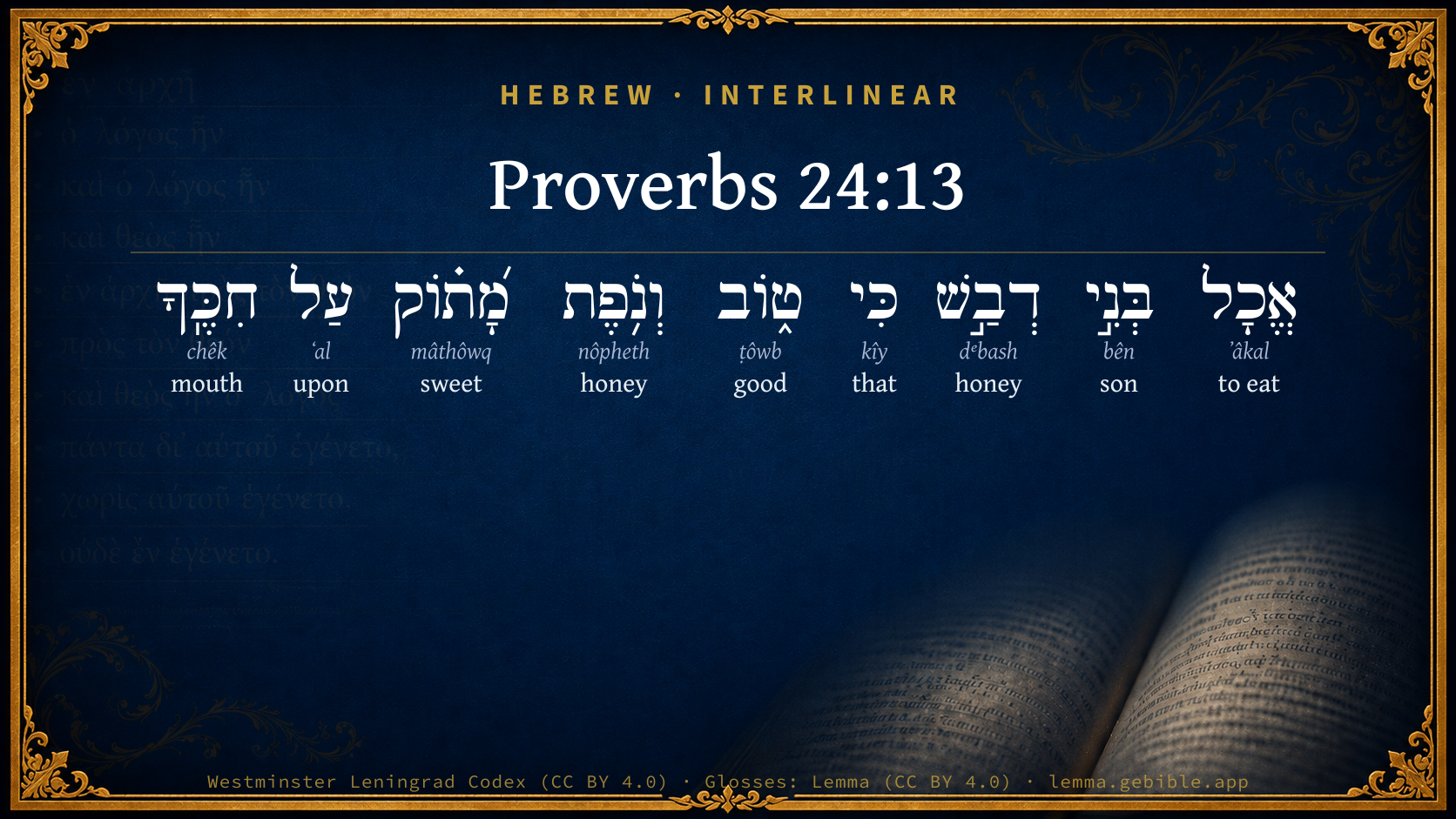
Hebrew (Westminster Leningrad Codex) Proverbs 24:13 appears in the Hebrew Old Testament. The text above is from the Westminster Leningrad Codex. Each word links to its Strong’s number, a concise gloss, and parsing drawn from the Open Scriptures Hebrew Bible morphology. Click any word for its full Brown-Driver-Briggs (BDB) entry.
Download image
Cite this verse

Proverbs 24:13 (World English Bible). Public Domain. Lemma interlinear Bible study tool, https://lemma.gebible.app/v/proverbs/24/13.

Show BibTeX & RIS
BibTeX
RIS
English Translation
My son, eat honey, for it is good; The droppings of the honeycomb, which are sweet to your taste:
World English Bible · Public Domain
Download a study sheet

One document with this verse’s original text, its word-by-word gloss line, the meaning frame, cross-references with their text, attributed commentary, and full source and license credits — printable, and it pastes into notes with its structure intact.

This verse Autodidact and up

Study sheet (.html) Plain text (.txt)

A passage Seminary Student

Up to 50 verses in one chapter. A passage sheet keeps up to 6 commentary sources and 12 cross-references per verse, in the order this page ranks them, and says so on the sheet whenever that leaves anything out. Ask for a single verse and you get the Autodidact verse sheet above.

Everything on this page stays free to read, with no account — the sheet is a download of what is already on screen, not access to it.

Want to remove ads? Support Godless Engineer
Compare translations 3

The same verse in 3 English versions, stacked beneath the original-language interlinear above. Click any original word for its lexicon entry.

Each is an independent rendering of the whole verse — the interlinear is not word-aligned to these translations.

Highlighted words mark where these versions differ — a whole-verse word diff, not a word-by-word alignment.

  • World English Bible Public Domain
    My son, eat honey, for it is good; The droppings of the honeycomb, which are sweet to your taste:
  • King James Version Public Domain
    My son, eat thou honey, because it is good; and the honeycomb, which is sweet to thy taste:
  • unfoldingWord Literal Text CC BY-SA 4.0
    My son, eat honey because good and the fresh honey sweet on your palate.

unfoldingWord Literal Text — © unfoldingWord, licensed CC BY-SA 4.0. Word-aligned USFM3 via Door43 (git.door43.org/unfoldingWord/en_ult).

Versions to compare (up to 4)

3 of 4 selected

Show all 18 translations

Every available English version of this verse, each an independent rendering of the whole verse.

  • World English Bible Public Domain
    My son, eat honey, for it is good; The droppings of the honeycomb, which are sweet to your taste:
  • Berean Standard Bible Public Domain
    Eat honey, my son, for it is good, and the honeycomb is sweet to your taste.
  • Majority Standard Bible Public Domain
    Eat honey, my son, for it is good, and the honeycomb is sweet to your taste.
  • King James Version Public Domain
    My son, eat thou honey, because it is good; and the honeycomb, which is sweet to thy taste:
  • American Standard Version (1901) Public Domain
    My son, eat thou honey, for it is good; And the droppings of the honeycomb, which are sweet to thy taste:
  • Revised Version (1885) Public Domain
    My son, eat thou honey, for it is good; and the honeycomb, which is sweet to thy taste:
  • Geneva Bible (1599) Public Domain
    My sonne, eate hony, for it is good, and the hony combe, for it is sweete vnto thy mouth.
  • Douay-Rheims (1899) Public Domain
    Fat honey, my son, because it is good, and the honeycomb most sweet to thy throat:
  • Young's Literal Translation Public Domain
    Eat my son, honey that `is' good, And the honeycomb -- sweet to thy palate.
  • Literal Standard Version CC BY-SA 4.0
    My son, eat honey that [is] good, || And the honeycomb [is] sweet to your palate.
  • Unlocked Literal Bible CC BY-SA 4.0
    My son, eat honey because it is good, because the drippings of the honeycomb are sweet to your taste.
  • unfoldingWord Literal Text CC BY-SA 4.0
    My son, eat honey because good and the fresh honey sweet on your palate.
  • Darby Bible Public Domain
    Eat honey, my son, for it is good; and a honeycomb is sweet to thy taste:
  • World Messianic Bible Public Domain
    My son, eat honey, for it is good, the droppings of the honeycomb, which are sweet to your taste;
  • Webster's Bible Public Domain
    My son, eat thou honey, because it is good; and the honey-comb, which is sweet to thy taste:
  • Free Bible Version CC BY-SA 4.0
    My son, eating honey is good for you; the honeycomb tastes sweet.
  • Bible in Basic English Public Domain
    My son, take honey, for it is good; and the flowing honey, which is sweet to your taste:
  • JPS Tanakh (1917) Public Domain
    My son, eat thou honey, for it is good, and the honeycomb is sweet to thy taste;

Literal Standard Version (2020), Covenant Press — licensed CC BY-SA 4.0. Text via the HelloAO Bible API (eBible.org). Unlocked Literal Bible (unfoldingWord) — licensed CC BY-SA 4.0. Text via the HelloAO Bible API (eBible.org). unfoldingWord Literal Text — © unfoldingWord, licensed CC BY-SA 4.0. Word-aligned USFM3 via Door43 (git.door43.org/unfoldingWord/en_ult). Free Bible Version, Dr. Jonathan Gallagher — licensed CC BY-SA 4.0. Text via the HelloAO Bible API (eBible.org).

Word by word

More ways to search: Search by grammar → Find every occurrence → Compare this word →

Practice this passage: Drill this verse → Learn its vocabulary →

About this verse

These counts appear in no published source. They are computed here, from the morphology-tagged text and Lemma’s own curated glosses. What Lemma adds →

9
words
9
distinct lemmas
Wisdom
section

Notable vocabulary

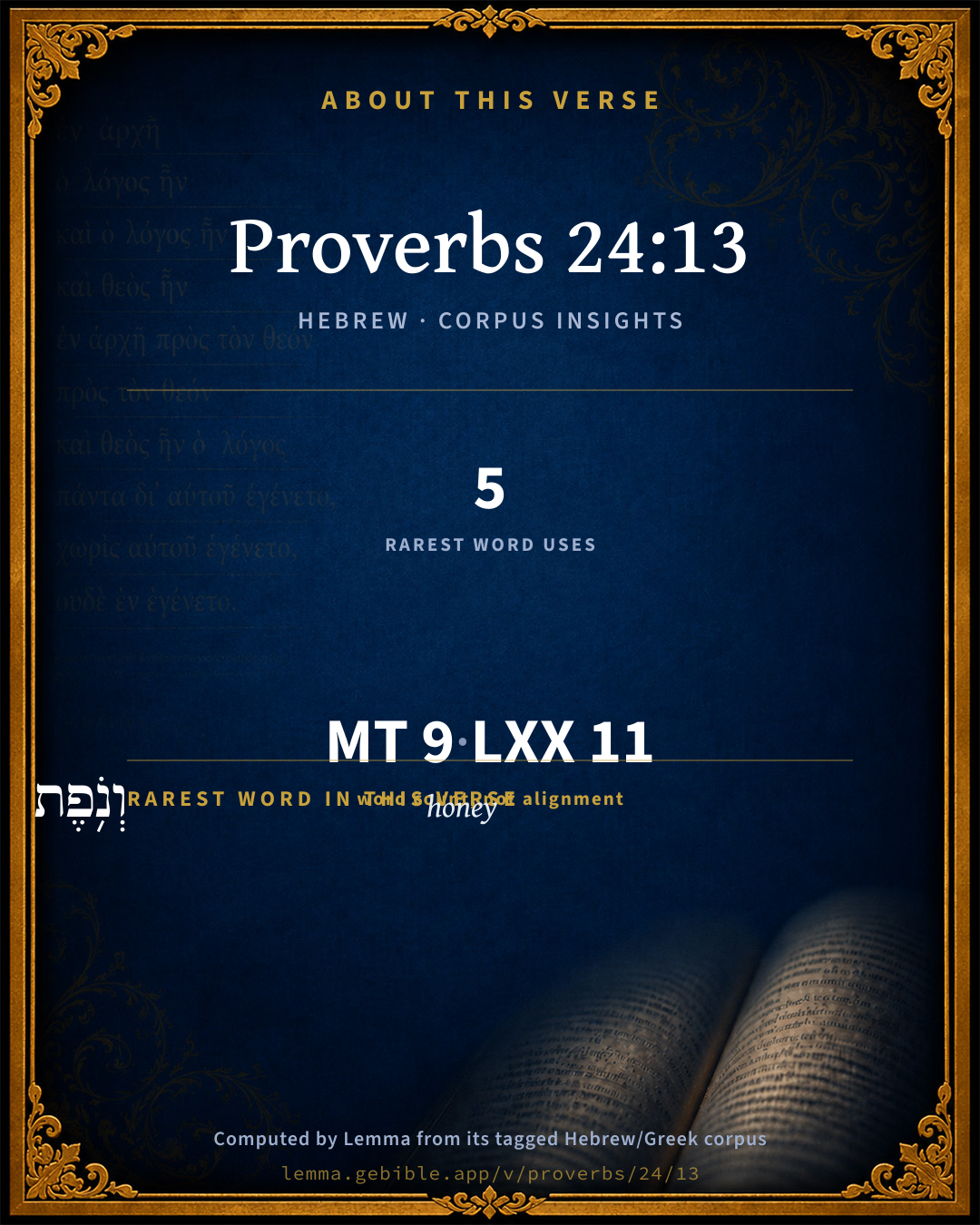
The rarest word here is וְנֹ֥פֶת honey H5317 — appearing just 5 times in the whole Hebrew Bible.

Shared distinctive vocabulary

וְנֹ֥פֶת honey H5317 occurs in 5 verses of the Hebrew Bible. Also found in:

Grammatical profile

  • 1 verb
  • 4 nouns
  • 2 adjectives
  • 1 preposition
  • 1 conjunction

Verb forms

  • אֱכָל Qal · Imperative

Hebrew & Septuagint length

In English translation the verse runs 19 words from the Hebrew and 15 from the Septuagint (LXX English) — closely comparable.

A rough comparison of the two English renderings, which tokenize alike — not a word-level alignment.

Word counts can differ between the Hebrew and the Greek without any difference in meaning — e.g. the Hebrew direct-object marker אֵת has no separate Greek word, and Greek often adds the article ὁ.

In the original languages it is 9 Hebrew tokens and 11 Greek tokens — but the two are counted differently (Hebrew bundles its prefixes and suffixes into one token; the Greek is in lemma form), so that isn’t a like-for-like length.

Cross-references

8

Topical passages linked to Proverbs 24:13 in the Treasury of Scripture Knowledge — connected by theme and wording, ordered by reader-vote popularity; previews shown in the World English Bible.

  • Isaiah 7:15 He shall eat butter and honey when he knows to refuse the evil, and choose the good.
  • Song of Solomon 5:1 I have come into my garden, my sister, my bride. I have gathered my myrrh with my spice; I have eaten my honeycomb with my honey; I have drunk my wine with my milk. Friends Eat, friends! Drink, yes, drink abundantly, beloved. Beloved
  • Proverbs 25:16 Have you found honey? Eat as much as is sufficient for you, Lest you eat too much, and vomit it.
  • Psalms 119:103 How sweet are your promises to my taste, More than honey to my mouth!
  • Song of Solomon 4:11 Your lips, my bride, drip like the honeycomb. Honey and milk are under your tongue. The smell of your garments is like the smell of Lebanon.
  • Psalms 19:10 More to be desired are they than gold, yes, than much fine gold; Sweeter also than honey and the extract of the honeycomb.
  • Proverbs 25:27 It is not good to eat much honey; Nor is it honorable to seek one's own honor.
  • Matthew 3:4 Now John himself wore clothing made of camel's hair, with a leather belt around his waist. His food was locusts and wild honey.

Cross-references courtesy of OpenBible.info (CC BY 4.0).

Hebrew and Greek witnesses Masoretic Hebrew ↔ Greek Septuagint

The same verse in the two great witnesses to the Old Testament, shown verse-for-verse.

These are two independent witnesses, not word-aligned to each other, and the Septuagint is shown in lemma (dictionary) form.

Hebrew Proverbs 24:13 Masoretic · Westminster Leningrad Codex

אֱכָל בְּנִ֣י דְבַ֣שׁ כִּי ט֑וֹב וְנֹ֥פֶת מָ֝ת֗וֹק עַל חִכֶּֽךָ

My son, eat honey, for it is good; The droppings of the honeycomb, which are sweet to your taste:

World English Bible · Public Domain

Greek LXX Proverbs 24:13 Septuagint · lemma form

ἐσθίω μέλι υἱός ἀγαθός γάρ κηρίον ἵνα γλυκαίνω σύ ὁ φάρυγξ

My son, eat honey, for the honeycomb is good, that your throat may be sweetened.

LXX2012 (modern English Septuagint) · Public Domain

On this verse, Keil & Delitzsch discusses the Septuagint’s reading. Read the note in Commentary ↓

Hebrew: Westminster Leningrad Codex (CC BY 4.0). Greek: Septuagint (public domain); English from LXX2012 (modern English Septuagint) (Public Domain). How the Septuagint differs from the Hebrew →

Commentary

Notes on Proverbs 24:13 from classic Christian and Jewish commentators (each source and its license shown beneath its notes). The classic Christian expositions comment on the surrounding passage and are grouped to its opening verse, so a note may address several verses; the Jewish commentaries on the Tanakh (Rashi and others) are per-verse, so they appear only where the commentator wrote on this verse.

Lemma curates 59 commentaries, every one of them public domain or Creative Commons licensed, each selected and text-cleaned for this edition rather than reprinted as found. About our sources →

Trapp's Complete Commentary

John Trapp

Pro 24:13 My son, eat thou honey, because [it is] good; and the honeycomb, [which is] sweet to thy taste:

Ver. 13. My son, eat thou honey, because it is good.] Profitable and pleasant, wholesome and toothsome. So, and much more than so, is divine knowledge. Plutarch tells of Eudoxus, that he would be willing to be burned up by the sun presently, so he might be admitted to come so near it as to learn the nature of it. How sweet must it needs be then to know Christ and him crucified! Sweeter it was to David than live honey dropping from the comb. {Psa 19:10; Psa 119:103} The believing Hebrews knew "within themselves" that there should be a reward, and that their expectation should not be cut off. {Heb 10:34} They drew the circumference of God’s promises to the centre of their hearts, and so living by faith they had the deserts of the feast of a good conscience as Master Latimer hath it: they tasted of that honey, the sweetness whereof none can find by any discourse, how elegant soever, so well as by eating of it, as Augustine speaketh.

John Trapp, A Commentary or Exposition upon All the Books of the Old and New Testament (1647–1656) — public domain. Text from a community e-Sword module.

The Biblical Illustrator

Joseph S. Exell

Pro_24:13-14

So shall the knowledge of wisdom be unto thy soul.

Spiritual knowledge

I. It is wholesome. My son, eat thou honey, because it is good. Honey was one of the choice productions of Canaan. It was used by its inhabitants as an article of diet; it was not only delicious to the palate, but strengthening to the frame. Divine knowledge is the aliment for mans spiritual nature; without it there is no moral strength; our faculties require God Himself to feed upon. Without God it starves. He is the food of the intellect, the affections, the imagination, the conscience.

II. It is delectable. And the honeycomb, which is sweet to the taste. Gods goodness in nature appears in this as well as in all other things: that the provisions essential to mans strength He has made palatable to the taste. Honey is not only strengthening, but sweet. The pleasures of spiritual knowledge are of the most exquisite kind.

III. It is satisfying. When thou hast found it, then there shall be a reward, and thy expectation shall not be cut off. There shall be a reward. Goodness is its own reward, and the reward is equal to the highest expectation. (D. Thomas, D.D.)

The Biblical Illustrator, edited by Joseph S. Exell (c. 1880s–1900s) — public domain. Text from a community e-Sword module.

Joseph Benson's Commentary

Pro 24:13-14. My son, eat thou honey — This is not a command, but a concession, and is here expressed only to illustrate the following verse. Do not slight, much less nauseate, such precepts as these; but, as honey is most acceptable to thy palate, especially that pure part of it which drops of itself immediately from the honey-comb, so let that knowledge be to thy mind, which tends to make thee wise and virtuous. Then there shall be a reward — As nothing is more necessary for thee, nothing more delightful; so, if it be seriously studied, and thoroughly digested, it will abundantly reward thy pains, even in the present world, but more especially in the next. It is well known, says Bishop Patrick, in how high esteem honey was among the ancients, for food, for drink, for medicine, for preserving of dead bodies, and particularly for infants. Isa 7:15. All this is here fitly applied to wisdom, from which the mind derives the greatest satisfaction, and which therefore ought to be our daily diet, our sweetest refreshment.

Joseph Benson's Commentary on the Old and New Testaments (1811–1818) — public domain. Text from a community e-Sword module.

The Preacher's Complete Homiletical Commentary

Joseph S. Exell (gen. ed.)

CRITICAL NOTES.—

Pro_24:14. There shall be a reward, rather, “there is a future,” as in chap. Pro_23:18.

MAIN HOMILETICS OF Pro_24:13-14

HONEY AND WISDOM

I. An analogy.

1. Honey is found by man ready prepared for his use; no human skill is needed to make it fit for food—nothing that man can do can render it more palatable than it is as it flows from the comb. So the revealed wisdom of God as it is found in the Scriptures needs no intervention of man to make it suitable to human needs.

2. As honey is evidently designed by God to furnish a wholesome and pleasant food for the body, so has He designed that the revelation of His mind and will by His inspired messengers shall provide wholesome and congenial food for the soul of man. The great abundance of honey in Palestine led to its forming a more prominent part of daily food than in western countries, and its possessing these two qualities made it very fit for general and constant use, and was a perpetual testimony to the providence of God in relation to the needs and enjoyment of His creatures. So is the provision which God has made for the spiritual wants of the children of men. On this point we must take the testimony of those who have tested this soul-food. We should not ask a man whether honey was pleasant to the taste if he had never eaten it, and those are not qualified to bear witness concerning the spiritual enjoyment and benefit to be derived from the “wisdom of God” who have not tested it. All those who have done so, whatever their condition in life, in whatever age they have lived, or whatever part of the world they have called their home, have agreed with David’s testimony that it is “more to be desired than gold, yea, than much fine gold: sweeter also than honey and the honey-comb” (Psa_19:10).

II. A contrast.

1. Honey may be eaten until it cloys the appetite and injures the eater, but not so with the word of God. Those who eat the most of this spiritual food are the most spiritually healthy, and have the keenest appetite for it.

2. Although this God-given bodily food may do much to nourish and sustain a healthy man, it cannot cure a diseased body, or prevent the inroads of sickness and decay. But there is a soul-transforming power in the spiritual food of which it is here an emblem. Those who eat of it are by it healed of spritual disease, and are continually and unceasingly growing in moral health and vigour.

3. The blessings flowing from eating the spiritual food are only fully realised in the life beyond the present. To this the wise man refers in the last clause. (For Homiletics on this thought, see on chaps. Pro_11:7; Pro_14:32, pages 201 and 391).

OUTLINES AND SUGGESTIVE COMMENTS

Pro_24:13. The wise man’s feast which he makes his son is but one dish. And what need of more when that is both good and pleasant? The glutton provideth many dishes, and costly to make them luscious, but they are not good, not good for the health of the body.… On the other side, the physician provideth divers meats, and they are good—good either for the preservation of health or for the recovery of it, but they are not pleasant and grateful to the palate. That is the best feeding when these are joined together.… Or else if they are not joined together, notice that the wise man putteth good in the first place; as teaching thee rather to take that which is good though not pleasant, than that which is pleasant but not good.—Jermin.

Pro_24:14. When thou hast found it. That is, when thou hast so found it that thou canst feed upon it and convert it into nourishment, then thy pains of seeking shall be rewarded. And though it be a late reward, for wisdom is not quickly found, yet there shall be a reward, and that so full, that in nothing thine expectation shall be cut off. For though hardly yet it is well-gotten; and with pleasure will sweeten the pains, with good will satisfy the tarrying and recompense the delay. The Chaldee rendereth the middle part of the verse, “If thou hast found, the last will come better than the first.” As if this were a mark whereby to know whether we have found wisdom or not, because then the further we go on the more sweetness we shall find.—Jermin.

The Preacher's Complete Homiletical Commentary (gen. ed. Joseph S. Exell; Funk & Wagnalls, c. 1892) — public domain (pre-1929). A full-Bible homiletical/sermon-outline anthology covering 65 of 66 books (2 John is absent from the source module). Text from a community e-Sword module.

Keil & Delitzsch

C. F. Keil & F. Delitzsch

The proverb now following stands in no obvious relation with the preceding. But in both a commencement is made with two lines, which contain, in the former, the principal thought; in this here, its reason:

13 My son, eat honey, for it is good,

And honeycomb is sweet to thy taste.

14 So apprehend wisdom for thy soul;

When thou hast found it, there is a future,

And thy hope is not destroyed.

After its nearest fundamental thought, טוב, Arab. ṭejjib, means that which smells and tastes well; honey (דּבשׁ, from דּבשׁ, to be thick, consistent) has, besides, according to the old idea (e.g., in the Koran), healing virtue, as in general bitterness is viewed as a property of the poisonous, and sweetness that of the wholesome. נפתו is second accus. dependent on אכל־, for honey and honeycomb were then spoken of as different; נפת (from נפת, to pour, to flow out) is the purest honey (virgin-honey), flowing of itself out of the comb. With right the accentuation takes 13b as independent, the substantival clause containing the reason, "for it is good:" honeycomb is sweet to thy taste, i.e., applying itself to it with the impression of sweetness; על, as at Neh 2:5; Psa 16:6 (Hitzig).

In the כּן of 14a, it is manifest that Pro 24:13 is not spoken for its own sake. To apprehend wisdom, is elsewhere equivalent to, to receive it into the mind, Pro 1:2; Ecc 1:17 (cf. דעת בינה, Pro 4:1, and frequently), according to which Bttcher also here explains: learn to understand wisdom. But כן unfolds itself in 14bc: even as honey has for the body, so wisdom has for the soul, beneficent wholesome effects. דעה חכמה is thus not absolute, but is meant in relation to these effects. Rightly Fleischer: talem reputa; Ewald: sic (talem) scito spaientiam (esse) animae tuae, know, recognise wisdom as something advantageous to thy soul, and worthy of commendation. Incorrectly Hitzig explains אם־מצאת, "if the opportunity presents itself." Apart from this, that in such a case the words would rather have been כּי תמצא, to find wisdom is always equivalent to, to obtain it, to make it one's own, Pro 3:13; Pro 8:35; cf. Pro 2:5; Pro 8:9. דּעה

(Note: Write דּעה with Illuj after the preceding Legarmeh, like 12b, הוּא (Thorath Emeth, p. 28).)

stands for דּעה, after the form רדה; שׁבה (after Bttcher, 396, not without the influence of the following commencing sound), cf. the similar transitions of ā into ě placed together at Psa 20:4; the form דּעה is also found, but דּעה is the form in the Cod. Hilleli,

(Note: Vid., Strack's Prolegomena critica in V.T. (1872), p. 19.)

as confirmed by Moses Kimchi in Comm., and by David Kimchi, Michlol 101b. With ישׁו begins the apodosis (lxx, Jerome, Targ., Luther, Rashi, Ewald, and others). In itself, וישׁ (cf. Gen 47:6) might also continue the conditional clause; but the explanation, si inveneris (eam) et ad postremum ventum erit (Fleischer, Bertheau, Zckler), has this against it, that ישׁ אחרית does not mean: the end comes, but: there is an end, Pro 23:18; cf. Pro 19:18; here: there is an end for thee, viz., an issue that is a blessed reward. The promise is the same as at Pro 23:18. In our own language we speak of the hope of one being cut off; (Arab.) jaz'a, to be cut off, is equivalent to, to give oneself up to despair.

Keil & Delitzsch — Biblical Commentary on the Old Testament (1861–1891) — public domain (CC PDM 1.0). Text via the HelloAO Bible API. (Old Testament only.)

Tyndale Open Study Notes

Tyndale Open Resources

24:13-14 Saying 26: Both honey and wisdom are sweet. Wisdom improves the soul, enhancing opportunities for the future.

Tyndale Open Study Notes — © Tyndale Open Resources, licensed CC BY-SA 4.0. Text via the HelloAO Bible API.

Geneva Bible (1599)

Geneva Bible translators

As honey is sweet and pleasant to the taste, so wisdom is to the soul.

Geneva Bible (1599) marginal notes — public domain. Text via Bolls.life.

Matthew Henry's Commentary

We are here quickened to the study of wisdom by the consideration both of the pleasure and the profit of it. 1. It will be very pleasant. We eat honey because it is sweet to the taste, and upon that account we call it good, especially that which runs first from the honey-comb. Canaan was said to flow with milk and honey, and honey was the common food of the country (Luk 24:41, Luk 24:42), even for children, Isa 7:15. Thus should we feed upon wisdom, and relish the good instructions of it. Those that have tasted honey need no further proof that it is sweet, nor can they by any argument be convinced of the contrary; so those that have experienced the power of truth and godliness are abundantly satisfied of the pleasure of both; they have tasted the sweetness of them, and all the atheists in the world with their sophistry, and the profane with their banter, cannot alter their sentiments. 2. It will be very profitable. Honey may be sweet to the taste and yet not wholesome, but wisdom has a future recompence attending it, as well as a present sweetness in it. "Thou art permitted to eat honey, and the agreeableness of it to thy taste invites thee to it; but thou hast much more reason to relish and digest the precepts of wisdom, for when thou hast found that, there shall be a reward; thou shalt be paid for thy pleasure, while the servants of sin pay dearly for their pains. Wisdom does indeed set thee to work, but there shall be a reward; it does indeed raise great expectations in thee, but as thy labour, so thy hope, shall not be in vain; thy expectation shall not be cut off (Pro 23:18), nay, it shall be infinitely outdone."

Matthew Henry's Commentary on the Whole Bible (1708–1710) — public domain (CC PDM 1.0). Text via the HelloAO Bible API.

Jamieson, Fausset & Brown

Robert Jamieson, A. R. Fausset & David Brown

As delicious food whets the appetite, so should the rewards of wisdom excite us to seek it.

Jamieson, Fausset & Brown — Commentary Critical and Explanatory on the Whole Bible (1871) — public domain (CC PDM 1.0). Text via the HelloAO Bible API.

Adam Clarke's Commentary

Verse 13. And the honey-comb] I have often had occasion to remark how much finer the flavour of honey is in the honey-comb than it is after it has been expressed from it, and exposed to the action of the air. But it has been asserted that the honey-comb is never eaten; it must be by those who have no acquaintance with the apiary. I have seen the comb with its contained honey eaten frequently, and of it I have repeatedly partaken. And that our Lord ate it, is evident from Lu 24:42. Nor can any man who has not eaten it in this way feel the full force of the allusions to the honey-comb and its sweetness in several parts of the sacred writings. See 1Sa 14:27; Ps 19:10; Pr 5:3; Pr 16:24; Pr 27:7; Son 4:11; Son 5:1; and the place before us.

Adam Clarke's Commentary on the Bible (1810–1826) — public domain. Text from a community e-Sword/MySword module.

John Gill's Exposition

So shall the knowledge of wisdom be unto thy soul,.... Or let it be taken in as greedily and with as good an appetite; as pleasant, useful, delightful, and profitable; even the knowledge of Christ, the Wisdom of God, which is preferable to all things else, and more desirable than the most pleasant and profitable things in the world; and of the Gospel of Christ, the wisdom of God in a mystery, than which nothing is more sweet and comfortable to a truly gracious soul; it is like Ezekiel's roll, which was in his mouth as honey for sweetness, Eze 3:3;

when thou hast found it, then there shall be a reward; for though there may be some difficulty and trouble to attain it, in the use of means, by reading, bearing, prayer, and meditation, yet, being enjoyed, it carries its own reward with it; a man is abundantly recompensed for all his pains in the pursuit of it, by the pleasure and profit it yields him now and hereafter; for it is the beginning of life eternal, and will issue in it, Joh 17:3; see Pro 2:3;

and thy expectation shall not be cut off; or "hope" (o); as the hope of the hypocrite will, Job 8:14, the hope of eternal life, as founded on Christ and his righteousness, where such that know Wisdom place their hope; and this hope will not make them ashamed; they will not be disappointed, their expectation shall not perish, they will have what they are waiting and hoping for, and what is promised unto them; see Gill on Pro 23:18. The Targum is,

"which if thou findest, the last shall come better than the first, and thy hope shall not be consumed.''

(o) "spes tua", Mercerus.

John Gill's Exposition of the Whole Bible (1746–1763) — public domain (CC PDM 1.0). Text via the HelloAO Bible API.

Albert Barnes' Notes on the Bible

Honey entered largely into the diet of Hebrew children Isa 7:15, so that it was as natural an emblem for the purest and simplest wisdom, as the “sincere milk of the word” was to the New Testament writers. The learner hears what seems to be a rule of diet - then Pro 24:14 the parable is explained.

Albert Barnes' Notes on the Bible (1834–1885) — public domain. Text from a community e-Sword/MySword module.

Haydock's Catholic Bible Commentary

Honey. Of wisdom, which is most delicious. (Menochius)

George Leo Haydock (1774–1849), Haydock's Catholic Family Bible and Commentary, 1859 edition — public domain. Excludes Psalms (Douay-Rheims chapter numbering differs from Protestant) and Deuterocanonical books (Catholic canon only).

Matthew Poole's English Annotations

This is not a command, but a concession, and is here expressed only to illustrate the following verse. Honey in those parts was excellent, and a usual and an acceptable food. See Deu 8:8; Jdg 14:18; 1Sa 14:25.

Matthew Poole's English Annotations on the Holy Bible (1683–1685) — public domain. Text from a community e-Sword/MySword module.

Whedon's Commentary on the Bible

Daniel D. Whedon

13, 14. Eat thou honey — These two verses, taken together, imply a comparison. There is first what seems a simple precept concerning diet, which is afterwards applied to the acquisition of wisdom. The sense may be given thus: As thou eatest honey because it is good, (Psa_19:10,) and the droppings of the honeycomb because they are sweet to thy palate, so do thou mentally know, or taste, wisdom for thyself. If thou find it, there shall be a [happy] hereafter, and thy hope shall not be cut off. Stuart renders: “If thou hast found it, and there is a hereafter, then thy expectation shall not be cut off.” Here, as in Pro_23:18, where the same word (אחרית, ahharith) occurs, the apparent conditionality is not one of doubt, but a supposed case, the reality of which is assumed; as sure as there is a hereafter — like the phrase, If there be a God, he will punish such wickedness. Comp. Pro_23:18.

Daniel D. Whedon (gen. ed.), Commentary on the Old and New Testaments (1874–1909) — public domain. Text from a community e-Sword module.

The Pulpit Commentary

Vers. 13, 14. An exhortation to the study of wisdom, with an analogy.

Eat thou honey, because it is good. Honey entered largely into the diet of the Oriental, and was regarded not only as pleasant to the taste and nutritious, but also as possessed of healing powers. It was especially used for children"s food, (Isa_7:15) and thus becomes an emblem of the purest wisdom. "I have eaten my honeycomb with my honey," says the lover in Son_5:1; and the psalmist says that the ordinances of the Lord are "sweeter than honey and the honeycomb". (Psa_19:10; see on Pro_25:16) Palestine was a land flowing with milk and honey; (Exo_3:8) hence is derived the continual reference to this article of diet in the Bible.

Vers. 13, 14. Zeal in the pursuit of wisdom.

I THE SWEETNESS OF WISDOM. (Ver. 13) Not without deep meaning is the sense of knowing the truth compared to the sensuous relish of the palate for sweet food. Here is, indeed, a "Perpetual feast of nectared sweets, Where no crude surfeit reigns." (Cf. Psa_19:11)

II ENCOURAGEMENT IN ITS PURSUIT. (Ver. 14) It brings a true satisfaction both during the pursuit and at its end, which can be said of few other objects of eager ambition in this world. The seeker for truth may be compared to the maiden of the parable, who timely fills her lamp with oil, and "hope that reaps not shame." The pursuit of wisdom, or of truth as understood and taught in this book, is no chase of dreams or abstractions; it is the affair of all. Truth is all that touches and convinces man, whether as an individual, or as a member of society, or the citizen of a nation. It is that which tells him that he is not isolated in the midst of unknown beings; but that beyond his individual life he partakes in a life that is universal. All that in the past, whether facts, thoughts, or sentiments, are in question, that makes us contemporary with the facts, fellow heirs with humanity in great thoughts, sympathetic with great sentiments, is truth. J.

The Pulpit Commentary (1880–1919), ed. H.D.M. Spence-Jones & Joseph S. Exell — public domain. Text from a community e-Sword module.

John Wesley's Explanatory Notes

Eat - This is not a command, but a concession, and is only here expressed to illustrate the following verse. Honey in those parts was an usual food.

John Wesley, Explanatory Notes Upon the Whole Bible (1754–1765) — public domain. Text via the GEBible commentary corpus.

Bridges on Proverbs

Charles Bridges

Honey was the choice procuct of Canaan;†1 the food of its inhabitants,†2 even of children;†3 good and sweet to the taste. ’So,’ when "the spiritual senses were exercised,"†4 ’shalt thou find the knowledge of wisdom unspeakably delectable to thy soul;’†5 — that knowledge of Christ, without which we are undone, and in which we are supremely happy.†6 Eating only can convey, what the most accurate description fails to give, a just perception of the sweetness of the honey-comb. (Jdg 14:18 .) Experimental knowledge alone gives spiritual discernment, and proves the gospel to be, not a golden dream, but a divine reality. And who ever mistakes honey for any other substance? Who would not instantly detect a counterfeit? And what intelligent Christian would mistake the semblance of heavenly wisdom for its substance? ’Lord! I have long wanted the true manna; all my former food was nothing but empty husks.’†7 Truly indeed the soul, hungering for bread, and feeding upon an experimental apprehension of Christian doctrine, realizes solidly what no formalist ever knows. He possesses a plausible shadow — emotion, impulse, conviction, external reformation. (Heb 6:4-5 .) But the living faith carries its own witness with it. ’It is all true — "I believed, and therefore have I spoken."’ (2Co 4:13 .) The treasure is found with the transport of Archimedes — bringing its own reward.†8

The expectation of the finder, so far from being cut off, shall be infinitely exceeded. "The love" that is manifested "passeth knowledge." (Eph 3:19 .) "The peace" that is sealed "passeth all understanding." (Php 4:7 .) "The joy" that is felt is "unspeakable, and full of glory." (1Pe 1:8 .) Shall we then timidly exhibit these privileges, as if they would lower the obligations of holiness, or paralyze exertion? They are not opiates, but cordials. They invigorate, while they refresh. Depression unnerves; fear enchains; but "the joy of the LORD is strength." (Neh 8:10 .) It inspires energy, elevates hope, and makes our ’service perfect freedom.’

Footnotes:

†1 Exo 3:8 . Eze 20:6 .

†2 Jdg 14:9. 1Sa 14:27 . Mat 3:4 . Luk 24:41-42 . Compare Sir 39:26 .

†3 Isa 7:15.

†4 Heb 5:14.

†5 Bp. Hall. Pro 16:24 . Psa 19:10 ; Psa 119:103 .

†6 Php 3:8. ’Lo! this’ — says good Bishop Hall — ’is the honey that I desire to eat. Give me of this honey, and I shall receive (like Jonathan of old, 1Sa 14:29 ) both clearness to mine eyes and vigor of my spirits, to the foiling of my spiritual enemies.’ — Soliloquies, liv.

†7 Augustine.

†8 Compare Jer 15:16 .

Charles Bridges, An Exposition of the Book of Proverbs (1846) — public domain. Text from a community e-Sword module.

Kretzmann's Popular Commentary

Paul E. Kretzmann

v. 13. My son, eat thou honey because it is good, and the honeycomb, which is sweet to thy taste, this figurative admonition serving to introduce the praise of the loveliness and agreeableness of true wisdom.

Paul E. Kretzmann, Popular Commentary of the Bible (1921–1924) — public domain. Text from a community e-Sword module.

unfoldingWord translationNotes

Door43 World Missions Community

General Information:

These verses continue the "thirty sayings" (Proverbs 22:20).

your hope will not be cut off

Possible meanings are 1) this is a simple passive that can be translated as in active form. AT: "no one will take your hope away" or 2) this is litotes that can be translated in positive form. AT: "your hope will surely continue" (See: Active or Passive and Litotes)

translationWords

honey

wise

soul

hope

cut off

unfoldingWord translationNotes — © Distant Shores Media and the Door43 World Missions Community, licensed CC BY-SA 4.0. Source: git.door43.org/Door43/en_tn.

Rashi

Rabbi Shlomo Yitzchaki (Rashi)

Eat honey, my son It is customary for people to eat honey because it is good; so too know wisdom for your soul, and just as you run to eat honey, so should you run to know wisdom.

Rashi on the Tanakh — English translations: “The Judaica Press complete Tanach with Rashi, translated by A. J. Rosenberg” (CC BY 4.0); “Pentateuch with Rashi's commentary by M. Rosenbaum and A.M. Silbermann, 1929-1934” (public domain); “The Metsudah Tanach series, Lakewood, N.J” (CC BY 4.0); and “The Book of Joshua, Metsudah Publications, 1997” (CC BY 4.0). Text via Sefaria.

Lesson kit

Teaching starters — assembled from the data on this page, not authored interpretation. Every prompt links to the verse data it draws on. Edit before teaching.

Proverbs, in the Wisdom, opens this verse with 9 words (9 distinct Hebrew lemmas). Its most distinctive word is nôpheth (“honey”). A historical commentator’s framing appears above. Read the whole chapter for the surrounding context.

Discussion questions

  1. The word nôpheth carries the sense “honey.” How does it shape the verse?
  2. How does Psalms 19:10, which shares the word «honey», read alongside this verse?
  3. These translations render this verse differently; the difference is in the English rendering, not the original. What questions does that raise?
  4. «אֱכָל» is a Qal Imperative verb. How does that grammatical form shape the action described?
  5. Compare how Trapp's Complete Commentary and The Biblical Illustrator read this verse. Where do they agree or differ?

Things to notice

Reading settings

Reading text

Shown beneath each verse's original-language words.

Old Testament
Old Testament edition

Read the OT as the Masoretic Hebrew (MT) or the Greek Septuagint (LXX).

English shown for the Greek Septuagint (in the Hebrew ↔ Greek comparison).

Comparing translations? Open the Compare panel on any verse page to stack up to four side by side.