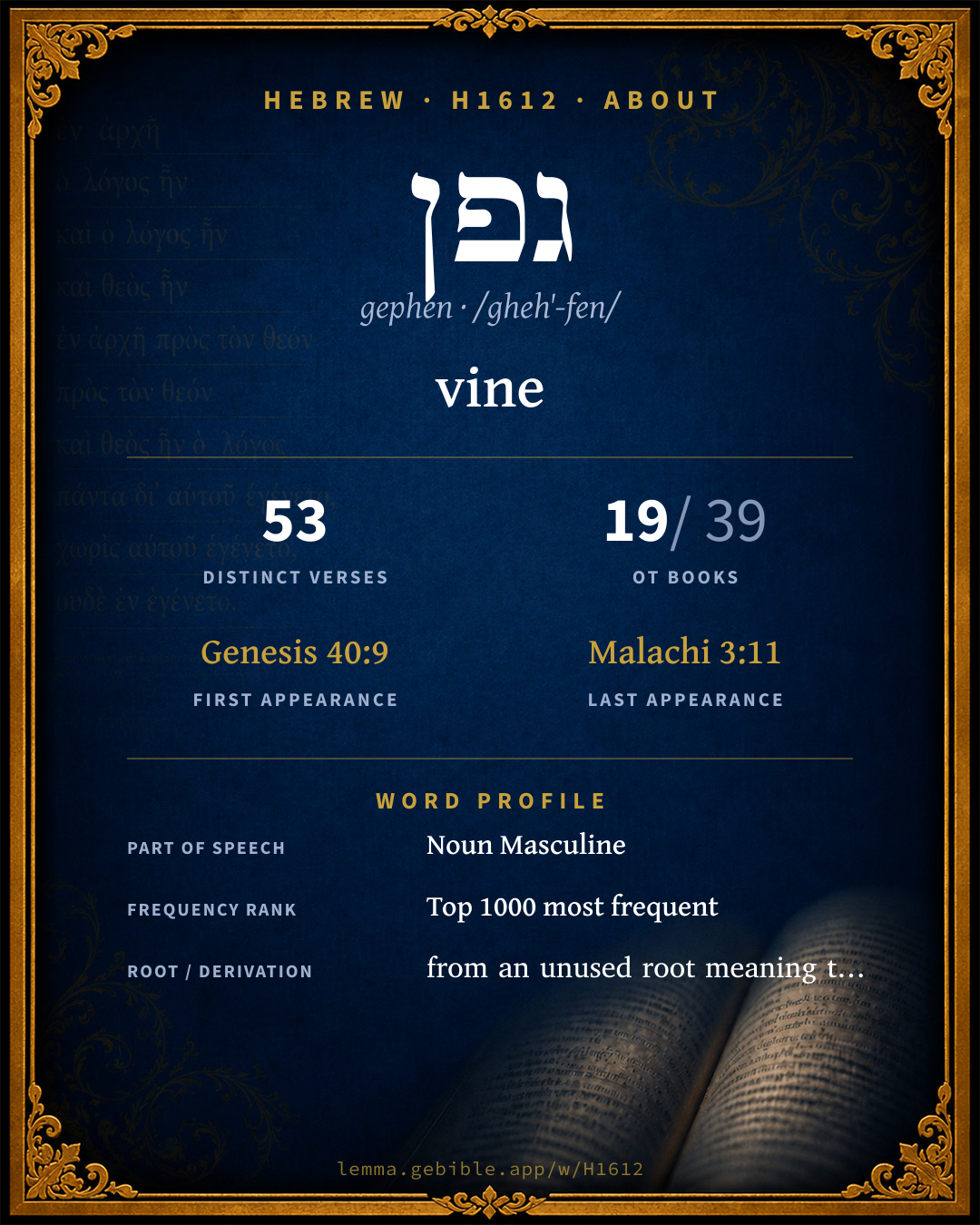
גֶּ֫פֶן
vine
‘vine’ is one of 4 main senses fuller range ↓
Full lexicon entry — Brown-Driver-Briggs (BDB)
From Brown-Driver-Briggs (BDB)
Where this word appears
See every Absolute-state word in the Hebrew Bible →
Grammar key — what these labels mean
Part of speech
- Noun
- A naming word — a person, place, thing, or idea.
Noun type
- Common
- A common noun — a general class of person, place, or thing (“king,” “city,” “water”), not a specific name.
State
- Absolute
- The independent form of a noun, not bound to a following word.
- Construct
- A noun bound to a following noun in a possessive / “of” relationship (the construct chain).
Gender
- Both
- Attested as both masculine and feminine.
Number
- Singular
- One.
- Plural
- More than one (in Hebrew, generally three or more).
Every verse where H1612 appears in the Book of Ezekiel — 6 distinct verses. Click any verse to open its interlinear word-by-word view. Verse text shown in the World English Bible for context — . Each verse’s Hebrew form is shown with its reference; the English is not keyword-highlighted, since the data carries no word-level English alignment. Use “Compare translations” on any verse to read it across multiple English versions. This concordance covers the Hebrew Bible; Septuagint (Greek Old Testament) occurrences are not indexed here.
Ezekiel
- Ezekiel 15:2 הַ/גֶּ֖פֶן ptcl def.art + n c bs Son of man, what is the vine tree more than any tree, the vine-branch which is among the trees of the forest?
- Ezekiel 15:6 הַ/גֶּ֨פֶן֙ ptcl def.art + n c bs Therefore thus says the Lord Yahweh: As the vine tree among the trees of the forest, which I have given to the fire for fuel, so will I give the inhabitants of Jerusalem.
- Ezekiel 17:6 לְ/גֶ֨פֶן לְ/גֶ֔פֶן prep + n c bs prep + n c bs It grew, and became a spreading vine of low stature, whose branches turned toward him, and the roots of it were under him: so it became a vine, and brought forth branches, and shot forth sprigs.
- Ezekiel 17:7 הַ/גֶּ֨פֶן ptcl def.art + n c bs There was also another great eagle with great wings and many feathers: and, behold, this vine did bend its roots toward him, and shot forth its branches toward him, from the beds of its plantation, that he might water it.
- Ezekiel 17:8 לְ/גֶ֥פֶן prep + n c bs cs It was planted in a good soil by many waters, that it might bring forth branches, and that it might bear fruit, that it might be a goodly vine.
- Ezekiel 19:10 כַ/גֶּ֛פֶן prep det + n c bs Your mother was like a vine, in your blood, planted by the waters: it was fruitful and full of branches by reason of many waters.
About this entry
At a glance — auto-summarized from this page’s data, not written by a person. Every figure links to its source below. This summary describes the numbers; it doesn’t interpret them.
At its core, גפן (gephen) means “vine.” Ranging over 4 senses, it is not a single-sense word. It turns up in 53 verses across 19 books, a moderately common footprint. It first appears in Genesis 40:9. Each statement above links to its evidence; the full detail follows below.
Gloss history
Strong's 1890 vs modern scholarship
About this word
Strong's H1612 catalogs a Hebrew word from the Hebrew Old Testament.
These counts are not copied from any lexicon or concordance. They are computed here, from the morphology-tagged Hebrew Old Testament. What Lemma adds →
- 53
- distinct verses
- The word appears in 53 distinct verses.
- 19 / 39
- OT books
- The word appears in 19 of 39 Old Testament books.
- #686
- by frequency
- Top 1000 most frequent Hebrew words (rank 686 of 8,640 Hebrew words by occurrence).
View all 53 occurrences in the concordance →
By section of the Old Testament
By traditional corpus
Conventional, traditional groupings — biblical authorship is debated, so this is a traditional corpus grouping, not an authorship claim. Each share is this word’s portion of its verses in that division of the Hebrew canon. Each figure is a share of the word’s 53 distinct verses.
- Prophets (Nevi'im) 36 verses · 68%
- Writings (Ketuvim) 10 verses · 19%
- Torah (Pentateuch) 7 verses · 13%
How translations render this word
Counts come from each version’s own published word-to-Strong’s tagging or interlinear alignment — an approximate guide to how each version renders this word, not a word-level alignment the data otherwise carries. Because each total is that version’s own tagged count, the per-version totals vary from one another and need not match the appearance or distinct-verse counts above. These counts may also differ from a printed concordance because Lemma counts each distinctly tagged rendering and does not collapse phrase taggings into a single head-word total. This is a fixed set of word-tagged versions (KJV, ASV, BSB, ULT) and does not change with the reading translation you choose elsewhere. Each version’s license is shown beside its name below (and on Sources).
- King James Version: Vine 32×, Vines 7×, Under his vine 2×
- American Standard Version: Vine 30×, Vines 7×, Under his vine 2×
- Berean Standard Bible: Vine 29×, Vines 12×, Grapevine 5×
- unfoldingWord Literal Text: Vine 35×, Vines 6×, Vine of 5×
King James Version Public Domain
Renders H1612 across 55 tagged occurrences — most commonly:
Plus 14 renderings that appear only once — usually multi-word phrases or single function words the recovered tagging swept in, not distinct renderings.
American Standard Version Public Domain
Renders H1612 across 55 tagged occurrences — most commonly:
Plus 14 renderings that appear only once — usually multi-word phrases or single function words the recovered tagging swept in, not distinct renderings.
Berean Standard Bible Public Domain
Renders H1612 across 55 tagged occurrences — most commonly:
Plus 5 renderings that appear only once — usually multi-word phrases or single function words the recovered tagging swept in, not distinct renderings.
unfoldingWord Literal Text CC BY-SA 4.0
Renders H1612 across 59 tagged occurrences — most commonly:
Plus 8 renderings that appear only once — usually multi-word phrases or single function words the recovered tagging swept in, not distinct renderings.
Senses in BDB
The 4 senses BDB distinguishes for this word, in lexicon order (not ranked by frequency or importance). The full entry — with sub-senses — is in the Lexicon Entry tab.
- vine, vine tree
- of Israel (figuratively)
- of stars fading at Jehovah's judgment (metaphorically)
- of prosperity
Word origin
n.f. Ju 9:13 + (m. only Ho 10:1, perhaps infl. of יִשְׂרָאֵל, 2 K 4:39) vine (NH id., Arabic جَفْنٌ (Yemen), Assyrian gapnu, cf. ZehnpfundBAS i. 633; Aramaic גּוֹפַן, גֶּפֶן, ܓܦܶܬܳܐ, pl. ܓܘܽܦ̈ܢܶܐ )—ג׳ Gn 40:9 + 38 times (also cstr., as Nu 6:4 Dt 32:32 Is 16:8, 9), גָּ֑פֶן Ju 9:12 + 2 times; sf. גַּפְנִי Jo 1:7, גַּפְנְךָ Je 5:17, גַּפְנוֹ 1 K 5:5 + 3 times, גַּפְנָהּ Ho 2:14, גַּפְנָם Dt 32:32 + 2 times; pl. גְּפָנִים Ct 2:13 Hb 3:17—vine (always grape-bearing except 2 K 4:39) Gn 40:9, 10 (in dream) 49:11 Nu 20:5 Dt 8:8 Ju 9:12, 13 (in allegory) 1 K 5:5 2 K 18:31 = Is 36:16, ψ 78:47; 105:33 Ct 2:13; 6:11; 7:13 Is 7:23; 24:7; 32:12 Je 5:17; 8:13 Ho 2:14 Jo 1:7, 12; 2:22 Mi 4:4 Hb 3:17 Hg 2:19 Zc 2:10; 8:12 Mal 3:11; גֶּפֶן שָׂדֶה a vine bearing poisonous gourds 2 K 4:39; גֶּפֶן הַיַּיִן Nu 6:4 (cf. Gn 40:10 Ju 9:13) Ju 13:14; אֶשְׁכְּלוֹת הַגֶּפֶן Ct 7:9; עֵץ הַגֶּפֶן Ez 15:2, 6; in simile of stars fading away at Yahweh’s judgment Is 34:4; in simile of wicked losing early promise Jb 15:33; in simile of wife ψ 128:3; fig. of Israel ψ 80:9, 15 Ez 17:6(×2), 7, 8 Ho 10:1 cf. Ez 19:10, Je 2:21; 6:9; also Ho 14:8; fig. of Israel as easily destroyed Ez 15:2, 6; fig. of godless enemies of Israel Dt 32:32 cf. Di; גֶּפֶן שִׂבְמָה fig. for prosperity of Moab Is 16:8, 9 Je 48:32.—On the vine in Syria cf. AnderlindZPV 1888, 160 ff.
— Brown-Driver-Briggs (Oxford 1906, public domain), digitized via Sefaria, supplemented by the OpenScriptures HebrewLexicon (CC BY 4.0). See Sources.
Origin: from an unused root meaning to bend
Jastrow Dictionary
A second Hebrew/Aramaic lexicon for comparison, covering Aramaic and post-biblical (Talmudic, Targumic, Midrashic) usage that the biblical-Hebrew BDB does not. Matched by lemma rather than by Strong’s number, so a lemma may carry more than one Jastrow headword (shown separately below), and the entries cover usage well beyond the Bible.
גֶּפֶן
- c. (b. h., v. גפף) vine, esp. grape-vine. Kil. VII, 2; a. fr.—פרי הג׳ wine. Ber. VI, 1; a. fr.—צֶמֶר ג׳ cotton, cotton tree, v. גּוּפְנָא. Kil. l. c.—Pl. גְּפָנִים. Ib.; a. fr.
A Dictionary of the Targumim, the Talmud Babli and Yerushalmi, and the Midrashic Literature (Marcus Jastrow; London, Luzac, 1903) — Public Domain. Digitized via Sefaria. Digitized via Sefaria. Full attribution on Sources.
Forms in the corpus
The 42 distinct written forms H1612 takes in the Hebrew Bible, most frequent first — each parse links to that state’s occurrences in the concordance. Hebrew forms include their vowel points and cantillation, so a single lemma takes many written forms.
Septuagint verse parallels
This word appears in 50 verses that also exist in the Greek Old Testament (Septuagint), out of the 53 Hebrew verses it occurs in. You can read those verses in Greek by switching the Old Testament edition to the Septuagint.
Read these verses in the Septuagint
- Genesis 40:9
- Numbers 6:4
- Deuteronomy 8:8
- Judges 9:12
- 2 Kings 4:39
- Job 15:33
- Psalms 80:8
- Song of Solomon 2:13
- Isaiah 7:23
- Jeremiah 2:21
- Ezekiel 15:2
- Hosea 2:12
This is a verse-level parallel only — the same verses exist in both the Hebrew and Greek Old Testaments. No word-level Hebrew↔Greek correspondence is claimed: the data carries no such alignment, so no Greek word is shown as this Hebrew word’s translation. Coverage is not total — the Septuagint omits the deuterocanon and renumbers the Psalms, so some Hebrew verses have no direct Greek parallel.