Song of Solomon 2:13

Hebrew (Westminster Leningrad Codex) Song of Solomon 2:13 appears in the Hebrew Old Testament. The text above is from the Westminster Leningrad Codex. Each word links to its Strong’s number, a concise gloss, and parsing drawn from the Open Scriptures Hebrew Bible morphology. Click any word for its full Brown-Driver-Briggs (BDB) entry.
Download image
Cite this verse

Song of Solomon 2:13 (World English Bible). Public Domain. Lemma interlinear Bible study tool, https://lemma.gebible.app/v/song-of-solomon/2/13.

Show BibTeX & RIS
BibTeX
RIS
English Translation
The fig tree ripens her green figs. The vines are in blossom; They give forth their fragrance. Arise, my love, my beautiful one, And come away. Lover
World English Bible · Public Domain
Highlights
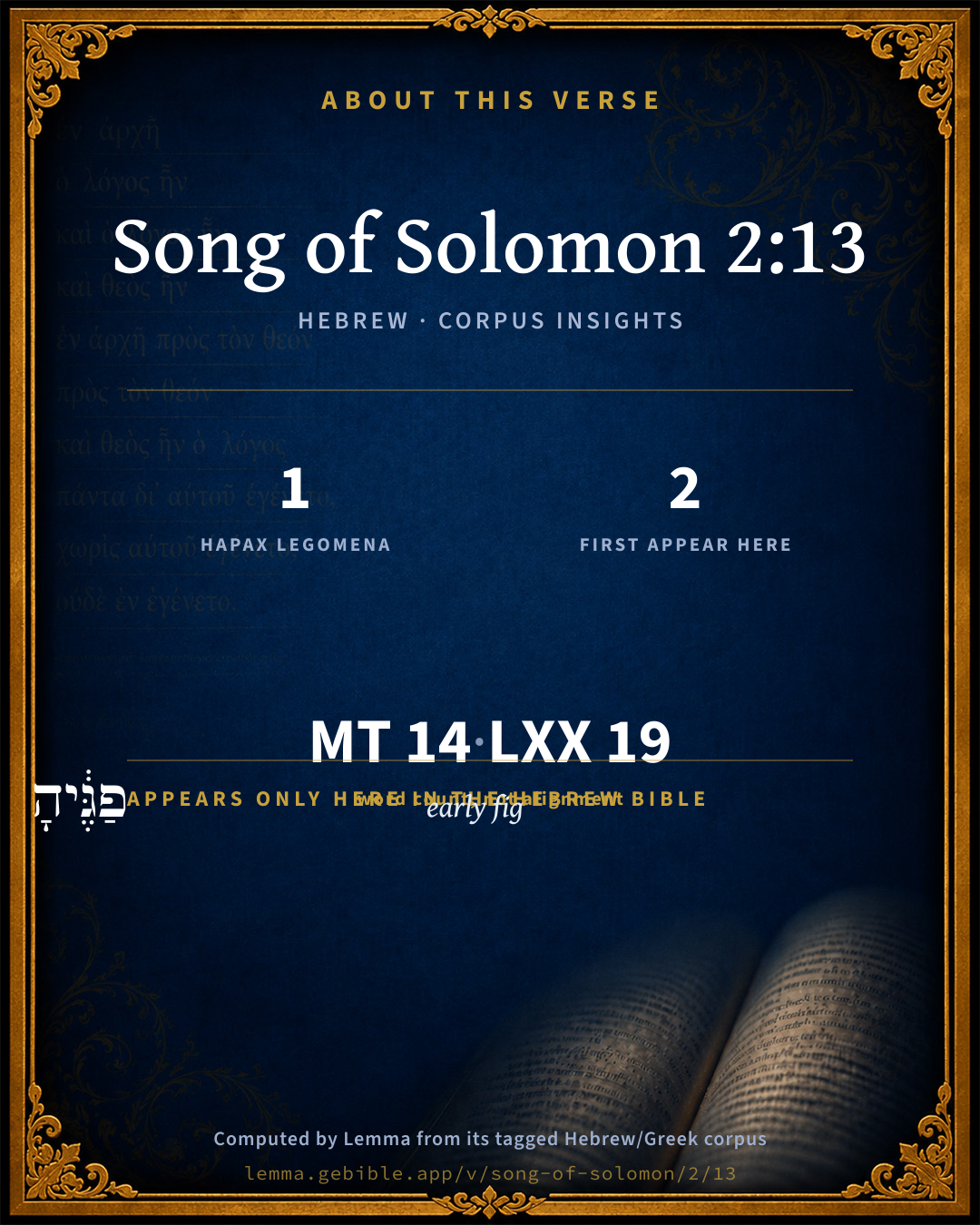
  • 1 hapax legomenon — only here in the Hebrew Bible
  • 2 first appearances in the Hebrew Bible
Full analysis ↓
Download a study sheet

One document with this verse’s original text, its word-by-word gloss line, the meaning frame, cross-references with their text, attributed commentary, and full source and license credits — printable, and it pastes into notes with its structure intact.

This verse Autodidact and up

Study sheet (.html) Plain text (.txt)

A passage Seminary Student

Up to 50 verses in one chapter. A passage sheet keeps up to 6 commentary sources and 12 cross-references per verse, in the order this page ranks them, and says so on the sheet whenever that leaves anything out. Ask for a single verse and you get the Autodidact verse sheet above.

Everything on this page stays free to read, with no account — the sheet is a download of what is already on screen, not access to it.

Want to remove ads? Support Godless Engineer
Compare translations 3

The same verse in 3 English versions, stacked beneath the original-language interlinear above. Click any original word for its lexicon entry.

Each is an independent rendering of the whole verse — the interlinear is not word-aligned to these translations.

Highlighted words mark where these versions differ — a whole-verse word diff, not a word-by-word alignment.

  • World English Bible Public Domain
    The fig tree ripens her green figs. The vines are in blossom; They give forth their fragrance. Arise, my love, my beautiful one, And come away. Lover
  • King James Version Public Domain
    The fig tree putteth forth her green figs, and the vines with the tender grape give a good smell. Arise, my love, my fair one, and come away.
  • unfoldingWord Literal Text CC BY-SA 4.0
    The fig tree ripens its green figs, and the vines blossom; they give off a smell. Get up, come, my darling, my beauty, and come.”

unfoldingWord Literal Text — © unfoldingWord, licensed CC BY-SA 4.0. Word-aligned USFM3 via Door43 (git.door43.org/unfoldingWord/en_ult).

Versions to compare (up to 4)

3 of 4 selected

Show all 18 translations

Every available English version of this verse, each an independent rendering of the whole verse.

  • World English Bible Public Domain
    The fig tree ripens her green figs. The vines are in blossom; They give forth their fragrance. Arise, my love, my beautiful one, And come away. Lover
  • Berean Standard Bible Public Domain
    The fig tree ripens its figs; the blossoming vines spread their fragrance. Arise, come away, my darling; come away with me, my beautiful one.”
  • Majority Standard Bible Public Domain
    The fig tree ripens its figs; the blossoming vines spread their fragrance. Arise, come away, my darling; come away with me, my beautiful one.”
  • King James Version Public Domain
    The fig tree putteth forth her green figs, and the vines with the tender grape give a good smell. Arise, my love, my fair one, and come away.
  • American Standard Version (1901) Public Domain
    The fig-tree ripeneth her green figs, And the vines are in blossom; They give forth their fragrance. Arise, my love, my fair one, and come away.
  • Revised Version (1885) Public Domain
    The fig tree ripeneth her green figs, and the vines are in blossom, they give forth their fragrance. Arise, my love, my fair one, and come away.
  • Geneva Bible (1599) Public Domain
    The figtree hath brought foorth her yong figges: and the vines with their small grapes haue cast a sauour: arise my loue, my faire one, and come away.
  • Douay-Rheims (1899) Public Domain
    The fig tree hath put forth her green figs: the vines in flower yield their sweet smell. Arise, my love, my beautiful one, and come:
  • Young's Literal Translation Public Domain
    The fig-tree hath ripened her green figs, And the sweet-smelling vines have given forth fragrance, Rise, come, my friend, my fair one, yea, come away.
  • Literal Standard Version CC BY-SA 4.0
    The fig tree has ripened her green figs, || And the sweet-smelling vines have given forth fragrance, || Rise, come, my friend, my beautiful one, indeed, come away.
  • Unlocked Literal Bible CC BY-SA 4.0
    The fig tree ripens her green figs, and the vines are in blossom; they give off their fragrance. Arise, my love, my beautiful one, and come away.
  • unfoldingWord Literal Text CC BY-SA 4.0
    The fig tree ripens its green figs, and the vines blossom; they give off a smell. Get up, come, my darling, my beauty, and come.”
  • Darby Bible Public Domain
    The fig-tree melloweth her winter figs, And the vines in bloom give forth [their] fragrance. Arise, my love, my fair one, and come away!
  • World Messianic Bible Public Domain
    The fig tree ripens her green figs. The vines are in blossom. They give out their fragrance. Arise, my love, my beautiful one, and come away.”
  • Webster's Bible Public Domain
    The fig-tree putteth forth her green figs, and the vines with the tender grape give a good smell. Arise, my love, my fair one, and come away.
  • Free Bible Version CC BY-SA 4.0
    Fig trees start producing ripe fruit, while grape vines blossom, giving off their fragrance. Get up, my darling, my beautiful girl, and come away with me!”
  • Bible in Basic English Public Domain
    The fig-tree puts out her green fruit and the vines with their young fruit give a good smell. Get up from your bed, my beautiful one, and come away.
  • JPS Tanakh (1917) Public Domain
    The fig-tree putteth forth her green figs, and the vines in blossom give forth their fragrance. Arise, my love, my fair one, and come away.

Literal Standard Version (2020), Covenant Press — licensed CC BY-SA 4.0. Text via the HelloAO Bible API (eBible.org). Unlocked Literal Bible (unfoldingWord) — licensed CC BY-SA 4.0. Text via the HelloAO Bible API (eBible.org). unfoldingWord Literal Text — © unfoldingWord, licensed CC BY-SA 4.0. Word-aligned USFM3 via Door43 (git.door43.org/unfoldingWord/en_ult). Free Bible Version, Dr. Jonathan Gallagher — licensed CC BY-SA 4.0. Text via the HelloAO Bible API (eBible.org).

Word by word

More ways to search: Search by grammar → Find every occurrence → Compare this word →

Practice this passage: Drill this verse → Learn its vocabulary →

פַגֶּ֔יהָ
pag
H6291
“early figs · her”
Noun, Common, Masculine, Plural, Construct + Suffix, Personal, 3rd Person, Feminine, Singular
Part of Speech
Noun
Type
Common
Gender
Masculine
Number
Plural
State
Construct
Full BDB Definition

Origin: from an unused root meaning to be torpid, i.e. crude

TWOT: 1729a

green fig, early fig
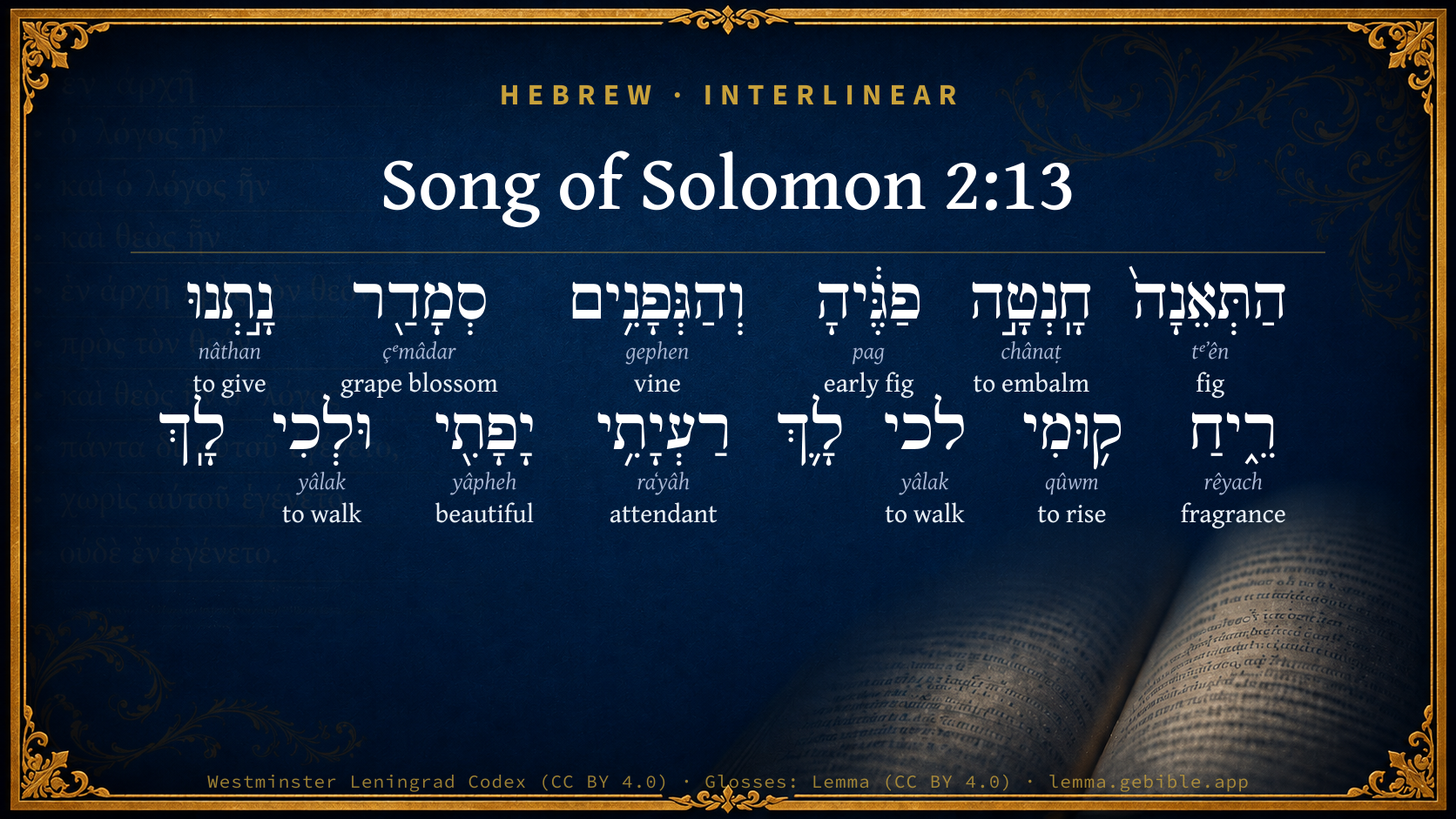
  1. הַתְּאֵנָה֙ tᵉʼên H8384 “the · fig” Particle, Definite Article + Noun, Common, Feminine, Singular, Absolute
  2. חָֽנְטָ֣ה chânaṭ H2590 “to embalm” Verb, Qal, Perfect, 3rd Person, Feminine, Singular
  3. וְהַגְּפָנִ֥ים gephen H1612 “and · the · vines” Conjunction + Particle, Definite Article + Noun, Common, Both, Plural, Absolute
  4. סְמָדַ֖ר çᵉmâdar H5563 “grape blossom” Noun, Common, Masculine, Singular, Absolute
  5. נָ֣תְנוּ nâthan H5414 “to give” Verb, Qal, Perfect, 3rd Person, Common, Plural
  6. רֵ֑יחַ rêyach H7381 “fragrance” Noun, Common, Masculine, Singular, Absolute
  7. ק֥וּמִי qûwm H6965 “rise” Verb, Qal, Imperative, 2nd Person, Feminine, Singular
  8. לכי yâlak H3212 “walk” Verb, Qal, Imperative, 2nd Person, Feminine, Singular
  9. רַעְיָתִ֥י raʻyâh H7474 “attendant · my” Noun, Common, Feminine, Singular, Construct + Suffix, Personal, 1st Person, Common, Singular
  10. יָפָתִ֖י yâpheh H3303 “beautiful · my” Adjective, Adjective, Feminine, Singular, Construct + Suffix, Personal, 1st Person, Common, Singular
  11. וּלְכִי yâlak H3212 “and · walk” Conjunction + Verb, Qal, Imperative, 2nd Person, Feminine, Singular

About this verse

These counts appear in no published source. They are computed here, from the morphology-tagged text and Lemma’s own curated glosses. What Lemma adds →

14
words
11
distinct lemmas
Wisdom
section

Notable vocabulary

1 hapax legomenon — a word that appears only here in the entire Hebrew Bible:

  • פַגֶּ֔יהָ early fig H6291

First appearance in Scripture

These words make their first canonical appearance in the Hebrew Bible here:

  • פַגֶּ֔יהָ early fig H6291
  • סְמָדַ֖ר grape blossom H5563

Shared distinctive vocabulary

סְמָדַ֖ר grape blossom H5563 occurs in 3 verses of the Hebrew Bible. Also found in:

Grammatical profile

  • 5 verbs
  • 6 nouns
  • 1 adjective
  • 2 prepositions

Verb forms

  • חָֽנְטָ֣ה Qal · Perfect
  • נָ֣תְנוּ Qal · Perfect
  • ק֥וּמִי Qal · Imperative
  • לכי Qal · Imperative
  • וּלְכִי Qal · Imperative

Repetition

A word recurs within this verse — often emphatic in Hebrew:

  • לכי to walk H3212 ×2

Hebrew & Septuagint length

In English translation the verse runs 27 words from the Hebrew and 31 from the Septuagint (LXX English) — closely comparable.

A rough comparison of the two English renderings, which tokenize alike — not a word-level alignment.

Word counts can differ between the Hebrew and the Greek without any difference in meaning — e.g. the Hebrew direct-object marker אֵת has no separate Greek word, and Greek often adds the article ὁ.

In the original languages it is 14 Hebrew tokens and 19 Greek tokens — but the two are counted differently (Hebrew bundles its prefixes and suffixes into one token; the Greek is in lemma form), so that isn’t a like-for-like length.

Cross-references

14

Topical passages linked to Song of Solomon 2:13 in the Treasury of Scripture Knowledge — connected by theme and wording, ordered by reader-vote popularity; previews shown in the World English Bible.

  • Song of Solomon 2:10 My beloved spoke, and said to me, Rise up, my love, my beautiful one, and come away.
  • Song of Solomon 7:11–13 Come, my beloved, let us go forth into the field. Let us lodge in the villages.
  • Isaiah 55:10–11 For as the rain comes down and the snow from the sky, and doesn't return there, but waters the earth, and makes it bring forth and bud, and gives seed to the sower and bread to the eater;
  • Isaiah 61:11 For as the earth brings forth its bud, and as the garden causes the things that are sown in it to spring forth; so the Lord Yahweh will cause righteousness and praise to spring forth before all the nations.
  • Luke 13:6–7 He spoke this parable. "A certain man had a fig tree planted in his vineyard, and he came seeking fruit on it, and found none.
  • 2 Corinthians 6:1–2 Working together, we entreat also that you not receive the grace of God in vain,
  • Song of Solomon 7:8 I said, "I will climb up into the palm tree. I will take hold of its fruit." Let your breasts be like clusters of the vine, The smell of your breath like apples, Beloved
  • Isaiah 18:5 For before the harvest, when the blossom is over, and the flower becomes a ripening grape, he will cut off the sprigs with pruning-hooks, and the spreading branches will he take away [and] cut down.
  • Hosea 14:6 His branches will spread, And his beauty will be like the olive tree, And his fragrance like Lebanon.
  • Haggai 2:19 Is the seed yet in the barn? Yes, the vine, the fig tree, the pomegranate, and the olive tree haven't brought forth. From this day will I bless you.'"
  • Matthew 24:32 "Now from the fig tree learn this parable. When its branch has now become tender, and puts forth its leaves, you know that the summer is near.
  • Luke 19:42 saying, "If you, even you, had known today the things which belong to your peace! But now, they are hidden from your eyes.
  • 2 Corinthians 5:20 We are therefore ambassadors on behalf of Christ, as though God were entreating by us. We beg you on behalf of Christ, be reconciled to God.
  • Song of Solomon 6:11 I went down into the nut tree grove, To see the green plants of the valley, To see whether the vine budded, And the pomegranates were in flower.

Cross-references courtesy of OpenBible.info (CC BY 4.0).

Hebrew and Greek witnesses Masoretic Hebrew ↔ Greek Septuagint

The same verse in the two great witnesses to the Old Testament, shown verse-for-verse.

These are two independent witnesses, not word-aligned to each other, and the Septuagint is shown in lemma (dictionary) form.

Hebrew Song of Solomon 2:13 Masoretic · Westminster Leningrad Codex

הַתְּאֵנָה֙ חָֽנְטָ֣ה פַגֶּ֔יהָ וְהַגְּפָנִ֥ים סְמָדַ֖ר נָ֣תְנוּ רֵ֑יחַ ק֥וּמִי לכי לָ֛ךְ רַעְיָתִ֥י יָפָתִ֖י וּלְכִי לָֽךְ

The fig tree ripens her green figs. The vines are in blossom; They give forth their fragrance. Arise, my love, my beautiful one, And come away. Lover

World English Bible · Public Domain

Greek LXX Song of Solomon 2:13 Septuagint · lemma form

ὁ συκῆ ἐκφέρω ὄλυνθος αὐτός ὁ ἄμπελος κυπρίζω δίδωμι ὀσμή ἀναἵστημι ἔρχομαι ὁ πλησίον ἐγώ καλός ἐγώ περιστερά ἐγώ

The fig tree has put forth its young figs, the vines put forth the tender grape, they yield a smell: arise, come, my companion, my fair one, my dove; yes, come.

LXX2012 (modern English Septuagint) · Public Domain

Hebrew: Westminster Leningrad Codex (CC BY 4.0). Greek: Septuagint (public domain); English from LXX2012 (modern English Septuagint) (Public Domain). How the Septuagint differs from the Hebrew →

Commentary

Notes on Song of Solomon 2:13 from classic Christian and Jewish commentators (each source and its license shown beneath its notes). The classic Christian expositions comment on the surrounding passage and are grouped to its opening verse, so a note may address several verses; the Jewish commentaries on the Tanakh (Rashi and others) are per-verse, so they appear only where the commentator wrote on this verse.

Lemma curates 59 commentaries, every one of them public domain or Creative Commons licensed, each selected and text-cleaned for this edition rather than reprinted as found. About our sources →

Trapp's Complete Commentary

John Trapp

Son 2:13 The fig tree putteth forth her green figs, and the vines [with] the tender grape give a [good] smell. Arise, my love, my fair one, and come away.

Ver. 13. The fig tree putteth forth her green figs, and the vines with the tender grapes, &c.] These two trees put forth their fruits first, when other trees for the most part put forth first flowers, and then fruits {a} in their season. Pliny {b} numbers the fig tree among the trees of quick nature. And our Saviour {Luk 21:29-30} makes the shooting forth of the fig tree to be a sign of summer’s approaching. When himself came hungry to that fig tree, {Mat 21:19} he thought to have found something on it more than leaves only; for though the time of figs was not yet (that is, of ripe figs, Mar 11:13), yet grossuli, green figs, at least, he looked for, those untimely figs that she casteth when she is shaken by a mighty wind; {Rev 6:13} his hunger would have made somewhat of them. It was at Bethphage (that house of green figs, as the word {c} signifieth), or near unto it, that he cursed this barren fig tree, {Mar 11:1; Mar 11:13} and therefore cursed it, because it answered not his expectation. It behoves us, therefore, not only to make a flourish of goodly words, with Naphtali, but to be fruitful boughs, with Joseph, being filled with the fruits of righteousness, which are by Jesus Christ unto the glory and praise of God. {Php 1:11} Joseph is a fruitful bough, {Gen 49:22} that is, of the vine, saith the Chaldee paraphrast there. But it may be Jacob meant it of the Egyptian fig tree, whereof Solinus reporteth that it beareth fruit seven times a year. {d} Pull off one fig, and another presently puts forth. {e} Now, if the fig tree slack not her duty, but laboureth quickly to bring forth her firstfruit, that so again and again she may be more fruitful, how much more should we hasten the fruits of holiness, break off our sins, and be abrupt in our repentance, {Dan 4:27} cut the cart ropes of vanity, and cast away the deeds of darkness, {Rom 13:12} bring forth fruits meet for repentance, parallel to it and tantamount, such as were to be seen in the penitent thief that suffered with our Saviour? Aaron’s rod was not sooner changed from a withered stick into a flourishing tree, than he was from a barren malefactor into a fruitful professor; for see what a deal of fruit he bears in an instant; he confesseth his own sin, rebuketh his companion, giveth a good testimony unto Christ, and prays that Christ would remember him when he came into his kingdom. This encouragement, among many others we have, that Christ will bless our very buds {f} {Isa 44:3} - see the Geneva translation. He will taste of our green figs, of our tender grapes, which, if not yet of a good taste, yet because they give a good smell, as this text hath it, they are well resented. Christ, when he comes into his garden, takes all he finds well aworth. He "gathereth his myrrh with his spice; he eats not only of his honey, but of his honeycomb; and drinks not only of his wine, but of his milk." {Son 5:1}

{a} Post flores fructus. After thye flowers, the fruit.

{b} Lib. xvii. cap. 13.

{c} פג, grossus. Hinc ficus, et fig. Hinc puto Bethphage dictum quasi locum grossorum. - Mercer.

{d} Uno anno septies fructus sufficit.

{e} Unde pomum decerpseris alterum protuberat.

{f} Una minutula. - R. David.

John Trapp, A Commentary or Exposition upon All the Books of the Old and New Testament (1647–1656) — public domain. Text from a community e-Sword module.

The Biblical Illustrator

Joseph S. Exell

Son_2:13

The vines with the tender grape give a good smell

The tender grapes

The vine is of all trees the most useless unless it bears fruit.

You cannot make hardly anything of it; you would scarcely be able to cut enough wood out of a vine to hang a pot upon; you cannot turn it into furniture, and barely could you use it in the least degree for building purposes. It must either bear fruit, or else it must be consumed in the fire. You all know that there is no possibility of bringing forth any fruit except we are in Christ, and except we abide in Christ. We must bear fruit, or we shall certainly perish; and we cannot have fruit unless we be knit to Christ, vitally one with him, just as a branch is really, after a living fashion, one with the stem. It would be no use to tie a branch to the stem of the vine; that would not cause it to bring forth fruit. It must be joined to it in a living union, so must you and I be livingly joined to Christ. I think I hear some one say, I hope I have begun to bring forth some fruit, but it is very little in quantity, and it is of very poor quality; and I do not suppose that the Lord Jesus will hardly stoop to notice it. Well, now, listen to what the text says; It is the heavenly Bride-groom, it is Christ Himself, who, in this Song, speaks to His spouse, and bids her come into the vineyard, and look about her. For, saith He, The vines with the tender grape give a good smell. So, you see, there was some fruit, though it could only be spoken of as the tender grape. Some read the passage, The vines in blossom give forth fragrance; others think it refers to the grape just as it begins to form. It was a poor little thing, but the Lord of the vineyard was the first to spy it out; and if there is any little fruit unto God upon any one, our Lord Jesus Christ can see it. Though the berry be scarcely formed, though it be only like a flower which has just begun to knit, He can see the fruit, and He delights in that fruit.

I. First, then, what are these tender grapes? What are these first fruits of the Spirit of God?

1. One of the first tender grapes that we spy out on living branches of the true Vine is, a secret mourning for sin, and very often, an open mourning, too. The man is no longer the jovial, light-headed, dare-devil sort of fellow that he was. He has found out that his life has not been right in the sight of God; he has become conscious that he has done much that is altogether wrong, and that he has left undone a thousand things which he ought to have done, and he feels heavy of heart, and sad in spirit. Whenever he sees his sin, it grieves him; and be is grieved because he does not grieve more than he does. This is a crop that will ripen and sweeten before long. Surely, never was there a truly gracious soul who did not put forth this as one of the firstfruits of the Spirit, a secret mourning for sin.

2. Another tender grape is, a humble faith in Jesus Christ. That little trembling faith is one of the tender grapes. It will grow, it will come to perfection in due time, for the least true faith has everlasting life in it.

3. Then there comes another tender grape, and that is, a genuine change of life. The man has evidently turned right about; he is not looking the way he used to look, and he is not living as he used to live. At first he fails, and perhaps fails a good many times, like a child who is learning to walk, and has many a tumble; but it will never walk if it does not tumble a bit. So, when men begin to live the new life, they have many slips. They thought that ugly temper of theirs would never rise again, hut it does, and it grieves them very much; and some old habit, from which they thought they had clean escaped, entangles them unawares, and they say. Surely I cannot be a child of God if I do these things again; and there is great brokenness of spirit, and soul-humbling. Well, that very soul-humbling is a tender grape. That effort to do better--not in your own strength, because you have none, and you are sure to fail utterly if you attempt such a task alone; but the effort to do better in the strength of God, yet with the full consciousness of your own weakness,--all that indicates a real change.

4. Another very blessed fruit of spiritual life in the soul is, secret devotion. The man never prayed before; he went sometimes to a place of worship, but he did not care much about it. Now, you see that he tries to get alone for private prayer as often as he can. Behold, he prayeth, is an indication that God has renewed his heart.

5. Another of these tender grapes is an eager desire for more grace, a longing for more of the good things of the covenant.

6. There is also, in such persons, another very precious sign of grace, and that is, a simple love to Jesus. The heart knows little, but it loves much; the understanding is not yet fully enlightened, but the affections are all on fire.

II. What is the Lords estimate of these tender grapes?

1. Well, first, He thinks so much of it that He calls His Church to come and look at it (Son_2:10-13). We do not usually call our friends to look at things which we do not ourselves admire; so here the Bridegroom calls His spouse to share in His joy in these tokens of the heavenly life of the Church of God. Be always on the look-out for the tender grapes. Ah! says one, that young man does not know much. Does he know that one thing, whereas he was blind, now he can see? Then, be thankful that he knows as much as that. Oh! you exclaim, but he has not much prudence. No; do you suppose that this young man is to have as much prudence as you have at your age, and you are perhaps sixty or seventy? I might possibly say with truth that you have not quite so much zeal as you might have to go with your prudence. Oh, but! you say, we want the young man to be more mature. Give him time, and he will get as mature as you are; but while the grapes are still tender, your Master and his calls you to look at them, and to thank Him for them, for there is something very cheering in the sight of the first weak, faint tokens of the working of the Holy Spirit in the soul of a young believer.

2. What is Christs estimate of these tender grapes? Why, next, He calls them tender, tie might have called them sour, but He does not; He calls them tender. He likes to use a sweet word, you see, the softest and best word that He can use; so when you describe a young convert, my dear brother, do not at once point out his immaturity, but call him tender.

3. Then He says something more: The vines with the tender grape give a good smell. Of what do they smell?

(1) Well, first, they smell of sincerity.

(2) Next, there is about these young believers a sweet smell of heartiness.

(3) There is sure to be also about these young Christians the sweet smell of zeal; and, whatever may be said against zeal, I will take up the cudgels for it as long as I live. In the work of God, we cannot do without fire.

(4) These young believers have another sweet smell: they are teachable, ready to learn, willing to be taught from the Scriptures and from those whose instructions God blesses to their souls.

(5) There is also another delicious smell about them, and that is, they are generally very joyful. I wish that we could catch the sweet contagion of the early joy of those who have just found the Saviour. There is something delightful in all joy when it is joy in the Lord, but there is a special brightness about the delight of those who are newly converted.

III. What is the danger to these tender grapes? (See Son_2:15). In the spiritual vineyard there are foxes of many kinds.

1. There is, first, the hard censurer. He will spoil the vines, if he can, and especially the vines that have the tender grapes. He finds fault with everything that he can see in you who are but young believers. May God deliver you from these cruel foxes! He will often do so by enabling you not to mind them. After all, this is only the way in which all Christians have been tried, there is nothing strange in your experience from these censurers; and they are not your judges, you will not be condemned because they condemn you. Go and do your best in the service of your Lord; trust in Christ, and do not mind what they say; and you will be delivered from that kind of fox.

2. A worse fox even than that one, however, is the flatterer. He comes to you smiling and smirking, and he begins to express his approval of your religion, and very likely tells you what a fine fellow you are. Indeed, you are so good that he thinks you are rather too precise, you have gone a little over the line! Get away from that fox at once. The man who tells you that you are too precise ought to be precisely told that you do not want company. There never lived a man yet who was too holy, and there never will live a man who will imitate Christ too closely, or avoid sin too rigidly.

3. Then there comes another foul fox, Mr. Worldly-wiseman. He says, You are a Christian, but do not be a fool. Carry your religion as far as you can make it pay; but if it comes to losing anything by it, well then, dont you do it. You see, this practice is the custom of the trade; it is not right, I know, but still, other people do it, and you ought to do it. If you do not, you will never get on in business. I know that there are many young people who, unless they are watchful and careful at the very beginning of their spiritual life, will get lamed, and never walk as they ought to do, because this fox has bitten them.

4. There is another ugly fox about, and that is, a doubting fox. He comes and says, You seem very happy, and very joyful; but is it true? You appear to have become quite a different person from what you used to be; but is there, after all, such a thing as conversion?

5. There are some foxes of evil doctrine, and they generally try to spoil our young people. Do not any of you young people be carried away with the notion that all the learned men are heretics; it is very largely the reverse, and it is your sham, shallow philosopher who goes running after heresy. Get out of the way of that fox, or else he will do much mischief to the tender grapes. (C. H. Spurgeon.)

The Biblical Illustrator, edited by Joseph S. Exell (c. 1880s–1900s) — public domain. Text from a community e-Sword module.

Adam Clarke's Commentary

Verse 13. The fig tree putteth forth her green figs] The fig tree in Judea bears double crops; the first of which is ripe in spring. But the tree, as I have elsewhere observed, bears figs all the year through, in the climes congenial to it. That is, the fig tree has always ripe or unripe fruit on it. I never saw a healthy tree naked. But in the beginning of spring they grow fast, and become turgid.

The vines with the tender grape] The versions understand this of the flowers of the vine. These were formerly put into the new wine (2 lbs. to every cask) to give it a fine flavour.

Adam Clarke's Commentary on the Bible (1810–1826) — public domain. Text from a community e-Sword/MySword module.

Ellicott's Commentary for English Readers

(13) The fig tree putteth forth her green figs.—Literally, has ripened its unripe figs. Heb., phag (preserved in Bethphage); not the early fruit that appears before the leaves (Mat_24:31), but the green fruit that remains through the winter (Gesenius and Tristram).

The vines with the tender grape.—Literally, the vines (are) blossoms, i.e., are in blossom.

A Bible Commentary for English Readers, edited by Charles John Ellicott (1878–1897) — public domain. Text from a community e-Sword module.

The Cambridge Bible for Schools and Colleges

gen. ed. J. J. S. Perowne

13. the fig tree putteth forth her green figs] The word for ‘green fig’ is paggâh, which occurs in its Aramaic form in the name Bethphage. According to Riehm’s Handwörterbuch, the fig bears two kinds of figs. (1) There is the early fig (Heb. bikkûrâh). These, when unripe, are called paggîm. They grow upon the old wood and appear before the leaf-buds, but require about four months, as a rule, to ripen. They are ripe towards the end of June. (2) The late figs (Heb. tì’çnîm) which grow successively upon the new branches so long as the development of vegetation continues, and ripen at various times. In Palestine they ripen from August onwards. Often, especially in the older trees, there are many figs still unripe when the leaves fall and vegetation stops. These remain on the tree in their unripe state throughout the winter and become ripe only in spring, partly before, and partly after, the coming of the leaves. These, which are usually darker and partly violet coloured, are called winter figs. These latter are the only ones that can be referred to here, for they are a mark of the coming of spring. Probably they too were called paggîm.

putteth forth] With regard to the word thus translated there is much difference of opinion. It is chânìṭä́h, and the verb occurs elsewhere in Scripture only in Gen_50:2; Gen_50:26, where it means ‘to embalm.’ The dictionaries give two meanings, (1) to spice, (2) to embalm. The latter is here out of the question, but the words may mean, the fig tree spiceth her unripe figs, that is, gives taste and perfume to them. On the other hand it may be rendered reddeneth as the Heb. word for ‘wheat,’ viz. chiṭṭâh, is in all probability derived from this root, and means the red or reddish-brown (cp. Levy’s Neuhebr. Wörterb. 11. 203 a). The corresponding Arabic word which means to redden, occurs of leather only, but all the data suggest that it was also used of the colour of plants approaching maturity. Here consequently it most probably means, the fig tree maketh red ripe her winter figs, which grow red or even violet as they ripen.

and the vines with the tender grape give a good smell] Rather, as R.V., and the vines (are) in blossom, they give forth their fragrance. Blossom is in Heb. sìmâdhar, a word which occurs only in the Song of Solomon. The Rabbis and the Mishnah say that the word signifies the tender grapes when they first appear. Twenty days later they become bôsìrîm = ὄμφακες, and when they are fully ripe they are called ‘anâbhîm. Similarly Kimchi. But in the Targum to Isa_18:5 nitztzâh = ‘flower’ is translated by semâdhar, and in the Syriac version of Isa_17:11 the same word is used where we have, “thou makest thy seed to blossom,” so that probably it is to be taken as ‘bloom’ or flower, more especially as the vines would hardly have rudimentary grapes so early as April, which is the time when the rain is over and gone. The derivation of the word is unknown.

my love] Here, as in Son_2:10 and elsewhere, my friend.

Arise, my love] should be Rise up, my friend.

The Cambridge Bible for Schools and Colleges (gen. ed. J. J. S. Perowne; Cambridge University Press, 1878–1918) — public domain. Text from a community e-Sword module.

Matthew Poole's English Annotations

Green figs; which it shooteth forth as soon as it doth leaves, in the spring time, Mat 24:32.

A good smell; which, though not strong, is pleasant and grateful, and given by it in the progress of the spring.

Come away: these words are here repeated, to show both the church’s infirmity and indisposition, which needs so many calls and arguments to press so necessary and advantageous a duty; and Christ’s tender compassion to her weakness, and fervent desire of converse with her.

Matthew Poole's English Annotations on the Holy Bible (1683–1685) — public domain. Text from a community e-Sword/MySword module.

Whedon's Commentary on the Bible

Daniel D. Whedon

13. The fig tree putteth forth — The verb means really to embalm, and the true sense is, The fig tree is spicing her green figs. The vines, etc. — The vines are abloom, they are fragrant.

Daniel D. Whedon (gen. ed.), Commentary on the Old and New Testaments (1874–1909) — public domain. Text from a community e-Sword module.

John Wesley's Explanatory Notes

Her figs - Which it shoots forth in the spring.

John Wesley, Explanatory Notes Upon the Whole Bible (1754–1765) — public domain. Text via the GEBible commentary corpus.

Rashi

Rabbi Shlomo Yitzchaki (Rashi)

The fig tree has put forth its green figs [This is to be explained] according to its apparent meaning.

and the vines with their tiny grapes When the blossom falls, and the grapes are separated from one another, and each grape is recognizable by itself, it is called סְמָדַר. This entire episode, according to its simple meaning, is an expression of the affection of enticement, i.e., a young man appealing to his betrothed to follow him. So did my beloved do to me.

[10] My beloved raised his voice through Moses.

and said to me through Aaron.

Arise, my beloved Hurry (Exod. 11:2): “and let each man borrow from his neighbor.”

[11] For behold, the winter has passed These are the four hundred years. I skipped them by counting them from Isaac’s birth.

the rain which is the hardship of winter, is over and has gone away; i.e., eighty-six years of harsh slavery were decreed upon you, and they have gone away. From the time that Miriam was born, the Egyptians intensified the bondage upon Israel; therefore, she was called Miriam, because they made it bitter (מַר) for them.

[12] The blossoms have appeared in the land Behold Moses and Aaron are prepared for you to fulfill all your needs.

the time of singing has arrived you are destined to recite the Song by the Sea.

and the voice of the turtledove Heb. הַתּוֹר, the great guide (תַּיָר). Another explanation: קוֹל הַתּוֹר means the voice [announcing] that the time of your exodus from Egypt has arrived. [תּוֹר is explained to mean time, as in Esther (2:12,15).]

[13] The fig tree put forth its green figs The time to bring the first fruits has arrived, for you will enter the Land.

and the vines with their tiny grapes The time of the wine libations has drawn near. Another explanation: The pious among you ripened and blossomed good deeds before Me and emitted a pleasant scent.

arise Heb. קוּמִי לָכִי. A superfluous “yud” is written. Arise to receive the Ten Commandments.

Another explanation: “The fig tree has put forth its green figs”—These are the transgressors of Israel, who perished during the three days of darkness.

and the vines with their tiny grapes gave forth their fragrance Those who remained of them repented and were accepted. So it is interpreted in Pesikta (Rabbathi 15:11, 12; Pesikta d’Rav Kahana, p. 50).

Rashi on the Tanakh — English translations: “The Judaica Press complete Tanach with Rashi, translated by A. J. Rosenberg” (CC BY 4.0); “Pentateuch with Rashi's commentary by M. Rosenbaum and A.M. Silbermann, 1929-1934” (public domain); “The Metsudah Tanach series, Lakewood, N.J” (CC BY 4.0); and “The Book of Joshua, Metsudah Publications, 1997” (CC BY 4.0). Text via Sefaria.

Lesson kit

Teaching starters — assembled from the data on this page, not authored interpretation. Every prompt links to the verse data it draws on. Edit before teaching.

Song of Solomon, in the Wisdom, opens this verse with 14 words (11 distinct Hebrew lemmas). Its most distinctive word is pag (“early fig”). A historical commentator’s framing appears above. Read the whole chapter for the surrounding context.

Discussion questions

  1. What does “early fig” (pag) contribute to the verse as a whole?
  2. 1 word here appears nowhere else in the Hebrew Bible. Why might the author reach for such rare wording?
  3. 2 words make their first appearance in Scripture here. What does this debut establish?
  4. How does Song of Solomon 2:15, which shares the word «grape blossom», read alongside this verse?
  5. What does the repetition of “to walk” (2× in this one verse) do in this verse?
  6. These translations render this verse differently. What is at stake in choosing one wording over another?
  7. «חָֽנְטָ֣ה» is a Qal Perfect verb. How does that grammatical form shape the action described?
  8. Compare how Trapp's Complete Commentary and The Biblical Illustrator read this verse. Where do they agree or differ?

Things to notice

  • 1 word in this verse appears nowhere else in the Hebrew Bible.
  • 2 words make their first canonical appearance in Scripture here.
  • This verse counts 14 Hebrew ↔ 19 Greek words.
  • These translations choose different wording for 21 words in this verse.
  • “to walk” occurs 2× in this single verse.

Reading settings

Reading text

Shown beneath each verse's original-language words.

Old Testament
Old Testament edition

Read the OT as the Masoretic Hebrew (MT) or the Greek Septuagint (LXX).

English shown for the Greek Septuagint (in the Hebrew ↔ Greek comparison).

Comparing translations? Open the Compare panel on any verse page to stack up to four side by side.