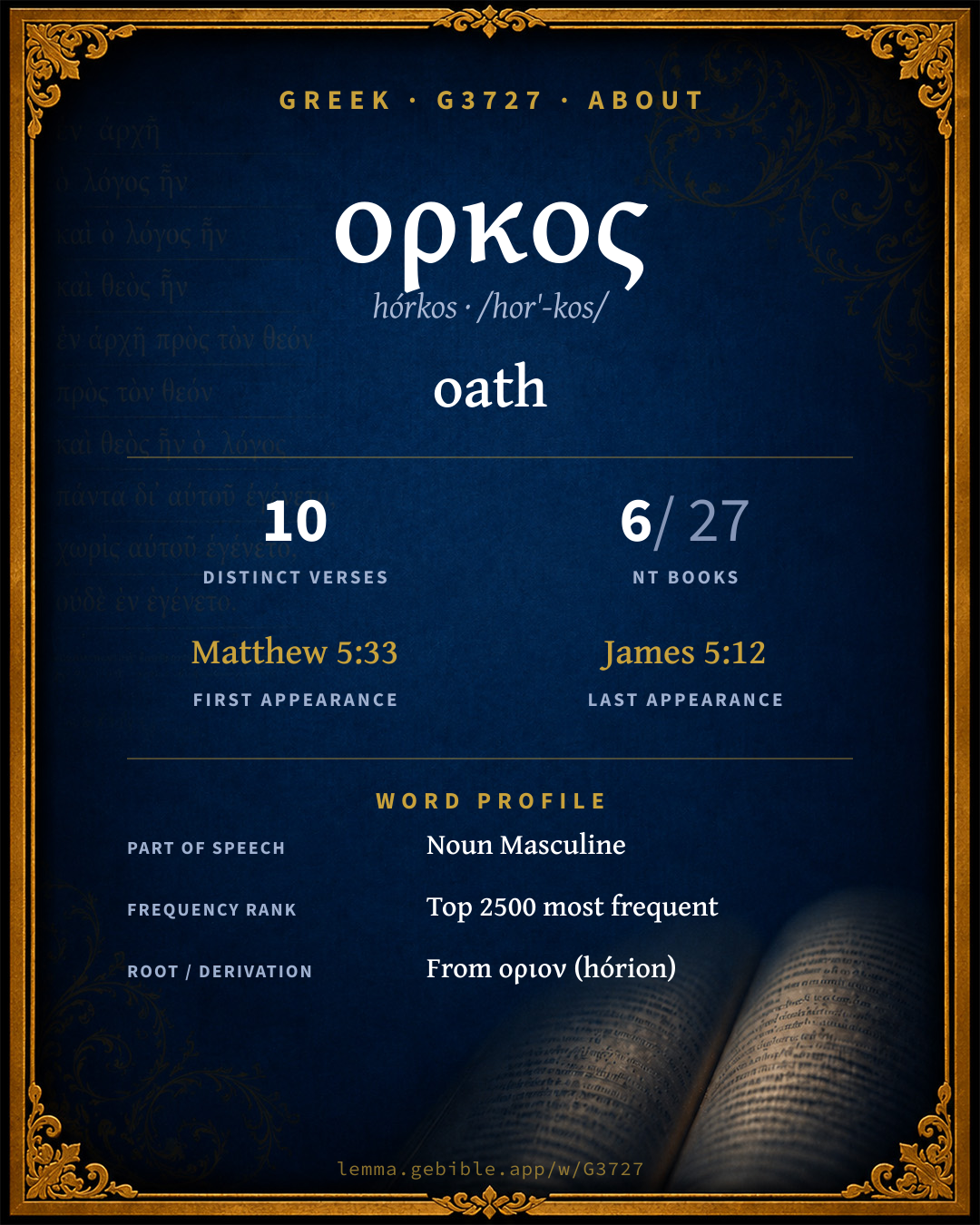
ὅρκος
oath
Full lexicon entry — Thayer's Greek Lexicon
From Thayer's Greek Lexicon
Where this word appears
See every Dative-case word in the Greek New Testament →
Grammar key — what these labels mean
Part of speech
- Noun
- A naming word — a person, place, thing, or idea.
Case
- Accusative
- The case of the direct object and of extent.
- Dative
- The case of the indirect object, means, or location — “to / for / with / in.”
- Genitive
- The case of source, possession, or “of” — answers “whose / from what.”
- Nominative
- The case of the subject (and the predicate nominative).
Gender
- Masculine
- Grammatically masculine.
Number
- Plural
- More than one.
- Singular
- One.
1 verse where G3727 appears in the Nominative case in the Book of Hebrews. Filtered view — show all forms. Click any verse to open its interlinear word-by-word view. Verse text shown in the World English Bible for context — . Each verse’s Greek form is shown with its reference; the English is not keyword-highlighted, since the data carries no word-level English alignment. Use “Compare translations” on any verse to read it across multiple English versions. This concordance covers the Greek New Testament; Septuagint (Greek Old Testament) occurrences of this word are not indexed here.
Hebrews
About this entry
At a glance — auto-summarized from this page’s data, not written by a person. Every figure links to its source below. This summary describes the numbers; it doesn’t interpret them.
ορκος (hórkos) is a Greek noun most often rendered “oath.” It first appears in Matthew 5:33. With 10 verses in 6 books, it is an uncommon word in the Greek New Testament. It concentrates in Matthew, which alone accounts for 40% of its uses. It clusters with οριον, οριζω and οροθεσια under a shared root. The sections below give every sense, occurrence, and version rendering.
Gloss history
Strong's 1890 vs modern scholarship
About this word
Strong's G3727 catalogs a Greek word from the Greek New Testament.
These counts are not copied from any lexicon or concordance. They are computed here, from the morphology-tagged Greek New Testament. What Lemma adds →
- 10
- distinct verses
- The word appears in 10 distinct verses.
- 6 / 27
- NT books
- The word appears in 6 of 27 New Testament books.
- #1,056
- by frequency
- Top 2500 most frequent Greek words (rank 1,056 of 5,347 Greek words by occurrence).
View all 10 occurrences in the concordance →
By section of the New Testament
By traditional corpus
Conventional, traditional groupings — biblical authorship is debated, so this is a traditional corpus grouping, not an authorship claim. Some books belong to more than one corpus (Luke is in both the Gospels and the Lukan corpus, and so on), so these shares overlap and need not total 100%. Each figure is a share of the word’s 10 distinct verses.
- Gospels 6 verses · 60%
- Lukan (Luke–Acts) 2 verses · 20%
- Hebrews 2 verses · 20%
- General (Catholic) Epistles 1 verse · 10%
How translations render this word
Counts come from each version’s own published word-to-Strong’s tagging or interlinear alignment — an approximate guide to how each version renders this word, not a word-level alignment the data otherwise carries. Because each total is that version’s own tagged count, the per-version totals vary from one another and need not match the appearance or distinct-verse counts above. These counts may also differ from a printed concordance because Lemma counts each distinctly tagged rendering and does not collapse phrase taggings into a single head-word total. This is a fixed set of word-tagged versions (KJV, ASV, BSB, ULT) and does not change with the reading translation you choose elsewhere. Each version’s license is shown beside its name below (and on Sources).
- King James Version: Oath 7×, Oath's sake 2×
- American Standard Version: Oath 6×, Sake 2×
- Berean Standard Bible: Oath 7×, Oaths 2×
- unfoldingWord Literal Text: Oath 7×, Oaths 3×
King James Version Public Domain
Renders G3727 across 10 tagged occurrences — most commonly:
Plus 1 rendering that appears only once — usually multi-word phrases or single function words the recovered tagging swept in, not distinct renderings.
American Standard Version Public Domain
Renders G3727 across 9 tagged occurrences — most commonly:
Plus 1 rendering that appears only once — usually multi-word phrases or single function words the recovered tagging swept in, not distinct renderings.
Berean Standard Bible Public Domain
Renders G3727 across 10 tagged occurrences — most commonly:
Plus 1 rendering that appears only once — usually multi-word phrases or single function words the recovered tagging swept in, not distinct renderings.
unfoldingWord Literal Text CC BY-SA 4.0
Renders G3727 across 11 tagged occurrences — most commonly:
Plus 1 rendering that appears only once — usually multi-word phrases or single function words the recovered tagging swept in, not distinct renderings.
Senses in Thayer's
The 1 sense Thayer's distinguishes for this word, in lexicon order (not ranked by frequency or importance). The full entry — with sub-senses — is in the Lexicon Entry tab.
- that which has been pledged or promised with an oath
Word origin
Derived from οριον (hórion) (G3725) — boundaries.
From ἕρκος herkos (a fence ; perhaps akin to G3725 ); a limit that is (sacred) restraint (specifically oath ): - oath.
— Strong’s Exhaustive Concordance (1890), public domain.
Forms in the corpus
The 5 distinct written forms G3727 takes in the Greek New Testament, most frequent first — each parse links to that case’s occurrences in the concordance.
| Form | Parsing | Example | Uses |
|---|---|---|---|
| ὅρκους hórkous | Noun, Accusative, Plural, Masculine | Matthew 5:33 | 3 |
| ὅρκον hórkon | Noun, Accusative, Singular, Masculine | Luke 1:73 | 2 |
| ὅρκου hórkou | Noun, Genitive, Singular, Masculine | Matthew 14:7 | 2 |
| ὅρκῳ hórkō | Noun, Dative, Singular, Masculine | Acts 2:30 | 2 |
| ὅρκος hórkos | Noun, Nominative, Singular, Masculine | Hebrews 6:16 | 1 |
Same root — word family
Other Thayer's entries built from the same root as G3727, grouped by Strong’s listed origin. These share a root / origin per the lexicon — not necessarily a shared meaning. Each links to that word’s own entry.
Derives from
Shares the same root
Derived from this word
Compare all same-root words → Showing 4 of 6 — not the complete family. They share a root, not necessarily a meaning.
Septuagint usage
The same Greek word ορκος appears 41 times in the Greek Old Testament (Septuagint), across 39 verses in 20 books.
- 41
- LXX occurrences
- Tagged occurrences of this Greek word in the Septuagint.
- 39
- verses
- Distinct Septuagint verses containing this word.
- 20 / 39
- OT books
- The word appears in 20 of the 39 Old Testament books.
Sample Septuagint occurrences
- Genesis 21:14 ὅρκος
- Exodus 13:19 ὅρκος
- Leviticus 5:4 ὅρκος
- Numbers 5:21 ὅρκος
- Deuteronomy 7:8 ὅρκος
- Joshua 2:17 ὅρκος
- Judges 21:5 ὅρκος
- 1 Samuel 14:26 ὅρκος
- 2 Samuel 21:7 ὅρκος
- 1 Kings 2:43 ὅρκος
- 1 Chronicles 16:16 ὅρκος
- 2 Chronicles 15:15 ὅρκος
Septuagint occurrences (same lexeme)
Every verse where the same Strong’s number (G3727) appears in the Greek Septuagint. Verse text shown in the World English Bible for context; the Greek form is the matched word — the English is not keyword-highlighted.
- Genesis 21:14 ὅρκος Abraham rose up early in the morning, and took bread and a bottle of water, and gave it to Hagar, putting it on her shoulder, and gave her the child, and sent her away. She departed, and wandered in the wilderness of Beersheba.
- Genesis 21:32 ὅρκος So they made a covenant at Beersheba. Abimelech rose up with Phicol, the captain of his host, and they returned into the land of the Philistines.
- Genesis 21:33 ὅρκος Abraham planted a tamarisk tree in Beersheba, and called there on the name of Yahweh, the Everlasting God.
- Genesis 22:19 ὅρκος So Abraham returned to his young men, and they rose up and went together to Beersheba. Abraham lived at Beersheba.
- Genesis 24:8 ὅρκος If the woman isn't willing to follow you, then you shall be clear from this my oath. Only you shall not bring my son there again."
- Genesis 26:3 ὅρκος Sojourn in this land, and I will be with you, and will bless you. For to you, and to your seed, I will give all these lands, and I will establish the oath which I swore to Abraham your father.
- Genesis 26:23 ὅρκος He went up from there to Beersheba.
- Genesis 26:33 ὅρκος He called it Shibah. Therefore the name of the city is Beersheba to this day.
- Genesis 28:10 ὅρκος Jacob went out from Beersheba, and went toward Haran.
- Genesis 46:1 ὅρκος Israel traveled with all that he had, and came to Beersheba, and offered sacrifices to the God of his father, Isaac.
- Genesis 46:5 ὅρκος Jacob rose up from Beersheba, and the sons of Israel carried Jacob, their father, their little ones, and their wives, in the wagons which Pharaoh had sent to carry him.
- Exodus 13:19 ὅρκος Moses took the bones of Joseph with him, for he had made the children of Israel swear, saying, "God will surely visit you, and you shall carry up my bones away from here with you."
- Exodus 22:10 ὅρκος "If a man delivers to his neighbor a donkey, an ox, a sheep, or any animal to keep, and it dies or is injured, or driven away, no man seeing it;
- Leviticus 5:4 ὅρκος "'Or if anyone swears rashly with his lips to do evil, or to do good, whatever it is that a man might utter rashly with an oath, and it is hidden from him; when he knows of it, then he shall be guilty of one of these.
- Numbers 5:21 ὅρκος then the priest shall cause the woman to swear with the oath of cursing, and the priest shall tell the woman, 'Yahweh make you a curse and an oath among your people, when Yahweh allows your thigh to fall away, and your body to swell;
- Numbers 30:3 ὅρκος Also when a woman vows a vow to Yahweh, and binds herself by a bond, being in her father's house, in her youth,
- Numbers 30:11 ὅρκος and her husband heard it, and held his peace at her, and didn't disallow her; then all her vows shall stand, and every bond with which she bound her soul shall stand.
- Numbers 30:14 ὅρκος But if her husband altogether hold his peace at her from day to day, then he establishes all her vows, or all her bonds, which are on her: he has established them, because he held his peace at her in the day that he heard them.
- Deuteronomy 7:8 ὅρκος but because Yahweh loves you, and because he would keep the oath which he swore to your fathers, has Yahweh brought you out with a mighty hand, and redeemed you out of the house of bondage, from the hand of Pharaoh king of Egypt.
- Joshua 2:17 ὅρκος The men said to her, We will be guiltless of this your oath which you have made us to swear.
- Joshua 2:19 ὅρκος It shall be, that whoever shall go out of the doors of your house into the street, his blood shall be on his head, and we shall be guiltless: and whoever shall be with you in the house, his blood shall be on our head, if any hand be on him.
- Joshua 2:20 ὅρκος But if you utter this our business, then we shall be guiltless of your oath which you have made us to swear.
- Joshua 9:20 ὅρκος This we will do to them, and let them live; lest wrath be on us, because of the oath which we swore to them.
- Judges 21:5 ὅρκος The children of Israel said, Who is there among all the tribes of Israel who didn't come up in the assembly to Yahweh? For they had made a great oath concerning him who didn't come up to Yahweh to Mizpah, saying, He shall surely be put to death.
- 1 Samuel 14:26 ὅρκος When the people were come to the forest, behold, the honey dropped: but no man put his hand to his mouth; for the people feared the oath.
- 2 Samuel 21:7 ὅρκος But the king spared Mephibosheth, the son of Jonathan the son of Saul, because of Yahweh's oath that was between them, between David and Jonathan the son of Saul.
- 1 Kings 2:43 ὅρκος Why then have you not kept the oath of Yahweh, and the commandment that I have charged you with?
- 1 Chronicles 16:16 ὅρκος [The covenant] which he made with Abraham, His oath to Isaac,
- 2 Chronicles 15:15 ὅρκος All Judah rejoiced at the oath; for they had sworn with all their heart, and sought him with their whole desire; and he was found of them: and Yahweh gave them rest round about.
- Ezra 20:30 ὅρκος
- Psalms 104:9 ὅρκος You have set a boundary that they may not pass over; That they don't turn again to cover the earth.
- Proverbs 29:24 ὅρκος Whoever is an accomplice of a thief is an enemy of his own soul. He takes an oath, but dares not testify.
- Ecclesiastes 8:2 ὅρκος I say, "Keep the king's command!" because of the oath to God.
- Ecclesiastes 9:2 ὅρκος All things come alike to all. There is one event to the righteous and to the wicked; to the good, to the clean, to the unclean, to him who sacrifices, and to him who doesn't sacrifice. As is the good, so is the sinner; he who takes an oath, as he who fears an oath.
- Jeremiah 11:5 ὅρκος that I may establish the oath which I swore to your fathers, to give them a land flowing with milk and honey, as at this day. Then answered I, and said, Amen, Yahweh.
- Daniel 9:11 ὅρκος Yes, all Israel have transgressed your law, even turning aside, that they should not obey your voice: therefore has the curse been poured out on us, and the oath that is written in the law of Moses the servant of God; for we have sinned against him.
- Daniel 11:18 ὅρκος After this shall he turn his face to the isles, and shall take many: but a prince shall cause the reproach offered by him to cease; yes, moreover, he shall cause his reproach to turn on him.
- Amos 5:5 ὅρκος But don't seek Bethel, Nor enter into Gilgal, And don't pass to Beersheba: For Gilgal shall surely go into captivity, And Bethel shall come to nothing.
- Zechariah 8:17 ὅρκος and let none of you devise evil in your hearts against his neighbor, and love no false oath: for all these are things that I hate," says Yahweh.
These are occurrences of the same Greek lexeme (G3727) in the Septuagint — not a translation of any one Hebrew word. The store carries no word-level Hebrew↔Greek alignment, so no Hebrew original is asserted here. Counts come from the recovered LXX Strong's tagging — high-frequency vocabulary is well covered, while rare or late forms may be untagged — so they reflect tagged occurrences and may slightly undercount.