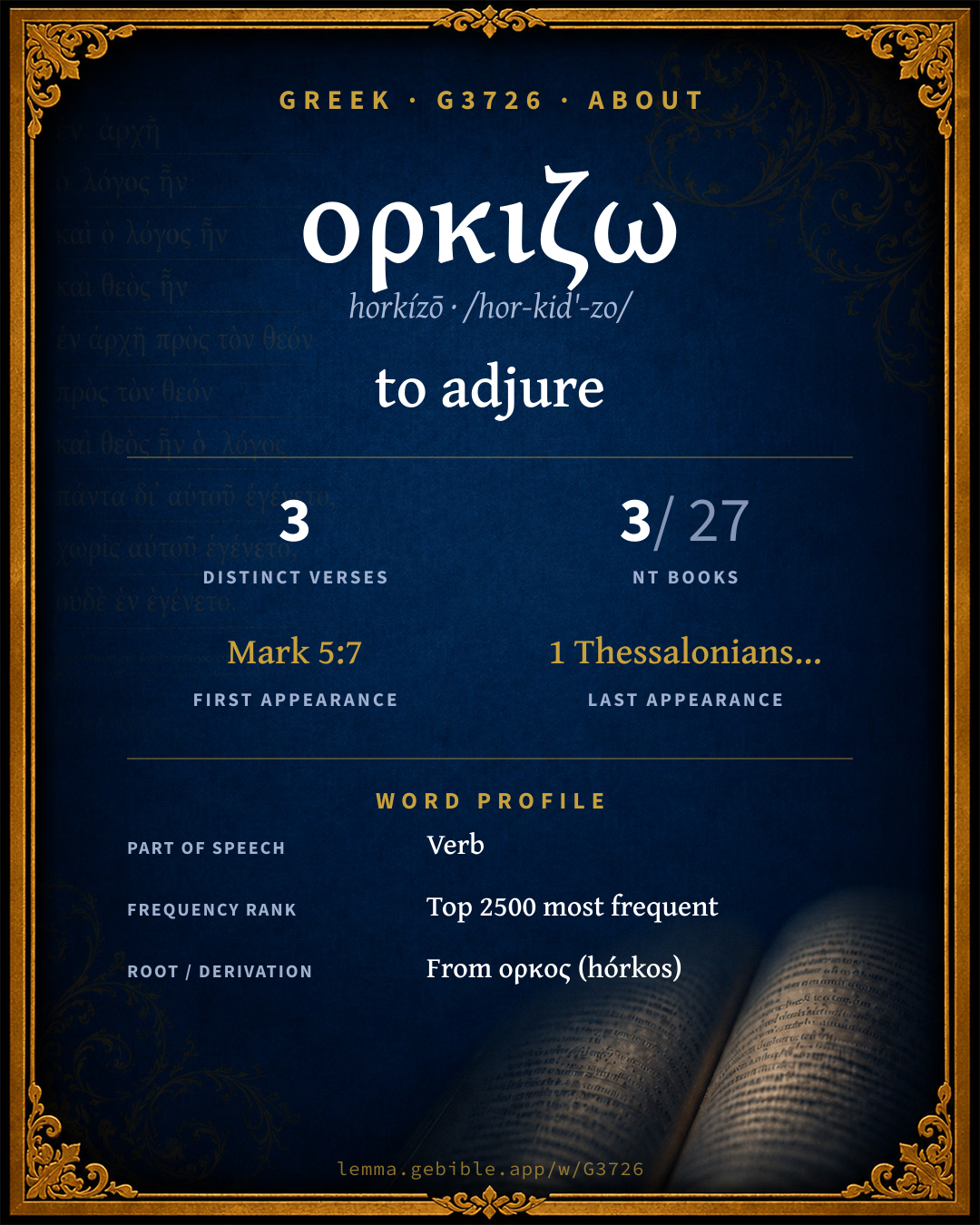
ὁρκίζω
to adjure
‘to adjure’ is one of 2 main senses fuller range ↓
Full lexicon entry — Thayer's Greek Lexicon
From Thayer's Greek Lexicon
Where this word appears
Grammar key — what these labels mean
Part of speech
- Verb
- An action or state-of-being word.
Tense
- Present
- Ongoing or general action in present time (imperfective aspect).
Voice
- Active
- The subject performs the action.
Mood
- Indicative
- States a fact or asks a factual question (the mood of reality).
Person
- 1st person
- The speaker (“I / we”).
Number
- Singular
- One.
Every verse where G3726 appears — 3 distinct verses across 3 books. Click any verse to open its interlinear word-by-word view. Verse text shown in the World English Bible for context — . Each verse’s Greek form is shown with its reference; the English is not keyword-highlighted, since the data carries no word-level English alignment. Use “Compare translations” on any verse to read it across multiple English versions. This concordance covers the Greek New Testament; Septuagint (Greek Old Testament) occurrences of this word are not indexed here.
Mark 1 verse
Acts 1 verse
1 Thessalonians 1 verse
About this entry
At a glance — auto-summarized from this page’s data, not written by a person. Every figure links to its source below. This summary describes the numbers; it doesn’t interpret them.
The Greek verb ορκιζω centers on the idea of “to adjure.” A scarce word — 3 verses in all of the Greek New Testament. Mark dominates its distribution — 1 of 3 verses. Its earliest occurrence is Mark 5:7. Lexicons map it across 2 senses. For the data behind this summary, explore the sense tree and the renderings breakdown below.
Gloss history
Strong's 1890 vs modern scholarship
About this word
Strong's G3726 catalogs a Greek word from the Greek New Testament.
These counts are not copied from any lexicon or concordance. They are computed here, from the morphology-tagged Greek New Testament. What Lemma adds →
- 3
- distinct verses
- The word appears in 3 distinct verses.
- 3 / 27
- NT books
- The word appears in 3 of 27 New Testament books.
- #2,203
- by frequency
- Top 2500 most frequent Greek words (rank 2,203 of 5,347 Greek words by occurrence).
View all 3 occurrences in the concordance →
Most concentrated in
- Mark 1 verse 33%
- Acts 1 verse 33%
- 1 Thessalonians 1 verse 33%
By section of the New Testament
By traditional corpus
Conventional, traditional groupings — biblical authorship is debated, so this is a traditional corpus grouping, not an authorship claim. Some books belong to more than one corpus (Luke is in both the Gospels and the Lukan corpus, and so on), so these shares overlap and need not total 100%. Each figure is a share of the word’s 3 distinct verses.
- Gospels 1 verse · 33%
- Lukan (Luke–Acts) 1 verse · 33%
- Pauline corpus 1 verse · 33%
How translations render this word
Counts come from each version’s own published word-to-Strong’s tagging or interlinear alignment — an approximate guide to how each version renders this word, not a word-level alignment the data otherwise carries. Because each total is that version’s own tagged count, the per-version totals vary from one another and need not match the appearance or distinct-verse counts above. These counts may also differ from a printed concordance because Lemma counts each distinctly tagged rendering and does not collapse phrase taggings into a single head-word total. This is a fixed set of word-tagged versions (KJV, ASV, BSB, ULT) and does not change with the reading translation you choose elsewhere. Each version’s license is shown beside its name below (and on Sources).
- King James Version: I adjure 1×, I charge 1×, We adjure 1×
- American Standard Version: I adjure 3×
- Berean Standard Bible: I beg 1×, I charge 1×, I command 1×
- unfoldingWord Literal Text: I adjure 1×, I make 1×, Swear 1×
King James Version Public Domain
Renders G3726 across 3 tagged occurrences — most commonly:
American Standard Version Public Domain
Renders G3726 across 3 tagged occurrences — most commonly:
Berean Standard Bible Public Domain
Renders G3726 across 3 tagged occurrences — most commonly:
unfoldingWord Literal Text CC BY-SA 4.0
Renders G3726 across 3 tagged occurrences — most commonly:
Senses in Thayer's
The 2 senses Thayer's distinguishes for this word, in lexicon order (not ranked by frequency or importance). The full entry — with sub-senses — is in the Lexicon Entry tab.
- to force to take an oath, to administer an oath to
- to adjure (solemnly implore)
Word origin
Derived from ορκος (hórkos) (G3727) — oath.
From G3727 ; to put on oath that is make swear ; by analogy to solemnly enjoin : - adjure charge.
— Strong’s Exhaustive Concordance (1890), public domain.
Forms in the corpus
The 2 distinct written forms G3726 takes in the Greek New Testament, most frequent first — each parse links to that tense’s occurrences in the concordance.
| Form | Parsing | Example | Uses |
|---|---|---|---|
| ὁρκίζω horkízō | Verb, Present, Active, Indicative, 1st person, Singular | Mark 5:7 | 2 |
| ἐνορκίζω enorkízō | Verb, Present, Active, Indicative, 1st person, Singular | 1 Thessalonians 5:27 | 1 |
Same root — word family
Other Thayer's entries built from the same root as G3726, grouped by Strong’s listed origin. These share a root / origin per the lexicon — not necessarily a shared meaning. Each links to that word’s own entry.
Derives from
Shares the same root
Compare all same-root words → They share a root, not necessarily a meaning.
Septuagint usage
The same Greek word ορκιζω appears 27 times in the Greek Old Testament (Septuagint), across 26 verses in 11 books.
- 27
- LXX occurrences
- Tagged occurrences of this Greek word in the Septuagint.
- 26
- verses
- Distinct Septuagint verses containing this word.
- 11 / 39
- OT books
- The word appears in 11 of the 39 Old Testament books.
Sample Septuagint occurrences
- Genesis 24:37 ὁρκίζω
- Exodus 13:19 ὁρκίζω
- Numbers 5:19 ὁρκίζω
- Joshua 6:26 ὁρκίζω
- 1 Samuel 14:27 ὁρκίζω
- 1 Kings 2:37 ὁρκίζω
- 2 Kings 11:4 ὁρκίζω
- 2 Chronicles 18:15 ὁρκίζω
- Ezra 10:5 ὁρκίζω
- Song of Solomon 2:7 ὁρκίζω
- Daniel 6:13 ὁρκίζω
Septuagint occurrences (same lexeme)
Every verse where the same Strong’s number (G3726) appears in the Greek Septuagint. Verse text shown in the World English Bible for context; the Greek form is the matched word — the English is not keyword-highlighted.
- Genesis 24:37 ὁρκίζω My master made me swear, saying, 'You shall not take a wife for my son of the daughters of the Canaanites, in whose land I live,
- Genesis 50:5 ὁρκίζω 'My father made me swear, saying, "Behold, I am dying. Bury me in my grave which I have dug for myself in the land of Canaan." Now therefore, please let me go up and bury my father, and I will come again.'"
- Genesis 50:6 ὁρκίζω Pharaoh said, "Go up, and bury your father, just like he made you swear."
- Genesis 50:16 ὁρκίζω They sent a message to Joseph, saying, "Your father commanded before he died, saying,
- Genesis 50:25 ὁρκίζω Joseph took an oath of the children of Israel, saying, "God will surely visit you, and you shall carry up my bones from here."
- Exodus 13:19 ὁρκίζω Moses took the bones of Joseph with him, for he had made the children of Israel swear, saying, "God will surely visit you, and you shall carry up my bones away from here with you."
- Numbers 5:19 ὁρκίζω The priest shall cause her to swear, and shall tell the woman, 'If no man has lain with you, and if you haven't gone aside to uncleanness, being under your husband, be free from this water of bitterness that brings a curse.
- Numbers 5:21 ὁρκίζω then the priest shall cause the woman to swear with the oath of cursing, and the priest shall tell the woman, 'Yahweh make you a curse and an oath among your people, when Yahweh allows your thigh to fall away, and your body to swell;
- Joshua 6:26 ὁρκίζω Joshua charged them with an oath at that time, saying, Cursed be the man before Yahweh, that rises up and builds this city Jericho: with the loss of his firstborn shall he lay the foundation of it, and with the loss of his youngest son shall he set up the gates of it.
- 1 Samuel 14:27 ὁρκίζω But Jonathan didn't hear when his father charged the people with the oath: therefore he put forth the end of the rod who was in his hand, and dipped it in the honeycomb, and put his hand to his mouth; and his eyes were enlightened.
- 1 Samuel 14:28 ὁρκίζω Then answered one of the people, and said, Your father directly charged the people with an oath, saying, Cursed be the man who eats food this day. The people were faint.
- 1 Kings 2:37 ὁρκίζω For on the day you go out, and pass over the brook Kidron, know you for certain that you shall surely die: your blood shall be on your own head.
- 1 Kings 2:42 ὁρκίζω The king sent and called for Shimei, and said to him, Didn't I adjure you by Yahweh, and protest to you, saying, Know for certain, that on the day you go out, and walk abroad any where, you shall surely die? and you said to me, The saying that I have heard is good.
- 1 Kings 22:16 ὁρκίζω The king said to him, How many times shall I adjure you that you speak to me nothing but the truth in the name of Yahweh?
- 2 Kings 11:4 ὁρκίζω In the seventh year Jehoiada sent and fetched the captains over hundreds of the Carites and of the guard, and brought them to him into the house of Yahweh; and he made a covenant with them, and took an oath of them in the house of Yahweh, and shown them the king's son.
- 2 Chronicles 18:15 ὁρκίζω The king said to him, How many times shall I adjure you that you speak to me nothing but the truth in the name of Yahweh?
- 2 Chronicles 36:13 ὁρκίζω He also rebelled against king Nebuchadnezzar, who had made him swear by God: but he stiffened his neck, and hardened his heart against turning to Yahweh, the God of Israel.
- Ezra 10:5 ὁρκίζω Then arose Ezra, and made the chiefs of the priests, the Levites, and all Israel, to swear that they would do according to this word. So they swore.
- Ezra 15:12 ὁρκίζω
- Ezra 23:25 ὁρκίζω
- Song of Solomon 2:7 ὁρκίζω I adjure you, daughters of Jerusalem, By the roes, or by the hinds of the field, That you not stir up, nor awaken love, Until it so desires.
- Song of Solomon 3:5 ὁρκίζω I adjure you, daughters of Jerusalem, By the roes, or by the hinds of the field, That you not stir up, nor awaken love, Until it so desires.
- Song of Solomon 5:8 ὁρκίζω I adjure you, daughters of Jerusalem, If you find my beloved, That you tell him that I am faint with love. Friends
- Song of Solomon 5:9 ὁρκίζω How is your beloved better than another beloved, You fairest among women? How is your beloved better than another beloved, That you do so adjure us? Beloved
- Song of Solomon 8:4 ὁρκίζω I adjure you, daughters of Jerusalem, That you not stir up, nor awaken love, Until it so desires. Friends
- Daniel 6:13 ὁρκίζω Then answered they and said before the king, That Daniel, who is of the children of the captivity of Judah, doesn't regard you, O king, nor the interdict that you have signed, but makes his petition three times a day.
These are occurrences of the same Greek lexeme (G3726) in the Septuagint — not a translation of any one Hebrew word. The store carries no word-level Hebrew↔Greek alignment, so no Hebrew original is asserted here. Counts come from the recovered LXX Strong's tagging — high-frequency vocabulary is well covered, while rare or late forms may be untagged — so they reflect tagged occurrences and may slightly undercount.