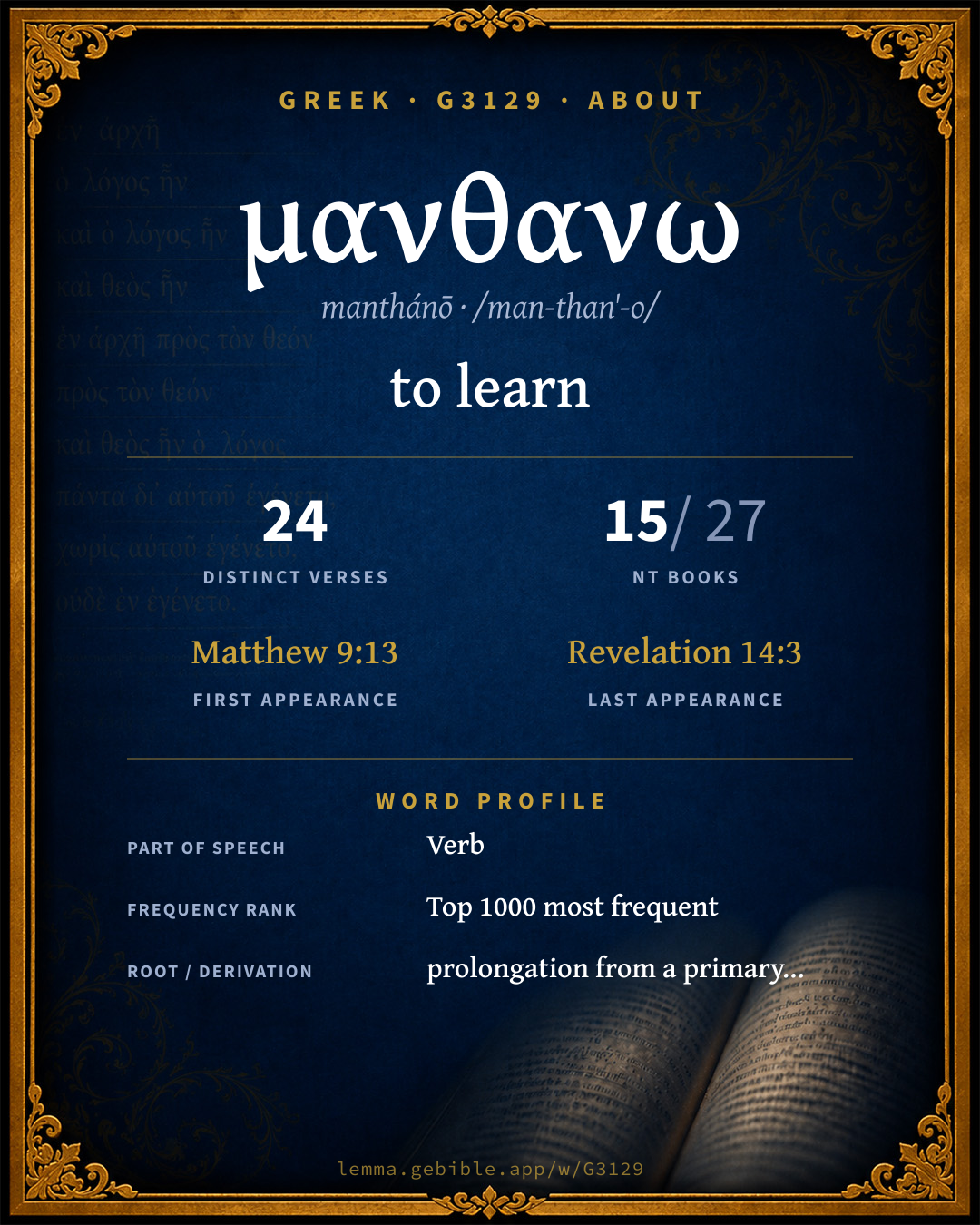
μανθάνω
to learn
‘to learn’ is one of 3 main senses fuller range ↓
Full lexicon entry — Thayer's Greek Lexicon
From Thayer's Greek Lexicon
Where this word appears
Grammar key — what these labels mean
Part of speech
- Verb
- An action or state-of-being word.
Tense
- Aorist
- Action viewed as a simple whole, without regard to duration — often past (perfective aspect).
- Present
- Ongoing or general action in present time (imperfective aspect).
- Perfect
- A completed past action with continuing present results.
Voice
- Active
- The subject performs the action.
Mood
- Indicative
- States a fact or asks a factual question (the mood of reality).
- Imperative
- Expresses a command or request.
- Infinitive
- A verbal noun (“to write”), unmarked for person or number.
- Participle
- A verbal adjective (“writing,” “having written”).
- Subjunctive
- Expresses probability, purpose, or possibility (the mood of contingency).
Case
- Nominative
- The case of the subject (and the predicate nominative).
- Accusative
- The case of the direct object and of extent.
Person
- 2nd person
- The one addressed (“you”).
- 3rd person
- The one spoken about (“he / she / it / they”).
- 1st person
- The speaker (“I / we”).
Gender
- Masculine
- Grammatically masculine.
- Neuter
- Grammatically neuter.
Number
- Plural
- More than one.
- Singular
- One.
Every verse where G3129 appears in the Book of Mark — 1 distinct verse. Click any verse to open its interlinear word-by-word view. Verse text shown in the World English Bible for context — . Each verse’s Greek form is shown with its reference; the English is not keyword-highlighted, since the data carries no word-level English alignment. Use “Compare translations” on any verse to read it across multiple English versions. This concordance covers the Greek New Testament; Septuagint (Greek Old Testament) occurrences of this word are not indexed here.
Mark
About this entry
At a glance — auto-summarized from this page’s data, not written by a person. Every figure links to its source below. This summary describes the numbers; it doesn’t interpret them.
“to learn” is the headline sense of the Greek verb μανθανω (manthánō). First canonically at Matthew 9:13, it enters the text early. It appears 24 verses across 15 books of the Greek New Testament, among its uncommon vocabulary. Lexicons map it across 3 senses. Related forms include μαθητης. The sections below give every sense, occurrence, and version rendering.
Gloss history
Strong's 1890 vs modern scholarship
About this word
Strong's G3129 catalogs a Greek word from the Greek New Testament.
These counts are not copied from any lexicon or concordance. They are computed here, from the morphology-tagged Greek New Testament. What Lemma adds →
- 24
- distinct verses
- The word appears in 24 distinct verses.
- 15 / 27
- NT books
- The word appears in 15 of 27 New Testament books.
- #530
- by frequency
- Top 1000 most frequent Greek words (rank 530 of 5,347 Greek words by occurrence).
View all 24 occurrences in the concordance →
Most concentrated in
- Matthew 3 verses 13%
- 1 Corinthians 3 verses 13%
- 1 Timothy 3 verses 13%
By section of the New Testament
By traditional corpus
Conventional, traditional groupings — biblical authorship is debated, so this is a traditional corpus grouping, not an authorship claim. Some books belong to more than one corpus (Luke is in both the Gospels and the Lukan corpus, and so on), so these shares overlap and need not total 100%. Each figure is a share of the word’s 24 distinct verses.
- Pauline corpus 15 verses · 63%
- Gospels 6 verses · 25%
- Johannine 3 verses · 13%
- Lukan (Luke–Acts) 1 verse · 4%
- Hebrews 1 verse · 4%
- Revelation 1 verse · 4%
How translations render this word
Counts come from each version’s own published word-to-Strong’s tagging or interlinear alignment — an approximate guide to how each version renders this word, not a word-level alignment the data otherwise carries. Because each total is that version’s own tagged count, the per-version totals vary from one another and need not match the appearance or distinct-verse counts above. These counts may also differ from a printed concordance because Lemma counts each distinctly tagged rendering and does not collapse phrase taggings into a single head-word total. This is a fixed set of word-tagged versions (KJV, ASV, BSB, ULT) and does not change with the reading translation you choose elsewhere. Each version’s license is shown beside its name below (and on Sources).
- King James Version: Learn 8×, Learned 4×, Have learned 2×
- American Standard Version: Learn 9×, Learned 4×, He 2×
- Berean Standard Bible: Learn 7×, You have learned 3×, Have learned 2×
- unfoldingWord Literal Text: Learn 8×, You learned 4×, Have learned 2×
King James Version Public Domain
Renders G3129 across 31 tagged occurrences — most commonly:
Plus 13 renderings that appear only once — usually multi-word phrases or single function words the recovered tagging swept in, not distinct renderings.
American Standard Version Public Domain
Renders G3129 across 32 tagged occurrences — most commonly:
Plus 13 renderings that appear only once — usually multi-word phrases or single function words the recovered tagging swept in, not distinct renderings.
Berean Standard Bible Public Domain
Renders G3129 across 25 tagged occurrences — most commonly:
Plus 13 renderings that appear only once — usually multi-word phrases or single function words the recovered tagging swept in, not distinct renderings.
unfoldingWord Literal Text CC BY-SA 4.0
Renders G3129 across 30 tagged occurrences — most commonly:
Plus 14 renderings that appear only once — usually multi-word phrases or single function words the recovered tagging swept in, not distinct renderings.
Senses in Thayer's
The 3 senses Thayer's distinguishes for this word, in lexicon order (not ranked by frequency or importance). The full entry — with sub-senses — is in the Lexicon Entry tab.
- to increase one's knowledge, to be increased in knowledge
- to hear, be informed
- to learn by use and practice
Word origin
Origin: prolongation from a primary verb, another form of which, matheo, is used as an alternate in certain tenses
Prolonged from a primary verb another form of which μαθέω matheō is used as an alternate in certain tenses; to learn (in any way): - learn understand.
— Strong’s Exhaustive Concordance (1890), public domain.
Forms in the corpus
The 14 distinct written forms G3129 takes in the Greek New Testament, most frequent first — each parse links to that tense’s occurrences in the concordance.
Same root — word family
Other Thayer's entries built from the same root as G3129, grouped by Strong’s listed origin. These share a root / origin per the lexicon — not necessarily a shared meaning. Each links to that word’s own entry.
Derived from this word
Compare all same-root words → They share a root, not necessarily a meaning.
Septuagint usage
The same Greek word μανθανω appears 36 times in the Greek Old Testament (Septuagint), across 34 verses in 11 books.
- 36
- LXX occurrences
- Tagged occurrences of this Greek word in the Septuagint.
- 34
- verses
- Distinct Septuagint verses containing this word.
- 11 / 39
- OT books
- The word appears in 11 of the 39 Old Testament books.
Sample Septuagint occurrences
- Exodus 2:4 μανθάνω
- Deuteronomy 4:10 μανθάνω
- 1 Chronicles 25:8 μανθάνω
- Esther 4:5 μανθάνω
- Job 34:36 μανθάνω
- Psalms 105:35 μανθάνω
- Proverbs 6:8 μανθάνω
- Isaiah 1:17 μανθάνω
- Jeremiah 9:4 μανθάνω
- Ezekiel 19:3 μανθάνω
- Micah 4:3 μανθάνω
Septuagint occurrences (same lexeme)
Every verse where the same Strong’s number (G3129) appears in the Greek Septuagint. Verse text shown in the World English Bible for context; the Greek form is the matched word — the English is not keyword-highlighted.
- Exodus 2:4 μανθάνω His sister stood far off, to see what would be done to him.
- Deuteronomy 4:10 μανθάνω the day that you stood before Yahweh your God in Horeb, when Yahweh said to me, Assemble me the people, and I will make them hear my words, that they may learn to fear me all the days that they live on the earth, and that they may teach their children.
- Deuteronomy 5:1 μανθάνω Moses called to all Israel, and said to them, Hear, Israel, the statutes and the ordinances which I speak in your ears this day, that you may learn them, and observe to do them.
- Deuteronomy 14:23 μανθάνω You shall eat before Yahweh your God, in the place which he shall choose, to cause his name to dwell there, the tithe of your grain, of your new wine, and of your oil, and the firstborn of your herd and of your flock; that you may learn to fear Yahweh your God always.
- Deuteronomy 17:19 μανθάνω and it shall be with him, and he shall read therein all the days of his life; that he may learn to fear Yahweh his God, to keep all the words of this law and these statutes, to do them;
- Deuteronomy 18:9 μανθάνω When you are come into the land which Yahweh your God gives you, you shall not learn to do after the abominations of those nations.
- Deuteronomy 31:12 μανθάνω Assemble the people, the men and the women and the little ones, and your foreigner who is within your gates, that they may hear, and that they may learn, and fear Yahweh your God, and observe to do all the words of this law;
- Deuteronomy 31:13 μανθάνω and that their children, who have not known, may hear, and learn to fear Yahweh your God, as long as you live in the land where you go over the Jordan to possess it.
- 1 Chronicles 25:8 μανθάνω They cast lots for their offices, all alike, as well the small as the great, the teacher as the scholar.
- Esther 4:5 μανθάνω Then called Esther for Hathach, one of the king's chamberlains, whom he had appointed to attend on her, and charged him to go to Mordecai, to know what this was, and why it was.
- Job 34:36 μανθάνω I wish that Job were tried to the end, Because of his answering like wicked men.
- Psalms 105:35 μανθάνω Ate up every plant in their land; And ate up the fruit of their ground.
- Psalms 118:7 μανθάνω Yahweh is on my side among those who help me. Therefore I will look in triumph at those who hate me.
- Psalms 118:71 μανθάνω
- Psalms 118:73 μανθάνω
- Proverbs 6:8 μανθάνω Provides her bread in the summer, And gathers her food in the harvest.
- Proverbs 17:16 μανθάνω Why is there money in the hand of a fool to buy wisdom, Seeing he has no understanding?
- Proverbs 22:25 μανθάνω Lest you learn his ways, And ensnare your soul.
- Isaiah 1:17 μανθάνω Learn to do well. Seek justice, Relieve the oppressed, Judge the fatherless, Plead for the widow."
- Isaiah 2:4 μανθάνω He will judge between the nations, And will decide concerning many peoples; And they shall beat their swords into plowshares, And their spears into pruning-hooks. Nation shall not lift up sword against nation, Neither shall they learn war any more.
- Isaiah 8:16 μανθάνω Bind up the testimony, seal the law among my disciples.
- Isaiah 26:9 μανθάνω With my soul have I desired you in the night; yes, with my spirit within me will I seek you earnestly: for when your judgments are in the earth, the inhabitants of the world learn righteousness.
- Isaiah 26:10 μανθάνω Let favor be shown to the wicked, yet will he not learn righteousness; in the land of uprightness will he deal wrongfully, and will not see the majesty of Yahweh.
- Isaiah 28:19 μανθάνω As often as it passes though, it shall take you; for morning by morning shall it pass through, by day and by night: and it shall be nothing but terror to understand the message.
- Isaiah 29:24 μανθάνω They also who err in spirit shall come to understanding, and those who murmur shall receive instruction.
- Isaiah 32:4 μανθάνω The heart of the rash shall understand knowledge, and the tongue of the stammerers shall be ready to speak plainly.
- Isaiah 47:12 μανθάνω Stand now with your enchantments, and with the multitude of your sorceries, in which you have labored from your youth; if so be you shall be able to profit, if so be you may prevail.
- Jeremiah 9:4 μανθάνω Take you heed everyone of his neighbor, and don't you trust in any brother; for every brother will utterly supplant, and every neighbor will go about with slanders.
- Jeremiah 10:2 μανθάνω Thus says Yahweh, "Don't learn the way of the nations, and don't be dismayed at the signs of the sky; for the nations are dismayed at them.
- Jeremiah 12:16 μανθάνω It shall happen, if they will diligently learn the ways of my people, to swear by my name, As Yahweh lives; even as they taught my people to swear by Baal; then shall they be built up in the midst of my people.
- Jeremiah 13:23 μανθάνω Can the Ethiopian change his skin, or the leopard his spots? then may you also do good, who are accustomed to do evil.
- Ezekiel 19:3 μανθάνω She brought up one of her cubs: he became a young lion, and he learned to catch the prey; he devoured men.
- Ezekiel 19:6 μανθάνω He went up and down among the lions; he became a young lion, and he learned to catch the prey; he devoured men.
- Micah 4:3 μανθάνω And he will judge between many peoples, And will decide concerning strong nations afar off. They will beat their swords into plowshares, And their spears into pruning hooks. Nation will not lift up sword against nation, Neither will they learn war any more.
These are occurrences of the same Greek lexeme (G3129) in the Septuagint — not a translation of any one Hebrew word. The store carries no word-level Hebrew↔Greek alignment, so no Hebrew original is asserted here. Counts come from the recovered LXX Strong's tagging — high-frequency vocabulary is well covered, while rare or late forms may be untagged — so they reflect tagged occurrences and may slightly undercount.