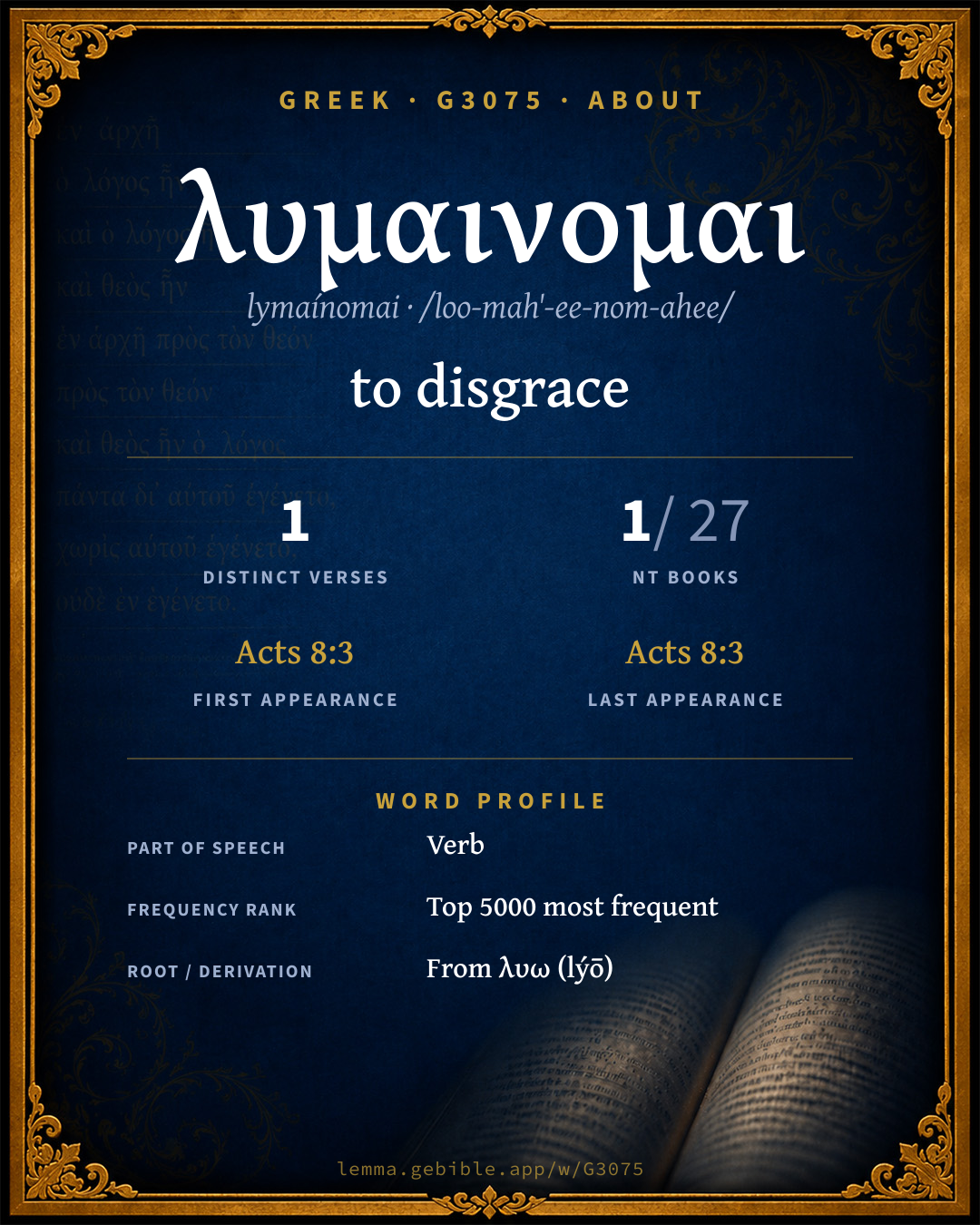
λυμαίνομαι
to disgrace
‘to disgrace’ is one of 2 main senses fuller range ↓
Full lexicon entry — Thayer's Greek Lexicon
From Thayer's Greek Lexicon
Where this word appears
Grammar key — what these labels mean
Part of speech
- Verb
- An action or state-of-being word.
Tense
- Imperfect
- Continuous or repeated action in past time (“was writing”).
Voice
- Middle or Passive deponent
- Middle/passive in form but active in meaning.
Mood
- Indicative
- States a fact or asks a factual question (the mood of reality).
Person
- 3rd person
- The one spoken about (“he / she / it / they”).
Number
- Singular
- One.
Every verse where G3075 appears — 1 distinct verse across 1 book. Click any verse to open its interlinear word-by-word view. Verse text shown in the World English Bible for context — . Each verse’s Greek form is shown with its reference; the English is not keyword-highlighted, since the data carries no word-level English alignment. Use “Compare translations” on any verse to read it across multiple English versions. This concordance covers the Greek New Testament; Septuagint (Greek Old Testament) occurrences of this word are not indexed here.
Acts 1 verse
About this entry
At a glance — auto-summarized from this page’s data, not written by a person. Every figure links to its source below. This summary describes the numbers; it doesn’t interpret them.
λυμαινομαι (lymaínomai) is a Greek verb most often rendered “to disgrace.” It is rare — just 1 verse in the entire Greek New Testament. Acts dominates its distribution — 1 of 1 verses. It occurs only once, in Acts 8:3. Ranging over 2 senses, it is not a single-sense word. The sections below give every sense, occurrence, and version rendering.
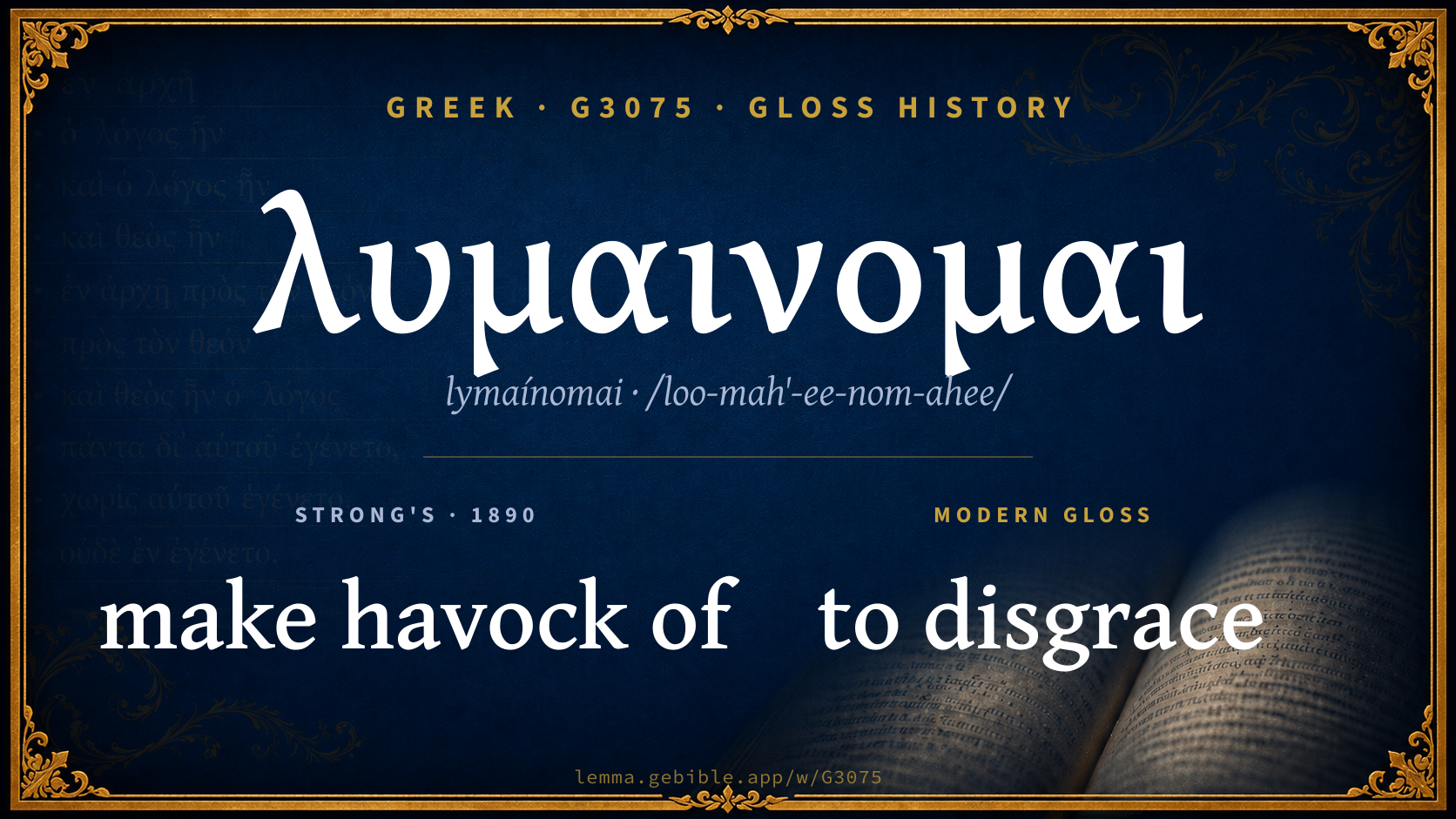
Gloss history
Strong's 1890 vs modern scholarship
About this word
Strong's G3075 catalogs a Greek word from the Greek New Testament.
These counts are not copied from any lexicon or concordance. They are computed here, from the morphology-tagged Greek New Testament. What Lemma adds →
- 1
- distinct verses
- The word appears in 1 distinct verse.
- 1 / 27
- NT books
- The word appears in 1 of 27 New Testament books.
- #3,503
- by frequency
- Top 5000 most frequent Greek words (rank 3,503 of 5,347 Greek words by occurrence).
View all 1 occurrence in the concordance →
Most concentrated in
- Acts 1 verse 100%
By section of the New Testament
By traditional corpus
Conventional, traditional groupings — biblical authorship is debated, so this is a traditional corpus grouping, not an authorship claim. Some books belong to more than one corpus (Luke is in both the Gospels and the Lukan corpus, and so on), so these shares overlap and need not total 100%. Each figure is a share of the word’s 1 distinct verse.
- Lukan (Luke–Acts) 1 verse · 100%
How translations render this word
Counts come from each version’s own published word-to-Strong’s tagging or interlinear alignment — an approximate guide to how each version renders this word, not a word-level alignment the data otherwise carries. Because each total is that version’s own tagged count, the per-version totals vary from one another and need not match the appearance or distinct-verse counts above. These counts may also differ from a printed concordance because Lemma counts each distinctly tagged rendering and does not collapse phrase taggings into a single head-word total. This is a fixed set of word-tagged versions (KJV, ASV, BSB, ULT) and does not change with the reading translation you choose elsewhere. Each version’s license is shown beside its name below (and on Sources).
- King James Version: He made havock 1×
- American Standard Version: Laid waste 1×
- Berean Standard Bible: Began to destroy 1×
- unfoldingWord Literal Text: Was harming 1×
King James Version Public Domain
Renders G3075 across 1 tagged occurrence — most commonly:
American Standard Version Public Domain
Renders G3075 across 1 tagged occurrence — most commonly:
Berean Standard Bible Public Domain
Renders G3075 across 1 tagged occurrence — most commonly:
unfoldingWord Literal Text CC BY-SA 4.0
Renders G3075 across 1 tagged occurrence — most commonly:
Senses in Thayer's
The 2 senses Thayer's distinguishes for this word, in lexicon order (not ranked by frequency or importance). The full entry — with sub-senses — is in the Lexicon Entry tab.
- to affix a stigma to, to dishonour, spot, defile
- to treat shamefully or with injury, to ravage, devastate, ruin
Word origin
Derived from λυω (lýō) (G3089) — to loose.
Middle voice from a probable derivative of G3089 (meaning filth ); properly to soil that is (figuratively) insult ( maltreat ): - make havock of.
— Strong’s Exhaustive Concordance (1890), public domain.
Same root — word family
Other Thayer's entries built from the same root as G3075, grouped by Strong’s listed origin. These share a root / origin per the lexicon — not necessarily a shared meaning. Each links to that word’s own entry.
Derives from
Shares the same root
Compare all same-root words → They share a root, not necessarily a meaning.
Septuagint usage
The same Greek word λυμαινομαι appears 14 times in the Greek Old Testament (Septuagint), across 14 verses in 8 books.
- 14
- LXX occurrences
- Tagged occurrences of this Greek word in the Septuagint.
- 14
- verses
- Distinct Septuagint verses containing this word.
- 8 / 39
- OT books
- The word appears in 8 of the 39 Old Testament books.
Sample Septuagint occurrences
- Exodus 23:8 λυμαίνω
- 2 Chronicles 16:10 λυμαίνω
- Psalms 79:14 λυμαίνω
- Proverbs 18:9 λυμαίνω
- Isaiah 65:8 λυμαίνω
- Jeremiah 28:2 λυμαίνω
- Ezekiel 16:25 λυμαίνω
- Amos 1:11 λυμαίνω
Septuagint occurrences (same lexeme)
Every verse where the same Strong’s number (G3075) appears in the Greek Septuagint. Verse text shown in the World English Bible for context; the Greek form is the matched word — the English is not keyword-highlighted.
- Exodus 23:8 λυμαίνω You shall take no bribe, for a bribe blinds those who have sight and perverts the words of the righteous.
- 2 Chronicles 16:10 λυμαίνω Then Asa was angry with the seer, and put him in the prison-house; for he was in a rage with him because of this thing. Asa oppressed some of the people at the same time.
- Psalms 79:14 λυμαίνω
- Proverbs 18:9 λυμαίνω One who is slack in his work Is brother to him who is a master of destruction.
- Proverbs 19:3 λυμαίνω The foolishness of man subverts his way; His heart rages against Yahweh.
- Proverbs 23:8 λυμαίνω The morsel which you have eaten you shall vomit up, And lose your good words.
- Proverbs 25:26 λυμαίνω Like a muddied spring, and a polluted well, So is a righteous man who gives way before the wicked.
- Proverbs 27:13 λυμαίνω Take his garment when he puts up collateral for a stranger; Hold it for a wayward woman!
- Isaiah 65:8 λυμαίνω Thus says Yahweh, As the new wine is found in the cluster, and one says, Don't destroy it, for a blessing is in it: so will I do for my servants' sake, that I may not destroy them all.
- Isaiah 65:25 λυμαίνω The wolf and the lamb shall feed together, and the lion shall eat straw like the ox; and dust shall be the serpent's food. They shall not hurt nor destroy in all my holy mountain, says Yahweh.
- Jeremiah 28:2 λυμαίνω Thus speaks Yahweh of Hosts, the God of Israel, saying, I have broken the yoke of the king of Babylon.
- Jeremiah 31:18 λυμαίνω I have surely heard Ephraim bemoaning himself [thus], You have chastised me, and I was chastised, as a calf unaccustomed [to the yoke]: turn you me, and I shall be turned; for you are Yahweh my God.
- Ezekiel 16:25 λυμαίνω You have built your lofty place at the head of every way, and have made your beauty an abomination, and have opened your feet to everyone who passed by, and multiplied your prostitution.
- Amos 1:11 λυμαίνω Thus says Yahweh: "For three transgressions of Edom, yes, for four, I will not turn away its punishment; Because he pursued his brother with the sword, And cast off all pity, And his anger raged continually, And he kept his wrath forever;
These are occurrences of the same Greek lexeme (G3075) in the Septuagint — not a translation of any one Hebrew word. The store carries no word-level Hebrew↔Greek alignment, so no Hebrew original is asserted here. Counts come from the recovered LXX Strong's tagging — high-frequency vocabulary is well covered, while rare or late forms may be untagged — so they reflect tagged occurrences and may slightly undercount.