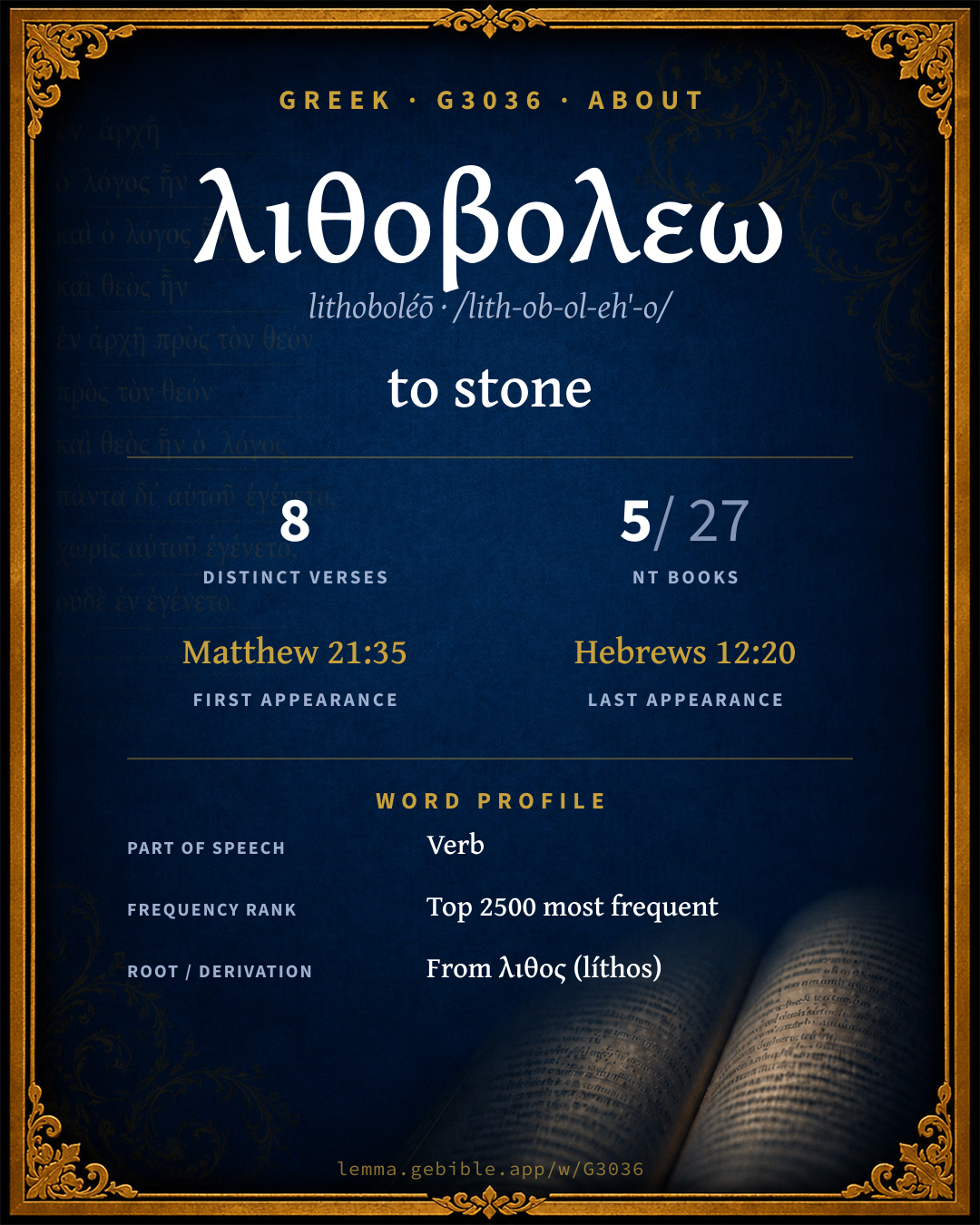
λιθοβολέω
to stone
‘to stone’ is one of 2 main senses fuller range ↓
Full lexicon entry — Thayer's Greek Lexicon
From Thayer's Greek Lexicon
Where this word appears
See every Present-tense verb in the Greek New Testament →
Grammar key — what these labels mean
Part of speech
- Verb
- An action or state-of-being word.
Tense
- Imperfect
- Continuous or repeated action in past time (“was writing”).
- Present
- Ongoing or general action in present time (imperfective aspect).
- Aorist
- Action viewed as a simple whole, without regard to duration — often past (perfective aspect).
- Future
- Action expected in future time.
Voice
- Active
- The subject performs the action.
- Passive
- The subject receives the action.
Mood
- Indicative
- States a fact or asks a factual question (the mood of reality).
- Participle
- A verbal adjective (“writing,” “having written”).
- Infinitive
- A verbal noun (“to write”), unmarked for person or number.
Case
- Nominative
- The case of the subject (and the predicate nominative).
Person
- 3rd person
- The one spoken about (“he / she / it / they”).
Gender
- Feminine
- Grammatically feminine.
Number
- Plural
- More than one.
- Singular
- One.
2 distinct verses where G3036 appears in the Imperfect tense, across 1 book. Filtered view — show all forms. Click any verse to open its interlinear word-by-word view. Verse text shown in the World English Bible for context — . Each verse’s Greek form is shown with its reference; the English is not keyword-highlighted, since the data carries no word-level English alignment. Use “Compare translations” on any verse to read it across multiple English versions. This concordance covers the Greek New Testament; Septuagint (Greek Old Testament) occurrences of this word are not indexed here.
Acts 2 verses
About this entry
At a glance — auto-summarized from this page’s data, not written by a person. Every figure links to its source below. This summary describes the numbers; it doesn’t interpret them.
λιθοβολεω — transliterated lithoboléō — is a Greek verb carrying the sense “to stone.” It first appears in Matthew 21:35. With 8 verses in 5 books, it is an uncommon word in the Greek New Testament. Its uses concentrate in Acts (38% of all occurrences). Its lexical range runs to 2 senses. See the sense tree, 8-verse concordance, and the renderings breakdown below.
Gloss history
Strong's 1890 vs modern scholarship
About this word
Strong's G3036 catalogs a Greek word from the Greek New Testament.
These counts are not copied from any lexicon or concordance. They are computed here, from the morphology-tagged Greek New Testament. What Lemma adds →
- 8
- distinct verses
- The word appears in 8 distinct verses.
- 5 / 27
- NT books
- The word appears in 5 of 27 New Testament books.
- #1,240
- by frequency
- Top 2500 most frequent Greek words (rank 1,240 of 5,347 Greek words by occurrence).
View all 8 occurrences in the concordance →
By section of the New Testament
By traditional corpus
Conventional, traditional groupings — biblical authorship is debated, so this is a traditional corpus grouping, not an authorship claim. Some books belong to more than one corpus (Luke is in both the Gospels and the Lukan corpus, and so on), so these shares overlap and need not total 100%. Each figure is a share of the word’s 8 distinct verses.
- Gospels 4 verses · 50%
- Lukan (Luke–Acts) 4 verses · 50%
- Johannine 1 verse · 13%
- Hebrews 1 verse · 13%
How translations render this word
Counts come from each version’s own published word-to-Strong’s tagging or interlinear alignment — an approximate guide to how each version renders this word, not a word-level alignment the data otherwise carries. Because each total is that version’s own tagged count, the per-version totals vary from one another and need not match the appearance or distinct-verse counts above. These counts may also differ from a printed concordance because Lemma counts each distinctly tagged rendering and does not collapse phrase taggings into a single head-word total. This is a fixed set of word-tagged versions (KJV, ASV, BSB, ULT) and does not change with the reading translation you choose elsewhere. Each version’s license is shown beside its name below (and on Sources).
- King James Version: Stoned 2×, Stonest 2×
- American Standard Version: Stone 2×, Stoned 2×, Stoneth 2×
- Berean Standard Bible: Stones 2×
- unfoldingWord Literal Text: Stoning 2×
King James Version Public Domain
Renders G3036 across 9 tagged occurrences — most commonly:
Plus 5 renderings that appear only once — usually multi-word phrases or single function words the recovered tagging swept in, not distinct renderings.
American Standard Version Public Domain
Renders G3036 across 9 tagged occurrences — most commonly:
Plus 3 renderings that appear only once — usually multi-word phrases or single function words the recovered tagging swept in, not distinct renderings.
Berean Standard Bible Public Domain
Renders G3036 across 7 tagged occurrences — most commonly:
Plus 5 renderings that appear only once — usually multi-word phrases or single function words the recovered tagging swept in, not distinct renderings.
unfoldingWord Literal Text CC BY-SA 4.0
Renders G3036 across 7 tagged occurrences — most commonly:
Plus 5 renderings that appear only once — usually multi-word phrases or single function words the recovered tagging swept in, not distinct renderings.
Senses in Thayer's
The 2 senses Thayer's distinguishes for this word, in lexicon order (not ranked by frequency or importance). The full entry — with sub-senses — is in the Lexicon Entry tab.
- to kill by stoning, to stone
- to pelt one with stones
Word origin
Derived from λιθος (líthos) (G3037) — stone.
Forms in the corpus
The 6 distinct written forms G3036 takes in the Greek New Testament, most frequent first — each parse links to that tense’s occurrences in the concordance.
| Form | Parsing | Example | Uses |
|---|---|---|---|
| λιθοβολοῦσα lithoboloûsa | Verb, Present, Active, Participle, Nominative, Singular, Feminine | Matthew 23:37 | 2 |
| ἐλιθοβόλουν elithobóloun | Verb, Imperfect, Active, Indicative, 3rd person, Plural | Acts 7:58 | 2 |
| λιθοβολεῖσθαι lithoboleîsthai | Verb, Present, Passive, Infinitive | John 8:5 | 1 |
| λιθοβοληθήσεται lithobolēthḗsetai | Verb, Future, Passive, Indicative, 3rd person, Singular | Hebrews 12:20 | 1 |
| λιθοβολῆσαι lithobolē̂sai | Verb, Aorist, Active, Infinitive | Acts 14:5 | 1 |
| ἐλιθοβόλησαν elithobólēsan | Verb, Aorist, Active, Indicative, 3rd person, Plural | Matthew 21:35 | 1 |
Same root — word family
Other Thayer's entries built from the same root as G3036, grouped by Strong’s listed origin. These share a root / origin per the lexicon — not necessarily a shared meaning. Each links to that word’s own entry.
Derives from
Shares the same root
Compare all same-root words → Showing 4 of 5 — not the complete family. They share a root, not necessarily a meaning.
Septuagint usage
The same Greek word λιθοβολεω appears 27 times in the Greek Old Testament (Septuagint), across 27 verses in 9 books.
- 27
- LXX occurrences
- Tagged occurrences of this Greek word in the Septuagint.
- 27
- verses
- Distinct Septuagint verses containing this word.
- 9 / 39
- OT books
- The word appears in 9 of the 39 Old Testament books.
Sample Septuagint occurrences
- Exodus 8:22 λιθοβολέω
- Leviticus 20:2 λιθοβολέω
- Numbers 15:35 λιθοβολέω
- Deuteronomy 13:11 λιθοβολέω
- Joshua 7:25 λιθοβολέω
- 1 Samuel 30:6 λιθοβολέω
- 1 Kings 12:18 λιθοβολέω
- 2 Chronicles 10:18 λιθοβολέω
- Ezekiel 16:40 λιθοβολέω
Septuagint occurrences (same lexeme)
Every verse where the same Strong’s number (G3036) appears in the Greek Septuagint. Verse text shown in the World English Bible for context; the Greek form is the matched word — the English is not keyword-highlighted.
- Exodus 8:22 λιθοβολέω I will set apart in that day the land of Goshen, in which my people dwell, that no swarms of flies shall be there; to the end you may know that I am Yahweh in the midst of the earth.
- Exodus 19:13 λιθοβολέω No hand shall touch him, but he shall surely be stoned or shot through; whether it is animal or man, he shall not live.' When the trumpet sounds long, they shall come up to the mountain."
- Exodus 21:28 λιθοβολέω "If a bull gores a man or a woman to death, the bull shall surely be stoned, and its flesh shall not be eaten; but the owner of the bull shall not be held responsible.
- Exodus 21:29 λιθοβολέω But if the bull had a habit of goring in the past, and it has been testified to its owner, and he has not kept it in, but it has killed a man or a woman, the bull shall be stoned, and its owner shall also be put to death.
- Exodus 21:32 λιθοβολέω If the bull gores a man-servant or a maid-servant, thirty shekels of silver shall be given to their master, and the ox shall be stoned.
- Leviticus 20:2 λιθοβολέω "Moreover, you shall tell the children of Israel, 'Anyone of the children of Israel, or of the strangers who live as foreigners in Israel, who gives any of his seed to Molech; he shall surely be put to death. The people of the land shall stone him with stones.
- Leviticus 20:27 λιθοβολέω "'A man or a woman that is a medium, or is a wizard, shall surely be put to death: they shall stone them with stones; their blood shall be upon them.'"
- Leviticus 24:14 λιθοβολέω "Bring out of the camp him who cursed; and let all who heard him lay their hands on his head, and let all the congregation stone him.
- Leviticus 24:16 λιθοβολέω He who blasphemes the name of Yahweh, he shall surely be put to death; all the congregation shall certainly stone him: the foreigner as well as the native-born, when he blasphemes the Name, shall be put to death.
- Leviticus 24:23 λιθοβολέω Moses spoke to the children of Israel; and they brought forth him who had cursed out of the camp, and stoned him with stones. The children of Israel did as Yahweh commanded Moses.
- Numbers 15:35 λιθοβολέω Yahweh said to Moses, The man shall surely be put to death: all the congregation shall stone him with stones outside of the camp.
- Numbers 15:36 λιθοβολέω All the congregation brought him outside of the camp, and stoned him to death with stones; as Yahweh commanded Moses.
- Deuteronomy 13:11 λιθοβολέω All Israel shall hear, and fear, and shall not do any more such wickedness as this is in the midst of you.
- Deuteronomy 17:5 λιθοβολέω then shall you bring forth that man or that woman, who has done this evil thing, to your gates, even the man or the woman; and you shall stone them to death with stones.
- Deuteronomy 21:21 λιθοβολέω All the men of his city shall stone him to death with stones: so shall you put away the evil from the midst of you; and all Israel shall hear, and fear.
- Deuteronomy 22:21 λιθοβολέω then they shall bring out the young lady to the door of her father's house, and the men of her city shall stone her to death with stones, because she has done folly in Israel, to play the prostitute in her father's house: so shall you put away the evil from the midst of you.
- Deuteronomy 22:24 λιθοβολέω then you shall bring them both out to the gate of that city, and you shall stone them to death with stones; the lady, because she didn't cry, being in the city; and the man, because he has humbled his neighbor's wife: so you shall put away the evil from the midst of you.
- Joshua 7:25 λιθοβολέω Joshua said, Why have you troubled us? Yahweh shall trouble you this day. All Israel stoned him with stones; and they burned them with fire, and stoned them with stones.
- 1 Samuel 30:6 λιθοβολέω David was greatly distressed; for the people spoke of stoning him, because the soul of all the people was grieved, every man for his sons and for his daughters: but David strengthened himself in Yahweh his God.
- 1 Kings 12:18 λιθοβολέω Then king Rehoboam sent Adoram, who was over the men subject to forced labor; and all Israel stoned him to death with stones. King Rehoboam made speed to get him up to his chariot, to flee to Jerusalem.
- 1 Kings 20:10 λιθοβολέω Ben Hadad sent to him, and said, The gods do so to me, and more also, if the dust of Samaria shall suffice for handfuls for all the people who follow me.
- 1 Kings 20:13 λιθοβολέω Behold, a prophet came near to Ahab king of Israel, and said, Thus says Yahweh, Have you seen all this great multitude? behold, I will deliver it into your hand this day; and you shall know that I am Yahweh.
- 1 Kings 20:14 λιθοβολέω Ahab said, By whom? He said, Thus says Yahweh, By the young men of the princes of the provinces. Then he said, Who shall begin the battle? He answered, You.
- 2 Chronicles 10:18 λιθοβολέω Then king Rehoboam sent Hadoram, who was over the men subject to forced labor; and the children of Israel stoned him to death with stones. King Rehoboam made speed to get him up to his chariot, to flee to Jerusalem.
- 2 Chronicles 24:21 λιθοβολέω They conspired against him, and stoned him with stones at the commandment of the king in the court of the house of Yahweh.
- Ezekiel 16:40 λιθοβολέω They shall also bring up a company against you, and they shall stone you with stones, and thrust you through with their swords.
- Ezekiel 23:47 λιθοβολέω The company shall stone them with stones, and dispatch them with their swords; they shall kill their sons and their daughters, and burn up their houses with fire.
These are occurrences of the same Greek lexeme (G3036) in the Septuagint — not a translation of any one Hebrew word. The store carries no word-level Hebrew↔Greek alignment, so no Hebrew original is asserted here. Counts come from the recovered LXX Strong's tagging — high-frequency vocabulary is well covered, while rare or late forms may be untagged — so they reflect tagged occurrences and may slightly undercount.