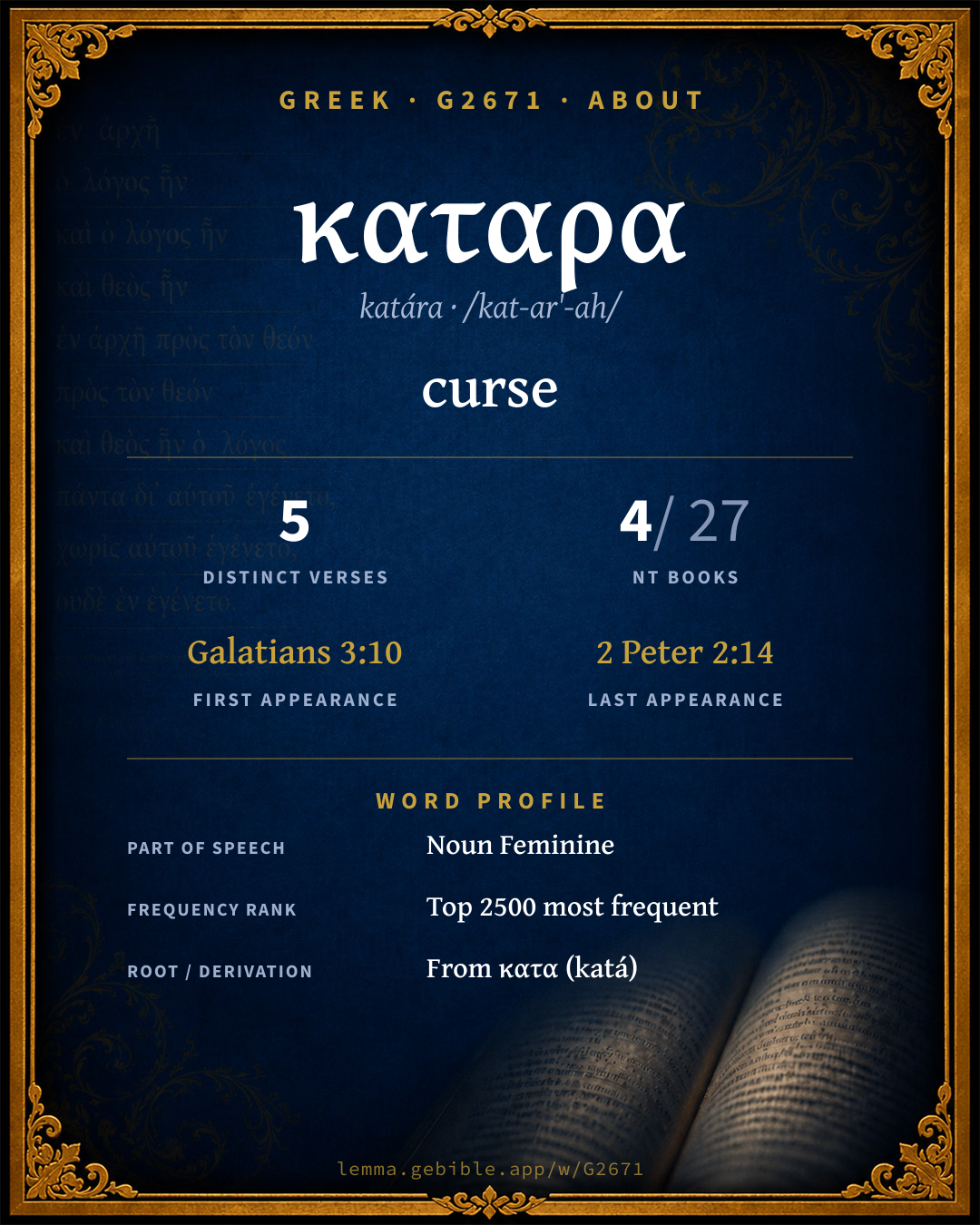
κατάρα
curse
Full lexicon entry — Thayer's Greek Lexicon
From Thayer's Greek Lexicon
Where this word appears
See every Genitive-case word in the Greek New Testament →
Grammar key — what these labels mean
Part of speech
- Noun
- A naming word — a person, place, thing, or idea.
Case
- Genitive
- The case of source, possession, or “of” — answers “whose / from what.”
- Nominative
- The case of the subject (and the predicate nominative).
- Accusative
- The case of the direct object and of extent.
Gender
- Feminine
- Grammatically feminine.
Number
- Singular
- One.
3 distinct verses where G2671 appears in the Genitive case, across 3 books. Filtered view — show all forms. Click any verse to open its interlinear word-by-word view. Verse text shown in the World English Bible for context — . Each verse’s Greek form is shown with its reference; the English is not keyword-highlighted, since the data carries no word-level English alignment. Use “Compare translations” on any verse to read it across multiple English versions. This concordance covers the Greek New Testament; Septuagint (Greek Old Testament) occurrences of this word are not indexed here.
Galatians 1 verse
Hebrews 1 verse
2 Peter 1 verse
About this entry
At a glance — auto-summarized from this page’s data, not written by a person. Every figure links to its source below. This summary describes the numbers; it doesn’t interpret them.
καταρα — transliterated katára — is a Greek noun carrying the sense “curse.” With only 5 verses it sits in the long tail of Greek New Testament vocabulary. More than a third of its appearances fall in Galatians. Debuting at Galatians 3:10, it then recurs through the corpus. It shares a root with κατα, καθα and καθαιρεω. See the sense tree, 5-verse concordance, and the renderings breakdown below.
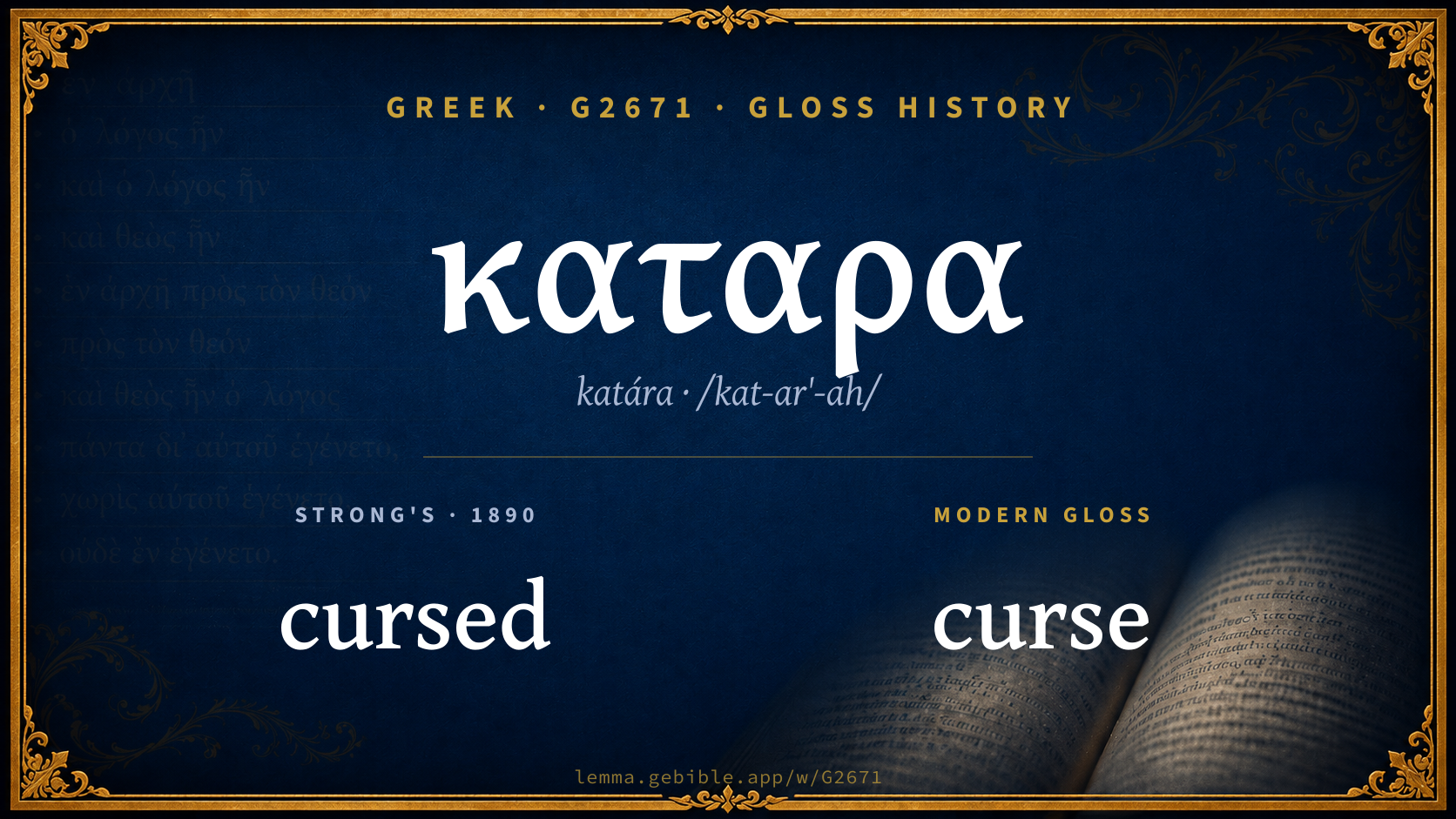
Gloss history
Strong's 1890 vs modern scholarship
About this word
Strong's G2671 catalogs a Greek word from the Greek New Testament.
These counts are not copied from any lexicon or concordance. They are computed here, from the morphology-tagged Greek New Testament. What Lemma adds →
- 5
- distinct verses
- The word appears in 5 distinct verses.
- 4 / 27
- NT books
- The word appears in 4 of 27 New Testament books.
- #1,476
- by frequency
- Top 2500 most frequent Greek words (rank 1,476 of 5,347 Greek words by occurrence).
View all 5 occurrences in the concordance →
By section of the New Testament
By traditional corpus
Conventional, traditional groupings — biblical authorship is debated, so this is a traditional corpus grouping, not an authorship claim. Some books belong to more than one corpus (Luke is in both the Gospels and the Lukan corpus, and so on), so these shares overlap and need not total 100%. Each figure is a share of the word’s 5 distinct verses.
- Pauline corpus 2 verses · 40%
- General (Catholic) Epistles 2 verses · 40%
- Hebrews 1 verse · 20%
How translations render this word
Counts come from each version’s own published word-to-Strong’s tagging or interlinear alignment — an approximate guide to how each version renders this word, not a word-level alignment the data otherwise carries. Because each total is that version’s own tagged count, the per-version totals vary from one another and need not match the appearance or distinct-verse counts above. These counts may also differ from a printed concordance because Lemma counts each distinctly tagged rendering and does not collapse phrase taggings into a single head-word total. This is a fixed set of word-tagged versions (KJV, ASV, BSB, ULT) and does not change with the reading translation you choose elsewhere. Each version’s license is shown beside its name below (and on Sources).
- King James Version: Curse 3×, Cursing 2×
- American Standard Version: Curse 4×, Cursing 2×
- Berean Standard Bible: Curse 4×
- unfoldingWord Literal Text: Curse 4×, Cursing 2×
King James Version Public Domain
Renders G2671 across 6 tagged occurrences — most commonly:
Plus 1 rendering that appears only once — usually multi-word phrases or single function words the recovered tagging swept in, not distinct renderings.
American Standard Version Public Domain
Renders G2671 across 6 tagged occurrences — most commonly:
Berean Standard Bible Public Domain
Renders G2671 across 6 tagged occurrences — most commonly:
Plus 2 renderings that appear only once — usually multi-word phrases or single function words the recovered tagging swept in, not distinct renderings.
unfoldingWord Literal Text CC BY-SA 4.0
Renders G2671 across 6 tagged occurrences — most commonly:
Senses in Thayer's
The 1 sense Thayer's distinguishes for this word, in lexicon order (not ranked by frequency or importance). The full entry — with sub-senses — is in the Lexicon Entry tab.
- an execration, imprecation, curse
Word origin
Derived from κατα (katá) (G2596) — down.
Forms in the corpus
The 3 distinct written forms G2671 takes in the Greek New Testament, most frequent first — each parse links to that case’s occurrences in the concordance.
| Form | Parsing | Example | Uses |
|---|---|---|---|
| κατάρας katáras | Noun, Genitive, Singular, Feminine | Galatians 3:13 | 3 |
| κατάρα katára | Noun, Nominative, Singular, Feminine | Galatians 3:13 | 2 |
| κατάραν katáran | Noun, Accusative, Singular, Feminine | Galatians 3:10 | 1 |
Same root — word family
Other Thayer's entries built from the same root as G2671, grouped by Strong’s listed origin. These share a root / origin per the lexicon — not necessarily a shared meaning. Each links to that word’s own entry.
Derives from
Shares the same root
- καθα kathá G2505 according as
- καθαιρεω kathairéō G2507 to tear down
- καθαπτω katháptō G2510 to fasten down
- καθεδρα kathédra G2515 seat
- καθεζομαι kathézomai G2516 to sit down
- καθεξης kathexēs G2517 in order
- καθευδω katheúdō G2518 to fall asleep
- καθηγητης kathēgētḗs G2519 guide
- καθηκω kathḗkō G2520 to come down
- καθημαι káthēmai G2521 to sit down
- καθημερινος kathēmerinós G2522 daily
- καθιημι kathíēmi G2524 to send down
- καθιστημι kathístēmi G2525 to place
- καθο kathó G2526 according to what
- καθολου kathólou G2527 wholly
- καθοπλιζω kathoplízō G2528 to arm
- καθοραω kathoráō G2529 to see clearly
- καθοτι kathóti G2530 according to what
- καθως kathṓs G2531 according as
- καμμυω kammýō G2576 to close eyes
- καταβαινω katabaínō G2597 to descend
- καταβαλλω katabállō G2598 to cast down
- καταβαρεω katabaréō G2599 to weigh down
- καταβιβαζω katabibázō G2601 to bring down
+103 more words share this root (not shown).
Derived from this word
Compare all same-root words → Showing 4 of 130 — not the complete family. They share a root, not necessarily a meaning.
Septuagint usage
The same Greek word καταρα appears 34 times in the Greek Old Testament (Septuagint), across 34 verses in 17 books.
- 34
- LXX occurrences
- Tagged occurrences of this Greek word in the Septuagint.
- 34
- verses
- Distinct Septuagint verses containing this word.
- 17 / 39
- OT books
- The word appears in 17 of the 39 Old Testament books.
Sample Septuagint occurrences
- Genesis 27:12 κατάρα
- Numbers 23:25 κατάρα
- Deuteronomy 11:26 κατάρα
- Joshua 9:2 κατάρα
- Judges 9:57 κατάρα
- 2 Samuel 16:12 κατάρα
- 1 Kings 2:8 κατάρα
- 2 Kings 22:19 κατάρα
- Ezra 23:2 κατάρα
- Job 31:30 κατάρα
- Psalms 108:17 κατάρα
- Proverbs 3:33 κατάρα
Septuagint occurrences (same lexeme)
Every verse where the same Strong’s number (G2671) appears in the Greek Septuagint. Verse text shown in the World English Bible for context; the Greek form is the matched word — the English is not keyword-highlighted.
- Genesis 27:12 κατάρα What if my father touches me? I will seem to him as a deceiver, and I would bring a curse on myself, and not a blessing."
- Genesis 27:13 κατάρα His mother said to him, "Let your curse be on me, my son. Only obey my voice, and go get them for me."
- Numbers 23:25 κατάρα Balak said to Balaam, Neither curse them at all, nor bless them at all.
- Deuteronomy 11:26 κατάρα Behold, I set before you this day a blessing and a curse:
- Deuteronomy 11:28 κατάρα and the curse, if you shall not listen to the commandments of Yahweh your God, but turn aside out of the way which I command you this day, to go after other gods, which you have not known.
- Deuteronomy 11:29 κατάρα It shall happen, when Yahweh your God shall bring you into the land where you go to possess it, that you shall set the blessing on Mount Gerizim, and the curse on Mount Ebal.
- Deuteronomy 23:6 κατάρα You shall not seek their peace nor their prosperity all your days forever.
- Deuteronomy 27:13 κατάρα These shall stand on Mount Ebal for the curse: Reuben, Gad, and Asher, and Zebulun, Dan, and Naphtali.
- Deuteronomy 28:15 κατάρα But it shall come to pass, if you will not listen to the voice of Yahweh your God, to observe to do all his commandments and his statutes which I command you this day, that all these curses shall come on you, and overtake you.
- Deuteronomy 28:45 κατάρα All these curses shall come on you, and shall pursue you, and overtake you, until you are destroyed; because you didn't listen to the voice of Yahweh your God, to keep his commandments and his statutes which he commanded you:
- Deuteronomy 29:26 κατάρα and went and served other gods, and worshiped them, gods that they didn't know, and that he had not given to them:
- Deuteronomy 30:1 κατάρα It shall happen, when all these things are come on you, the blessing and the curse, which I have set before you, and you shall call them to mind among all the nations, where Yahweh your God has driven you,
- Deuteronomy 30:19 κατάρα I call heaven and earth to witness against you this day, that I have set before you life and death, the blessing and the curse: therefore choose life, that you may live, you and your seed;
- Joshua 9:2 κατάρα that they gathered themselves together, to fight with Joshua and with Israel, with one accord.
- Judges 9:57 κατάρα and all the wickedness of the men of Shechem did God requite on their heads: and on them came the curse of Jotham the son of Jerubbaal.
- 2 Samuel 16:12 κατάρα It may be that Yahweh will look on the wrong done to me, and that Yahweh will requite me good for [his] cursing of me this day.
- 1 Kings 2:8 κατάρα Behold, there is with you Shimei the son of Gera, the Benjamite, of Bahurim, who cursed me with a grievous curse in the day when I went to Mahanaim; but he came down to meet me at the Jordan, and I swore to him by Yahweh, saying, I will not put you to death with the sword.
- 1 Kings 2:35 κατάρα The king put Benaiah the son of Jehoiada in his room over the host; and Zadok the priest did the king put in the room of Abiathar.
- 2 Kings 22:19 κατάρα because your heart was tender, and you did humble yourself before Yahweh, when you heard what I spoke against this place, and against the inhabitants of it, that they should become a desolation and a curse, and have torn your clothes, and wept before me; I also have heard you, says Yahweh.
- Ezra 23:2 κατάρα
- Job 31:30 κατάρα (Yes, I have not allowed my mouth to sin By asking his life with a curse);
- Psalms 108:17 κατάρα
- Psalms 108:18 κατάρα
- Proverbs 3:33 κατάρα Yahweh's curse is in the house of the wicked, But he blesses the habitation of the righteous.
- Isaiah 64:9 κατάρα Don't be angry very sore, Yahweh, neither remember iniquity forever: see, look, we beg you, we are all your people.
- Isaiah 65:23 κατάρα They shall not labor in vain, nor bring forth for calamity; for they are the seed of the blessed of Yahweh, and their offspring with them.
- Jeremiah 24:9 κατάρα I will even give them up to be tossed back and forth among all the kingdoms of the earth for evil; to be a reproach and a proverb, a taunt and a curse, in all places where I shall drive them.
- Jeremiah 33:6 κατάρα Behold, I will bring it health and cure, and I will cure them; and I will reveal to them abundance of peace and truth.
- Jeremiah 36:17 κατάρα They asked Baruch, saying, Tell us now, How did you write all these words at his mouth?
- Jeremiah 51:8 κατάρα Babylon is suddenly fallen and destroyed: wail for her; take balm for her pain, if so be she may be healed.
- Jeremiah 51:12 κατάρα Set up a standard against the walls of Babylon, make the watch strong, set the watchmen, prepare the ambushes; for Yahweh has both purposed and done that which he spoke concerning the inhabitants of Babylon.
- Daniel 9:11 κατάρα Yes, all Israel have transgressed your law, even turning aside, that they should not obey your voice: therefore has the curse been poured out on us, and the oath that is written in the law of Moses the servant of God; for we have sinned against him.
- Zechariah 8:13 κατάρα It shall come to pass that, as you were a curse among the nations, house of Judah and house of Israel, so will I save you, and you shall be a blessing. Don't be afraid. Let your hands be strong."
- Malachi 2:2 κατάρα If you will not listen, and if you will not lay it to heart, to give glory to my name," says Yahweh of Hosts, "then will I send the curse on you, and I will curse your blessings. Indeed, I have cursed them already, because you do not lay it to heart.
These are occurrences of the same Greek lexeme (G2671) in the Septuagint — not a translation of any one Hebrew word. The store carries no word-level Hebrew↔Greek alignment, so no Hebrew original is asserted here. Counts come from the recovered LXX Strong's tagging — high-frequency vocabulary is well covered, while rare or late forms may be untagged — so they reflect tagged occurrences and may slightly undercount.