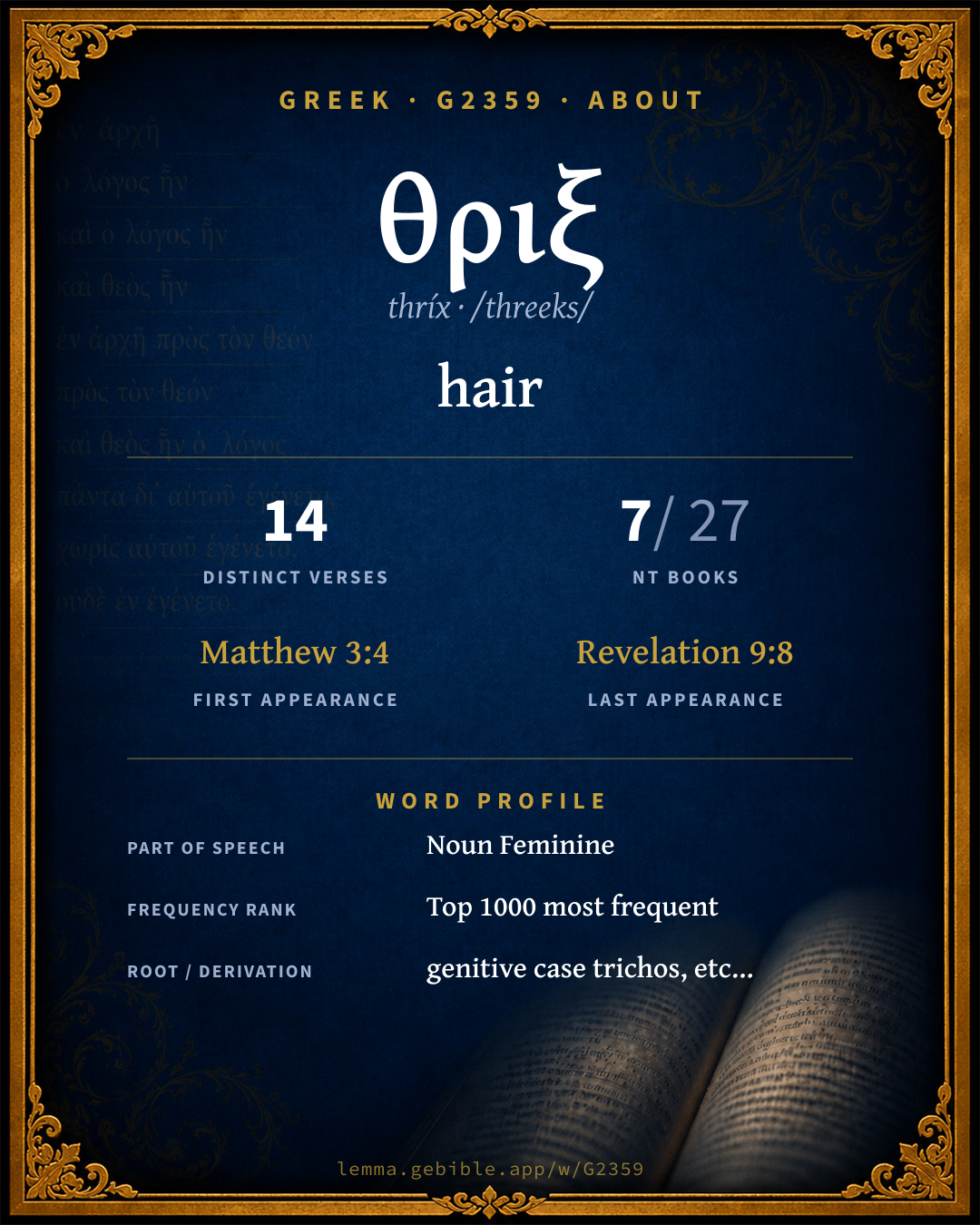
θριξ
hair
‘hair’ is one of 2 main senses fuller range ↓
Full lexicon entry — Thayer's Greek Lexicon
From Thayer's Greek Lexicon
Where this word appears
Grammar key — what these labels mean
Part of speech
- Noun
- A naming word — a person, place, thing, or idea.
Case
- Dative
- The case of the indirect object, means, or location — “to / for / with / in.”
- Accusative
- The case of the direct object and of extent.
- Nominative
- The case of the subject (and the predicate nominative).
- Genitive
- The case of source, possession, or “of” — answers “whose / from what.”
Gender
- Feminine
- Grammatically feminine.
Number
- Plural
- More than one.
- Singular
- One.
Every verse where G2359 appears in the Book of John — 2 distinct verses. Click any verse to open its interlinear word-by-word view. Verse text shown in the World English Bible for context — . Each verse’s Greek form is shown with its reference; the English is not keyword-highlighted, since the data carries no word-level English alignment. Use “Compare translations” on any verse to read it across multiple English versions. This concordance covers the Greek New Testament; Septuagint (Greek Old Testament) occurrences of this word are not indexed here.
John
- John 11:2 θριξὶν n dat pl fem It was that Mary who had anointed the Lord with ointment, and wiped his feet with her hair, whose brother, Lazarus, was sick.
- John 12:3 θριξὶν n dat pl fem Mary, therefore, took a pound of ointment of pure nard, very precious, and anointed the feet of Jesus, and wiped his feet with her hair. The house was filled with the fragrance of the ointment.
About this entry
At a glance — auto-summarized from this page’s data, not written by a person. Every figure links to its source below. This summary describes the numbers; it doesn’t interpret them.
At its core, θριξ (thríx) means “hair.” Scripture first uses it in Matthew 3:4. It turns up in 14 verses across 7 books, an uncommon footprint. The word gravitates to Luke (29%), then Matthew and John. Catalogued under 2 senses, its meaning is not single-sense. Each statement above links to its evidence; the full detail follows below.
Gloss history
Strong's 1890 vs modern scholarship
About this word
Strong's G2359 catalogs a Greek word from the Greek New Testament.
These counts are not copied from any lexicon or concordance. They are computed here, from the morphology-tagged Greek New Testament. What Lemma adds →
- 14
- distinct verses
- The word appears in 14 distinct verses.
- 7 / 27
- NT books
- The word appears in 7 of 27 New Testament books.
- #768
- by frequency
- Top 1000 most frequent Greek words (rank 768 of 5,347 Greek words by occurrence).
View all 14 occurrences in the concordance →
By section of the New Testament
By traditional corpus
Conventional, traditional groupings — biblical authorship is debated, so this is a traditional corpus grouping, not an authorship claim. Some books belong to more than one corpus (Luke is in both the Gospels and the Lukan corpus, and so on), so these shares overlap and need not total 100%. Each figure is a share of the word’s 14 distinct verses.
- Gospels 10 verses · 71%
- Lukan (Luke–Acts) 5 verses · 36%
- Johannine 4 verses · 29%
- Revelation 2 verses · 14%
- General (Catholic) Epistles 1 verse · 7%
How translations render this word
Counts come from each version’s own published word-to-Strong’s tagging or interlinear alignment — an approximate guide to how each version renders this word, not a word-level alignment the data otherwise carries. Because each total is that version’s own tagged count, the per-version totals vary from one another and need not match the appearance or distinct-verse counts above. These counts may also differ from a printed concordance because Lemma counts each distinctly tagged rendering and does not collapse phrase taggings into a single head-word total. This is a fixed set of word-tagged versions (KJV, ASV, BSB, ULT) and does not change with the reading translation you choose elsewhere. Each version’s license is shown beside its name below (and on Sources).
- King James Version: Hair 10×, Hairs 5×
- American Standard Version: Hair 11×, With 3×, 's hair 2×
- Berean Standard Bible: Hair 12×, Hairs 2×
- unfoldingWord Literal Text: Hair 13×, With 3×, Hairs 2×
King James Version Public Domain
Renders G2359 across 15 tagged occurrences — most commonly:
American Standard Version Public Domain
Renders G2359 across 20 tagged occurrences — most commonly:
Plus 2 renderings that appear only once — usually multi-word phrases or single function words the recovered tagging swept in, not distinct renderings.
Berean Standard Bible Public Domain
Renders G2359 across 14 tagged occurrences — most commonly:
Not rendered by a distinct English word in 1 further occurrence.
unfoldingWord Literal Text CC BY-SA 4.0
Renders G2359 across 18 tagged occurrences — most commonly:
Senses in Thayer's
The 2 senses Thayer's distinguishes for this word, in lexicon order (not ranked by frequency or importance). The full entry — with sub-senses — is in the Lexicon Entry tab.
- the hair of the head
- the hair of animals
Word origin
Origin: genitive case trichos, etc., of uncertain derivation
Of uncertain derivation; hair : - hair. Compare G2864 .
— Strong’s Exhaustive Concordance (1890), public domain.
Forms in the corpus
The 6 distinct written forms G2359 takes in the Greek New Testament, most frequent first — each parse links to that case’s occurrences in the concordance.
| Form | Parsing | Example | Uses |
|---|---|---|---|
| θριξὶν thrixìn | Noun, Dative, Plural, Feminine | Luke 7:38 | 4 |
| τρίχας tríchas | Noun, Accusative, Plural, Feminine | Mark 1:6 | 3 |
| τρίχες tríches | Noun, Nominative, Plural, Feminine | Matthew 10:30 | 3 |
| θρὶξ thrìx | Noun, Nominative, Singular, Feminine | Luke 21:18 | 2 |
| τριχῶν trichō̂n | Noun, Genitive, Plural, Feminine | Matthew 3:4 | 2 |
| τρίχα trícha | Noun, Accusative, Singular, Feminine | Matthew 5:36 | 1 |
Same root — word family
Other Thayer's entries built from the same root as G2359, grouped by Strong’s listed origin. These share a root / origin per the lexicon — not necessarily a shared meaning. Each links to that word’s own entry.
Derived from this word
Compare all same-root words → They share a root, not necessarily a meaning.
Septuagint usage
The same Greek word θριξ appears 38 times in the Greek Old Testament (Septuagint), across 36 verses in 14 books.
- 38
- LXX occurrences
- Tagged occurrences of this Greek word in the Septuagint.
- 36
- verses
- Distinct Septuagint verses containing this word.
- 14 / 39
- OT books
- The word appears in 14 of the 39 Old Testament books.
Sample Septuagint occurrences
- Exodus 25:4 θρίξ
- Leviticus 13:3 θρίξ
- Numbers 6:5 θρίξ
- Judges 16:22 θρίξ
- 1 Samuel 14:45 θρίξ
- 2 Samuel 14:11 θρίξ
- 1 Kings 1:52 θρίξ
- Ezra 9:3 θρίξ
- Job 4:15 θρίξ
- Psalms 39:13 θρίξ
- Proverbs 23:7 θρίξ
- Isaiah 7:20 θρίξ
Septuagint occurrences (same lexeme)
Every verse where the same Strong’s number (G2359) appears in the Greek Septuagint. Verse text shown in the World English Bible for context; the Greek form is the matched word — the English is not keyword-highlighted.
- Exodus 25:4 θρίξ blue, purple, scarlet, fine linen, goats' hair,
- Exodus 35:6 θρίξ blue, purple, scarlet, fine linen, goats' hair,
- Exodus 35:26 θρίξ All the women whose heart stirred them up in wisdom spun the goats' hair.
- Exodus 36:10 θρίξ He coupled five curtains to one another, and the other five curtains he coupled one to another.
- Leviticus 13:3 θρίξ and the priest shall examine the plague in the skin of the body: and if the hair in the plague has turned white, and the appearance of the plague is deeper than the body's skin, it is the plague of leprosy; and the priest shall examine him, and pronounce him unclean.
- Leviticus 13:4 θρίξ If the bright spot is white in the skin of his body, and the appearance of it isn't deeper than the skin, and the hair of it hasn't turned white, then the priest shall isolate the infected person for seven days.
- Leviticus 13:10 θρίξ and the priest shall examine him. Behold, if there is a white rising in the skin, and it has turned the hair white, and there is raw flesh in the rising,
- Leviticus 13:20 θρίξ and the priest shall examine it; and, behold, if the appearance of it is lower than the skin, and the hair of it has turned white, then the priest shall pronounce him unclean. It is the plague of leprosy. It has broken out in the boil.
- Leviticus 13:21 θρίξ But if the priest examines it, and, behold, there are no white hairs in it, and it isn't deeper than the skin, but is dim, then the priest shall isolate him seven days.
- Leviticus 13:25 θρίξ then the priest shall examine it; and, behold, if the hair in the bright spot has turned white, and the appearance of it is deeper than the skin; it is leprosy. It has broken out in the burning, and the priest shall pronounce him unclean. It is the plague of leprosy.
- Leviticus 13:26 θρίξ But if the priest examines it, and, behold, there is no white hair in the bright spot, and it isn't lower than the skin, but is faded; then the priest shall isolate him seven days.
- Leviticus 13:30 θρίξ then the priest shall examine the plague; and, behold, if the appearance of it is deeper than the skin, and the hair in it is yellow and thin, then the priest shall pronounce him unclean: it is an itch, it is leprosy of the head or of the beard.
- Leviticus 13:31 θρίξ If the priest examines the plague of itching, and, behold, its appearance isn't deeper than the skin, and there is no black hair in it, then the priest shall isolate him the person infected with itching seven days.
- Leviticus 13:32 θρίξ On the seventh day the priest shall examine the plague; and, behold, if the itch hasn't spread, and there is no yellow hair in it, and the appearance of the itch isn't deeper than the skin,
- Leviticus 13:36 θρίξ then the priest shall examine him; and, behold, if the itch has spread in the skin, the priest shall not look for the yellow hair; he is unclean.
- Leviticus 13:37 θρίξ But if in his eyes the itch is arrested, and black hair has grown in it; the itch is healed, he is clean. The priest shall pronounce him clean.
- Leviticus 14:8 θρίξ "He who is to be cleansed shall wash his clothes, and shave off all his hair, and bathe himself in water; and he shall be clean. After that he shall come into the camp, but shall dwell outside his tent seven days.
- Leviticus 14:9 θρίξ It shall be on the seventh day, that he shall shave all his hair off his head and his beard and his eyebrows, even all his hair he shall shave off. He shall wash his clothes, and he shall bathe his body in water, then he shall be clean.
- Numbers 6:5 θρίξ "All the days of his vow of separation there shall no razor come on his head, until the days are fulfilled, in which he separates himself to Yahweh. He shall be holy. He shall let the locks of the hair of his head grow long.
- Numbers 6:18 θρίξ The Nazirite shall shave the head of his separation at the door of the Tent of Meeting, and shall take the hair of the head of his separation, and put it on the fire which is under the sacrifice of peace offerings.
- Judges 16:22 θρίξ However the hair of his head began to grow again after he was shaved.
- Judges 20:16 θρίξ Among all this people there were seven hundred chosen men left-handed; everyone could sling stones at a hair-breadth, and not miss.
- 1 Samuel 14:45 θρίξ The people said to Saul, Shall Jonathan die, who has worked this great salvation in Israel? Far from it: as Yahweh lives, there shall not one hair of his head fall to the ground; for he has worked with God this day. So the people rescued Jonathan, that he didn't die.
- 2 Samuel 14:11 θρίξ Then said she, Please let the king remember Yahweh your God, that the avenger of blood destroy not any more, lest they destroy my son. He said, As Yahweh lives, there shall not one hair of your son fall to the earth.
- 2 Samuel 14:26 θρίξ When he cut the hair of his head (now it was at every year's end that he cut it; because it was heavy on him, therefore he cut it); he weighed the hair of his head at two hundred shekels, after the king's weight.
- 1 Kings 1:52 θρίξ Solomon said, If he shall show himself a worthy man, there shall not a hair of him fall to the earth; but if wickedness be found in him, he shall die.
- Ezra 9:3 θρίξ When I heard this thing, I tore my garment and my robe, and plucked off the hair of my head and of my beard, and sat down confounded.
- Job 4:15 θρίξ Then a spirit passed before my face; The hair of my flesh stood up.
- Psalms 39:13 θρίξ Oh spare me, that I may recover strength, Before I go away, and be no more."
- Psalms 67:22 θρίξ
- Psalms 68:5 θρίξ A father of the fatherless, and a defender of the widows, Is God in his holy habitation.
- Proverbs 23:7 θρίξ For as he thinks about the cost, so he is. "Eat and drink!" he says to you, But his heart is not with you.
- Isaiah 7:20 θρίξ In that day the Lord will shave with a razor that is hired in the parts beyond the River, even with the king of Assyria, the head and the hair of the feet; and it shall also consume the beard.
- Ezekiel 16:7 θρίξ I caused you to multiply as that which grows in the field, and you increased and grew great, and you attained to excellent ornament; your breasts were fashioned, and your hair was grown; yet you were naked and bare.
- Daniel 3:94 θρίξ
- Daniel 4:26 θρίξ Whereas they commanded to leave the stump of the roots of the tree; your kingdom shall be sure to you, after that you shall have known that the heavens do rule.
These are occurrences of the same Greek lexeme (G2359) in the Septuagint — not a translation of any one Hebrew word. The store carries no word-level Hebrew↔Greek alignment, so no Hebrew original is asserted here. Counts come from the recovered LXX Strong's tagging — high-frequency vocabulary is well covered, while rare or late forms may be untagged — so they reflect tagged occurrences and may slightly undercount.