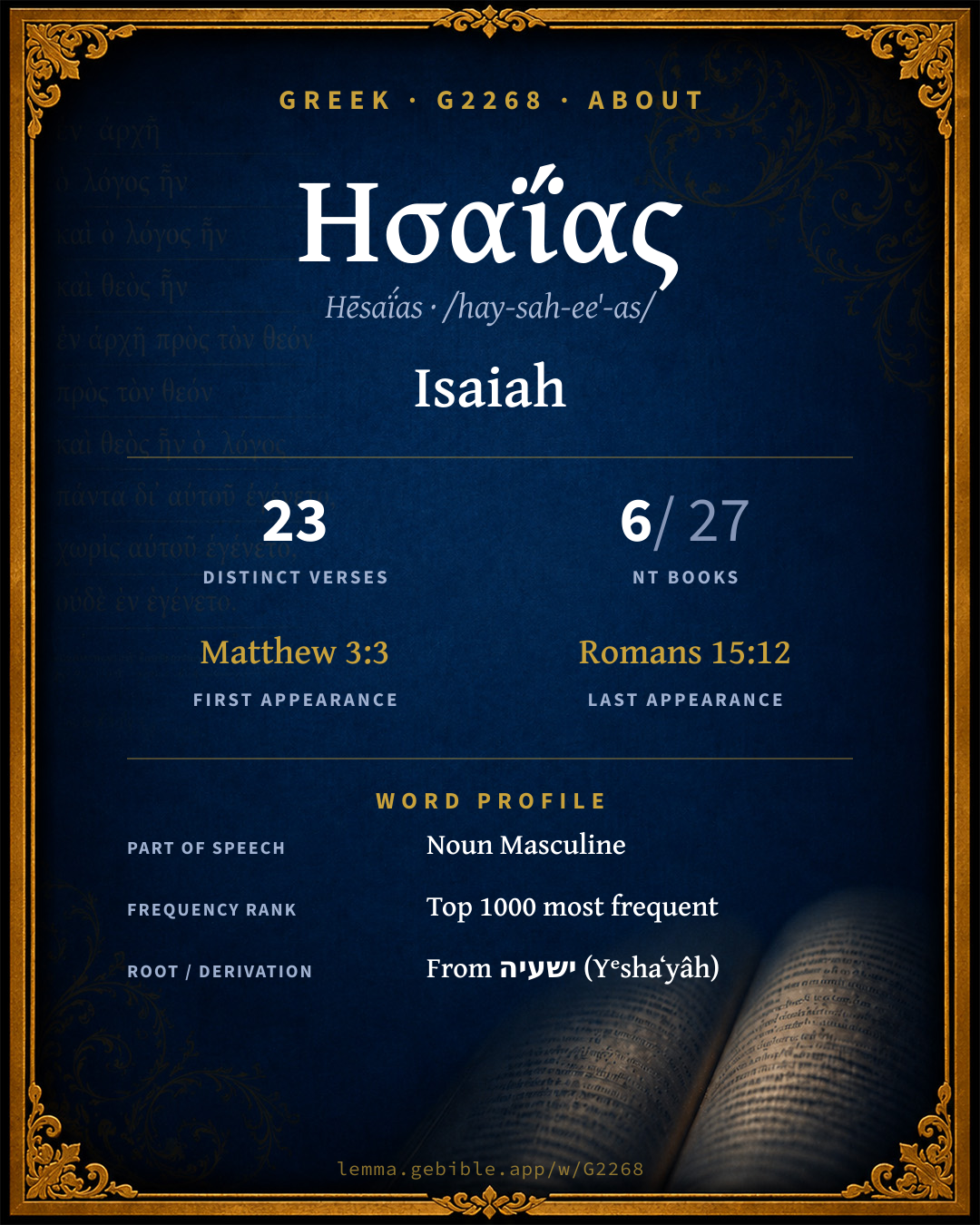
Ἡσαΐ́ας
Isaiah
Thayer's lists 2 entries for ‘Isaiah’ fuller range ↓
Full lexicon entry — Thayer's Greek Lexicon
From Thayer's Greek Lexicon
Where this word appears
See every Genitive-case word in the Greek New Testament →
Grammar key — what these labels mean
Part of speech
- Noun
- A naming word — a person, place, thing, or idea.
Case
- Genitive
- The case of source, possession, or “of” — answers “whose / from what.”
- Nominative
- The case of the subject (and the predicate nominative).
- Accusative
- The case of the direct object and of extent.
- Dative
- The case of the indirect object, means, or location — “to / for / with / in.”
Gender
- Masculine
- Grammatically masculine.
Number
- Singular
- One.
Grammatical forms
- Noun, Genitive, Singular, Masculine 10 times (43%)
- Noun, Nominative, Singular, Masculine 10 times (43%)
- Noun, Accusative, Singular, Masculine 2 times (9%)
- Noun, Dative, Singular, Masculine 1 time (4%)
Parsed forms decoded from the imported morphology (Robinson–Tischendorf, public domain), counted across 23 parsed occurrences — not distinct verses.
Every verse where G2268 appears — 23 distinct verses across 6 books. Click any verse to open its interlinear word-by-word view. Verse text shown in the World English Bible for context — . Each verse’s Greek form is shown with its reference; the English is not keyword-highlighted, since the data carries no word-level English alignment. Use “Compare translations” on any verse to read it across multiple English versions. This concordance covers the Greek New Testament; Septuagint (Greek Old Testament) occurrences of this word are not indexed here.
Matthew 7 verses
- Matthew 3:3 Ἡσαΐου n gen sg masc For this is he who was spoken of by Isaiah the prophet, saying, "The voice of one crying in the wilderness, Make ready the way of the Lord, Make his paths straight."
- Matthew 4:14 Ἡσαΐου n gen sg masc that it might be fulfilled which was spoken through Isaiah the prophet, saying,
- Matthew 8:17 Ἡσαΐου n gen sg masc that it might be fulfilled which was spoken through Isaiah the prophet, saying: "He took our infirmities, and bore our diseases."
- Matthew 12:17 Ἡσαΐου n gen sg masc that it might be fulfilled which was spoken through Isaiah the prophet, saying,
- Matthew 13:14 Ἡσαΐου n gen sg masc In them the prophecy of Isaiah is fulfilled, which says, 'By hearing you will hear, And will in no way understand; Seeing you will see, And will in no way perceive:
- Matthew 13:35 Ἡσαίου n gen sg masc that it might be fulfilled which was spoken through the prophet, saying, "I will open my mouth in parables; I will utter things hidden from the foundation of the world."
- Matthew 15:7 Ἡσαΐας n nom sg masc You hypocrites! Well did Isaiah prophesy of you, saying,
Mark 2 verses
- Mark 1:2 Ἡσαΐᾳ n dat sg masc As it is written in the prophets, "Behold, I send my messenger before your face, Who will prepare your way before you.
- Mark 7:6 Ἡσαΐας n nom sg masc He answered them, "Well did Isaiah prophesy of you hypocrites, as it is written, 'This people honors me with their lips, But their heart is far from me.
Luke 2 verses
- Luke 3:4 Ἡσαΐου n gen sg masc As it is written in the book of the words of Isaiah the prophet, "The voice of one crying in the wilderness, 'Make ready the way of the Lord. Make his paths straight.
- Luke 4:17 Ἡσαΐου n gen sg masc The book of the prophet Isaiah was handed to him. He opened the book, and found the place where it was written,
John 4 verses
- John 1:23 Ἡσαΐας n nom sg masc He said, "I am the voice of one crying in the wilderness, 'Make straight the way of the Lord,' as Isaiah the prophet said."
- John 12:38 Ἡσαΐου n gen sg masc that the word of Isaiah the prophet might be fulfilled, which he spoke, "Lord, who has believed our report? To whom has the arm of the Lord been revealed?"
- John 12:39 Ἡσαΐας n nom sg masc For this cause they couldn't believe, for Isaiah said again,
- John 12:41 Ἡσαΐας n nom sg masc Isaiah said these things when he saw his glory, and spoke of him.
Acts 3 verses
- Acts 8:28 Ἠσαΐαν n acc sg masc He was returning and sitting in his chariot, and was reading the prophet Isaiah.
- Acts 8:30 Ἠσαΐαν n acc sg masc Philip ran to him, and heard him reading Isaiah the prophet, and said, "Do you understand what you are reading?"
- Acts 28:25 Ἠσαΐου n gen sg masc When they didn't agree among themselves, they departed after Paul had spoken one word, "The Holy Spirit spoke rightly through Isaiah, the prophet, to our fathers,
Romans 5 verses
- Romans 9:27 Ἡσαΐας n nom sg masc Isaiah cries concerning Israel, "If the number of the children of Israel are as the sand of the sea, It is the remnant who will be saved;
- Romans 9:29 Ἡσαΐας n nom sg masc As Isaiah has said before, "Unless the Lord of Hosts had left us a seed, We would have become like Sodom, And would have been made like Gomorrah."
- Romans 10:16 Ἡσαΐας n nom sg masc But they didn't all listen to the glad news. For Isaiah says, "Lord, who has believed our report?"
- Romans 10:20 Ἡσαΐας n nom sg masc Isaiah is very bold, and says, "I was found by those who didn't seek me. I was revealed to those who didn't ask for me."
- Romans 15:12 Ἡσαΐας n nom sg masc Again, Isaiah says, "There will be the root of Jesse, He who arises to rule over the Gentiles; On him will the Gentiles hope."
About this entry
At a glance — auto-summarized from this page’s data, not written by a person. Every figure links to its source below. This summary describes the numbers; it doesn’t interpret them.
“Isaiah” is the headline sense of the Greek name Ησαΐας (Hēsaḯas). Its earliest occurrence is Matthew 3:3. The Greek New Testament uses it across 23 verses — uncommon. More than a quarter of its appearances fall in Matthew. The sections below give every occurrence and version rendering.
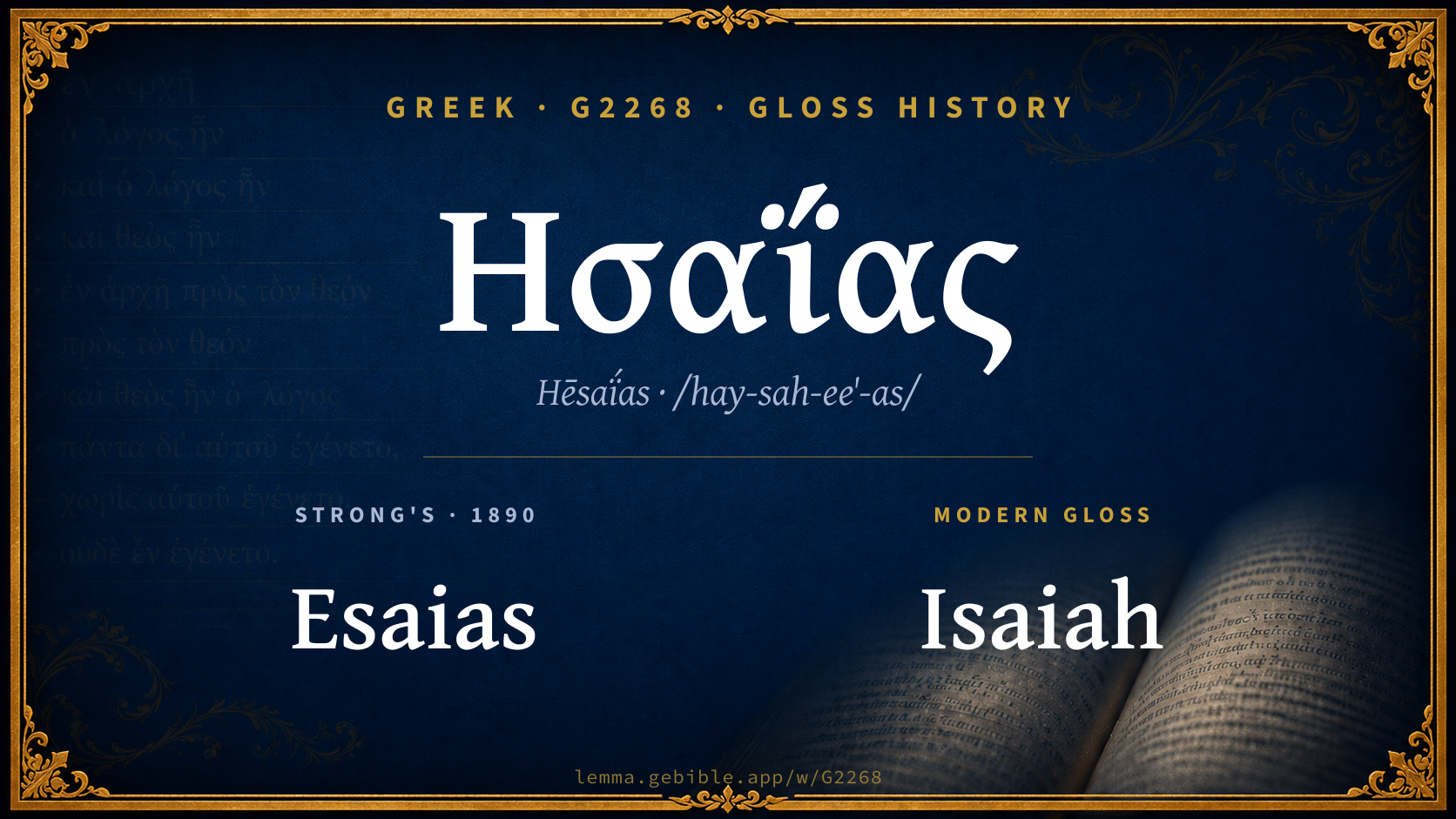
Gloss history
Strong's 1890 vs modern scholarship
About this word
Strong's G2268 catalogs a Greek word from the Greek New Testament.
These counts are not copied from any lexicon or concordance. They are computed here, from the morphology-tagged Greek New Testament. What Lemma adds →
- 23
- distinct verses
- The word appears in 23 distinct verses.
- 6 / 27
- NT books
- The word appears in 6 of 27 New Testament books.
- #563
- by frequency
- Top 1000 most frequent Greek words (rank 563 of 5,347 Greek words by occurrence).
View all 23 occurrences in the concordance →
By section of the New Testament
By traditional corpus
Conventional, traditional groupings — biblical authorship is debated, so this is a traditional corpus grouping, not an authorship claim. Some books belong to more than one corpus (Luke is in both the Gospels and the Lukan corpus, and so on), so these shares overlap and need not total 100%. Each figure is a share of the word’s 23 distinct verses.
- Gospels 15 verses · 65%
- Lukan (Luke–Acts) 5 verses · 22%
- Pauline corpus 5 verses · 22%
- Johannine 4 verses · 17%
How translations render this word
Counts come from each version’s own published word-to-Strong’s tagging or interlinear alignment — an approximate guide to how each version renders this word, not a word-level alignment the data otherwise carries. Because each total is that version’s own tagged count, the per-version totals vary from one another and need not match the appearance or distinct-verse counts above. These counts may also differ from a printed concordance because Lemma counts each distinctly tagged rendering and does not collapse phrase taggings into a single head-word total. This is a fixed set of word-tagged versions (KJV, ASV, BSB, ULT) and does not change with the reading translation you choose elsewhere. Each version’s license is shown beside its name below (and on Sources).
- King James Version: Esaias 20×
- American Standard Version: Isaiah 20×
- Berean Standard Bible: Isaiah 22×
- unfoldingWord Literal Text: Isaiah 22×
King James Version Public Domain
Renders G2268 across 21 tagged occurrences — most commonly:
Plus 1 rendering that appears only once — usually multi-word phrases or single function words the recovered tagging swept in, not distinct renderings.
American Standard Version Public Domain
Renders G2268 across 20 tagged occurrences — most commonly:
Berean Standard Bible Public Domain
Renders G2268 across 22 tagged occurrences — most commonly:
unfoldingWord Literal Text CC BY-SA 4.0
Renders G2268 across 22 tagged occurrences — most commonly:
Senses in Thayer's
The 2 senses Thayer's distinguishes for this word, in lexicon order (not ranked by frequency or importance). The full entry — with sub-senses — is in the Lexicon Entry tab.
- Isaiah = "Jehovah's help"
- a famous Hebrew prophet who prophesied in the reigns of Uzziah, Jotham, Ahaz, and Hezekiah
Word origin
Derived from ישעיה (Yᵉshaʻyâh) (H3470) — Isaiah.
Of hebrew origin [ H3470 ]; hesaias (that is Jeshajah ) an Israelite : - Esaias.
— Strong’s Exhaustive Concordance (1890), public domain.
Forms in the corpus
The 6 distinct written forms G2268 takes in the Greek New Testament, most frequent first — each parse links to that case’s occurrences in the concordance.
| Form | Parsing | Example | Uses |
|---|---|---|---|
| Ἡσαΐας Hēsaí̈as | Noun, Nominative, Singular, Masculine | Matthew 15:7 | 10 |
| Ἡσαΐου Hēsaí̈ou | Noun, Genitive, Singular, Masculine | Matthew 3:3 | 8 |
| Ἠσαΐαν Ēsaí̈an | Noun, Accusative, Singular, Masculine | Acts 8:28 | 2 |
| Ἠσαΐου Ēsaí̈ou | Noun, Genitive, Singular, Masculine | Acts 28:25 | 1 |
| Ἡσαΐᾳ Hēsaí̈a | Noun, Dative, Singular, Masculine | Mark 1:2 | 1 |
| Ἡσαίου Hēsaíou | Noun, Genitive, Singular, Masculine | Matthew 13:35 | 1 |
Bible dictionary
Public-domain dictionary articles matched to this entry by name (Isaiah). A biblical name can be shared by more than one person or place, so an article may treat several.
Easton's Bible Dictionary · M. G. Easton, 1897
(Heb. Yesh'yahu, i.e., "the salvation of Jehovah"). (1.) The son of Amoz (Isa. 1:1; 2:1), who was apparently a man of humble rank. His wife was called "the prophetess" (8:3), either because she was endowed with the prophetic gift, like Deborah (Judg. 4:4) and Huldah (2 Kings 22:14-20), or simply because she was the wife of "the prophet" (Isa. 38:1). He had two sons, who bore symbolical names.
He exercised the functions of his office during the reigns of Uzziah (or Azariah), Jotham, Ahaz, and Hezekiah (1:1). Uzziah reigned fifty-two years (B.C. 810-759), and Isaiah must have begun his career a few years before Uzziah's death, probably B.C. 762. He lived till the fourteenth year of Hezekiah, and in all likelihood outlived that monarch (who died B.C. 698), and may have been contemporary for some years with Manasseh. Thus Isaiah may have prophesied for the long period of at least sixty-four years.
His first call to the prophetical office is not recorded. A second call came to him "in the year that King Uzziah died" (Isa. 6:1). He exercised his ministry in a spirit of uncompromising firmness and boldness in regard to all that bore on the interests of religion. He conceals nothing and keeps nothing back from fear of man. He was also noted for his spirituality and for his deep-toned reverence toward "the holy One of Israel."
In early youth Isaiah must have been moved by the invasion of Israel by the Assyrian monarch Pul (q.v.), 2 Kings 15:19; and again, twenty years later, when he had already entered on his office, by the invasion of Tiglath-pileser and his career of conquest. Ahaz, king of Judah, at this crisis refused to co-operate with the kings of Israel and Syria in opposition to the Assyrians, and was on that account attacked and defeated by Rezin of Damascus and Pekah of Samaria (2 Kings 16:5; 2 Chr. 28:5, 6). Ahaz, thus humbled, sided with Assyria, and sought the aid of Tiglath-pileser against Israel and Syria. The consequence was that Rezin and Pekah were conquered and many of the people carried captive to Assyria (2 Kings 15:29; 16:9; 1 Chr. 5:26). Soon after this Shalmaneser determined wholly to subdue the kingdom of Israel. Samaria was taken and destroyed (B.C. 722). So long as Ahaz reigned, the kingdom of Judah was unmolested by the Assyrian power; but on his accession to the throne, Hezekiah (B.C. 726), who "rebelled against the king of Assyria" (2 Kings 18:7), in which he was encouraged by Isaiah, who exhorted the people to place all their dependence on Jehovah (Isa. 10:24; 37:6), entered into an alliance with the king of Egypt (Isa. 30:2-4). This led the king of Assyria to threaten the king of Judah, and at length to invade the land. Sennacherib (B.C. 701) led a powerful army into Palestine. Hezekiah was reduced to despair, and submitted to the Assyrians (2 Kings 18:14-16). But after a brief interval war broke out again, and again Sennacherib (q.v.) led an army into Palestine, one detachment of which threatened Jerusalem (Isa. 36:2-22; 37:8). Isaiah on that occasion encouraged Hezekiah to resist the Assyrians (37:1-7), whereupon Sennacherib sent a threatening letter to Hezekiah, which he "spread before the Lord" (37:14). The judgement of God now fell on the Assyrian host. "Like Xerxes in Greece, Sennacherib never recovered from the shock of the disaster in Judah. He made no more expeditions against either Southern Palestine or Egypt." The remaining years of Hezekiah's reign were peaceful (2 Chr. 32:23, 27-29). Isaiah probably lived to its close, and possibly into the reign of Manasseh, but the time and manner of his death are unknown. There is a tradition that he suffered martyrdom in the heathen reaction in the time of Manasseh (q.v.).
(2.) One of the heads of the singers in the time of David (1 Chr. 25:3, 15, "Jeshaiah").
(3.) A Levite (1 Chr. 26:25). (4.) Ezra 8:7. (5.) Neh. 11:7.
Smith's Bible Dictionary · William Smith, 1863
the prophet, son of Amoz. The Hebrew name signifies Salvation of Jahu (a shortened form of Jehovah), He prophesied concerning Judah and Jerusalem in the days of Uzziah, Jotham, Ahaz and Hezekiah, kings of Judah, (Isaiah 1:1) covering probably 758 to 698 B.C. He was married and had two sons. Rabbinical tradition says that Isaiah, when 90 years old, was sawn asunder in the trunk of a carob tree by order of Manasseh, to which it is supposed that reference is made in (Hebrews 11:37)
Hitchcock's Bible Names Dictionary · Roswell D. Hitchcock, 1869
the salvation of the Lord
Classic public-domain reference works; full attribution on Sources.
Septuagint usage
The same Greek word Ησαΐας appears 29 times in the Greek Old Testament (Septuagint), across 29 verses in 3 books.
- 29
- LXX occurrences
- Tagged occurrences of this Greek word in the Septuagint.
- 29
- verses
- Distinct Septuagint verses containing this word.
- 3 / 39
- OT books
- The word appears in 3 of the 39 Old Testament books.
Sample Septuagint occurrences
- 2 Kings 19:2 ησαιας
- 2 Chronicles 32:20 ησαιας
- Isaiah 1:1 ησαιας
Septuagint occurrences (same lexeme)
Every verse where the same Strong’s number (G2268) appears in the Greek Septuagint. Verse text shown in the World English Bible for context; the Greek form is the matched word — the English is not keyword-highlighted.
- 2 Kings 19:2 ησαιας He sent Eliakim, who was over the household, and Shebna the scribe, and the elders of the priests, covered with sackcloth, to Isaiah the prophet the son of Amoz.
- 2 Kings 19:5 ησαιας So the servants of king Hezekiah came to Isaiah.
- 2 Kings 19:6 ησαιας Isaiah said to them, Thus shall you tell your master, Thus says Yahweh, Don't be afraid of the words that you have heard, with which the servants of the king of Assyria have blasphemed me.
- 2 Kings 19:20 ησαιας Then Isaiah the son of Amoz sent to Hezekiah, saying, Thus says Yahweh, the God of Israel, Whereas you have prayed to me against Sennacherib king of Assyria, I have heard [you].
- 2 Kings 20:1 ησαιας In those days was Hezekiah sick to death. Isaiah the prophet the son of Amoz came to him, and said to him, Thus says Yahweh, Set your house in order: for you shall die, and not live.
- 2 Kings 20:4 ησαιας It happened, before Isaiah was gone out into the middle part of the city, that the word of Yahweh came to him, saying,
- 2 Kings 20:8 ησαιας Hezekiah said to Isaiah, What shall be the sign that Yahweh will heal me, and that I shall go up to the house of Yahweh the third day?
- 2 Kings 20:9 ησαιας Isaiah said, This shall be the sign to you from Yahweh, that Yahweh will do the thing that he has spoken: shall the shadow go forward ten steps, or go back ten steps?
- 2 Kings 20:11 ησαιας Isaiah the prophet cried to Yahweh; and he brought the shadow ten steps backward, by which it had gone down on the dial of Ahaz.
- 2 Kings 20:14 ησαιας Then came Isaiah the prophet to king Hezekiah, and said to him, What said these men? and from whence came they to you? Hezekiah said, They are come from a far country, even from Babylon.
- 2 Kings 20:16 ησαιας Isaiah said to Hezekiah, Hear the word of Yahweh.
- 2 Kings 20:19 ησαιας Then said Hezekiah to Isaiah, Good is the word of Yahweh which you have spoken. He said moreover, Isn't it so, if peace and truth shall be in my days?
- 2 Chronicles 32:20 ησαιας Hezekiah the king, and Isaiah the prophet the son of Amoz, prayed because of this, and cried to heaven.
- 2 Chronicles 32:32 ησαιας Now the rest of the acts of Hezekiah, and his good deeds, behold, they are written in the vision of Isaiah the prophet the son of Amoz, in the book of the kings of Judah and Israel.
- Isaiah 1:1 ησαιας The vision of Isaiah the son of Amoz, which he saw concerning Judah and Jerusalem, in the days of Uzziah, Jotham, Ahaz, and Hezekiah, kings of Judah.
- Isaiah 2:1 ησαιας This is what Isaiah the son of Amoz saw concerning Judah and Jerusalem.
- Isaiah 7:3 ησαιας Then Yahweh said to Isaiah, "Go out now to meet Ahaz, you, and Shearjashub your son, at the end of the conduit of the upper pool, on the highway of the fuller's field.
- Isaiah 13:1 ησαιας The burden of Babylon, which Isaiah the son of Amoz did see.
- Isaiah 20:3 ησαιας Yahweh said, Like as my servant Isaiah has walked naked and barefoot three years for a sign and a wonder concerning Egypt and concerning Ethiopia;
- Isaiah 37:2 ησαιας He sent Eliakim, who was over the household, and Shebna the scribe, and the elders of the priests, covered with sackcloth, to Isaiah the prophet the son of Amoz.
- Isaiah 37:5 ησαιας So the servants of king Hezekiah came to Isaiah.
- Isaiah 37:6 ησαιας Isaiah said to them, Thus shall you tell your master, Thus says Yahweh, Don't be afraid of the words that you have heard, with which the servants of the king of Assyria have blasphemed me.
- Isaiah 37:21 ησαιας Then Isaiah the son of Amoz sent to Hezekiah, saying, Thus says Yahweh, the God of Israel, Whereas you have prayed to me against Sennacherib king of Assyria,
- Isaiah 38:1 ησαιας In those days was Hezekiah sick to death. Isaiah the prophet the son of Amoz came to him, and said to him, Thus says Yahweh, Set your house in order; for you shall die, and not live.
- Isaiah 38:4 ησαιας Then came the word of Yahweh to Isaiah, saying,
- Isaiah 38:21 ησαιας Now Isaiah had said, Let them take a cake of figs, and lay it for a plaster on the boil, and he shall recover.
- Isaiah 39:3 ησαιας Then came Isaiah the prophet to king Hezekiah, and said to him, What said these men? and from whence came they to you? Hezekiah said, They are come from a far country to me, even from Babylon.
- Isaiah 39:4 ησαιας Then said he, What have they seen in your house? Hezekiah answered, All that is in my house have they seen: there is nothing among my treasures that I have not shown them.
- Isaiah 39:5 ησαιας Then said Isaiah to Hezekiah, Hear the word of Yahweh of Hosts:
These are occurrences of the same Greek lexeme (G2268) in the Septuagint — not a translation of any one Hebrew word. The store carries no word-level Hebrew↔Greek alignment, so no Hebrew original is asserted here. Counts come from the recovered LXX Strong's tagging — high-frequency vocabulary is well covered, while rare or late forms may be untagged — so they reflect tagged occurrences and may slightly undercount.