
Isaiah 38:4

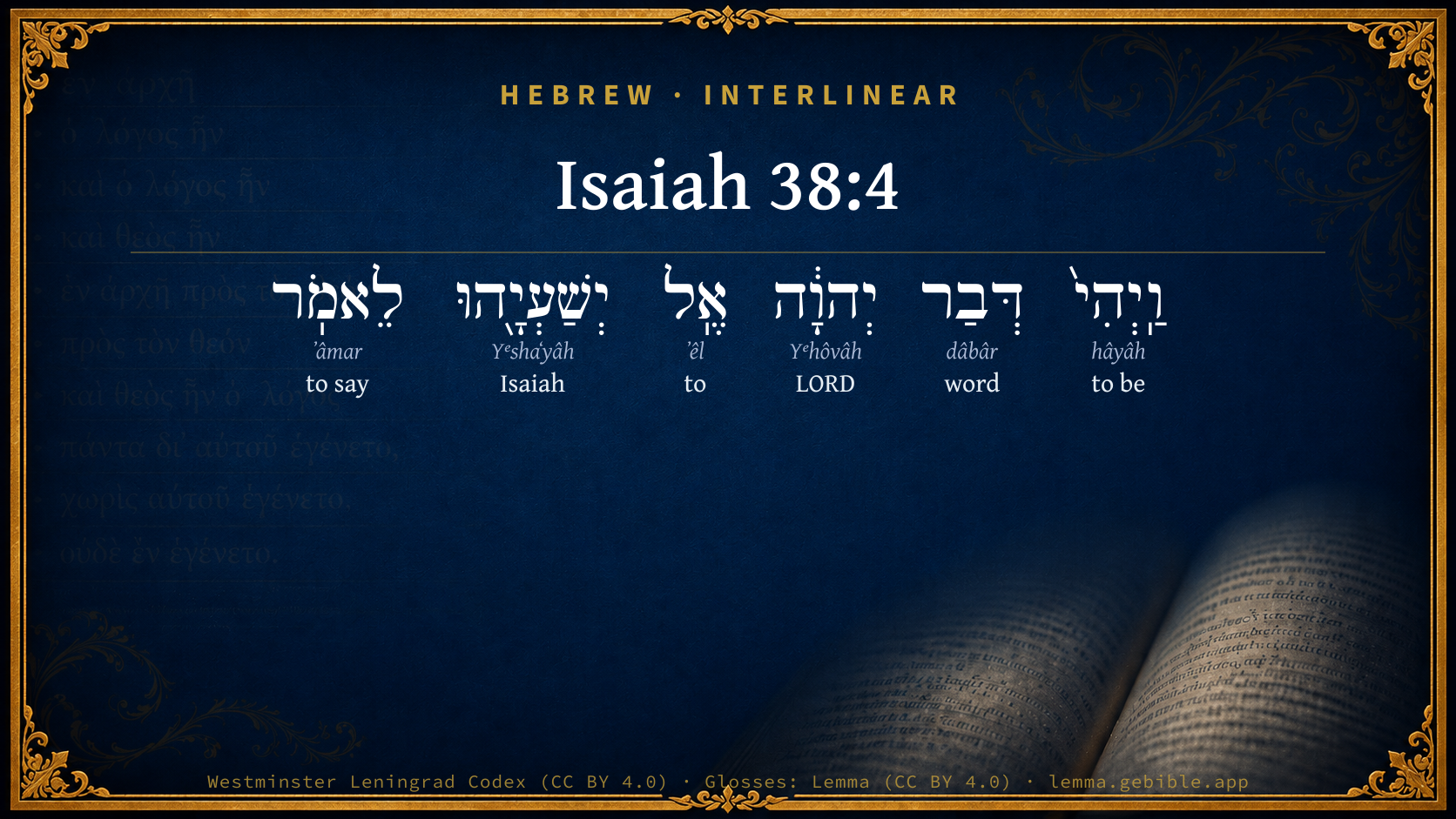
Hebrew (Westminster Leningrad Codex) Isaiah 38:4 appears in the Hebrew Old Testament. The text above is from the Westminster Leningrad Codex. Each word links to its Strong’s number, a concise gloss, and parsing drawn from the Open Scriptures Hebrew Bible morphology. Click any word for its full Brown-Driver-Briggs (BDB) entry.
Download image
Cite this verse

Isaiah 38:4 (World English Bible). Public Domain. Lemma interlinear Bible study tool, https://lemma.gebible.app/v/isaiah/38/4.

Show BibTeX & RIS
BibTeX
RIS
English Translation
Then came the word of Yahweh to Isaiah, saying,
World English Bible · Public Domain
Download a study sheet

One document with this verse’s original text, its word-by-word gloss line, the meaning frame, cross-references with their text, attributed commentary, and full source and license credits — printable, and it pastes into notes with its structure intact.

This verse Autodidact and up

Study sheet (.html) Plain text (.txt)

A passage Seminary Student

Up to 50 verses in one chapter. A passage sheet keeps up to 6 commentary sources and 12 cross-references per verse, in the order this page ranks them, and says so on the sheet whenever that leaves anything out. Ask for a single verse and you get the Autodidact verse sheet above.

Everything on this page stays free to read, with no account — the sheet is a download of what is already on screen, not access to it.

Want to remove ads? Support Godless Engineer
Compare translations 3

The same verse in 3 English versions, stacked beneath the original-language interlinear above. Click any original word for its lexicon entry.

Each is an independent rendering of the whole verse — the interlinear is not word-aligned to these translations.

Highlighted words mark where these versions differ — a whole-verse word diff, not a word-by-word alignment.

  • World English Bible Public Domain
    Then came the word of Yahweh to Isaiah, saying,
  • King James Version Public Domain
    Then came the word of the LORD to Isaiah, saying,
  • unfoldingWord Literal Text CC BY-SA 4.0
    And the word of Yahweh was to Isaiah, saying,

unfoldingWord Literal Text — © unfoldingWord, licensed CC BY-SA 4.0. Word-aligned USFM3 via Door43 (git.door43.org/unfoldingWord/en_ult).

Versions to compare (up to 4)

3 of 4 selected

Show all 18 translations

Every available English version of this verse, each an independent rendering of the whole verse.

  • World English Bible Public Domain
    Then came the word of Yahweh to Isaiah, saying,
  • Berean Standard Bible Public Domain
    And the word of the LORD came to Isaiah, saying,
  • Majority Standard Bible Public Domain
    And the word of the LORD came to Isaiah, saying,
  • King James Version Public Domain
    Then came the word of the LORD to Isaiah, saying,
  • American Standard Version (1901) Public Domain
    Then came the word of Jehovah to Isaiah, saying,
  • Revised Version (1885) Public Domain
    Then came the word of the LORD to Isaiah, saying,
  • Geneva Bible (1599) Public Domain
    Then came the worde of the Lord to Isaiah, saying,
  • Douay-Rheims (1899) Public Domain
    And the word of the Lord came to Isaias, saying:
  • Young's Literal Translation Public Domain
    And a word of Jehovah is unto Isaiah, saying,
  • Literal Standard Version CC BY-SA 4.0
    And a word of YHWH is to Isaiah, saying,
  • Unlocked Literal Bible CC BY-SA 4.0
    Then the word of Yahweh came to Isaiah, saying,
  • unfoldingWord Literal Text CC BY-SA 4.0
    And the word of Yahweh was to Isaiah, saying,
  • Darby Bible Public Domain
    And the word of Jehovah came to Isaiah, saying,
  • World Messianic Bible Public Domain
    Then the LORD’s word came to Isaiah, saying,
  • Webster's Bible Public Domain
    Then came the word of the LORD to Isaiah, saying,
  • Free Bible Version CC BY-SA 4.0
    Then the Lord sent a message to Isaiah, saying,
  • Bible in Basic English Public Domain
    Then the word of the Lord came to Isaiah, saying,
  • JPS Tanakh (1917) Public Domain
    Then came the word of the LORD to Isaiah, saying:

Literal Standard Version (2020), Covenant Press — licensed CC BY-SA 4.0. Text via the HelloAO Bible API (eBible.org). Unlocked Literal Bible (unfoldingWord) — licensed CC BY-SA 4.0. Text via the HelloAO Bible API (eBible.org). unfoldingWord Literal Text — © unfoldingWord, licensed CC BY-SA 4.0. Word-aligned USFM3 via Door43 (git.door43.org/unfoldingWord/en_ult). Free Bible Version, Dr. Jonathan Gallagher — licensed CC BY-SA 4.0. Text via the HelloAO Bible API (eBible.org).

Word by word

More ways to search: Search by grammar → Find every occurrence → Compare this word →

Practice this passage: Drill this verse → Learn its vocabulary →

יְשַׁעְיָ֖הוּ
Yᵉshaʻyâh
H3470
“Isaiah”
Noun, Proper
Part of Speech
Noun
Type
Proper
Full BDB Definition

Origin: from H3467 and H3050

TWOT: None

Isaiah or Jesaiah or Jeshaiah = "Jehovah has saved" - the major prophet, son of Amoz, who prophesied concerning Judah and Jerusalem during the days of kings Uzziah, Jotham, Ahaz, and Hezekiah of Judah; author of the prophetic book by his name; tradition has it that he was sawn asunder in the trunk of a carob tree by king Manasseh and that this is the incident referred to in Heb 11:37 - son of Hananiah, brother of Pelatiah, and grandson of Zerubbabel - a Benjamite - one of the 6 sons of Jeduthun - son of Rehabiah, a descendant of Moses through Gershom, and an ancestor of a Levite treasurer in the time of David - son of Athaliah and chief of the house of Elam who returned with Ezra - a chief of the descendants of Merari who returned with Ezra
  1. וַֽיְהִי֙ hâyâh H1961 “and · to be” Conjunction + Verb, Qal, Sequential Imperfect, 3rd Person, Masculine, Singular
  2. דְּבַר dâbâr H1697 “word of” Noun, Common, Masculine, Singular, Construct
  3. יְהוָ֔ה Yᵉhôvâh H3068 “LORD” Noun, Proper
  4. אֶֽל ʼêl H413 “to” Preposition
  5. לֵאמֹֽר ʼâmar H559 “to say” Preposition + Verb, Qal, Infinitive Construct

About this verse

These counts appear in no published source. They are computed here, from the morphology-tagged text and Lemma’s own curated glosses. What Lemma adds →

6
words
6
distinct lemmas
Prophets
section

Shared distinctive vocabulary

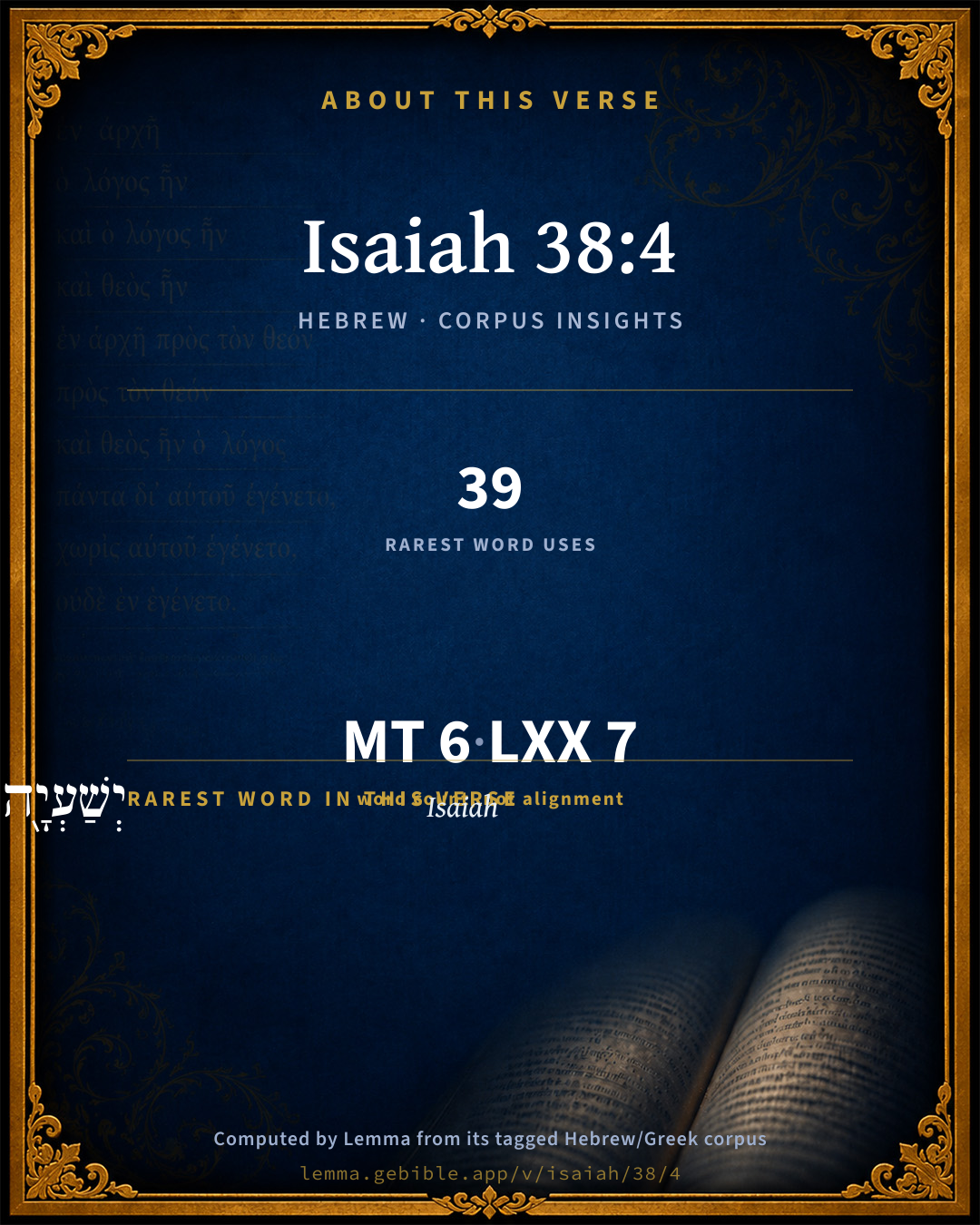
יְשַׁעְיָ֖הוּ Isaiah H3470 occurs in 39 verses of the Hebrew Bible. Also found in:

Grammatical profile

  • 2 verbs
  • 3 nouns
  • 1 preposition

Verb forms

  • וַֽיְהִי֙ Qal · Sequential Imperfect
  • לֵאמֹֽר Qal · Infinitive Construct

Hebrew & Septuagint length

In English translation the verse runs 9 words from the Hebrew and 15 from the Septuagint (LXX English) — the Septuagint runs noticeably longer here. See the side-by-side →

A rough comparison of the two English renderings, which tokenize alike — not a word-level alignment.

Word counts can differ between the Hebrew and the Greek without any difference in meaning — e.g. the Hebrew direct-object marker אֵת has no separate Greek word, and Greek often adds the article ὁ.

In the original languages it is 6 Hebrew tokens and 7 Greek tokens — but the two are counted differently (Hebrew bundles its prefixes and suffixes into one token; the Greek is in lemma form), so that isn’t a like-for-like length.

Hebrew and Greek witnesses Masoretic Hebrew ↔ Greek Septuagint

The same verse in the two great witnesses to the Old Testament, shown verse-for-verse.

Here the Septuagint runs noticeably longer than the Hebrew — LXX2012 (modern English Septuagint) 15 words vs World English Bible 9. A rough length comparison of the two English translations, not a word-level alignment — read both below.

These are two independent witnesses, not word-aligned to each other, and the Septuagint is shown in lemma (dictionary) form.

Hebrew Isaiah 38:4 Masoretic · Westminster Leningrad Codex

וַֽיְהִי֙ דְּבַר יְהוָ֔ה אֶֽל יְשַׁעְיָ֖הוּ לֵאמֹֽר

Then came the word of Yahweh to Isaiah, saying,

World English Bible · Public Domain

Greek LXX Isaiah 38:4 Septuagint · lemma form

καί γίγνομαι λόγος κύριος πρός ησαιας λέγω

And the word of the Lord came to Esaias, saying, Go, and say to Ezekias,

LXX2012 (modern English Septuagint) · Public Domain

Hebrew: Westminster Leningrad Codex (CC BY 4.0). Greek: Septuagint (public domain); English from LXX2012 (modern English Septuagint) (Public Domain). How the Septuagint differs from the Hebrew →

Targum (Aramaic paraphrase)

1

The Targum is the ancient Jewish Aramaic paraphrase of the Hebrew Scriptures — an interpretive translation, not the Hebrew text itself. Onkelos (literal) and Pseudo-Jonathan (expansive) render the Torah, and Jonathan the Prophets. Coverage is partial: where no permissively-licensed English translation exists for a verse, only the Aramaic is shown. This is verse-level text, not a word-by-word alignment to the Hebrew.

  1. Targum Jonathan Prophets (Joshua–Malachi)
    וַהֲוָה פִתְגָמֵי נְבוּאָה מִן קֳדָם יְיָ עִם יְשַׁעְיָה לְמֵימָר:

    Then the words of prophecy came from before the Lord to Isaiah, saying,

    Targum Jonathan — Aramaic: “Mikraot Gedolot” (public domain). English: “Sefaria Community Translation” (CC0 1.0 (public-domain dedication)); “London "Chaldee Paraphrase," 1871” (public domain). Text via Sefaria.

Commentary

Notes on Isaiah 38:4 from classic Christian and Jewish commentators (each source and its license shown beneath its notes). The classic Christian expositions comment on the surrounding passage and are grouped to its opening verse, so a note may address several verses; the Jewish commentaries on the Tanakh (Rashi and others) are per-verse, so they appear only where the commentator wrote on this verse.

Lemma curates 59 commentaries, every one of them public domain or Creative Commons licensed, each selected and text-cleaned for this edition rather than reprinted as found. About our sources →

Trapp's Complete Commentary

John Trapp

Isa 38:4 Then came the word of the LORD to Isaiah, saying,

Ver. 4. See 2Ki 20:4 {See Trapp on "2Ki 20:4"}

John Trapp, A Commentary or Exposition upon All the Books of the Old and New Testament (1647–1656) — public domain. Text from a community e-Sword module.

The Biblical Illustrator

Joseph S. Exell

Isa_38:4-5

I have heard thy prayer

Was Hezekiahs recovery an unmitigated blessing?

Most of us who have had some experience of life, have seen instances in which a man who has set his heart too fondly upon one object, has gained that object, and with it (to use the language of St. Paul to his shipmates) much harm and loss. He has won the position which he coveted; but perhaps he finds himself saddled with the burden of a crushing responsibility; or perhaps his health--the one condition of enjoyment--breaks up just as he grasps the prize; or perhaps he is snatched away by death, while the meat is yet in his mouth; and those who knew him are unpleasantly reminded of the end of Israels lusting in the wilderness, He gave them their desire, and sent leanness withal into their soul. And thinking men say, when they hear of this result, Strong wishes for earthly blessings are to be avoided. The Book of God, as being the book of Truth, gives an exact echo of human experience in this matter. God acceded to Hezekiahs request, and added fifteen years to his life. But now comes the grave question, Did the fifteen years thus added prove, in the issue, a blessing to Hezekiah personally, or to the nation over which he so worthily presided? The sacred narrative gives an emphatic negative to both branches of the question.

1. Hezekiah, when God had originally proposed to take him to Himself, and had sent Isaiah with the message, Set thine house in order: for thou shalt die, and not live, was at the zenith of his spiritual prosperity. And now Hezekiah was to be gathered to his fathers, full, if not of years, yet of honours, spiritual and temporal. But by his prayers and his tears he succeeded in prolonging his span; and the first result of this, which the history brings before us, points to a spiritual decline in Hezekiah (chap. 39.). The sweet ointment of Hezekiahs graces was flawed and corrupted by the dead fly of vanity. Had Hezekiah died when God proposed to take him, he would have died humble; as it is, he dies after being humbled by God; and all those who read the narrative thoughtfully will surely say, Better far he had died at first.

2. But more than personal interests are at stake in the life of princes; and we are led to inquire what, as far as it is given us to know them, may have been the effects upon the Jewish nation of the addition of fifteen years to Hezekiahs life? The answer is conveyed in these words: Manasseh (Hezekiahs son, who succeeded to the throne) was twelve years old when he began to reign; so that if Hezekiah had died when God intended he should, Manasseh would never have existed. Now who was Manasseh? and what part did he play in Jewish history? Manasseh, by his extraordinary wickedness, surpassing that of all who had gone before him, involved the nation which he governed in ruin. Manassehs crimes cried to heaven for vengeance, and were heard, long after Manasseh s body had mingled with the dust, and long after Manassehs soul had become, through Divine grace, profoundly penitent. For when the author of the Books of Kings traces up the captivity to its originating cause, thus he writes: Surely at the commandment of the Lord came this upon Judah, to remove them out of His sight, for the sine of Manasseh, according to all that he did; and also for the innocent blood that he shed (for he filled Jerusalem with innocent blood), which the Lord would not pardon. Possibly, then, if Manasseh had not existed, the great national de gradation of the Jews by the captivity, and the demolition of the city and temple, would never have taken place. (Dean Goulburn.)

Ministers should have access to the sick

Besides its other important lessons, this history teaches the propriety of admitting the minister of God into the chamber of sickness. His soothing words and the prayer of faith, always secure to the sufferer some blessing, which he could little afford to lose. No intelligent, right-minded medical man will bar the door of the sickroom against the physician of the soul. (J. N. Norton.)

Hezekiah a life prolonged

He had an interview with the Giver of life. (J. Parker, D. D.)

The Biblical Illustrator, edited by Joseph S. Exell (c. 1880s–1900s) — public domain. Text from a community e-Sword module.

Jamieson, Fausset & Brown

Robert Jamieson, A. R. Fausset & David Brown

In Kg2 20:4, the quickness of God's answer to the prayer is marked, "afore Isaiah had gone out into the middle court, the word of the LORD came to him"; that is, before he had left Hezekiah, or at least when he had just left him, and Hezekiah was in the act of praying after having heard God's message by Isaiah (compare Isa 65:24; Psa 32:5; Dan 9:21).

Jamieson, Fausset & Brown — Commentary Critical and Explanatory on the Whole Bible (1871) — public domain (CC PDM 1.0). Text via the HelloAO Bible API.

The Cambridge Bible for Schools and Colleges

gen. ed. J. J. S. Perowne

4. In 2Ki_20:4 we read that “afore Isaiah was gone out into the middle court,” this message came to him. So quickly was the king’s prayer answered. A somewhat similar instance of the revocation of one prophetic communication by another is that of Nathan in the matter of the building of the Temple (2Sa_7:3-4 ff.).

The Cambridge Bible for Schools and Colleges (gen. ed. J. J. S. Perowne; Cambridge University Press, 1878–1918) — public domain. Text from a community e-Sword module.

John Gill's Exposition

Go and say to Hezekiah,.... Turn again, and tell him, Kg2 20:5,

thus saith the Lord the God of David thy father; this is said, to show that he remembered the covenant he made with David his father, concerning the kingdom, and the succession of his children in it; and that he had a regard to him, as walking in his steps:

I have heard thy prayer; and therefore was not surely a foolish one, as Luther somewhere calls it, since it was heard and answered so quickly:

I have seen thy tears; which he shed in prayer, and so studiously concealed from others, when he turned his face to the wall:

behold, I will add unto thy days fifteen years; that is, to the days he had lived already, and beyond which it was not probable, according to the nature of his disease, he could live; and besides, he had the sentence of death pronounced on him, and had it within himself, nor did he pray for his life; so that these fifteen years were over and above what he could or did expect to live; and because it was unusual in such a case, and after such a declaration made, that a man should live, and especially so long a time after, it is ushered in with a "behold", as a note of admiration; it being a thing unheard of, and unprecedented, and entirely the Lord's doing, and which, no doubt, was marvellous in the eyes of the king.

John Gill's Exposition of the Whole Bible (1746–1763) — public domain (CC PDM 1.0). Text via the HelloAO Bible API.

Albert Barnes' Notes on the Bible

Then came the word of the Lord - In the parallel place in 2Ki 20:4, it is said, ‘And it came to pass, afore Isaiah was gone out into the middle court, that the word of the Lord came unto him.’ That is, the message of God name to Isaiah before he had left Hezekiah; or as soon as he had offered his prayer. This circumstance is omitted by Isaiah on the revision of his narrative which we have before us. But there is no contradiction. In this place it is implied that the message came to him soon, or immediately.

Albert Barnes' Notes on the Bible (1834–1885) — public domain. Text from a community e-Sword/MySword module.

Whedon's Commentary on the Bible

Daniel D. Whedon

4, 5. Go… say to Hezekiah — Isaiah lives in holy communion with God. A divine conviction seizes him before he has even crossed the outer entrance of the middle court, as is shown 2Ki_20:4, to go back and give a contrary announcement to the king. Hezekiah was duly tested by the announcement that he must die. His grief was not on his own account, but for the peril he foresees to the kingdom. On Isaiah’s return Hezekiah was promised an addition of fifteen years to his life.

Daniel D. Whedon (gen. ed.), Commentary on the Old and New Testaments (1874–1909) — public domain. Text from a community e-Sword module.

The Pulpit Commentary

Then came the word of the Lord to Isaiah, saying. The author of Kings describes graphically how Isaiah, after delivering his message, had gone out, but had not reached the middle court of the palace, when his footsteps were arrested, and the Divine voice bade him "turn again and relieve Hezekiah"s fears by a fresh announcement". (2Ki_20:4) So swiftly does God answer "the prayer of faith.

Vers. 4-6. Human life; the kindness of God and the wisdom of man.

In the providential ordering and in the human direction of this our mortal life, we see

I THE KINDNESS OF GOD.

1. The strong links by which God has connected us together. "The God of David thy father;" for David"s sake, in part, he would render deliverance. Human life is so ordered that we are all of us immeasurably the better for the piety, the virtue, the patient and faithful labours of those who came before us.

2. His sensitiveness to our suffering. "I have seen thy tears." "Like as a father pitieth his children," etc.; "When he saw the multitude, he was moved with compassion.

3. His attention to our appeal. "I have heard thy prayer." God"s ear is open, not only to the prayers of "the great congregation," but to the faintest breath of one believing soul; though he may sometimes seem to be deaf, yet is he always "inclining his ear" unto us.

4. His multiplication of our days. "I will add unto thy days." With the morning light, as it continually returns, we should say, "This is the day which the Lord hath made," etc.; it is a new gift from his gracious hand. We take it too much for granted, as if he were under some obligation to add it to those he has given us before. But it is all "of grace so much more than we deserve or have any right to expect at his hand. To the "Lord of our time, whose hand has set New time upon our score,we should render heartfelt praise for his daily gift.

5. His compounding our cup of hope and of uncertainty. God told Hezekiah he would add to his "days fifteen years." Is it not a yet kinder act of our Father that he holds out to us the hope of future years, without letting us know how far he will fulfil our wishes! Without the hope, we should lose all the inspiration which urges us to fruitful action; without the uncertainty, we should presume on the continuance of our life, and be bereft of one of the mast potent checks on folly and on sin. A strong hope, with an element of uncertainty, is the most favourable condition for the cultivation of wisdom and virtue.

II THE WISDOM OF MAN. Our wisdom, under those conditions in which we find ourselves, is:

1. To prepare for length of days. By patient diligence, by prudent forethought, to be ready for long life, in case God should give us that blessing.

2. To prepare for sudden death and the long future. By faith in Jesus Christ and by fidelity in the "few things" of time, to be ready at any hour to stand at the judgment-seat, to pass to the "many things" of eternity. C.

The Pulpit Commentary (1880–1919), ed. H.D.M. Spence-Jones & Joseph S. Exell — public domain. Text from a community e-Sword module.

Keil & Delitzsch

C. F. Keil & F. Delitzsch

The prospect is now mercifully changed. "And it came to pass (K. Isaiah was not yet out of the inner city; keri סהצר, the forecourt, and) the word of Jehovah came to Isaiah (K. to him) as follows: Go (K. turn again) and say to Hizkiyahu (K. adds, to the prince of my people), Thus saith Jehovah, the God of David thine ancestor, I have heard thy prayer, seen thy tears; behold, I (K. will cure thee, on the third day thou shalt go up to the house of Jehovah) add (K. and I add) to thy days fifteen years. And I will deliver thee ad this city out of the hand of the king of Asshur, and will defend this city (K. for mine own sake and for David my servant's sake)." In the place of העיר (the city) the keri and the earlier translators have הצר. The city of David is not called the "inner city" anywhere else; in fact, Zion, with the temple hill, formed the upper city, so that apparently it is the inner space of the city of David that is here referred to, and Isaiah had not yet passed through the middle gate to return to the lower city, where he dwelt. The text of Kings is the more authentic throughout; except that עמּי נגיד, "the prince of my people," is an annalistic adorning which is hardly original. סהלוך in Isaiah is an inf. abs. used in an imperative sense; שׁוּב, on the other hand, which we find in the other text, is imperative. On yōsiph, see at Isa 29:14.

Keil & Delitzsch — Biblical Commentary on the Old Testament (1861–1891) — public domain (CC PDM 1.0). Text via the HelloAO Bible API. (Old Testament only.)

J. A. Alexander on Isaiah

Joseph Addison Alexander

“And the word of Jehovah was (or came) to Isaiah, saying” (what follows in the next verse). The middle city may either mean the middle of the city (media urbs), or a particular part of Jerusalem so called, perhaps that in which the temple stood, or more generally that which lay between the upper city on Mount Zion and the lower city on Mount Akra. The communication may have been through the middle gate mentioned by Jeremiah (Jer 39:3). In either ease, the interval could not have been a long one, though sufficient to try the faith of Hezekiah.

Joseph Addison Alexander, The Prophecies of Isaiah (1846–1847; New York: Scribner, 1870–1878) — public domain. Text from a community e-Sword module.

unfoldingWord translationNotes

Door43 World Missions Community

the word of Yahweh came

This is an idiom that is used to introduce something that God told his prophets or his people. AT: "Yahweh spoke this message" or "Yahweh spoke these words" (See: Idiom)

See

This is used to ask the listener to pay attention to what is said next. AT: "Listen"

fifteen years

"15 years" (See: Numbers)

the hand of the king of Assyria

Here the king's "hand" refers to his power. AT: "the power of the king of Assyria" (See: Metonymy)

translationWords

word of God

Isaiah

Hezekiah

people of God

David

life

king

Assyria

unfoldingWord translationNotes — © Distant Shores Media and the Door43 World Missions Community, licensed CC BY-SA 4.0. Source: git.door43.org/Door43/en_tn.

Lesson kit

Teaching starters — assembled from the data on this page, not authored interpretation. Every prompt links to the verse data it draws on. Edit before teaching.

Isaiah, in the Prophets, opens this verse with 6 words (6 distinct Hebrew lemmas). Its most distinctive word is Yᵉshaʻyâh (“Isaiah”). The Greek Septuagint runs longer here. A historical commentator’s framing appears above. Read the whole chapter for the surrounding context.

Discussion questions

  1. How does “Isaiah” (Yᵉshaʻyâh) shape what this verse is saying?
  2. 2 Kings 19:2 shares the word «Isaiah» with this verse. How do the two illuminate each other?
  3. Compared with the Hebrew, the Septuagint runs longer here. What questions does that raise?
  4. These translations render this verse differently. What is at stake in choosing one wording over another?
  5. The verb «וַֽיְהִי֙» is Qal Sequential Imperfect. How does its form color the action?
  6. Reading how Trapp's Complete Commentary and The Biblical Illustrator read this verse, where do the two commentators agree and where do they part?

Things to notice

Reading settings

Reading text

Shown beneath each verse's original-language words.

Old Testament
Old Testament edition

Read the OT as the Masoretic Hebrew (MT) or the Greek Septuagint (LXX).

English shown for the Greek Septuagint (in the Hebrew ↔ Greek comparison).

Comparing translations? Open the Compare panel on any verse page to stack up to four side by side.