
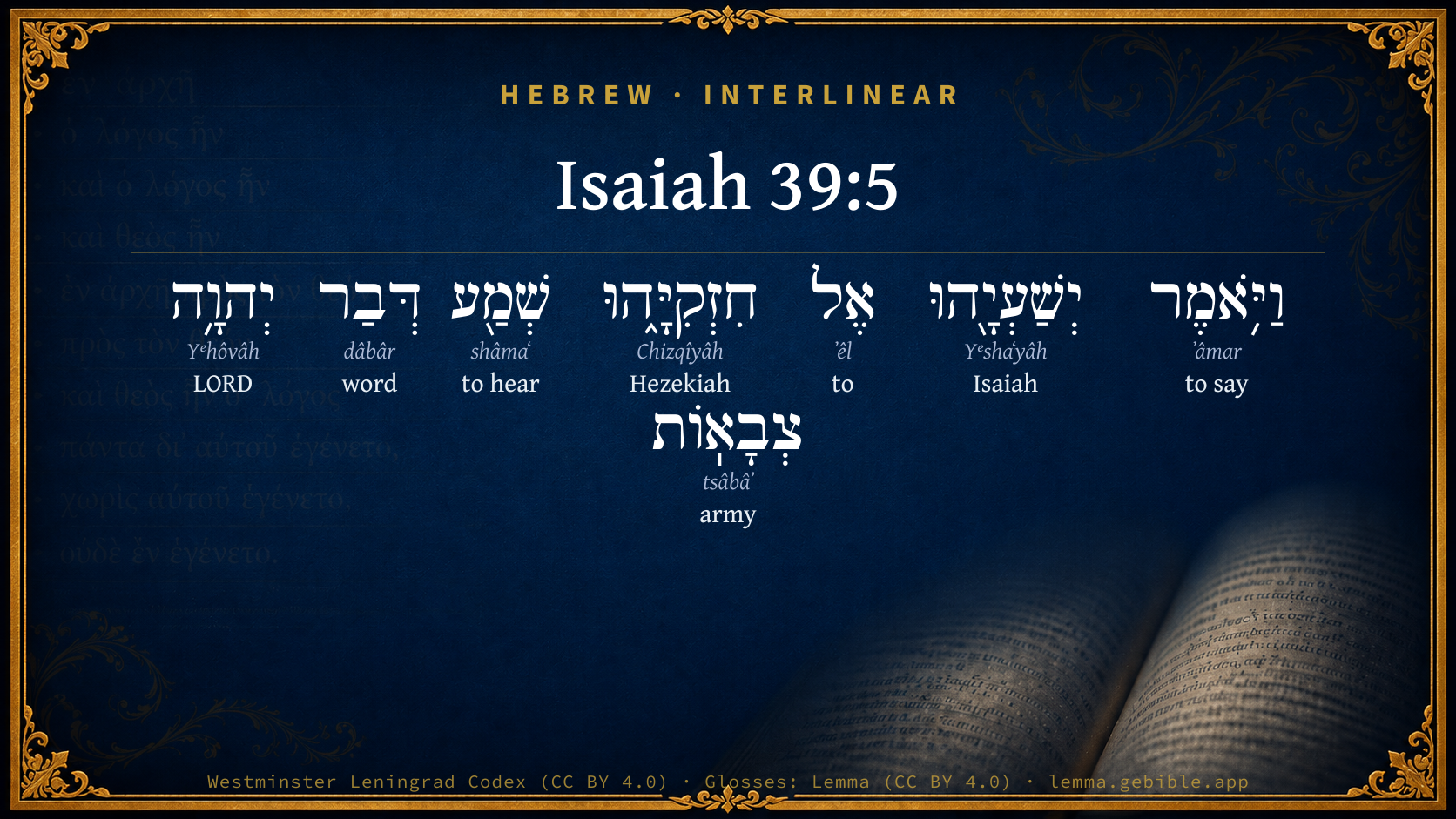
Isaiah 39:5

Hebrew (Westminster Leningrad Codex) Isaiah 39:5 appears in the Hebrew Old Testament. The text above is from the Westminster Leningrad Codex. Each word links to its Strong’s number, a concise gloss, and parsing drawn from the Open Scriptures Hebrew Bible morphology. Click any word for its full Brown-Driver-Briggs (BDB) entry.
Download image
Cite this verse

Isaiah 39:5 (World English Bible). Public Domain. Lemma interlinear Bible study tool, https://lemma.gebible.app/v/isaiah/39/5.

Show BibTeX & RIS
BibTeX
RIS
English Translation
Then said Isaiah to Hezekiah, Hear the word of Yahweh of Hosts:
World English Bible · Public Domain
Download a study sheet

One document with this verse’s original text, its word-by-word gloss line, the meaning frame, cross-references with their text, attributed commentary, and full source and license credits — printable, and it pastes into notes with its structure intact.

This verse Autodidact and up

Study sheet (.html) Plain text (.txt)

A passage Seminary Student

Up to 50 verses in one chapter. A passage sheet keeps up to 6 commentary sources and 12 cross-references per verse, in the order this page ranks them, and says so on the sheet whenever that leaves anything out. Ask for a single verse and you get the Autodidact verse sheet above.

Everything on this page stays free to read, with no account — the sheet is a download of what is already on screen, not access to it.

Want to remove ads? Support Godless Engineer
Compare translations 3

The same verse in 3 English versions, stacked beneath the original-language interlinear above. Click any original word for its lexicon entry.

Each is an independent rendering of the whole verse — the interlinear is not word-aligned to these translations.

Highlighted words mark where these versions differ — a whole-verse word diff, not a word-by-word alignment.

  • World English Bible Public Domain
    Then said Isaiah to Hezekiah, Hear the word of Yahweh of Hosts:
  • King James Version Public Domain
    Then said Isaiah to Hezekiah, Hear the word of the LORD of hosts:
  • unfoldingWord Literal Text CC BY-SA 4.0
    And Isaiah said to Hezekiah, “Hear the word of Yahweh of Armies.

unfoldingWord Literal Text — © unfoldingWord, licensed CC BY-SA 4.0. Word-aligned USFM3 via Door43 (git.door43.org/unfoldingWord/en_ult).

Versions to compare (up to 4)

3 of 4 selected

Show all 18 translations

Every available English version of this verse, each an independent rendering of the whole verse.

  • World English Bible Public Domain
    Then said Isaiah to Hezekiah, Hear the word of Yahweh of Hosts:
  • Berean Standard Bible Public Domain
    Then Isaiah said to Hezekiah, “Hear the word of the LORD of Hosts:
  • Majority Standard Bible Public Domain
    Then Isaiah said to Hezekiah, “Hear the word of the LORD of Hosts:
  • King James Version Public Domain
    Then said Isaiah to Hezekiah, Hear the word of the LORD of hosts:
  • American Standard Version (1901) Public Domain
    Then said Isaiah to Hezekiah, Hear the word of Jehovah of hosts:
  • Revised Version (1885) Public Domain
    Then said Isaiah to Hezekiah, Hear the word of the LORD of hosts.
  • Geneva Bible (1599) Public Domain
    And Isaiah saide to Hezekiah, Heare the worde of the Lord of hostes,
  • Douay-Rheims (1899) Public Domain
    And Isaias said to Ezechias: Rear the word of the Lord of hosts.
  • Young's Literal Translation Public Domain
    And Isaiah saith unto Hezekiah, `Hear a word of Jehovah of Hosts:
  • Literal Standard Version CC BY-SA 4.0
    And Isaiah says to Hezekiah, “Hear a word of YHWH of Hosts:
  • Unlocked Literal Bible CC BY-SA 4.0
    Then Isaiah said to Hezekiah, “Listen to the word of Yahweh of hosts:
  • unfoldingWord Literal Text CC BY-SA 4.0
    And Isaiah said to Hezekiah, “Hear the word of Yahweh of Armies.
  • Darby Bible Public Domain
    And Isaiah said to Hezekiah, Hear the word of Jehovah of hosts:
  • World Messianic Bible Public Domain
    Then Isaiah said to Hezekiah, “Hear the word of the LORD of Hosts:
  • Webster's Bible Public Domain
    Then said Isaiah to Hezekiah, Hear the word of the LORD of hosts:
  • Free Bible Version CC BY-SA 4.0
    Isaiah told Hezekiah, “Listen to what the Lord says:
  • Bible in Basic English Public Domain
    Then said Isaiah to Hezekiah, Give ear to the word of the Lord of armies:
  • JPS Tanakh (1917) Public Domain
    Then said Isaiah to Hezekiah: 'Hear the word of the LORD of hosts:

Literal Standard Version (2020), Covenant Press — licensed CC BY-SA 4.0. Text via the HelloAO Bible API (eBible.org). Unlocked Literal Bible (unfoldingWord) — licensed CC BY-SA 4.0. Text via the HelloAO Bible API (eBible.org). unfoldingWord Literal Text — © unfoldingWord, licensed CC BY-SA 4.0. Word-aligned USFM3 via Door43 (git.door43.org/unfoldingWord/en_ult). Free Bible Version, Dr. Jonathan Gallagher — licensed CC BY-SA 4.0. Text via the HelloAO Bible API (eBible.org).

Word by word

More ways to search: Search by grammar → Find every occurrence → Compare this word →

Practice this passage: Drill this verse → Learn its vocabulary →

יְשַׁעְיָ֖הוּ
Yᵉshaʻyâh
H3470
“Isaiah”
Noun, Proper
Part of Speech
Noun
Type
Proper
Full BDB Definition

Origin: from H3467 and H3050

TWOT: None

Isaiah or Jesaiah or Jeshaiah = "Jehovah has saved" - the major prophet, son of Amoz, who prophesied concerning Judah and Jerusalem during the days of kings Uzziah, Jotham, Ahaz, and Hezekiah of Judah; author of the prophetic book by his name; tradition has it that he was sawn asunder in the trunk of a carob tree by king Manasseh and that this is the incident referred to in Heb 11:37 - son of Hananiah, brother of Pelatiah, and grandson of Zerubbabel - a Benjamite - one of the 6 sons of Jeduthun - son of Rehabiah, a descendant of Moses through Gershom, and an ancestor of a Levite treasurer in the time of David - son of Athaliah and chief of the house of Elam who returned with Ezra - a chief of the descendants of Merari who returned with Ezra
  1. וַיֹּ֥אמֶר ʼâmar H559 “and · to say” Conjunction + Verb, Qal, Sequential Imperfect, 3rd Person, Masculine, Singular
  2. אֶל ʼêl H413 “to” Preposition
  3. חִזְקִיָּ֑הוּ Chizqîyâh H2396 “Hezekiah” Noun, Proper
  4. שְׁמַ֖ע shâmaʻ H8085 “hear” Verb, Qal, Imperative, 2nd Person, Masculine, Singular
  5. דְּבַר dâbâr H1697 “word of” Noun, Common, Masculine, Singular, Construct
  6. יְהוָ֥ה Yᵉhôvâh H3068 “LORD” Noun, Proper
  7. צְבָאֽוֹת tsâbâʼ H6635 “armies” Noun, Common, Both, Plural, Absolute

About this verse

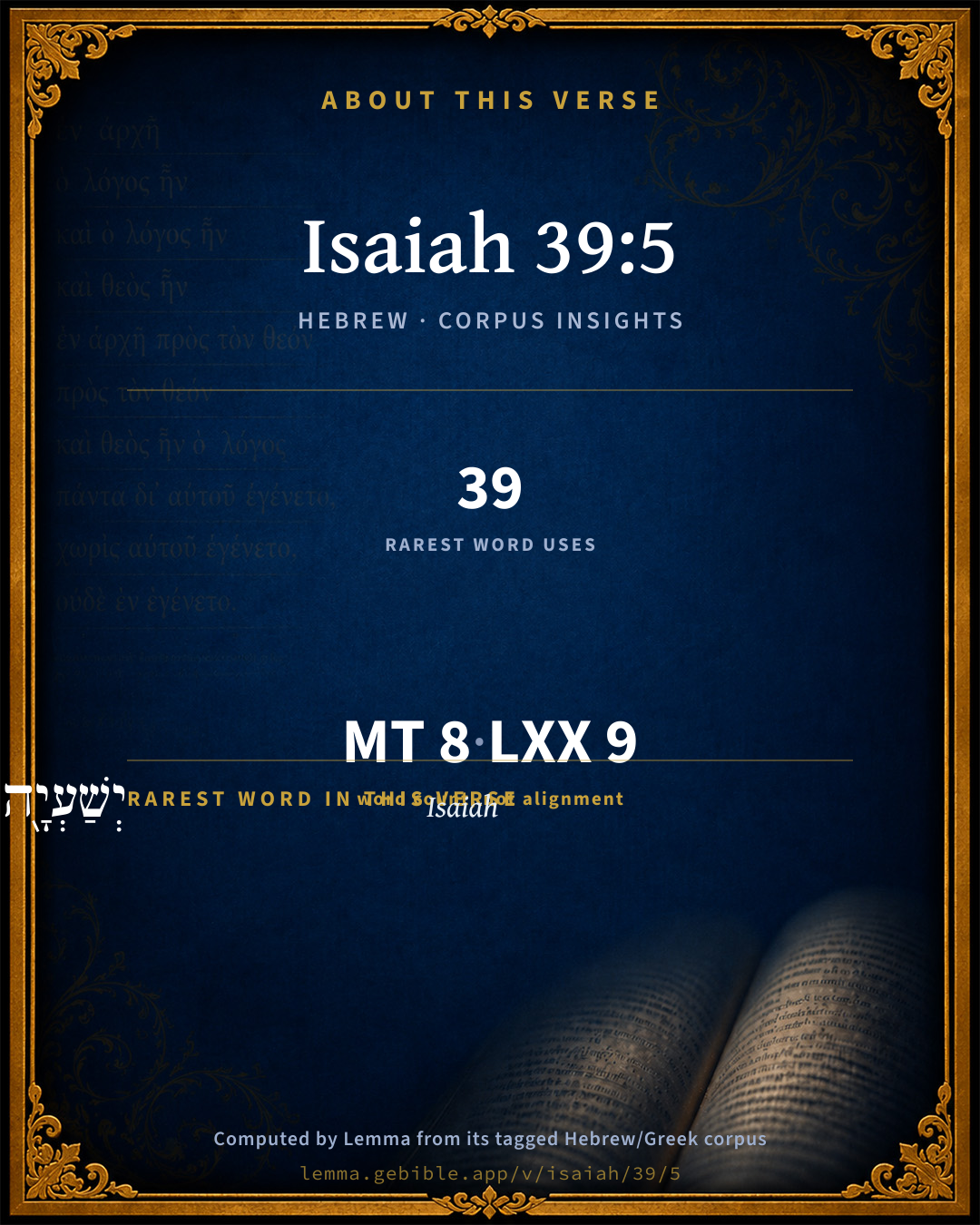
These counts appear in no published source. They are computed here, from the morphology-tagged text and Lemma’s own curated glosses. What Lemma adds →

8
words
8
distinct lemmas
Prophets
section

Shared distinctive vocabulary

יְשַׁעְיָ֖הוּ Isaiah H3470 occurs in 39 verses of the Hebrew Bible. Also found in:

Grammatical profile

  • 2 verbs
  • 5 nouns
  • 1 preposition

Verb forms

  • וַיֹּ֥אמֶר Qal · Sequential Imperfect
  • שְׁמַ֖ע Qal · Imperative

Hebrew & Septuagint length

In English translation the verse runs 12 words from the Hebrew and 13 from the Septuagint (LXX English) — closely comparable.

A rough comparison of the two English renderings, which tokenize alike — not a word-level alignment.

Word counts can differ between the Hebrew and the Greek without any difference in meaning — e.g. the Hebrew direct-object marker אֵת has no separate Greek word, and Greek often adds the article ὁ.

In the original languages it is 8 Hebrew tokens and 9 Greek tokens — but the two are counted differently (Hebrew bundles its prefixes and suffixes into one token; the Greek is in lemma form), so that isn’t a like-for-like length.

Cross-references

2

Topical passages linked to Isaiah 39:5 in the Treasury of Scripture Knowledge — connected by theme and wording, ordered by reader-vote popularity; previews shown in the World English Bible.

  • 1 Samuel 13:13–14 Samuel said to Saul, You have done foolishly; you have not kept the commandment of Yahweh your God, which he commanded you: for now would Yahweh have established your kingdom on Israel forever.
  • 1 Samuel 15:16 Then Samuel said to Saul, Stay, and I will tell you what Yahweh has said to me this night. He said to him, Say on.

Cross-references courtesy of OpenBible.info (CC BY 4.0).

Hebrew and Greek witnesses Masoretic Hebrew ↔ Greek Septuagint

The same verse in the two great witnesses to the Old Testament, shown verse-for-verse.

These are two independent witnesses, not word-aligned to each other, and the Septuagint is shown in lemma (dictionary) form.

Hebrew Isaiah 39:5 Masoretic · Westminster Leningrad Codex

וַיֹּ֥אמֶר יְשַׁעְיָ֖הוּ אֶל חִזְקִיָּ֑הוּ שְׁמַ֖ע דְּבַר יְהוָ֥ה צְבָאֽוֹת

Then said Isaiah to Hezekiah, Hear the word of Yahweh of Hosts:

World English Bible · Public Domain

Greek LXX Isaiah 39:5 Septuagint · lemma form

καί εἶπον αὐτός ησαιας ἀκούω ὁ λόγος κύριος σαβαωθ

And Esaias said to him, Hear the word of the Lord of hosts:

LXX2012 (modern English Septuagint) · Public Domain

Hebrew: Westminster Leningrad Codex (CC BY 4.0). Greek: Septuagint (public domain); English from LXX2012 (modern English Septuagint) (Public Domain). How the Septuagint differs from the Hebrew →

Targum (Aramaic paraphrase)

1

The Targum is the ancient Jewish Aramaic paraphrase of the Hebrew Scriptures — an interpretive translation, not the Hebrew text itself. Onkelos (literal) and Pseudo-Jonathan (expansive) render the Torah, and Jonathan the Prophets. Coverage is partial: where no permissively-licensed English translation exists for a verse, only the Aramaic is shown. This is verse-level text, not a word-by-word alignment to the Hebrew.

  1. Targum Jonathan Prophets (Joshua–Malachi)
    וַאֲמַר יְשַׁעְיָה לְחִזְקִיָה קַבֵּיל פִּתְגָמָא דַייָ צְבָאוֹת:

    Then said Isaiah to Hezekiah, Hear the word of the Lord of hosts:

    Targum Jonathan — Aramaic: “Mikraot Gedolot” (public domain). English: “Sefaria Community Translation” (CC0 1.0 (public-domain dedication)); “London "Chaldee Paraphrase," 1871” (public domain). Text via Sefaria.

Commentary

Notes on Isaiah 39:5 from classic Christian and Jewish commentators (each source and its license shown beneath its notes). The classic Christian expositions comment on the surrounding passage and are grouped to its opening verse, so a note may address several verses; the Jewish commentaries on the Tanakh (Rashi and others) are per-verse, so they appear only where the commentator wrote on this verse.

Lemma curates 59 commentaries, every one of them public domain or Creative Commons licensed, each selected and text-cleaned for this edition rather than reprinted as found. About our sources →

The Biblical Illustrator

Joseph S. Exell

Isa_39:5-7

Hear the word of the Lord of hosts

Isaiahs prophecy of the Babylonian captivity

Jarchi directs attention to the exact correspondence of the punishment with the offence.

As the Babylonians had seen all, they should one day take all; as nothing had been withheld from them now, so nothing should be withheld from them hereafter. (J. A. Alexander.)

A costly gratification

Benjamin Franklin, when a lad, was greatly enamoured of a whistle he saw for sale. Swept away by the desire to possess the toy, he gathered all his money and offered it to the vendor, who at once took it and handed over the whistle to the eager boy. For a time the sense of a craving gratified shut out all other consideration. Then, gradually, the lad realised how he had been fooled; and in after-days the wise man, as he observed men and their foolish ways, would remember his own early experience, and say of this man and of that, He has paid too dear for his whistle. (W. C. Bonnet.)

The Biblical Illustrator, edited by Joseph S. Exell (c. 1880s–1900s) — public domain. Text from a community e-Sword module.

Matthew Henry's Commentary

Hence let us observe, 1. That, if God love us, he will humble us, and will find some way or other to pull down our spirits when they are lifted up above measure. A mortifying message is sent to Hezekiah, that he might be humbled for the pride of his heart, and be convinced of the folly of it; for though God may suffer his people to fall into sin, as he did Hezekiah here, to prove him, that he might know all that was in his heart, yet he will not suffer them to lie still in it. 2. It is just with God to take that from us which we make the matter of our pride, and on which we build a carnal confidence. When David was proud of the numbers of his people God took a course to make them fewer; and when Hezekiah boasts of his treasures, and looks upon them with too great a complacency, he is told that he acts like the foolish traveller who shows his money and gold to one that proves a thief and is thereby tempted to rob him. 3. If we could but see things that will be, we should be ashamed of our thoughts of things that are. If Hezekiah had known that the seed and successors of this king of Babylon would hereafter be the ruin of his family and kingdom, he would not have complimented his ambassadors as he did; and, when the prophet told him that it would be so, we may well imagine how he was vexed at himself for what he had done. We cannot certainly foresee what will be, but are told, in general, All is vanity, and therefore it is vanity for us to take complacency and put confidence in any thing that goes under that character. 4. Those that are fond of an acquaintance or alliance with irreligious men will first or last have enough of it, and will have cause to repent it. Hezekiah thought himself very happy in the friendship of Babylon, though it was the mother of harlots and idolatries; but Babylon, who now courted Jerusalem, in process of time conquered her and carried her captive. Leagues with sinners, and leagues with sin too, will end thus; it is therefore our wisdom to keep at a distance from them. 5. Those that truly repent of their sins will take it well to be reproved for them and will be willing to be told of their faults. Hezekiah reckoned that word of the Lord good which discovered sin to him, and made him sensible that he had done amiss, which before he was not aware of. The language of true penitents is, Let the righteous smite me; it shall be a kindness; and the law is therefore good, because, being spiritual, in it sin appears sin, and exceedingly sinful. 6. True penitents will quietly submit, not only to the reproofs of the word, but to the rebukes of Providence for their sins. When Hezekiah was told of the punishment of his iniquity he said, Good is the word of the Lord, not only the mitigation of the sentence, but the sentence itself; he has nothing to object against the equity of it, but says Amen to the threatening. Those that see the evil of sin, and what it deserves, will justify God in all that is brought upon them for it, and own that he punishes them less than their iniquities deserve. 7. Though we must not be regardless of those that come after us, yet we must reckon ourselves well done by if there be peace and truth in our days, and better than we had reason to expect. If a storm be coming, we must reckon it a favour to get into the harbour before it comes, and be gathered to the grave in peace; yet we can never be secure of this, but must prepare for changes in our own time, that we may stand complete in all the will of God, and bid it welcome whatever it is.

Matthew Henry's Commentary on the Whole Bible (1708–1710) — public domain (CC PDM 1.0). Text via the HelloAO Bible API.

Jamieson, Fausset & Brown

Robert Jamieson, A. R. Fausset & David Brown

Lord of hosts--who has all thy goods at His disposal.

Jamieson, Fausset & Brown — Commentary Critical and Explanatory on the Whole Bible (1871) — public domain (CC PDM 1.0). Text via the HelloAO Bible API.

The Cambridge Bible for Schools and Colleges

gen. ed. J. J. S. Perowne

5. Hear the word of the Lord] Isaiah’s tone is threatening, because he sees in this thing a sin against Jehovah. It was not necessary to specify wherein the offence consisted; king and prophet understood each other perfectly. The reception of an embassy from the sworn enemy of the king of Assyria was in itself an act of rebellion likely to precipitate a conflict which Isaiah strove to avert; and the childish vanity displayed by Hezekiah, his pride in earthly resources, and his readiness to enter into friendly relations with the powers of this world, were tendencies against which Isaiah’s ministry had been a continuous protest. All these tendencies sprang from a single root, the lack of that absolute faith in Jehovah as the all-sufficient guide and protector of the nation which was the fundamental article of Isaiah’s political programme.

The Cambridge Bible for Schools and Colleges (gen. ed. J. J. S. Perowne; Cambridge University Press, 1878–1918) — public domain. Text from a community e-Sword module.

John Gill's Exposition

Then said Isaiah to Hezekiah,.... Now he begins to let him know that he came not of himself, and that he did not ask these questions to gratify his own curiosity, but that he came from the Lord, and with a word of rebuke from him:

hear the word of the Lord of hosts; a greater King than thou art, who art so elated with thy riches, and grandeur, and fame; or than the king of Babylon, whose ambassadors these are; even the King of kings, and Lord of armies above and below, and who is able to make good every word that is spoken by him, and therefore should be solemnly attended to.

John Gill's Exposition of the Whole Bible (1746–1763) — public domain (CC PDM 1.0). Text via the HelloAO Bible API.

Albert Barnes' Notes on the Bible

Hear the word of the Lord of hosts - Hear what the mighty God that rules in heaven says of this. This is an instance of great fidelity on the part of the prophet. He felt himself sent from God in a solemn manner to rebuke sin in a monarch, and a pious monarch. It is an instance that strikingly resembles the boldness and faithfulness of Nathan when he went to David, and said, ‘Thou art the man’ 2Sa 12:7.

Albert Barnes' Notes on the Bible (1834–1885) — public domain. Text from a community e-Sword/MySword module.

Whedon's Commentary on the Bible

Daniel D. Whedon

5, 6. Hear the word of the Lord — The prophet’s soul was surcharged now with a coming of explicit, definite affliction upon his own people. The king’s imprudence was, for the first time, the occasion of such an utterance. Babylon now rises to his view as the next great engulfing power against the nation.

Behold, the days come — Days of captivity. In one hundred and twenty years they did come.

All that is in thine house — Which Hezekiah had himself gathered since he was plundered by Sennacherib.

And that which thy fathers have laid up in store — Possibly of this Sennacherib got nothing. Was it not in keeping with the prudence of this people to preserve in most secret store, large wealth never to be touched but in extreme emergencies?

Shall be carried to Babylon — But preserved, as a fact of history, (Ezr_1:7,) to be used again in the restored temple at restored Jerusalem. The divine principle, a remnant shall be saved, extended to all that pertained to the symbols of the spiritual life of that people.

Nothing shall be left — The old national life was to expire utterly, to be resurrected in the spiritual remnant.

Daniel D. Whedon (gen. ed.), Commentary on the Old and New Testaments (1874–1909) — public domain. Text from a community e-Sword module.

The Pulpit Commentary

Hear the word of the Lord of hosts. Either the prophet had been specially charged with a Divine message to the king before he sought his presence, or the prophetic afflatus now came on him suddenly. The former is, on the whole, more probable.

The Pulpit Commentary (1880–1919), ed. H.D.M. Spence-Jones & Joseph S. Exell — public domain. Text from a community e-Sword module.

J. A. Alexander on Isaiah

Joseph Addison Alexander

“And Isaiah said to Hezekiah, Hear the word of Jehovah of Hosts.” This form of expression gives to what follows the solemnity and authority of a divine decree. The parallel passage (2Ki 20:16) omits ‘Hosts’.

Joseph Addison Alexander, The Prophecies of Isaiah (1846–1847; New York: Scribner, 1870–1878) — public domain. Text from a community e-Sword module.

unfoldingWord translationNotes

Door43 World Missions Community

Yahweh of hosts

See how you translated this phrase in Isaiah 1:9.

the word

"the message"

Look

This word is used here to draw Hezekiah's attention to what is said next. AT: "Listen"

when everything in your palace ... will be carried to Babylon

This can be expressed positively. AT: "when the enemy army will take everything in your palace ... back to Babylon" (See: Active or Passive)

translationWords

Isaiah

Hezekiah

word

Yahweh of hosts

Babylon

Yahweh

unfoldingWord translationNotes — © Distant Shores Media and the Door43 World Missions Community, licensed CC BY-SA 4.0. Source: git.door43.org/Door43/en_tn.

Lesson kit

Teaching starters — assembled from the data on this page, not authored interpretation. Every prompt links to the verse data it draws on. Edit before teaching.

Isaiah, in the Prophets, opens this verse with 8 words (8 distinct Hebrew lemmas). Its most distinctive word is Yᵉshaʻyâh (“Isaiah”). A historical commentator’s framing appears above. Read the whole chapter for the surrounding context.

Discussion questions

  1. How does “Isaiah” (Yᵉshaʻyâh) shape what this verse is saying?
  2. 2 Kings 19:2 shares the word «Isaiah» with this verse. How do the two illuminate each other?
  3. The translations on this page render this verse differently — a whole-verse word diff, not a word-by-word alignment. What might account for the different wordings?
  4. The verb «וַיֹּ֥אמֶר» is Qal Sequential Imperfect. How does its form color the action?
  5. Reading how The Biblical Illustrator and Matthew Henry's Commentary read this verse, where do the two commentators agree and where do they part?

Things to notice

Reading settings

Reading text

Shown beneath each verse's original-language words.

Old Testament
Old Testament edition

Read the OT as the Masoretic Hebrew (MT) or the Greek Septuagint (LXX).

English shown for the Greek Septuagint (in the Hebrew ↔ Greek comparison).

Comparing translations? Open the Compare panel on any verse page to stack up to four side by side.