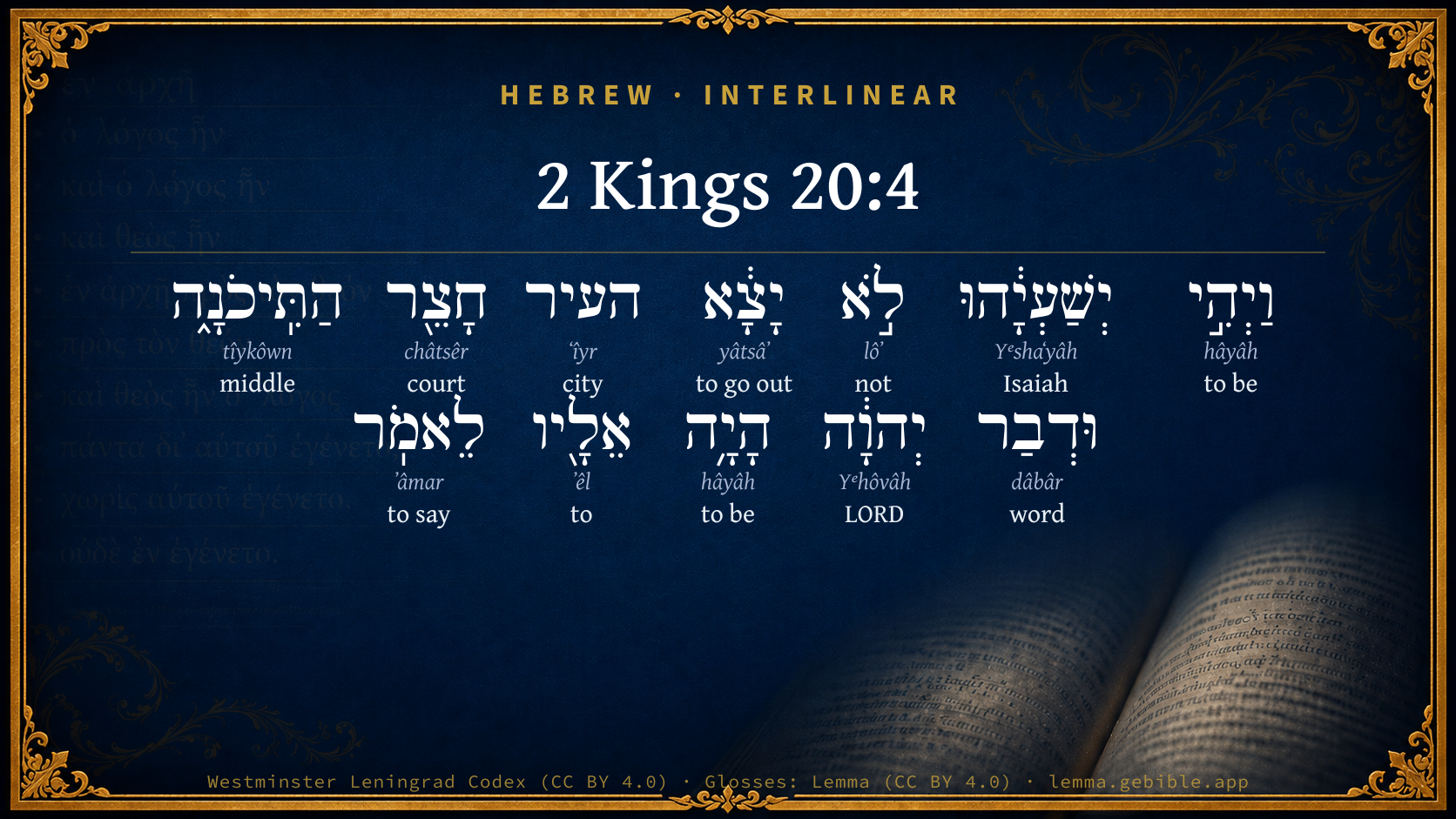
2 Kings 20:4

Hebrew (Westminster Leningrad Codex) 2 Kings 20:4 appears in the Hebrew Old Testament. The text above is from the Westminster Leningrad Codex. Each word links to its Strong’s number, a concise gloss, and parsing drawn from the Open Scriptures Hebrew Bible morphology. Click any word for its full Brown-Driver-Briggs (BDB) entry.
Download image
Cite this verse

2 Kings 20:4 (World English Bible). Public Domain. Lemma interlinear Bible study tool, https://lemma.gebible.app/v/2-kings/20/4.

Show BibTeX & RIS
BibTeX
RIS
English Translation
It happened, before Isaiah was gone out into the middle part of the city, that the word of Yahweh came to him, saying,
World English Bible · Public Domain
Download a study sheet

One document with this verse’s original text, its word-by-word gloss line, the meaning frame, cross-references with their text, attributed commentary, and full source and license credits — printable, and it pastes into notes with its structure intact.

This verse Autodidact and up

Study sheet (.html) Plain text (.txt)

A passage Seminary Student

Up to 50 verses in one chapter. A passage sheet keeps up to 6 commentary sources and 12 cross-references per verse, in the order this page ranks them, and says so on the sheet whenever that leaves anything out. Ask for a single verse and you get the Autodidact verse sheet above.

Everything on this page stays free to read, with no account — the sheet is a download of what is already on screen, not access to it.

Want to remove ads? Support Godless Engineer
Compare translations 3

The same verse in 3 English versions, stacked beneath the original-language interlinear above. Click any original word for its lexicon entry.

Each is an independent rendering of the whole verse — the interlinear is not word-aligned to these translations.

Highlighted words mark where these versions differ — a whole-verse word diff, not a word-by-word alignment.

  • World English Bible Public Domain
    It happened, before Isaiah was gone out into the middle part of the city, that the word of Yahweh came to him, saying,
  • King James Version Public Domain
    And it came to pass, afore Isaiah was gone out into the middle court, that the word of the LORD came to him, saying,
  • unfoldingWord Literal Text CC BY-SA 4.0
    And it happened, Isaiah had not gone out the middle courtyard, and the word of Yahweh was to him, saying,

unfoldingWord Literal Text — © unfoldingWord, licensed CC BY-SA 4.0. Word-aligned USFM3 via Door43 (git.door43.org/unfoldingWord/en_ult).

Versions to compare (up to 4)

3 of 4 selected

Show all 18 translations

Every available English version of this verse, each an independent rendering of the whole verse.

  • World English Bible Public Domain
    It happened, before Isaiah was gone out into the middle part of the city, that the word of Yahweh came to him, saying,
  • Berean Standard Bible Public Domain
    Before Isaiah had left the middle courtyard, the word of the LORD came to him, saying,
  • Majority Standard Bible Public Domain
    Before Isaiah had left the middle courtyard, the word of the LORD came to him, saying,
  • King James Version Public Domain
    And it came to pass, afore Isaiah was gone out into the middle court, that the word of the LORD came to him, saying,
  • American Standard Version (1901) Public Domain
    And it came to pass, before Isaiah was gone out into the middle part of the city, that the word of Jehovah came to him, saying,
  • Revised Version (1885) Public Domain
    And it came to pass, afore Isaiah was gone out into the middle part of the city, that the word of the LORD came to him, saying,
  • Geneva Bible (1599) Public Domain
    And afore Isaiah was gone out into the middle of the court, the worde of the Lord came to him, saying,
  • Douay-Rheims (1899) Public Domain
    And before Isaias was gone out of the middle of the court, the word of the Lord came to him, saying:
  • Young's Literal Translation Public Domain
    And it cometh to pass -- Isaiah hath not gone out to the middle court -- that the word of Jehovah hath been unto him, saying,
  • Literal Standard Version CC BY-SA 4.0
    And it comes to pass, [when] Isaiah has not [yet] gone out to the middle court, that the word of YHWH has been to him, saying,
  • Unlocked Literal Bible CC BY-SA 4.0
    Before Isaiah had gone out into the middle courtyard, the word of Yahweh came to him, saying,
  • unfoldingWord Literal Text CC BY-SA 4.0
    And it happened, Isaiah had not gone out the middle courtyard, and the word of Yahweh was to him, saying,
  • Darby Bible Public Domain
    And it came to pass before Isaiah had gone out into the middle city that the word of Jehovah came to him saying,
  • World Messianic Bible Public Domain
    Before Isaiah had gone out into the middle part of the city, the LORD’s word came to him, saying,
  • Webster's Bible Public Domain
    And it came to pass, before Isaiah had gone out into the middle court, that the word of the LORD came to him, saying,
  • Free Bible Version CC BY-SA 4.0
    Before Isaiah had left the middle courtyard, the Lord spoke to him, saying,
  • Bible in Basic English Public Domain
    Now before Isaiah had gone out of the middle of the town, the word of the Lord came to him, saying,
  • JPS Tanakh (1917) Public Domain
    And it came to pass, before Isaiah was gone out of the inner court of the city, that the word of the LORD came to him, saying:

Literal Standard Version (2020), Covenant Press — licensed CC BY-SA 4.0. Text via the HelloAO Bible API (eBible.org). Unlocked Literal Bible (unfoldingWord) — licensed CC BY-SA 4.0. Text via the HelloAO Bible API (eBible.org). unfoldingWord Literal Text — © unfoldingWord, licensed CC BY-SA 4.0. Word-aligned USFM3 via Door43 (git.door43.org/unfoldingWord/en_ult). Free Bible Version, Dr. Jonathan Gallagher — licensed CC BY-SA 4.0. Text via the HelloAO Bible API (eBible.org).

Word by word

More ways to search: Search by grammar → Find every occurrence → Compare this word →

Practice this passage: Drill this verse → Learn its vocabulary →

הַתִּֽיכֹנָ֑ה
tîykôwn
H8484
“the · middle”
Particle, Definite Article + Adjective, Adjective, Feminine, Singular, Absolute
Part of Speech
Particle + Adjective
Type
Adjective
Gender
Feminine
Number
Singular
State
Absolute
Full BDB Definition

Origin: from H8432

TWOT: 2498a

middle
  1. וַיְהִ֣י hâyâh H1961 “and · to be” Conjunction + Verb, Qal, Sequential Imperfect, 3rd Person, Masculine, Singular
  2. יְשַׁעְיָ֔הוּ Yᵉshaʻyâh H3470 “Isaiah” Noun, Proper
  3. לֹ֣א lôʼ H3808 “not” Particle, Negative
  4. יָצָ֔א yâtsâʼ H3318 “to go out” Verb, Qal, Perfect, 3rd Person, Masculine, Singular
  5. העיר ʻîyr H5892 “the · city” Particle, Definite Article + Noun, Common, Feminine, Singular, Absolute
  6. חָצֵ֖ר châtsêr H2691 “court” Noun, Common, Both, Singular, Absolute
  7. וּדְבַר dâbâr H1697 “and · word of” Conjunction + Noun, Common, Masculine, Singular, Construct
  8. יְהוָ֔ה Yᵉhôvâh H3068 “LORD” Noun, Proper
  9. הָיָ֥ה hâyâh H1961 “to be” Verb, Qal, Perfect, 3rd Person, Masculine, Singular
  10. אֵלָ֖יו ʼêl H413 “to · him” Preposition + Suffix, Personal, 3rd Person, Masculine, Singular
  11. לֵאמֹֽר ʼâmar H559 “to say” Preposition + Verb, Qal, Infinitive Construct

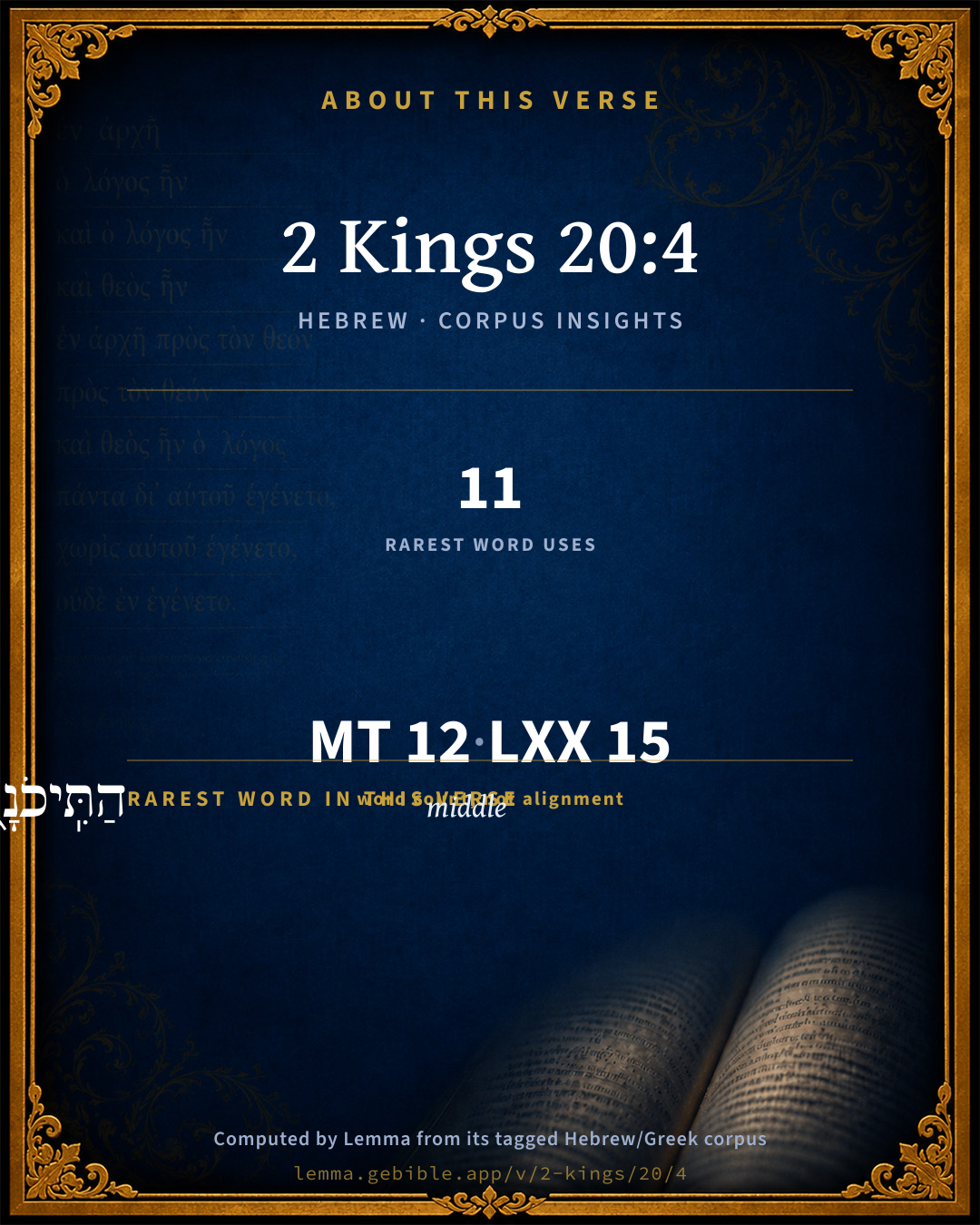
About this verse

These counts appear in no published source. They are computed here, from the morphology-tagged text and Lemma’s own curated glosses. What Lemma adds →

12
words
11
distinct lemmas
Historical
section

Notable vocabulary

The rarest word here is הַתִּֽיכֹנָ֑ה middle H8484 — appearing just 11 times in the whole Hebrew Bible.

Shared distinctive vocabulary

הַתִּֽיכֹנָ֑ה middle H8484 occurs in 9 verses of the Hebrew Bible. Also found in:

Grammatical profile

  • 4 verbs
  • 5 nouns
  • 1 adjective
  • 1 preposition
  • 1 particle

Verb forms

  • וַיְהִ֣י Qal · Sequential Imperfect
  • יָצָ֔א Qal · Perfect
  • הָיָ֥ה Qal · Perfect
  • לֵאמֹֽר Qal · Infinitive Construct

Repetition

A word recurs within this verse — often emphatic in Hebrew:

  • וַיְהִ֣י to be H1961 ×2

Hebrew & Septuagint length

In English translation the verse runs 23 words from the Hebrew and 17 from the Septuagint (LXX English) — closely comparable.

A rough comparison of the two English renderings, which tokenize alike — not a word-level alignment.

Word counts can differ between the Hebrew and the Greek without any difference in meaning — e.g. the Hebrew direct-object marker אֵת has no separate Greek word, and Greek often adds the article ὁ.

In the original languages it is 12 Hebrew tokens and 15 Greek tokens — but the two are counted differently (Hebrew bundles its prefixes and suffixes into one token; the Greek is in lemma form), so that isn’t a like-for-like length.

Cross-references

2

Topical passages linked to 2 Kings 20:4 in the Treasury of Scripture Knowledge — connected by theme and wording, ordered by reader-vote popularity; previews shown in the World English Bible.

  • 1 Kings 7:8 His house where he was to dwell, the other court within the porch, was of the like work. He made also a house for Pharaoh's daughter (whom Solomon had taken as wife), like this porch.
  • 2 Kings 22:14 So Hilkiah the priest, and Ahikam, and Achbor, and Shaphan, and Asaiah, went to Huldah the prophetess, the wife of Shallum the son of Tikvah, the son of Harhas, keeper of the wardrobe (now she lived in Jerusalem in the second quarter); and they talked with her.

Cross-references courtesy of OpenBible.info (CC BY 4.0).

Hebrew and Greek witnesses Masoretic Hebrew ↔ Greek Septuagint

The same verse in the two great witnesses to the Old Testament, shown verse-for-verse.

These are two independent witnesses, not word-aligned to each other, and the Septuagint is shown in lemma (dictionary) form.

Hebrew 2 Kings 20:4 Masoretic · Westminster Leningrad Codex

וַיְהִ֣י יְשַׁעְיָ֔הוּ לֹ֣א יָצָ֔א העיר חָצֵ֖ר הַתִּֽיכֹנָ֑ה וּדְבַר יְהוָ֔ה הָיָ֥ה אֵלָ֖יו לֵאמֹֽר

It happened, before Isaiah was gone out into the middle part of the city, that the word of Yahweh came to him, saying,

World English Bible · Public Domain

Greek LXX 2 Kings 20:4 Septuagint · lemma form

καί εἰμί ησαιας ἐν ὁ αὐλή ὁ μέσος καί ῥῆμα κύριος γίγνομαι πρός αὐτός λέγω

And Esaias was in the middle court, and the word of the Lord came to him, saying,

LXX2012 (modern English Septuagint) · Public Domain

On this verse, The Cambridge Bible for Schools and Colleges discusses the Septuagint’s reading. Read the note in Commentary ↓

Hebrew: Westminster Leningrad Codex (CC BY 4.0). Greek: Septuagint (public domain); English from LXX2012 (modern English Septuagint) (Public Domain). How the Septuagint differs from the Hebrew →

Targum (Aramaic paraphrase)

1

The Targum is the ancient Jewish Aramaic paraphrase of the Hebrew Scriptures — an interpretive translation, not the Hebrew text itself. Onkelos (literal) and Pseudo-Jonathan (expansive) render the Torah, and Jonathan the Prophets. Coverage is partial: where no permissively-licensed English translation exists for a verse, only the Aramaic is shown. This is verse-level text, not a word-by-word alignment to the Hebrew.

  1. Targum Jonathan Prophets (Joshua–Malachi)
    וַהֲוָה יְשַׁעְיָה לָא נְפַק לְדָרְתָא מְצִיעָאָה וּפִתְגָם נְבוּאָה מִן קֳדָם יְיָ הֲוָה עִמֵיהּ לְמֵימָר:

    (no public-domain English translation for this verse)

    Targum Jonathan — Aramaic: “Mikraot Gedolot” (public domain). English: “Sefaria Community Translation” (CC0 1.0 (public-domain dedication)); “London "Chaldee Paraphrase," 1871” (public domain). Text via Sefaria.

Commentary

Notes on 2 Kings 20:4 from classic Christian and Jewish commentators (each source and its license shown beneath its notes). The classic Christian expositions comment on the surrounding passage and are grouped to its opening verse, so a note may address several verses; the Jewish commentaries on the Tanakh (Rashi and others) are per-verse, so they appear only where the commentator wrote on this verse.

Lemma curates 59 commentaries, every one of them public domain or Creative Commons licensed, each selected and text-cleaned for this edition rather than reprinted as found. About our sources →

Trapp's Complete Commentary

John Trapp

2Ki 20:4 And it came to pass, afore Isaiah was gone out into the middle court, that the word of the LORD came to him, saying,

Ver. 4. Before Isaiah was gone out into the middle court.] So the Chetib. Or, Into the middle of the city; so the Cheri, or margin, hath it. It is probable that the king’s court was like a city. The Turk’s seraglio or palace is in circuit more than two miles. Before Isaiah was gone out into the court within the porch, {1Ki 7:8} he was sent again with this countermand. Oh, the power of prayer!

“ Flectitur iratus voce rogante Deus. ”

John Trapp, A Commentary or Exposition upon All the Books of the Old and New Testament (1647–1656) — public domain. Text from a community e-Sword module.

Joseph Benson's Commentary

2Ki 20:4-5. Afore Isaiah was gone out into the middle court — Namely, of the king’s palace. This is mentioned to show God’s great readiness to hear the prayers of his children. Thus saith the God of thy father David —

I am mindful of my promise made to David and his house, and will make it good in thy person. I have heard thy prayer, I have seen thy tears — Prayer addressed to God with fervency and affection, is in a special manner pleasing to him; and when offered in faith, and for things which he, in his word, hath encouraged or authorized us to ask, shall be heard and answered. I will heal thee — Diseases are God’s servants; as they go where he sends them, so they come when he remands them, Mat 8:8-9. On the third day thou shalt go up to the house of the Lord — To give him solemn praise for his mercy. That he was able to go up so soon as the third day, showed the cure to be miraculous.

Joseph Benson's Commentary on the Old and New Testaments (1811–1818) — public domain. Text from a community e-Sword module.

Jamieson, Fausset & Brown

Robert Jamieson, A. R. Fausset & David Brown

afore Isaiah was gone out into the middle court--of the royal castle.

Jamieson, Fausset & Brown — Commentary Critical and Explanatory on the Whole Bible (1871) — public domain (CC PDM 1.0). Text via the HelloAO Bible API.

Adam Clarke's Commentary

Verse 4. Into the middle court] הצר hatstser, the court. This is the reading of the Masoretic Keri: העיר haair, "of the city," is the reading of the text, and of most MSS.; but the versions follow the Keri.

Adam Clarke's Commentary on the Bible (1810–1826) — public domain. Text from a community e-Sword/MySword module.

Ellicott's Commentary for English Readers

(4) Into the middle court.—This is the reading of some Heb. MSS., and of all the versions. The Hebrew text (city; see margin) is wrong. Before Isaiah had left the precincts of the palace, he was bidden to return. (Keil says that here, as in 2Ki_10:25, the word rendered “city” denotes “castle,” i.e., the royal residence.)

A Bible Commentary for English Readers, edited by Charles John Ellicott (1878–1897) — public domain. Text from a community e-Sword module.

The Cambridge Bible for Schools and Colleges

gen. ed. J. J. S. Perowne

4. into the middle court] R.V. middle part of the city. The variation is due to a difference of reading, the R.V. translating, as is nearly always the case, the Kethib. The LXX. and most of the versions render the Keri, which the A.V. follows. The Kethib has הציר, the Keri substitutes חצר, which latter is the word for the ‘court’ of the palace in the description of Solomon’s buildings (1Ki_7:8). But the city of Jerusalem was built on two hills, the western of which was more than a hundred feet higher than the eastern. The expression in the text would apply exactly to the portion lying between these two, and there seems to be no reason for accepting the Keri. It probably has sprung from a desire to represent God as hearing prayer so readily that a favourable answer was given before the prophet was beyond the precincts of the palace.

A description of the city will be found in Josephus, B. J. v. 4, 1, seqq. where the three parts of Jerusalem are noticed, the upper city (ἡ ἄνω πόλις) being Zion, the lower (ἡ κάτω πόλις) Akra. Isaiah had, according to the Kethib, gone into the portion between these two.

The Cambridge Bible for Schools and Colleges (gen. ed. J. J. S. Perowne; Cambridge University Press, 1878–1918) — public domain. Text from a community e-Sword module.

John Gill's Exposition

Turn again, and tell Hezekiah the captain of my people,.... The king of them, as the Targum:

thus saith the Lord God of David thy father, I have heard thy prayer, I have seen thy tears; See Gill on Isa 38:5.

behold, I will heal thee; instantly, miraculously; and none but God could heal him, his disease being in its kind mortal, and he had been told from the Lord that he should die:

on the third day thou shalt go up unto the house of the Lord: the temple, to give thanks for his recovery; and this he should do on the third day from thence; so soon should he be well, which would show the cure to be miraculous.

John Gill's Exposition of the Whole Bible (1746–1763) — public domain (CC PDM 1.0). Text via the HelloAO Bible API.

Albert Barnes' Notes on the Bible

The middle court - i. e., of the royal palace. This is preferable to the marginal reading.

Albert Barnes' Notes on the Bible (1834–1885) — public domain. Text from a community e-Sword/MySword module.

Haydock's Catholic Bible Commentary

Court. Hebrew her, "city:" but in the margin, (Calmet) etsor. Septuagint Greek aule, "hall," or court, is retained, and followed by the Chaldean. (Calmet) --- Protestants, "the middle court." (Haydock)

George Leo Haydock (1774–1849), Haydock's Catholic Family Bible and Commentary, 1859 edition — public domain. Excludes Psalms (Douay-Rheims chapter numbering differs from Protestant) and Deuterocanonical books (Catholic canon only).

Matthew Poole's English Annotations

Into the middle court, to wit, of the king’s palace; of which See Poole "1Ki 7:8". Or, into the middle city, as it is in the Hebrew. For some observe that there were three cities, or three parts of this city; one called the city of David in Zion; another called Jebus, or Salem; and a third, which was betwixt these two parts, and united them all into one city, called Jerusalem. This is noted to show God’s great readiness to hear the sincere and fervent prayers of his children.

Matthew Poole's English Annotations on the Holy Bible (1683–1685) — public domain. Text from a community e-Sword/MySword module.

Whedon's Commentary on the Bible

Daniel D. Whedon

4. The middle court — So the Keri and the ancient versions; but the Kethib seems to be the more ancient reading, the middle of the city, that is, the central part of Jerusalem. So this word of the Lord came to him soon after he had left the king’s presence.

Daniel D. Whedon (gen. ed.), Commentary on the Old and New Testaments (1874–1909) — public domain. Text from a community e-Sword module.

The Pulpit Commentary

And it same to pass, afore Isaiah was gone out into the middle court. The narrative in Isa_38:4 does not contain this touch,which is very graphic, and indicative of the eye-witness. "The middle court" is probably the second or intermediate court of the royal palace. Isaiah had not gone further than this, when he was arrested in his course by a Divine communication. That the word of the Lord came to him, saying. How the word of the Lord came to the prophets is an inscrutable mystery. Sometimes, no doubt, it came in vision, which to a certain extent we can understand. But how, when the prophet was secularly engaged, as in this instance, walking across a court, he knew that the thought which occurred to him was a Divine message, it is almost impossible to conceive. Still, we cannot doubt that if God determines to communicate his will to man, he must be able, with the message, to impart an absolute certainty of its source, an assured conviction that it is his word, which precludes all question, hesitation, or dubiety. Isaiah, in the middle of his walk, finds his steps arrested, anew injunction laid upon him, with a necessity of immediately obeying it.

The Pulpit Commentary (1880–1919), ed. H.D.M. Spence-Jones & Joseph S. Exell — public domain. Text from a community e-Sword module.

John Wesley's Explanatory Notes

Court - Of the king's palace. This is noted to shew God's great readiness to hear the prayers of his children.

John Wesley, Explanatory Notes Upon the Whole Bible (1754–1765) — public domain. Text via the GEBible commentary corpus.

unfoldingWord translationNotes

Door43 World Missions Community

the word of Yahweh came

"Word" represents the message Yahweh revealed to Isaiah. This is a common way of speaking, an idiom. AT: "Yahweh spoke his word" (See: Metonymy and Idiom)

I have heard your prayer, and I have seen your tears

The second part reinforces the first part to make one message by using parallelism. AT: "I have heard your prayers and seen your tears" (See: Parallelism)

on the third day

"two days from now" The day Isaiah said this was the first day, so "the third day" would be the same as "two days from now."

translationWords

court

word of God

turn

people of God

God

David

cure

house of God

unfoldingWord translationNotes — © Distant Shores Media and the Door43 World Missions Community, licensed CC BY-SA 4.0. Source: git.door43.org/Door43/en_tn.

Rashi

Rabbi Shlomo Yitzchaki (Rashi)

Had not gone out of the … courtyard, etc. The Holy One, Blessed Is He, hurried to notify him about his cure before the rumor would spread in the city that he has been sentenced to death, as stated in [Talmud] Yerushalmi.

Rashi on the Tanakh — English translations: “The Judaica Press complete Tanach with Rashi, translated by A. J. Rosenberg” (CC BY 4.0); “Pentateuch with Rashi's commentary by M. Rosenbaum and A.M. Silbermann, 1929-1934” (public domain); “The Metsudah Tanach series, Lakewood, N.J” (CC BY 4.0); and “The Book of Joshua, Metsudah Publications, 1997” (CC BY 4.0). Text via Sefaria.

Lesson kit

Teaching starters — assembled from the data on this page, not authored interpretation. Every prompt links to the verse data it draws on. Edit before teaching.

2 Kings, in the Historical, opens this verse with 12 words (11 distinct Hebrew lemmas). Its most distinctive word is tîykôwn (“middle”). A historical commentator’s framing appears above. Read the whole chapter for the surrounding context.

Discussion questions

  1. The word tîykôwn carries the sense “middle.” How does it shape the verse?
  2. Exodus 26:28 shares the word «middle» with this verse. How do the two illuminate each other?
  3. “to be” occurs 2× in this one verse. What is the effect of the repetition?
  4. These translations render this verse differently; the difference is in the English rendering, not the original. What questions does that raise?
  5. The verb «וַיְהִ֣י» is Qal Sequential Imperfect. How does its form color the action?
  6. Reading how Trapp's Complete Commentary and Joseph Benson's Commentary read this verse, where do the two commentators agree and where do they part?

Things to notice

Reading settings

Reading text

Shown beneath each verse's original-language words.

Old Testament
Old Testament edition

Read the OT as the Masoretic Hebrew (MT) or the Greek Septuagint (LXX).

English shown for the Greek Septuagint (in the Hebrew ↔ Greek comparison).

Comparing translations? Open the Compare panel on any verse page to stack up to four side by side.