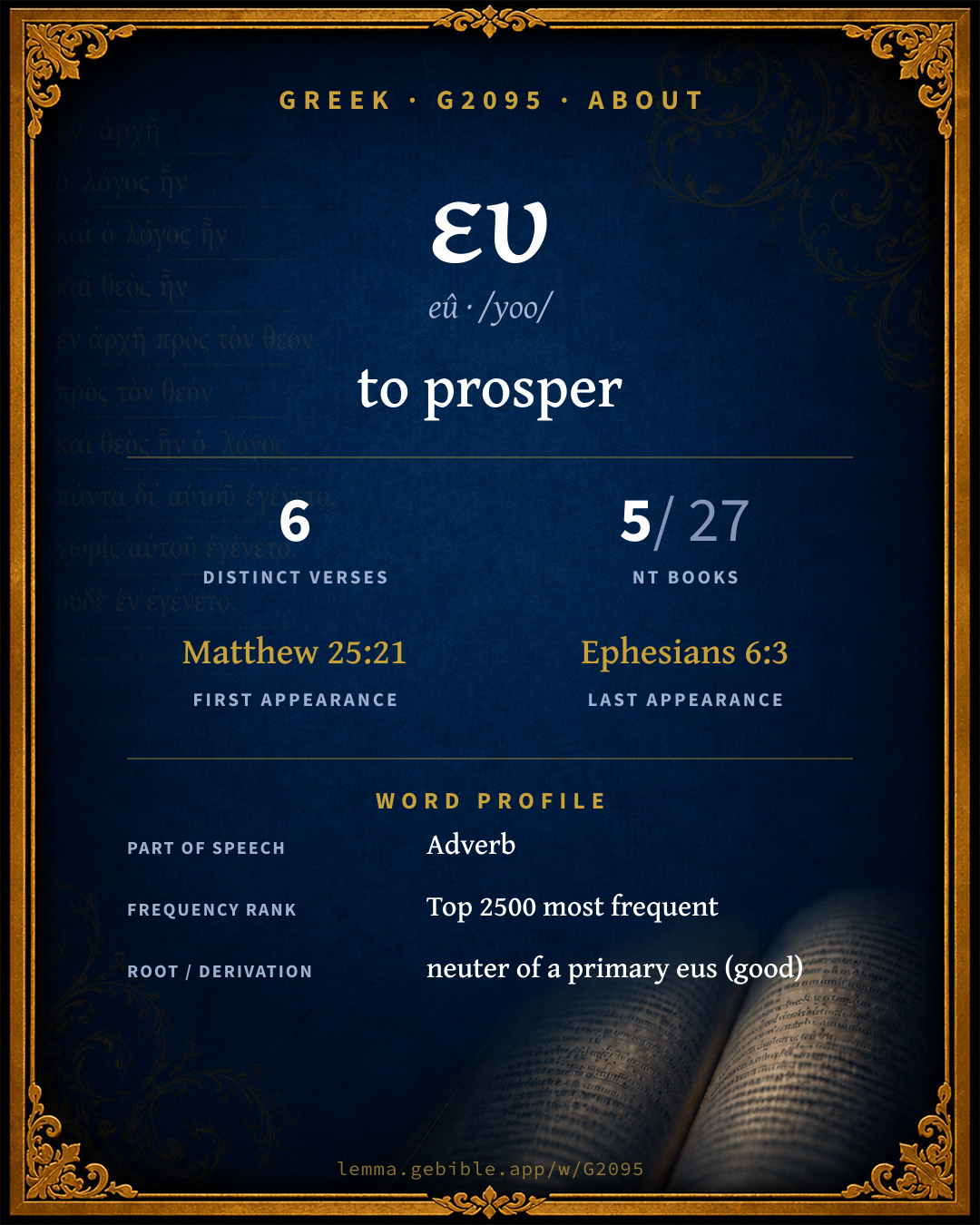
εὖ
to prosper
‘to prosper’ is one of 2 main senses fuller range ↓
Full lexicon entry — Thayer's Greek Lexicon
From Thayer's Greek Lexicon
Where this word appears
Grammar key — what these labels mean
Part of speech
- Adverb
- A word that modifies a verb, adjective, or other adverb.
Every verse where G2095 appears in the Book of Matthew — 2 distinct verses. Click any verse to open its interlinear word-by-word view. Verse text shown in the World English Bible for context — . Each verse’s Greek form is shown with its reference; the English is not keyword-highlighted, since the data carries no word-level English alignment. Use “Compare translations” on any verse to read it across multiple English versions. This concordance covers the Greek New Testament; Septuagint (Greek Old Testament) occurrences of this word are not indexed here.
Matthew
- Matthew 25:21 εὖ adv "His lord said to him, 'Well done, good and faithful servant. You have been faithful over a few things, I will set you over many things. Enter into the joy of your lord.'
- Matthew 25:23 εὖ adv "His lord said to him, 'Well done, good and faithful servant. You have been faithful over a few things, I will set you over many things. Enter into the joy of your lord.'
About this entry
At a glance — auto-summarized from this page’s data, not written by a person. Every figure links to its source below. This summary describes the numbers; it doesn’t interpret them.
The Greek verb ευ centers on the idea of “to prosper.” Its earliest occurrence is Matthew 25:21. It appears 6 verses across 5 books of the Greek New Testament, among its uncommon vocabulary. The word gravitates to Matthew (33%), then Mark and Luke. Lexicons map it across 2 senses. For the data behind this summary, explore the sense tree and the renderings breakdown below.
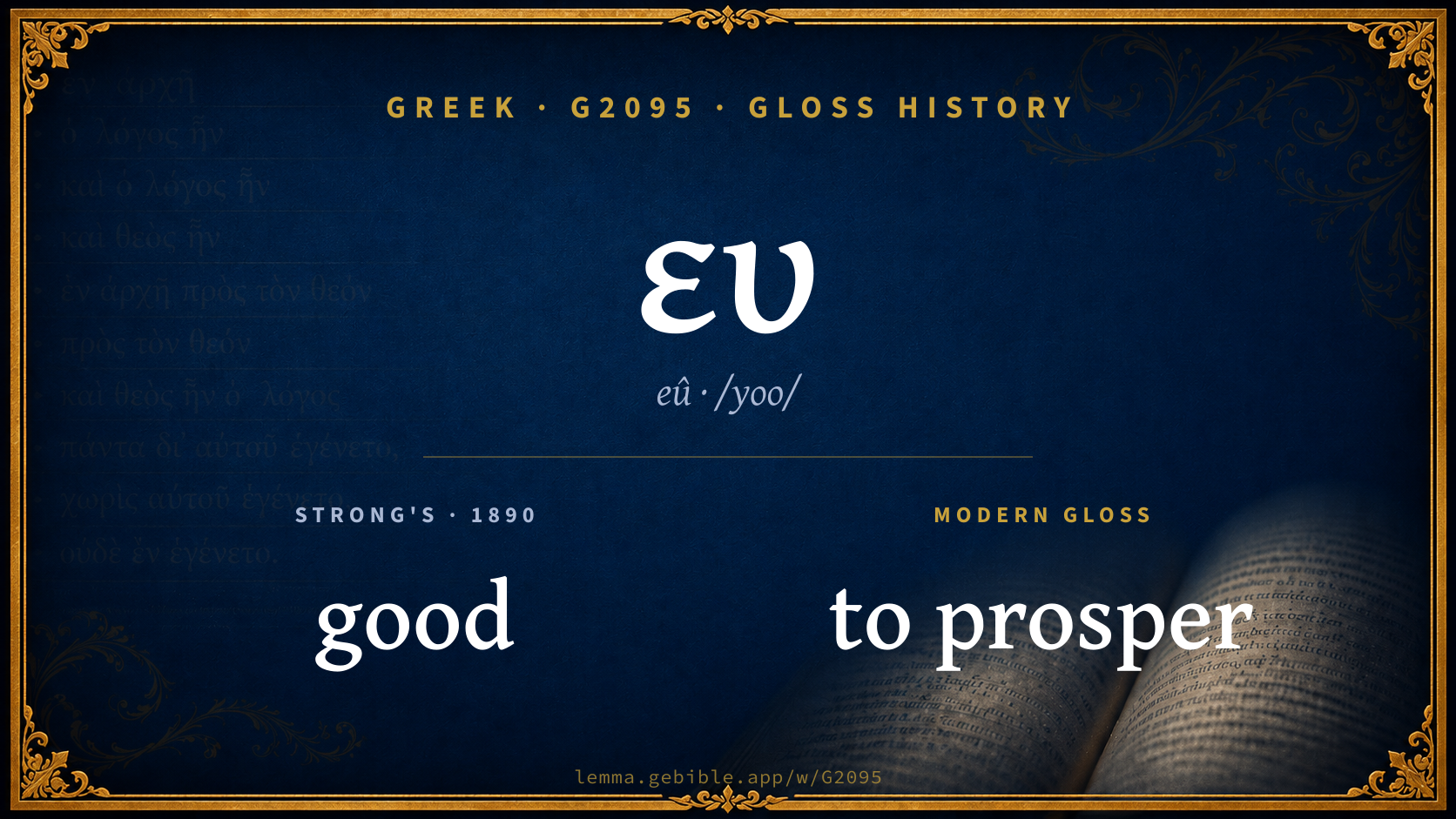
Gloss history
Strong's 1890 vs modern scholarship
About this word
Strong's G2095 catalogs a Greek word from the Greek New Testament.
These counts are not copied from any lexicon or concordance. They are computed here, from the morphology-tagged Greek New Testament. What Lemma adds →
- 6
- distinct verses
- The word appears in 6 distinct verses.
- 5 / 27
- NT books
- The word appears in 5 of 27 New Testament books.
- #1,476
- by frequency
- Top 2500 most frequent Greek words (rank 1,476 of 5,347 Greek words by occurrence).
View all 6 occurrences in the concordance →
By section of the New Testament
By traditional corpus
Conventional, traditional groupings — biblical authorship is debated, so this is a traditional corpus grouping, not an authorship claim. Some books belong to more than one corpus (Luke is in both the Gospels and the Lukan corpus, and so on), so these shares overlap and need not total 100%. Each figure is a share of the word’s 6 distinct verses.
- Gospels 4 verses · 67%
- Lukan (Luke–Acts) 2 verses · 33%
- Pauline corpus 1 verse · 17%
How translations render this word
Counts come from each version’s own published word-to-Strong’s tagging or interlinear alignment — an approximate guide to how each version renders this word, not a word-level alignment the data otherwise carries. Because each total is that version’s own tagged count, the per-version totals vary from one another and need not match the appearance or distinct-verse counts above. These counts may also differ from a printed concordance because Lemma counts each distinctly tagged rendering and does not collapse phrase taggings into a single head-word total. This is a fixed set of word-tagged versions (KJV, ASV, BSB, ULT) and does not change with the reading translation you choose elsewhere. Each version’s license is shown beside its name below (and on Sources).
- King James Version: Well 3×, Well done 2×
- American Standard Version: Well 3×, Well done 2×
- Berean Standard Bible: Well done 3×, Well 2×
- unfoldingWord Literal Text: Well done 3×, Well 2×
King James Version Public Domain
Renders G2095 across 6 tagged occurrences — most commonly:
Plus 1 rendering that appears only once — usually multi-word phrases or single function words the recovered tagging swept in, not distinct renderings.
American Standard Version Public Domain
Renders G2095 across 6 tagged occurrences — most commonly:
Plus 1 rendering that appears only once — usually multi-word phrases or single function words the recovered tagging swept in, not distinct renderings.
Berean Standard Bible Public Domain
Renders G2095 across 6 tagged occurrences — most commonly:
Plus 1 rendering that appears only once — usually multi-word phrases or single function words the recovered tagging swept in, not distinct renderings.
unfoldingWord Literal Text CC BY-SA 4.0
Renders G2095 across 6 tagged occurrences — most commonly:
Plus 1 rendering that appears only once — usually multi-word phrases or single function words the recovered tagging swept in, not distinct renderings.
Senses in Thayer's
The 2 senses Thayer's distinguishes for this word, in lexicon order (not ranked by frequency or importance). The full entry — with sub-senses — is in the Lexicon Entry tab.
- to be well off, fare well, prosper
- acting well
Word origin
Origin: neuter of a primary eus (good)
Neuter of a primary word εὖς eus ( good ); (adverbially) well : - good well (done).
— Strong’s Exhaustive Concordance (1890), public domain.
Forms in the corpus
The 2 distinct written forms G2095 takes in the Greek New Testament, most frequent first — each parse links to that case’s occurrences in the concordance.
| Form | Parsing | Example | Uses |
|---|---|---|---|
| εὖ eû | Adverb | Matthew 25:21 | 5 |
| εὖγε eûge | Adverb | Luke 19:17 | 1 |
Same root — word family
Other Thayer's entries built from the same root as G2095, grouped by Strong’s listed origin. These share a root / origin per the lexicon — not necessarily a shared meaning. Each links to that word’s own entry.
Derived from this word
- ευαγγελιζω euangelízō G2097 to evangelize
- ευαρεστος euárestos G2101 pleasing
- ευγενης eugenḗs G2104 noble
- ευδια eudía G2105 fair weather
- ευδοκεω eudokéō G2106 to be pleased
- ευδοκια eudokía G2107 pleasure
- ευεργετης euergétēs G2110 benefactor
- ευθετος eúthetos G2111 well situated
- ευθυμος eúthymos G2115 courageous
- ευθυς euthýs G2117 straight
- ευκαιρος eúkairos G2121 opportune
- ευκοπωτερος eukopṓteros G2123 easy
- ευλαβης eulabḗs G2126 devout
- ευλογεω eulogéō G2127 to praise
- ευμεταδοτος eumetádotos G2130 generous
- ευνοεω eunoéō G2132 to wish well
- ευοδοω euodóō G2137 to prosper
- ευπειθης eupeithḗs G2138 obedient
- ευπεριστατος euperístatos G2139 besetting
- ευποιΐα eupoiḯa G2140 doing good
- ευπρεπεια euprépeia G2143 beauty
- ευπροσδεκτος euprósdektos G2144 acceptable
- ευπροσεδρος euprósedros G2145 devoted
- ευπροσωπεω euprosōpéō G2146 to please
+14 more words derive from G2095 (not shown).
Proper names from this root
People and places named from this root — a name, not an additional meaning of the word.
Compare all same-root words → Showing 4 of 42 — not the complete family. 3 of the same-root words are proper names (people or places). They share a root, not necessarily a meaning.
Septuagint usage
The same Greek word ευ appears 40 times in the Greek Old Testament (Septuagint), across 39 verses in 13 books.
- 40
- LXX occurrences
- Tagged occurrences of this Greek word in the Septuagint.
- 39
- verses
- Distinct Septuagint verses containing this word.
- 13 / 39
- OT books
- The word appears in 13 of the 39 Old Testament books.
Sample Septuagint occurrences
- Genesis 12:13 εὖ
- Exodus 1:20 εὖ
- Numbers 10:29 εὖ
- Deuteronomy 4:40 εὖ
- Joshua 24:20 εὖ
- Ruth 3:1 εὖ
- Job 24:21 εὖ
- Psalms 47:3 εὖ
- Proverbs 3:27 εὖ
- Isaiah 41:23 εὖ
- Jeremiah 7:23 εὖ
- Ezekiel 21:20 εὖ
Septuagint occurrences (same lexeme)
Every verse where the same Strong’s number (G2095) appears in the Greek Septuagint. Verse text shown in the World English Bible for context; the Greek form is the matched word — the English is not keyword-highlighted.
- Genesis 12:13 εὖ Please say that you are my sister, that it may be well with me for your sake, and that my soul may live because of you."
- Genesis 12:16 εὖ He dealt well with Abram for her sake. He had sheep, and oxen, and male donkeys, and men-servants, and maid-servants, and female donkeys, and camels.
- Genesis 32:10 εὖ I am not worthy of the least of all the loving kindnesses, and of all the truth, which you have shown to your servant; for with just my staff I passed over this Jordan; and now I have become two companies.
- Genesis 32:13 εὖ He lodged there that night, and took from that which he had with him, a present for Esau, his brother:
- Genesis 40:14 εὖ But remember me when it will be well with you, and show kindness, please, to me, and make mention of me to Pharaoh, and bring me out of this house.
- Exodus 1:20 εὖ God dealt well with the midwives, and the people multiplied, and grew very mighty.
- Exodus 20:12 εὖ "Honor your father and your mother, that your days may be long in the land which Yahweh your God gives you.
- Numbers 10:29 εὖ Moses said to Hobab, the son of Reuel the Midianite, Moses' father-in-law, We are journeying to the place of which Yahweh said, I will give it you: come you with us, and we will do you good; for Yahweh has spoken good concerning Israel.
- Numbers 10:32 εὖ It shall be, if you go with us, yes, it shall be, that whatever good Yahweh shall do to us, the same will we do to you.
- Deuteronomy 4:40 εὖ You shall keep his statutes, and his commandments, which I command you this day, that it may go well with you, and with your children after you, and that you may prolong your days in the land, which Yahweh your God gives you, forever.
- Deuteronomy 5:16 εὖ "Honor your father and your mother, as Yahweh your God commanded you; that your days may be long, and that it may go well with you, in the land which Yahweh your God gives you.
- Deuteronomy 5:29 εὖ Oh that there were such a heart in them, that they would fear me, and keep all my commandments always, that it might be well with them, and with their children forever!
- Deuteronomy 5:33 εὖ You shall walk in all the way which Yahweh your God has commanded you, that you may live, and that it may be well with you, and that you may prolong your days in the land which you shall possess.
- Deuteronomy 6:3 εὖ Hear therefore, Israel, and observe to do it; that it may be well with you, and that you may increase mightily, as Yahweh, the God of your fathers, has promised to you, in a land flowing with milk and honey.
- Deuteronomy 6:18 εὖ You shall do that which is right and good in the sight of Yahweh; that it may be well with you, and that you may go in and possess the good land which Yahweh swore to your fathers,
- Deuteronomy 6:24 εὖ Yahweh commanded us to do all these statutes, to fear Yahweh our God, for our good always, that he might preserve us alive, as at this day.
- Deuteronomy 8:16 εὖ who fed you in the wilderness with manna, which your fathers didn't know; that he might humble you, and that he might prove you, to do you good at your latter end:
- Deuteronomy 10:13 εὖ to keep the commandments of Yahweh, and his statutes, which I command you this day for your good?
- Deuteronomy 12:25 εὖ You shall not eat it; that it may go well with you, and with your children after you, when you shall do that which is right in the eyes of Yahweh.
- Deuteronomy 12:28 εὖ Observe and hear all these words which I command you, that it may go well with you, and with your children after you forever, when you do that which is good and right in the eyes of Yahweh your God.
- Deuteronomy 15:16 εὖ It shall be, if he tell you, I will not go out from you; because he loves you and your house, because he is well with you;
- Deuteronomy 19:13 εὖ Your eye shall not pity him, but you shall put away the innocent blood from Israel, that it may go well with you.
- Deuteronomy 22:7 εὖ you shall surely let the hen go, but the young you may take to yourself; that it may be well with you, and that you may prolong your days.
- Deuteronomy 28:63 εὖ It shall happen that as Yahweh rejoiced over you to do you good, and to multiply you, so Yahweh will rejoice over you to cause you to perish, and to destroy you; and you shall be plucked from off the land where you go in to possess it.
- Deuteronomy 30:5 εὖ and Yahweh your God will bring you into the land which your fathers possessed, and you shall possess it; and he will do you good, and multiply you above your fathers.
- Joshua 24:20 εὖ If you forsake Yahweh, and serve foreign gods, then he will turn and do you evil, and consume you, after that he has done you good.
- Ruth 3:1 εὖ Naomi her mother-in-law said to her, My daughter, shall I not seek rest for you, that it may be well with you?
- Job 24:21 εὖ He devours the barren who don't bear. He shows no kindness to the widow.
- Job 28:23 εὖ "God understands its way, And he knows its place.
- Psalms 47:3 εὖ He subdues nations under us, And peoples under our feet.
- Proverbs 3:27 εὖ Don't withhold good from those to whom it is due, When it is in the power of your hand to do it.
- Proverbs 3:28 εὖ Don't say to your neighbor, "Go, and come again, Tomorrow I will give it to you," When you have it by you.
- Isaiah 41:23 εὖ Declare the things that are to come hereafter, that we may know that you are gods: yes, do good, or do evil, that we may be dismayed, and see it together.
- Isaiah 53:11 εὖ He shall see of the travail of his soul, [and] shall be satisfied: by the knowledge of himself shall my righteous servant justify many; and he shall bear their iniquities.
- Jeremiah 7:23 εὖ but this thing I commanded them, saying, Listen to my voice, and I will be your God, and you shall be my people; and walk you in all the way that I command you, that it may be well with you.
- Jeremiah 13:23 εὖ Can the Ethiopian change his skin, or the leopard his spots? then may you also do good, who are accustomed to do evil.
- Ezekiel 21:20 εὖ You shall appoint a way for the sword to come to Rabbah of the children of Ammon, and to Judah in Jerusalem the fortified.
- Ezekiel 36:11 εὖ and I will multiply on you man and animal; and they shall increase and be fruitful; and I will cause you to be inhabited after your former estate, and will do better [to you] than at your beginnings: and you shall know that I am Yahweh.
- Daniel 3:30 εὖ Then the king promoted Shadrach, Meshach, and Abednego in the province of Babylon.
These are occurrences of the same Greek lexeme (G2095) in the Septuagint — not a translation of any one Hebrew word. The store carries no word-level Hebrew↔Greek alignment, so no Hebrew original is asserted here. Counts come from the recovered LXX Strong's tagging — high-frequency vocabulary is well covered, while rare or late forms may be untagged — so they reflect tagged occurrences and may slightly undercount.