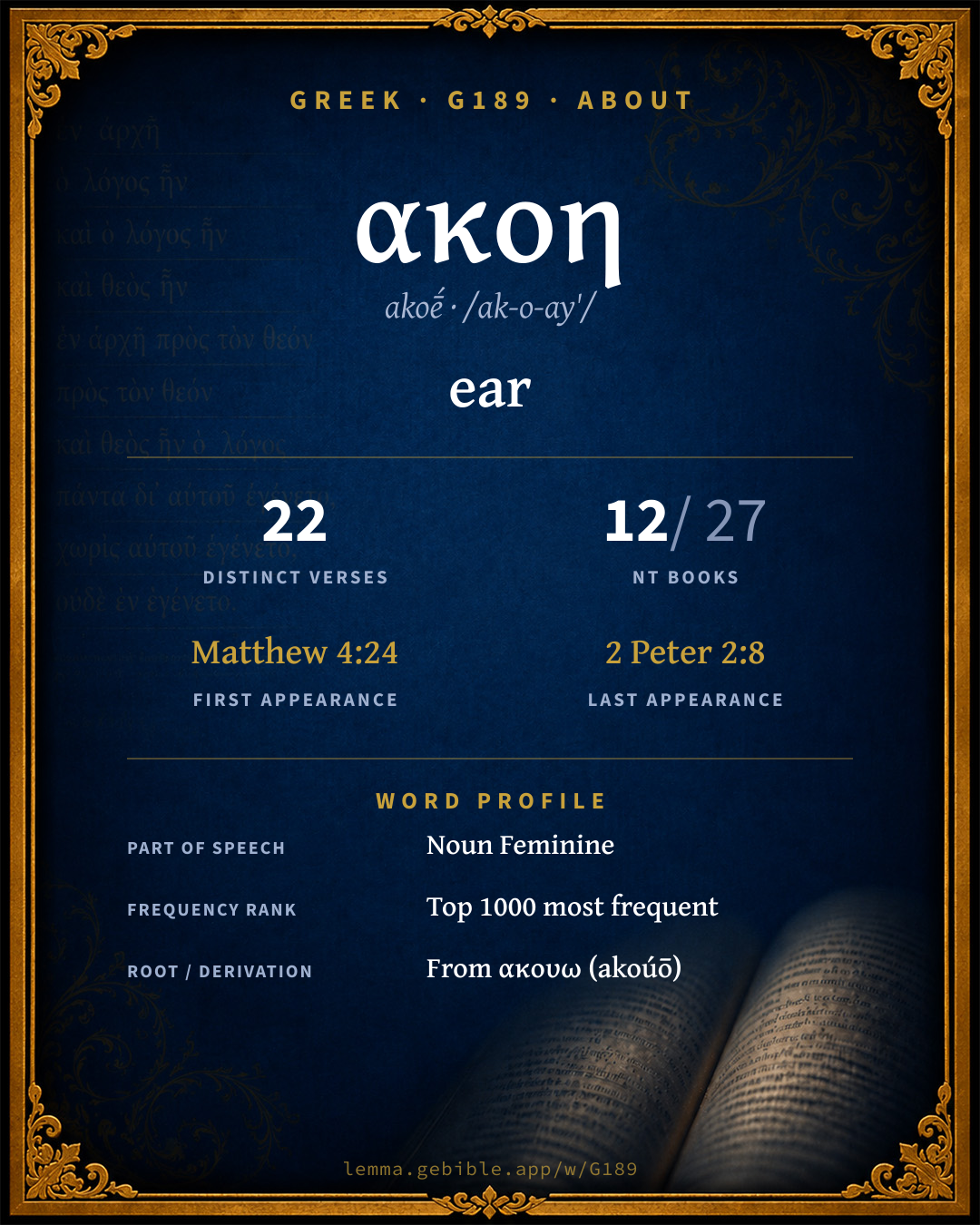
ἀκοή
ear
‘ear’ is one of 4 main senses fuller range ↓
Full lexicon entry — Thayer's Greek Lexicon
From Thayer's Greek Lexicon
Where this word appears
See every Dative-case word in the Greek New Testament →
Grammar key — what these labels mean
Part of speech
- Noun
- A naming word — a person, place, thing, or idea.
Case
- Dative
- The case of the indirect object, means, or location — “to / for / with / in.”
- Genitive
- The case of source, possession, or “of” — answers “whose / from what.”
- Nominative
- The case of the subject (and the predicate nominative).
- Accusative
- The case of the direct object and of extent.
Gender
- Feminine
- Grammatically feminine.
Number
- Singular
- One.
- Plural
- More than one.
Every verse where G189 appears in the Book of Hebrews — 2 distinct verses. Click any verse to open its interlinear word-by-word view. Verse text shown in the World English Bible for context — . Each verse’s Greek form is shown with its reference; the English is not keyword-highlighted, since the data carries no word-level English alignment. Use “Compare translations” on any verse to read it across multiple English versions. This concordance covers the Greek New Testament; Septuagint (Greek Old Testament) occurrences of this word are not indexed here.
Hebrews
- Hebrews 4:2 ἀκοῆς n gen sg fem For indeed we have had good news preached to us, even as they also did, but the word they heard didn't profit them, because it wasn't mixed with faith by those who heard.
- Hebrews 5:11 ἀκοαῖς n dat pl fem About him we have many words to say, and hard to interpret, seeing you have become dull of hearing.
About this entry
At a glance — auto-summarized from this page’s data, not written by a person. Every figure links to its source below. This summary describes the numbers; it doesn’t interpret them.
At its core, ακοη (akoḗ) means “ear.” Catalogued under 4 senses, its meaning is not single-sense. With 22 verses in 12 books, it is an uncommon word in the Greek New Testament. First canonically at Matthew 4:24, it enters the text early. From the same root come ακουω and ακροατης. Dig into 22-verse concordance and the renderings breakdown below.
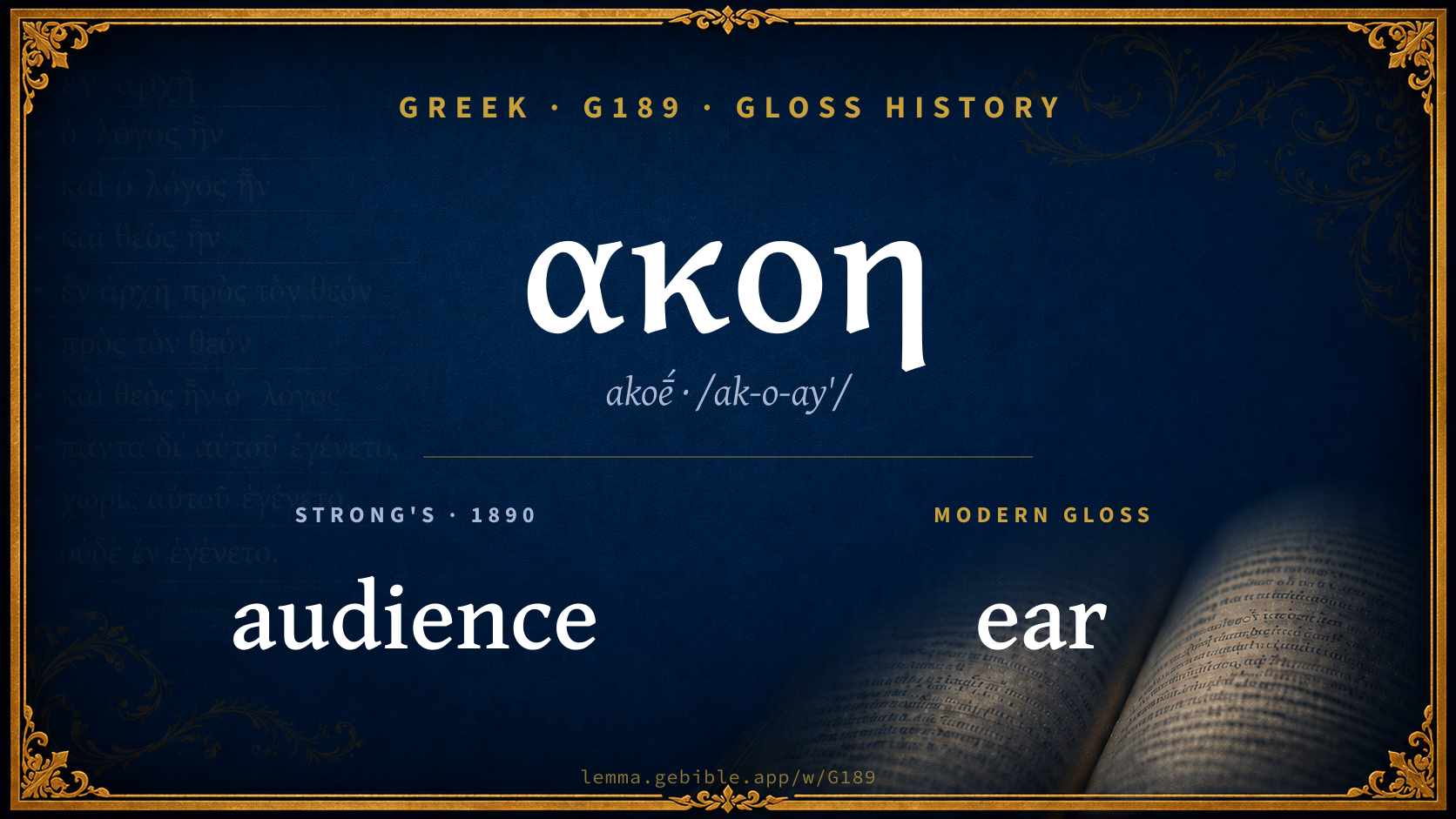
Gloss history
Strong's 1890 vs modern scholarship
About this word
Strong's G189 catalogs a Greek word from the Greek New Testament.
These counts are not copied from any lexicon or concordance. They are computed here, from the morphology-tagged Greek New Testament. What Lemma adds →
- 22
- distinct verses
- The word appears in 22 distinct verses.
- 12 / 27
- NT books
- The word appears in 12 of 27 New Testament books.
- #548
- by frequency
- Top 1000 most frequent Greek words (rank 548 of 5,347 Greek words by occurrence).
View all 22 occurrences in the concordance →
By section of the New Testament
By traditional corpus
Conventional, traditional groupings — biblical authorship is debated, so this is a traditional corpus grouping, not an authorship claim. Some books belong to more than one corpus (Luke is in both the Gospels and the Lukan corpus, and so on), so these shares overlap and need not total 100%. Each figure is a share of the word’s 22 distinct verses.
- Gospels 9 verses · 41%
- Pauline corpus 8 verses · 36%
- Lukan (Luke–Acts) 3 verses · 14%
- Hebrews 2 verses · 9%
- Johannine 1 verse · 5%
- General (Catholic) Epistles 1 verse · 5%
How translations render this word
Counts come from each version’s own published word-to-Strong’s tagging or interlinear alignment — an approximate guide to how each version renders this word, not a word-level alignment the data otherwise carries. Because each total is that version’s own tagged count, the per-version totals vary from one another and need not match the appearance or distinct-verse counts above. These counts may also differ from a printed concordance because Lemma counts each distinctly tagged rendering and does not collapse phrase taggings into a single head-word total. This is a fixed set of word-tagged versions (KJV, ASV, BSB, ULT) and does not change with the reading translation you choose elsewhere. Each version’s license is shown beside its name below (and on Sources).
- King James Version: Hearing 8×, Ears 4×, Fame 3×
- American Standard Version: Hearing 9×, Ears 5×, Report 5×
- Berean Standard Bible: Hearing 5×, Ears 3×, Message 2×
- unfoldingWord Literal Text: Hearing 13×, Ear 3×, Ears 2×
King James Version Public Domain
Renders G189 across 24 tagged occurrences — most commonly:
Plus 5 renderings that appear only once — usually multi-word phrases or single function words the recovered tagging swept in, not distinct renderings.
American Standard Version Public Domain
Renders G189 across 23 tagged occurrences — most commonly:
Plus 2 renderings that appear only once — usually multi-word phrases or single function words the recovered tagging swept in, not distinct renderings.
Berean Standard Bible Public Domain
Renders G189 across 23 tagged occurrences — most commonly:
Plus 9 renderings that appear only once — usually multi-word phrases or single function words the recovered tagging swept in, not distinct renderings. Not rendered by a distinct English word in 1 further occurrence.
unfoldingWord Literal Text CC BY-SA 4.0
Renders G189 across 25 tagged occurrences — most commonly:
Plus 1 rendering that appears only once — usually multi-word phrases or single function words the recovered tagging swept in, not distinct renderings.
Senses in Thayer's
The 4 senses Thayer's distinguishes for this word, in lexicon order (not ranked by frequency or importance). The full entry — with sub-senses — is in the Lexicon Entry tab.
- the sense of hearing
- the organ of hearing, the ear
- instruction, namely oral
- hearsay, report or rumour
Word origin
Derived from ακουω (akoúō) (G191) — to hear.
From G191 ; hearing (the act the sense or the thing heard): - audience ear fame which ye heard hearing preached report rumor.
— Strong’s Exhaustive Concordance (1890), public domain.
Forms in the corpus
The 9 distinct written forms G189 takes in the Greek New Testament, most frequent first — each parse links to that case’s occurrences in the concordance.
| Form | Parsing | Example | Uses |
|---|---|---|---|
| ἀκοῆς akoē̂s | Noun, Genitive, Singular, Feminine | Romans 10:17 | 5 |
| ἀκοῇ akoē̂ | Noun, Dative, Singular, Feminine | Matthew 13:14 | 5 |
| ἀκοὰς akoàs | Noun, Accusative, Plural, Feminine | Matthew 24:6 | 4 |
| ἀκοὴ akoḕ | Noun, Nominative, Singular, Feminine | Matthew 4:24 | 3 |
| ἀκοή akoḗ | Noun, Nominative, Singular, Feminine | 1 Corinthians 12:17 | 2 |
| ἀκοὴν akoḕn | Noun, Accusative, Singular, Feminine | Matthew 14:1 | 2 |
| ἀκοήν akoḗn | Noun, Accusative, Singular, Feminine | 2 Timothy 4:3 | 1 |
| ἀκοαί akoaí | Noun, Nominative, Plural, Feminine | Mark 7:35 | 1 |
| ἀκοαῖς akoaîs | Noun, Dative, Plural, Feminine | Hebrews 5:11 | 1 |
Same root — word family
Other Thayer's entries built from the same root as G189, grouped by Strong’s listed origin. These share a root / origin per the lexicon — not necessarily a shared meaning. Each links to that word’s own entry.
Derives from
Shares the same root
Compare all same-root words → They share a root, not necessarily a meaning.
Septuagint usage
The same Greek word ακοη appears 41 times in the Greek Old Testament (Septuagint), across 39 verses in 16 books.
- 41
- LXX occurrences
- Tagged occurrences of this Greek word in the Septuagint.
- 39
- verses
- Distinct Septuagint verses containing this word.
- 16 / 39
- OT books
- The word appears in 16 of the 39 Old Testament books.
Sample Septuagint occurrences
- Exodus 15:26 ἀκοή
- Deuteronomy 11:13 ἀκοή
- 1 Samuel 2:24 ἀκοή
- 2 Samuel 13:30 ἀκοή
- 1 Kings 2:28 ἀκοή
- 2 Chronicles 9:6 ἀκοή
- Job 37:2 ἀκοή
- Psalms 17:45 ἀκοή
- Isaiah 6:9 ἀκοή
- Jeremiah 6:24 ἀκοή
- Ezekiel 16:56 ἀκοή
- Daniel 11:44 ἀκοή
Septuagint occurrences (same lexeme)
Every verse where the same Strong’s number (G189) appears in the Greek Septuagint. Verse text shown in the World English Bible for context; the Greek form is the matched word — the English is not keyword-highlighted.
- Exodus 15:26 ἀκοή and he said, "If you will diligently listen to the voice of Yahweh your God, and will do that which is right in his eyes, and will pay attention to his commandments, and keep all his statutes, I will put none of the diseases on you, which I have put on the Egyptians; for I am Yahweh who heals you."
- Exodus 19:5 ἀκοή Now therefore, if you will indeed obey my voice, and keep my covenant, then you shall be my own possession from among all peoples; for all the earth is mine;
- Exodus 22:22 ἀκοή "You shall not take advantage of any widow or fatherless child.
- Exodus 23:1 ἀκοή "You shall not spread a false report. Don't join your hand with the wicked to be a malicious witness.
- Exodus 23:22 ἀκοή But if you indeed listen to his voice, and do all that I speak, then I will be an enemy to your enemies, and an adversary to your adversaries.
- Deuteronomy 11:13 ἀκοή It shall happen, if you shall listen diligently to my commandments which I command you this day, to love Yahweh your God, and to serve him with all your heart and with all your soul,
- Deuteronomy 11:22 ἀκοή For if you shall diligently keep all this commandment which I command you, to do it, to love Yahweh your God, to walk in all his ways, and to cleave to him;
- Deuteronomy 15:5 ἀκοή if only you diligently listen to the voice of Yahweh your God, to observe to do all this commandment which I command you this day.
- Deuteronomy 28:1 ἀκοή It shall happen, if you shall listen diligently to the voice of Yahweh your God, to observe to do all his commandments which I command you this day, who Yahweh your God will set you on high above all the nations of the earth:
- Deuteronomy 28:2 ἀκοή and all these blessings shall come on you, and overtake you, if you shall listen to the voice of Yahweh your God.
- 1 Samuel 2:24 ἀκοή No, my sons; for it is no good report that I hear: you make Yahweh's people to disobey.
- 1 Samuel 15:22 ἀκοή Samuel said, Has Yahweh as great delight in burnt offerings and sacrifices, as in obeying the voice of Yahweh? Behold, to obey is better than sacrifice, and to listen than the fat of rams.
- 2 Samuel 13:30 ἀκοή It happened, while they were in the way, that the news came to David, saying, Absalom has slain all the king's sons, and there is not one of them left.
- 2 Samuel 22:45 ἀκοή The foreigners shall submit themselves to me: As soon as they hear of me, they shall obey me.
- 2 Samuel 23:23 ἀκοή He was more honorable than the thirty, but he didn't attain to the [first] three. David set him over his guard.
- 1 Kings 2:28 ἀκοή The news came to Joab; for Joab had turned after Adonijah, though he didn't turn after Absalom. Joab fled to the Tent of Yahweh, and caught hold on the horns of the altar.
- 1 Kings 10:7 ἀκοή However I didn't believe the words, until I came, and my eyes had seen it: and, behold, the half was not told me; your wisdom and prosperity exceed the fame which I heard.
- 2 Chronicles 9:6 ἀκοή However I didn't believe their words, until I came, and my eyes had seen it; and, behold, the half of the greatness of your wisdom was not told me: you exceed the fame that I heard.
- Job 37:2 ἀκοή Hear, oh, hear the noise of his voice, The sound that goes out of his mouth.
- Job 42:5 ἀκοή I had heard of you by the hearing of the ear, But now my eye sees you.
- Psalms 17:45 ἀκοή
- Psalms 111:7 ἀκοή The works of his hands are truth and justice. All his precepts are sure.
- Isaiah 6:9 ἀκοή He said, "Go, and tell this people, 'You hear indeed, But don't understand; And you see indeed, But don't perceive.'
- Isaiah 52:7 ἀκοή How beautiful on the mountains are the feet of him who brings good news, who publishes peace, who brings good news of good, who publishes salvation, who says to Zion, Your God reigns!
- Isaiah 53:1 ἀκοή Who has believed our message? and to whom has the arm of Yahweh been revealed?
- Jeremiah 6:24 ἀκοή We have heard the report of it; our hands wax feeble: anguish has taken hold of us, [and] pangs as of a woman in travail.
- Jeremiah 10:22 ἀκοή The voice of news, behold, it comes, and a great commotion out of the north country, to make the cities of Judah a desolation, a dwelling-place of jackals.
- Jeremiah 17:24 ἀκοή It shall happen, if you diligently listen to me, says Yahweh, to bring in no burden through the gates of this city on the Sabbath day, but to make the Sabbath day holy, to do no work therein;
- Jeremiah 27:43 ἀκοή
- Jeremiah 30:8 ἀκοή It shall come to pass in that day, says Yahweh of Hosts, that I will break his yoke from off your neck, and will burst your bonds; and strangers shall no more make him their bondservant;
- Jeremiah 30:29 ἀκοή
- Jeremiah 38:18 ἀκοή But if you will not go forth to the king of Babylon's princes, then shall this city be given into the hand of the Chaldeans, and they shall burn it with fire, and you shall not escape out of their hand.
- Jeremiah 44:5 ἀκοή But they didn't listen, nor inclined their ear to turn from their wickedness, to burn no incense to other gods.
- Ezekiel 16:56 ἀκοή For your sister Sodom was not mentioned by your mouth in the day of your pride,
- Daniel 11:44 ἀκοή But news out of the east and out of the north shall trouble him; and he shall go forth with great fury to destroy and utterly to sweep away many.
- Hosea 7:12 ἀκοή When they go, I will spread my net on them. I will bring them down like the birds of the sky. I will chastise them, as their congregation has heard.
- Obadiah 1:1 ἀκοή The vision of Obadiah. This is what the Lord Yahweh says about Edom. We have heard news from Yahweh, and an ambassador is sent among the nations, saying, "Arise, and let's rise up against her in battle.
- Nahum 1:12 ἀκοή Thus says Yahweh: "Though they be in full strength, and likewise many, even so they will be cut down, and he shall pass away. Though I have afflicted you, I will afflict you no more.
- Habakkuk 3:2 ἀκοή Yahweh, I have heard of your fame. I stand in awe of your deeds, Yahweh. Renew your work in the midst of the years. In the midst of the years make it known. In wrath, you remember mercy.
These are occurrences of the same Greek lexeme (G189) in the Septuagint — not a translation of any one Hebrew word. The store carries no word-level Hebrew↔Greek alignment, so no Hebrew original is asserted here. Counts come from the recovered LXX Strong's tagging — high-frequency vocabulary is well covered, while rare or late forms may be untagged — so they reflect tagged occurrences and may slightly undercount.