
Job 37:2

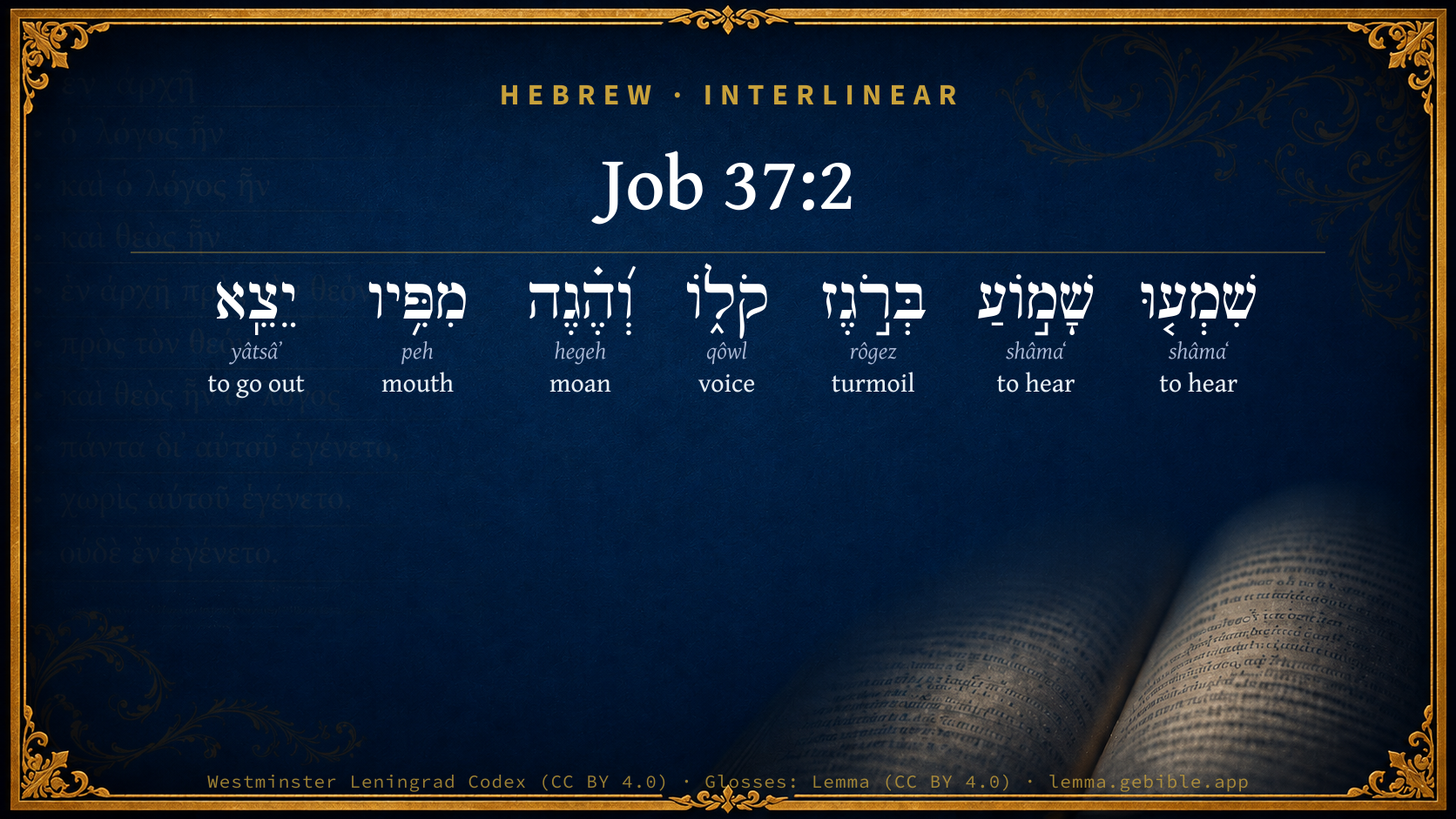
Hebrew (Westminster Leningrad Codex) Job 37:2 appears in the Hebrew Old Testament. The text above is from the Westminster Leningrad Codex. Each word links to its Strong’s number, a concise gloss, and parsing drawn from the Open Scriptures Hebrew Bible morphology. Click any word for its full Brown-Driver-Briggs (BDB) entry.
Download image
Cite this verse

Job 37:2 (World English Bible). Public Domain. Lemma interlinear Bible study tool, https://lemma.gebible.app/v/job/37/2.

Show BibTeX & RIS
BibTeX
RIS
English Translation
Hear, oh, hear the noise of his voice, The sound that goes out of his mouth.
World English Bible · Public Domain
Highlights
  • 1 first appearance in the Hebrew Bible
Full analysis ↓
Download a study sheet

One document with this verse’s original text, its word-by-word gloss line, the meaning frame, cross-references with their text, attributed commentary, and full source and license credits — printable, and it pastes into notes with its structure intact.

This verse Autodidact and up

Study sheet (.html) Plain text (.txt)

A passage Seminary Student

Up to 50 verses in one chapter. A passage sheet keeps up to 6 commentary sources and 12 cross-references per verse, in the order this page ranks them, and says so on the sheet whenever that leaves anything out. Ask for a single verse and you get the Autodidact verse sheet above.

Everything on this page stays free to read, with no account — the sheet is a download of what is already on screen, not access to it.

Want to remove ads? Support Godless Engineer
Compare translations 3

The same verse in 3 English versions, stacked beneath the original-language interlinear above. Click any original word for its lexicon entry.

Each is an independent rendering of the whole verse — the interlinear is not word-aligned to these translations.

Highlighted words mark where these versions differ — a whole-verse word diff, not a word-by-word alignment.

  • World English Bible Public Domain
    Hear, oh, hear the noise of his voice, The sound that goes out of his mouth.
  • King James Version Public Domain
    Hear attentively the noise of his voice, and the sound that goeth out of his mouth.
  • unfoldingWord Literal Text CC BY-SA 4.0
    Hearing, hear the roar of his voice and the sound comes from his mouth!

unfoldingWord Literal Text — © unfoldingWord, licensed CC BY-SA 4.0. Word-aligned USFM3 via Door43 (git.door43.org/unfoldingWord/en_ult).

Versions to compare (up to 4)

3 of 4 selected

Show all 18 translations

Every available English version of this verse, each an independent rendering of the whole verse.

  • World English Bible Public Domain
    Hear, oh, hear the noise of his voice, The sound that goes out of his mouth.
  • Berean Standard Bible Public Domain
    Listen closely to the thunder of His voice and the rumbling that comes from His mouth.
  • Majority Standard Bible Public Domain
    Listen closely to the thunder of His voice and the rumbling that comes from His mouth.
  • King James Version Public Domain
    Hear attentively the noise of his voice, and the sound that goeth out of his mouth.
  • American Standard Version (1901) Public Domain
    Hear, oh, hear the noise of his voice, And the sound that goeth out of his mouth.
  • Revised Version (1885) Public Domain
    Hearken ye unto the noise of his voice, and the sound that goeth out of his mouth.
  • Geneva Bible (1599) Public Domain
    Heare the sound of his voyce, and the noyse that goeth out of his mouth.
  • Douay-Rheims (1899) Public Domain
    Hear ye attentively the terror of his voice, and the sound that cometh out of his mouth.
  • Young's Literal Translation Public Domain
    Hearken diligently to the trembling of His voice, Yea, the sound from His mouth goeth forth.
  • Literal Standard Version CC BY-SA 4.0
    Listen diligently to the trembling of His voice, || Indeed, the sound goes forth from His mouth.
  • Unlocked Literal Bible CC BY-SA 4.0
    Hear, oh, hear the noise of his voice, the sound that goes out from his mouth.
  • unfoldingWord Literal Text CC BY-SA 4.0
    Hearing, hear the roar of his voice and the sound comes from his mouth!
  • Darby Bible Public Domain
    Hear attentively the roar of his voice, and the murmur going forth from his mouth.
  • World Messianic Bible Public Domain
    Hear, oh, hear the noise of his voice, the sound that goes out of his mouth.
  • Webster's Bible Public Domain
    Hear attentively the noise of his voice, and the sound that goeth out of his mouth.
  • Free Bible Version CC BY-SA 4.0
    Listen carefully to God's thunderous voice that rumbles as he speaks.
  • Bible in Basic English Public Domain
    Give ear to the rolling noise of his voice; to the hollow sound which goes out of his mouth.
  • JPS Tanakh (1917) Public Domain
    Hear attentively the noise of His voice, and the sound that goeth out of His mouth.

Literal Standard Version (2020), Covenant Press — licensed CC BY-SA 4.0. Text via the HelloAO Bible API (eBible.org). Unlocked Literal Bible (unfoldingWord) — licensed CC BY-SA 4.0. Text via the HelloAO Bible API (eBible.org). unfoldingWord Literal Text — © unfoldingWord, licensed CC BY-SA 4.0. Word-aligned USFM3 via Door43 (git.door43.org/unfoldingWord/en_ult). Free Bible Version, Dr. Jonathan Gallagher — licensed CC BY-SA 4.0. Text via the HelloAO Bible API (eBible.org).

Word by word

More ways to search: Search by grammar → Find every occurrence → Compare this word →

Practice this passage: Drill this verse → Learn its vocabulary →

About this verse

These counts appear in no published source. They are computed here, from the morphology-tagged text and Lemma’s own curated glosses. What Lemma adds →

7
words
6
distinct lemmas
Wisdom
section

Notable vocabulary

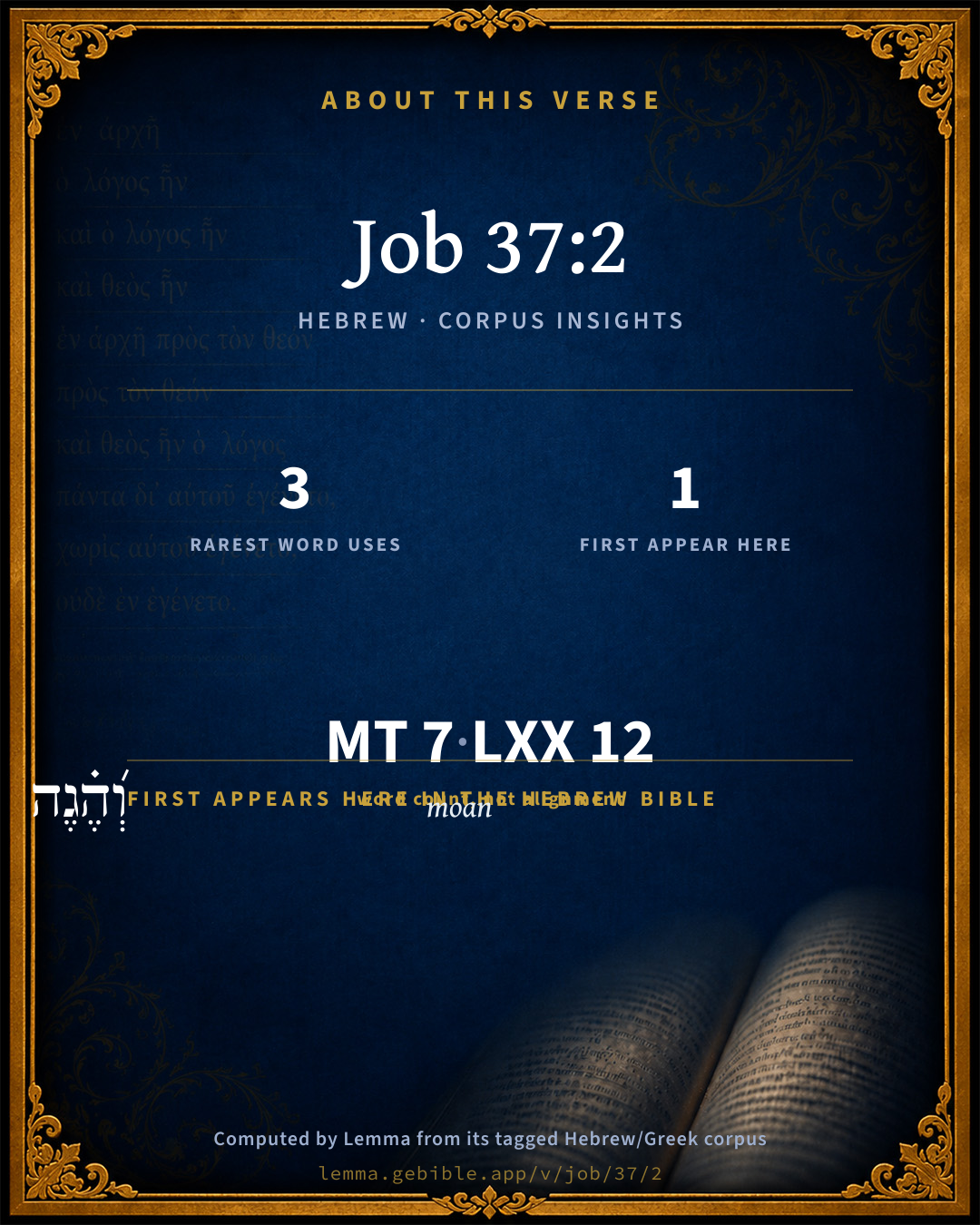
The rarest word here is וְ֝הֶ֗גֶה moan H1899 — appearing just 3 times in the whole Hebrew Bible.

First appearance in Scripture

This word makes its first canonical appearance in the Hebrew Bible here:

  • וְ֝הֶ֗גֶה moan H1899

Shared distinctive vocabulary

וְ֝הֶ֗גֶה moan H1899 occurs in 3 verses of the Hebrew Bible. Also found in:

Grammatical profile

  • 3 verbs
  • 4 nouns

Verb forms

  • שִׁמְע֤וּ Qal · Imperative
  • שָׁמ֣וֹעַ Qal · Infinitive Absolute
  • יֵצֵֽא Qal · Imperfect

Repetition

A word recurs within this verse — often emphatic in Hebrew:

  • שִׁמְע֤וּ to hear H8085 ×2

Hebrew & Septuagint length

In English translation the verse runs 16 words from the Hebrew and 20 from the Septuagint (LXX English) — closely comparable.

A rough comparison of the two English renderings, which tokenize alike — not a word-level alignment.

Word counts can differ between the Hebrew and the Greek without any difference in meaning — e.g. the Hebrew direct-object marker אֵת has no separate Greek word, and Greek often adds the article ὁ.

In the original languages it is 7 Hebrew tokens and 12 Greek tokens — but the two are counted differently (Hebrew bundles its prefixes and suffixes into one token; the Greek is in lemma form), so that isn’t a like-for-like length.

Cross-references

7

Topical passages linked to Job 37:2 in the Treasury of Scripture Knowledge — connected by theme and wording, ordered by reader-vote popularity; previews shown in the World English Bible.

  • Job 36:33 The noise of it tells about him, And the cattle also concerning the storm that comes up.
  • Job 37:5 God thunders marvelously with his voice. He does great things, which we can't comprehend.
  • Exodus 19:16–19 It happened on the third day, when it was morning, that there were thunders and lightnings, and a thick cloud on the mountain, and the sound of an exceedingly loud trumpet; and all the people who were in the camp trembled.
  • Job 38:1 Then Yahweh answered Job out of the whirlwind,
  • Psalms 29:3–9 Yahweh's voice is on the waters. The God of glory thunders, even Yahweh on many waters.
  • Psalms 104:7 At your rebuke they fled. At the voice of your thunder they hurried away.
  • Job 36:29 Yes, can any understand the spreading of the clouds, And the thunderings of his pavilion?

Cross-references courtesy of OpenBible.info (CC BY 4.0).

Hebrew and Greek witnesses Masoretic Hebrew ↔ Greek Septuagint

The same verse in the two great witnesses to the Old Testament, shown verse-for-verse.

These are two independent witnesses, not word-aligned to each other, and the Septuagint is shown in lemma (dictionary) form.

Hebrew Job 37:2 Masoretic · Westminster Leningrad Codex

שִׁמְע֤וּ שָׁמ֣וֹעַ בְּרֹ֣גֶז קֹל֑וֹ וְ֝הֶ֗גֶה מִפִּ֥יו יֵצֵֽא

Hear, oh, hear the noise of his voice, The sound that goes out of his mouth.

World English Bible · Public Domain

Greek LXX Job 37:2 Septuagint · lemma form

ἀκούω ἀκοή ἐν ὀργή θυμός κύριος καί μελέτη ἐκ στόμα αὐτός ἐκἔρχομαι

Hear you a report by the anger of the Lord's wrath, and a discourse shall come out of his mouth.

LXX2012 (modern English Septuagint) · Public Domain

Hebrew: Westminster Leningrad Codex (CC BY 4.0). Greek: Septuagint (public domain); English from LXX2012 (modern English Septuagint) (Public Domain). How the Septuagint differs from the Hebrew →

Commentary

Notes on Job 37:2 from classic Christian and Jewish commentators (each source and its license shown beneath its notes). The classic Christian expositions comment on the surrounding passage and are grouped to its opening verse, so a note may address several verses; the Jewish commentaries on the Tanakh (Rashi and others) are per-verse, so they appear only where the commentator wrote on this verse.

Lemma curates 59 commentaries, every one of them public domain or Creative Commons licensed, each selected and text-cleaned for this edition rather than reprinted as found. About our sources →

Trapp's Complete Commentary

John Trapp

Job 37:2 Hear attentively the noise of his voice, and the sound [that] goeth out of his mouth.

Ver. 2. Hear attentively the noise of his voice] Coniunctam commotione vocem eius, the great thunder crack that now is; that angry noise, as the word signifieth. Hear in hearing; you cannot but hear it with the ears of your bodies, hear it also with the ears of your minds; tremble and sin not; contrary to the course of most men, who sin and tremble not, drowning the noise of their consciences, as the old Italians did the thunder, by ringing their greatest bells, discharging their Roaring Megs, {a huge piece of ordnance.} &c. But what saith Elihu here to his hearers? Audite, audite, audite etiam atque etiam, contremiscetis et vos, vos testes adhibeo, as Mercer paraphraseth it out of Kimchi: Hear ye, hear ye, hear ye again and again, and then ye also will tremble. I take you to witness; whether ye consider his greater thunder claps ringing and roaring in your ears, see Psa 29:4; Psa 87:7, or the lesser rumblings, called here Murmur vel mussitationem, vel habitum, citra quem sermo non profertur; the sound, or breath, that goeth out of his mouth. All is ascribed to God; though naturalists tell us, and truly, that there are second causes of thunder and lightning (Aristot. Pliny); wherein, nevertheless, we must not stick, but give God the glory of his majesty, as David teacheth, Psa 29:1-3, and as blind heathens did, when they called their Iove Altitonantem, the high thunderer. The best philosophy in this point is to hear God Almighty by his thunder speaking to us from heaven as if he were present; and to see him in his lightnings, as if he cast his eyes upon us to see what we had been doing. His eyes are as a flaming fire, Rev 1:14, and the school of nature teacheth, that the fiery eye seeth extra mittendo, by sending out a ray.

John Trapp, A Commentary or Exposition upon All the Books of the Old and New Testament (1647–1656) — public domain. Text from a community e-Sword module.

Joseph Benson's Commentary

Job 37:2. Hear attentively the noise of his voice — Or, as ברגז קלו, berogez kolo, may properly be rendered, his voice with trembling. The thunder is called God’s voice, because by it God speaks to the children of men to fear before him: and the sound that goeth out of his mouth — That is produced by his word or command. Poole, Henry, and divers other commentators, have thought it probable that, at this time, while Elihu was speaking, it thundered greatly, and that the tempest was begun wherewith God ushered in his speech, as it follows, Job 38:1. And this, they suppose, might occasion Elihu’s return to that subject, of which he had discoursed before. Bishop Patrick thus paraphrases this verse: “Hearken, I beseech you, seriously to the horrible noise which comes out of some of those clouds, and it will astonish you also. The smallest murmurs of it are so dreadful, that it may be fitly styled the voice of God calling men to stand in awe of him.”

Joseph Benson's Commentary on the Old and New Testaments (1811–1818) — public domain. Text from a community e-Sword module.

Tyndale Open Study Notes

Tyndale Open Resources

37:2 The Old Testament often associates thunder with God’s voice (36:29, 33; 37:5; 38:1; Exod 19:16-19; Ps 104:7).

Tyndale Open Study Notes — © Tyndale Open Resources, licensed CC BY-SA 4.0. Text via the HelloAO Bible API.

Geneva Bible (1599)

Geneva Bible translators

That is, the thunder, whereby he speaketh to men to waken their dullness, and to bring them to the consideration of his works.

Geneva Bible (1599) marginal notes — public domain. Text via Bolls.life.

Jamieson, Fausset & Brown

Robert Jamieson, A. R. Fausset & David Brown

Hear attentively--the thunder (noise), &c., and then you will feel that there is good reason to tremble.

sound--muttering of the thunder.

Jamieson, Fausset & Brown — Commentary Critical and Explanatory on the Whole Bible (1871) — public domain (CC PDM 1.0). Text via the HelloAO Bible API.

Adam Clarke's Commentary

Verse 2. Hear attentively] "Hear with hearing." The words seem to intimate that there was actually at that time a violent storm of thunder and lightning, and that the successive peals were now breaking over the house, and the lightning flashing before their eyes. The storm continued till Elihu had finished, and out of that storm the Almighty spoke. See the beginning of the succeeding chapter. See Clarke on Job 38:1.

The noise of his voice] The sudden clap.

And the sound that goeth out.] The peal or continued rattling, pounding, and thumping, to the end of the peal. The whole is represented as the voice of God himself, and the thunder is immediately issuing from his mouth.

Adam Clarke's Commentary on the Bible (1810–1826) — public domain. Text from a community e-Sword/MySword module.

The Cambridge Bible for Schools and Colleges

gen. ed. J. J. S. Perowne

2. the sound that goeth] Or, the muttering. The thunder is the voice of God, going forth out of His mouth.

The Cambridge Bible for Schools and Colleges (gen. ed. J. J. S. Perowne; Cambridge University Press, 1878–1918) — public domain. Text from a community e-Sword module.

John Gill's Exposition

Hear attentively the noise of his voice,.... Of the voice of God in the clouds; and of thunder, which is his voice, Job 40:9. Elihu being affected with it himself, exhorts the company about him to hearken and listen to it, and learn something from it;

and the sound that goeth out of his mouth: as the former clause may have respect to loud thunder, a more violent crack or clap of it; so this may intend some lesser whispers and murmurs of it at a distance; or a rumbling noise in the clouds before they burst; since the word is sometimes used for private meditation. Now the voice of God, whether in his works of nature, or in the dispensations of his providence, or in his word; whether in the thunder of the law, or in the still sound of the Gospel, is to be attentively hearkened to; because it is the voice of God, the voice of the God of glory, majestic and powerful, and is attended with various effects; of which see Psa 29:3.

John Gill's Exposition of the Whole Bible (1746–1763) — public domain (CC PDM 1.0). Text via the HelloAO Bible API.

Albert Barnes' Notes on the Bible

Hear attentively - Margin, as in Hebrew “hear in hearing;” that is, bear with attention. It has been supposed by many, and not without probability, that the tempest was already seen rising, out of which God was to address Job Job 38, and that Elihu here calls the special attention of his hearers to the gathering storm, and to the low muttering thunder in the distance.

The noise of his voice - Thunder is often represented as the voice of God, and this was one of the most natural of all suppositions when its nature was little understood, and is at all times a beautiful poetic conception; see the whole of Psa 29:1-11. The word rendered “noise” (רגז rôgez), means properly “commotion,” that which is fitted to produce perturbation, or disquiet (see Job 3:17, Job 3:26; Isa 14:3), and is used here to denote the commotion, or “raging” of thunder.

And the sound - The word used here (הגה hegeh) means properly a “muttering growling” - as of thunder. It is often used to denote sighing, moaning, and meditation, in contradistinction from clear enunciation. Here it refers to the thunder which seems to mutter or growl in the sky.

Albert Barnes' Notes on the Bible (1834–1885) — public domain. Text from a community e-Sword/MySword module.

Matthew Poole's English Annotations

It seems not improbable, that whilst Elihu was speaking it thundered greatly, and that tempest was begun wherewith God ushered in his speech, as it here follows, Job 38:1, and that this occasioned his return to that subject of which he had discoursed before, and his exhortation to them to mind it with deeper attention.

The noise of his voice; or, his voice (to wit, the thunder, which is called a voice, Exo 20:18, and God’s voice, Psa 29:4) with trembling; because the thunder is an effect or evidence of God’s mighty power, and ofttimes of his anger also. The sound that goeth out of his mouth; as the voice (and thunder is God’s voice) goeth out of man’s mouth. Or, that is produced by God’s word or command, which is oft signified by his mouth.

Matthew Poole's English Annotations on the Holy Bible (1683–1685) — public domain. Text from a community e-Sword/MySword module.

Whedon's Commentary on the Bible

Daniel D. Whedon

2. Attentively — The Hebrew text repeats the preceding word, as in the margin, and may be read, “Hear, O hear.”

The sound — הגה signifies, also, a murmur (thus Maurer) or a thought. “We spend our years as a tale,”

(as a thought.) Psa_90:9. The thunder was the voice, the thought, of God. In the startled language, “Hear, O hear,” Elihu directs attention to the low-voiced, muttering thunder rolling along the sky.

Daniel D. Whedon (gen. ed.), Commentary on the Old and New Testaments (1874–1909) — public domain. Text from a community e-Sword module.

The Pulpit Commentary

Hear attentively the noise of his voice, and the sound that goeth out of his mouth; or, Hearken ye, hearken ye to the noise of his voice. (comp. Psa_77:18:104:7; and below, vers. 4, 5) We need not suppose Elihu to speak otherwise than poetically. He does not, like the Indian of "... untutored mind, See God in clouds or hear him in the wind. He does not mean that the thunder is actually God"s voice, but that it tells of him, reminds of him, brings naturally to men"s minds the thought of his marvellous greatness and power, and should therefore be listened to with awe and trembling, not passed over lightly, like any other sound.

The Pulpit Commentary (1880–1919), ed. H.D.M. Spence-Jones & Joseph S. Exell — public domain. Text from a community e-Sword module.

John Wesley's Explanatory Notes

Hear - It is probable that while Elihu was speaking it thundered, and that tempest was begun, wherewith God ushered in his speech. And this might occasion his return to that subject of which he had discoursed before. Voice - The thunder is called God's voice. Because by it God speaks to the children of men, to fear before him. Mouth - That is produced by God's word or command, which is often signified by his mouth.

John Wesley, Explanatory Notes Upon the Whole Bible (1754–1765) — public domain. Text via the GEBible commentary corpus.

Rashi

Rabbi Shlomo Yitzchaki (Rashi)

Hear attentively the noise of His voice The thunders that He thunders in the sky are like a sound that emanates from His mouth.

Rashi on the Tanakh — English translations: “The Judaica Press complete Tanach with Rashi, translated by A. J. Rosenberg” (CC BY 4.0); “Pentateuch with Rashi's commentary by M. Rosenbaum and A.M. Silbermann, 1929-1934” (public domain); “The Metsudah Tanach series, Lakewood, N.J” (CC BY 4.0); and “The Book of Joshua, Metsudah Publications, 1997” (CC BY 4.0). Text via Sefaria.

Lesson kit

Teaching starters — assembled from the data on this page, not authored interpretation. Every prompt links to the verse data it draws on. Edit before teaching.

Job, in the Wisdom, opens this verse with 7 words (6 distinct Hebrew lemmas). Its most distinctive word is hegeh (“moan”). A historical commentator’s framing appears above. Read the whole chapter for the surrounding context.

Discussion questions

  1. The word hegeh carries the sense “moan.” How does it shape the verse?
  2. This is the first place “moan” appears in Scripture (first appears here). What does its debut here establish?
  3. How does Psalms 90:9, which shares the word «moan», read alongside this verse?
  4. What does the repetition of “to hear” (2× in this one verse) do in this verse?
  5. These translations render this verse differently. What is at stake in choosing one wording over another?
  6. «שִׁמְע֤וּ» is a Qal Imperative verb. How does that grammatical form shape the action described?
  7. Compare how Trapp's Complete Commentary and Joseph Benson's Commentary read this verse. Where do they agree or differ?

Things to notice

Reading settings

Reading text

Shown beneath each verse's original-language words.

Old Testament
Old Testament edition

Read the OT as the Masoretic Hebrew (MT) or the Greek Septuagint (LXX).

English shown for the Greek Septuagint (in the Hebrew ↔ Greek comparison).

Comparing translations? Open the Compare panel on any verse page to stack up to four side by side.