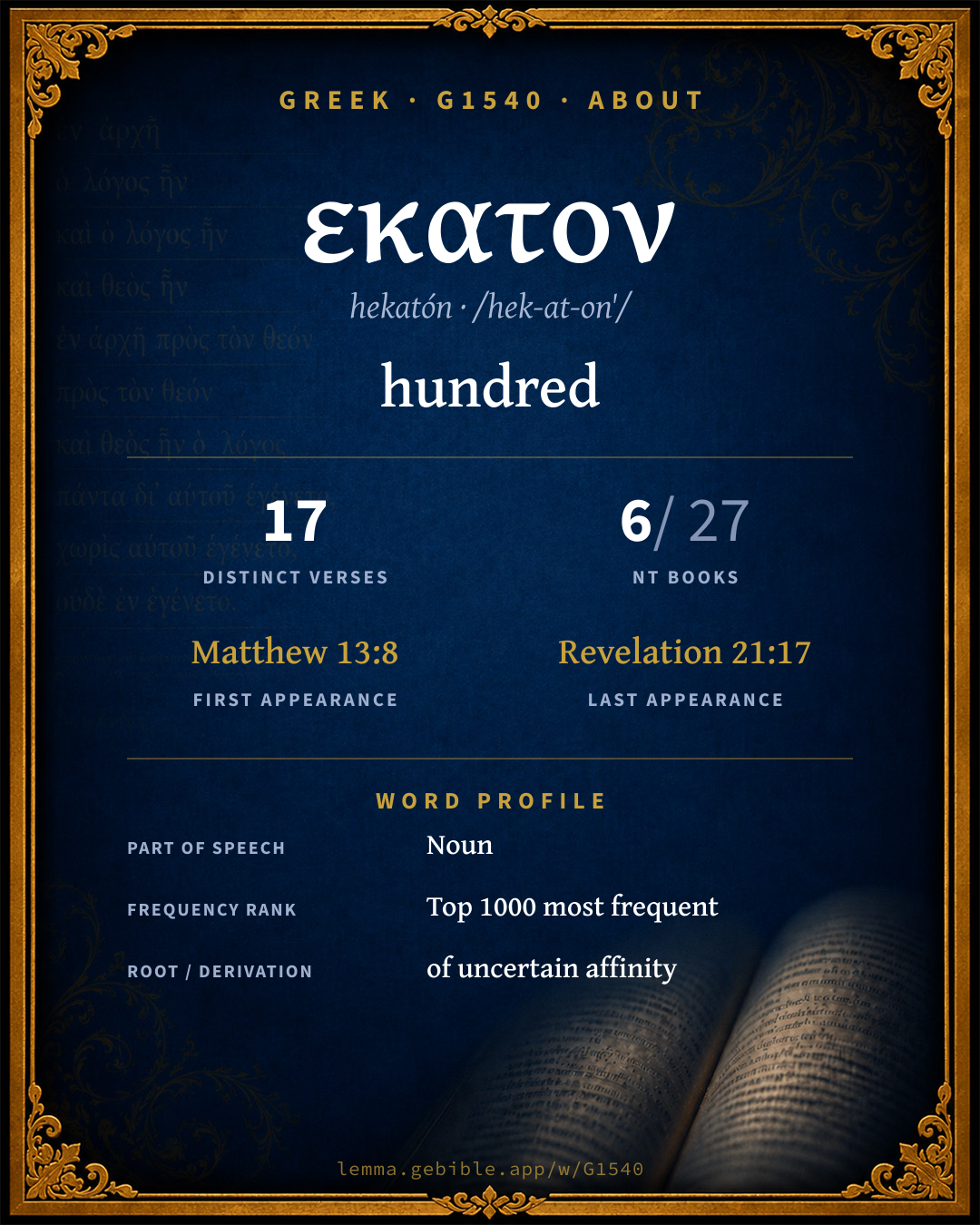
ἑκατόν
hundred
Full lexicon entry — Thayer's Greek Lexicon
From Thayer's Greek Lexicon
Where this word appears
Every verse where G1540 appears in the Book of Luke — 3 distinct verses. Click any verse to open its interlinear word-by-word view. Verse text shown in the World English Bible for context — . Each verse’s Greek form is shown with its reference; the English is not keyword-highlighted, since the data carries no word-level English alignment. Use “Compare translations” on any verse to read it across multiple English versions. This concordance covers the Greek New Testament; Septuagint (Greek Old Testament) occurrences of this word are not indexed here.
Luke
- Luke 15:4 ἑκατὸν adj num indecl "Which of you men, if you had one hundred sheep, and lost one of them, wouldn't leave the ninety-nine in the wilderness, and go after the one that was lost, until he found it?
- Luke 16:6 ἑκατὸν adj num indecl He said, 'A hundred batos of oil.' He said to him, 'Take your bill, and sit down quickly and write fifty.'
- Luke 16:7 ἑκατὸν adj num indecl Then said he to another, 'How much do you owe?' He said, 'A hundred cors of wheat.' He said to him, 'Take your bill, and write eighty.'
About this entry
At a glance — auto-summarized from this page’s data, not written by a person. Every figure links to its source below. This summary describes the numbers; it doesn’t interpret them.
εκατον (hekatón) is a Greek noun most often rendered “hundred.” Scripture first uses it in Matthew 13:8. It turns up in 17 verses across 6 books, an uncommon footprint. It clusters with εκατονταετης, εκατονταπλασιων and εκατονταρχης under a shared root. For the data behind this summary, explore the sense tree and the renderings breakdown below.
Gloss history
Strong's 1890 vs modern scholarship
About this word
Strong's G1540 catalogs a Greek word from the Greek New Testament.
These counts are not copied from any lexicon or concordance. They are computed here, from the morphology-tagged Greek New Testament. What Lemma adds →
- 17
- distinct verses
- The word appears in 17 distinct verses.
- 6 / 27
- NT books
- The word appears in 6 of 27 New Testament books.
- #697
- by frequency
- Top 1000 most frequent Greek words (rank 697 of 5,347 Greek words by occurrence).
View all 17 occurrences in the concordance →
Most concentrated in
- Matthew 4 verses 24%
- Revelation 4 verses 24%
- Mark 3 verses 18%
By section of the New Testament
By traditional corpus
Conventional, traditional groupings — biblical authorship is debated, so this is a traditional corpus grouping, not an authorship claim. Some books belong to more than one corpus (Luke is in both the Gospels and the Lukan corpus, and so on), so these shares overlap and need not total 100%. Each figure is a share of the word’s 17 distinct verses.
- Gospels 12 verses · 71%
- Johannine 6 verses · 35%
- Lukan (Luke–Acts) 4 verses · 24%
- Revelation 4 verses · 24%
How translations render this word
Counts come from each version’s own published word-to-Strong’s tagging or interlinear alignment — an approximate guide to how each version renders this word, not a word-level alignment the data otherwise carries. Because each total is that version’s own tagged count, the per-version totals vary from one another and need not match the appearance or distinct-verse counts above. These counts may also differ from a printed concordance because Lemma counts each distinctly tagged rendering and does not collapse phrase taggings into a single head-word total. This is a fixed set of word-tagged versions (KJV, ASV, BSB, ULT) and does not change with the reading translation you choose elsewhere. Each version’s license is shown beside its name below (and on Sources).
- King James Version: Hundred 14×, Hundredfold 2×
- American Standard Version: Hundred 11×, Hundredfold 2×
- Berean Standard Bible: Hundred 6×, Hundredfold 4×
- unfoldingWord Literal Text: Hundreds 1×
King James Version Public Domain
Renders G1540 across 17 tagged occurrences — most commonly:
Plus 1 rendering that appears only once — usually multi-word phrases or single function words the recovered tagging swept in, not distinct renderings.
American Standard Version Public Domain
Renders G1540 across 15 tagged occurrences — most commonly:
Plus 2 renderings that appear only once — usually multi-word phrases or single function words the recovered tagging swept in, not distinct renderings.
Berean Standard Bible Public Domain
Renders G1540 across 12 tagged occurrences — most commonly:
Plus 2 renderings that appear only once — usually multi-word phrases or single function words the recovered tagging swept in, not distinct renderings. Not rendered by a distinct English word in 5 further occurrences.
unfoldingWord Literal Text CC BY-SA 4.0
Renders G1540 across 1 tagged occurrence — most commonly:
Not rendered by a distinct English word in 16 further occurrences.
Senses in Thayer's
The 1 sense Thayer's distinguishes for this word, in lexicon order (not ranked by frequency or importance). The full entry — with sub-senses — is in the Lexicon Entry tab.
- a hundred
Word origin
Origin: of uncertain affinity
Of uncertain affinity; a hundred : - hundred.
— Strong’s Exhaustive Concordance (1890), public domain.
Forms in the corpus
The 2 distinct written forms G1540 takes in the Greek New Testament, most frequent first — each parse links to that case’s occurrences in the concordance.
| Form | Parsing | Example | Uses |
|---|---|---|---|
| ἑκατὸν hekatòn | Adjective, Numeral (indeclinable) | Matthew 18:12 | 12 |
| ἑκατόν hekatón | Adjective, Numeral (indeclinable) | Matthew 13:8 | 5 |
Same root — word family
Other Thayer's entries built from the same root as G1540, grouped by Strong’s listed origin. These share a root / origin per the lexicon — not necessarily a shared meaning. Each links to that word’s own entry.
Derived from this word
- εκατονταετης hekatontaétēs G1541 centenarian
- εκατονταπλασιων hekatontaplasíōn G1542 hundredfold
- εκατονταρχης hekatontárchēs G1543 centurion
Compare all same-root words → They share a root, not necessarily a meaning.
Septuagint usage
The same Greek word εκατον appears 195 times in the Greek Old Testament (Septuagint), across 174 verses in 22 books.
- 195
- LXX occurrences
- Tagged occurrences of this Greek word in the Septuagint.
- 174
- verses
- Distinct Septuagint verses containing this word.
- 22 / 39
- OT books
- The word appears in 22 of the 39 Old Testament books.
Sample Septuagint occurrences
- Genesis 5:9 ἑκατόν
- Exodus 6:16 ἑκατόν
- Leviticus 26:8 ἑκατόν
- Numbers 2:9 ἑκατόν
- Deuteronomy 22:19 ἑκατόν
- Joshua 24:30 ἑκατόν
- Judges 2:8 ἑκατόν
- 1 Samuel 18:15 ἑκατόν
- 2 Samuel 3:14 ἑκατόν
- 1 Kings 2:46 ἑκατόν
- 2 Kings 3:4 ἑκατόν
- 1 Chronicles 5:21 ἑκατόν
Septuagint occurrences (same lexeme)
Every verse where the same Strong’s number (G1540) appears in the Greek Septuagint — showing the first 50 of 174. Verse text shown in the World English Bible for context; the Greek form is the matched word — the English is not keyword-highlighted.
- Genesis 5:9 ἑκατόν Enosh lived ninety years, and became the father of Kenan.
- Genesis 5:12 ἑκατόν Kenan lived seventy years, and became the father of Mahalalel.
- Genesis 5:15 ἑκατόν Mahalalel lived sixty-five years, and became the father of Jared.
- Genesis 5:18 ἑκατόν Jared lived one hundred sixty-two years, and became the father of Enoch.
- Genesis 5:21 ἑκατόν Enoch lived sixty-five years, and became the father of Methuselah.
- Genesis 5:25 ἑκατόν Methuselah lived one hundred eighty-seven years, and became the father of Lamech.
- Genesis 5:28 ἑκατόν Lamech lived one hundred eighty-two years, and became the father of a son,
- Genesis 6:3 ἑκατόν Yahweh said, "My Spirit will not strive with man forever, because he also is flesh; yet will his days be one hundred twenty years."
- Genesis 7:24 ἑκατόν The waters prevailed on the earth one hundred fifty days.
- Genesis 8:3 ἑκατόν The waters receded from off the earth continually. After the end of one hundred fifty days the waters decreased.
- Genesis 11:10 ἑκατόν This is the history of the generations of Shem. Shem was one hundred years old, and became the father of Arpachshad two years after the flood.
- Genesis 11:12 ἑκατόν Arpachshad lived thirty-five years, and became the father of Shelah.
- Genesis 11:13 ἑκατόν Arpachshad lived after he became the father of Shelah four hundred three years, and became the father of sons and daughters.
- Genesis 11:14 ἑκατόν Shelah lived thirty years, and became the father of Eber:
- Genesis 11:16 ἑκατόν Eber lived thirty-four years, and became the father of Peleg.
- Genesis 11:18 ἑκατόν Peleg lived thirty years, and became the father of Reu.
- Genesis 11:20 ἑκατόν Reu lived thirty-two years, and became the father of Serug.
- Genesis 11:22 ἑκατόν Serug lived thirty years, and became the father of Nahor.
- Genesis 11:25 ἑκατόν Nahor lived after he became the father of Terah one hundred nineteen years, and became the father of sons and daughters.
- Genesis 21:5 ἑκατόν Abraham was one hundred years old when his son, Isaac, was born to him.
- Genesis 23:1 ἑκατόν Sarah lived one hundred twenty-seven years. These were the years of Sarah's life.
- Genesis 25:7 ἑκατόν These are the days of the years of Abraham's life which he lived: one hundred seventy-five years.
- Genesis 25:17 ἑκατόν These are the years of the life of Ishmael: one hundred thirty-seven years. He gave up the spirit and died, and was gathered to his people.
- Genesis 33:19 ἑκατόν He bought the parcel of ground, where he had spread his tent, at the hand of the children of Hamor, Shechem's father, for one hundred pieces of money.
- Genesis 35:28 ἑκατόν The days of Isaac were one hundred eighty years.
- Genesis 47:9 ἑκατόν Jacob said to Pharaoh, "The days of the years of my pilgrimage are one hundred thirty years. Few and evil have been the days of the years of my life, and they have not attained to the days of the years of the life of my fathers in the days of their pilgrimage."
- Genesis 47:28 ἑκατόν Jacob lived in the land of Egypt seventeen years. So the days of Jacob, the years of his life, were one hundred forty-seven years.
- Genesis 50:22 ἑκατόν Joseph lived in Egypt, he, and his father's house. Joseph lived one hundred ten years.
- Genesis 50:26 ἑκατόν So Joseph died, being one hundred ten years old, and they embalmed him, and he was put in a coffin in Egypt.
- Exodus 6:16 ἑκατόν These are the names of the sons of Levi according to their generations: Gershon, and Kohath, and Merari; and the years of the life of Levi were one hundred thirty-seven years.
- Exodus 6:18 ἑκατόν The sons of Kohath: Amram, and Izhar, and Hebron, and Uzziel; and the years of the life of Kohath were one hundred thirty-three years.
- Exodus 6:20 ἑκατόν Amram took Jochebed his father's sister to himself as wife; and she bore him Aaron and Moses: and the years of the life of Amram were a hundred and thirty-seven years.
- Exodus 27:9 ἑκατόν "You shall make the court of the tent: for the south side southward there shall be hangings for the court of fine twined linen one hundred cubits long for one side:
- Exodus 27:11 ἑκατόν Likewise for the north side in length there shall be hangings one hundred cubits long, and the pillars of it twenty, and their sockets twenty, of brass; the hooks of the pillars, and their fillets, of silver.
- Exodus 27:18 ἑκατόν The length of the court shall be one hundred cubits, and the breadth fifty every where, and the height five cubits, of fine twined linen, and their sockets of brass.
- Exodus 37:7 ἑκατόν He made two cherubim of gold. He made them of beaten work them, at the two ends of the mercy seat;
- Exodus 37:9 ἑκατόν The cherubim spread out their wings on high, covering the mercy seat with their wings, with their faces toward one another. The faces of the cherubim were toward the mercy seat.
- Exodus 39:2 ἑκατόν He made the ephod of gold, blue, purple, scarlet, and fine twined linen.
- Exodus 39:4 ἑκατόν They made shoulder-pieces for it, joined together. At the two ends it was joined together.
- Leviticus 26:8 ἑκατόν Five of you shall chase a hundred, and a hundred of you shall chase ten thousand; and your enemies shall fall before you by the sword.
- Numbers 2:9 ἑκατόν All who were numbered of the camp of Judah were one hundred eighty-six thousand four hundred, according to their divisions. They shall set out first.
- Numbers 2:16 ἑκατόν "All who were numbered of the camp of Reuben were one hundred fifty-one thousand four hundred fifty, according to their hosts. They shall set out second.
- Numbers 2:24 ἑκατόν "All who were numbered of the camp of Ephraim were one hundred eight thousand one hundred, according to their divisions. They shall set out third.
- Numbers 2:31 ἑκατόν "All who were numbered of the camp of Dan were one hundred fifty-seven thousand six hundred. They shall set out last by their standards."
- Numbers 7:13 ἑκατόν and his offering was: one silver platter, the weight of which was one hundred thirty shekels, one silver bowl of seventy shekels, after the shekel of the sanctuary; both of them full of fine flour mixed with oil for a meal offering;
- Numbers 7:19 ἑκατόν He offered for his offering: one silver platter, the weight of which was one hundred thirty shekels, one silver bowl of seventy shekels, after the shekel of the sanctuary; both of them full of fine flour mixed with oil for a meal offering;
- Numbers 7:25 ἑκατόν gave his offering: one silver platter, the weight of which was a hundred and thirty shekels, one silver bowl of seventy shekels, after the shekel of the sanctuary; both of them full of fine flour mixed with oil for a meal offering;
- Numbers 7:31 ἑκατόν gave his offering: one silver platter, the weight of which was one hundred thirty shekels, one silver bowl of seventy shekels, after the shekel of the sanctuary; both of them full of fine flour mixed with oil for a meal offering;
- Numbers 7:37 ἑκατόν gave his offering: one silver platter, the weight of which was one hundred thirty shekels, one silver bowl of seventy shekels, after the shekel of the sanctuary; both of them full of fine flour mixed with oil for a meal offering;
- Numbers 7:43 ἑκατόν gave his offering: one silver platter, the weight of which was one hundred thirty shekels, one silver bowl of seventy shekels, after the shekel of the sanctuary; both of them full of fine flour mixed with oil for a meal offering;
These are occurrences of the same Greek lexeme (G1540) in the Septuagint — not a translation of any one Hebrew word. The store carries no word-level Hebrew↔Greek alignment, so no Hebrew original is asserted here. Counts come from the recovered LXX Strong's tagging — high-frequency vocabulary is well covered, while rare or late forms may be untagged — so they reflect tagged occurrences and may slightly undercount.