
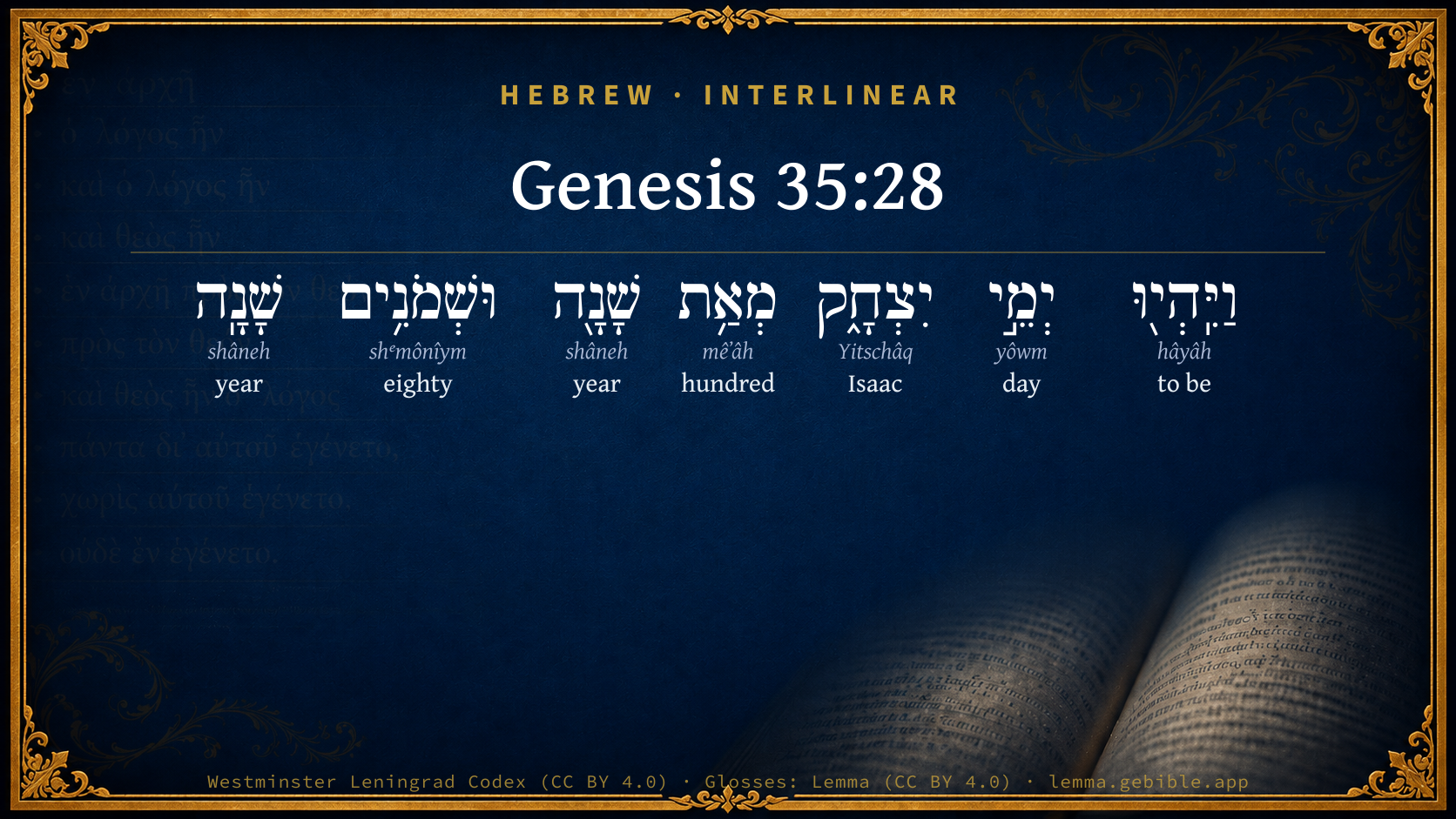
Genesis 35:28

Hebrew (Westminster Leningrad Codex) Genesis 35:28 appears in the Hebrew Old Testament. The text above is from the Westminster Leningrad Codex. Each word links to its Strong’s number, a concise gloss, and parsing drawn from the Open Scriptures Hebrew Bible morphology. Click any word for its full Brown-Driver-Briggs (BDB) entry.
Download image
Cite this verse

Genesis 35:28 (World English Bible). Public Domain. Lemma interlinear Bible study tool, https://lemma.gebible.app/v/genesis/35/28.

Show BibTeX & RIS
BibTeX
RIS
English Translation
The days of Isaac were one hundred eighty years.
World English Bible · Public Domain
Download a study sheet

One document with this verse’s original text, its word-by-word gloss line, the meaning frame, cross-references with their text, attributed commentary, and full source and license credits — printable, and it pastes into notes with its structure intact.

This verse Autodidact and up

Study sheet (.html) Plain text (.txt)

A passage Seminary Student

Up to 50 verses in one chapter. A passage sheet keeps up to 6 commentary sources and 12 cross-references per verse, in the order this page ranks them, and says so on the sheet whenever that leaves anything out. Ask for a single verse and you get the Autodidact verse sheet above.

Everything on this page stays free to read, with no account — the sheet is a download of what is already on screen, not access to it.

Want to remove ads? Support Godless Engineer
Compare translations 3

The same verse in 3 English versions, stacked beneath the original-language interlinear above. Click any original word for its lexicon entry.

Each is an independent rendering of the whole verse — the interlinear is not word-aligned to these translations.

Highlighted words mark where these versions differ — a whole-verse word diff, not a word-by-word alignment.

  • World English Bible Public Domain
    The days of Isaac were one hundred eighty years.
  • King James Version Public Domain
    And the days of Isaac were an hundred and fourscore years.
  • unfoldingWord Literal Text CC BY-SA 4.0
    And the days of Isaac were 180 years.

unfoldingWord Literal Text — © unfoldingWord, licensed CC BY-SA 4.0. Word-aligned USFM3 via Door43 (git.door43.org/unfoldingWord/en_ult).

Versions to compare (up to 4)

3 of 4 selected

Show all 18 translations

Every available English version of this verse, each an independent rendering of the whole verse.

  • World English Bible Public Domain
    The days of Isaac were one hundred eighty years.
  • Berean Standard Bible Public Domain
    And Isaac lived 180 years.
  • Majority Standard Bible Public Domain
    And Isaac lived 180 years.
  • King James Version Public Domain
    And the days of Isaac were an hundred and fourscore years.
  • American Standard Version (1901) Public Domain
    And the days of Isaac were a hundred and fourscore years.
  • Revised Version (1885) Public Domain
    And the days of Isaac were an hundred and fourscore years.
  • Geneva Bible (1599) Public Domain
    And the daies of Izhak were an hundreth and fourescore yeeres.
  • Douay-Rheims (1899) Public Domain
    And the days of Isaac were a hundred and eighty years.
  • Young's Literal Translation Public Domain
    And the days of Isaac are a hundred and eighty years,
  • Literal Standard Version CC BY-SA 4.0
    And the days of Isaac are one hundred and eighty years,
  • Unlocked Literal Bible CC BY-SA 4.0
    Isaac lived for one hundred eighty years.
  • unfoldingWord Literal Text CC BY-SA 4.0
    And the days of Isaac were 180 years.
  • Darby Bible Public Domain
    And the days of Isaac were a hundred and eighty years.
  • World Messianic Bible Public Domain
    The days of Isaac were one hundred eighty years.
  • Webster's Bible Public Domain
    And the days of Isaac were a hundred and eighty years.
  • Free Bible Version CC BY-SA 4.0
    Isaac lived to be 180
  • Bible in Basic English Public Domain
    And Isaac was a hundred and eighty years old.
  • JPS Tanakh (1917) Public Domain
    And the days of Isaac were a hundred and fourscore years.

Literal Standard Version (2020), Covenant Press — licensed CC BY-SA 4.0. Text via the HelloAO Bible API (eBible.org). Unlocked Literal Bible (unfoldingWord) — licensed CC BY-SA 4.0. Text via the HelloAO Bible API (eBible.org). unfoldingWord Literal Text — © unfoldingWord, licensed CC BY-SA 4.0. Word-aligned USFM3 via Door43 (git.door43.org/unfoldingWord/en_ult). Free Bible Version, Dr. Jonathan Gallagher — licensed CC BY-SA 4.0. Text via the HelloAO Bible API (eBible.org).

Word by word

More ways to search: Search by grammar → Find every occurrence → Compare this word →

Practice this passage: Drill this verse → Learn its vocabulary →

About this verse

These counts appear in no published source. They are computed here, from the morphology-tagged text and Lemma’s own curated glosses. What Lemma adds →

7
words
6
distinct lemmas
Pentateuch
section

Shared distinctive vocabulary

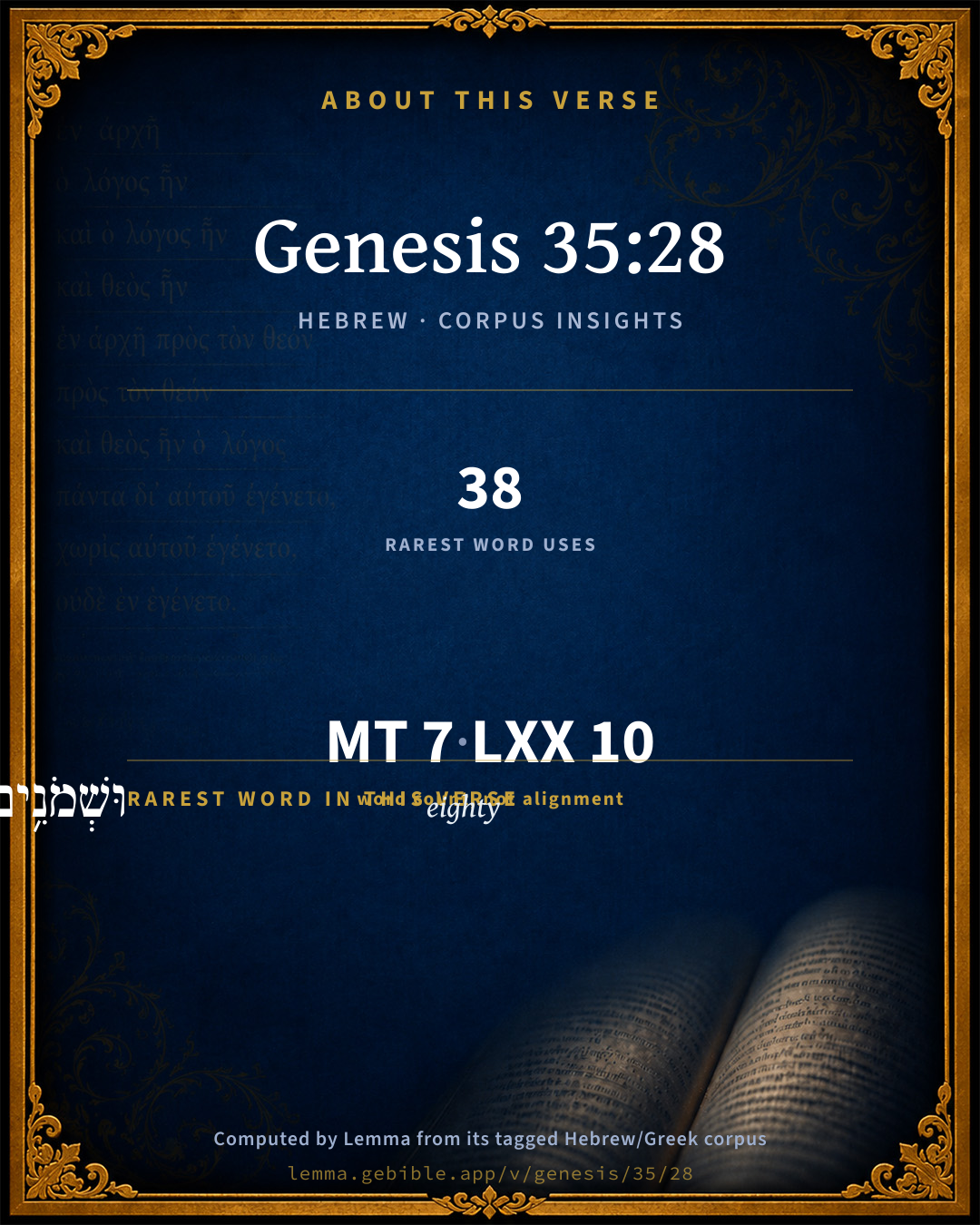
וּשְׁמֹנִ֥ים eighty H8084 occurs in 37 verses of the Hebrew Bible. Also found in:

Grammatical profile

  • 1 verb
  • 4 nouns
  • 2 adjectives

Verb forms

  • וַיִּֽהְי֖וּ Qal · Sequential Imperfect

Repetition

A word recurs within this verse — often emphatic in Hebrew:

  • שָׁנָ֖ה year H8141 ×2

Hebrew & Septuagint length

In English translation the verse runs 9 words from the Hebrew and 14 from the Septuagint (LXX English) — the Septuagint runs noticeably longer here. See the side-by-side →

A rough comparison of the two English renderings, which tokenize alike — not a word-level alignment.

Word counts can differ between the Hebrew and the Greek without any difference in meaning — e.g. the Hebrew direct-object marker אֵת has no separate Greek word, and Greek often adds the article ὁ.

In the original languages it is 7 Hebrew tokens and 10 Greek tokens — but the two are counted differently (Hebrew bundles its prefixes and suffixes into one token; the Greek is in lemma form), so that isn’t a like-for-like length.

Cross-references

3

Topical passages linked to Genesis 35:28 in the Treasury of Scripture Knowledge — connected by theme and wording, ordered by reader-vote popularity; previews shown in the World English Bible.

  • Genesis 25:7 These are the days of the years of Abraham's life which he lived: one hundred seventy-five years.
  • Genesis 50:26 So Joseph died, being one hundred ten years old, and they embalmed him, and he was put in a coffin in Egypt.
  • Genesis 47:28 Jacob lived in the land of Egypt seventeen years. So the days of Jacob, the years of his life, were one hundred forty-seven years.

Cross-references courtesy of OpenBible.info (CC BY 4.0).

Hebrew and Greek witnesses Masoretic Hebrew ↔ Greek Septuagint

The same verse in the two great witnesses to the Old Testament, shown verse-for-verse.

Here the Septuagint runs noticeably longer than the Hebrew — LXX2012 (modern English Septuagint) 14 words vs World English Bible 9. A rough length comparison of the two English translations, not a word-level alignment — read both below.

These are two independent witnesses, not word-aligned to each other, and the Septuagint is shown in lemma (dictionary) form.

Hebrew Genesis 35:28 Masoretic · Westminster Leningrad Codex

וַיִּֽהְי֖וּ יְמֵ֣י יִצְחָ֑ק מְאַ֥ת שָׁנָ֖ה וּשְׁמֹנִ֥ים שָׁנָֽה

The days of Isaac were one hundred eighty years.

World English Bible · Public Domain

Greek LXX Genesis 35:28 Septuagint · lemma form

γίγνομαι δέ ὁ ἡμέρα ισαακ ὅς ζάω ἔτος ἑκατόν ὀγδοήκοντα

And the days of Isaac which he lived were one hundred and eighty years.

LXX2012 (modern English Septuagint) · Public Domain

Hebrew: Westminster Leningrad Codex (CC BY 4.0). Greek: Septuagint (public domain); English from LXX2012 (modern English Septuagint) (Public Domain). How the Septuagint differs from the Hebrew →

Targum (Aramaic paraphrase)

2

The Targum is the ancient Jewish Aramaic paraphrase of the Hebrew Scriptures — an interpretive translation, not the Hebrew text itself. Onkelos (literal) and Pseudo-Jonathan (expansive) render the Torah, and Jonathan the Prophets. Coverage is partial: where no permissively-licensed English translation exists for a verse, only the Aramaic is shown. This is verse-level text, not a word-by-word alignment to the Hebrew.

  1. Targum Onkelos Torah (Genesis–Deuteronomy)
    וַהֲווֹ יוֹמֵי יִצְחָק מְאָה וּתְמָנָן שְׁנִין

    (no public-domain English translation for this verse)

    Targum Onkelos — Aramaic: “Onkelos Genesis” (public domain); “Onkelos Exodus” (public domain); “Onkelos Leviticus” (public domain); “Onkelos Numbers” (public domain); “Onkelos Deuteronomy” (public domain). English: “Sefaria Community Translation” (CC0 1.0 (public-domain dedication)); “J.W. Etheridge. The Targums of Onkelos and Jonathan Ben Uzziel on the Pentateuch. London: Longmans, Green, 1862” (public domain). Text via Sefaria.

  2. Targum Pseudo-Jonathan Torah (Genesis–Deuteronomy)
    וַהֲווֹ יוֹמֵי יִצְחָק מֵאָה וְתַמְנָן שְׁנִין

    And the days of Izhak were an hundred and eighty years.

    Targum Pseudo-Jonathan — Aramaic: “Targum Jonathan on Genesis” (public domain); “Targum Jonathan on Exodus” (public domain); “Targum Jonathan on Leviticus” (public domain); “Targum Jonathan on Numbers” (public domain); “Targum Jonathan on Deuteronomy” (public domain). English: “The Targum of Jonathan ben Uzziel, trans. J. W. Etheridge, London, 1862” (public domain). Text via Sefaria.

Commentary

Notes on Genesis 35:28 from classic Christian and Jewish commentators (each source and its license shown beneath its notes). The classic Christian expositions comment on the surrounding passage and are grouped to its opening verse, so a note may address several verses; the Jewish commentaries on the Tanakh (Rashi and others) are per-verse, so they appear only where the commentator wrote on this verse.

Lemma curates 59 commentaries, every one of them public domain or Creative Commons licensed, each selected and text-cleaned for this edition rather than reprinted as found. About our sources →

Trapp's Complete Commentary

John Trapp

Gen 35:28 And the days of Isaac were an hundred and fourscore years.

Ver. 29. And Isaac gave up the ghost.] Twelve years after Joseph was sold, and forty years after he first became blind. Three special friends Jacob buries, in this chapter. Crosses come thick: be patient.

John Trapp, A Commentary or Exposition upon All the Books of the Old and New Testament (1647–1656) — public domain. Text from a community e-Sword module.

The Biblical Illustrator

Joseph S. Exell

Gen_35:28-29

And the days of Isaac were a hundred and fourscore years.

And Isaac gave up the ghost

The character of Isaac

The lives of Abraham and Jacob are as attractive as the life of Isaac is apparently unattractive. Isaacs character had few salient features. It had no great faults, no striking virtues; it is the quietest, smoothest, most silent character in the Old Testament. It is owing to this that there are so few remarkable events in the life of Isaac, for the remarkableness of events is created by the character that meets them. It seems to be a law that all national, social, and personal life should advance by alternate contractions and expansions. There are few instances where a great father has had a son who equalled him in greatness. The old power more often reappears in Jacob than in Isaac. The spirit of Abrahams energy passed over his son to his sons son. The circumstances that moulded the character of Isaac were these.

1. He was an only son.

2. His parents were both very old. At atmosphere of antique quiet hung about his life.

3. These two old hearts lived for him alone.

I. Take the EXCELLENCES of his character first. His submissive self-surrender on Mount Gerizim, which shadowed forth the perfect sacrifice of Christ.

2. His tender constancy, seen in his mourning for his mother, and in the fact that he alone of the patriarchs represented to the Jewish nation the ideal of true marriage.

3. His piety. It was as natural to him as to a woman to trust and love: not strongly, hut constantly, sincerely. His trust became the habit of his soul. His days were knit each to each by natural piety.

II. Look next at the FAULTS of Isaacs character.

1. He was slow, indifferent, inactive. We find this exemplified in the story of the wells (verse 26:18-22).

2. The same weakness, ending in selfishness, appears in the history of Isaacs lie to Abimelech.

3. He showed his weakness in the division between Jacob and Esau. He took no pains to harmonize them. The curse of favouritism prevailed in his tent.

4. He dropped into a querulous old age, and became a lover of savoury meat. But our last glimpse of him is happy. He saw the sons of Jacob at Hebron, and felt that Gods promise was fulfilled. (S. A. Brooke, M. A.)

The death and burial of Isaac

I. IT WAS THE OCCASION OF FAMILY REUNION.

II. IT WAS A TIME FOR REVIVAL OF MEMORIES OF THE PAST,

III. IT WAS THE BEGINNING OF ANOTHER AND A HIGHER LIFE. (T. H. Leale.)

The death of Isaac

I. THAT HIS DEATH WAS PEACEFUL.

1. Because his spirit was given up to the rightful owner.

2. Because the souls earthly activities had come to an end.

3. Because his souls temporal purposes had been gained.

II. THAT HIS LIFE WAS WELL SPENT.

1. His souls interests had not been neglected.

2. Society had been benefited.

3. God had been served.

III. HE WAS BELOVED AND HONOURED BY HIS FAMILY. This is intimated to us--

1. By his being buried with his people.

2. By his sons attending his funeral. (Homilist.)

Lessons

1. God brings at last His Jacob and Church to their desired place in their pilgrimage.

2. God makes good His word in making Jacob successor to Abraham and Isaac in their sojourning (Gen_35:27).

3. The blessing of long life God grants to His servants, when and where it may be beneficial to His Church (Gen_35:28).

4. Expiration and dissolution are the appointed conditions of saints in order unto glory.

5. Saints in dissolution go out of the world unto their own people.

6. Old age or fulness of days is given here sometimes to Gods saints, i.e., days full of work, as well as many.

7. Nature and grace agree to evince and perform the duty of burial.

8. It is piety to parents deceased so to order their burial and interment that it may be comely and honourable.

9. The death as well as the life of saints God recordeth for His Churchs instruction, and to point out distinct periods (Gen_35:29). (G. Hughes, B. D.)

Esau and Jacob at Isaacs deathbed

The tenderness of these two brothers towards one another and towards their father was probably quickened by remorse when they met at his deathbed. They could not, perhaps, think that they had hastened his end by causing him anxieties which age has not strength to throw off; but they could not miss the reflection that the life now closed and finally sealed up might have been a much brighter life had they acted the part of dutiful, loving sons. Scarcely can one of our number pass from among us without leaving in our minds some self-reproach that we were not more kindly towards him, and that now he was beyond our kindness; that our opportunity for being brotherly towards him is for ever gone. And when we have very manifestly erred in this respect: perhaps there are among all the stings of a guilty conscience few more bitterly piercing than this. Many a son who has stood unmoved by the tears of a living mother--his mother by whom he lives, who has cherished him as her own soul, who has forgiven and forgiven and forgiven him, who has toiled and prayed, and watched for him--though he has hardened himself against her looks of imploring love and turned carelessly from her entreaties and burst through all the fond cords and snares by which she has sought to keep him, has yet broken down before the calm, unsolicitous, resting face of the dead. Hitherto he has not listened to her pleadings, and now she pleads no more. Hitherto she has heard no word of pure love from him, and now she hears no more. Hitherto he has done nothing for her of all that a son may do, and now there is nothing he can do. All the goodness of her life gathers up and stands out at once, and the time for gratitude is past. He sees suddenly, as by the withdrawal of a veil, all that that worn body has passed through for him, and all the goodness these features have expressed, and now they can never light up with joyful acceptance of his love and duty. Such grief as this finds its one alleviation in the knowledge that we may follow those who have gone before us; that we may yet make reparation. (M. Dods, D. D.)

.

The Biblical Illustrator, edited by Joseph S. Exell (c. 1880s–1900s) — public domain. Text from a community e-Sword module.

Joseph Benson's Commentary

Gen 35:28-29. The days of Isaac were a hundred and fourscore years — He lived the longest of all the patriarchs, even five years longer than Abraham. He was a mild and quiet man, and these qualities probably contributed no little to his health and long life. Isaac lived about forty years after he made his will. We shall not die an hour the sooner, but abundantly the better, for our timely setting our heart and house in order. Isaac gave up the ghost and died — Although it appears by computation that he did not die till many years after Joseph was sold into Egypt, and, indeed, not till about the time he was preferred there; yet his death is here recorded that his story might be finished, and the subsequent narrative proceed without interruption. His sons Esau and Jacob buried him — Solemnized his funeral in an amicable manner, being now perfectly united in brotherly affection. This is mentioned to show how wonderfully God had changed Esau’s mind, since he vowed his brother’s murder, upon his father’s death, Gen 27:41. God has many ways of preventing ill men from doing the mischief they intended; he can either tie their hands, or change their hearts.

Joseph Benson's Commentary on the Old and New Testaments (1811–1818) — public domain. Text from a community e-Sword module.

John Calvin's Commentaries

28. And the days of Isaac. The death of Isaac is not related in its proper order, as will soon appear from the connection of the history: but, as we have elsewhere seen, the figure hysteron proteron was familiar to Moses. When it is said, that he died old, and full of days, the meaning is, that, having fulfilled the course of his life, he departed by a mature death; this, therefore, is ascribed to the blessing of God. Nevertheless, I refer these words not merely to the duration of his life, but also to the state of his feelings; implying that Isaac, being satisfied with life, willingly and placidly departed out of the world. For we may see certain decrepit old men, who are not less desirous of life then they were in the flower of their age; and with one foot in the grave, they still have a horror of death. Therefore, though long life is reckoned among the blessings of God; yet it is not enough for men to be able to count up a great number of years; unless they feel that they have lived long, and, being satisfied with the favor of God and with their own age, prepare themselves for their departure. Now, in order that old men may leave their minds formed to this kind of moderation, it behoves them to have a good conscience, to the end, that they may not flee from the presence of God; for an evil conscience pursues and agitates the wicked with terror. Moses adds, that Isaac was buried by his two sons. For since, at that time, the resurrection was not clearly revealed, and its first fruits had not yet appeared, it behoved the holy fathers to be so much the more diligently trained in significant ceremonies, in order that they might correct the impression produced by the semblance of destruction which is presented in death. By the fact that Esau is put first, we are taught again, that the fruit of the paternal benediction was not received by Jacob in this life; for he who was the first-born by right, is still subjected to the other, after his father’s death.

John Calvin's Commentaries (1540-1563) — public domain. Text from the Calvin Translation Society English edition (1840s-50s) via the Christian Classics Ethereal Library (ccel.org). Calvin's coverage is partial (roughly two-thirds of the Bible); uncommented books and verses are honest gaps, never fabricated. The 19th-century editor's footnotes and remarks are omitted so the notes are faithfully Calvin's own voice.

Ellicott's Commentary for English Readers

(28) The days of Isaac were an hundred and fourscore years.—As Isaac was sixty when his sons were born, Jacob was one hundred and twenty years of age at his father’s death, and one hundred and thirty when he appeared before Pharaoh (Gen_47:9). Now, as Joseph was seventeen when sold into Egypt (Gen_37:2), and thirty when raised to power (Gen_41:46), and as the seven years of plenty and two of the years of famine had passed before Jacob went down into Egypt, it follows that the cruel deed, whereby he was robbed of his favourite child, was committed about twelve years before the death of Isaac.

A Bible Commentary for English Readers, edited by Charles John Ellicott (1878–1897) — public domain. Text from a community e-Sword module.

The Cambridge Bible for Schools and Colleges

gen. ed. J. J. S. Perowne

28. the days of Isaac] Isaac is here credited with a longer life by 5 years than Abraham. Cf. Gen_25:7. Comparing this verse with Gen_25:20, Gen_26:34, Jacob, according to P, was 120 years old at his father’s death; he had left his father at the age of 40; and had resided in Canaan for nearly 60 years. There is no mention of his having visited Isaac again.

The Cambridge Bible for Schools and Colleges (gen. ed. J. J. S. Perowne; Cambridge University Press, 1878–1918) — public domain. Text from a community e-Sword module.

Whedon's Commentary on the Bible

Daniel D. Whedon

28. Hundred and fourscore years — He lived five years more than his father Abraham. Gen_25:7.

Daniel D. Whedon (gen. ed.), Commentary on the Old and New Testaments (1874–1909) — public domain. Text from a community e-Sword module.

The Pulpit Commentary

And the days of Isaac were a hundred and fourscore years. At this time Jacob was 120; but at 130 he stood before Pharaoh in Egypt, at which date Joseph had been 10 years governor. He was therefore 120 when Joseph was promoted at the age of 30, and 107 when Joseph was sold; consequently Isaac was 167 years of age when Joseph was sold, so that he must have survived that event and sympathized with Jacob his son for a period of 13 years.

The Pulpit Commentary (1880–1919), ed. H.D.M. Spence-Jones & Joseph S. Exell — public domain. Text from a community e-Sword module.

John Wesley's Explanatory Notes

The age and death of Isaac are here recorded, though it appears by computation that he died not 'till many years after Joseph was sold into Egypt, and much about the time that he was preferred there. Isaac, a mild quiet man, lived the longest of all the patriarchs, for he was one hundred and eighty years old: Abraham was but one hundred and seventy-five. Isaac lived about forty years after he had made his will, chap. xxvii, 2. We shall not die an hour the sooner, but abundance the better, for our timely setting of our heart and house in order. Particular notice is taken of the amicable agreement of Esau and Jacob in solemnizing their father's funeral, ver. 29, to shew how God had wonderfully changed Esau's mind, since he vowed his brother's murder, upon his father's death, chap. xxvii, 41. God has many ways of preventing ill men from doing the mischief they in tended; he can either tie their hands, or turn their hearts.

John Wesley, Explanatory Notes Upon the Whole Bible (1754–1765) — public domain. Text via the GEBible commentary corpus.

unfoldingWord translationNotes

Door43 World Missions Community

one hundred eighty years

"180 years" (See: Numbers)

Isaac breathed his last and died

"Isaac took his last breath and died." The phrases "breathed his last" and "died" mean basically the same thing. See how you translated a similar phrase in Genesis 25:08. AT: "Isaac died" (See: Doublet)

breathed his last

This is a polite way of saying a person died. See how you translated this in Genesis 25:8. (See: Euphemism)

was gathered to his ancestors

This means that after Isaac died, his soul went to the same place as his relatives who died before him. This can be stated in active form. AT: "he joined his family members who had already died" (See: Idiom and Active or Passive)

an old man full of days

The phrases "old man" and "full of days" mean basically the same thing. They emphasize that Isaac lived a very long time. AT: "after he had lived a very long time and was very old" (See: Doublet)

translationWords

Isaac

year

ancestor

Esau

Jacob

bury

unfoldingWord translationNotes — © Distant Shores Media and the Door43 World Missions Community, licensed CC BY-SA 4.0. Source: git.door43.org/Door43/en_tn.

Ramban (Nachmanides)

Rabbi Moshe ben Nachman (Ramban / Nachmanides)

AND THE DAYS OF ISAAC WERE. There is no strict chronological order in the narrative of the Torah. The sale of Joseph preceded Isaac’s death. This is Rashi’s language. Now I have already written that such is the customary way of Scripture with respect to all generations: it tells of a person and his children and his death and then begins with the account of the next generation even though the generations overlapped.Now it would have been proper for Scripture to present Isaac’s death prior to the experiences of Jacob, just as it did in the case of Abraham and all former generations. But by this delay, Scripture intended to state that Isaac died in a good old age, an old man, and full of years, 25:8. — [just as is said of Abraham] — after his blessed son Jacob, the inheritor of his high rank, returned to him, and his sons Esau and Jacob, great men of the world, buried him. It was not necessary for Scripture to mention that they buried him in the cave of Machpelah since it mentioned that Isaac was in the city of Hebron, and where should they bury him if not near the gravesite of his father?

Ramban (Nachmanides) on the Tanakh — English translation: “Commentary on the Torah by Ramban (Nachmanides). Translated and annotated by Charles B. Chavel. New York, Shilo Pub. House, 1971-1976” (CC BY 4.0). Text via Sefaria.

Lesson kit

Teaching starters — assembled from the data on this page, not authored interpretation. Every prompt links to the verse data it draws on. Edit before teaching.

Genesis, in the Pentateuch, opens this verse with 7 words (6 distinct Hebrew lemmas). Its most distinctive word is shᵉmônîym (“eighty”). The Greek Septuagint runs longer here. A historical commentator’s framing appears above. Read the whole chapter for the surrounding context.

Discussion questions

  1. What does “eighty” (shᵉmônîym) contribute to the verse as a whole?
  2. Genesis 5:25 shares the word «eighty» with this verse. How do the two illuminate each other?
  3. “year” occurs 2× in this one verse. What is the effect of the repetition?
  4. Compared with the Hebrew, the Septuagint runs longer here. What questions does that raise?
  5. These translations render this verse differently; the difference is in the English rendering, not the original. What questions does that raise?
  6. The verb «וַיִּֽהְי֖וּ» is Qal Sequential Imperfect. How does its form color the action?
  7. Reading how Trapp's Complete Commentary and The Biblical Illustrator read this verse, where do the two commentators agree and where do they part?

Things to notice

Reading settings

Reading text

Shown beneath each verse's original-language words.

Old Testament
Old Testament edition

Read the OT as the Masoretic Hebrew (MT) or the Greek Septuagint (LXX).

English shown for the Greek Septuagint (in the Hebrew ↔ Greek comparison).

Comparing translations? Open the Compare panel on any verse page to stack up to four side by side.