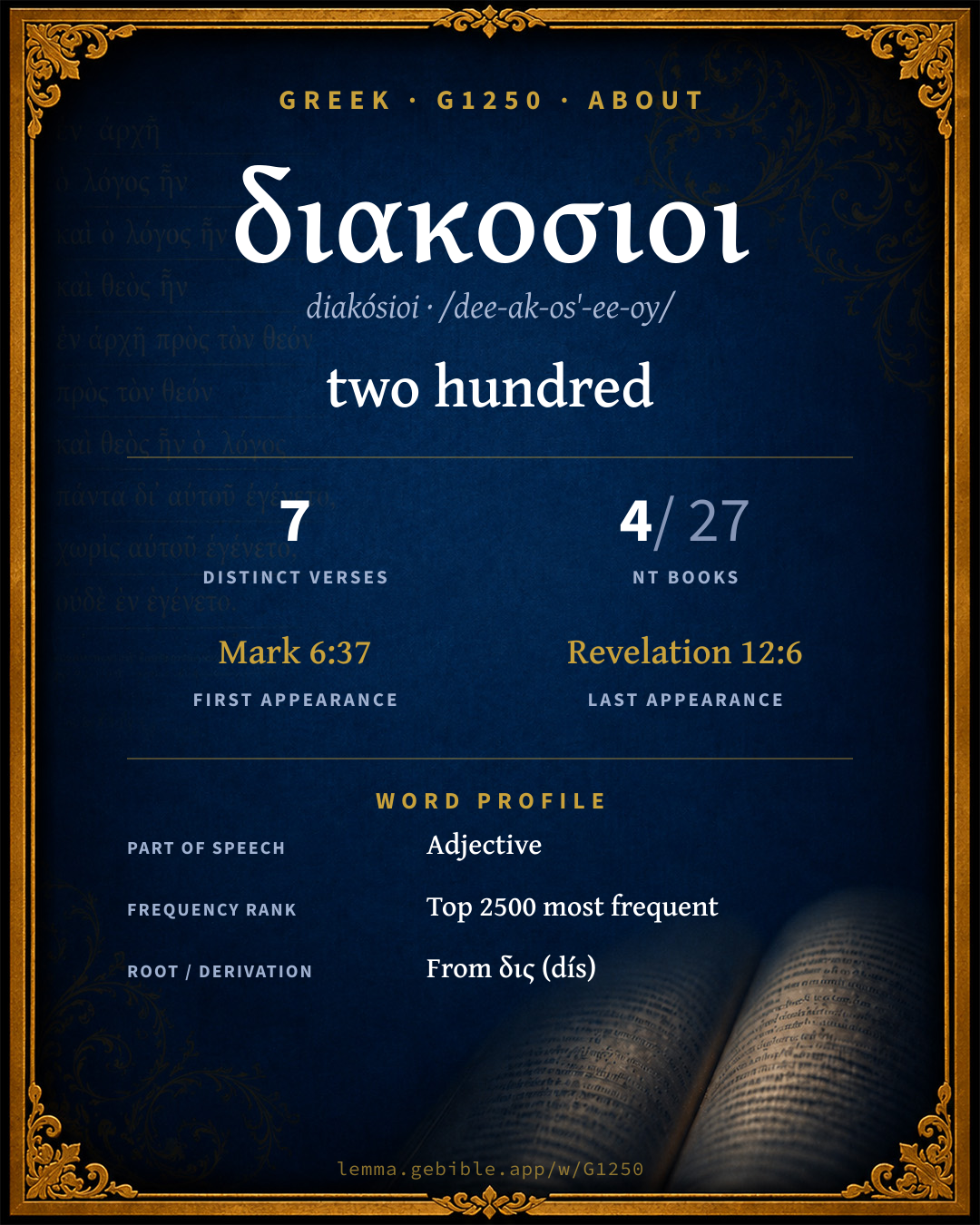
διακόσιοι
two hundred
Full lexicon entry — Thayer's Greek Lexicon
From Thayer's Greek Lexicon
Where this word appears
See every Accusative-case word in the Greek New Testament →
Grammar key — what these labels mean
Part of speech
- Adjective
- A word that describes or qualifies a noun.
Case
- Accusative
- The case of the direct object and of extent.
- Genitive
- The case of source, possession, or “of” — answers “whose / from what.”
- Nominative
- The case of the subject (and the predicate nominative).
Gender
- Feminine
- Grammatically feminine.
- Masculine
- Grammatically masculine.
- Neuter
- Grammatically neuter.
Number
- Plural
- More than one.
Grammatical forms
- Adjective, Accusative, Plural, Feminine 2 times (25%)
- Adjective, Accusative, Plural, Masculine 2 times (25%)
- Adjective, Genitive, Plural, Neuter 2 times (25%)
- Adjective, Genitive, Plural, Masculine 1 time (13%)
- Adjective, Nominative, Plural, Feminine 1 time (13%)
Parsed forms decoded from the imported morphology (Robinson–Tischendorf, public domain), counted across 8 parsed occurrences — not distinct verses.
Every verse where G1250 appears — 7 distinct verses across 4 books. Click any verse to open its interlinear word-by-word view. Verse text shown in the World English Bible for context — . Each verse’s Greek form is shown with its reference; the English is not keyword-highlighted, since the data carries no word-level English alignment. Use “Compare translations” on any verse to read it across multiple English versions. This concordance covers the Greek New Testament; Septuagint (Greek Old Testament) occurrences of this word are not indexed here.
Mark 1 verse
John 2 verses
- John 6:7 διακοσίων adj gen pl neut Philip answered him, "Two hundred denarii worth of bread is not sufficient for them, that everyone of them may receive a little."
- John 21:8 διακοσίων adj gen pl masc But the other disciples came in the little boat (for they were not far from the land, but about two hundred cubits away), dragging the net full of fish.
Acts 2 verses
- Acts 23:23 διακοσίους διακοσίους adj acc pl masc adj acc pl masc He called to himself two of the centurions, and said, "Prepare two hundred soldiers to go as far as Caesarea, with seventy horsemen, and two hundred men armed with spears, at the third hour of the night."
- Acts 27:37 διακόσιαι adj nom pl fem In all, we were two hundred seventy-six souls on the ship.
Revelation 2 verses
- Revelation 11:3 διακοσίας adj acc pl fem I will give power to my two witnesses, and they will prophesy one thousand two hundred sixty days, clothed in sackcloth."
- Revelation 12:6 διακοσίας adj acc pl fem The woman fled into the wilderness, where she has a place prepared by God, that there they may nourish her one thousand two hundred sixty days.
About this entry
At a glance — auto-summarized from this page’s data, not written by a person. Every figure links to its source below. This summary describes the numbers; it doesn’t interpret them.
διακοσιοι — transliterated diakósioi — is a Greek adjective carrying the sense “two hundred.” Debuting at Mark 6:37, it then recurs through the corpus. With 7 verses in 4 books, it is an uncommon word in the Greek New Testament. Its uses concentrate in John (29% of all occurrences). Sharing its root, it stands alongside δις, διδραχμον and διετης. See the sense tree, 7-verse concordance, and the renderings breakdown below.
Gloss history
Strong's 1890 vs modern scholarship
About this word
Strong's G1250 catalogs a Greek word from the Greek New Testament.
These counts are not copied from any lexicon or concordance. They are computed here, from the morphology-tagged Greek New Testament. What Lemma adds →
- 7
- distinct verses
- The word appears in 7 distinct verses.
- 4 / 27
- NT books
- The word appears in 4 of 27 New Testament books.
- #1,240
- by frequency
- Top 2500 most frequent Greek words (rank 1,240 of 5,347 Greek words by occurrence).
View all 7 occurrences in the concordance →
Most concentrated in
- John 2 verses 29%
- Acts 2 verses 29%
- Revelation 2 verses 29%
By section of the New Testament
By traditional corpus
Conventional, traditional groupings — biblical authorship is debated, so this is a traditional corpus grouping, not an authorship claim. Some books belong to more than one corpus (Luke is in both the Gospels and the Lukan corpus, and so on), so these shares overlap and need not total 100%. Each figure is a share of the word’s 7 distinct verses.
- Johannine 4 verses · 57%
- Gospels 3 verses · 43%
- Lukan (Luke–Acts) 2 verses · 29%
- Revelation 2 verses · 29%
How translations render this word
Counts come from each version’s own published word-to-Strong’s tagging or interlinear alignment — an approximate guide to how each version renders this word, not a word-level alignment the data otherwise carries. Because each total is that version’s own tagged count, the per-version totals vary from one another and need not match the appearance or distinct-verse counts above. These counts may also differ from a printed concordance because Lemma counts each distinctly tagged rendering and does not collapse phrase taggings into a single head-word total. This is a fixed set of word-tagged versions (KJV, ASV, BSB, ULT) and does not change with the reading translation you choose elsewhere. Each version’s license is shown beside its name below (and on Sources).
- King James Version: Two hundred 8×
- American Standard Version: Two hundred 8×
- Berean Standard Bible: Two hundred 4×
- unfoldingWord Literal Text: not separately translated
King James Version Public Domain
Renders G1250 across 8 tagged occurrences — most commonly:
American Standard Version Public Domain
Renders G1250 across 8 tagged occurrences — most commonly:
Berean Standard Bible Public Domain
Renders G1250 across 5 tagged occurrences — most commonly:
Plus 1 rendering that appears only once — usually multi-word phrases or single function words the recovered tagging swept in, not distinct renderings. Not rendered by a distinct English word in 3 further occurrences.
unfoldingWord Literal Text CC BY-SA 4.0
Does not render G1250 with a distinct English word (not separately translated in its 8 tagged occurrences).
Senses in Thayer's
The 1 sense Thayer's distinguishes for this word, in lexicon order (not ranked by frequency or importance). The full entry — with sub-senses — is in the Lexicon Entry tab.
- two hundred
Word origin
Derived from δις (dís) (G1364) — twice.
Forms in the corpus
The 4 distinct written forms G1250 takes in the Greek New Testament, most frequent first — each parse links to that case’s occurrences in the concordance.
| Form | Parsing | Example | Uses |
|---|---|---|---|
| διακοσίων diakosíōn | Adjective, Genitive, Plural, Neuter | Mark 6:37 | 3 |
| διακοσίας diakosías | Adjective, Accusative, Plural, Feminine | Revelation 11:3 | 2 |
| διακοσίους diakosíous | Adjective, Accusative, Plural, Masculine | Acts 23:23 | 2 |
| διακόσιαι diakósiai | Adjective, Nominative, Plural, Feminine | Acts 27:37 | 1 |
Same root — word family
Other Thayer's entries built from the same root as G1250, grouped by Strong’s listed origin. These share a root / origin per the lexicon — not necessarily a shared meaning. Each links to that word’s own entry.
Derives from
Shares the same root
- διδραχμον dídrachmon G1323 didrachma
- διετης dietḗs G1332 two-year-old
- διθαλασσος dithálassos G1337 between two seas
- διλογος dílogos G1351 double-tongued
- διπλους diploûs G1362 double
- δισταζω distázō G1365 to doubt
- διστομος dístomos G1366 double-mouthed
- δισχιλιοι dischílioi G1367 two thousand
- διχαζω dicházō G1369 to cut asunder
- διχοστασια dichostasía G1370 dissension
- διχοτομεω dichotoméō G1371 to scourge severely
- διψυχος dípsychos G1374 double-minded
Proper names from this root
People and places named from this root — a name, not an additional meaning of the word.
Compare all same-root words → Showing 4 of 15 — not the complete family. 1 of the same-root words is a proper name (a person or place). They share a root, not necessarily a meaning.
Septuagint usage
The same Greek word διακοσιοι appears 77 times in the Greek Old Testament (Septuagint), across 71 verses in 15 books.
- 77
- LXX occurrences
- Tagged occurrences of this Greek word in the Septuagint.
- 71
- verses
- Distinct Septuagint verses containing this word.
- 15 / 39
- OT books
- The word appears in 15 of the 39 Old Testament books.
Sample Septuagint occurrences
- Genesis 5:3 διακόσιοι
- Exodus 30:23 διακόσιοι
- Numbers 1:33 διακόσιοι
- Joshua 7:21 διακόσιοι
- Judges 17:4 διακόσιοι
- 1 Samuel 25:13 διακόσιοι
- 2 Samuel 14:26 διακόσιοι
- 1 Kings 21:15 διακόσιοι
- 1 Chronicles 5:21 διακόσιοι
- 2 Chronicles 8:10 διακόσιοι
- Ezra 1:10 διακόσιοι
- Job 42:16 διακόσιοι
Septuagint occurrences (same lexeme)
Every verse where the same Strong’s number (G1250) appears in the Greek Septuagint — showing the first 50 of 71. Verse text shown in the World English Bible for context; the Greek form is the matched word — the English is not keyword-highlighted.
- Genesis 5:3 διακόσιοι Adam lived one hundred thirty years, and became the father of a son in his own likeness, after his image, and named him Seth.
- Genesis 5:6 διακόσιοι Seth lived one hundred five years, and became the father of Enosh.
- Genesis 5:22 διακόσιοι Enoch walked with God after he became the father of Methuselah three hundred years, and became the father of sons and daughters.
- Genesis 11:19 διακόσιοι Peleg lived after he became the father of Reu two hundred nine years, and became the father of sons and daughters.
- Genesis 11:21 διακόσιοι Reu lived after he became the father of Serug two hundred seven years, and became the father of sons and daughters.
- Genesis 11:23 διακόσιοι Serug lived after he became the father of Nahor two hundred years, and became the father of sons and daughters.
- Genesis 11:32 διακόσιοι The days of Terah were two hundred five years. Terah died in Haran.
- Genesis 32:15 διακόσιοι thirty milk camels and their colts, forty cows, ten bulls, twenty she-donkeys and ten foals.
- Exodus 30:23 διακόσιοι "Also take fine spices: of liquid myrrh, five hundred shekels; and of fragrant cinnamon half as much, even two hundred and fifty; and of fragrant cane, two hundred and fifty;
- Numbers 1:33 διακόσιοι those who were numbered of them, of the tribe of Ephraim, were forty thousand five hundred.
- Numbers 2:21 διακόσιοι His division, and those who were numbered of them, were thirty-two thousand two hundred.
- Numbers 3:43 διακόσιοι All the firstborn males according to the number of names, from a month old and upward, of those who were numbered of them, were twenty-two thousand two hundred seventy-three.
- Numbers 3:46 διακόσιοι For the redemption of the two hundred seventy-three of the firstborn of the children of Israel, who exceed the number of the Levites,
- Numbers 4:36 διακόσιοι Those who were numbered of them by their families were two thousand seven hundred fifty.
- Numbers 4:44 διακόσιοι even those who were numbered of them by their families, were three thousand two hundred.
- Numbers 16:2 διακόσιοι and they rose up before Moses, with certain of the children of Israel, two hundred fifty princes of the congregation, called to the assembly, men of renown;
- Numbers 16:17 διακόσιοι and take every man his censer, and put incense on them, and bring you before Yahweh every man his censer, two hundred fifty censers; you also, and Aaron, each his censer.
- Numbers 16:35 διακόσιοι Fire came forth from Yahweh, and devoured the two hundred fifty men who offered the incense.
- Numbers 26:10 διακόσιοι and the earth opened its mouth, and swallowed them up together with Korah, when that company died; what time the fire devoured two hundred fifty men, and they became a sign.
- Numbers 26:14 διακόσιοι These are the families of the Simeonites, twenty-two thousand two hundred.
- Joshua 7:21 διακόσιοι when I saw among the spoil a goodly Babylonian mantle, and two hundred shekels of silver, and a wedge of gold of fifty shekels weight, then I coveted them, and took them; and, behold, they are hid in the earth in the midst of my tent, and the silver under it.
- Judges 17:4 διακόσιοι When he restored the money to his mother, his mother took two hundred [pieces] of silver, and gave them to the founder, who made of it an engraved image and a molten image: and it was in the house of Micah.
- 1 Samuel 25:13 διακόσιοι David said to his men, Gird you on every man his sword. They girded on every man his sword; and David also girded on his sword: and there went up after David about four hundred men; and two hundred abode by the baggage.
- 1 Samuel 25:18 διακόσιοι Then Abigail made haste, and took two hundred loaves, and two bottles of wine, and five sheep ready dressed, and five measures of parched grain, and one hundred clusters of raisins, and two hundred cakes of figs, and laid them on donkeys.
- 1 Samuel 30:10 διακόσιοι But David pursued, he and four hundred men; for two hundred stayed behind, who were so faint that they couldn't go over the brook Besor.
- 1 Samuel 30:21 διακόσιοι David came to the two hundred men, who were so faint that they could not follow David, whom also they had made to abide at the brook Besor; and they went forth to meet David, and to meet the people who were with him: and when David came near to the people, he greeted them.
- 2 Samuel 14:26 διακόσιοι When he cut the hair of his head (now it was at every year's end that he cut it; because it was heavy on him, therefore he cut it); he weighed the hair of his head at two hundred shekels, after the king's weight.
- 2 Samuel 15:11 διακόσιοι With Absalom went two hundred men out of Jerusalem, who were invited, and went in their simplicity; and they didn't know anything.
- 2 Samuel 16:1 διακόσιοι When David was a little past the top [of the ascent], behold, Ziba the servant of Mephibosheth met him, with a couple of donkeys saddled, and on them two hundred loaves of bread, and one hundred clusters of raisins, and one hundred summer fruits, and a bottle of wine.
- 1 Kings 21:15 διακόσιοι It happened, when Jezebel heard that Naboth was stoned, and was dead, that Jezebel said to Ahab, Arise, take possession of the vineyard of Naboth the Jezreelite, which he refused to give you for money; for Naboth is not alive, but dead.
- 1 Chronicles 5:21 διακόσιοι They took away their cattle; of their camels fifty thousand, and of sheep two hundred fifty thousand, and of donkeys two thousand, and of men one hundred thousand.
- 1 Chronicles 7:9 διακόσιοι They were reckoned by genealogy, after their generations, heads of their fathers' houses, mighty men of valor, twenty thousand two hundred.
- 1 Chronicles 7:11 διακόσιοι All these were sons of Jediael, according to the heads of their fathers' [houses], mighty men of valor, seventeen thousand and two hundred, who were able to go forth in the host for war.
- 1 Chronicles 9:22 διακόσιοι All these who were chosen to be porters in the thresholds were two hundred and twelve. These were reckoned by genealogy in their villages, whom David and Samuel the seer did ordain in their office of trust.
- 1 Chronicles 12:33 διακόσιοι Of Zebulun, such as were able to go out in the host, who could set the battle in array, with all manner of instruments of war, fifty thousand, and who could order [the battle array, and were] not of double heart.
- 1 Chronicles 15:6 διακόσιοι of the sons of Merari, Asaiah the chief, and his brothers two hundred twenty;
- 1 Chronicles 15:8 διακόσιοι of the sons of Elizaphan, Shemaiah the chief, and his brothers two hundred;
- 1 Chronicles 25:7 διακόσιοι The number of them, with their brothers who were instructed in singing to Yahweh, even all who were skillful, was two hundred eighty-eight.
- 2 Chronicles 8:10 διακόσιοι These were the chief officers of king Solomon, even two hundred fifty, who ruled over the people.
- 2 Chronicles 9:15 διακόσιοι King Solomon made two hundred bucklers of beaten gold; six hundred [shekels] of beaten gold went to one buckler.
- 2 Chronicles 12:3 διακόσιοι with twelve hundred chariots, and sixty thousand horsemen. The people were without number who came with him out of Egypt: the Lubim, the Sukkiim, and the Ethiopians.
- 2 Chronicles 14:7 διακόσιοι For he said to Judah, Let us build these cities, and make about them walls, and towers, gates, and bars; the land is yet before us, because we have sought Yahweh our God; we have sought him, and he has given us rest on every side. So they built and prospered.
- 2 Chronicles 17:15 διακόσιοι and next to him Jehohanan the captain, and with him two hundred eighty thousand;
- 2 Chronicles 17:16 διακόσιοι and next to him Amasiah the son of Zichri, who willingly offered himself to Yahweh; and with him two hundred thousand mighty men of valor.
- 2 Chronicles 17:17 διακόσιοι Of Benjamin: Eliada a mighty man of valor, and with him two hundred thousand armed with bow and shield;
- 2 Chronicles 29:32 διακόσιοι The number of the burnt offerings which the assembly brought was seventy bulls, one hundred rams, and two hundred lambs: all these were for a burnt offering to Yahweh.
- Ezra 1:10 διακόσιοι thirty bowls of gold, silver bowls of a second sort four hundred and ten, and other vessels one thousand.
- Ezra 2:7 διακόσιοι The children of Elam, one thousand two hundred fifty-four.
- Ezra 2:12 διακόσιοι The children of Azgad, one thousand two hundred twenty-two.
- Ezra 2:19 διακόσιοι The children of Hashum, two hundred Twenty-three.
These are occurrences of the same Greek lexeme (G1250) in the Septuagint — not a translation of any one Hebrew word. The store carries no word-level Hebrew↔Greek alignment, so no Hebrew original is asserted here. Counts come from the recovered LXX Strong's tagging — high-frequency vocabulary is well covered, while rare or late forms may be untagged — so they reflect tagged occurrences and may slightly undercount.