2 Samuel 15:11

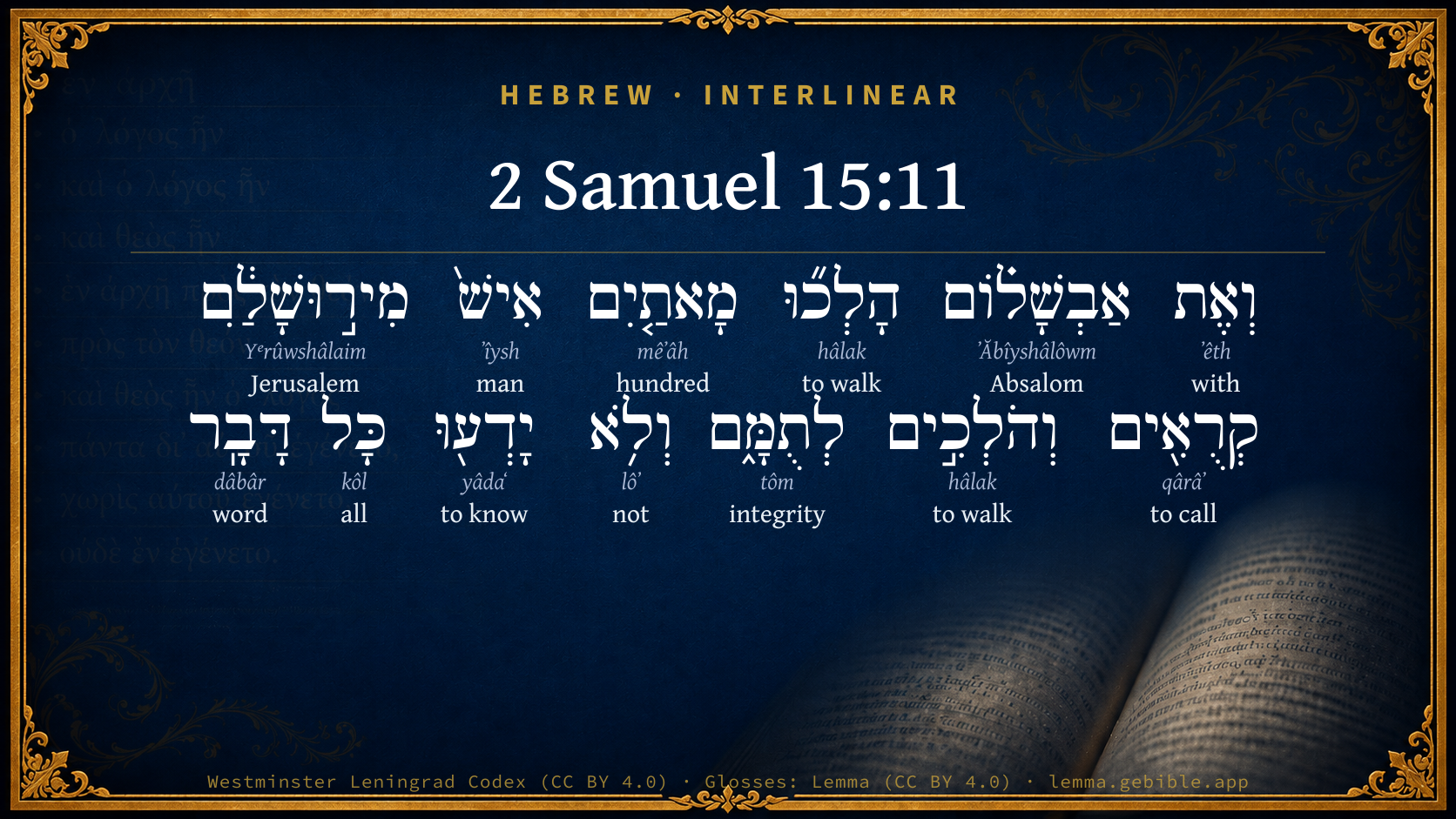
Hebrew (Westminster Leningrad Codex) 2 Samuel 15:11 appears in the Hebrew Old Testament. The text above is from the Westminster Leningrad Codex. Each word links to its Strong’s number, a concise gloss, and parsing drawn from the Open Scriptures Hebrew Bible morphology. Click any word for its full Brown-Driver-Briggs (BDB) entry.
Download image
Cite this verse

2 Samuel 15:11 (World English Bible). Public Domain. Lemma interlinear Bible study tool, https://lemma.gebible.app/v/2-samuel/15/11.

Show BibTeX & RIS
BibTeX
RIS
English Translation
With Absalom went two hundred men out of Jerusalem, who were invited, and went in their simplicity; and they didn't know anything.
World English Bible · Public Domain
Download a study sheet

One document with this verse’s original text, its word-by-word gloss line, the meaning frame, cross-references with their text, attributed commentary, and full source and license credits — printable, and it pastes into notes with its structure intact.

This verse Autodidact and up

Study sheet (.html) Plain text (.txt)

A passage Seminary Student

Up to 50 verses in one chapter. A passage sheet keeps up to 6 commentary sources and 12 cross-references per verse, in the order this page ranks them, and says so on the sheet whenever that leaves anything out. Ask for a single verse and you get the Autodidact verse sheet above.

Everything on this page stays free to read, with no account — the sheet is a download of what is already on screen, not access to it.

Want to remove ads? Support Godless Engineer
Compare translations 3

The same verse in 3 English versions, stacked beneath the original-language interlinear above. Click any original word for its lexicon entry.

Each is an independent rendering of the whole verse — the interlinear is not word-aligned to these translations.

Highlighted words mark where these versions differ — a whole-verse word diff, not a word-by-word alignment.

  • World English Bible Public Domain
    With Absalom went two hundred men out of Jerusalem, who were invited, and went in their simplicity; and they didn't know anything.
  • King James Version Public Domain
    And with Absalom went two hundred men out of Jerusalem, that were called; and they went in their simplicity, and they knew not any thing.
  • unfoldingWord Literal Text CC BY-SA 4.0
    Now 200 men from Jerusalem had gone with Absalom, called and walking in their innocence, and they did not know any of the matter.

unfoldingWord Literal Text — © unfoldingWord, licensed CC BY-SA 4.0. Word-aligned USFM3 via Door43 (git.door43.org/unfoldingWord/en_ult).

Versions to compare (up to 4)

3 of 4 selected

Show all 18 translations

Every available English version of this verse, each an independent rendering of the whole verse.

  • World English Bible Public Domain
    With Absalom went two hundred men out of Jerusalem, who were invited, and went in their simplicity; and they didn't know anything.
  • Berean Standard Bible Public Domain
    Two hundred men from Jerusalem accompanied Absalom. They had been invited as guests and they went along innocently, for they knew nothing about the matter.
  • Majority Standard Bible Public Domain
    Two hundred men from Jerusalem accompanied Absalom. They had been invited as guests and they went along innocently, for they knew nothing about the matter.
  • King James Version Public Domain
    And with Absalom went two hundred men out of Jerusalem, that were called; and they went in their simplicity, and they knew not any thing.
  • American Standard Version (1901) Public Domain
    And with Absalom went two hundred men out of Jerusalem, that were invited, and went in their simplicity; and they knew not anything.
  • Revised Version (1885) Public Domain
    And with Absalom went two hundred men out of Jerusalem, that were invited, and went in their simplicity; and they knew not any thing.
  • Geneva Bible (1599) Public Domain
    And with Absalom went two hundreth men out of Ierusalem, that were called: and they went in their simplicitie, knowing nothing.
  • Douay-Rheims (1899) Public Domain
    Now there went with Absalom two hundred men out of Jerusalem that were called, going with simplicity of heart, and knowing nothing of the design.
  • Young's Literal Translation Public Domain
    And with Absalom have gone two hundred men, out of Jerusalem, invited ones, and they are going in their simplicity, and have not known anything;
  • Literal Standard Version CC BY-SA 4.0
    And two hundred men have gone with Absalom out of Jerusalem, invited ones, and they are going in their simplicity, and have not known anything;
  • Unlocked Literal Bible CC BY-SA 4.0
    With Absalom went two hundred men from Jerusalem, who were invited. They went in their innocence, not knowing anything that Absalom had planned.
  • unfoldingWord Literal Text CC BY-SA 4.0
    Now 200 men from Jerusalem had gone with Absalom, called and walking in their innocence, and they did not know any of the matter.
  • Darby Bible Public Domain
    And with Absalom went two hundred men out of Jerusalem, that were invited; and they went in their simplicity, and they knew nothing.
  • World Messianic Bible Public Domain
    Two hundred men went with Absalom out of Jerusalem, who were invited, and went in their simplicity; and they didn’t know anything.
  • Webster's Bible Public Domain
    And with Absalom went two hundred men from Jerusalem, that were called; and they went in their simplicity, and they knew not any thing.
  • Free Bible Version CC BY-SA 4.0
    Two hundred men from Jerusalem went with Absalom. They had been invited and went in all innocence, because they didn't know anything about what was planned.
  • Bible in Basic English Public Domain
    And with Absalom, at his request, went two hundred men from Jerusalem, who were completely unconscious of his designs.
  • JPS Tanakh (1917) Public Domain
    And with Absalom went two hundred men out of Jerusalem, that were invited, and went in their simplicity; and they knew not any thing.

Literal Standard Version (2020), Covenant Press — licensed CC BY-SA 4.0. Text via the HelloAO Bible API (eBible.org). Unlocked Literal Bible (unfoldingWord) — licensed CC BY-SA 4.0. Text via the HelloAO Bible API (eBible.org). unfoldingWord Literal Text — © unfoldingWord, licensed CC BY-SA 4.0. Word-aligned USFM3 via Door43 (git.door43.org/unfoldingWord/en_ult). Free Bible Version, Dr. Jonathan Gallagher — licensed CC BY-SA 4.0. Text via the HelloAO Bible API (eBible.org).

Word by word

More ways to search: Search by grammar → Find every occurrence → Compare this word →

Practice this passage: Drill this verse → Learn its vocabulary →

לְתֻמָּ֑ם
tôm
H8537
“to/for · integrity · their”
Preposition + Noun, Common, Masculine, Singular, Construct + Suffix, Personal, 3rd Person, Masculine, Plural
Part of Speech
Preposition + Noun
Type
Common
Gender
Masculine
Number
Singular
State
Construct
Full BDB Definition

Origin: from H8552

TWOT: 2522a

integrity, completeness - completeness, fulness - innocence, simplicity - integrity
  1. וְאֶת ʼêth H854 “and · with” Conjunction + Preposition
  2. אַבְשָׁל֗וֹם ʼĂbîyshâlôwm H53 “Absalom” Noun, Proper
  3. הָלְכ֞וּ hâlak H1980 “to walk” Verb, Qal, Perfect, 3rd Person, Common, Plural
  4. מָאתַ֤יִם mêʼâh H3967 “hundred” Adjective, Cardinal number, Both, Dual, Absolute
  5. אִישׁ֙ ʼîysh H376 “man” Noun, Common, Masculine, Singular, Absolute
  6. מִיר֣וּשָׁלִַ֔ם Yᵉrûwshâlaim H3389 “from · Jerusalem” Preposition + Noun, Proper
  7. קְרֻאִ֖ים qârâʼ H7121 “called” Verb, Qal, Participle Passive, Masculine, Plural, Absolute
  8. וְהֹלְכִ֣ים hâlak H1980 “and · walking” Conjunction + Verb, Qal, Participle Active, Masculine, Plural, Absolute
  9. וְלֹ֥א lôʼ H3808 “and · not” Conjunction + Particle, Negative
  10. יָדְע֖וּ yâdaʻ H3045 “to know” Verb, Qal, Perfect, 3rd Person, Common, Plural
  11. כָּל kôl H3605 “all of” Noun, Common, Masculine, Singular, Construct
  12. דָּבָֽר dâbâr H1697 “word” Noun, Common, Masculine, Singular, Absolute

About this verse

These counts appear in no published source. They are computed here, from the morphology-tagged text and Lemma’s own curated glosses. What Lemma adds →

13
words
12
distinct lemmas
Historical
section

Notable vocabulary

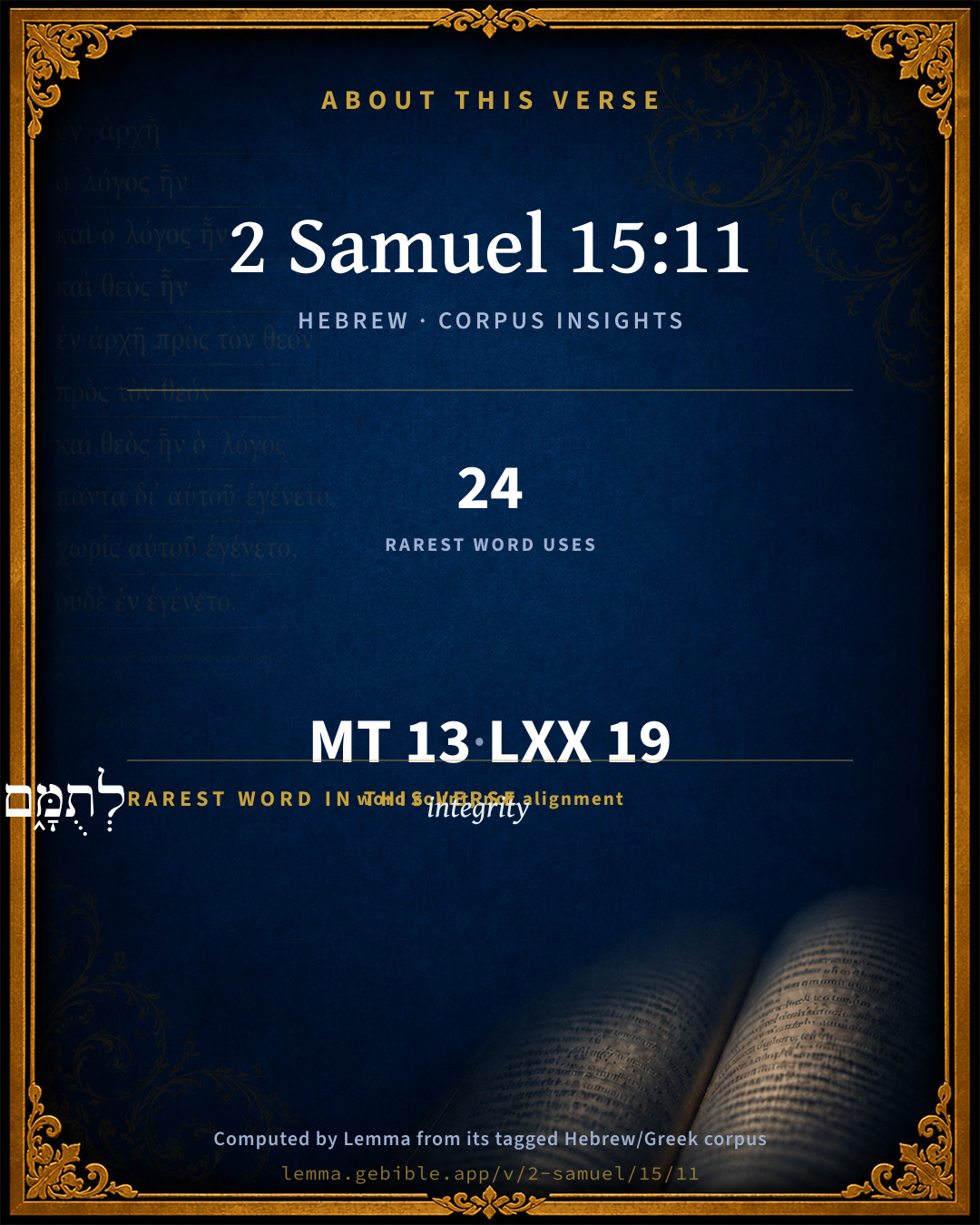
The rarest word here is לְתֻמָּ֑ם integrity H8537 — appearing just 24 times in the whole Hebrew Bible.

Shared distinctive vocabulary

לְתֻמָּ֑ם integrity H8537 occurs in 24 verses of the Hebrew Bible. Also found in:

Grammatical profile

  • 4 verbs
  • 6 nouns
  • 1 adjective
  • 1 preposition
  • 1 particle

Verb forms

  • הָלְכ֞וּ Qal · Perfect
  • קְרֻאִ֖ים Qal · Participle Passive
  • וְהֹלְכִ֣ים Qal · Participle Active
  • יָדְע֖וּ Qal · Perfect

Repetition

A word recurs within this verse — often emphatic in Hebrew:

  • הָלְכ֞וּ to walk H1980 ×2

Hebrew & Septuagint length

In English translation the verse runs 22 words from the Hebrew and 21 from the Septuagint (LXX English) — closely comparable.

A rough comparison of the two English renderings, which tokenize alike — not a word-level alignment.

Word counts can differ between the Hebrew and the Greek without any difference in meaning — e.g. the Hebrew direct-object marker אֵת has no separate Greek word, and Greek often adds the article ὁ.

In the original languages it is 13 Hebrew tokens and 19 Greek tokens — but the two are counted differently (Hebrew bundles its prefixes and suffixes into one token; the Greek is in lemma form), so that isn’t a like-for-like length.

Cross-references

8

Topical passages linked to 2 Samuel 15:11 in the Treasury of Scripture Knowledge — connected by theme and wording, ordered by reader-vote popularity; previews shown in the World English Bible.

  • 1 Samuel 9:13 as soon as you are come into the city, you shall immediately find him, before he goes up to the high place to eat; for the people will not eat until he come, because he does bless the sacrifice; [and] afterwards they eat who are invited. Now therefore get you up; for at this time you shall find him.
  • 1 Samuel 22:15 Have I today begun to inquire of God for him? be it far from me: don't let the king impute anything to his servant, nor to all the house of my father; for your servant knows nothing of all this, less or more.
  • Genesis 20:5 Didn't he tell me, 'She is my sister?' She, even she herself said, 'He is my brother.' In the integrity of my heart and the innocence of my hands have I done this."
  • 1 Samuel 16:3–5 Call Jesse to the sacrifice, and I will show you what you shall do: and you shall anoint to me him whom I name to you.
  • Proverbs 14:15 A simple man believes everything, But the prudent man carefully considers his ways.
  • Proverbs 22:3 A prudent man sees danger, and hides himself; But the simple pass on, and suffer for it.
  • Matthew 10:16 "Behold, I send you out as sheep in the midst of wolves. Therefore be wise as serpents, and harmless as doves.
  • Romans 16:18–19 For those who are such don't serve our Lord, Jesus Christ, but their own belly; and by their smooth and flattering speech, they deceive the hearts of the innocent.

Cross-references courtesy of OpenBible.info (CC BY 4.0).

Hebrew and Greek witnesses Masoretic Hebrew ↔ Greek Septuagint

The same verse in the two great witnesses to the Old Testament, shown verse-for-verse.

These are two independent witnesses, not word-aligned to each other, and the Septuagint is shown in lemma (dictionary) form.

Hebrew 2 Samuel 15:11 Masoretic · Westminster Leningrad Codex

וְאֶת אַבְשָׁל֗וֹם הָלְכ֞וּ מָאתַ֤יִם אִישׁ֙ מִיר֣וּשָׁלִַ֔ם קְרֻאִ֖ים וְהֹלְכִ֣ים לְתֻמָּ֑ם וְלֹ֥א יָדְע֖וּ כָּל דָּבָֽר

With Absalom went two hundred men out of Jerusalem, who were invited, and went in their simplicity; and they didn't know anything.

World English Bible · Public Domain

Greek LXX 2 Samuel 15:11 Septuagint · lemma form

καί μετά αβεσσαλωμ πορεύομαι διακόσιοι ἀνήρ ἐκ ἰερουσαλήμ κλητός καί πορεύομαι ὁ ἁπλότης αὐτός καί οὐ γιγνώσκω πᾶς ῥῆμα

And there went with Abessalom two hundred chosen men from Jerusalem; and they went in their simplicity, and knew not anything.

LXX2012 (modern English Septuagint) · Public Domain

Hebrew: Westminster Leningrad Codex (CC BY 4.0). Greek: Septuagint (public domain); English from LXX2012 (modern English Septuagint) (Public Domain). How the Septuagint differs from the Hebrew →

Targum (Aramaic paraphrase)

1

The Targum is the ancient Jewish Aramaic paraphrase of the Hebrew Scriptures — an interpretive translation, not the Hebrew text itself. Onkelos (literal) and Pseudo-Jonathan (expansive) render the Torah, and Jonathan the Prophets. Coverage is partial: where no permissively-licensed English translation exists for a verse, only the Aramaic is shown. This is verse-level text, not a word-by-word alignment to the Hebrew.

  1. Targum Jonathan Prophets (Joshua–Malachi)
    וְעִם אַבְשָׁלוֹם אֲזַלוּ מָאתָן גַבְרִין מִירוּשְׁלֵם זְמִינִין וְאָזְלִין לְתוּמֵיהוֹן וְלָא יָדְעִין כָּל מִדָעַם:

    (no public-domain English translation for this verse)

    Targum Jonathan — Aramaic: “Mikraot Gedolot” (public domain). English: “Sefaria Community Translation” (CC0 1.0 (public-domain dedication)); “London "Chaldee Paraphrase," 1871” (public domain). Text via Sefaria.

Commentary

Notes on 2 Samuel 15:11 from classic Christian and Jewish commentators (each source and its license shown beneath its notes). The classic Christian expositions comment on the surrounding passage and are grouped to its opening verse, so a note may address several verses; the Jewish commentaries on the Tanakh (Rashi and others) are per-verse, so they appear only where the commentator wrote on this verse.

Lemma curates 59 commentaries, every one of them public domain or Creative Commons licensed, each selected and text-cleaned for this edition rather than reprinted as found. About our sources →

Trapp's Complete Commentary

John Trapp

2Sa 15:11 And with Absalom went two hundred men out of Jerusalem, [that were] called; and they went in their simplicity, and they knew not any thing.

Ver. 11. And with Absalom went two hundred men out of Jerusalem.] These were, doubtless, the principal men of the city; and this was likewise done by the policy of Ahithophel, (1.) That the plot might be the better concealed, since such confiding men were invited; (2.) That other cities, thinking that Jerusalem was for Absalom, might the sooner be drawn to follow him also.

And they went in their simplicity.] So did many of our forefathers after Antichrist, by whom, being kept in gross ignorance, they had the happiness not to know those depths of Satan, that is, the chief and most pernicious corruptions of Popery, God’s providence so disposing, Ut sub Antichristi sacerdotibus Christi populus non accideret, as Hillary hath it, that the people of Christ should not perish under the priests of Antichrist.

John Trapp, A Commentary or Exposition upon All the Books of the Old and New Testament (1647–1656) — public domain. Text from a community e-Sword module.

Joseph Benson's Commentary

2Sa 15:11. With Absalom went two hundred men that were called — That is, that were invited by him to feast with him on his sacrifice, and were such as he had picked out as fit for his purpose; principal persons of the city, no doubt, and of some reputation with the king and people. These he took with him that they might give a countenance to his undertaking, and cause the people at first to think that he was acting in all this by his father’s consent and approbation, as being now aged and infirm, and willing to resign the kingdom to his son. They went in their simplicity, and knew not anything — Of his design, but only went to attend him, and pay him respect as the king’s son, who did them the honour to invite them to a holy feast. It is no new thing for good men to be made use of by designing men, to put a colour on ill practices.

Joseph Benson's Commentary on the Old and New Testaments (1811–1818) — public domain. Text from a community e-Sword module.

Geneva Bible (1599)

Geneva Bible translators

And bid to his feast in Hebron.

Geneva Bible (1599) marginal notes — public domain. Text via Bolls.life.

Jamieson, Fausset & Brown

Robert Jamieson, A. R. Fausset & David Brown

with Absalom went two hundred men . . . that were called--From their quality, reputation, and high standing, such as would create the impression that the king patronized the movement and, being aged and infirm, was willing to adopt his oldest and noblest son to divide with him the cares and honors of government.

Jamieson, Fausset & Brown — Commentary Critical and Explanatory on the Whole Bible (1871) — public domain (CC PDM 1.0). Text via the HelloAO Bible API.

Adam Clarke's Commentary

Verse 11. Went two hundred men] These were probably soldiers, whom he supposed would be of considerable consequence to him. They had been seduced by his specious conduct, but knew nothing of his present design.

Adam Clarke's Commentary on the Bible (1810–1826) — public domain. Text from a community e-Sword/MySword module.

Ellicott's Commentary for English Readers

(11) Went in their simplicity.—The two hundred guests whom Absalom had invited to take part with him in his sacrifices, were doubtless prominent and influential citizens of Jerusalem. That they were entirely ignorant of Absalom’s purposes shows the extreme secrecy with which the affair was managed. Absalom, no doubt, hoped when he once had them at Hebron, to secure them for his side, or, failing this, forcibly to prevent their opposition. In any case it would appear to the people that they were with him, and he would thus secure additional prestige.

A Bible Commentary for English Readers, edited by Charles John Ellicott (1878–1897) — public domain. Text from a community e-Sword module.

The Cambridge Bible for Schools and Colleges

gen. ed. J. J. S. Perowne

11. two hundred men … that were called] Invited to the sacrificial feast as Absalom’s guests. In all probability they were men of distinction, and would naturally be regarded, both at Jerusalem and at Hebron, as accomplices in the conspiracy. No doubt Absalom hoped that many of them, finding themselves thus compromised, and seeing the number of his supporters, would decide to join him; or failing this, they might be held as hostages.

The Cambridge Bible for Schools and Colleges (gen. ed. J. J. S. Perowne; Cambridge University Press, 1878–1918) — public domain. Text from a community e-Sword module.

John Gill's Exposition

And with Absalom went two hundred men out of Jerusalem, that were called,.... Invited by him to go with him and partake of his peace offerings, as the payment of his vow in Hebron; part of which was made a feast of for his friends, whomsoever he should think fit to invite, as he did to the number of two hundred, and for the entertainment of whom a large provision ought to be made; the Jews (h) have a tradition, that he had leave of his father only to invite two to go with him, and that he asked two more unknown to the first, and so on, two after two, until they amounted to two hundred:

and they went in their simplicity; to partake of the feast of the peace offerings, to which they were invited; being quite harmless and upright in their intentions, having no thought of disloyalty and rebellion in their breasts:

and they knew not anything; of an intended conspiracy; howbeit, doubtless many of them were drawn into it when got thither; and as these may be supposed to be some of the principal men of Jerusalem, it was a great weakening of David's interest, and laid a considerable foundation for Absalom to begin upon.

(h) Bemidbar Rabba, sect. 9. fol. 194. 4.

John Gill's Exposition of the Whole Bible (1746–1763) — public domain (CC PDM 1.0). Text via the HelloAO Bible API.

Haydock's Catholic Bible Commentary

Design. Their hearts had been stolen, ver. 6. They only meant to do honour to the prince, but by no means to join in his rebellion, like the rest. (Calmet)

George Leo Haydock (1774–1849), Haydock's Catholic Family Bible and Commentary, 1859 edition — public domain. Excludes Psalms (Douay-Rheims chapter numbering differs from Protestant) and Deuterocanonical books (Catholic canon only).

Matthew Poole's English Annotations

That were called; such as Absalom had picked out as fit for his purpose; such as were of some quality and reputation with the king and people, which would give a great countenance to his undertaking, and give occasion to people at first to think that this was done by his father’s consent or connivance, as being now aged, and infirm, and willing to resign the kingdom to him, as his eldest son, and the noblest too, as being descended from a king by both parents; and such as by their wisdom and interest in the people might have done David much service in this needful time; yet such as were not very martial men, nor likely with violence to oppose his proceedings. They knew not any thing concerning Absalom’s design.

Matthew Poole's English Annotations on the Holy Bible (1683–1685) — public domain. Text from a community e-Sword/MySword module.

Whedon's Commentary on the Bible

Daniel D. Whedon

11. Two hundred men… called — Persons who had been personally and privately invited or “bidden” to attend the sacrificial festival which he proposed to make at Hebron. Compare marginal references.

In their simplicity — In complete innocence, not knowing the designs of Absalom. This helped to hide from the inhabitants of Jerusalem the conspiracy of the prince.

Daniel D. Whedon (gen. ed.), Commentary on the Old and New Testaments (1874–1909) — public domain. Text from a community e-Sword module.

The Pulpit Commentary

Two hundred men. These, doubtless, were courtiers and men of rank, who were so accustomed to Absalom"s love of display, that, when called, that is, invited, they would go without suspicion. To Absalom their attendance was most important, not only because, being compromised, many would join him, and even all of them for a time be forced to yield obedience, but because they would make the people of Hebron suppose that Absalom had a powerful body of supporters at Jerusalem. It is quite possible that at Hebron, and generally in Judah, there was great discontent because David had left their tribe to choose a capital elsewhere, and because he did not show them any decided preference over the other tribes, whose good will he would rightly seek to conciliate. The existence of much jealousy between Judah and the ten tribes is plain from 2Sa_19:41-43.

The Pulpit Commentary (1880–1919), ed. H.D.M. Spence-Jones & Joseph S. Exell — public domain. Text from a community e-Sword module.

John Wesley's Explanatory Notes

Called - Such as Absalom had picked out as fit for his purpose; such as were of some reputation with the king and people, which would give a countenance to his undertaking, and give occasion to people at first to think that this was done by his father's consent, as being now aged, and infirm, and willing to resign the kingdom to him. It is no new thing, for good men to be made use of by designing men to put a colour upon ill practices.

John Wesley, Explanatory Notes Upon the Whole Bible (1754–1765) — public domain. Text via the GEBible commentary corpus.

unfoldingWord translationNotes

Door43 World Missions Community

who were invited

This can be stated in active form. AT: "who he had invited" (See: Active or Passive)

went in their innocence

"went innocently"

he sent for Ahithophel

This means that he sent a messenger to go get Ahithophel and bring him back to him. AT: "he sent a messenger to go get Ahithophel who was" (See: Idiom)

Ahithophel

This is the name of a man. (See: How to Translate Names)

Giloh

This is the name of a place. (See: How to Translate Names)

translationWords

Jerusalem

innocent

sacrifice

David

advice

unfoldingWord translationNotes — © Distant Shores Media and the Door43 World Missions Community, licensed CC BY-SA 4.0. Source: git.door43.org/Door43/en_tn.

Rashi

Rabbi Shlomo Yitzchaki (Rashi)

Invited and leaving in innovence. It is explained in the Yerushalmi tractate of Sotah that he [Avsholom] requested of his father that he [Dovid] write [a document] for him that any two people that he request go with him, should go. He [proceeded] to show it [the document] to two people here and afterwords to two other people and in this way to many.

Rashi on the Tanakh — English translations: “The Judaica Press complete Tanach with Rashi, translated by A. J. Rosenberg” (CC BY 4.0); “Pentateuch with Rashi's commentary by M. Rosenbaum and A.M. Silbermann, 1929-1934” (public domain); “The Metsudah Tanach series, Lakewood, N.J” (CC BY 4.0); and “The Book of Joshua, Metsudah Publications, 1997” (CC BY 4.0). Text via Sefaria.

Lesson kit

Teaching starters — assembled from the data on this page, not authored interpretation. Every prompt links to the verse data it draws on. Edit before teaching.

2 Samuel, in the Historical, opens this verse with 13 words (12 distinct Hebrew lemmas). Its most distinctive word is tôm (“integrity”). A historical commentator’s framing appears above. Read the whole chapter for the surrounding context.

Discussion questions

  1. The word tôm carries the sense “integrity.” How does it shape the verse?
  2. How does Genesis 20:5, which shares the word «integrity», read alongside this verse?
  3. What does the repetition of “to walk” (2× in this one verse) do in this verse?
  4. These translations render this verse differently; the difference is in the English rendering, not the original. What questions does that raise?
  5. «הָלְכ֞וּ» is a Qal Perfect verb. How does that grammatical form shape the action described?
  6. Compare how Trapp's Complete Commentary and Joseph Benson's Commentary read this verse. Where do they agree or differ?

Things to notice

Reading settings

Reading text

Shown beneath each verse's original-language words.

Old Testament
Old Testament edition

Read the OT as the Masoretic Hebrew (MT) or the Greek Septuagint (LXX).

English shown for the Greek Septuagint (in the Hebrew ↔ Greek comparison).

Comparing translations? Open the Compare panel on any verse page to stack up to four side by side.