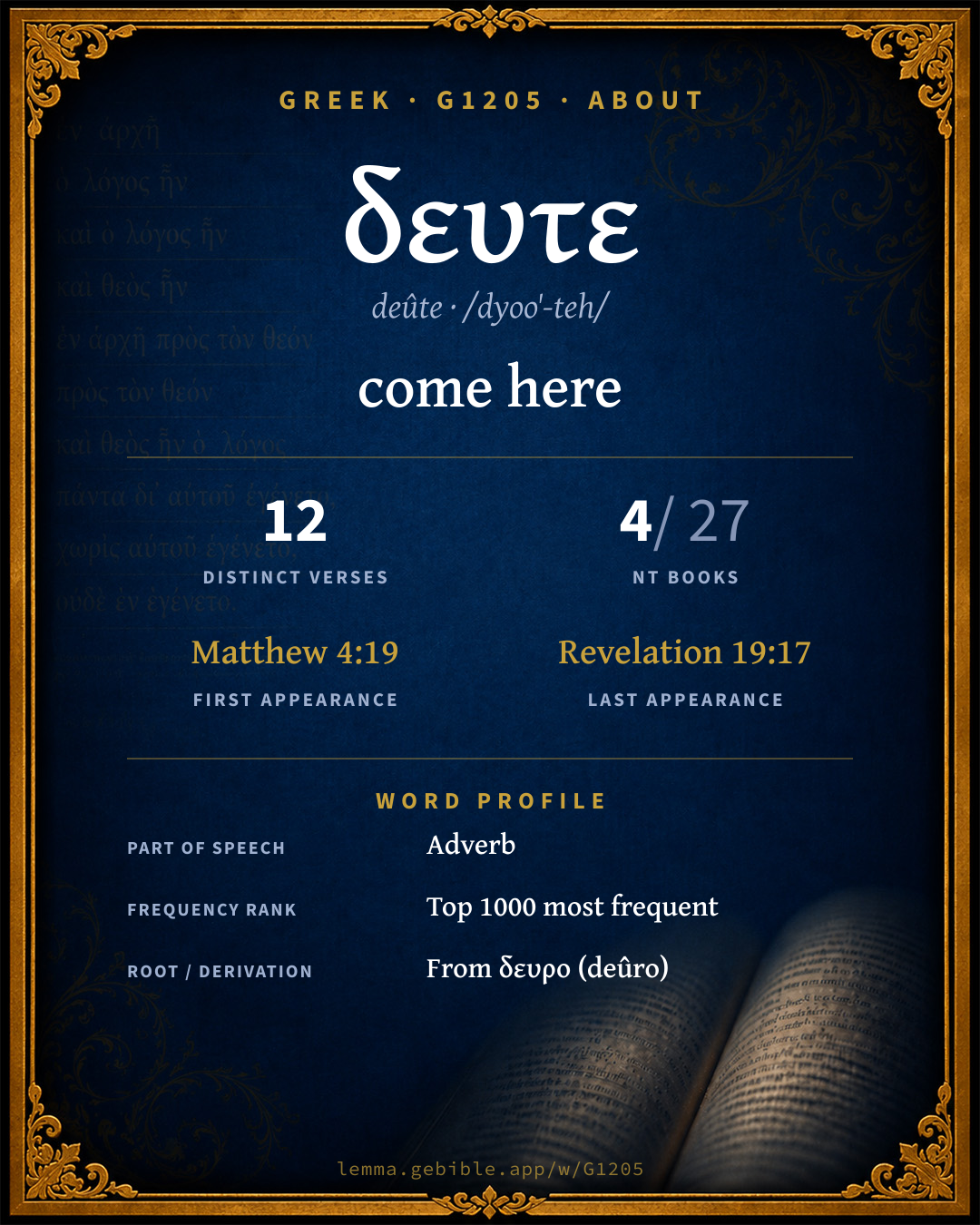
δεῦτε
come here
also: come hither, come fuller range ↓
Full lexicon entry — Thayer's Greek Lexicon
From Thayer's Greek Lexicon
Where this word appears
Grammar key — what these labels mean
Part of speech
- Verb
- An action or state-of-being word.
Tense
- Present
- Ongoing or general action in present time (imperfective aspect).
Voice
- Active
- The subject performs the action.
Mood
- Imperative
- Expresses a command or request.
Person
- 2nd person
- The one addressed (“you”).
Number
- Plural
- More than one.
Every verse where G1205 appears — 12 distinct verses across 4 books. Click any verse to open its interlinear word-by-word view. Verse text shown in the World English Bible for context — . Each verse’s Greek form is shown with its reference; the English is not keyword-highlighted, since the data carries no word-level English alignment. Use “Compare translations” on any verse to read it across multiple English versions. This concordance covers the Greek New Testament; Septuagint (Greek Old Testament) occurrences of this word are not indexed here.
Matthew 6 verses
- Matthew 4:19 δεῦτε pres act impv 2pl He said to them, "Come after me, and I will make you fishers for men."
- Matthew 11:28 Δεῦτε pres act impv 2pl "Come to me, all you who labor and are heavily burdened, and I will give you rest.
- Matthew 21:38 δεῦτε pres act impv 2pl But the farmers, when they saw the son, said among themselves, 'This is the heir. Come, let's kill him, and seize his inheritance.'
- Matthew 22:4 δεῦτε pres act impv 2pl Again he sent out other servants, saying, 'Tell those who are invited, "Behold, I have made ready my dinner. My oxen and my fatlings are killed, and all things are ready. Come to the marriage feast!"'
- Matthew 25:34 δεῦτε pres act impv 2pl Then the King will tell those on his right hand, 'Come, blessed of my Father, inherit the Kingdom prepared for you from the foundation of the world;
- Matthew 28:6 δεῦτε pres act impv 2pl He is not here, for he has risen, just like he said. Come, see the place where the Lord was lying.
Mark 3 verses
- Mark 1:17 δεῦτε pres act impv 2pl Jesus said to them, "Come after me, and I will make you into fishers for men."
- Mark 6:31 δεῦτε pres act impv 2pl He said to them, "You come apart into a deserted place, and rest awhile." For there were many coming and going, and they had no leisure so much as to eat.
- Mark 12:7 δεῦτε pres act impv 2pl But those farmers said among themselves, 'This is the heir. Come, let's kill him, and the inheritance will be ours.'
John 2 verses
Revelation 1 verse
About this entry
At a glance — auto-summarized from this page’s data, not written by a person. Every figure links to its source below. This summary describes the numbers; it doesn’t interpret them.
δευτε (deûte) is a Greek verb most often rendered “come here.” Matthew dominates its distribution — 6 of 12 verses. Spanning 12 verses in 4 books, it ranks among the uncommon words of the Greek New Testament. It first appears in Matthew 4:19. The lexical range runs to 2 senses — “come here” plus “come hither” and “come”. For the data behind this summary, explore the sense tree and the renderings breakdown below.
Gloss history
Strong's 1890 vs modern scholarship
About this word
Strong's G1205 catalogs a Greek word from the Greek New Testament.
These counts are not copied from any lexicon or concordance. They are computed here, from the morphology-tagged Greek New Testament. What Lemma adds →
- 12
- distinct verses
- The word appears in 12 distinct verses.
- 4 / 27
- NT books
- The word appears in 4 of 27 New Testament books.
- #904
- by frequency
- Top 1000 most frequent Greek words (rank 904 of 5,347 Greek words by occurrence).
View all 12 occurrences in the concordance →
By section of the New Testament
By traditional corpus
Conventional, traditional groupings — biblical authorship is debated, so this is a traditional corpus grouping, not an authorship claim. Some books belong to more than one corpus (Luke is in both the Gospels and the Lukan corpus, and so on), so these shares overlap and need not total 100%. Each figure is a share of the word’s 12 distinct verses.
- Gospels 11 verses · 92%
- Johannine 3 verses · 25%
- Revelation 1 verse · 8%
How translations render this word
Counts come from each version’s own published word-to-Strong’s tagging or interlinear alignment — an approximate guide to how each version renders this word, not a word-level alignment the data otherwise carries. Because each total is that version’s own tagged count, the per-version totals vary from one another and need not match the appearance or distinct-verse counts above. These counts may also differ from a printed concordance because Lemma counts each distinctly tagged rendering and does not collapse phrase taggings into a single head-word total. This is a fixed set of word-tagged versions (KJV, ASV, BSB, ULT) and does not change with the reading translation you choose elsewhere. Each version’s license is shown beside its name below (and on Sources).
- King James Version: Come 11×
- American Standard Version: Come 11×
- Berean Standard Bible: Come 10×, Come follow 2×
- unfoldingWord Literal Text: Come 12×
King James Version Public Domain
Renders G1205 across 13 tagged occurrences — most commonly:
Plus 2 renderings that appear only once — usually multi-word phrases or single function words the recovered tagging swept in, not distinct renderings.
American Standard Version Public Domain
Renders G1205 across 13 tagged occurrences — most commonly:
Plus 2 renderings that appear only once — usually multi-word phrases or single function words the recovered tagging swept in, not distinct renderings.
Berean Standard Bible Public Domain
Renders G1205 across 12 tagged occurrences — most commonly:
unfoldingWord Literal Text CC BY-SA 4.0
Renders G1205 across 12 tagged occurrences — most commonly:
Senses in Thayer's
The 2 senses Thayer's distinguishes for this word, in lexicon order (not ranked by frequency or importance). The full entry — with sub-senses — is in the Lexicon Entry tab.
- come hither, come here, come
- interjection, come!, come now!
Word origin
Derived from δευρο (deûro) (G1204) — here.
From G1204 and an imperative of εἶμι eimi (to go ); come hither! : - come X follow.
— Strong’s Exhaustive Concordance (1890), public domain.
Forms in the corpus
The 2 distinct written forms G1205 takes in the Greek New Testament, most frequent first — each parse links to that tense’s occurrences in the concordance.
| Form | Parsing | Example | Uses |
|---|---|---|---|
| δεῦτε deûte | Verb, Present, Active, Imperative, 2nd person, Plural | Matthew 4:19 | 11 |
| Δεῦτε Deûte | Verb, Present, Active, Imperative, 2nd person, Plural | Matthew 11:28 | 1 |
Septuagint usage
The same Greek word δευτε appears 39 times in the Greek Old Testament (Septuagint), across 38 verses in 13 books.
- 39
- LXX occurrences
- Tagged occurrences of this Greek word in the Septuagint.
- 38
- verses
- Distinct Septuagint verses containing this word.
- 13 / 39
- OT books
- The word appears in 13 of the 39 Old Testament books.
Sample Septuagint occurrences
- Genesis 11:3 δεῦτε
- Exodus 1:10 δεῦτε
- Joshua 10:4 δεῦτε
- Judges 9:15 δεῦτε
- 2 Kings 1:2 δεῦτε
- Ezra 12:17 δεῦτε
- Job 17:10 δεῦτε
- Psalms 33:12 δεῦτε
- Isaiah 1:18 δεῦτε
- Jeremiah 11:19 δεῦτε
- Daniel 6:6 δεῦτε
- Jonah 1:7 δεῦτε
Septuagint occurrences (same lexeme)
Every verse where the same Strong’s number (G1205) appears in the Greek Septuagint. Verse text shown in the World English Bible for context; the Greek form is the matched word — the English is not keyword-highlighted.
- Genesis 11:3 δεῦτε They said one to another, "Come, let's make brick, and burn them thoroughly." They had brick for stone, and they used tar for mortar.
- Genesis 11:4 δεῦτε They said, "Come, let's build us a city, and a tower, whose top reaches to the sky, and let's make us a name; lest we be scattered abroad on the surface of the whole earth."
- Genesis 11:7 δεῦτε Come, let's go down, and there confuse their language, that they may not understand one another's speech."
- Genesis 37:20 δεῦτε Come now therefore, and let's kill him, and cast him into one of the pits, and we will say, 'An evil animal has devoured him.' We will see what will become of his dreams."
- Genesis 37:27 δεῦτε Come, and let's sell him to the Ishmaelites, and not let our hand be on him; for he is our brother, our flesh." His brothers listened to him.
- Exodus 1:10 δεῦτε Come, let us deal wisely with them, lest they multiply, and it happen that when any war breaks out, they also join themselves to our enemies, and fight against us, and escape out of the land."
- Joshua 10:4 δεῦτε Come up to me, and help me, and let us strike Gibeon; for it has made peace with Joshua and with the children of Israel.
- Judges 9:15 δεῦτε The bramble said to the trees, If in truth you anoint me king over you, then come and take refuge in my shade; and if not, let fire come out of the bramble, and devour the cedars of Lebanon.
- 2 Kings 1:2 δεῦτε Ahaziah fell down through the lattice in his upper chamber that was in Samaria, and was sick: and he sent messengers, and said to them, Go, inquire of Baal Zebub, the god of Ekron, whether I shall recover of this sickness.
- 2 Kings 1:6 δεῦτε They said to him, There came up a man to meet us, and said to us, Go, turn again to the king who sent you, and tell him, Thus says Yahweh, Is it because there is no God in Israel, that you send to inquire of Baal Zebub, the god of Ekron? therefore you shall not come down from the bed where you are gone up, but shall surely die.
- 2 Kings 6:2 δεῦτε Let us go, we pray you, to the Jordan, and take there every man a beam, and let us make us a place there, where we may dwell. He answered, Go you.
- 2 Kings 6:13 δεῦτε He said, Go and see where he is, that I may send and get him. It was told him, saying, Behold, he is in Dothan.
- 2 Kings 6:19 δεῦτε Elisha said to them, This is not the way, neither is this the city: follow me, and I will bring you to the man whom you seek. He led them to Samaria.
- 2 Kings 7:4 δεῦτε If we say, We will enter into the city, then the famine is in the city, and we shall die there; and if we sit still here, we die also. Now therefore come, and let us fall to the host of the Syrians: if they save us alive, we shall live; and if they kill us, we shall but die.
- 2 Kings 7:14 δεῦτε They took therefore two chariots with horses; and the king sent after the host of the Syrians, saying, Go and see.
- 2 Kings 22:13 δεῦτε Go you, inquire of Yahweh for me, and for the people, and for all Judah, concerning the words of this book that is found; for great is the wrath of Yahweh that is kindled against us, because our fathers have not listened to the words of this book, to do according to all that which is written concerning us.
- Ezra 12:17 δεῦτε
- Job 17:10 δεῦτε But as for you all, come on now again; I shall not find a wise man among you.
- Psalms 33:12 δεῦτε Blessed is the nation whose God is Yahweh, The people whom he has chosen for his own inheritance.
- Psalms 45:9 δεῦτε Kings' daughters are among your honorable women. At your right hand the queen stands in gold of Ophir.
- Psalms 65:5 δεῦτε By awesome deeds of righteousness, you answer us, God of our salvation. You who are the hope of all the ends of the earth, Of those who are far away on the sea;
- Psalms 65:16 δεῦτε
- Psalms 73:8 δεῦτε They scoff and speak with malice. In arrogance, they threaten oppression.
- Psalms 82:5 δεῦτε They don't know, neither do they understand. They walk back and forth in darkness. All the foundations of the earth are shaken.
- Psalms 94:1 δεῦτε Yahweh, you God to whom vengeance belongs, You God to whom vengeance belongs, shine forth.
- Psalms 94:6 δεῦτε They kill the widow and the alien, And murder the fatherless.
- Isaiah 1:18 δεῦτε "Come now, and let us reason together," says Yahweh: "Though your sins be as scarlet, they shall be as white as snow. Though they be red like crimson, they shall be as wool.
- Isaiah 2:3 δεῦτε Many peoples shall go and say, "Come, let's go up to the mountain of Yahweh, To the house of the God of Jacob; And he will teach us of his ways, And we will walk in his paths. For out of Zion the law shall go forth, And the word of Yahweh from Jerusalem.
- Isaiah 2:5 δεῦτε House of Jacob, come, and let us walk in the light of Yahweh.
- Isaiah 9:9 δεῦτε All the people shall know, [even] Ephraim and the inhabitant of Samaria, who say in pride and in arrogance of heart,
- Isaiah 27:11 δεῦτε When the boughs of it are withered, they shall be broken off; the women shall come, and set them on fire; for it is a people of no understanding: therefore he who made them will not have compassion on them, and he who formed them will show them no favor.
- Isaiah 56:9 δεῦτε All you animals of the field, come to devour, [yes], all you animals in the forest.
- Jeremiah 11:19 δεῦτε But I was like a gentle lamb that is led to the slaughter; and I didn't know that they had devised devices against me, [saying], Let us destroy the tree with the fruit of it, and let us cut him off from the land of the living, that his name may be no more remembered.
- Jeremiah 18:18 δεῦτε Then said they, Come, and let us devise devices against Jeremiah; for the law shall not perish from the priest, nor counsel from the wise, nor the word from the prophet. Come, and let us strike him with the tongue, and let us not give heed to any of his words.
- Jeremiah 28:10 δεῦτε Then Hananiah the prophet took the bar from off the prophet Jeremiah's neck, and broke it.
- Daniel 6:6 δεῦτε Then these presidents and satraps assembled together to the king, and said thus to him, King Darius, live forever.
- Jonah 1:7 δεῦτε They all said to each other, "Come, let us cast lots, that we may know for whose cause this evil is on us." So they cast lots, and the lot fell on Jonah.
- Micah 4:2 δεῦτε Many nations will go and say, "Come, and let us go up to the mountain of Yahweh, And to the house of the God of Jacob; And he will teach us of his ways, And we will walk in his paths." For out of Zion will go forth the law, And the word of Yahweh from Jerusalem;
These are occurrences of the same Greek lexeme (G1205) in the Septuagint — not a translation of any one Hebrew word. The store carries no word-level Hebrew↔Greek alignment, so no Hebrew original is asserted here. Counts come from the recovered LXX Strong's tagging — high-frequency vocabulary is well covered, while rare or late forms may be untagged — so they reflect tagged occurrences and may slightly undercount.