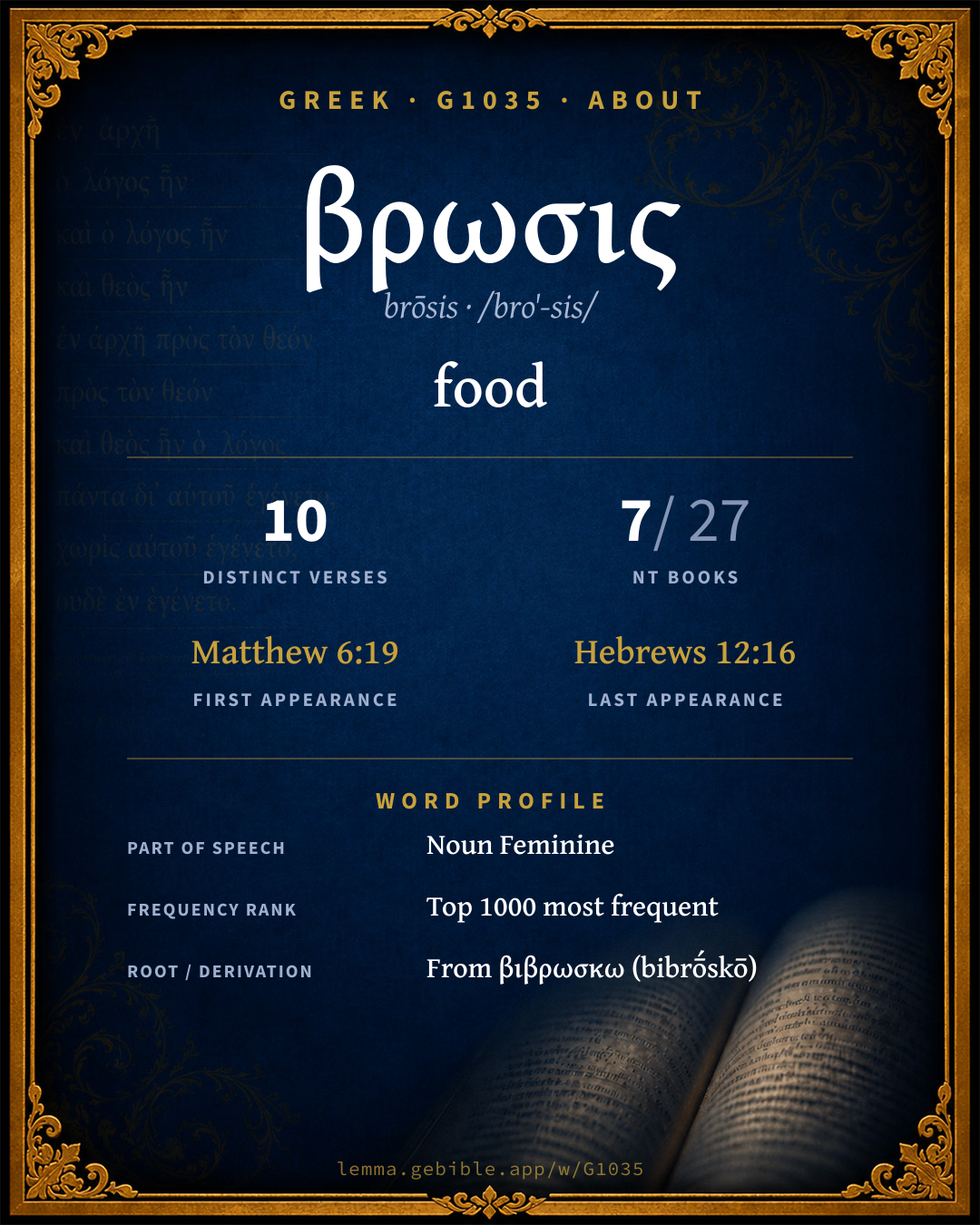
βρῶσις
food
‘food’ is one of 2 main senses fuller range ↓
Full lexicon entry — Thayer's Greek Lexicon
From Thayer's Greek Lexicon
Where this word appears
See every Accusative-case word in the Greek New Testament →
Grammar key — what these labels mean
Part of speech
- Noun
- A naming word — a person, place, thing, or idea.
Case
- Accusative
- The case of the direct object and of extent.
- Nominative
- The case of the subject (and the predicate nominative).
- Genitive
- The case of source, possession, or “of” — answers “whose / from what.”
- Dative
- The case of the indirect object, means, or location — “to / for / with / in.”
Gender
- Feminine
- Grammatically feminine.
Number
- Singular
- One.
Every verse where G1035 appears in the Book of John — 3 distinct verses. Click any verse to open its interlinear word-by-word view. Verse text shown in the World English Bible for context — . Each verse’s Greek form is shown with its reference; the English is not keyword-highlighted, since the data carries no word-level English alignment. Use “Compare translations” on any verse to read it across multiple English versions. This concordance covers the Greek New Testament; Septuagint (Greek Old Testament) occurrences of this word are not indexed here.
John
- John 4:32 βρῶσιν n acc sg fem But he said to them, "I have food to eat that you don't know about."
- John 6:27 βρῶσιν βρῶσιν n acc sg fem n acc sg fem Don't work for the food which perishes, but for the food which remains to eternal life, which the Son of Man will give to you. For God the Father has sealed him."
- John 6:55 βρῶσις n nom sg fem For my flesh is food indeed, and my blood is drink indeed.
About this entry
At a glance — auto-summarized from this page’s data, not written by a person. Every figure links to its source below. This summary describes the numbers; it doesn’t interpret them.
At its core, βρωσις (brōsis) means “food.” Older and newer Bibles part ways — “meat” in the King James Version, “food” (Berean Standard Bible) in modern versions. See the renderings breakdown. It turns up in 10 verses across 7 books, an uncommon footprint. The word gravitates to John (30%), then Matthew and Romans. Catalogued under 2 senses, its meaning is not single-sense. Each statement above links to its evidence; the full detail follows below.
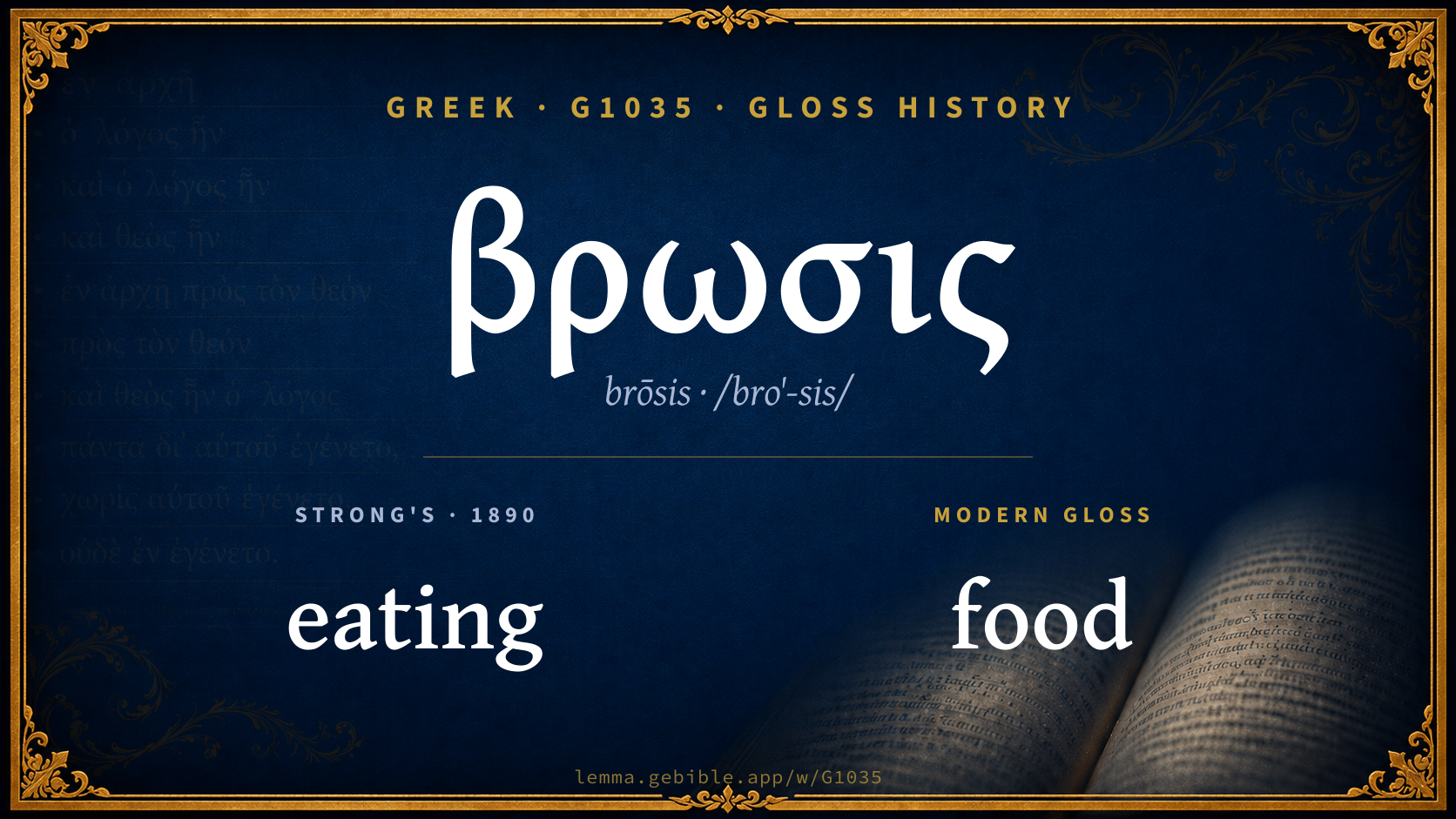
Gloss history
Strong's 1890 vs modern scholarship
About this word
Strong's G1035 catalogs a Greek word from the Greek New Testament.
These counts are not copied from any lexicon or concordance. They are computed here, from the morphology-tagged Greek New Testament. What Lemma adds →
- 10
- distinct verses
- The word appears in 10 distinct verses.
- 7 / 27
- NT books
- The word appears in 7 of 27 New Testament books.
- #978
- by frequency
- Top 1000 most frequent Greek words (rank 978 of 5,347 Greek words by occurrence).
View all 10 occurrences in the concordance →
By section of the New Testament
By traditional corpus
Conventional, traditional groupings — biblical authorship is debated, so this is a traditional corpus grouping, not an authorship claim. Some books belong to more than one corpus (Luke is in both the Gospels and the Lukan corpus, and so on), so these shares overlap and need not total 100%. Each figure is a share of the word’s 10 distinct verses.
- Gospels 5 verses · 50%
- Pauline corpus 4 verses · 40%
- Johannine 3 verses · 30%
- Hebrews 1 verse · 10%
How translations render this word
Counts come from each version’s own published word-to-Strong’s tagging or interlinear alignment — an approximate guide to how each version renders this word, not a word-level alignment the data otherwise carries. Because each total is that version’s own tagged count, the per-version totals vary from one another and need not match the appearance or distinct-verse counts above. These counts may also differ from a printed concordance because Lemma counts each distinctly tagged rendering and does not collapse phrase taggings into a single head-word total. This is a fixed set of word-tagged versions (KJV, ASV, BSB, ULT) and does not change with the reading translation you choose elsewhere. Each version’s license is shown beside its name below (and on Sources).
- King James Version: Meat 6×, Rust 2×
- American Standard Version: Food 3×, Meat 3×, Eating 2×
- Berean Standard Bible: Food 5×, Eating 2×, Rust 2×
- unfoldingWord Literal Text: Food 7×, Rust 2×
King James Version Public Domain
Renders G1035 across 11 tagged occurrences — most commonly:
Plus 3 renderings that appear only once — usually multi-word phrases or single function words the recovered tagging swept in, not distinct renderings.
American Standard Version Public Domain
Renders G1035 across 11 tagged occurrences — most commonly:
Plus 1 rendering that appears only once — usually multi-word phrases or single function words the recovered tagging swept in, not distinct renderings.
Berean Standard Bible Public Domain
Renders G1035 across 11 tagged occurrences — most commonly:
Plus 2 renderings that appear only once — usually multi-word phrases or single function words the recovered tagging swept in, not distinct renderings.
unfoldingWord Literal Text CC BY-SA 4.0
Renders G1035 across 11 tagged occurrences — most commonly:
Plus 2 renderings that appear only once — usually multi-word phrases or single function words the recovered tagging swept in, not distinct renderings.
Senses in Thayer's
The 2 senses Thayer's distinguishes for this word, in lexicon order (not ranked by frequency or importance). The full entry — with sub-senses — is in the Lexicon Entry tab.
- act of eating
- that which is eaten, food, ailment
Word origin
Derived from βιβρωσκω (bibrṓskō) (G977) — to eat.
From the base of G977 ; (abstractly) eating (literally or figuratively); by extension (concretely) food (literally or figuratively): - eating food meat.
— Strong’s Exhaustive Concordance (1890), public domain.
Forms in the corpus
The 4 distinct written forms G1035 takes in the Greek New Testament, most frequent first — each parse links to that case’s occurrences in the concordance.
| Form | Parsing | Example | Uses |
|---|---|---|---|
| βρῶσιν brō̂sin | Noun, Accusative, Singular, Feminine | John 4:32 | 4 |
| βρῶσις brō̂sis | Noun, Nominative, Singular, Feminine | Matthew 6:19 | 4 |
| βρώσεως brṓseōs | Noun, Genitive, Singular, Feminine | 1 Corinthians 8:4 | 2 |
| βρώσει brṓsei | Noun, Dative, Singular, Feminine | Colossians 2:16 | 1 |
Same root — word family
Other Thayer's entries built from the same root as G1035, grouped by Strong’s listed origin. These share a root / origin per the lexicon — not necessarily a shared meaning. Each links to that word’s own entry.
Derives from
Shares the same root
Derived from this word
Compare all same-root words → Showing 4 of 5 — not the complete family. They share a root, not necessarily a meaning.
Septuagint usage
The same Greek word βρωσις appears 36 times in the Greek Old Testament (Septuagint), across 35 verses in 15 books.
- 36
- LXX occurrences
- Tagged occurrences of this Greek word in the Septuagint.
- 35
- verses
- Distinct Septuagint verses containing this word.
- 15 / 39
- OT books
- The word appears in 15 of the 39 Old Testament books.
Sample Septuagint occurrences
- Genesis 1:29 βρῶσις
- Leviticus 7:24 βρῶσις
- Deuteronomy 32:24 βρῶσις
- 1 Samuel 2:28 βρῶσις
- 2 Samuel 16:2 βρῶσις
- 1 Kings 19:8 βρῶσις
- Job 33:20 βρῶσις
- Psalms 13:4 βρῶσις
- Isaiah 55:10 βρῶσις
- Jeremiah 7:33 βρῶσις
- Lamentations 1:11 βρῶσις
- Ezekiel 47:12 βρῶσις
Septuagint occurrences (same lexeme)
Every verse where the same Strong’s number (G1035) appears in the Greek Septuagint. Verse text shown in the World English Bible for context; the Greek form is the matched word — the English is not keyword-highlighted.
- Genesis 1:29 βρῶσις God said, "Behold, I have given you every herb yielding seed, which is on the surface of all the earth, and every tree, which bears fruit yielding seed. It will be your food.
- Genesis 1:30 βρῶσις To every animal of the earth, and to every bird of the sky, and to everything that creeps on the earth, in which there is life, I have given every green herb for food." And it was so.
- Genesis 2:9 βρῶσις Out of the ground Yahweh God made every tree to grow that is pleasant to the sight, and good for food; the tree of life also in the midst of the garden, and the tree of the knowledge of good and evil.
- Genesis 2:16 βρῶσις Yahweh God commanded the man, saying, "Of every tree of the garden you may freely eat:
- Genesis 3:6 βρῶσις When the woman saw that the tree was good for food, and that it was a delight to the eyes, and that the tree was to be desired to make one wise, she took of the fruit of it, and ate; and she gave some to her husband with her, and he ate.
- Genesis 9:3 βρῶσις Every moving thing that lives will be food for you. As the green herb, I have given everything to you.
- Genesis 25:28 βρῶσις Now Isaac loved Esau, because he ate his venison. Rebekah loved Jacob.
- Genesis 47:24 βρῶσις It will happen at the harvests, that you shall give a fifth to Pharaoh, and four parts will be your own, for seed of the field, for your food, for them of your households, and for food for your little ones."
- Leviticus 7:24 βρῶσις The fat of that which dies of itself, and the fat of that which is torn of animals, may be used for any other service, but you shall in no way eat of it.
- Leviticus 19:7 βρῶσις If it is eaten at all on the third day, it is an abomination. It will not be accepted;
- Leviticus 25:7 βρῶσις For your cattle also, and for the animals that are in your land, shall all the increase of it be for food.
- Deuteronomy 32:24 βρῶσις [They shall be] wasted with hunger, and devoured with burning heat Bitter destruction; The teeth of animals will I send on them, With the poison of crawling things of the dust.
- 1 Samuel 2:28 βρῶσις and did I choose him out of all the tribes of Israel to be my priest, to go up to my altar, to burn incense, to wear an ephod before me? and did I give to the house of your father all the offerings of the children of Israel made by fire?
- 2 Samuel 16:2 βρῶσις The king said to Ziba, What do you mean by these? Ziba said, The donkeys are for the king's household to ride on; and the bread and summer fruit for the young men to eat; and the wine, that such as are faint in the wilderness may drink.
- 2 Samuel 19:43 βρῶσις The men of Israel answered the men of Judah, and said, We have ten parts in the king, and we have also more [right] in David than you: why then did you despise us, that our advice should not be first had in bringing back our king? The words of the men of Judah were fiercer than the words of the men of Israel.
- 1 Kings 19:8 βρῶσις He arose, and ate and drink, and went in the strength of that food forty days and forty nights to Horeb the Mount of God.
- Job 33:20 βρῶσις So that his life abhors bread, And his soul dainty food.
- Job 34:3 βρῶσις For the ear tries words, As the palate tastes food.
- Psalms 13:4 βρῶσις Lest my enemy say, "I have prevailed against him;" Lest my adversaries rejoice when I fall.
- Psalms 43:12 βρῶσις
- Psalms 52:5 βρῶσις God will likewise destroy you forever. He will take you up, and pluck you out of your tent, And root you out of the land of the living. Selah.
- Psalms 77:30 βρῶσις
- Psalms 103:21 βρῶσις Praise Yahweh, all you hosts of his, You servants of his, who do his pleasure.
- Isaiah 55:10 βρῶσις For as the rain comes down and the snow from the sky, and doesn't return there, but waters the earth, and makes it bring forth and bud, and gives seed to the sower and bread to the eater;
- Jeremiah 7:33 βρῶσις The dead bodies of this people shall be food for the birds of the sky, and for the animals of the earth; and none shall frighten them away.
- Jeremiah 15:3 βρῶσις I will appoint over them four kinds, says Yahweh: the sword to kill, and the dogs to tear, and the birds of the sky, and the animals of the earth, to devour and to destroy.
- Jeremiah 19:7 βρῶσις I will make void the counsel of Judah and Jerusalem in this place; and I will cause them to fall by the sword before their enemies, and by the hand of those who seek their life: and their dead bodies will I give to be food for the birds of the sky, and for the animals of the earth.
- Jeremiah 41:20 βρῶσις
- Lamentations 1:11 βρῶσις All her people sigh, they seek bread; They have given their pleasant things for food to refresh the soul: Look, Yahweh, and see; for I am become abject.
- Lamentations 1:19 βρῶσις I called for my lovers, [but] they deceived me: My priests and my elders gave up the spirit in the city, While they sought them food to refresh their souls.
- Lamentations 4:10 βρῶσις The hands of the pitiful women have boiled their own children; They were their food in the destruction of the daughter of my people.
- Ezekiel 47:12 βρῶσις By the river on the bank of it, on this side and on that side, shall grow every tree for food, whose leaf shall not wither, neither shall the fruit of it fail: it shall bring forth new fruit every month, because the waters of it issue out of the sanctuary; and the fruit of it shall be for food, and the leaf of it for healing.
- Daniel 1:10 βρῶσις The prince of the eunuchs said to Daniel, I fear my lord the king, who has appointed your food and your drink: for why should he see your faces worse looking than the youths who are of your own age? so would you endanger my head with the king.
- Habakkuk 3:17 βρῶσις For though the fig tree doesn't flourish, Nor fruit be in the vines; The labor of the olive fails, The fields yield no food; The flocks are cut off from the fold, And there is no herd in the stalls:
- Malachi 3:11 βρῶσις I will rebuke the devourer for your sakes, and he shall not destroy the fruits of your ground; neither shall your vine cast its fruit before its time in the field," says Yahweh of Hosts.
These are occurrences of the same Greek lexeme (G1035) in the Septuagint — not a translation of any one Hebrew word. The store carries no word-level Hebrew↔Greek alignment, so no Hebrew original is asserted here. Counts come from the recovered LXX Strong's tagging — high-frequency vocabulary is well covered, while rare or late forms may be untagged — so they reflect tagged occurrences and may slightly undercount.