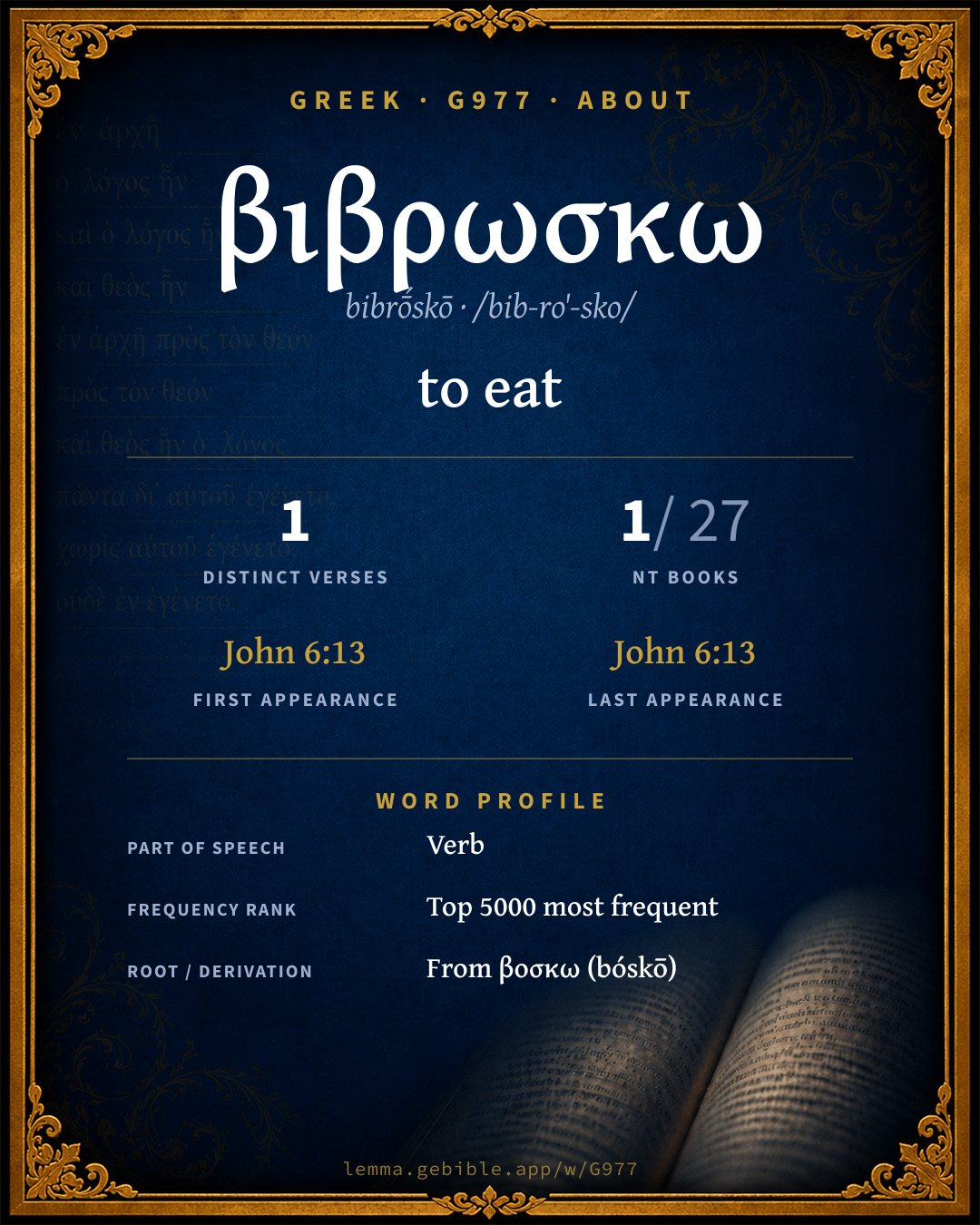
βιβρώσκω
to eat
Full lexicon entry — Thayer's Greek Lexicon
From Thayer's Greek Lexicon
Where this word appears
Grammar key — what these labels mean
Part of speech
- Verb
- An action or state-of-being word.
Tense
- Perfect
- A completed past action with continuing present results.
Voice
- Active
- The subject performs the action.
Mood
- Participle
- A verbal adjective (“writing,” “having written”).
Case
- Dative
- The case of the indirect object, means, or location — “to / for / with / in.”
Gender
- Masculine
- Grammatically masculine.
Number
- Plural
- More than one.
Every verse where G977 appears — 1 distinct verse across 1 book. Click any verse to open its interlinear word-by-word view. Verse text shown in the World English Bible for context — . Each verse’s Greek form is shown with its reference; the English is not keyword-highlighted, since the data carries no word-level English alignment. Use “Compare translations” on any verse to read it across multiple English versions. This concordance covers the Greek New Testament; Septuagint (Greek Old Testament) occurrences of this word are not indexed here.
John 1 verse
About this entry
At a glance — auto-summarized from this page’s data, not written by a person. Every figure links to its source below. This summary describes the numbers; it doesn’t interpret them.
At its core, βιβρωσκω (bibrṓskō) means “to eat.” It occurs a mere 1 verse across Scripture. The word gravitates to John (100%). Its lone occurrence is John 6:13. It shares a root with βοσκω, βοτανη and βους. Dig into 1-verse concordance and the renderings breakdown below.
Gloss history
Strong's 1890 vs modern scholarship
About this word
Strong's G977 catalogs a Greek word from the Greek New Testament.
These counts are not copied from any lexicon or concordance. They are computed here, from the morphology-tagged Greek New Testament. What Lemma adds →
- 1
- distinct verses
- The word appears in 1 distinct verse.
- 1 / 27
- NT books
- The word appears in 1 of 27 New Testament books.
- #3,503
- by frequency
- Top 5000 most frequent Greek words (rank 3,503 of 5,347 Greek words by occurrence).
View all 1 occurrence in the concordance →
Most concentrated in
- John 1 verse 100%
By section of the New Testament
By traditional corpus
Conventional, traditional groupings — biblical authorship is debated, so this is a traditional corpus grouping, not an authorship claim. Some books belong to more than one corpus (Luke is in both the Gospels and the Lukan corpus, and so on), so these shares overlap and need not total 100%. Each figure is a share of the word’s 1 distinct verse.
- Gospels 1 verse · 100%
- Johannine 1 verse · 100%
How translations render this word
Counts come from each version’s own published word-to-Strong’s tagging or interlinear alignment — an approximate guide to how each version renders this word, not a word-level alignment the data otherwise carries. Because each total is that version’s own tagged count, the per-version totals vary from one another and need not match the appearance or distinct-verse counts above. These counts may also differ from a printed concordance because Lemma counts each distinctly tagged rendering and does not collapse phrase taggings into a single head-word total. This is a fixed set of word-tagged versions (KJV, ASV, BSB, ULT) and does not change with the reading translation you choose elsewhere. Each version’s license is shown beside its name below (and on Sources).
- King James Version: Had eaten 1×
- American Standard Version: Had eaten 1×
- Berean Standard Bible: Had eaten 1×
- unfoldingWord Literal Text: Having eaten 1×
King James Version Public Domain
Renders G977 across 1 tagged occurrence — most commonly:
American Standard Version Public Domain
Renders G977 across 1 tagged occurrence — most commonly:
Berean Standard Bible Public Domain
Renders G977 across 1 tagged occurrence — most commonly:
unfoldingWord Literal Text CC BY-SA 4.0
Renders G977 across 1 tagged occurrence — most commonly:
Senses in Thayer's
The 1 sense Thayer's distinguishes for this word, in lexicon order (not ranked by frequency or importance). The full entry — with sub-senses — is in the Lexicon Entry tab.
- to eat
Word origin
Derived from βοσκω (bóskō) (G1006) — to feed.
A reduplicated and prolonged form of an obsolete primary verb (perhaps causative of G1006 ); to eat : - eat.
— Strong’s Exhaustive Concordance (1890), public domain.
Same root — word family
Other Thayer's entries built from the same root as G977, grouped by Strong’s listed origin. These share a root / origin per the lexicon — not necessarily a shared meaning. Each links to that word’s own entry.
Derives from
Shares the same root
Derived from this word
Compare all same-root words → Showing 4 of 6 — not the complete family. They share a root, not necessarily a meaning.
Septuagint usage
The same Greek word βιβρωσκω appears 38 times in the Greek Old Testament (Septuagint), across 37 verses in 11 books.
- 38
- LXX occurrences
- Tagged occurrences of this Greek word in the Septuagint.
- 37
- verses
- Distinct Septuagint verses containing this word.
- 11 / 39
- OT books
- The word appears in 11 of the 39 Old Testament books.
Sample Septuagint occurrences
- Exodus 12:46 βιβρώσκω
- Leviticus 6:9 βιβρώσκω
- Deuteronomy 12:23 βιβρώσκω
- Joshua 5:12 βιβρώσκω
- Judges 14:14 βιβρώσκω
- 1 Samuel 30:12 βιβρώσκω
- Job 5:3 βιβρώσκω
- Isaiah 9:17 βιβρώσκω
- Jeremiah 24:2 βιβρώσκω
- Ezekiel 4:14 βιβρώσκω
- Nahum 1:10 βιβρώσκω
Septuagint occurrences (same lexeme)
Every verse where the same Strong’s number (G977) appears in the Greek Septuagint. Verse text shown in the World English Bible for context; the Greek form is the matched word — the English is not keyword-highlighted.
- Exodus 12:46 βιβρώσκω In one house shall it be eaten; you shall not carry forth anything of the flesh abroad out of the house; neither shall you break a bone of it.
- Exodus 13:3 βιβρώσκω Moses said to the people, "Remember this day, in which you came out from Egypt, out of the house of bondage; for by strength of hand Yahweh brought you out from this place. No leavened bread shall be eaten.
- Exodus 21:28 βιβρώσκω "If a bull gores a man or a woman to death, the bull shall surely be stoned, and its flesh shall not be eaten; but the owner of the bull shall not be held responsible.
- Exodus 29:34 βιβρώσκω If anything of the flesh of the consecration, or of the bread, remains to the morning, then you shall burn the remainder with fire: it shall not be eaten, because it is holy.
- Leviticus 6:9 βιβρώσκω "Command Aaron and his sons, saying, 'This is the law of the burnt offering: the burnt offering shall be on the hearth on the altar all night until the morning; and the fire of the altar shall be kept burning on it.
- Leviticus 6:16 βιβρώσκω That which is left of it Aaron and his sons shall eat. It shall be eaten without yeast in a holy place. They shall eat it in the court of the Tent of Meeting
- Leviticus 6:19 βιβρώσκω Yahweh spoke to Moses, saying,
- Leviticus 6:23 βιβρώσκω Every meal offering of a priest shall be wholly burned. It shall not be eaten."
- Leviticus 7:15 βιβρώσκω The flesh of the sacrifice of his peace offerings for thanksgiving shall be eaten on the day of his offering. He shall not leave any of it until the morning.
- Leviticus 7:16 βιβρώσκω "'But if the sacrifice of his offering is a vow, or a freewill offering, it shall be eaten on the day that he offers his sacrifice; and on the next day what remains of it shall be eaten:
- Leviticus 7:19 βιβρώσκω "'The flesh that touches any unclean thing shall not be eaten. It shall be burned with fire. As for the flesh, everyone who is clean may eat it;
- Leviticus 7:24 βιβρώσκω The fat of that which dies of itself, and the fat of that which is torn of animals, may be used for any other service, but you shall in no way eat of it.
- Leviticus 11:13 βιβρώσκω "'These you shall detest among the birds; they shall not be eaten, they are an abomination: the eagle, and the vulture, and the black vulture,
- Leviticus 11:41 βιβρώσκω "'Every creeping thing that creeps on the earth is an abomination. It shall not be eaten.
- Leviticus 19:6 βιβρώσκω It shall be eaten the same day you offer it, and on the next day: and if anything remains until the third day, it shall be burned with fire.
- Leviticus 19:7 βιβρώσκω If it is eaten at all on the third day, it is an abomination. It will not be accepted;
- Leviticus 19:23 βιβρώσκω "'When you come into the land, and have planted all kinds of trees for food, then you shall count their fruit as forbidden. Three years shall they be forbidden to you. It shall not be eaten.
- Leviticus 22:30 βιβρώσκω It shall be eaten on the same day; you shall leave none of it until the morning. I am Yahweh.
- Deuteronomy 12:23 βιβρώσκω Only be sure that you don't eat the blood: for the blood is the life; and you shall not eat the life with the flesh.
- Joshua 5:12 βιβρώσκω The manna ceased on the next day, after they had eaten of the produce of the land; neither had the children of Israel manna any more; but they ate of the fruit of the land of Canaan that year.
- Joshua 9:5 βιβρώσκω and old and patched shoes on their feet, and old garments on them; and all the bread of their provision was dry and was become moldy.
- Joshua 9:12 βιβρώσκω This our bread we took hot for our provision out of our houses on the day we came forth to go to you; but now, behold, it is dry, and is become moldy:
- Judges 14:14 βιβρώσκω He said to them, Out of the eater came forth food, Out of the strong came forth sweetness. They couldn't in three days declare the riddle.
- 1 Samuel 30:12 βιβρώσκω They gave him a piece of a cake of figs, and two clusters of raisins: and when he had eaten, his spirit came again to him; for he had eaten no bread, nor drunk any water, three days and three nights.
- Job 5:3 βιβρώσκω I have seen the foolish taking root, But suddenly I cursed his habitation.
- Job 6:6 βιβρώσκω Can that which has no flavor be eaten without salt? Or is there any taste in the white of an egg?
- Job 18:13 βιβρώσκω The members of his body shall be devoured, The firstborn of death shall devour his members.
- Isaiah 9:17 βιβρώσκω Therefore the Lord will not rejoice over their young men, neither will he have compassion on their fatherless and widows; for everyone is profane and an evil-doer, and every mouth speaks folly. For all this his anger is not turned away, but his hand is stretched out still.
- Isaiah 28:28 βιβρώσκω Bread [grain] is ground; for he will not be always threshing it: and though the wheel of his cart and his horses scatter it, he does not grind it.
- Isaiah 51:8 βιβρώσκω For the moth shall eat them up like a garment, and the worm shall eat them like wool; but my righteousness shall be forever, and my salvation to all generations.
- Jeremiah 24:2 βιβρώσκω One basket had very good figs, like the figs that are first-ripe; and the other basket had very bad figs, which could not be eaten, they were so bad.
- Jeremiah 24:3 βιβρώσκω Then said Yahweh to me, What see you, Jeremiah? I said, Figs; the good figs, very good; and the bad, very bad, that can't be eaten, they are so bad.
- Jeremiah 24:8 βιβρώσκω As the bad figs, which can't be eaten, they are so bad, surely thus says Yahweh, So will I give up Zedekiah the king of Judah, and his princes, and the residue of Jerusalem, who remain in this land, and those who dwell in the land of Egypt,
- Jeremiah 37:16 βιβρώσκω When Jeremiah was come into the dungeon-house, and into the cells, and Jeremiah had remained there many days;
- Ezekiel 4:14 βιβρώσκω Then said I, Ah Lord Yahweh! behold, my soul has not been polluted; for from my youth up even until now have I not eaten of that which dies of itself, or is torn of animals; neither came there abominable flesh into my mouth.
- Ezekiel 18:15 βιβρώσκω who has not eaten on the mountains, neither has lifted up his eyes to the idols of the house of Israel, has not defiled his neighbor's wife,
- Nahum 1:10 βιβρώσκω For entangled like thorns, and drunken as with their drink, they are consumed utterly like dry stubble.
These are occurrences of the same Greek lexeme (G977) in the Septuagint — not a translation of any one Hebrew word. The store carries no word-level Hebrew↔Greek alignment, so no Hebrew original is asserted here. Counts come from the recovered LXX Strong's tagging — high-frequency vocabulary is well covered, while rare or late forms may be untagged — so they reflect tagged occurrences and may slightly undercount.