Isaiah 42:3

Hebrew (Westminster Leningrad Codex) Isaiah 42:3 appears in the Hebrew Old Testament. The text above is from the Westminster Leningrad Codex. Each word links to its Strong’s number, a concise gloss, and parsing drawn from the Open Scriptures Hebrew Bible morphology. Click any word for its full Brown-Driver-Briggs (BDB) entry.
Download image
Cite this verse

Isaiah 42:3 (World English Bible). Public Domain. Lemma interlinear Bible study tool, https://lemma.gebible.app/v/isaiah/42/3.

Show BibTeX & RIS
BibTeX
RIS
English Translation
A bruised reed will he not break, and a dimly burning wick will he not quench: he will bring forth justice in truth.
World English Bible · Public Domain
Download a study sheet

One document with this verse’s original text, its word-by-word gloss line, the meaning frame, cross-references with their text, attributed commentary, and full source and license credits — printable, and it pastes into notes with its structure intact.

This verse Autodidact and up

Study sheet (.html) Plain text (.txt)

A passage Seminary Student

Up to 50 verses in one chapter. A passage sheet keeps up to 6 commentary sources and 12 cross-references per verse, in the order this page ranks them, and says so on the sheet whenever that leaves anything out. Ask for a single verse and you get the Autodidact verse sheet above.

Everything on this page stays free to read, with no account — the sheet is a download of what is already on screen, not access to it.

Want to remove ads? Support Godless Engineer
Compare translations 3

The same verse in 3 English versions, stacked beneath the original-language interlinear above. Click any original word for its lexicon entry.

Each is an independent rendering of the whole verse — the interlinear is not word-aligned to these translations.

Highlighted words mark where these versions differ — a whole-verse word diff, not a word-by-word alignment.

  • World English Bible Public Domain
    A bruised reed will he not break, and a dimly burning wick will he not quench: he will bring forth justice in truth.
  • King James Version Public Domain
    A bruised reed shall he not break, and the smoking flax shall he not quench: he shall bring forth judgment unto truth.
  • unfoldingWord Literal Text CC BY-SA 4.0
    He will not break a crushed reed, and he will not quench a dim wick. He will bring forth justice in faithfulness.

unfoldingWord Literal Text — © unfoldingWord, licensed CC BY-SA 4.0. Word-aligned USFM3 via Door43 (git.door43.org/unfoldingWord/en_ult).

Versions to compare (up to 4)

3 of 4 selected

Show all 18 translations

Every available English version of this verse, each an independent rendering of the whole verse.

  • World English Bible Public Domain
    A bruised reed will he not break, and a dimly burning wick will he not quench: he will bring forth justice in truth.
  • Berean Standard Bible Public Domain
    A bruised reed He will not break and a smoldering wick He will not extinguish; He will faithfully bring forth justice.
  • Majority Standard Bible Public Domain
    A bruised reed He will not break and a smoldering wick He will not extinguish; He will faithfully bring forth justice.
  • King James Version Public Domain
    A bruised reed shall he not break, and the smoking flax shall he not quench: he shall bring forth judgment unto truth.
  • American Standard Version (1901) Public Domain
    A bruised reed will he not break, and a dimly burning wick will he not quench: he will bring forth justice in truth.
  • Revised Version (1885) Public Domain
    A bruised reed shall he not break, and the smoking flax shall he not quench: he shall bring forth judgment in truth.
  • Geneva Bible (1599) Public Domain
    A bruised reede shall hee not breake, and the smoking flaxe shall he not quench: he shall bring foorth iudgement in trueth.
  • Douay-Rheims (1899) Public Domain
    The bruised reed he shall not break, and smoking flax he shall not quench: he shall bring forth judgment unto truth.
  • Young's Literal Translation Public Domain
    A bruised reed he breaketh not, And dim flax he quencheth not, To truth he bringeth forth judgment.
  • Literal Standard Version CC BY-SA 4.0
    A bruised reed He does not break, || And faded flax He does not quench, || He brings forth judgment to truth.
  • Unlocked Literal Bible CC BY-SA 4.0
    A crushed reed he will not break, and a dimly burning wick he will not quench: he will faithfully execute justice.
  • unfoldingWord Literal Text CC BY-SA 4.0
    He will not break a crushed reed, and he will not quench a dim wick. He will bring forth justice in faithfulness.
  • Darby Bible Public Domain
    A bruised reed shall he not break, and smoking flax shall he not quench: he shall bring forth judgment according to truth.
  • World Messianic Bible Public Domain
    He won’t break a bruised reed. He won’t quench a dimly burning wick. He will faithfully bring justice.
  • Webster's Bible Public Domain
    A bruised reed shall he not break, and the smoking flax shall he not quench: he shall bring forth judgment to truth.
  • Free Bible Version CC BY-SA 4.0
    He won't break a damaged reed; he won't snuff out a smoldering wick. He will faithfully make sure everyone is treated fairly.
  • Bible in Basic English Public Domain
    He will not let a crushed stem be quite broken, and he will not let a feebly burning light be put out: he will go on sending out the true word to the peoples.
  • JPS Tanakh (1917) Public Domain
    A bruised reed shall he not break, and the dimly burning wick shall he not quench; he shall make the right to go forth according to the truth.

Literal Standard Version (2020), Covenant Press — licensed CC BY-SA 4.0. Text via the HelloAO Bible API (eBible.org). Unlocked Literal Bible (unfoldingWord) — licensed CC BY-SA 4.0. Text via the HelloAO Bible API (eBible.org). unfoldingWord Literal Text — © unfoldingWord, licensed CC BY-SA 4.0. Word-aligned USFM3 via Door43 (git.door43.org/unfoldingWord/en_ult). Free Bible Version, Dr. Jonathan Gallagher — licensed CC BY-SA 4.0. Text via the HelloAO Bible API (eBible.org).

Word by word

More ways to search: Search by grammar → Find every occurrence → Compare this word →

Practice this passage: Drill this verse → Learn its vocabulary →

וּפִשְׁתָּ֥ה
pishtâh
H6594
“and · flax”
Conjunction + Noun, Common, Feminine, Singular, Absolute
Part of Speech
Conjunction + Noun
Type
Common
Gender
Feminine
Number
Singular
State
Absolute
Full BDB Definition

Origin: from H6593

TWOT: 1849

flax - flax (of the plant) - as wick for lamp
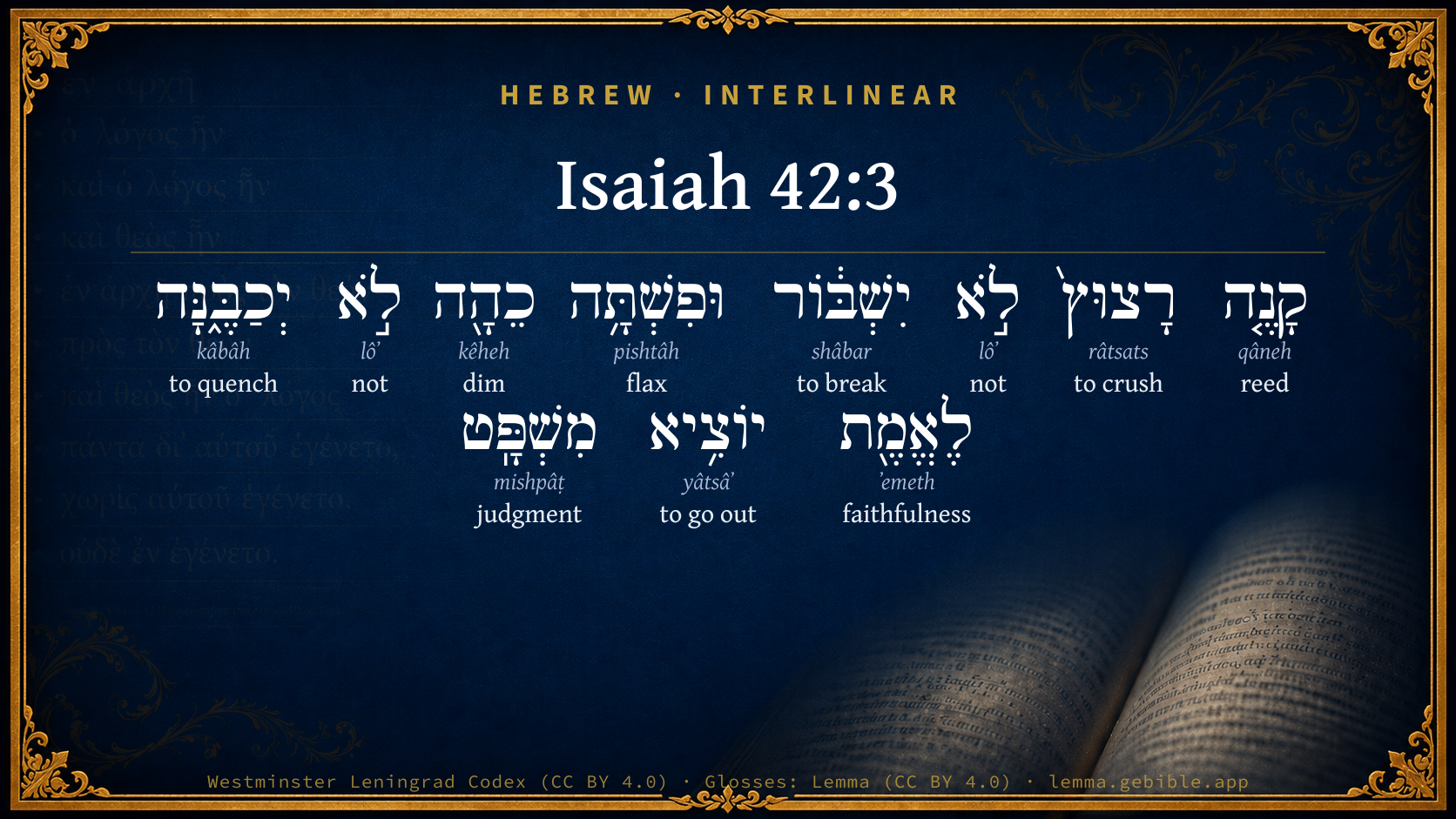
  1. קָנֶ֤ה qâneh H7070 “reed” Noun, Common, Masculine, Singular, Absolute
  2. רָצוּץ֙ râtsats H7533 “crushed” Verb, Qal, Participle Passive, Masculine, Singular, Absolute
  3. לֹ֣א lôʼ H3808 “not” Particle, Negative
  4. יִשְׁבּ֔וֹר shâbar H7665 “to break” Verb, Qal, Imperfect, 3rd Person, Masculine, Singular
  5. כֵהָ֖ה kêheh H3544 “dim” Adjective, Adjective, Feminine, Singular, Absolute
  6. לֹ֣א lôʼ H3808 “not” Particle, Negative
  7. יְכַבֶּ֑נָּה kâbâh H3518 “to quench · her” Verb, Piel, Imperfect, 3rd Person, Masculine, Singular + Suffix, Personal, 3rd Person, Feminine, Singular
  8. לֶאֱמֶ֖ת ʼemeth H571 “to/for · faithfulness” Preposition + Noun, Common, Feminine, Singular, Absolute
  9. יוֹצִ֥יא yâtsâʼ H3318 “to go out” Verb, Hiphil, Imperfect, 3rd Person, Masculine, Singular
  10. מִשְׁפָּֽט mishpâṭ H4941 “judgment” Noun, Common, Masculine, Singular, Absolute

About this verse

These counts appear in no published source. They are computed here, from the morphology-tagged text and Lemma’s own curated glosses. What Lemma adds →

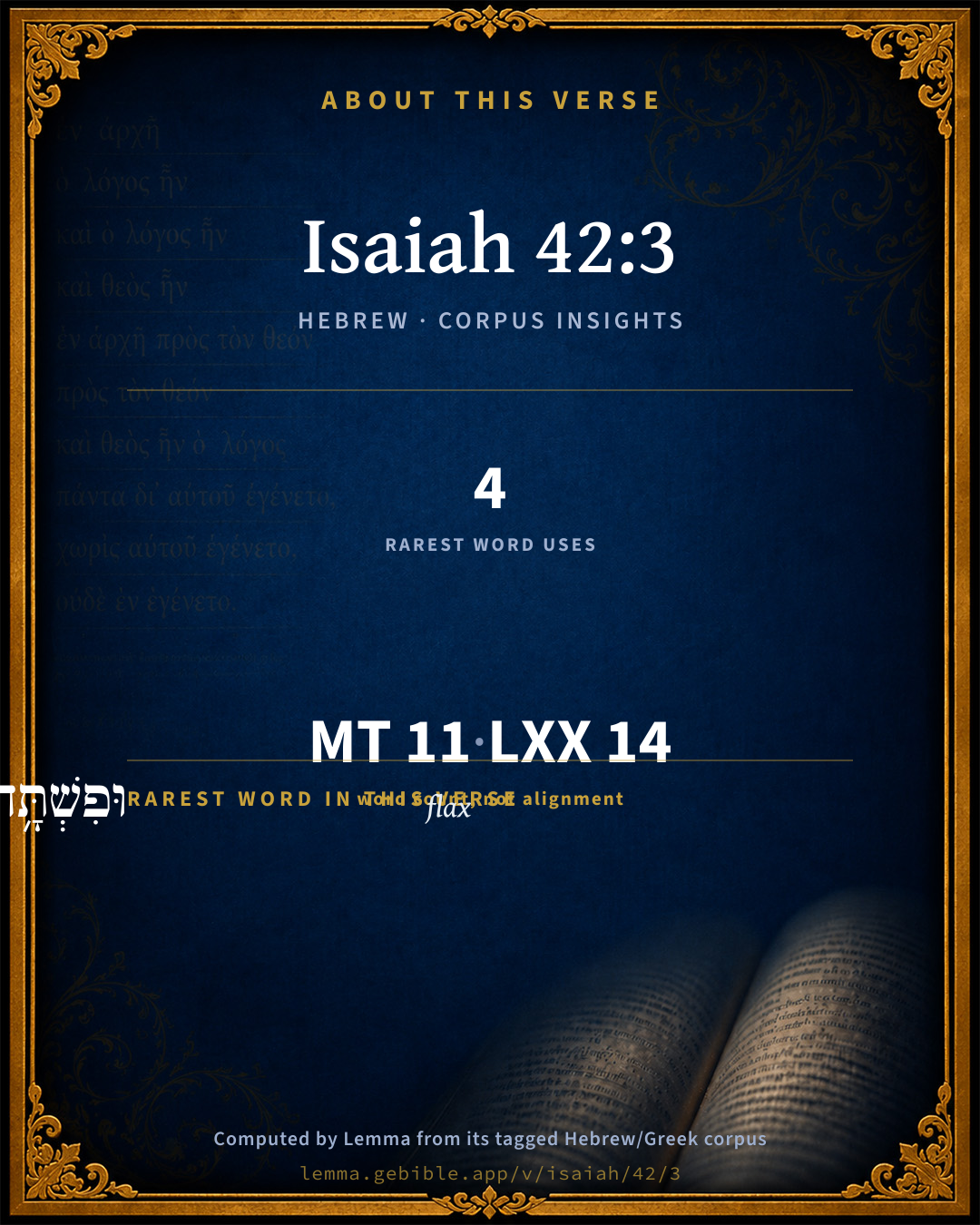
11
words
10
distinct lemmas
Prophets
section

Notable vocabulary

The rarest word here is וּפִשְׁתָּ֥ה flax H6594 — appearing just 4 times in the whole Hebrew Bible.

Shared distinctive vocabulary

וּפִשְׁתָּ֥ה flax H6594 occurs in 3 verses of the Hebrew Bible. Also found in:

Grammatical profile

  • 4 verbs
  • 4 nouns
  • 1 adjective
  • 2 particles

Verb forms

  • רָצוּץ֙ Qal · Participle Passive
  • יִשְׁבּ֔וֹר Qal · Imperfect
  • יְכַבֶּ֑נָּה Piel · Imperfect
  • יוֹצִ֥יא Hiphil · Imperfect

Repetition

A word recurs within this verse — often emphatic in Hebrew:

Hebrew & Septuagint length

In English translation the verse runs 23 words from the Hebrew and 22 from the Septuagint (LXX English) — closely comparable.

A rough comparison of the two English renderings, which tokenize alike — not a word-level alignment.

Word counts can differ between the Hebrew and the Greek without any difference in meaning — e.g. the Hebrew direct-object marker אֵת has no separate Greek word, and Greek often adds the article ὁ.

In the original languages it is 11 Hebrew tokens and 14 Greek tokens — but the two are counted differently (Hebrew bundles its prefixes and suffixes into one token; the Greek is in lemma form), so that isn’t a like-for-like length.

Cross-references

27

Topical passages linked to Isaiah 42:3 in the Treasury of Scripture Knowledge — connected by theme and wording, ordered by reader-vote popularity; previews shown in the World English Bible.

  • Ezekiel 34:16 I will seek that which was lost, and will bring back that which was driven away, and will bind up that which was broken, and will strengthen that which was sick: but the fat and the strong I will destroy; I will feed them in justice.
  • Jeremiah 31:25 For I have satiated the weary soul, and every sorrowful soul have I replenished.
  • Psalms 147:3 He heals the broken in heart, And binds up their wounds.
  • Isaiah 40:11 He will feed his flock like a shepherd, he will gather the lambs in his arm, and carry them in his bosom, [and] will gently lead those who have their young.
  • Matthew 11:28 "Come to me, all you who labor and are heavily burdened, and I will give you rest.
  • Isaiah 11:3–4 His delight shall be in the fear of Yahweh; and he shall not judge after the sight of his eyes, neither decide after the hearing of his ears;
  • John 5:30 I can of myself do nothing. As I hear, I judge, and my judgment is righteous; because I don't seek my own will, but the will of my Father who sent me.
  • Matthew 18:10–14 See that you don't despise one of these little ones, for I tell you that in heaven their angels always see the face of my Father who is in heaven.
  • Revelation 19:11 I saw the heaven opened, and behold, a white horse, and he who sat on it is called Faithful and True. In righteousness he judges and makes war.
  • John 20:19–21 When therefore it was evening, on that day, the first day of the week, and when the doors were locked where the disciples were assembled, for fear of the Jews, Jesus came and stood in the midst, and said to them, "Peace be to you."
  • Psalms 96:13 Before Yahweh; for he comes, For he comes to judge the earth. He will judge the world with righteousness, The peoples with his truth.
  • Isaiah 50:10 Who is among you who fears Yahweh, who obeys the voice of his servant? He who walks in darkness, and has no light, let him trust in the name of Yahweh, and rely on his God.
  • Psalms 98:9 Let them sing before Yahweh, For he comes to judge the earth. He will judge the world with righteousness, And the peoples with equity.
  • Isaiah 40:29–31 He gives power to the faint; and to him who has no might he increases strength.
  • Luke 22:31–32 The Lord said, "Simon, Simon, behold, Satan asked to have you, that he might sift you as wheat,
  • Psalms 72:2–4 He will judge your people with righteousness, And your poor with justice.
  • Isaiah 35:3–4 Strengthen you the weak hands, and confirm the feeble knees.
  • Psalms 103:13–14 Like a father has compassion on his children, So Yahweh has compassion on those who fear him.
  • Isaiah 66:2 For all these things has my hand made, and [so] all these things came to be, says Yahweh: but to this man will I look, even to him who is poor and of a contrite spirit, and who trembles at my word.
  • Jeremiah 31:18–20 I have surely heard Ephraim bemoaning himself [thus], You have chastised me, and I was chastised, as a calf unaccustomed [to the yoke]: turn you me, and I shall be turned; for you are Yahweh my God.
  • Micah 7:9 I will bear the indignation of Yahweh, Because I have sinned against him, Until he pleads my case, and executes judgment for me. He will bring me forth to the light. I will see his righteousness.
  • Hebrews 2:17–18 Therefore he was obligated in all things to be made like his brothers, that he might become a merciful and faithful high priest in things pertaining to God, to make atonement for the sins of the people.
  • Isaiah 50:4 The Lord Yahweh has given me the tongue of those who are taught, that I may know how to sustain with words him who is weary: he wakens morning by morning, he wakens my ear to hear as those who are taught.
  • Jeremiah 30:12–17 For thus says Yahweh, Your hurt is incurable, and your wound grievous.
  • John 20:27 Then he said to Thomas, "Reach here your finger, and see my hands. Reach here your hand, and put it into my side. Don't be unbelieving, but believing."
  • Isaiah 57:15–18 For thus says the high and lofty One who inhabits eternity, whose name is Holy: I dwell in the high and holy place, with him also who is of a contrite and humble spirit, to revive the spirit of the humble, and to revive the heart of the contrite.
  • Isaiah 61:1–3 The Spirit of the Lord Yahweh is on me; because Yahweh has anointed me to preach good news to the humble; he has sent me to bind up the broken-hearted, to proclaim liberty to the captives, and the opening [of the prison] to those who are bound;

Cross-references courtesy of OpenBible.info (CC BY 4.0).

Hebrew and Greek witnesses Masoretic Hebrew ↔ Greek Septuagint

The same verse in the two great witnesses to the Old Testament, shown verse-for-verse.

These are two independent witnesses, not word-aligned to each other, and the Septuagint is shown in lemma (dictionary) form.

Hebrew Isaiah 42:3 Masoretic · Westminster Leningrad Codex

קָנֶ֤ה רָצוּץ֙ לֹ֣א יִשְׁבּ֔וֹר וּפִשְׁתָּ֥ה כֵהָ֖ה לֹ֣א יְכַבֶּ֑נָּה לֶאֱמֶ֖ת יוֹצִ֥יא מִשְׁפָּֽט

A bruised reed will he not break, and a dimly burning wick will he not quench: he will bring forth justice in truth.

World English Bible · Public Domain

Greek LXX Isaiah 42:3 Septuagint · lemma form

κάλαμος θλάω οὐ συντρίβω καί λίνον καπνίζω οὐ σβέννυμι ἀλλά εἰς ἀλήθεια ἐκφέρω κρίσις

A bruised reed shall he not break, and smoking flax shall he not quench; but he shall bring forth judgment to truth.

LXX2012 (modern English Septuagint) · Public Domain

On this verse, Trapp's Complete Commentary discusses the Septuagint’s reading. Read the note in Commentary ↓

Hebrew: Westminster Leningrad Codex (CC BY 4.0). Greek: Septuagint (public domain); English from LXX2012 (modern English Septuagint) (Public Domain). How the Septuagint differs from the Hebrew →

Targum (Aramaic paraphrase)

1

The Targum is the ancient Jewish Aramaic paraphrase of the Hebrew Scriptures — an interpretive translation, not the Hebrew text itself. Onkelos (literal) and Pseudo-Jonathan (expansive) render the Torah, and Jonathan the Prophets. Coverage is partial: where no permissively-licensed English translation exists for a verse, only the Aramaic is shown. This is verse-level text, not a word-by-word alignment to the Hebrew.

  1. Targum Jonathan Prophets (Joshua–Malachi)
    עִנְוְתָנַיָא דְאִינוּן דָמָן לְקַנְיָא רְעִיעַ לָא יִתַּבְּרוּן וַחֲשִׁיכַיָא דִכְבוּצִין עַמִי לָא יִטְפוּן לְקוּשְׁטָא יַפֵיק דִינָא:

    The meek who are like a bruised reed He shall not break; and the poor who are as a glimmering wick with him, he will not quench: he shall bring forth judgment unto truth.

    Targum Jonathan — Aramaic: “Mikraot Gedolot” (public domain). English: “Sefaria Community Translation” (CC0 1.0 (public-domain dedication)); “London "Chaldee Paraphrase," 1871” (public domain). Text via Sefaria.

Commentary

Notes on Isaiah 42:3 from classic Christian and Jewish commentators (each source and its license shown beneath its notes). The classic Christian expositions comment on the surrounding passage and are grouped to its opening verse, so a note may address several verses; the Jewish commentaries on the Tanakh (Rashi and others) are per-verse, so they appear only where the commentator wrote on this verse.

Lemma curates 59 commentaries, every one of them public domain or Creative Commons licensed, each selected and text-cleaned for this edition rather than reprinted as found. About our sources →

Jamieson, Fausset & Brown

Robert Jamieson, A. R. Fausset & David Brown

bruised--"It pleased the Lord to bruise Him" (Isa 53:5, Isa 53:10; Gen 3:15); so He can feel for the bruised. As Isa 42:2 described His unturbulent spirit towards His violent enemies (Mat 12:14-16), and His utter freedom from love of notoriety, so Isa 42:3, His tenderness in cherishing the first spark of grace in the penitent (Isa 40:11).

reed--fragile: easily "shaken with the wind" (Mat 11:7). Those who are at best feeble, and who besides are oppressed by calamity or by the sense of sin.

break--entirely crush or condemn. Compare "bind up the broken-hearted" (Isa 50:4; Isa 61:1; Mat 11:28).

flax--put for the lamp-wick, formed of flax. The believer is the lamp (so the Greek, Mat 5:15; Joh 5:35): his conscience enlightened by the Holy Ghost is the wick. "Smoking" means "dimly burning," "smouldering," the flame not quite extinct. This expresses the positive side of the penitent's religion; as "bruised reed," the negative. Broken-hearted in himself, but not without some spark of flame: literally, "from above." Christ will supply such a one with grace as with oil. Also, the light of nature smouldering in the Gentiles amidst the hurtful fumes of error. He not only did not quench, but cleared away the mists and superadded the light of revelation. See JEROME, To Algasia, Question 2.

truth--Mat 12:20 quotes it, "send forth judgment unto victory." Matthew, under the Spirit, gives the virtual sense, but varies the word, in order to bring out a fresh aspect of the same thing. Truth has in itself the elements of victory over all opposing forces. Truth is the victory of Him who is "the truth" (Joh 14:6). The gospel judicial sifting ("judgment") of believers and unbelievers, begun already in part (Joh 3:18-19; Joh 9:39), will be consummated victoriously in truth only at His second coming; Isa 42:13-14, here, and Mat 12:32, Mat 12:36, Mat 12:41-42, show that there is reference to the judicial aspect of the Gospel, especially finally: besides the mild triumph of Jesus coming in mercy to the penitent now (Isa 42:2), there shall be finally the judgment on His enemies, when the "truth" shall be perfectly developed. Compare Isa 61:1-3, where the two comings are similarly joined (Psa 2:4-6, Psa 2:8; Rev 15:2, Rev 15:4; Rev 19:11-16). On "judgment," see on Isa 42:1.

Jamieson, Fausset & Brown — Commentary Critical and Explanatory on the Whole Bible (1871) — public domain (CC PDM 1.0). Text via the HelloAO Bible API.

Trapp's Complete Commentary

John Trapp

Isa 42:3 A bruised reed shall he not break, and the smoking flax shall he not quench: he shall bring forth judgment unto truth.

Ver. 3. A bruised reed shall he not break,] i.e., A contrite heart, {Psa 51:17} in whom there shall appear to be anything of Christ, though never so little: that are faithful in weakness, though but weak in faith, as he was who cried out, Lord, I believe, help mine unbelief; {Mar 9:24} and another, Invoco te fide quamvis languida, fide tamen. {a} See on Mat 12:20.

He shall bring forth judgment unto truth.] Unto victory, saith the evangelist, after the Septuagint. Truth will prevail, sincerity proceed to perfection. "The righteous also shall hold on his way: and he that hath clean hands shall be stronger and stronger." {Job 17:9} Where there is truth of grace, there will be victory. Bernard never went from God without God. And holy Bradford would never give over any good duty till he found something coming in - as in confession, till his heart melted; in begging pardon, till it was quieted; in seeking grace, till it was quickened, &c.

{a} Cruciger.

John Trapp, A Commentary or Exposition upon All the Books of the Old and New Testament (1647–1656) — public domain. Text from a community e-Sword module.

The Biblical Illustrator

Joseph S. Exell

Isa_42:3-4

A bruised reed shall He not break

The bruised reed

The reed, or calamus, is a plant with hollow stem, which grew principally by the side of lakes or rivers.

Those who have been in Palestine are familiar with it in the tangled thickets which still line the shores of the ancient Merom and Genesis nesaret, or, above all, in the dense copse fringing the banks of the Jordan. The plant might well be taken as an emblem of whatever was weak, fragile, brittle. The foot of the wild beast that made its lair in the jungle, trampled it to pieces. Its slender stalk bent or snapped under the weight of the bird that sought to make it a perch. The wind and hail-storm shivered its delicate tubes, or laid them prostrate on the ground. A reed shaken by the wind was the metaphor employed by One whose eyes, in haunts most loved and frequented by Him, had ofttimes gazed on this significant emblem of human weakness and instability. Once broken, it was rendered of no use. Other stems which had been bent by the hurricane might, by careful nursing and tending, be recovered; but the reed, with its heavy culm, once shattered, became worthless. In a preceding chapter (36:6) it is spoken of as an emblem of tottering, fragile Egypt. (J. R. Macduff, D. D.)

A bruised reed

Say some an instrument was meant, and there was a rift in it, which spoiled the music. Jesus Christ said, We must repair this; something must be done with this reed; it was meant for music, and we must look at it with that end in view. He does not take it, saying, There is a rift in the lute, and the music is impossible; rend it and throw it away. He always looks to see if a man cannot be made somewhat better. Or a bruised reed may mean that wild beasts in rushing through to the water, or from the flood, have crushed the growing plants, so that they are bent, they no more stand upright; but Jesus Christ comes to heal them and to restore them. (J. Parker, D. D)

The bruised reed and She smoking flax

God has His strong ones in His Church--His oaks of Bashan and cedars of Lebanon; noble forest trees, spreading far and wide their branches of faith and love and holiness; those who are deeply rooted in the truth, able to wrestle with fierce tempests of unbelief, and to grapple with temptations in their sterner forms. But He has His weaklings and His saplings also--those that require to be tenderly shielded from the blast, and who are liable, from constitutional temperament, to become the prey of doubts and fears, to which the others are strangers. Sensitive in times of trial, irresolute in times of difficulty and danger, unstable in times of severe temptation; or it may be in perpetual disquietude and alarm about their spiritual safety. To such, the loving ways and dealings of the Saviour are unfolded. (J. R. Macduff, D. D.)

Rudiments of religion in the heathen world

It is an interesting question whether these rudiments of religion are conceived as existing in the heathen world or in the breasts of individual Israelites. The former view is, no doubt, that to which the national interpretation of the servant most readily accommodates itself, and is also most in keeping with the scope of the passage as a whole. But in later sections a mission in and to Israel is undoubtedly assigned to the servant, and a reference to that here cannot be pronounced impossible. (Prof. J Skinner, D. D.)

The bruised reed

I. INSIGNIFICANCE ESCAPES NOT CHRISTS ATTENTION. There is no insignificant life, nor insignificant incident of life. All is fraught with the importance of endless existence.

II. UNWORTHINESS FORFEITS NOT CHRISTS REGARD. Nothing more worthless than a bruised reed. Yet He will not break it. As there is no trifle that escapes His notice, so there is no unworthiness that transcends His gracious regard. Where is the bruised reed that the Redeemer has ever broken? Is it the dying thief? Is it Mary Magdalene? Is it Saul of Tarsus?

III. UNPROFITABLENESS ABATES NOT CHRISTS LOVE. Nothing more unprofitable than a bruised reed. The heart that yields no large return for all His care He loves and blesses still. The unprofitable bruised reed He will not break. (Homiletic Review.)

Gods negatives imply strong affirmations

As that negative assertion is the Hebrew way of conveying a strong affirmative, it is equivalent to saying that He will bind up the broken heart, that He will cement the splintered stem of the hanging bulrush, endowing it with new life and strength and vigour causing it to spring up among the grass, as willows by the watercourses; that He will pardon, pity, comfort, relieve. (J. R.Macduff, D. D.)

Fragrance from the bruised-soul

In the case of some aromatic plants, it is when bruised they give forth the sweetest fragrance. So, it is often the soul, crushed with a sense of sin, which sends forth the sweetest aroma of humility, gratitude, and love. Blessed are they that mourn, for they shall be comforted. (J. R. Macduff, D. D.)

Bruised reeds

It is quite a relief to come across words of such gracious import as these, and to learn that there is One having to do with us, while immeasurably above us, in whose heart pity has a place, in whose eyes are tears as they look on our woes, whose touch is soft while strong, whose voice has no harshness in it when addressing the weak and failing--for we live in a cold, callous, cruel world, still darkened by the foulest crimes, where thousands are handled roughly and are driven into out-of-the-way places to die, unattended, unhelped, and unblessed, except, perhaps, by the angels of God. Read history: it is written largely in letters of blood. Read your newspaper, that mirror of the worlds daily life, and weep over fallen human nature as you do so. Read your scientific books, and you will find vivisection preached so far as animals are concerned, and natural selection and the survival of the fittest so far as the race is concerned. Let the weak perish, let the afflicted be cut off, says a pitiless science--thus following the ancient Spartans, who killed off their sickly and deformed offspring, and Plato, who favoured infanticide. These people would deliberately and in cold blood break the bruised reed and quench the smoking flax. Into such a world as this Christ comes, comes to teach us that God is love, that the strongest Being in the universe is the gentlest, that all life is precious, that even maimed humanity is worth saving, that the man who has been smitten by a mighty misfortune is to have the tenderest attention, that the man most in the mud is to be lifted out, so that his powers may unfold themselves in winsome and undecaying blossoms by the river of life. The slender bulrush,, with its sides crushed and dinted, its head hanging by a thread, stands for that large class who have been injured by evil of any kind, and to all these Jesus deals out an unwonted, unheard of, restorative tenderness.

I. SOME ARE BRUISED BY ANCESTRAL SINS. Our scientists now accept and emphasise the great Mosaic doctrine, The sins of the fathers shall be visited upon the children unto the third and fourth generations of them that hate Me. Many are seriously handicapped by hereditary taints. The great men of the world are the forest kings of the social landscape; the rich are its olives, the clever are its orchids; the fashionable are its climbing roses; the merry are its purple vines; but here at the bottom, in the dirt, are the bruised reeds of humanity, the outcast, the forsaken, the ill-starred, the poverty-stricken, the weak, the wronged, the fallen. To which did Jesus give His best, His primary attention? He won for Himself the name, A friend of publicans and sinners. When His disciples queried Him as to who was responsible for a mans blindness, He refused to be drawn into a discussion of the law of heredity to satisfy their unfeeling curiosity. To Christ the blind man was something more than a scientific or theological problem--he was a brother whose blindness was an appeal for help, and He helped him by opening his eyes.

II. SOME ARE BRUISED BY PERSONAL SIN. There are many who realise that their lives are knocked out of their proper shape. How many of us have robbed, degraded, and damaged ourselves! God meant us to be temples, but we have desecrated the hallowed shrine. God meant us to be kings, but we have given our crowns away. God meant us to be priest, but we have made ourselves vile. God meant us to be His children, but we have wandered away and become Satans serfs. No one has injured us half as much as we have injured ourselves. What a contrast is Jesus even to the best of His followers in the treatment of self-injured men! Someone has said, How surprising it seems that we find in Jesus no feeling of scorn for man. Surprising? There was not a shade of a shadow of contempt in His nature, not even for the sorriest sons of Adam.

III. SOME ARE BRUISED BY THE SINS OF SOCIETY. Some are more sinned against than sinning. Society must be indicted as a great sinner. Full often it is thoughtless, careless, cruel, wicked. It has a dont-care sort of mien. It cares nothing for others rights, feelings, happiness. Its maxim is, Every man for himself, and the devil take the hindmost. Thus the reeds are trodden on, and there is small wonder that they have hard thoughts of man and God. Whatever our treatment of them, our Lord metes out to them a royal generosity, a most delicate consideration. When He was under Calvarys shadow the soldiers put a reed into His right hand--they did it in mockery, but they knew not what they did. That reed was a sceptre, the symbol of the reign of gentleness. The bruised reed may be nothing to us--but to Him who knoweth all things it suggests music, beauty,usefulness. (J. Pearce.)

The weak Christian comforted

Nothing is more common than for the inspired writers to represent spiritual and Divine things by an allusion to those which are natural. Notice--

I. SOME OF THE CHARACTERISTICS OF THE BELIEVERS WEAKNESS.

1. He has knowledge, but it is as yet imperfect.

2. He has faith, but as yet it is comparatively powerless.

3. He has hope, but it is faint and feeble.

4. His joys are few and transient. But these characteristics of the Christians weakness are also the sources of his sorrow.

II. SOME OF THE PLEDGES OF THE BELIEVERS SECURITY. He will not break, etc if faith be genuine, though but like the smallest grain of seed, He owns it; if hope be legitimate, though feeble, He owns it; if love be sincere, though languid, He owns it. The pledges of the believers security are many and great.

1. Weak believers, equally with the strong, stand in a Divine relation to God.

2. They are, equally with the strong, the purchased possession of the Redeemer.

3. The weak believer is, equally with the strong, supplied out of the inexhaustible store of Divine grace. (S. Bridge, M. A.)

The bruised reed

I. WHO ARE SET FORTH UNDER THE FIGURE OF A BRUISED REED? It is a description that well suits all believers, without exception. Some are comparatively stronger than others. How is this where all are so weak? Because they have a deeper, more deeply felt experience of weakness. They live more by faith, lean more on Jesus, are brought into deeper poverty of spirit, receive Him more fully. Those branches next the stem are always the strongest. But our text sets forth the weak believer, and one who is conscious of it. It is not only a reed, but a bruised reed. Perhaps heavy afflictions wound the believer, and temporal troubles become strong spiritual temptations. It is storm upon storm, tempest upon tempest, and the poor reed not only bends beneath it, but is bruised beneath it. The world is unkind, friends are unkind, saints are unkind, and faith being weak, God seems unkind; and then the soul, full of suspicion, is unkind to itself, and suspects its own grace. What s bruising is this! Perhaps a deep sense of sin and inward corruption is added to this.

II. OUR LORDS CONDUCT TO SUCH. He will not break this bruised reed.

1. His faithfulness will not permit it. These are of those whom the Father has entrusted to His love.

2. His holiness will not permit it. Here is a spark of His own kindling, a germ of His own planting, a new nature of His own creating, a child of God, one who loves Him--will He bruise such a one?

3. His tenderness will not permit it. Will a kind physician neglect his patient? Will a shepherd forget his wandering sheep? Will a mother dash her sick child to the earth?

Conclusion--

1. Beware lest you make your feebleness an excuse. There is all fulness in Christ.

2. Beware lest you increase your feebleness. Sin enfeebles, neglects enfeeble, the world enfeebles; want of peace in the conscience enfeebles; living on anything but Christ enfeebles.

3. Admire that condescending Saviour who can stoop to this bruised reed.

4. Admire the compassion of the Saviour.

5. Still more admire Him who has supported, who has all grace to help.

6. Be contented to be ever weak in yourself. (J. H. Evans, M. A.)

The compassion of Christ

I. INQUIRE WHY THE PERSONS SPOKEN OF MAY BE COMPARED TO THE BRUISED REED AND SMOKING FLAX.

1. Both these objects have a mean appearance, and are deemed of little use: and low and humble Christians are much the same. Especially if in a declining state, they bring but little honour to their profession, and often afford matter for reproach.

2. The bruised reed has some strength, and the smoking flax some fire, though both in a small degree; so the Christian, though he has but a little strength, like the church at Philadelphia, yet he is still alive, and the light of Israel is not quenched.

3. Many are ready to break the bruised reed and quench the smoking flax. Great also are the oppositions and discouragements which weak believers meet with, and yet they are still preserved.

4. The bruised reed needs to be supported, and the smoking flax to be enkindled: so does the Christian need to be strengthened, and quickened afresh by Divine grace.

II. NOTICE WHAT IS IMPLIED IN CHRISTS NOT BREAKING THE BRUISED REED, NOR QUENCHING THE SMOKING FLAX. Much more is implied than is expressed. The Lord will not put the weak believer to those trials which are disproportioned to his strength. He will not suffer him to be tempted above what he is able to bear; but will with the temptation also make a way for his escape. The following things are also implied.

1. That as Christ will not break the bruised reed, so neither will He suffer others to do it.

2. Instead of breaking the bruised reed, He will binD it up, and strengthen it; and will cherish the smoking flax till it break forth into a flame. He who notices the smallest sins to punish them, will also notice the weakest efforts of grace to encourage and reward them.

III. AN IMPROVEMENT OF THE SUBJECT.

1. Let weak Christians be encouraged from hence to commit themselves to Christ, and place an entire confidence in His faithfulness and compassion.

2. Let us imitate this part of our Lords conduct, and carry it towards others as He carries it towards us.

3. It becomes us to beware that we do not abuse the mercy of our Saviour, by supposing that we have weak grace, when, indeed, we have none; for it is real and not counterfeit piety to which He shows His tender regard. Nor yet by contenting ourselves with weak grace, though it is true.

4. If weak Christians shall not be neglected, much less the strong. (B. Beddome, M. A,)

The source of Christs perfect tenderness to sinners

The source of Christs perfect tenderness to sinners is none other than the Divine compassion. It was the love and pity of the Word made flesh.

1. It is plain that this gentle reception even of the greatest sinners implies that, where there is so much as a spark of life in the conscience, there is possibility of an entire conversion to God. Where there is room to hope anything, there is room to hope all things. Such is the mysterious nature of the human spirit, of its affections and will, such its energies and intensity, that it may at any time be so renewed by the Spirit of the new creation as to expel, with the most perfect rejection, all the powers, qualities, visions, and thoughts of evil.

2. Another great truth implied in our Lords conduct to sinners is, that the only sure way of fostering the beginning of repentance is to receive them with gentleness and compassion. On those in whom there is the faintest stirring of repentance the love of Christ falls with a soft but penetrating force. To receive sinners coldly, or with an averted eye, an estranged heart, and a hasty, unsparing tongue, will seldom fail to drive them into defiance or self-abandonment. A sinner that is out of hope is lost. Hope is the last thing left. If this be crushed the flax is extinct. Truth told without love is perilous in the measure in which it is true. There is in every sinner a great burden of misery, soreness, and alarm; but even these, instead of driving him to confession, make him shut himself up in a fevered and brooding fear. And it was in this peculiar wretchedness of sin that the gentleness of our Lord gave them courage and hope. It was a strange courage that came upon them; a boldness without trembling, yet an awe without alarm. What little motions of good were in them, what little stirrings of conscience, what faint remainder of better resolutions, what feeble gleams of all but extinguished light,--all seemed to revive, and to turn in sympathy towards some source of kindred nature, and to stretch itself out in hope to something long desired, with a dim unconscious love. It is an affinity of the spirit working in penitents with the Spirit of Christ that made them draw to Him. It was not only because of His infinite compassion as God that Christ so dealt with sinners; but because, knowing the nature of man, its strange depths and windings, its weakness and fears, He knew that this was the surest way of winning them to Himself. (H. E. Manning, D. D.)

The transforming tenderness of Jesus

He uses and loves and transfigures broken reeds. They become pens to write His truth. They become instruments of sweet music to sound forth His praise. They become pillars to support and adorn His Temple. They become swords and spears to rout His enemies; so that, as Mr. Lowell sings, the bruised reed is amply tough to pierce the shield of error through. And He loves and employs and fans into bright and glowing flame dimly burning wicks. They are changed into lamps that shine, into beacon-fires that warn, into torches that hand on His message to the generation following, into lighthouse rays and beams that guide storm-tossed sailors into the desired haven. (A. Sradlle, M. A.)

The long-suffering of Messiah

A passage setting forth the gentleness of the new Prince of Righteousness promised to Israel.

I. THE ANALOGIES OF HIS FORBEARANCE.

1. Few of natures forms are more lovely and symmetrical than the tall cane of the reed rising by the marsh or river edge. One of the elements of our pleasure as we look at it, is derived from our sense of its marvellous power of resisting the pressure of the wind or the dashing of the waves. It is one of the triumphs of natures architecture. Yet let but a rough stroke fall suddenly upon it, and all its glory is abased. Every passing wind only aggravates the injury. Of what good is it henceforth, but to be cut down and cast into the oven! Yet this, which we should esteem reasonable in the husbandman, is precisely what the Messiah does not do with respect to souls that have been similarly injured.

2. The other illustration of the prophet is from the home or the temple. The oil-lamp was one of the most common objects there. The wick fed by the oil is able to sustain a flame which, although feeble, is clear, and sufficient for the small chambers of the poor. The oil, however, is supposed to be exhausted, and the wick is sending forth a weak, smoky, disagreeable light, soon to subside into darkness. Would it not be better, one might ask, to put out such a light altogether than to endure its disagreeable stench, or, all unprepared, find ourselves plunged in darkness? These two images set before us suggestions of what would be reasonable actions on the part of man, when considering merely human ends.

These two things are--

1. Types of spiritual states.

2. Suggestions of judicial action.

II. THE ULTIMATE AIM OF HIS FORBEARANCE. Until He bring forth judgment unto truth. The gentleness of Christ without some such obvious explanation might appear moral indifference, or amiable eccentricity, or insane belief in the inherent goodness of men. This aim gives it an entirely new, a far nobler aspect.

1. To every man is given an opportunity of putting himself right with God. The force of circumstances will be counterbalanced so that the will and affections may work freely; inequalities, opposition, etc., will be neutralised or allowed for in so far as they affect conduct.

2. Judgment will be withheld until the career of man is complete. Good and evil alike will work themselves out. There is a tragic power of evolution latent in all sin. Righteousness, too, is as a seed.

3. The character of this judgment, therefore, will be final and absolute. (St. J. A. Frere, M. A.)

A bruised reed and smoking flax

The two metaphors are not altogether parallel. A bruised reed has suffered an injury which, however, is neither complete nor irreparable. Smoking flax, on the other hand--by which, of course, is meant flax used as a wick in an old-fashioned oil lamp--is partially lit. In the one a process has been begun which, if continued, ends in destruction; in the other a process has been begun which, if continued, ends in a bright flame. So the one metaphor may express the beginnings of evil which may still be averted, and the other the beginnings of incipient and incomplete good. If we keep that distinction in mind, the words of our text gain wonderfully in comprehensiveness. (A. Maclaren, D. D.)

The strong servant of Jehovah

It is to be noticed that in Isa_42:4 we have an echo of these metaphors. The word translated fail is the same as that rendered in the previous verse, smoking, or dimly burning; and the word discouraged is the same as that rendered in the previous verse, bruised. So then this servant of the Lord, Who is not to break the bruised reed, nor quench the smoking flax, is fitted for His work because He Himself has no share in the evils which He would heal, and none in the weaknesses which He would strengthen. His perfect manhood knows no flaws nor bruises; His complete goodness is capable of and needs no increase. Neither outward force nor inward weakness can hinder His power to heal and bless; therefore His work can never cease till it has attained its ultimate purpose. He shall not fail nor be discouraged, shall neither be broken by outward violence, nor shall the flame of His saving energy burn faint until He hath set judgment in the earth, and crowned His purposes with complete success. (A. Maclaren, D. D

Christ the arrester of begun evil, and the nourisher of incipient good

We have here set before us three significant representations of that Servant of the Lord, which may well commend Him to our confidence and our love.

I. AS THE RESTORER OF THE BRUISE THAT IT MAY NOT BE BROKEN. He shall not break the bruised reed. It is bruised, but the bruise is not irreparable. And so there are reeds bruised and shaken by the wind, but yet not broken. And the tender Christ comes with His gentle, wise, skilful surgery, to bind these up and to make them strong again. To whom does this text apply?

1. In a very solemn sense to all mankind. In all the dints and marks of sin are plainly seen. Our manhood has been crushed and battered out of its right shape, and has received awful wounds from that evil that has found entrance within us. But there emerges from the metaphor not only the solemn thought of the bruises by sin that all men bear, but the other blessed one, that there is no man so bruised as that he is broken. And Christ looks on all the tremendous bulk of a worlds sins with the confidence that He can move that mountain and cast it into the depths of the sea.

2. But then the words may be taken in a somewhat narrow sense, applying more directly to a class. The broken and the contrite heart, bruised and pulverised as it were by a sense of evil, may be typified for us by this bruised reed. And then there emerges the blessed hope that such a heart, wholesomely removed from its self-complacent fancy of soundness, shall certainly be healed and bound up by His tender hand. Wheresoever there is a touch of penitence there is present a restoring Christ.

3. The words may be looked at from yet another point of view, as representing the merciful dealing of the Master with the spirits which are beaten and bruised.

II. AS THE FOSTERER OF INCIPIENT AND IMPERFECT GOOD. The dimly burning wick He shall not quench. Who are represented by this smoking flax?

1. I am not contradicting what I have been saying, if I claim for this second metaphor as wide a universality as the former. There is no man out of hell but has in him something that wants but to be brought to sovereign power in his life in order to make him a light in the world. You have got consciences at the least; you have convictions, which if you followed them out would make Christians of you straight away. You have got aspirations after good, desires, some of you, after purity and nobleness of living, which only need to be raised to the height and the dominance in your lives which they ought to possess, in order to revolutionise your whole course. There is a spark in every man which, fanned and cared for, will change him from darkness into light. Fanned and cared for it can only be by a Divine power coming down upon it from without.

2. Then, in a narrower way, the words may be applied to a class. There are some of us who have a little spark, as we believe, of a Divine life, the faint beginnings of a Christian character. They say that where there is smoke there is fire. There is a deal more smoke than fire in the most of Christian people in this generation. And if it were not for such thoughts as this about that dear Christ that will not lay a hasty hand upon some little tremulous spark, and by one rash movement extinguish it for ever, there would be but little hope for a great many of us. Look at His life on earth; think how He bore with those blundering, foolish, selfish disciples of His. Remember how, when a man came to Him with a very imperfect goodness, the Evangelist tells us that Jesus, beholding him, loved him. And take out of these blessed stories this great hope, that howsoever small men despise the day of small things, the Greatest does not. How do you make smoking flax burn? You give it oil, you give it air, and you take away the charred portions. And Christ will give you, in your feebleness, the oil of His Spirit, that you may burn brightly as one of the candlesticks in His temple; and He will let air in, and take away the charred portions by the wise discipline of sorrow and trial sometimes in order that the smoking flax may become the shining light. The reason why so many Christian mens Christian light is so fulinginous and dim is just that they keep away from Jesus Christ.

III. AS EXEMPT FROM HUMAN EVIL AND WEAKNESS, as the foundation of His restoring and fostering work. He shall not burn dimly nor be broken till He hath set judgment in the earth. There are no bruises in this reed. That is to say, Christs manhood is free from all scars and wounds of evil or of sin. There is no dimness in this light. That is to say, Christs character is perfect, His goodness needs no increase. There is no trace of effort in His holiness, no growth manifest in His God likeness, from the beginning to the end. There is no outward violence that can be brought to bear upon Him that shall stay Him in His purpose. There is no inward failure of strength that may lead us to fear that His work shall not be completed. And because of all these things, because of His perfect exemption from human infirmity, because in Him was no sin, He is manifested to take away our sins. (A. Maclaren, D. D)

The smoking flex shall He not quench

The smoking flax

I. A STATE OF GRACE IS SUPPOSED. The figure is that of a lamp. Such are believers (Mat_5:15-16).

II. THE FEEBLENESS OF THAT STATE. Smoking flax. There is some light, yet but little, and that little seems all but ready to be extinguished. There is something of the light of Gods Word in the soul, a real spark of grace, but it seems little more than this. Some warmth of affection, but it acts feebly. Many causes conspire to produce this. Some have but the first spark. All things seem ready to put it out. Strong corruptions, fleshly passions, vanities of the world, evil companions, entire inexperience are all extinguishers. Others have little light in the school of self-knowledge--the danger of temptation, the evil of the heart, the worth of Jesus, the character of God. There is much of the smoke of vain confidence, fearlessness of consequences, tampering with things dangerous, and this very smoke obscures the light still more. Some are in great prosperity--the wick grows tall and all is dim. In some, the light is obscured by neglects with a certain degree of wilfulness in them. In some, by want of deep humbling and thorough repentance on account of sin. In some, by ceaseless engagement, that scarcely allows any real dealing with God. In some, the constant, undeviating habit of looking at themselves rather than Christ, living more by sense than faith. In short, we may dim the light by whatever grieves the Spirit.

III. THE CONDUCT OF OUR LORD WITH RESPECT TO IT. He shall not quench it. He will greatly exceed this. He will tend this smoking flax. The flax is His own, the light His own, the oil His own, all His heart is shown in all His actings here. He will dress it. True, He may cut down the wick--humble, lower, abase. He will increase the light. He giveth more grace. He will perfect it. Conclusion--

1. Perhaps there are some whose hopes of worldly happiness are like a dying taper, and, alas! they have little, if any other, hope. Such a beam was in the heart of poor Manasseh. Is it but the faintest, the feeblest, yet does it take thee poor and needy to the Saviour? Will He cast out? Never!

2. If the blessed Saviour does not despise, neither should we. (J. H.Evans, M. A.)

Smelting flax

I. WHAT STATE THIS METAPHOR REPRESENTS.

1. A smoking flax represents a state in which there is a little good. The margin is dimly burning flax. It is burning; but it is burning very dimly. There is a spark of good within the heart.

2. You are like smoking flax, because your good is too little to be of much use to anybody. What could we do with a smoking flax if we had it here to-night, and the gas was all out?

3. Smoking flax, then, has a little fire, but it is so little that it is of small service, and, what is worse, it is so little that it is rather unpleasant.

4. Though the good of it is so little that it is of very little use to other people, and sometimes is very obnoxious, yet there is enough good in you to be dangerous in Satans esteem. He does not like to observe that there is yet a little fire in you, for he fears that it may become a flame.

II. WHEN ARE SOULS IN THAT STATE?

1. Some are in that state when they are newly saved--when the flax has just been lighted.

2. Sometimes a candle smokes, not because it is newly lit, but because it is almost extinguished. I speak to some Christians who have been alight with the fire of grace for many years, and yet they feel as if they were near the dark hour of extinction. But you shall not go out. The Lord will keep you alight with grace.

3. Sometimes the wick smokes when worldliness has damped it.

4. At times a wick burns low because a very strong wind has blown upon it. Many men and women are the subjects of very fierce temptations.

III. WHAT DOES JESUS DO WITH THOSE WHO ARE IN THIS STATE? He will not quench the smoking flax. What a world of mercy lies in that word!

1. He will not quench you by pronouncing legal judgment upon you.

2. He will not quench you by setting up a high experimental standard.

3. He will not judge you by a lofty standard of knowledge. The Lord has some of His children whose heads are in a very queer state; and if He first puts their hearts right He afterwards puts their heads right.

4. The Lord will not quench you by setting up a standard by which to measure your graces. It is not, So much faith, and you are saved. So little faith, and you are lost. If thou hast faith as a grain of mustard-seed it will save thee. Come along, you little ones,-you trembling ones! Jesus will not quench you. He will blow upon you with the soft breath of His love till the little spark will rise into a flame. (C. H. Spurgeon.)

The Biblical Illustrator, edited by Joseph S. Exell (c. 1880s–1900s) — public domain. Text from a community e-Sword module.

Keil & Delitzsch

C. F. Keil & F. Delitzsch

With this unassuming appearance there is associated a tender pastoral care. "A bruised reed He does not break, and a glimmering wick He does not put out: according to truth He brings out right." "Bruised:" râtsūts signifies here, as in Isa 36:6, what is cracked, and therefore half-broken already. Glimmering: kēheh (a form indicative of defects, like עוּר), that which is burning feebly, and very nearly extinguished. Tertullian understands by the "bruised reed" (arundinem contusam) the faith of Israel, and by the "glimmering wick" (linum ardens) the momentary zeal of the Gentiles. But the words hardly admit of this distinction; the reference is rather a general one, to those whose inner and outer life is only hanging by a slender thread. In the statement that in such a case as this He does not completely break or extinguish, there is more implied than is really expressed. Not only will He not destroy the life that is dying out, but He will actually save it; His course is not to destroy, but to save. If we explain the words that follow as meaning, "He will carry out right to truth," i.e., to its fullest efficacy and permanence (lxx εἰς ἀλήθειαν; instead of which we find εἰς νῖκος, "unto victory," in Mat 12:20,

(Note: "Ad victoriam enim kri'sin perducit qui ad veritatem perducit." - Anger.)

as if the reading were לנצח, as in Hab 1:4), the connection between the first and last clauses of Isa 42:3 is a very loose one. It becomes much closer if we take the ל as indicating the standard, as in Isa 11:3 and Isa 32:1, and adopt the rendering "according to truth" (Hitzig and Knobel). It is on its subjective and practical side that truth is referred to here, viz., as denoting such a knowledge, and acknowledgement of the true facts in the complicated affairs of men, as will promote both equity and kindness.

Keil & Delitzsch — Biblical Commentary on the Old Testament (1861–1891) — public domain (CC PDM 1.0). Text via the HelloAO Bible API. (Old Testament only.)

MacLaren's Expositions of Holy Scripture

Alexander MacLaren

Isaiah

CHRIST THE ARRESTER OF INCIPIENT EVIL AND THE NOURISHER OF INCIPIENT GOOD

Isa 42:3 - Isa 42:4.

The two metaphors which we have in the former part of these words are not altogether parallel. ‘A bruised reed’ has suffered an injury which, however, is neither complete nor irreparable. ‘Smoking flax,’ on the other hand-by which, of course, is meant flax used as a wick in an old-fashioned oil lamp-is partially lit. In the one a process has been begun which, if continued, ends in destruction; in the other, a process has been begun which, if continued, ends in a bright flame. So the one metaphor may refer to the beginnings of evil which may still be averted, and the other the beginnings of incipient and incomplete good. If we keep this distinction in mind, the words of our text gain wonderfully in comprehensiveness.

Then again, it is to be noticed that in the last words of our text, which are separated from the former by a clause which we omit, we have an echo of these metaphors. The word translated ‘fail’ is the same as that rendered in the previous verse ‘smoking,’ or ‘dimly burning’; and the word ‘discouraged’ is the same as that rendered in the previous verse ‘bruised.’ So then, this ‘Servant of the Lord,’ who is not to break the bruised reed nor quench the smoking flax, is fitted for His work, because He Himself has no share in the evils which He would heal, and none in the weaknesses which He would strengthen. His perfect manhood knows no flaws nor bruises; His complete goodness is capable of and needs no increase. Neither outward force nor inward weakness can hinder His power to heal and bless; therefore His work can never cease till it has attained its ultimate purpose. ‘He shall not fail nor be discouraged’; shall neither be broken by outward violence, nor shall the flame of His fading energy burn faint until He hath ‘set judgment in the earth,’ and crowned His purposes with complete success.

We have, then, here set before us three significant representations of the servant of the Lord, which may well commend Him to our confidence and our love. I shall not spend any time in answering the question: Of whom speaketh the prophet this? The answer is plain for us. He speaks of the personal Servant of the Lord, and the personal Servant of the Lord is Jesus Christ our Saviour. I ask you then to come with me while I deal, as simply as may be, with these three ideas that lie before us in this great prophecy.

I. Consider then, first, the representation of the Servant of the Lord as the arrester of incipient ruin.

‘He shall not break the bruised reed.’ Here is the picture-a slender bulrush, growing by the margin of some tarn or pond; its sides crushed and dented in by some outward power, a gust of wind, a sudden blow, the foot of a passing animal. The head is hanging by a thread, but it is not yet snapped or broken off from the stem.

But, blessed be God! there emerges from the metaphor not only the solemn thought of the bruises by sin that all men bear, but the other blessed one, that there is no man so bruised as that he is broken; none so injured as that restoration is impossible, no depravity so total but that it may be healed, none so far off but that he may be brought nigh. On no man has sin fastened its venomous claws so deeply but that these may be wrenched away. In none of us has the virus so gone through our veins but that it is capable of being expelled. The reeds are all bruised, the reeds are none of them broken. And so my text comes with its great triumphant hopefulness, and gathers into one mass as capable of restoration the most abject, the most worthless, the most ignorant, the most sensuous, the most godless, the most Christ-hating of the race. Jesus looks on all the tremendous bulk of a world’s sins with the confidence that He can move that mountain and cast it into the depths of the sea.

There is a man in Paris that says he has found a cure for that horrible disease of hydrophobia, and who therefore regards the poor sufferers of whom others despair as not beyond the reach of hope. Christ looks upon a world of men smitten with madness, and in whose breasts awful poison is working, with the calm confidence that He carries in His hand an elixir, one drop of which inoculated into the veins of the furious patient will save him from death, and make him whole. ‘The blood of Jesus Christ cleanseth from all sin.’ ‘He will not break,’ and that means He will restore, ‘the bruised reed.’ There are no hopeless outcasts. None of you are beyond the reach of a Saviour’s love, a Saviour’s blood, a Saviour’s healing.

But then the words in my text may be taken in a somewhat narrower sense, applying more particularly to a class. In accordance with other metaphors of Scripture, we may think of ‘the bruised reed’ as expressive of the condition of men whose hearts have been crushed by the consciousness of their sins. ‘The broken and the contrite heart,’ bruised and pulverised, as it were, by a sense of evil, may be typified for us by this bruised reed. And then from the words of my text there emerges the great and blessed hope that such a heart, wholesomely removed from its self-complacent fancy of soundness, shall certainly be healed and bound up by His tender hand. Did you ever see a gardener dealing with some plant, a spray of which may have been wounded? How delicately and tenderly the big, clumsy hand busies itself about the tiny spray, and by stays and bandages brings it into an erect position, and then gives it water and loving care. Just so does Jesus Christ deal with the conscious and sensitive heart of a man who has begun to find out how bad he is, and has been driven away from all his foolish confidence. Christ comes to such an one and restores him, and just because he is crushed deals with him gently, pouring in His consolation. Wheresoever there is a touch of penitence, there is present a restoring Christ.

And the words may be looked at from yet another point of view. We may think of them as representing to us the merciful dealing of the Master with the spirits which are beaten and bruised, sore and wounded, by sorrows and calamities; to whom the Christ comes in all the tenderness of His gentleness, and lays a hand upon them-the only hand in all the universe that can touch a bleeding heart without hurting it.

Brother and sister suffering from any sorrow, and bleeding from any wound, there is a balm and a physician. There is one hand that will never be laid with blundering kindness or with harshness upon our sore hearts, but whose touch will be healing, and whose presence will be peace.

The Christ who knows our sins and sorrows will not break the bruised reed. The whole race of man may be represented in that parable that came from His own lips, as fallen among thieves that have robbed him and wounded him and left him bruised, but, blessed be God! only ‘half dead’; sorely wounded, indeed, but not so sorely but that he may be restored. And there comes One with the wine and the oil, and pours them into the wounds. ‘The bruised reed shall He not break.’

II. Now, in the next place, look at the completing thought that is here, in the second clause, which represents Christ as the fosterer of incipient and imperfect good.

‘The dimly-burning wick He shall not quench.’ A process, as I have said, is begun in the smoking flax, which only needs to be carried on to lead to a brilliant flame. That represents for us not the beginnings of a not irreparable evil, but the commencement of very dim and imperfect good. Now, then, who are represented by this ‘smoking flax’? You will not misunderstand me, nor think that I am contradicting what I have already been saying, if I claim for this second metaphor as wide a universality as the former, and say that in all men, just because the process of evil and the wounds from it are not so deep and complete as that restoration is impossible, therefore is there something in their nature which corresponds to this dim flame that needs to be fostered in order to blaze brightly abroad. There is no man out of hell but has in him something that needs but to be brought to sovereign power in his life in order to make him a light in the world. You have consciences at the least; you have convictions, you know you have, which if you followed them out would make Christians of you straight away. You have aspirations after good, desires, some of you, after purity and nobleness of living, which only need to be raised to the height and the dominance in your lives which they ought to possess, in order to revolutionise your whole course. There is a spark in every man which, fanned and cared for, will change him from darkness into light. Fanned and cared for it needs to be, and fanned and cared for it can only be by a divine power coming down upon it from without. This second metaphor of my text, as truly as the other, belongs to every soul of man upon the earth. He from whom all sparks and light have died out is not a man but a devil. And for all of us the exhortation comes: ‘Thou hast a voice within testifying to God and to duty’; listen to it and care for it.

Then again, dear brethren, in a narrower way, the words may be applied to a class. There are some of us who have in us a little spark, as we believe, of a divine life, the faint beginnings of a Christian character. We call ourselves Christ’s disciples. We are; but oh! how dimly the flax burns. They say that where there is smoke there is fire. There is a great deal more smoke than fire in the most of Christian people in this generation, and if it were not for such thoughts as this of my text about that dear Christ who will not lay a hasty hand upon some little tremulous spark, and by one rash movement extinguish it for ever, there would be but small hope for a great many of us.

Whether, then, the dimly-burning wick be taken to symbolise the lingering remains of a better nature which still abides with all sinful men, yet capable of redemption, or whether it be taken to mean the low and imperfect and inconsistent and feeble Christianity of us professing Christians, the words of my text are equally blessed and equally true. Christ will neither despise, nor so bring down His hand upon it as to extinguish, the feeblest spark. Look at His life on earth, think how He bore with those blundering, foolish, selfish disciples of His; how patient the divine Teacher was with their slow learning of His meaning and catching of His character. Remember how, when a man came to Him with a very imperfect goodness, the Evangelist tells us that Jesus, beholding him, loved him. And take out of these blessed stories this great hope, that howsoever small men ‘despise the day of small things,’ the Greatest does not; and howsoever men may say ‘Such a little spark can never be kindled into flame, the fire is out, you may as well let it alone,’ He never says that, but by patient teaching and fostering and continual care and wise treatment will nourish and nurture it until it leaps into a blaze.

How do you make ‘smoking flax’ burn? You give it oil, you give it air, and you take away the charred portions. And Christ will give you, in your feebleness, the oil of His Spirit, that you may burn brightly as one of the candlesticks in His Temple; and He will let air in, and sometimes take away the charred portions by the wise discipline of sorrow and trial, in order that the smoking flax may become a shining light. But by whatsoever means He may work, be sure of this, that He will neither despise nor neglect the feeblest inclination of good after Him, but will nourish it to perfection and to beauty.

The reason why so many Christian men’s Christian light is so fuliginous and dim is just that they keep away from Jesus Christ. ‘Abide in Me and I in you.’ ‘As the branch cannot bear fruit of itself, except it abide in the vine, no more can ye, except ye abide in Me.’ How can the Temple lamps burn bright unless the Priest of the Temple tends them? Keep near Him that His hand may nourish your smoking dimness into a pure flame, leaping heavenward and illuminating your lives.

III. And now, lastly, we have here the representation of the servant of the Lord’s exemption from human evil and weakness, as the foundation of His restoring and fostering work.

‘He shall not burn dimly nor be broken till He hath set judgment in the earth.’ There are no bruises in this reed; that is to say, Christ’s manhood is free from all scars and wounds of evil or of sin. There is no dimness in this light, that is to say, Christ’s character is perfect, His goodness needs no increase. There is no trace of effort in His holiness, no growth manifest in His God-likeness, from the beginning to the end. There is no outward violence that can be brought to bear upon Him that will stay Him in His purpose. There is no inward failure of strength in Him that may lead us to fear that His work shall not be completed. And because of these things, because of His perfect exemption from human infirmity, because in Him was no sin. He is manifested to take away our sins. Because in Him there was goodness incapable of increase, being perfect from the beginning, therefore He is manifested to make us participants of His own unalterable and infinite goodness and purity. Because no outward violence, no inward weakness, can ever stay His course, nor make Him abandon His purpose, therefore His gospel looks upon the world with boundless hopefulness, with calm triumph; will not hear of there being any outcast and irreclaimable classes; declares it to be a blasphemy against God and Christ to say that any men or any nations are incapable of receiving the gospel and of being redeemed by it, and comes with supreme love and a calm consciousness of infinite power to you, my brother, in your deepest darkness, in your moods most removed from God and purity, and insures you that it will heal you, and will raise all that in you is feeble to its own strength. Every man may pray to that strong Christ who fails not nor is discouraged-

‘What in me is dark

Illumine; what is low, raise and support,’

in the confidence that He will hear and answer. If you do that you will not do it in vain, but His gentle hand laid upon you will heal the bruises that sin has made. Out of your weakness, as of ‘a reed shaken with the wind,’ the Restorer will make a pillar of marble in the Temple of His God. And out of your smoking dimness and wavering light, a spark at the best, almost buried in the thick smoke that accompanies it, the fostering Christ will make a brightness which shall flame as the perfect light that ‘shineth more and more unto the noontide of the day.’

Alexander MacLaren, Expositions of Holy Scripture (1904–1910) — public domain. Text from a community e-Sword module.

Tyndale Open Study Notes

Tyndale Open Resources

42:3 The royal servant will be gentle with the oppressed and discouraged (see 3:15; 41:17).

Tyndale Open Study Notes — © Tyndale Open Resources, licensed CC BY-SA 4.0. Text via the HelloAO Bible API.

Geneva Bible (1599)

Geneva Bible translators

Meaning, the wick of a lamp, or candle which is almost out, but he will cherish it and snuff it, that it may shine brighter.

He will not hurt the weak and feeble, but support and comfort them.

Although he favor the weak, yet will he not spare the wicked, but will judge them according to truth and equity.

Geneva Bible (1599) marginal notes — public domain. Text via Bolls.life.

Ellicott's Commentary for English Readers

(3) A bruised reed shall he not break . . .—Physical, moral, spiritual weakness are all brought under the same similitude. In another context the image has met us in Isa_36:6. The simple negative “he shall not break” implies, as in the rhetoric of all times, the opposite extreme, the tender care that props and supports. The humanity of the servant of the Lord was to embody what had been already predicated of the Divine will (Psa_51:17). The dimly burning flax, the wick of a lamp nearly out, He will foster and cherish and feed the spiritual life, all but extinguished, with oil till it burns brightly again. In Mat_25:1-13 we have to deal with lamps that are going out, and these not even He could light again unless the bearers of the lamps “bought oil” for themselves.

Judgment unto truth—i.e., according to the perfect standard of truth, with something of the sense of St. John’s “true” in the sense of representing the ideal (Joh_1:9; Joh_15:1).

A Bible Commentary for English Readers, edited by Charles John Ellicott (1878–1897) — public domain. Text from a community e-Sword module.

The Cambridge Bible for Schools and Colleges

gen. ed. J. J. S. Perowne

3. His gentleness towards the downtrodden expiring good in men.

the smoking flax] R.V. marg. the dimly burning wick. The metaphor (like the preceding) involves a litotes: the meaning is that instead of crushing the expiring elements of goodness he will strengthen and purify them. It is an interesting question whether these rudiments of religion are conceived as existing in the heathen world or in the breasts of individual Israelites. The former view is no doubt that to which the national interpretation of the Servant most readily accommodates itself, and is also most in keeping with the scope of the passage as a whole. But in later sections a mission in and to Israel is undoubtedly assigned to the Servant, and a reference to that here cannot be pronounced impossible.

unto truth] i.e. probably, in accordance with truth. The rendering of R.V., however, “in truth,” may be right.

The Cambridge Bible for Schools and Colleges (gen. ed. J. J. S. Perowne; Cambridge University Press, 1878–1918) — public domain. Text from a community e-Sword module.

John Gill's Exposition

A bruised reed shall not break,.... The tenderness of Christ to weak and ignorant persons is here and in the next clause expressed; by whom young converts or weak believers seem to be designed; who are compared to a "reed", because worthless with respect to God, whom they cannot profit; and in the view of men, who reckon them as nothing; and in themselves, and in their own view, who judge themselves unworthy of the least of mercies; and because they are weak, not only as all men are, of which weakness they are sensible; but they are weak in grace, especially in faith, and have but little hope, their love is the strongest; and because they are wavering like the reed, tossed to and fro with every wind of doctrine, and shaken with the temptations of Satan, and disturbed with many doubts and fears; and are like a "bruised" reed that is squeezed, and almost broke to pieces, and so of no use; these are broken in heart, under a sense of sin and unworthiness; whose spirits are bruised and wounded with it, and whose hearts are contrite on account of it. On these Christ does not lay his iron rod, but holds out the golden sceptre of his grace to them; he does not call them to service and sufferings beyond their strength; but strengthens, supports, and upholds them with the right hand of his righteousness; he binds up their broken hearts, having poured in the balm of Gilead, his own blood, and the wine and oil of his love; he encourages them in their application to him for salvation, and manifests his pardoning grace, and restores comforts to them, and revives their souls:

and the smoking flax shall he not quench; or, "the wick of a candle; (h)" which just going out, has some heat, a little light, smokes, and is offensive; so the persons intended by it are fired or lighted by the divine word; have some heat of affection in them to spiritual things, but have but little light; into the corruption of nature into the glories of Christ's person; into the doctrines of the Gospel; into the everlasting love of God, and the covenant of grace; and but little light of joy and comfort, and this almost gone, and seemingly ready to go out; and yet Christ will not extinguish it, or suffer it to be extinct; he does not discourage small beginnings of grace, or despise the day of small things; he blows up their light into a flame; he increases their spiritual light and knowledge; supplies them with the oil of grace; trims, snuffs, and causes their lamps to burn brighter. The Targum is,

"the meek, who are like to a bruised reed, shall not be broken; and the poor, who are as obscure as flax (or a lamp ready to go out), shall not be extinct:''

he shall bring forth judgment unto truth; which some understand of Christ's severity to wicked men, in opposition to his tenderness to his own people; see Isa 11:4, others of the Gospel, as preached by him in truth, as in Isa 42:1, but rather it designs the power of his Spirit and grace accompanying the word, to the carrying on of his own work in the hearts of his people; which, though attended with many difficulties and discouragements, shall go on, and be performed; grace will break through all obstructions, and prove victorious at last; see Mat 12:20.

(h) "ellychnium fumigans", Junius & Tremellius; "fumans", Piscator.

John Gill's Exposition of the Whole Bible (1746–1763) — public domain (CC PDM 1.0). Text via the HelloAO Bible API.

Albert Barnes' Notes on the Bible

A bruised reed - The word ‘reed’ means the cane or calamus which grows up in marshy or wet places (Isa 36:6; see the note at Isa 43:24). The word, therefore, literally denotes that which is fragile, weak, easily waved by the wind, or broken down; and stands in contrast with a lofty and firm tree (compare Mat 11:7): ‘What went ye out into the wilderness to see? A reed shaken with the wind?’ The word here, therefore, may be applied to people who are conscious of feebleness and sin; that are moved and broken by calamity; that feel that they have no strength to bear up against the ills of life. The word ‘bruised’ (רצוּץ râtsûts) means that which is broken or crushed, but not entirely broken off. As used here, it may denote those who are in themselves naturally feeble, and who have been crushed or broken down by a sense of sin, by calamity, or by affliction. We speak familiarly of crushing or breaking down by trials; and the phrase here is intensive and emphatic, denoting those who are at best like a reed - feeble and fragile; and who, in addition to that, have been broken and oppressed by a sense of their sins, or by calamity.

Shall he not break - Shall he not break off. He will not carry on the work of destruction, and entirely crush or break it. And the idea is, that he will not make those already broken down with a sense of sin and with calamity, more wretched. He will not deepen their afflictions, or augment their trials, or multiply their sorrows. The sense is, that he will have an affectionate regard for the broken-hearted, the humble, the penitent, and the afflicted. Luther has well expressed this: ‘He does not cast away, nor crush, nor condemn the wounded in conscience, those who are terrified in view of their sins; the weak in faith and practice, but watches over and cherishes them, makes them whole, and affectionately embraces them.’ The expression is parallel to that which occurs in Isa 61:1, where it is said of the Messiah, ‘He hath sent me to bind up the broken-hearted;’ and to the declaration in Isa 50:4, where it is said, ‘that I should know how to speak a word in season to him that is weary.’

The smoking flax - The word used here denotes flax, and then a wick that is made of it. The word rendered ‘smoking’ (כהה kēhâh) means that which is weak, small, thin, feeble; then that which is just ready to go out, or to be extinguished; and the phrase refers literally to the expiring wick of a lamp, when the oil is almost consumed, and when it shines with a feeble and dying luster. It may denote here the condition of one who is feeble and disheartened, and whose love to God seems almost ready to expire. And the promise that he will not extinguish or quench that, means that he would cherish, feed, and cultivate it; he would supply it with grace, as with oil to cherish the dying flame, and cause it to be enkindled, and to rise with a high and steady brilliancy. The whole passage is descriptive of the Redeemer, who nourishes the most feeble piety in the hearts of his people, and who will not suffer true religion in the soul ever to become wholly extinct. It may seem as if the slightest breath of misfortune or opposition would extinguish it forever; it may be like the dying flame that hangs on the point of the wick, but if there be true religion it will not be extinguished, but will be enkindled to a pure and glowing flame, and it will yet rise high, and burn brightly.

He shall bring forth judgment - (See Isa 42:1). The word ‘judgment’ here evidently denotes the true religion; the laws, institutions, and appointments of God.

Unto truth - Matthew Mat 12:29 renders this, ‘unto victory.’ The meaning in Isaiah is, that he shall establish his religion according to truth; he shall faithfully announce the true precepts of religion, and secure their ascendency among mankind. It shall overcome all falsehood, and all idolatry, and shall obtain a final triumph in all nations. Thus explained, it is clear that Matthew has retained the general idea of the passage, though he has not quoted it literally.

Albert Barnes' Notes on the Bible (1834–1885) — public domain. Text from a community e-Sword/MySword module.

Matthew Poole's English Annotations

A bruised reed shall he not break; he will not break it to pieces, but rather will strengthen and bind it up. It is a common figure, whereby more is understood than was expressed, and one contrary is left to be gathered from another, of which many instances have been given in former texts. The sense is plainly this, Christ will not deal roughly and rigorously with those that come to him, but he will use all gentleness and kindness to them, passing by their greatest sins, bearing with their present infirmities, cherishing and encouraging the smallest beginnings of grace, comforting and healing wounded consciences, and the like.

The smoking flax shall he not quench; the same thing is repeated in other words, to give us the greater assurance of the truth of it. That wick of a candle (called flax metonymically, because it is made of flax) which is almost extinct, and doth only smoke and not flame, he will not utterly quench, but will revive and kindle it again.

He shall bring forth judgment unto truth: judgment may be here taken either,

1. For the law or will of God, or the doctrine of the gospel, which he will

bring forth, i.e. publish, which he will do unto, or in, or with, or according to (for this preposition is used all those ways) truth, i.e. truly and faithfully, not concealing nor corrupting it, as false teachers commonly do. So this is a character like that which is given to Christ, Mat 22:16, Thou art true, and teachest the way of God in truth; and thus this phrase of bringing forth judgment is taken here, as it is Isa 42:1. Or,

2. For the cause which is debated, or for the sentence which is given in the cause, as this word is most frequently used, which he will bring forth, i.e. bring to light, or discover, or publish; and this he will do according to truth and equity, and not unjustly and partially, as corrupt judges use to give sentence against the poor and meek. In this sense this very phrase of

bringing forth judgment is taken Psa 37:6. And this sense seems to be favoured, both by the consideration of the quality of the persons, to whom this judgment is here implied to be brought forth, who are called bruised reeds, and smoking flax, whereby they are supposed to be persons discouraged and oppressed, and in a contest with themselves, or with their spiritual adversaries, about the state of their souls; as also by comparing this place with Mat 12:20, where these very words are quoted, and thus rendered, till he send forth judgment unto victory, i.e. till judgment or sentence be given for him, in which case a man is said to be victorious in judgment. If it be said for the former interpretation, that it seems most reasonable to understand judgment here as it is understood Isa 42:1,4, and bringing forth judgment here as it is taken, Isa 42:1, it may be truly and fairly answered, that it is a very common thing in Scripture for the same words or phrases to be used in several senses, not only in two neighbouring verses, but sometimes also in the very same verse, whereof I have formerly given divers instances.

Matthew Poole's English Annotations on the Holy Bible (1683–1685) — public domain. Text from a community e-Sword/MySword module.

Whedon's Commentary on the Bible

Daniel D. Whedon

3. A bruised reed — In Isa_36:6, Egypt, impaired by Sargon of Assyria, was called a “broken reed.” Figuratively, the bruised and oppressed in Israel are compassionated by Messiah.

Shall he not break — He will not bruise it more. His nature is to deal tenderly with all; not to command, but to give help more effective than individuals or peoples can obtain from other quarters.

The smoking flax — The dimly burning and smoking wick, ready to go out for lack of oil, he trims and replenishes, thus imparting to it efficiency; whatever the exigency, he is at hand mercifully to give aid.

Judgment — The true religion, with all it involves.

Unto truth — Unto victory, to the ends of the earth and forever.

Daniel D. Whedon (gen. ed.), Commentary on the Old and New Testaments (1874–1909) — public domain. Text from a community e-Sword module.

The Pulpit Commentary

A bruised reed shall he not break. Egypt was compared to a "bruised reed" by Sennacherib, (Isa_36:6) as being untrustworthy and destitute of physical strength; but here the image represents the weak and depressed in spirit, the lowly and dejected. Christ would deal tenderly with such, not violently. Smoking flax shall he not quench; rather, the wick which burns dimly (margin) he shall not quench. Where the flame of devotion burns at all, however feebly and dimly, Messiah will take care not to quench it. Rather he will tend it, and trim it, and give it fresh oil, and cause it to burn more brightly. He shall bring forth judgment unto truth. But with all this tenderness, this "economy," this allowance for the shortcomings and weaknesses of individuals, he will be uncompromising in his assertion of absolute justice and absolute truth. He will sanction nothing short of the very highest standard of moral purity and excellence. (For an instance of the combination of extreme tenderness with unswerving maintenance of an absolute standard, see Joh_8:8-11)

HOMILIES BY W.M. STATHAM Ver. 3. The tenderness of God.

"A bruised reed shall he not break." Then he is very unlike us. We are often over-indignant with wrong done to ourselves. We find that there is an imperious temper in humanity, and that even parents sometimes "break" the spirit of their children. How many are discouraged and disheartened in life through a want of sympathy, through the coldness and hauteur of others!

I THERE ARE BRUISINGS OF SIN. Christ will heal these. He never drives to despair. He might, indeed, condemn; for he knows all the subtle intricacies of evil in our hearts. But the Son of man is not come to condemn the world, but that the world through him might be saved.

II THERE ARE BRUISINGS OF DOUBT. St. Thomas felt these, and he expresses his doubts with startling emphasis and boldness. But Christ is sympathetic even then shows Thomas his hands and his side, and tells him to reach hither his hand. Alas! many have been driven into infidelity because their doubts have been treated as sins, and the bruised minds have been broken!

III THERE ARE BRUISINGS OF SORROW. But God knows when godly sorrow has worked repentance not to be repeated of. He knows when the poor heart is well-nigh crushed with grief at its departure from him. He does not delight in pain. The Roman emperors did. But he whose throne was a cross, and whose sceptre is love, he loves to heal. In sin and doubt and sorrow, let us go to Christ alone. W.M.S.

The Pulpit Commentary (1880–1919), ed. H.D.M. Spence-Jones & Joseph S. Exell — public domain. Text from a community e-Sword module.

John Wesley's Explanatory Notes

Break - Christ will not deal rigorously with those that come to him, but he will use all gentleness, cherishing the smallest beginnings of grace, comforting and healing wounded consciences. Quench - That wick of a candle which is almost extinct, he will not quench, but revive and kindle it again. Judgment - The law of God, or the doctrine of the gospel, which he will bring forth, unto, with, or according to truth, that is, truly and faithfully.

John Wesley, Explanatory Notes Upon the Whole Bible (1754–1765) — public domain. Text via the GEBible commentary corpus.

J. A. Alexander on Isaiah

Joseph Addison Alexander

“A bruised (or crushed) reed He will not break, and a dim wick He will not quench; by the truth will He bring forth judgment.” The verbs of the first clause have no exact equivalents in English. The first appears to mean broken but not broken off, which last is denoted by the other. The common version, smoking flax, is that of the Septuagint and Vulgate. The Hebrew noun really denotes ‘flax’ (Exo 9:31) but the adjective means faint or dim; so that in order to convey the meaning in translation, the former must be taken in the specific sense of ‘wick’, which it also has in Isa 43:17. The verse continues the description of the mode in which the Messiah and His people were to bring forth judgment to the nations, or in other words to spread the true religion. It was not to be by clamor or by violence. The first of these ideas is expressed in the preceding verse, the last in this. That such is the true import of the words is clear from the addition of the last clause, which would be unmeaning if the verse related merely to a compassionate and sympathetic temper. That this verse is included in Matthew’s quotation (Mat 12:20) shows that he did not quote the one before it as descriptive of a modest and retiring disposition. For although such a temper might be proved by Christ’s prohibiting the publication of His miracles, this prohibition could not have been cited as an evidence of tenderness and mildness. The only way in which the whole quotation can be made appropriate to the case in hand, is by supposing that it was meant to be descriptive, not merely of our Savior’s human virtues, but of the nature of His kingdom and of the means by which it was to be established. That He was both lowly and compassionate is true, but it is not the truth which He established by his conduct upon this occasion, nor the truth which the evangelist intended to illustrate by the citation of these words. As well in their original connection as in Matthew’s application of them, they describe that kingdom which was not of this world; which came not with observation (Luk 17:20), which was neither meat nor drink, but righteousness, and peace, and joy in the Holy Spirit (Rom 14:17) which was founded and promoted not by might nor by power, but by the Spirit of the Lord (Zec 4:6) and of which its founder said, (Joh 18:36), “If my kingdom were of this world, then would my servants fight, that I should not be delivered to the Jews, but now is my kingdom not from hence”. And again, (Joh 18:37), when Pilate said unto him, “Art thou a king then?” Jesus answered, “Thou sayest (rightly) that I am a king; to this end was I born, and for this cause came I into the world, that I should bear witness to the truth; every one that is of the truth heareth my voice.” How perfectly does this august description tally with the great prophetic picture of the Servant of Jehovah, who was to bring forth judgment to the nations, and in doing so was not to cry or raise his voice or let men hear it in the streets, nor by brutal force to break the crushed reed or quench the dim wick, but to conquer by healing and imparting strength. This passage also throws light on the true sense of the somewhat obscure phrase ‘the truth’, by showing that it means ‘with respect to the truth’, which is here equivalent to saying ‘by the truth’. This construction, by presenting an antithesis between the true and false way of bringing forth judgment to the Gentiles, is much to be preferred to those constructions which explain the phrase as simply meaning ‘in truth’ (i.e., truly), or ‘in permanence’ (i.e., surely), or ‘unto truth’ (i.e., so as to establish and secure it). All these may be suggested as accessory ideas; but the main idea seems to be the one first stated, namely, that the end in question is to be accomplished not by clamor, not by violence, but by the truth.

Joseph Addison Alexander, The Prophecies of Isaiah (1846–1847; New York: Scribner, 1870–1878) — public domain. Text from a community e-Sword module.

unfoldingWord translationNotes

Door43 World Missions Community

General Information:

Yahweh continues speaking.

A crushed reed he will not break, and a dimly burning wick he will not quench

Yahweh speaks of weak and helpless people as if they were crushed reeds and dimly burning wicks. (See: Metaphor)

crushed reed

A reed is the long, thin stem of a plant like tall grass. If it is crushed, it cannot carry any weight. See how you translated this in Isaiah 36:6.

he will not break

"My servant will not break"

the coastlands

This refers to the people who live on the islands and in the lands bordering or beyond the Mediterranean Sea. See how you translated this in Isaiah 41:1. AT: "the people who live on the coastlands" (See: Metonymy)

translationWords

quench

faithful

just

earth

law, laws

unfoldingWord translationNotes — © Distant Shores Media and the Door43 World Missions Community, licensed CC BY-SA 4.0. Source: git.door43.org/Door43/en_tn.

Rashi

Rabbi Shlomo Yitzchaki (Rashi)

A breaking reed he shall not break Jonathan paraphrases: The meek, who are like a breaking reed, shall not break, and the poor, who are like a flickering candle, shall not be quenched.

and a flickering flaxen wick A wet flaxen wick, that is nearly extinguished. Their king will not rob the poor and will not break the poor and the weak.

Rashi on the Tanakh — English translations: “The Judaica Press complete Tanach with Rashi, translated by A. J. Rosenberg” (CC BY 4.0); “Pentateuch with Rashi's commentary by M. Rosenbaum and A.M. Silbermann, 1929-1934” (public domain); “The Metsudah Tanach series, Lakewood, N.J” (CC BY 4.0); and “The Book of Joshua, Metsudah Publications, 1997” (CC BY 4.0). Text via Sefaria.

Ibn Ezra

Rabbi Abraham ibn Ezra

A bruised reed. This is a prolepsis, like And stripped the naked of their clothing (Job 22:6). He will not break a reed, is figuratively said for he will not act by violence.

ופשתה כהה לא יכבנה And glimmering flax shall he not quench. Flax is easily put out. Glimmering flax is here a prolepsis. כהה thin; comp. כהה hath become smaller (Lev. 13:6). There is, however, some difference between these two words; that in Leviticus is a verb, the word used here is an adjective. The meaning of the whole verse is: The prophet does no harm to any nation by his prophecies; he is but proclaiming what is to come in future.

He shall bring forth judgment unto truth. The judgment upon each nation, as it is decreed by the Lord, is meant.

Ibn Ezra on the Tanakh — English translations: “Sefaria Community Translation” (CC0 1.0 (public-domain dedication)); “Yalkut, Sifsei Chachomim Chumash, Metsudah Publications, 2009” (CC BY 4.0); and “Commentary of Ibn Ezra on Isaiah - trans. by M. Friedlander, 1873” (public domain). Text via Sefaria.

Lesson kit

Teaching starters — assembled from the data on this page, not authored interpretation. Every prompt links to the verse data it draws on. Edit before teaching.

Isaiah, in the Prophets, opens this verse with 11 words (10 distinct Hebrew lemmas). Its most distinctive word is pishtâh (“flax”). A historical commentator’s framing appears above. Read the whole chapter for the surrounding context.

Discussion questions

  1. The word pishtâh carries the sense “flax.” How does it shape the verse?
  2. Exodus 9:31 shares the word «flax» with this verse. How do the two illuminate each other?
  3. “not” occurs 2× in this one verse. What is the effect of the repetition?
  4. These translations render this verse differently; the difference is in the English rendering, not the original. What questions does that raise?
  5. The verb «רָצוּץ֙» is Qal Participle Passive. How does its form color the action?
  6. Reading how Jamieson, Fausset & Brown and Trapp's Complete Commentary read this verse, where do the two commentators agree and where do they part?

Things to notice

Reading settings

Reading text

Shown beneath each verse's original-language words.

Old Testament
Old Testament edition

Read the OT as the Masoretic Hebrew (MT) or the Greek Septuagint (LXX).

English shown for the Greek Septuagint (in the Hebrew ↔ Greek comparison).

Comparing translations? Open the Compare panel on any verse page to stack up to four side by side.