
Haggai 1:10

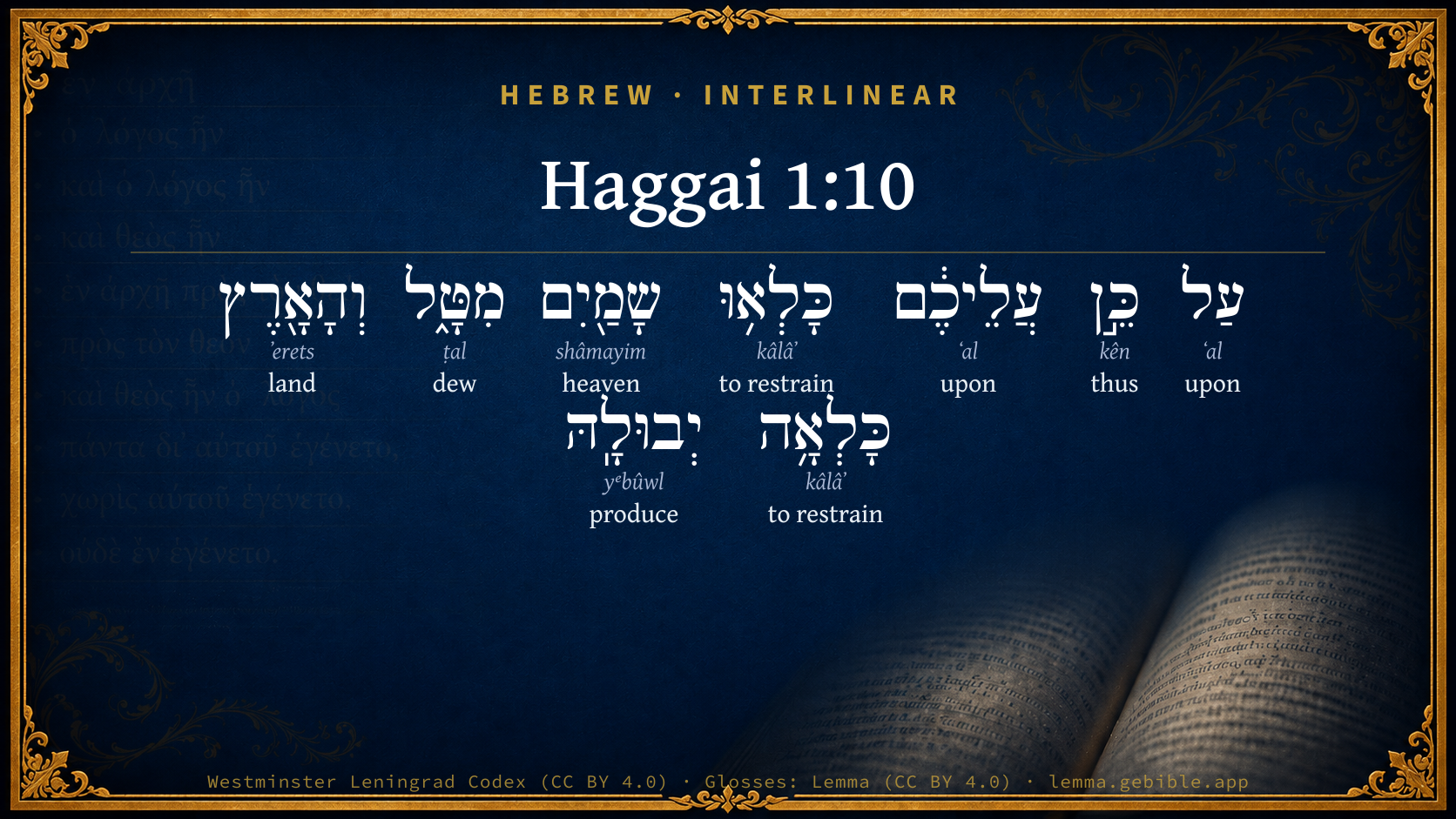
Hebrew (Westminster Leningrad Codex) Haggai 1:10 appears in the Hebrew Old Testament. The text above is from the Westminster Leningrad Codex. Each word links to its Strong’s number, a concise gloss, and parsing drawn from the Open Scriptures Hebrew Bible morphology. Click any word for its full Brown-Driver-Briggs (BDB) entry.
Download image
Cite this verse

Haggai 1:10 (World English Bible). Public Domain. Lemma interlinear Bible study tool, https://lemma.gebible.app/v/haggai/1/10.

Show BibTeX & RIS
BibTeX
RIS
English Translation
Therefore for your sake the heavens withhold the dew, and the earth withholds its fruit.
World English Bible · Public Domain
Download a study sheet

One document with this verse’s original text, its word-by-word gloss line, the meaning frame, cross-references with their text, attributed commentary, and full source and license credits — printable, and it pastes into notes with its structure intact.

This verse Autodidact and up

Study sheet (.html) Plain text (.txt)

A passage Seminary Student

Up to 50 verses in one chapter. A passage sheet keeps up to 6 commentary sources and 12 cross-references per verse, in the order this page ranks them, and says so on the sheet whenever that leaves anything out. Ask for a single verse and you get the Autodidact verse sheet above.

Everything on this page stays free to read, with no account — the sheet is a download of what is already on screen, not access to it.

Want to remove ads? Support Godless Engineer
Compare translations 3

The same verse in 3 English versions, stacked beneath the original-language interlinear above. Click any original word for its lexicon entry.

Each is an independent rendering of the whole verse — the interlinear is not word-aligned to these translations.

Highlighted words mark where these versions differ — a whole-verse word diff, not a word-by-word alignment.

  • World English Bible Public Domain
    Therefore for your sake the heavens withhold the dew, and the earth withholds its fruit.
  • King James Version Public Domain
    Therefore the heaven over you is stayed from dew, and the earth is stayed from her fruit.
  • unfoldingWord Literal Text CC BY-SA 4.0
    Therefore the heavens above you refrain from dew and the earth withholds its produce.

unfoldingWord Literal Text — © unfoldingWord, licensed CC BY-SA 4.0. Word-aligned USFM3 via Door43 (git.door43.org/unfoldingWord/en_ult).

Versions to compare (up to 4)

3 of 4 selected

Show all 18 translations

Every available English version of this verse, each an independent rendering of the whole verse.

  • World English Bible Public Domain
    Therefore for your sake the heavens withhold the dew, and the earth withholds its fruit.
  • Berean Standard Bible Public Domain
    Therefore, on account of you the heavens have withheld their dew and the earth has withheld its crops.
  • Majority Standard Bible Public Domain
    Therefore, on account of you the heavens have withheld their dew and the earth has withheld its crops.
  • King James Version Public Domain
    Therefore the heaven over you is stayed from dew, and the earth is stayed from her fruit.
  • American Standard Version (1901) Public Domain
    Therefore for your sake the heavens withhold the dew, and the earth withholdeth its fruit.
  • Revised Version (1885) Public Domain
    Therefore for your sake the heaven is stayed from dew, and the earth is stayed from her fruit.
  • Geneva Bible (1599) Public Domain
    Therefore the heauen ouer you stayed it selfe from dewe, and the earth stayed her fruite.
  • Douay-Rheims (1899) Public Domain
    Therefore the heavens over you were stayed from giving dew, and the earth was hindered from yielding her fruits:
  • Young's Literal Translation Public Domain
    Therefore, over you refrained have the heavens from dew, And the land hath refrained its increase.
  • Literal Standard Version CC BY-SA 4.0
    Therefore, over you the heavens have refrained from dew, || And the land has refrained its increase.
  • Unlocked Literal Bible CC BY-SA 4.0
    Because of this the heavens withhold the dew from you, and the earth withholds its produce.
  • unfoldingWord Literal Text CC BY-SA 4.0
    Therefore the heavens above you refrain from dew and the earth withholds its produce.
  • Darby Bible Public Domain
    Therefore over you the heavens withhold their dew, and the earth withholdeth its fruit.
  • World Messianic Bible Public Domain
    Therefore for your sake the heavens withhold the dew, and the earth withholds its fruit.
  • Webster's Bible Public Domain
    Therefore the heaven over you is stayed from dew, and the earth is stayed from her fruit.
  • Free Bible Version CC BY-SA 4.0
    That's why the clouds of heaven refused to send rain, and the earth refused to produce crops.
  • Bible in Basic English Public Domain
    For this cause the heaven over you is kept from giving dew, and the earth from giving her fruit.
  • JPS Tanakh (1917) Public Domain
    Therefore over you the heaven hath kept back, so that there is no dew, and the earth hath kept back her produce.

Literal Standard Version (2020), Covenant Press — licensed CC BY-SA 4.0. Text via the HelloAO Bible API (eBible.org). Unlocked Literal Bible (unfoldingWord) — licensed CC BY-SA 4.0. Text via the HelloAO Bible API (eBible.org). unfoldingWord Literal Text — © unfoldingWord, licensed CC BY-SA 4.0. Word-aligned USFM3 via Door43 (git.door43.org/unfoldingWord/en_ult). Free Bible Version, Dr. Jonathan Gallagher — licensed CC BY-SA 4.0. Text via the HelloAO Bible API (eBible.org).

Word by word

More ways to search: Search by grammar → Find every occurrence → Compare this word →

Practice this passage: Drill this verse → Learn its vocabulary →

About this verse

These counts appear in no published source. They are computed here, from the morphology-tagged text and Lemma’s own curated glosses. What Lemma adds →

9
words
7
distinct lemmas
Prophets
section

Notable vocabulary

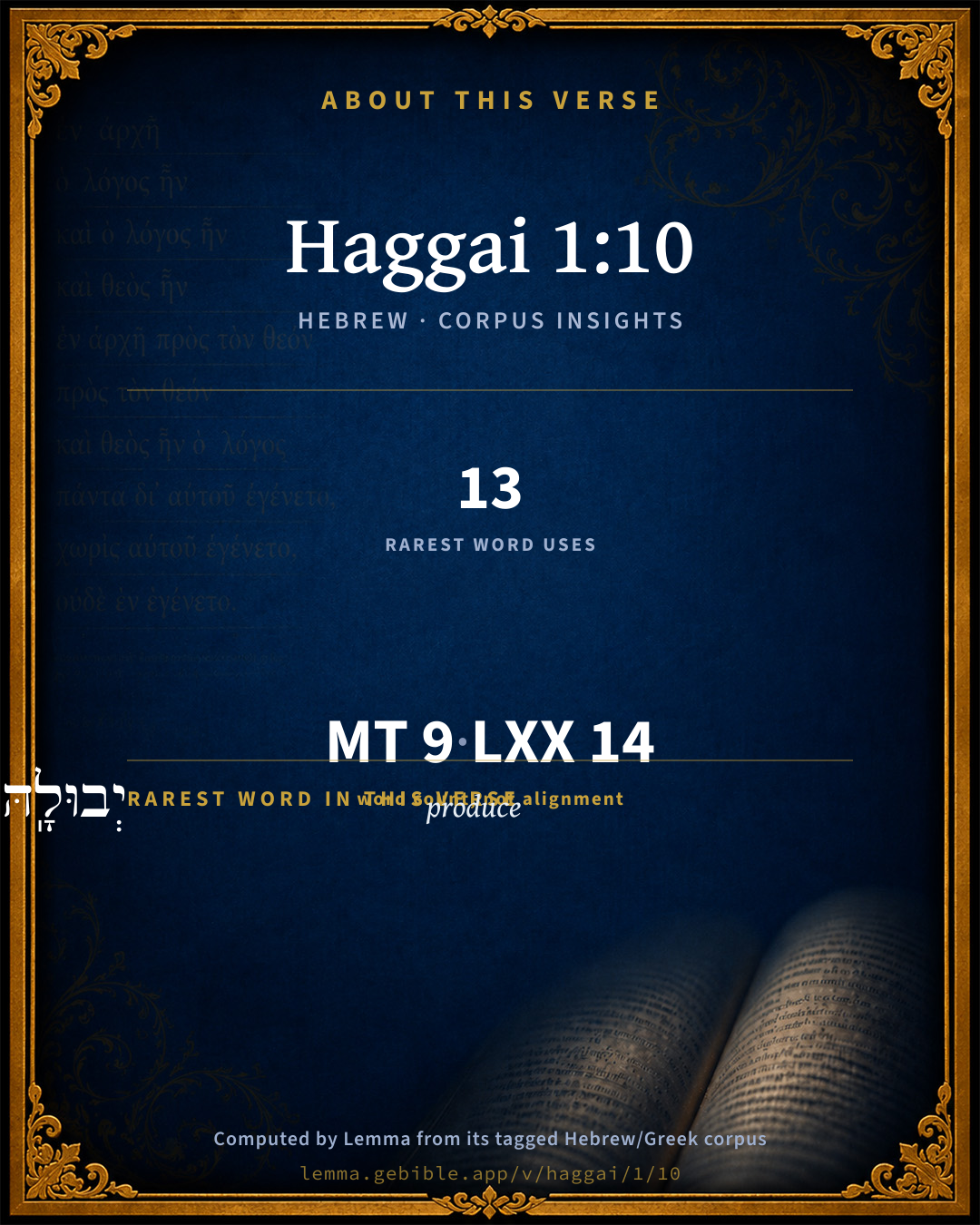
The rarest word here is יְבוּלָֽהּ produce H2981 — appearing just 13 times in the whole Hebrew Bible.

Shared distinctive vocabulary

יְבוּלָֽהּ produce H2981 occurs in 13 verses of the Hebrew Bible. Also found in:

Grammatical profile

  • 2 verbs
  • 4 nouns
  • 2 prepositions
  • 1 particle

Verb forms

  • כָּלְא֥וּ Qal · Perfect
  • כָּלְאָ֥ה Qal · Perfect

Repetition

Words recur within this verse — often emphatic in Hebrew:

  • עַל upon H5921 ×2
  • כָּלְא֥וּ to restrain H3607 ×2

Hebrew & Septuagint length

In English translation the verse runs 15 words from the Hebrew and 14 from the Septuagint (LXX English) — closely comparable.

A rough comparison of the two English renderings, which tokenize alike — not a word-level alignment.

Word counts can differ between the Hebrew and the Greek without any difference in meaning — e.g. the Hebrew direct-object marker אֵת has no separate Greek word, and Greek often adds the article ὁ.

In the original languages it is 9 Hebrew tokens and 14 Greek tokens — but the two are counted differently (Hebrew bundles its prefixes and suffixes into one token; the Greek is in lemma form), so that isn’t a like-for-like length.

Cross-references

7

Topical passages linked to Haggai 1:10 in the Treasury of Scripture Knowledge — connected by theme and wording, ordered by reader-vote popularity; previews shown in the World English Bible.

  • 1 Kings 8:35 When the sky is shut up, and there is no rain, because they have sinned against you; if they pray toward this place, and confess your name, and turn from their sin, when you do afflict them:
  • Leviticus 26:19 I will break the pride of your power, and I will make your sky like iron, and your soil like brass;
  • Deuteronomy 28:23–24 Your sky that is over your head shall be brass, and the earth that is under you shall be iron.
  • 1 Kings 17:1 Elijah the Tishbite, who was of the foreigners of Gilead, said to Ahab, As Yahweh, the God of Israel, lives, before whom I stand, there shall not be dew nor rain these years, but according to my word.
  • Joel 1:18–20 How the animals groan! The herds of cattle are perplexed, because they have no pasture. Yes, the flocks of sheep are made desolate.
  • Jeremiah 14:1–6 The word of Yahweh that came to Jeremiah concerning the drought.
  • Hosea 2:9 Therefore I will take back my grain in its time, And my new wine in its season, And will pluck away my wool and my flax which should have covered her nakedness.

Cross-references courtesy of OpenBible.info (CC BY 4.0).

Hebrew and Greek witnesses Masoretic Hebrew ↔ Greek Septuagint

The same verse in the two great witnesses to the Old Testament, shown verse-for-verse.

These are two independent witnesses, not word-aligned to each other, and the Septuagint is shown in lemma (dictionary) form.

Hebrew Haggai 1:10 Masoretic · Westminster Leningrad Codex

עַל כֵּ֣ן עֲלֵיכֶ֔ם כָּלְא֥וּ שָמַ֖יִם מִטָּ֑ל וְהָאָ֖רֶץ כָּלְאָ֥ה יְבוּלָֽהּ

Therefore for your sake the heavens withhold the dew, and the earth withholds its fruit.

World English Bible · Public Domain

Greek LXX Haggai 1:10 Septuagint · lemma form

διά οὗτος ἀναἔχω ὁ οὐρανός ἀπό δρόσος καί ὁ γῆ ὑποστέλλω ὁ ἐκφόριον αὐτός

therefore shall the sky withhold dew, and the earth shall keep back her produce.

LXX2012 (modern English Septuagint) · Public Domain

Hebrew: Westminster Leningrad Codex (CC BY 4.0). Greek: Septuagint (public domain); English from LXX2012 (modern English Septuagint) (Public Domain). How the Septuagint differs from the Hebrew →

Targum (Aramaic paraphrase)

1

The Targum is the ancient Jewish Aramaic paraphrase of the Hebrew Scriptures — an interpretive translation, not the Hebrew text itself. Onkelos (literal) and Pseudo-Jonathan (expansive) render the Torah, and Jonathan the Prophets. Coverage is partial: where no permissively-licensed English translation exists for a verse, only the Aramaic is shown. This is verse-level text, not a word-by-word alignment to the Hebrew.

  1. Targum Jonathan Prophets (Joshua–Malachi)
    עַל כֵּן בְּדִיל חוֹבֵיכוֹן פְּסָקוּ שְׁמַיָא מִלְאָחָתָא מִטְרָא וְאַרְעָא פְּסָקַת מִלְמֶעְבַד פֵּירִין:

    (no public-domain English translation for this verse)

    Targum Jonathan — Aramaic: “Mikraot Gedolot” (public domain). English: “Sefaria Community Translation” (CC0 1.0 (public-domain dedication)); “London "Chaldee Paraphrase," 1871” (public domain). Text via Sefaria.

Commentary

Notes on Haggai 1:10 from classic Christian and Jewish commentators (each source and its license shown beneath its notes). The classic Christian expositions comment on the surrounding passage and are grouped to its opening verse, so a note may address several verses; the Jewish commentaries on the Tanakh (Rashi and others) are per-verse, so they appear only where the commentator wrote on this verse.

Lemma curates 59 commentaries, every one of them public domain or Creative Commons licensed, each selected and text-cleaned for this edition rather than reprinted as found. About our sources →

Trapp's Complete Commentary

John Trapp

Hag 1:10 Therefore the heaven over you is stayed from dew, and the earth is stayed [from] her fruit.

Ver. 10. Therefore the heaven over you is stayed from rain, &c.] It is never well with man (whose life is ever in fuga, in flight, as the philosopher hath it, and must be maintained by meat, as the fire is by fuel) till God "hear the heaven, and the heaven hear the earth, and the earth hear the corn, the wine, and the oil, and these hear Jezreel," Hos 2:21-22, where we may see the genealogy of these good creatures resolved into God. The earth, though a kind mother, cannot open her bowels, and yield "seed to the sower, and bread to the eater," if not watered from above. The heaven, though the storehouse of God’s good treasure, which he openeth to our profit and nourishment, Deu 28:12, cannot drop down fatness upon the earth if God close it up, and withhold the seasonable showers. This the very heathens acknowledged in their fictions of Jupiter and Juno; and the Metapontines, having had a good harvest, consecrated χρυσουν θερος, a harvest cut in gold, to their god, in the temple at Delphi. Now, when a rabble of rebels shall conspire against God, and fight against him with his own weapons, as Jehu did against Jehoram with his own men, what can he do less than cut them short? that make them know the worth of his benefits by the want of them?

John Trapp, A Commentary or Exposition upon All the Books of the Old and New Testament (1647–1656) — public domain. Text from a community e-Sword module.

The Biblical Illustrator

Joseph S. Exell

Hag_1:10

Therefore the heaven over you is stayed from dew, and the earth is stayed from her fruit.

Nature penalties

With respect to the withholding of dew and of produce, we know that the prophets took from the law what served to teach the people, and accommodated it to their own purposes. The curses of the law are general (Deu_11:17). It is therefore the same thing as though the prophet had said that what God had threatened by Moses was really fulfilled. It ought not to have been to them a new thing, that whenever heaven denied its dew and rain, it was a sign of Gods wrath. But as, at this day, during wars, or famine, or pestilence, men do not regard this general truth, it is necessary to make the application: and godly teachers ought wisely to attend to this point, that is, to remind men, according to what the state of things and circumstances may require, that God proves by facts what He has testified in His Word. God intimates that the heavens have no care to provide for us, and to distil dew so that the earth may bring forth fruit, and that the earth also, though called the mother of men, does not of itself open its bowels, but that the heavens as well as the earth bear a sure testimony to His paternal love, and also to the care which He exercises over us. God then shows, both by the heavens and the earth, that He provides for us; for when the heavens and the earth administer and supply us with the blessings of God, they thus declare His love towards us. So also, when the heaven is, as it were, iron, and when the earth with closed bowels refuses us food, we ought to know that they are commissioned to execute on us the vengeance of God. For they are not only the instruments of His bounty, but, when it is necessary, God employs them for the purpose of punishing us. (John Calvin.)

The Biblical Illustrator, edited by Joseph S. Exell (c. 1880s–1900s) — public domain. Text from a community e-Sword module.

Jamieson, Fausset & Brown

Robert Jamieson, A. R. Fausset & David Brown

heaven . . . is stayed from dew--literally "stays itself." Thus heaven or the sky is personified; implying that inanimate nature obeys Jehovah's will; and, shocked at His people's disobedience, withholds its goods from them (compare Jer 2:12-13).

Jamieson, Fausset & Brown — Commentary Critical and Explanatory on the Whole Bible (1871) — public domain (CC PDM 1.0). Text via the HelloAO Bible API.

Adam Clarke's Commentary

Verse 10. Therefore the heaven over you is stayed from dew] It appears from the following verse that God had sent a drought upon the land, which threatened them with scarcity and famine.

Adam Clarke's Commentary on the Bible (1810–1826) — public domain. Text from a community e-Sword/MySword module.

John Calvin's Commentaries

He confirms what the last verse contains—that God had made it evident that he was displeased with the people because their zeal for religion had become cold, and, especially, because they were all strangely devoted to their own interest and manifested no concern for building the Temple. Hence, he says, therefore the heavens are shut up and withhold the dew; that is, they distil no dew on the earth; and he adds, that the earth was closed that it produced no fruit; it yielded no increase, and disappointed its cultivators. As to the particle על-כן, ol-can, we must bear in mind what I have stated, that God did not regard the external and visible Temple, but rather the end for which it was designed; for it was his will then that he should be worshipped under the ceremonies of the law. When, therefore, the Jews offered mutilated, lame, or diseased sacrifices, they manifested impiety and contempt of God. It is yet true, that it was the same thing as to God; but he had not commanded sacrifices to be offered to him for his own sake, but that by such services they might foster true religion. When, therefore, he says now, that he punished their neglect of the Temple, we ought ever to regard that as a pattern of heavenly things, so that we may understand that the coldness and indifference of the Jews were reproved; because it hence evidently appeared that they had no care for the worship of God.

With respect to the withholding of dew and of produce, we know that the Prophets took from the law what served to teach the people, and accommodated it to their own purposes. The curses of the law are general. (Deuteronomy 11:17.) It is therefore the same thing as though the Prophet had said, that what God had threatened by Moses was really fulfilled. It ought not to have been to them a new thing, that whenever heaven denied its dew and rain it was a sign of God’s wrath. But as, at this day, during wars, or famine, or pestilence, men do not regard this general truth, it is necessary to make the application: and godly teachers ought wisely to attend to this point, that is, to remind men, according to what the state of things and circumstances may require, that God proves by facts what he has testified in his word. This is what is done by our Prophet now, withheld have the heavens the dew and the earth its produce

In a word, God intimates, that the heavens leave no care to provide for us, and to distil dew so that the earth may bring forth fruit, and that the earth also, though called the mother of men, does not of itself open its bowels, but that the heavens as well as the earth bear a sure testimony to his paternal love, and also to the care which he exercises over us. God then shows, both by the heavens and the earth, that he provides for us; for when the heavens and the earth administer and supply us with the blessings of God, they thus declare his love towards us. So also, when the heaven is, as it were, iron, and when the earth with closed bowels refuses us food, we ought to know that they are commissioned to execute on us the vengeance of God. For they are not only the instruments of his bounty, but, when it is necessary, God employs them for the purpose of punishing us. This is briefly the meaning.

John Calvin's Commentaries (1540-1563) — public domain. Text from the Calvin Translation Society English edition (1840s-50s) via the Christian Classics Ethereal Library (ccel.org). Calvin's coverage is partial (roughly two-thirds of the Bible); uncommented books and verses are honest gaps, never fabricated. The 19th-century editor's footnotes and remarks are omitted so the notes are faithfully Calvin's own voice.

Ellicott's Commentary for English Readers

(10) Over you.—Better, on your account.—Scil., because of the neglect of God’s House, mentioned in Hag_1:9.

A Bible Commentary for English Readers, edited by Charles John Ellicott (1878–1897) — public domain. Text from a community e-Sword module.

The Cambridge Bible for Schools and Colleges

gen. ed. J. J. S. Perowne

10. the heaven over you, &c.] Lit. upon you are stayed the heavens. Some understand by “upon” or “against” you, “on your account,” on account of, or in punishment of your sins (for your sake, R. V. text). But there would be something of tautology in this, because the same thing has been said in the first word of the verse, “therefore” (on account of what has been mentioned in the preceding verses) has this judgment come upon you. It is better therefore to take it, as in A. V., and R. V. margin, “the heaven over you.” Compare the terms in which the judgment had been threatened by Moses, “thy heaven that is over thy head shall be brass,” Deu_28:23.

from dew] not rain only, but even dew had been withholden. “Coeli non solum pluviam non dederunt, sed ne rorem quidem, quo arentes agri saltem humore modico temperarentur.” Hieron. We must not forget how copious, and therefore how important to the husbandman, especially in the absence of rain, was the dew in Palestine. “In a latitude so high as ours, and which yet has a mean temperature higher than its degrees should give it, the chill of the night serves only to shed fog or mist upon the lower stratum of air; but in warmer climates—and in no country is it more so than in Syria—the vast burden of the watery element, which the fervour of day has raised aloft, becomes, quickly after sunset, a prodigious dew, breaking down upon the earth, as a mighty yet noiseless deluge.” Isaac Taylor, Spirit of Heb. Poetry, c. IV. pp. 85, 86.

The Cambridge Bible for Schools and Colleges (gen. ed. J. J. S. Perowne; Cambridge University Press, 1878–1918) — public domain. Text from a community e-Sword module.

John Gill's Exposition

Therefore the heaven over you is stayed from dew,.... Or, "therefore over", or "upon you" (a); where should be a stop; that is, because, of your neglect of the house of God; therefore upon you, and upon you only, and not upon other nations, the heaven is restrained from letting down the dew: or, "therefore I am against you" (b); for the above reason, and which the following things show; and sad it is to have God to be an enemy, and against a people! or, "for your sake"; so the Syriac version, to which sense is the Targum,

"therefore for your sins;''

and so Jarchi, "the heaven is stayed from dew"; none descends from it; the Lord, who has the ordering of it, will not suffer it: to have the dew fall upon the earth in the night season is a great blessing; it makes the earth fruitful, revives the corn, plants, and herbs, and causes them to flourish and increase; and to have it restrained is a judgment:

and the earth is stayed from her fruit; from bringing forth its increase, which is the consequence of the dew being withheld.

(a) "propterea super vos", Varenius, Reinbeck, Burkius. (b) "Idcirco contra vos", Junius & Tremellius, Piscator.

John Gill's Exposition of the Whole Bible (1746–1763) — public domain (CC PDM 1.0). Text via the HelloAO Bible API.

Albert Barnes' Notes on the Bible

Therefore, for you, - on your account; (As in Ps. 44:43.) for your sins, (Jon.) He points out the moral cause of the drought, whereas men think of this or that cause of the variations of the seasons, and we, e. g., take into our mouths Scriptural words, as “murrain of cattle,” and the like, and think of nothing less than why it was sent, or who sent it. Haggai directs the mind to the higher Cause, that as they withheld their service from God, so, on their account and by His will, His creatures withheld their service from them.

Albert Barnes' Notes on the Bible (1834–1885) — public domain. Text from a community e-Sword/MySword module.

Matthew Poole's English Annotations

Therefore; for your great intolerable neglect of God, his house and worship.

The heaven, Heb. heavens. is stayed; shut up, sealed, prohibited; God, whose they are, hath forbidden them, they drop not one pearl of dew; and the earth must be barren, when dry without the fructifying influences of heaven.

Matthew Poole's English Annotations on the Holy Bible (1683–1685) — public domain. Text from a community e-Sword/MySword module.

The Pulpit Commentary

Over you. This would be a reference to Deu_28:23. But the preposition is probably not local, but means rather, "on youraccount," i.e. on account of your sin, as (Psa_44:22. This is not tautological after the preceding "therefore," but more closely defines and explains the illative. Is stayed from dew; hath stayed itself from dew; withholds not only rain, but even dew. (comp. Zec_8:12) On the importance of dew in the climate of Palestine, see note on Mic_5:7. The dews generally are remarkably heavy, and in the summer months take the place of rain. Dr. Thomson speaks of the dew rolling in the morning off his tent like rain ("Land and the Book," p. 491) The earth is stayed from her fruit; hath stayed her fruit; according to the threat. (Deu_11:17)

The Pulpit Commentary (1880–1919), ed. H.D.M. Spence-Jones & Joseph S. Exell — public domain. Text from a community e-Sword module.

John Wesley's Explanatory Notes

Is stayed - God hath forbidden them, to drop down dew.

John Wesley, Explanatory Notes Upon the Whole Bible (1754–1765) — public domain. Text via the GEBible commentary corpus.

unfoldingWord translationNotes

Door43 World Missions Community

the heavens withhold the dew from you

The dew that appears at night is spoken of as if it formed in the sky and fell like rain. The sky is spoken of as if it were a person who refused to give a present or a parent who refused to feed his child. AT: "the sky does not allow the dew to fall" or "no dew forms" (See: Metaphor)

I have summoned a drought upon the land

Rain not falling for a long time is spoken of as if Yahweh had told a person to come and make the land dry. AT: "I have kept the rain from falling on the land" (See: Personification)

upon the new wine, upon the oil

"Wine" and "oil" are metonyms for grapes and olives. (See: Metonymy)

all the labor of your hands

The abstract noun "labor" can be translated using the phrase "work hard." The labor that the hands perform is a metonym for the things that the labor produces. The hand is a metonym for the person. AT: "everything you have worked hard to make" (See: Abstract Nouns and Metonymy)

translationWords

heaven

earth

grain

wine

oil

labor

unfoldingWord translationNotes — © Distant Shores Media and the Door43 World Missions Community, licensed CC BY-SA 4.0. Source: git.door43.org/Door43/en_tn.

Rashi

Rabbi Shlomo Yitzchaki (Rashi)

because of you the heavens have kept back Because of your sins.

Rashi on the Tanakh — English translations: “The Judaica Press complete Tanach with Rashi, translated by A. J. Rosenberg” (CC BY 4.0); “Pentateuch with Rashi's commentary by M. Rosenbaum and A.M. Silbermann, 1929-1934” (public domain); “The Metsudah Tanach series, Lakewood, N.J” (CC BY 4.0); and “The Book of Joshua, Metsudah Publications, 1997” (CC BY 4.0). Text via Sefaria.

Lesson kit

Teaching starters — assembled from the data on this page, not authored interpretation. Every prompt links to the verse data it draws on. Edit before teaching.

Haggai, in the Prophets, opens this verse with 9 words (7 distinct Hebrew lemmas). Its most distinctive word is yᵉbûwl (“produce”). A historical commentator’s framing appears above. Read the whole chapter for the surrounding context.

Discussion questions

  1. How does “produce” (yᵉbûwl) shape what this verse is saying?
  2. How does Leviticus 26:4, which shares the word «produce», read alongside this verse?
  3. What does the repetition of “upon” (2× in this one verse) do in this verse?
  4. These translations render this verse differently. What is at stake in choosing one wording over another?
  5. «כָּלְא֥וּ» is a Qal Perfect verb. How does that grammatical form shape the action described?
  6. Compare how Trapp's Complete Commentary and The Biblical Illustrator read this verse. Where do they agree or differ?

Things to notice

Reading settings

Reading text

Shown beneath each verse's original-language words.

Old Testament
Old Testament edition

Read the OT as the Masoretic Hebrew (MT) or the Greek Septuagint (LXX).

English shown for the Greek Septuagint (in the Hebrew ↔ Greek comparison).

Comparing translations? Open the Compare panel on any verse page to stack up to four side by side.