
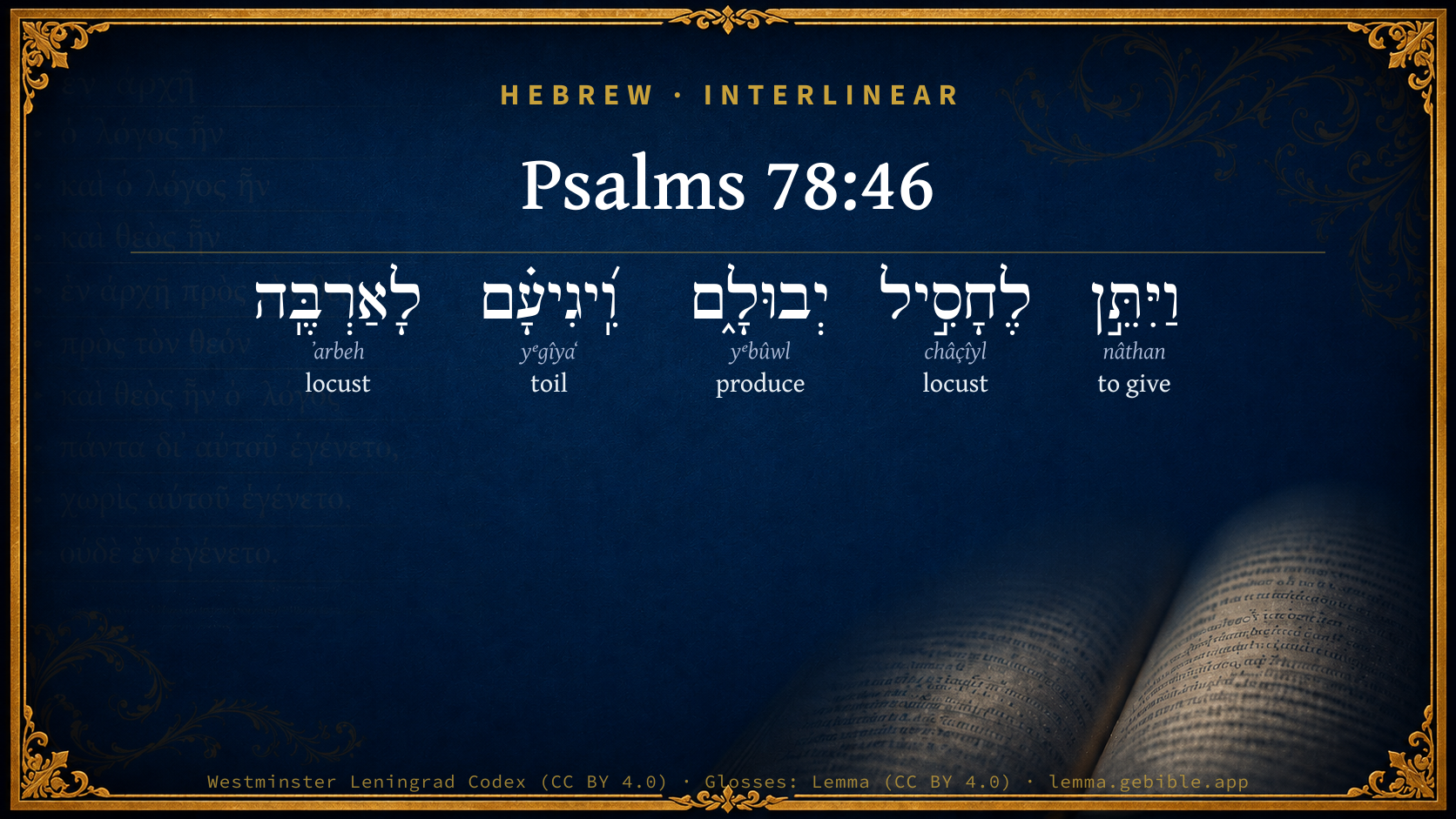
Psalms 78:46

Hebrew (Westminster Leningrad Codex) Psalms 78:46 appears in the Hebrew Old Testament. The text above is from the Westminster Leningrad Codex. Each word links to its Strong’s number, a concise gloss, and parsing drawn from the Open Scriptures Hebrew Bible morphology. Click any word for its full Brown-Driver-Briggs (BDB) entry.
Download image
Cite this verse

Psalms 78:46 (World English Bible). Public Domain. Lemma interlinear Bible study tool, https://lemma.gebible.app/v/psalms/78/46.

Show BibTeX & RIS
BibTeX
RIS
English Translation
He gave also their increase to the caterpillar, And their labor to the locust.
World English Bible · Public Domain
Download a study sheet

One document with this verse’s original text, its word-by-word gloss line, the meaning frame, cross-references with their text, attributed commentary, and full source and license credits — printable, and it pastes into notes with its structure intact.

This verse Autodidact and up

Study sheet (.html) Plain text (.txt)

A passage Seminary Student

Up to 50 verses in one chapter. A passage sheet keeps up to 6 commentary sources and 12 cross-references per verse, in the order this page ranks them, and says so on the sheet whenever that leaves anything out. Ask for a single verse and you get the Autodidact verse sheet above.

Everything on this page stays free to read, with no account — the sheet is a download of what is already on screen, not access to it.

Want to remove ads? Support Godless Engineer
Compare translations 3

The same verse in 3 English versions, stacked beneath the original-language interlinear above. Click any original word for its lexicon entry.

Each is an independent rendering of the whole verse — the interlinear is not word-aligned to these translations.

Highlighted words mark where these versions differ — a whole-verse word diff, not a word-by-word alignment.

  • World English Bible Public Domain
    He gave also their increase to the caterpillar, And their labor to the locust.
  • King James Version Public Domain
    He gave also their increase unto the caterpiller, and their labour unto the locust.
  • unfoldingWord Literal Text CC BY-SA 4.0
    And he gave their produce to the locust and their labor to the swarming locust.

unfoldingWord Literal Text — © unfoldingWord, licensed CC BY-SA 4.0. Word-aligned USFM3 via Door43 (git.door43.org/unfoldingWord/en_ult).

Versions to compare (up to 4)

3 of 4 selected

Show all 18 translations

Every available English version of this verse, each an independent rendering of the whole verse.

  • World English Bible Public Domain
    He gave also their increase to the caterpillar, And their labor to the locust.
  • Berean Standard Bible Public Domain
    He gave their crops to the grasshopper, the fruit of their labor to the locust.
  • Majority Standard Bible Public Domain
    He gave their crops to the grasshopper, the fruit of their labor to the locust.
  • King James Version Public Domain
    He gave also their increase unto the caterpiller, and their labour unto the locust.
  • American Standard Version (1901) Public Domain
    He gave also their increase unto the caterpillar, And their labor unto the locust.
  • Revised Version (1885) Public Domain
    He gave also their increase unto the caterpiller, and their labour unto the locust.
  • Geneva Bible (1599) Public Domain
    He gaue also their fruites vnto the caterpiller, and their labour vnto the grassehopper.
  • Douay-Rheims (1899) Public Domain
    And he gave up their fruits to the blast, and their labours to the locust.
  • Young's Literal Translation Public Domain
    And giveth to the caterpillar their increase, And their labour to the locust.
  • Literal Standard Version CC BY-SA 4.0
    And gives their increase to the caterpillar, || And their labor to the locust.
  • Unlocked Literal Bible CC BY-SA 4.0
    He gave their crops to the grasshopper and their labor to the locust.
  • unfoldingWord Literal Text CC BY-SA 4.0
    And he gave their produce to the locust and their labor to the swarming locust.
  • Darby Bible Public Domain
    And he gave their increase unto the caterpillar, and their labour unto the locust;
  • World Messianic Bible Public Domain
    He also gave their increase to the caterpillar, and their labor to the locust.
  • Webster's Bible Public Domain
    He gave also their increase to the caterpillar, and their labor to the locust.
  • Free Bible Version CC BY-SA 4.0
    He gave their crops to locusts; everything they worked had for was taken by locusts.
  • Bible in Basic English Public Domain
    He gave the increase of their fields to worms, the fruits of their industry to the locusts.
  • JPS Tanakh (1917) Public Domain
    He gave also their increase unto the caterpillar, and their labour unto the locust.

Literal Standard Version (2020), Covenant Press — licensed CC BY-SA 4.0. Text via the HelloAO Bible API (eBible.org). Unlocked Literal Bible (unfoldingWord) — licensed CC BY-SA 4.0. Text via the HelloAO Bible API (eBible.org). unfoldingWord Literal Text — © unfoldingWord, licensed CC BY-SA 4.0. Word-aligned USFM3 via Door43 (git.door43.org/unfoldingWord/en_ult). Free Bible Version, Dr. Jonathan Gallagher — licensed CC BY-SA 4.0. Text via the HelloAO Bible API (eBible.org).

Word by word

More ways to search: Search by grammar → Find every occurrence → Compare this word →

Practice this passage: Drill this verse → Learn its vocabulary →

About this verse

These counts appear in no published source. They are computed here, from the morphology-tagged text and Lemma’s own curated glosses. What Lemma adds →

5
words
5
distinct lemmas
Wisdom
section

Notable vocabulary

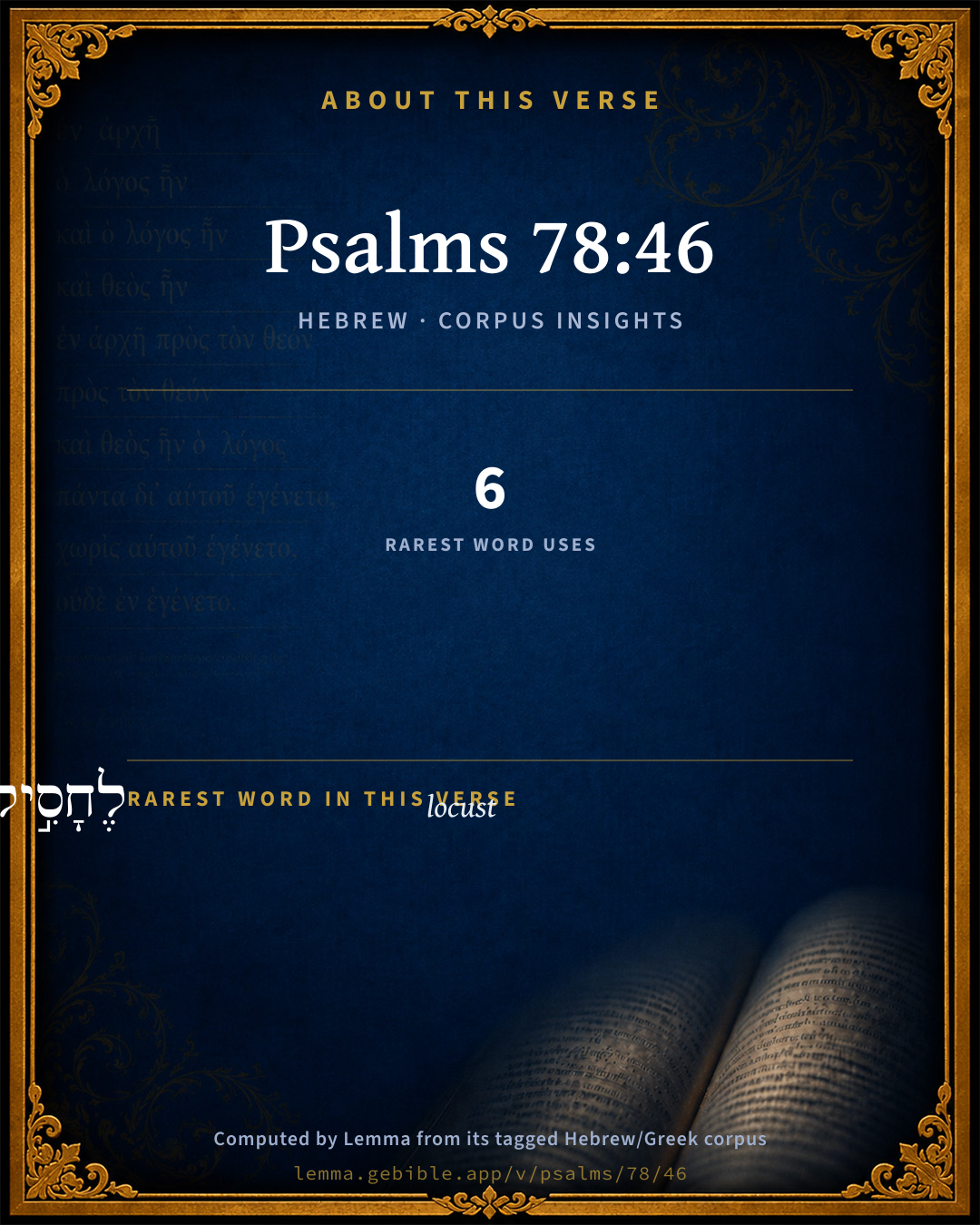
The rarest word here is לֶחָסִ֣יל locust H2625 — appearing just 6 times in the whole Hebrew Bible.

Shared distinctive vocabulary

לֶחָסִ֣יל locust H2625 occurs in 6 verses of the Hebrew Bible. Also found in:

Grammatical profile

  • 1 verb
  • 4 nouns

Verb forms

  • וַיִּתֵּ֣ן Qal · Sequential Imperfect

Hebrew & Septuagint length

In English translation the verse runs 14 words from the Hebrew and 15 from the Septuagint (LXX English) — closely comparable.

A rough comparison of the two English renderings, which tokenize alike — not a word-level alignment.

Word counts can differ between the Hebrew and the Greek without any difference in meaning — e.g. the Hebrew direct-object marker אֵת has no separate Greek word, and Greek often adds the article ὁ.

Cross-references

6

Topical passages linked to Psalms 78:46 in the Treasury of Scripture Knowledge — connected by theme and wording, ordered by reader-vote popularity; previews shown in the World English Bible.

  • Exodus 10:12–15 Yahweh said to Moses, "Stretch out your hand over the land of Egypt for the locusts, that they may come up on the land of Egypt, and eat every herb of the land, even all that the hail has left."
  • Psalms 105:34–35 He spoke, and the locusts came, And the grasshoppers, without number,
  • Joel 1:4–7 What the swarming locust has left, the great locust has eaten. What the great locust has left, the grasshopper has eaten. What the grasshopper has left, the caterpillar has eaten.
  • Joel 2:25 I will restore to you the years that the swarming locust has eaten, The great locust, the grasshopper, and the caterpillar, My great army, which I sent among you.
  • Amos 7:1–2 Thus the Lord Yahweh showed me: and, behold, he formed locusts in the beginning of the shooting up of the latter growth; and, behold, it was the latter growth after the king's harvest.
  • Revelation 9:2–11 He opened the pit of the abyss, and smoke went up out of the pit, like the smoke from a burning furnace. The sun and the air were darkened because of the smoke from the pit.

Cross-references courtesy of OpenBible.info (CC BY 4.0).

Hebrew and Greek witnesses Masoretic Hebrew ↔ Greek Septuagint

The same verse in the two great witnesses to the Old Testament, shown verse-for-verse.

You’re reading Greek Psalm 77 (Hebrew Psalm 78). The Septuagint counts the superscription, so verse numbers can differ from the Hebrew — chapter-level alignment, not verse-by-verse. Numbering follows Rahlfs.

These are two independent witnesses, not word-aligned to each other, and the Septuagint is shown in lemma (dictionary) form.

Hebrew Psalms 78:46 Masoretic · Westminster Leningrad Codex

וַיִּתֵּ֣ן לֶחָסִ֣יל יְבוּלָ֑ם וִֽ֝יגִיעָ֗ם לָאַרְבֶּֽה

He gave also their increase to the caterpillar, And their labor to the locust.

World English Bible · Public Domain

Greek LXX Greek Psalm 77:46 Septuagint · lemma form

καί δίδωμι ὁ ἐρυσίβη ὁ καρπός αὐτός καί ὁ πόνος αὐτός ὁ ἀκρίς

And he gave their fruit to the canker worm, and their labors to the locust.

LXX2012 (modern English Septuagint) · Public Domain

On this verse, Ellicott's Commentary for English Readers discusses the Septuagint’s reading. Read the note in Commentary ↓

Hebrew: Westminster Leningrad Codex (CC BY 4.0). Greek: Septuagint (public domain); English from LXX2012 (modern English Septuagint) (Public Domain). How the Septuagint differs from the Hebrew →

Commentary

Notes on Psalms 78:46 from classic Christian and Jewish commentators (each source and its license shown beneath its notes). The classic Christian expositions comment on the surrounding passage and are grouped to its opening verse, so a note may address several verses; the Jewish commentaries on the Tanakh (Rashi and others) are per-verse, so they appear only where the commentator wrote on this verse.

Lemma curates 59 commentaries, every one of them public domain or Creative Commons licensed, each selected and text-cleaned for this edition rather than reprinted as found. About our sources →

Trapp's Complete Commentary

John Trapp

Psa 78:46 He gave also their increase unto the caterpiller, and their labour unto the locust.

Ver. 46. He gave also their increase unto the caterpillar] Together with the grasshopper, Exo 10:12-15, God’s great army, Joe 2:11

And their labour] i.e. The fruits of the earth, which they had laboured for; they lost both their husbandry and their harvest.

John Trapp, A Commentary or Exposition upon All the Books of the Old and New Testament (1647–1656) — public domain. Text from a community e-Sword module.

J. A. Alexander on Psalms

Joseph Addison Alexander

46. (Psa 78:46) And he gave (up) to the caterpillar their produce, and their labour to the locust. Both the animal names in this verse are really designations of the locust, one meaning the devourer, and the other denoting the vast numbers of that insect. Their labour, i. e. its effect or fruit. Compare the narrative in Exo 10:12-19.

Joseph Addison Alexander, The Psalms Translated and Explained (1850) — public domain. Text from a community e-Sword module.

Geneva Bible (1599)

Geneva Bible translators

He repeateth not here all the miracles that God did in Egypt, but certain which might be sufficient to convince the people of malice and ingratitude.

Geneva Bible (1599) marginal notes — public domain. Text via Bolls.life.

Adam Clarke's Commentary

Verse 46. The caterpillar and - the locust.] See on Ex 10:13.

Adam Clarke's Commentary on the Bible (1810–1826) — public domain. Text from a community e-Sword/MySword module.

Ellicott's Commentary for English Readers

(46) Caterpillar.—Heb., chasîl. (See 1Ki_8:37.) Probably the locust in the larva or pupa state. For locust see Exo_10:4 seq., and Bib. Ed., iv. 292. The LXX., Vulg., and Symmachus have “blight.” but in 2Ch_6:28 “cockchafer,” as Aquila and Jerome here.

A Bible Commentary for English Readers, edited by Charles John Ellicott (1878–1897) — public domain. Text from a community e-Sword module.

The Cambridge Bible for Schools and Colleges

gen. ed. J. J. S. Perowne

46. The eighth plague, Exo_10:1 ff.

their increase] The produce of the land (Psa_67:6). The word rendered ‘caterpillar’ is not used in Exodus, but often occurs elsewhere, and probably denotes the locust in the larva or pupa state.

The Cambridge Bible for Schools and Colleges (gen. ed. J. J. S. Perowne; Cambridge University Press, 1878–1918) — public domain. Text from a community e-Sword module.

John Gill's Exposition

He destroyed their vines with hail,.... Or "killed" (k) them; for there is a vegetative life in plants: this was the seventh plague of Egypt, attended with thunder and lightning, and was very terrible to Pharaoh, Exo 9:23, with this compare Rev 16:21,

and their sycamore trees with frost: sycamore trees, according to Kimchi, were a sort of wild figs, and these with the vines are only mentioned; though the plague of hail destroyed all sorts of trees; because there were many of these in Egypt, and are put for all others; and who also observes, that the word rendered "frost", which is only used in this place, signifies a kind of hail; and so Aben Ezra interprets it of great hailstones which beat off the fruit of the sycamore trees: but R. Saadiah Gaon explains it by the Arabic word "Al-sakia", which signifies a strong frost which breaks the buds of trees, and dries up their moisture. Jarchi will have it to be, according to the Midrash, a kind of locust, which comes and sits and cuts off the green of the trees and grass, and eats it. Aben Ezra makes mention of this sense, but rejects it.

(k) "occidit", Pagninus, Montanus, Musculus, Junius & Tremellius, Piscator; "interfecit", Gejerus.

John Gill's Exposition of the Whole Bible (1746–1763) — public domain (CC PDM 1.0). Text via the HelloAO Bible API.

Albert Barnes' Notes on the Bible

He gave also their increase unto the caterpillar - The increase or the produce of their fields. Exo 10:12-14. The word חסיל châsı̂yl - is supposed to denote a species of locust rather than the caterpillar. It literally means the devourer. In our version, however, it is uniformly rendered caterpillar as here; 1Ki 8:37; 2Ch 6:28; Isa 33:4; Joe 1:4; Joe 2:25. It occurs nowhere else.

And their labor unto the locust - The fruit of their labor; the harvests in their fields.

Albert Barnes' Notes on the Bible (1834–1885) — public domain. Text from a community e-Sword/MySword module.

Matthew Poole's English Annotations

The herbs and grains which were come up by their care and diligent labour.

Matthew Poole's English Annotations on the Holy Bible (1683–1685) — public domain. Text from a community e-Sword/MySword module.

The Treasury of David

Charles H. Spurgeon

Ver. 46. He gave also their increase unto the caterpillar, and their labour unto the locust. Different sorts of devourers ate up every green herb and tree. What one would not eat another did. What they expected from the natural fertility of the soil, and what they looked for from their own toil, they saw devoured before their eyes by an insatiable multitude against whose depredation no defense could be found. Observe in the text that the Lord did it all"he sent, " "he gave, ""he destroyed, ""he gave up, "etc.; whatever the second agent may be, the direct hand of the Lord is in every national visitation.

Ver. 46. Caterpillar. (lyox), chasil, is rendered broucos by the LXX, in 2Ch 6:28, and by Aquila here, and also by the Vulgate in Chronicles and in Isa 33:4, and is rendered by Jerome here, bruchas, "the chaffer, "which everyone knows to be a great devourer of the leaves of trees. The Syriac in Joe 1:4 2:25, renders it (arwuru) tzartzooro, which Michaelis, from the Arabic (ruru) tzartzar, a cricket, interprets the mole cricket, which in its grub state, is also very destructive to corn, grass, and other vegetables, by cankering the roots on which it feeds. Editorial note to Calvin in loc.

Ver. 46. Caterpillar, In former times, any destructive, crawling creature occurring in cultivated places was thus called; now, by general consent, we restrict the term to the second stage of insects of the Lepidopterous order, namely, butterflies and moths. These caterpillars, by the voracity with which they attack the leaves, the fruit, and sometimes the solid wood of plants and trees, are made conspicuous even to those who are little acquainted with natural history. "Biblical Treasury."

Ver. 46. Locust. Their quantity is incredible to all who have not themselves witnessed their astonishing numbers; the whole earth is covered with them for the space of several leagues. The noise they make in browsing on the trees and herbage may be heard at a great distance, and resembles that of an army plundering in secret. The Tartars themselves are a less destructive enemy than these little animals. One would imagine that fire had followed their progress. Wherever their myriads spread, the verdure of the country disappears; trees and plants stripped of their leaves and reduced to their naked boughs and stems, cause the dreary image of winter to succeed in an instant to the rich scenery of spring. When these clouds of locusts take their flight, to surmount any obstacles, or to traverse more rapidly a desert soil, the heavens may literally be said to be obscured with them. F. C., Comte de Volney.

None.

Charles H. Spurgeon's The Treasury of David (1869–1885) — public domain. Psalms only. Text from a community e-Sword/MySword module.

Whedon's Commentary on the Bible

Daniel D. Whedon

46. Caterpillar… locust—If, as some suppose, the former word (הסיל, hhaseel) denotes the larva, or caterpillar stage of the locust, then the latter word (ארבה, arbeh,) must signify the winged locust: but if the former be taken for locust, the latter must be understood of some particular species, like the Acridium peregrinum, more terrible for its destructive habits. The Septuagint has ερυσιβη, blight, canker, and in Psa_105:34, βρουχος, a species of locust without wings, or otherwise answering to the unwinged locust when it emerges from the caterpillar stage, at which time they are as destructive as in the mature state, moving along on the ground in vast numbers. In this state, Van Lennep say, “They are correctly pictured on a Babylonian gem.” See more on Psa_105:34

Daniel D. Whedon (gen. ed.), Commentary on the Old and New Testaments (1874–1909) — public domain. Text from a community e-Sword module.

The Pulpit Commentary

He gave also their increase unto the caterpillar, and their labour unto the locust. Khasil (lysij), here translated "caterpillar," is probably either a particular kind of locust, or the locust in one of its stages. (On the plague of locusts in Egypt, see Exo_10:14, Exo_10:15)

The Pulpit Commentary (1880–1919), ed. H.D.M. Spence-Jones & Joseph S. Exell — public domain. Text from a community e-Sword module.

John Wesley's Explanatory Notes

labour - The herbs which were come up by their care and labour.

John Wesley, Explanatory Notes Upon the Whole Bible (1754–1765) — public domain. Text via the GEBible commentary corpus.

Lesson kit

Teaching starters — assembled from the data on this page, not authored interpretation. Every prompt links to the verse data it draws on. Edit before teaching.

Psalms, in the Wisdom, opens this verse with 5 words (5 distinct Hebrew lemmas). Its most distinctive word is châçîyl (“locust”). A historical commentator’s framing appears above. Read the whole chapter for the surrounding context.

Discussion questions

  1. How does “locust” (châçîyl) shape what this verse is saying?
  2. How does 1 Kings 8:37, which shares the word «locust», read alongside this verse?
  3. These translations render this verse differently; the difference is in the English rendering, not the original. What questions does that raise?
  4. «וַיִּתֵּ֣ן» is a Qal Sequential Imperfect verb. How does that grammatical form shape the action described?
  5. Compare how Trapp's Complete Commentary and J. A. Alexander on Psalms read this verse. Where do they agree or differ?

Things to notice

Reading settings

Reading text

Shown beneath each verse's original-language words.

Old Testament
Old Testament edition

Read the OT as the Masoretic Hebrew (MT) or the Greek Septuagint (LXX).

English shown for the Greek Septuagint (in the Hebrew ↔ Greek comparison).

Comparing translations? Open the Compare panel on any verse page to stack up to four side by side.