Psalms 68:6

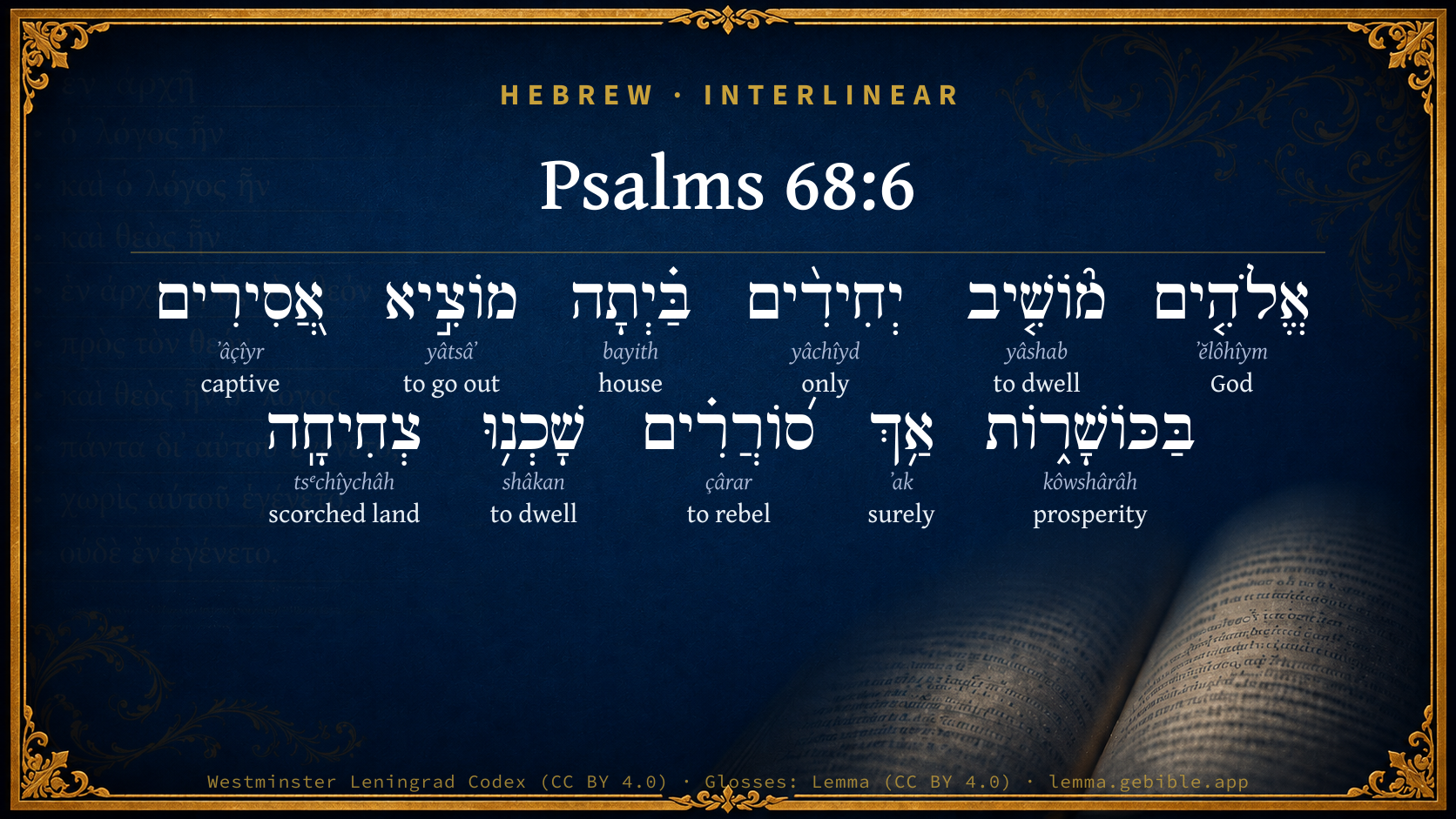
Hebrew (Westminster Leningrad Codex) Psalms 68:6 appears in the Hebrew Old Testament. The text above is from the Westminster Leningrad Codex. Each word links to its Strong’s number, a concise gloss, and parsing drawn from the Open Scriptures Hebrew Bible morphology. Click any word for its full Brown-Driver-Briggs (BDB) entry.
Download image
Cite this verse

Psalms 68:6 (World English Bible). Public Domain. Lemma interlinear Bible study tool, https://lemma.gebible.app/v/psalms/68/6.

Show BibTeX & RIS
BibTeX
RIS
English Translation
God sets the lonely in families. He brings out the prisoners with singing, But the rebellious dwell in a sun-scorched land.
World English Bible · Public Domain
Highlights
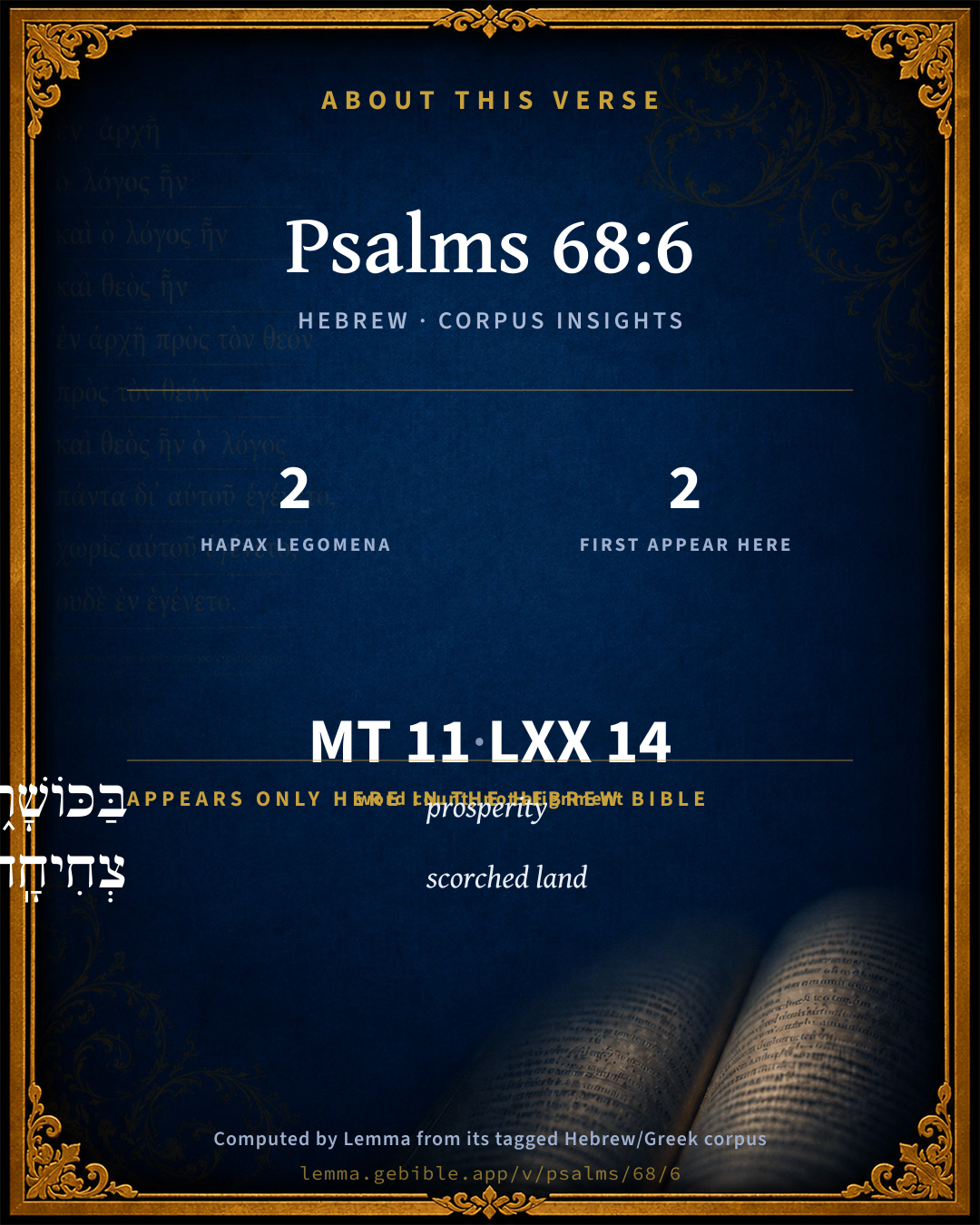
  • 2 hapax legomena — only here in the Hebrew Bible
  • 2 first appearances in the Hebrew Bible
Full analysis ↓
Download a study sheet

One document with this verse’s original text, its word-by-word gloss line, the meaning frame, cross-references with their text, attributed commentary, and full source and license credits — printable, and it pastes into notes with its structure intact.

This verse Autodidact and up

Study sheet (.html) Plain text (.txt)

A passage Seminary Student

Up to 50 verses in one chapter. A passage sheet keeps up to 6 commentary sources and 12 cross-references per verse, in the order this page ranks them, and says so on the sheet whenever that leaves anything out. Ask for a single verse and you get the Autodidact verse sheet above.

Everything on this page stays free to read, with no account — the sheet is a download of what is already on screen, not access to it.

Want to remove ads? Support Godless Engineer
Compare translations 3

The same verse in 3 English versions, stacked beneath the original-language interlinear above. Click any original word for its lexicon entry.

Each is an independent rendering of the whole verse — the interlinear is not word-aligned to these translations.

Highlighted words mark where these versions differ — a whole-verse word diff, not a word-by-word alignment.

  • World English Bible Public Domain
    God sets the lonely in families. He brings out the prisoners with singing, But the rebellious dwell in a sun-scorched land.
  • King James Version Public Domain
    God setteth the solitary in families: he bringeth out those which are bound with chains: but the rebellious dwell in a dry land.
  • unfoldingWord Literal Text CC BY-SA 4.0
    God is making the lonely dwell in a house; he is bringing out prisoners into prosperity. But the ones rebelling dwell in dryness.

unfoldingWord Literal Text — © unfoldingWord, licensed CC BY-SA 4.0. Word-aligned USFM3 via Door43 (git.door43.org/unfoldingWord/en_ult).

Versions to compare (up to 4)

3 of 4 selected

Show all 18 translations

Every available English version of this verse, each an independent rendering of the whole verse.

  • World English Bible Public Domain
    God sets the lonely in families. He brings out the prisoners with singing, But the rebellious dwell in a sun-scorched land.
  • Berean Standard Bible Public Domain
    God settles the lonely in families; He leads the prisoners out to prosperity, but the rebellious dwell in a sun-scorched land.
  • Majority Standard Bible Public Domain
    God settles the lonely in families; He leads the prisoners out to prosperity, but the rebellious dwell in a sun-scorched land.
  • King James Version Public Domain
    God setteth the solitary in families: he bringeth out those which are bound with chains: but the rebellious dwell in a dry land.
  • American Standard Version (1901) Public Domain
    God setteth the solitary in families: He bringeth out the prisoners into prosperity; But the rebellious dwell in a parched land.
  • Revised Version (1885) Public Domain
    God setteth the solitary in families: he bringeth out the prisoners into prosperity: but the rebellious dwell in a parched land.
  • Geneva Bible (1599) Public Domain
    God maketh the solitarie to dwell in families, and deliuereth them that were prisoners in stocks: but the rebellious shall dwell in a dry land.
  • Douay-Rheims (1899) Public Domain
    who is the father of orphans, and the judge of widows. God in his holy place:
  • Young's Literal Translation Public Domain
    God -- causing the lonely to dwell at home, Bringing out bound ones into prosperity, Only -- the refractory have inhabited a dry place.
  • Literal Standard Version CC BY-SA 4.0
    God—causing the lonely to dwell at home, || Bringing out bound ones into prosperity, || Only—the stubborn have inhabited a dry place.
  • Unlocked Literal Bible CC BY-SA 4.0
    God puts the lonely into families; he brings out the prisoners with singing; but the rebellious live in a parched land.
  • unfoldingWord Literal Text CC BY-SA 4.0
    God is making the lonely dwell in a house; he is bringing out prisoners into prosperity. But the ones rebelling dwell in dryness.
  • Darby Bible Public Domain
    God maketh the solitary into families; those that were bound he bringeth out into prosperity: but the rebellious dwell in a parched [land].
  • World Messianic Bible Public Domain
    God sets the lonely in families. He brings out the prisoners with singing, but the rebellious dwell in a sun-scorched land.
  • Webster's Bible Public Domain
    \\68:5\\A father of the fatherless, and a judge of the widows, is God in his holy habitation.
  • Free Bible Version CC BY-SA 4.0
    God gives those who are abandoned a family to live with. He sets prisoners free with celebration. But those who rebel live in a desert wasteland.
  • Bible in Basic English Public Domain
    Those who are without friends, God puts in families; he makes free those who are in chains; but those who are turned away from him are given a dry land.
  • JPS Tanakh (1917) Public Domain
    (68-7) God maketh the solitary to dwell in a house; He bringeth out the prisoners into prosperity; the rebellious dwell but in a parched land.

Literal Standard Version (2020), Covenant Press — licensed CC BY-SA 4.0. Text via the HelloAO Bible API (eBible.org). Unlocked Literal Bible (unfoldingWord) — licensed CC BY-SA 4.0. Text via the HelloAO Bible API (eBible.org). unfoldingWord Literal Text — © unfoldingWord, licensed CC BY-SA 4.0. Word-aligned USFM3 via Door43 (git.door43.org/unfoldingWord/en_ult). Free Bible Version, Dr. Jonathan Gallagher — licensed CC BY-SA 4.0. Text via the HelloAO Bible API (eBible.org).

Word by word

More ways to search: Search by grammar → Find every occurrence → Compare this word →

Practice this passage: Drill this verse → Learn its vocabulary →

בַּכּוֹשָׁר֑וֹת
kôwshârâh
H3574
“in/at the · prosperity”
Preposition, Determined + Noun, Common, Feminine, Plural, Absolute
Part of Speech
Preposition + Noun
Type
Common
Gender
Feminine
Number
Plural
State
Absolute
Full BDB Definition

Origin: from H3787

TWOT: 1052a

prosperity - (TWOT) singing
  1. אֱלֹהִ֤ים ʼĕlôhîym H430 “God(s)” Noun, Common, Masculine, Plural, Absolute
  2. מ֘וֹשִׁ֤יב yâshab H3427 “dwelling” Verb, Hiphil, Participle Active, Masculine, Singular, Absolute
  3. יְחִידִ֨ים yâchîyd H3173 “only” Adjective, Adjective, Masculine, Plural, Absolute
  4. בַּ֗יְתָה bayith H1004 “house · toward” Noun, Common, Masculine, Singular, Absolute + Suffix, Demonstrative
  5. מוֹצִ֣יא yâtsâʼ H3318 “going out” Verb, Hiphil, Participle Active, Masculine, Singular, Absolute
  6. אֲ֭סִירִים ʼâçîyr H615 “captives” Noun, Common, Masculine, Plural, Absolute
  7. אַ֥ךְ ʼak H389 “surely” Particle, Accusative
  8. ס֝וֹרֲרִ֗ים çârar H5637 “rebelling” Verb, Qal, Participle Active, Masculine, Plural, Absolute
  9. שָׁכְנ֥וּ shâkan H7931 “to dwell” Verb, Qal, Perfect, 3rd Person, Common, Plural
  10. צְחִיחָֽה tsᵉchîychâh H6707 “scorched land” Noun, Common, Feminine, Singular, Absolute

About this verse

These counts appear in no published source. They are computed here, from the morphology-tagged text and Lemma’s own curated glosses. What Lemma adds →

11
words
11
distinct lemmas
Wisdom
section

Notable vocabulary

2 hapax legomena — words that appear only here in the entire Hebrew Bible:

  • בַּכּוֹשָׁר֑וֹת prosperity H3574
  • צְחִיחָֽה scorched land H6707

First appearance in Scripture

These words make their first canonical appearance in the Hebrew Bible here:

  • בַּכּוֹשָׁר֑וֹת prosperity H3574
  • צְחִיחָֽה scorched land H6707

Shared distinctive vocabulary

יְחִידִ֨ים only H3173 occurs in 12 verses of the Hebrew Bible. Also found in:

Grammatical profile

  • 4 verbs
  • 5 nouns
  • 1 adjective
  • 1 particle

Verb forms

  • מ֘וֹשִׁ֤יב Hiphil · Participle Active
  • מוֹצִ֣יא Hiphil · Participle Active
  • ס֝וֹרֲרִ֗ים Qal · Participle Active
  • שָׁכְנ֥וּ Qal · Perfect

Hebrew & Septuagint length

In English translation the verse runs 21 words from the Hebrew and 22 from the Septuagint (LXX English) — closely comparable.

A rough comparison of the two English renderings, which tokenize alike — not a word-level alignment.

Word counts can differ between the Hebrew and the Greek without any difference in meaning — e.g. the Hebrew direct-object marker אֵת has no separate Greek word, and Greek often adds the article ὁ.

In the original languages it is 11 Hebrew tokens and 14 Greek tokens — but the two are counted differently (Hebrew bundles its prefixes and suffixes into one token; the Greek is in lemma form), so that isn’t a like-for-like length.

Cross-references

15

Topical passages linked to Psalms 68:6 in the Treasury of Scripture Knowledge — connected by theme and wording, ordered by reader-vote popularity; previews shown in the World English Bible.

  • Psalms 69:33 For Yahweh hears the needy, And doesn't despise his captive people.
  • Psalms 113:9 He settles the barren woman in her home, As a joyful mother of children. Praise Yah!
  • Psalms 107:10 Some sat in darkness and in the shadow of death, Being bound in affliction and iron,
  • Isaiah 61:1 The Spirit of the Lord Yahweh is on me; because Yahweh has anointed me to preach good news to the humble; he has sent me to bind up the broken-hearted, to proclaim liberty to the captives, and the opening [of the prison] to those who are bound;
  • Psalms 107:14 He brought them out of darkness and the shadow of death, And broke their bonds in sunder.
  • Psalms 146:7 Who executes justice for the oppressed; Who gives food to the hungry. Yahweh frees the prisoners.
  • Psalms 107:40–41 He pours contempt on princes, And causes them to wander in a trackless waste.
  • Galatians 4:27 For it is written, "Rejoice, you barren who don't bear. Break forth and shout, you that don't travail. For more are the children of the desolate than of her who has a husband."
  • 1 Samuel 2:5 Those who were full have hired out themselves for bread; Those who were hungry have ceased [to hunger]: Yes, the barren has borne seven; She who has many children languishes.
  • Acts 12:6–25 The same night when Herod was about to bring him out, Peter was sleeping between two soldiers, bound with two chains. Guards in front of the door kept the prison.
  • Acts 16:26 Suddenly there was a great earthquake, so that the foundations of the prison were shaken; and immediately all the doors were opened, and everyone's bonds were loosened.
  • Deuteronomy 28:23–24 Your sky that is over your head shall be brass, and the earth that is under you shall be iron.
  • Psalms 107:34 And a fruitful land into a salt waste, For the wickedness of those who dwell in it.
  • Hosea 2:3 Lest I strip her naked, And make her bare as in the day that she was born, And make her like a wilderness, And set her like a dry land, And kill her with thirst.
  • Malachi 1:3 but Esau I hated, and made his mountains a desolation, and gave his heritage to the jackals of the wilderness."

Cross-references courtesy of OpenBible.info (CC BY 4.0).

Hebrew and Greek witnesses Masoretic Hebrew ↔ Greek Septuagint

The same verse in the two great witnesses to the Old Testament, shown verse-for-verse.

You’re reading Greek Psalm 67 (Hebrew Psalm 68). The Septuagint counts the superscription, so verse numbers can differ from the Hebrew — chapter-level alignment, not verse-by-verse. Numbering follows Rahlfs.

These are two independent witnesses, not word-aligned to each other, and the Septuagint is shown in lemma (dictionary) form.

Hebrew Psalms 68:6 Masoretic · Westminster Leningrad Codex

אֱלֹהִ֤ים מ֘וֹשִׁ֤יב יְחִידִ֨ים בַּ֗יְתָה מוֹצִ֣יא אֲ֭סִירִים בַּכּוֹשָׁר֑וֹת אַ֥ךְ ס֝וֹרֲרִ֗ים שָׁכְנ֥וּ צְחִיחָֽה

God sets the lonely in families. He brings out the prisoners with singing, But the rebellious dwell in a sun-scorched land.

World English Bible · Public Domain

Greek LXX Greek Psalm 67:6 Septuagint · lemma form

ὁ πατήρ ὁ ὀρφανός καί κριτής ὁ χήρα ὁ θεός ἐν τόπος ἅγιος αὐτός

God settles the solitary in a house; leading forth prisoners mightily, also them that act provokingly, even them that dwell in tombs.

LXX2012 (modern English Septuagint) · Public Domain

On this verse, John Gill's Exposition discusses the Septuagint’s reading. Read the note in Commentary ↓

Hebrew: Westminster Leningrad Codex (CC BY 4.0). Greek: Septuagint (public domain); English from LXX2012 (modern English Septuagint) (Public Domain). How the Septuagint differs from the Hebrew →

Commentary

Notes on Psalms 68:6 from classic Christian and Jewish commentators (each source and its license shown beneath its notes). The classic Christian expositions comment on the surrounding passage and are grouped to its opening verse, so a note may address several verses; the Jewish commentaries on the Tanakh (Rashi and others) are per-verse, so they appear only where the commentator wrote on this verse.

Lemma curates 59 commentaries, every one of them public domain or Creative Commons licensed, each selected and text-cleaned for this edition rather than reprinted as found. About our sources →

Trapp's Complete Commentary

John Trapp

Psa 68:6 God setteth the solitary in families: he bringeth out those which are bound with chains: but the rebellious dwell in a dry [land].

Ver. 6. God setteth the solitary in families] i.e. He blesseth them with issue. See Psa 113:9, and so he doth the Church, Isa 54:1, in these days of the gospel especially.

He bringeth out those which are bound in chains] As he did Peter, Act 12:7, Paul and Silas, Act 16:25-26 Some read it thus, He bringeth out those which are bound, in commoditates, into places where they may live commodiously and cheerfully. As on the other side,

The rebellious dwell in a dry land] In locis torridis, aridis, exsuccis et siticulosis, in dry and desert countries, where they are destitute of God’s blessing and his soul refreshing comforts. The Hebrew word signifieth a bleak or white soil, such as is all Egypt where the Nile arriveth not, viz. a whitish sand, bearing no grass, but two little weeds, of which they make glass. Where the river watereth is a black mould, so fruitful, say travellers, as they do but throw in the seed, and have four rich harvests in less than four months. Hence Egypt is called the world’s granary.

John Trapp, A Commentary or Exposition upon All the Books of the Old and New Testament (1647–1656) — public domain. Text from a community e-Sword module.

The Biblical Illustrator

Joseph S. Exell

Psa_68:6

God setteth the solitary in families.

The manifold mercies of God--the family

There is a strong disposition on the part of many now to deny the goodness of God as seen in Creation. A great philosopher, recently deceased, assures us, in his last deliverance about Nature, that on the whole this is a very clumsily conducted world. No doubt this pessimistic state of mind has been partly caused by the foolish and excessive optimism of the writers on Christian evidences. These quietly ignored the deeper difficulties and perplexities of the subject, and the philosophers have taken revenge by parading them and deepening their complexion. True, Dr. Watts, for reasons connected with mans depravity, preferred to find this world of ours not a proper habitation for an upright being: its form is rude, irregular, abrupt, and horrid. It is curious to find Dr. Watts and Mr. Mill in such entire harmony about Nature. Dr. Watts sees a fallen and corrupted in what the other sees an originally ill-constructed and ill-compacted world. But the world has working in it the principle of progress, and this is continually refining, elevating, and developing both man and his world. Nature, like man, is saved by hope. The depreciation which has fallen upon the Order of Creation falls more heavily on the order of the human world. And, no doubt, the signs of strife, struggle, confusion, of waste and wreck manifest in Creation, are yet more so in the human sphere. The signs of dire disorder affront us everywhere. The skeleton stalks abroad; it saddens with its ghastly presence the sunlight of life. It is a great mystery. It is inevitable that these things should perplex us when we consider the large and far-reaching plan on which God has made the world. The key to it is the culture of a free being: his education for a free and noble eternity. No key but this will fit all the wards of Nature and of life. Much of the complaint that is heard is really against mans freedom, and because he is not more of a machine. If men were machines, and all filings were the result of a mechanical arrangement; if what looks like freedom were only reflex action, then one would be driven to the conclusion that the machine is extremely clumsy and ill-arranged. We could, in that case, readily conceive that a much more simple one might have been constructed, which would work much more smoothly, and with far less fret and friction. But, judging by the lights of Reason and Revelation, God has chosen to construct the world upon quite another scheme, in which the education of free, moral beings for an immortal life is the deep thought that underlies it. Everything must be judged absolutely by its fitness for this purpose. And if this be the purpose, then it is worth while to study profoundly this great scheme, and to search out all its depths. Contemplate, then, the Divine goodness in the order of human society, which grows out of the social instincts and aptitudes which are the special endowments of man. And at the root of them all lies the institution of the family. Out of that human society grows. We may understand the text as telling both of Gods loving care for the solitary, or as indicating the loving provision for mans happiness, solace and development, which the institution of the family secures. Now, the immediate purposes of this order seem to be--

1. The drawing forth and the culture of the several faculties of the individual, and--

2. The continual elevation and purification of the life of society: its constant progress towards an ideal, the vision of which God has set before mankind. In the family you have, in little, the picture of society. It is there in miniature. It is under your eye and hand; you can study it readily and see how it works. And the pessimist philosophers would tell you that they find in the family constitution just the mischievous blundering of which they complain elsewhere. As the world, so the family is, they say, capriciously governed. And some speak of it more harshly still. It hands over, they complain, the character and career of each successive generation to individual caprice and will, concerning which you can take and hold no security: it is all blind chance what the parents may he. Plato sought, and communistic ideals seek, to rectify this supposed flaw in the arrangement of society, which is the result of family life. It is said, What sort of blundering is it which places young children in their formative years, on which everything depends, under the control of those who are tolerably certain to be capricious and foolish? Would it not be better to take possession of the children from the first and place them under the rule of those who will be certain to train them in wisdom and virtue? And there does seem something to be said for this. For what awful consequences come from bad parental influences! How many myriads of children are ruined by it! Now, it is not a complete answer to say that man has gone aside from Gods intention, because it allows that God made man capable of thus falling. But we must remember that all this is for our ,education, and is a mighty instrument in it, and we must take eternity into view. Then and there, if not here and now, we shall see Gods ways justified. (J. Baldwin Brown, B. A.)

The Divine origin and unity of the family

The family has been best defined as the institute of the affections. In its ideal state it is the home of love. It is the place of all others in which the affectionate side of human nature receives its strongest impulse, its freest, fullest development. While the family is first in order of time, having in embryo all the after fruits of civilization, being at the beginning of things, it held also within its limits both Church and State in their primitive condition. The home is the first Church, and the home is the first State. Historically and germinally there has sprung from the family all that is best in human history, all that we most admire in human life.

1. Every one who takes the Bible as his guide must believe that the family is Divine in its origin. It was instituted in Eden by God Himself for the preservation of the race, for the welfare and happiness of His creatures. It has stood the test of time. Sin has corrupted, but could not destroy it. Christ came to a sinning world to redeem and regenerate it. Sin had polluted all the relations of man and those institutions which God had established for mans happiness and glory, so pure in their first inception. The family had not been exempt from this downward drag of sin. Christ would touch this centre of influence and bring the family back to its original place. He re-emphasized its sacredness. He put Himself in direct opposition to the theories of His age. Nowhere in the literature that preceded Him can you find such exalted views of marriage and the home as were presented by Him. That which by the perversion of sin had become such a power for evil He aimed to transform into a ministry of light and love. Through it He sought to propagate His faith and to establish the kingdom of heaven on earth.

2. Consider next the unity of the family--its oneness of life. The family is treated as a unit in the Bible. The members of it are not so many isolated beings, each one independent and thoughtless of the other. They have a common interest and a common life; what affects one affects the other. This is true not only of every living generation, but of all subsequent generations. Every family has a history distinct from all others. It is a link binding the past and the future. Receiving from its fathers the heritage of their virtues, it is expected to transmit them to those who follow. Just as surely as every Church and nation has its unmistakable tone and spirit, so, surely, is there a common family life. Every household has its marked characteristics, natural aptitudes, its distinctive views, tastes, and ideas: Too much has been made of heredity in certain quarters, but the basis of truth in connection with it we must all recognize.

(1) It is interesting to note, even from a physiological point of view, the physical traits which reappear in the same family in successive generations. You take the child of to-day and trace a very close resemblance between him and the pictures of ancestors who lived one hundred or two hundred years ago. You detect the same features, the same colour of the hair and expression of the eye.

(2) Mental traits also descend from parents to children. The prominent and remarkable men of the world have, as a rule, had a remarkable mother. Distinguished women have borne the impress of a distinguished father. Say what we will, blood has much to do in deciding what we are to be and do in this short life.

(3) If it be generally admitted that physical and mental traits are transmitted, it will not be difficult to show that the spiritual nature of the child takes its direction very largely from the spiritual nature of the parent. Given parents who are gluttonous, intemperate, licentious, who are the slaves of their sensual appetites, what may we expect of the children who partake of their natures, who breathe the air and imbibe the teachings of their home. Who can measure the power of this family spirit? How often it is the very opposite to what it should be! Here it is money, money written on every face; here it is good living; here it is show; here scandal and detraction. Sometimes the sense of religion and of spiritual things will seem to be nearly lost or obliterated. Not that God permits this evil spirit of the household to have full and undisputed sway. He has established remedies and counter forces to resist it. Wicked homes are often broken up. Children whose natural parents will not care for them are gathered into public institutions or private homes by Christian workers. Families, too, are constantly intermingling. Better influences from without may overcome the wicked spirit at home. But that does not disprove the unity of the family, that oneness of spirit and character which manifests itself in successive generations. It is something more than influence, direct or indirect. Every child is born into the peculiar life of its own family, partakes of its nature, and feels its power. (S. W. Dana, D. D.)

The family

I. The family is a Divine institution. In the case of other relationships, such, for example, as those of neighbourhood and partnership, each man has been left, always, of course, under the presiding providence of God, to follow his own inclinations. It is a matter of choice with any one as to whether he shall live in town or country, but unless where Gods law has been contravened, every man belongs of necessity to some family. God has instituted the home on earth. What says our Lord on this matter? (Mat_19:4). The fitness of the family constitution as God established it at first for securing the end which I have stated will be most convincingly seen by contrasting it with other systems which men have attempted to put in its place. Take, for example, that of polygamy, as seen either in the harem of an Eastern Mussulman or in that of a Western Mormon, and you will at once perceive that the very unity of which I have spoken is destroyed, and that there are few facilities for the training of children into highest nobleness of character.

II. The family is intimately connected with our earthly happiness. It is not in the magnificence of your dwelling, or the gorgeousness of your furniture, or the luxuries of your table, or the costliness of your attire that your home happiness depends, for you may have all these and be miserable still. Neither is it the absence of these things that causes discord and division in a house, for you may meet the highest felicity in the humblest abode. The question is, Do you honour God or not?

III. The family intercourse has the most powerful influence on human character. The law of the physical world is that action and reaction are equal, and there is something like that in the moral. We are assimilated to those with whom we come into most frequent and intimate contact. There is a family likeness, in spiritual character, as well as in outward form and feature, between the members of the same household. The husband moulds the wife and the wife the husband, until, as it has been often remarked, they come to resemble each other even in the expression of the countenance, and the one will often anticipate the very expressions which the other was about to utter. John Randolph said to an intimate friend, I should have been a French atheist if it had not been for one recollection, and that was the memory of the time when my departed mother used to take my little hand in hers and cause me on my knees to say, Our Father, who art in heaven. The mother of John Newton died when he was but six years old, but during these six years she had stored his mind with Divine truth, and those early lessons, as he himself records, he never could get rid of, even during the wildest part of his career. Oh, mothers, what a power is yours[ See to it that you remember your trust, and seek by faith, and prayer, and perseverance to be faithful to it.

IV. The earthly family is not a permanent and abiding thing. (W. M. Taylor, D. D.)

Gods love of companionship

You will observe that in the margins these words are rendered, God setteth the solitary in a house. The Hebrew word means literally a house, or a dwelling-place, and figuratively, a family or a race. Now, we find in all parts of Scripture, but especially in the Psalms, short but emphatic descriptions of what God does, which open to us with no common clearness what God is. From brief notices of the conduct, we derive some of the best apprehensions of the character of our Maker. Thus, the sentence which we have brought before you as our subject of discourse discloses what we may cull a love of companionship in God. When the garden of Eden had been enamelled with beauty, and Adam placed there as its tenant, the Lord God said, It is not good that the man should be alone; I will make a helpmeet for him. It was thus at the very outset of the creature dispensation that God showed His purpose of associating beings, or bringing them into companionship, in place of allowing the solitary to continue the solitary. And whatever the period at which this spirit of companionship began to be developed, it is unquestionably one which may be traced in the whole course of Gods dealings with mankind. We are not at liberty to doubt that it is by Divine appointment that men have been clustered into those various groups which constitute what we designate human society. This human society is nothing more than a system of mutual dependencies, which will net tolerate, for the most part, anything of solitariness. You see that the whole machinery of a kingdom would quickly come to a stand; yea, that an arrest would be put on all the business of life, and therefore very speedily on life itself, if there were a determination on the part of each individual to keep himself to himself, and to have nothing whatever to do with the surrounding mass of his fellows. There must be the interchange of benefits between man and man. Paul says to the Romans--As we have many members in one body, and all the members have not the same office: so we, being many, are one body in Christ, and every one members one of another. And if once you admit this doctrine of the communion of saints, you are ready for the full understanding of God setting the solitary in families. It proves that the very instant a man becomes converted and renewed, there is a bond of the very mightiest union established between himself and countless individuals in different sections of the earth. He is not shut out from the sweetness of domestic worship by the mountain and the forest which surround him, but, participating still in the relationships of brothers and sisters, fathers and mothers, what shall be said of him, but that, in his loneliness and desertion, he vindicates the truth that God setteth the solitary in families? (H. Melvill, B. D.)

The Biblical Illustrator, edited by Joseph S. Exell (c. 1880s–1900s) — public domain. Text from a community e-Sword module.

J. A. Alexander on Psalms

Joseph Addison Alexander

7. (Psa 68:6). God makes the lonely dwell in houses, makes the captives come forth into enjoyments; only rebels (still) inhabit a dry land (or desert). This, though a general proposition, seems to have a special reference to the change in the condition of the Israelites, when brought out of the wilderness into possession of the promised land. The participles in the original (sealing, bringing out) express habitual or customary acts. In houses, literally in a house, or still more closely to a house, the idea of removal being really implied. The word might also be translated homewards or at home. The last word in this clause occurs nowhere else, and has been variously explained to mean in chains, by force, and into pleasures or enjoyments, which last is now preferred by most interpreters.

Joseph Addison Alexander, The Psalms Translated and Explained (1850) — public domain. Text from a community e-Sword module.

Tyndale Open Study Notes

Tyndale Open Resources

68:6 God released Israel from slavery in Egypt (Exod 20:2; see Ps 69:33), and he still sets the prisoners free. • The sun-scorched desert represents alienation from God and separation from blessing.

Tyndale Open Study Notes — © Tyndale Open Resources, licensed CC BY-SA 4.0. Text via the HelloAO Bible API.

Geneva Bible (1599)

Geneva Bible translators

He giveth children to them that be childless, and increaseth their families.

Which is barren of God’s blessings, which before they had abused.

Geneva Bible (1599) marginal notes — public domain. Text via Bolls.life.

Jamieson, Fausset & Brown

Robert Jamieson, A. R. Fausset & David Brown

setteth the solitary in families--literally, "settleth the lonely" (as wanderers) "at home." Though a general truth, there is perhaps allusion to the wandering and settlement of the Israelites.

rebellious dwell in a dry land--removed from all the comforts of home.

Jamieson, Fausset & Brown — Commentary Critical and Explanatory on the Whole Bible (1871) — public domain (CC PDM 1.0). Text via the HelloAO Bible API.

Adam Clarke's Commentary

Verse 6. The solitary in families] יחדים yechidim, the single persons. Is not the meaning, God is the Author of marriage; and children, the legal fruit of it, are an inheritance from him?

Adam Clarke's Commentary on the Bible (1810–1826) — public domain. Text from a community e-Sword/MySword module.

Ellicott's Commentary for English Readers

(6) Solitary . . .—This might refer to the childless (comp. Psa_113:9), but it is better, in connection with the next clause, to think of the exiles scattered and dispersed, and who are by the Divine arm brought home.

With chains.—The Hebrew word is peculiar to this passage, and is derived by the Rabbis from a root meaning to bind. Modern scholars give “to prosper” as the meaning of the root, and render, he bringeth the captives into prosperity.

But.—Literally, only.

Rebellious.—As in Psa_66:7; stubborn, refractory.

In a dry land.—Or, desert.

It is natural, remembering the connection between the imagery of Psa_68:4 and parts of the great prophet of the Return, to refer its expressions to those who were left behind in Babylon when the restoration took place.

(7–10) We come now to the first of three unmistakable historic retrospects—the rescue from Egypt, the conquest of Canaan, and the establishment of Jerusalem as the political and religious capital. In these patriotic recollections the poet is naturally inspired by the strains of former odes of victory and freedom. The music especially of Deborah’s mighty song (Judges 5), which, directly or indirectly, coloured so much of later Hebrew poetry (see Deu_33:2; Habakkuk 3) is in his ears throughout.

Wentest forth . . . didst march.—The parallel clauses as well as the words employed have, in the sound and sequence, a martial tread. The latter word, “didst march,” is peculiar to Judges 5, Habakkuk 3, and this psalm.

Even Sinai itself.—Better, this Sinai. (See Note, Jdg_5:5, where the clause completing the parallelism, here omitted, is retained, and shows us that the predicate to be supplied here is melted.)

“The mountain melted from before Jehovah,

This Sinai from before Jehovah, God of Israel.”

The demonstrative “this Sinai” appears more natural if we suppose the verse, even in Deborah’s song, to be an echo or fragment of some older pieces contemporary with the Exodus itself. Such fragments of ancient poetry actually survive in some of the historical books—e.g., Num_21:17-18; Exo_15:1-19.

A Bible Commentary for English Readers, edited by Charles John Ellicott (1878–1897) — public domain. Text from a community e-Sword module.

The Cambridge Bible for Schools and Colleges

gen. ed. J. J. S. Perowne

6. God maketh the solitary to dwell in a house;

He bringeth out prisoners into prosperity;

But the stubborn dwell In a parched land.

The verse describes general principles of God’s dealings with men, yet with special allusion to the establishment of Israel in Canaan, to their liberation from the bondage of Egypt, and to the fate of the rebels in the wilderness: and again, if the Ps. is rightly placed in the Exile, to the second Exodus from Babylon, and the reestablishment of the Israelites in their ancient home, while the faithless and rebellious part of the people will be left in the dreary and inhospitable heathen land, unwatered by the streams of divine grace (Psa_63:1). Rebellious or stubborn has been understood by some to refer to the heathen, but the usage of the word (which is applied to the ‘stubborn and rebellious son’ in Deu_21:18; Deu_21:20) suggests rather that refractory Israelites are meant, as in Psa_78:8. Stubborn rebellion against Jehovah’s will was characteristic of the whole course of Israel’s history; and it is hinted not obscurely that as of old the rebels perished in the wilderness instead of entering Canaan, so now the murmurers in Babylon, of whom it is plain from Isaiah 40-66 (e.g. Psa_65:2) that there were many, will be left there to their fate. The solitary or desolate (Psa_25:16) are the homeless and friendless. Cp. Isa_58:7; and (though the word is different) Lam_1:1.

The Cambridge Bible for Schools and Colleges (gen. ed. J. J. S. Perowne; Cambridge University Press, 1878–1918) — public domain. Text from a community e-Sword module.

John Gill's Exposition

God setteth the solitary in families,.... Which the Jewish writers generally understand of an increase of families, with children in lawful marriage; see Psa 113:9; an instance of which we have in Abraham and Sarah; from which single or solitary ones, when joined in marriage, sprung a numerous offspring, Isa 51:2. And to this sense the Targum paraphrases the words;

"God is he that joins, couples single ones into a couple, as one:''

some copies add,

"to build an house out of them;''

that is, a family; see Rut 4:11. But it may be better interpreted of the fruitfulness and increase of the church with converts, under the Gospel dispensation, even from among the Gentiles; who were before solitary, or were alone, without God and Christ, and aliens from the commonwealth of Israel; but being called and converted by the ministry of the word, were brought into and placed in Gospel churches, or families; see Isa 54:1; and may be applied to particular persons, who, before conversion, may be said to be "solitary" or alone; living without God, the knowledge and fear of him, and fellowship with him, being alienated from the life of him through ignorance; and without Christ, and communion with him, he not dwelling in them, nor they in him; and also sensual, not having the Spirit, his graces and fruits; being destitute of faith, hope, and love: and, moreover, aliens from the people of God, having no society with them, being in a state of solitude and darkness, and under the power of sin and Satan; helpless and "desolate", as the word here used rendered, Psa 25:16. But, in effectual calling, such are brought out of this dismal state, and being drawn with the cords of love by the Spirit, to the Father and the Son, and brought to a spiritual acquaintance with them, they are "set in families", or placed in Gospel churches; which, as families, have a master over them, who is Christ the Son and firstborn, of whom they are named; where are saints of various ages, sizes, and standing; some fathers, some young men, and some children; where are provisions suitable for them, and stewards to give them their portion of meat in due season, who are the ministers of the word; and laws and rules, by which they are directed and regulated, and everything is kept in good decorum;

he bringeth out those which are bound with chains; as Peter and others literally, Act 12:5; or rather it is to be understood spiritually of such as are bound with the chains of their own sins, and are under the power of them, with the fetters of the law, in which they are held, and who are led and kept captive by Satan; those Christ the Son makes free, proclaims liberty to them, says to such prisoners, Go forth; and, by the blood of his covenant, sends them forth, and directs them to himself, the strong hold, as prisoners of hope; see Isa 61:1. The Septuagint and Vulgate Latin versions render it, "he bringeth forth the prisoners with fortitude"; so Apollinarius, "with his great power and strength"; and the Syriac version, with prosperity; or in a pompous manner, as the Targum. But the words may be better rendered, "he bringeth forth the prisoners", either as Ainsworth, "into fit (and commodious) places", or rather, "into the conveniencies" or "commodities": that is, of life, such as prisoners are destitute of;

but the rebellious dwell in a dry land; meaning the Jews, to whom Christ came, and whom they rejected, reviled, hated, and would not have him to reign over them, and were a gainsaying and disobedient people; for which their land was smitten with a curse, and in the time of their wars became a dry land; when famine and pestilence were everywhere, and such tribulation as was never known, Isa 8:21. Moreover, the nations of the world, among whom they are dispersed, are a dry land to them; and even such places as are become fruitful through the preaching of the Gospel are no other to them, who neither do hear it, nor will they hear it; and they are like persons in a dry and thirsty land, vainly expecting a Messiah, who will never come. This may also be applied to all that obey not the Gospel of Christ, who will be punished with everlasting destruction from his presence, and shall not have a drop of cold water allowed them to cool their tongue. The allusion may be thought to be to the Jews, that murmured and rebelled against God, and vexed his Spirit in the wilderness, where their carcasses fell; and so dwelt in a dry land, and entered not into rest, or the land of Canaan. The Septuagint, Vulgate Latin, and all the Oriental versions, render it, "in graves"; Apollinarius paraphrases it,

"he bringeth the dead out of the graves to light.''

John Gill's Exposition of the Whole Bible (1746–1763) — public domain (CC PDM 1.0). Text via the HelloAO Bible API.

Albert Barnes' Notes on the Bible

God setteth the solitary in families - Margin, as in Hebrew, in a house. The word rendered solitary means properly one alone, as an only child; Gen 22:2, Gen 22:12, Gen 22:16; and then it means alone, solitary, wretched, forsaken. See the notes at Psa 22:20. The word rendered “families” would be more literally and better translated as in the margin, houses. The idea then is, not that he constitutes families of those who were solitary and alone, but that to those who are alone in the world - who seem to have no friends - who are destitute, wretched, forsaken, he gives comfortable dwellings. Thus the idea is carried out which is expressed in the previous verse. God is the friend of the orphan and the widow; and, in like manner, he is the friend of the cast out - the wandering - the homeless; - he provides for them a home. The meaning is, that he is benevolent and kind, and that they who have no other friend may find a friend in God. At the same time it is true, however, that the family organization is to be traced to God. It is his original appointment; and all that there is in the family that contributes to the happiness of mankind - all that there is of comfort in the world that depends on the family organization - is to be traced to the goodness of God. Nothing more clearly marks the benignity and the wisdom of God than the arrangement by which people, instead of being solitary wanderers on the face of the earth, with nothing to bind them in sympathy, in love, and in interest to each other, are grouped together in families.

He bringeth out those which are bound with chains - He releases the prisoners. That is, He delivers those who are unjustly confined in prison, and held in bondage. The principles of his administration are opposed to oppression and wrong, and in favor of the rights of man. The meaning is not that he always does this by his direct power, but that his law, his government, his requirements are all against oppression and wrong, and in favor of liberty. So Psa 146:7, “The Lord looseth the prisoners.” Compare the notes at Isa 61:1.

But the rebellious dwell in a dry land - The rebels; all who rebel against him. The word rendered dry land means a dry or arid place; a desert. The idea is, that the condition of the rebellious as contrasted with that of those whom God has under his protection would be as a fertile and well-watered field compared with a desert. For the one class he would provide a comfortable home; the other, the wicked, would be left as if to dwell in deserts and solitudes: In other words, the difference in condition between those who are the objects of his favor, and those who are found in proud rebellion against him, would be as great as that between such as have comfortable abodes in a land producing abundance, and such as are wretched and homeless wanderers in regions of arid sand. While God be-friends the poor and the needy, while he cares for the widow and the orphan, he leaves the rebel to misery and want. The allusion here probably is to his conducting his people through the desert to the land of promise and of plenty; but still the passage contains a general truth in regard to the principles of his administration.

Albert Barnes' Notes on the Bible (1834–1885) — public domain. Text from a community e-Sword/MySword module.

Matthew Poole's English Annotations

Setteth the solitary in families; such as were single and solitary he blesseth with a wife and children, as he did Abraham. Houses are oft put for posterity, as Exo 1:21; Rth 4:11; 2Sa 7:11.

Bringeth out those which are bound with chains; he setteth captives and prisoners at liberty, as he did the Israelites, &c.

The rebellious; those who rebel against God, as the Egyptians did.

Dwell in a dry land; are deprived of all true comfort, and plagued with manifold calamities.

Matthew Poole's English Annotations on the Holy Bible (1683–1685) — public domain. Text from a community e-Sword/MySword module.

The Treasury of David

Charles H. Spurgeon

Ver. 6. God setteth the solitary in families. The people had been sundered and scattered over Egypt; family ties had been disregarded, and affections crushed; but when the people escaped from Pharaoh they came together again, and all the fond associations of household life were restored. This was a great joy.

He bringeth out those which are bound with chains. The most oppressed in Egypt were chained and imprisoned, but the divine Emancipator brought them all forth into perfect liberty. He who did this of old continues his gracious work. The solitary heart, convinced of sin and made to pine alone, is admitted into the family of the Firstborn; the fettered spirit is set free, and its prison broken down, when sin is forgiven; and for all this, God is to be greatly extolled, for he hath done it, and magnified the glory of his grace.

But the rebellious dwell in a dry land. If any find the rule of Jehovah to be irksome, it is because their rebellious spirits kick against his power. Israel did not find the desert dry, for the smitten rock gave forth its streams; but even in Canaan itself men were consumed with famine, because they cast off their allegiance to their covenant God. Even where God is revealed on the mercyseat, some men persist in rebellion, and such need not wonder if they find no peace, no comfort, no joy, even where all these abound. Justice is the rule of the Lord's kingdom, and hence there is no provision for the unjust to indulge their evil lustings: a perfect earth, and even heaven itself, would be a dry land to those who can only drink of the waters of sin. Of the most soul satisfying of sacred ordinances these witless rebels cry, "what a weariness it is!" and, under the most soul sustaining ministry, they complain of "the foolishness of preaching." When a man has a rebellious heart, he must of necessity find all around him a dry land.

Ver. 6. God setteth the solitary in families. It may be interpreted of the fruitfulness and increase of the church with converts, under the gospel dispensation, even from among the Gentiles, who were before solitary, or were alone, without God and Christ, and aliens from the commonwealth of Israel; but, being called and converted by the ministry of the word, were brought into and placed in gospel churches, or families... Gospel churches, like families, have a master over them, who is Christ the Son and firstborn, of whom they are named; where are saints of various ages, sizes, and standing; some fathers, some young men, and some children; where are provisions suitable for them, and stewards to give them their portion of meat in due season, who are the ministers of the word; and laws and rules, by which they are directed and regulated, and everything is kept in good decorum. John Gill.

Ver. 6. Comparison of churches to families. See extract from Dr. Gill.

Ver. 6.

I. Two curable evils: "solitary", "bound with chains."

II. Two rich blessings: "set in families, ""bringeth out."

III. One monster evil, and its miserable consequences.

Psalms 68:7*

Charles H. Spurgeon's The Treasury of David (1869–1885) — public domain. Psalms only. Text from a community e-Sword/MySword module.

Whedon's Commentary on the Bible

Daniel D. Whedon

6. Setteth the solitary in families—This is not necessarily restricted to conjugal life, but is a direct expression of sympathy for those who, by providential causes, are bereft of kindred and thrown out as waifs upon society. God leads them, with or without marriage, to a family relation which restores their social status, and opens to them the hopes and enjoyments of life. But the promise applies only to such as fear and trust God.

Daniel D. Whedon (gen. ed.), Commentary on the Old and New Testaments (1874–1909) — public domain. Text from a community e-Sword module.

The Pulpit Commentary

God setteth the solitary in families; or, in a home; i.e. gives "solitary ones outcasts, wanderers a home to dwell in. The reference is to the settlement of the nomadic Israelites in Canaan. He bringeth out those which are bound. (see Psa_146:7, "The Lord looseth the prisoners;" and compare the many references to the "bondage" of Israel in Egypt) The Exodus is glanced at, but not exclusively. God "brings men out" from the tyranny of worldly oppressors, of ghostly enemies, and of their own lusts and sins. With chains; rather, into prosperity (Hengstenberg, Kay, Cheyne, Revised Version). But the rebellious dwell in a dry land. Rebels against God are not "brought out." They are left to dwell in the "dry land" of their own impenitence and self-will. (comp. Num_14:29-35)

The Pulpit Commentary (1880–1919), ed. H.D.M. Spence-Jones & Joseph S. Exell — public domain. Text from a community e-Sword module.

John Wesley's Explanatory Notes

Rebellious - Those who rebel against God.

John Wesley, Explanatory Notes Upon the Whole Bible (1754–1765) — public domain. Text via the GEBible commentary corpus.

Rashi

Rabbi Shlomo Yitzchaki (Rashi)

O Father of orphans And this is the praise that You shall praise before Him: the entire matter until the end of the psalm.

Father of orphans Who became a father to Israel, who are orphans, as it is said (Lam. 5:3): “We were orphans without a father.”

and Judge of widows Who performed the judgment of Jerusalem, concerning which it says (Lam. 1:1): “was like a widow.”

Rashi on the Tanakh — English translations: “The Judaica Press complete Tanach with Rashi, translated by A. J. Rosenberg” (CC BY 4.0); “Pentateuch with Rashi's commentary by M. Rosenbaum and A.M. Silbermann, 1929-1934” (public domain); “The Metsudah Tanach series, Lakewood, N.J” (CC BY 4.0); and “The Book of Joshua, Metsudah Publications, 1997” (CC BY 4.0). Text via Sefaria.

Lesson kit

Teaching starters — assembled from the data on this page, not authored interpretation. Every prompt links to the verse data it draws on. Edit before teaching.

Psalms, in the Wisdom, opens this verse with 11 words (11 distinct Hebrew lemmas). Its most distinctive word is kôwshârâh (“prosperity”). A historical commentator’s framing appears above. Read the whole chapter for the surrounding context.

Discussion questions

  1. How does “prosperity” (kôwshârâh) shape what this verse is saying?
  2. This verse holds 2 words here found nowhere else in the Hebrew Bible. What might the rare words draw attention to?
  3. 2 words here appear for the first time in Scripture. What is being introduced at this debut?
  4. Genesis 22:2 shares the word «only» with this verse. How do the two illuminate each other?
  5. These translations render this verse differently; the difference is in the English rendering, not the original. What questions does that raise?
  6. The verb «מ֘וֹשִׁ֤יב» is Hiphil Participle Active. How does its form color the action?
  7. Reading how Trapp's Complete Commentary and The Biblical Illustrator read this verse, where do the two commentators agree and where do they part?

Things to notice

Reading settings

Reading text

Shown beneath each verse's original-language words.

Old Testament
Old Testament edition

Read the OT as the Masoretic Hebrew (MT) or the Greek Septuagint (LXX).

English shown for the Greek Septuagint (in the Hebrew ↔ Greek comparison).

Comparing translations? Open the Compare panel on any verse page to stack up to four side by side.