

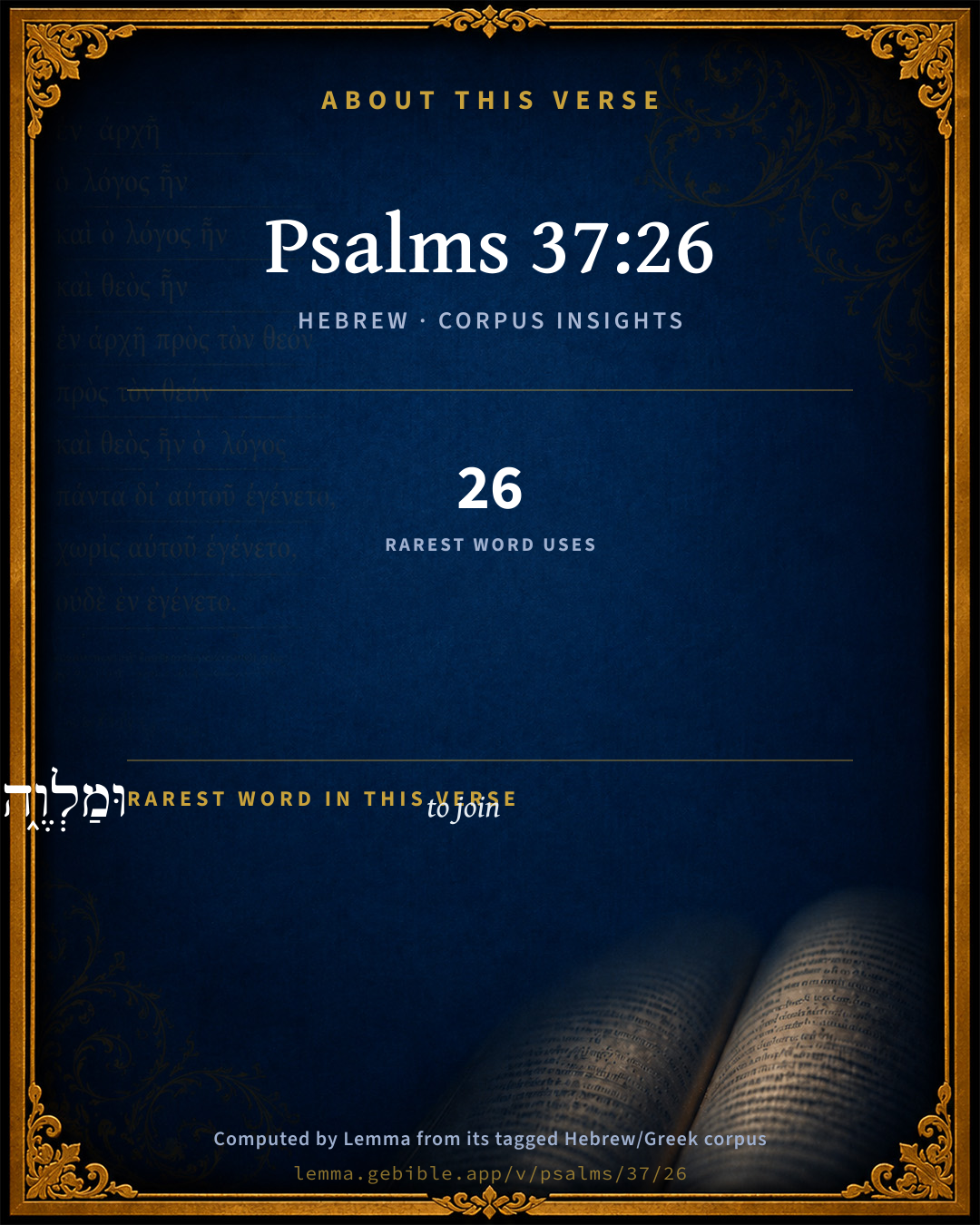
Psalms 37:26

Hebrew (Westminster Leningrad Codex) Psalms 37:26 appears in the Hebrew Old Testament. The text above is from the Westminster Leningrad Codex. Each word links to its Strong’s number, a concise gloss, and parsing drawn from the Open Scriptures Hebrew Bible morphology. Click any word for its full Brown-Driver-Briggs (BDB) entry.
Download image
Cite this verse

Psalms 37:26 (World English Bible). Public Domain. Lemma interlinear Bible study tool, https://lemma.gebible.app/v/psalms/37/26.

Show BibTeX & RIS
BibTeX
RIS
English Translation
All day long he deals graciously, and lends. His seed is blessed.
World English Bible · Public Domain
Download a study sheet

One document with this verse’s original text, its word-by-word gloss line, the meaning frame, cross-references with their text, attributed commentary, and full source and license credits — printable, and it pastes into notes with its structure intact.

This verse Autodidact and up

Study sheet (.html) Plain text (.txt)

A passage Seminary Student

Up to 50 verses in one chapter. A passage sheet keeps up to 6 commentary sources and 12 cross-references per verse, in the order this page ranks them, and says so on the sheet whenever that leaves anything out. Ask for a single verse and you get the Autodidact verse sheet above.

Everything on this page stays free to read, with no account — the sheet is a download of what is already on screen, not access to it.

Want to remove ads? Support Godless Engineer
Compare translations 3

The same verse in 3 English versions, stacked beneath the original-language interlinear above. Click any original word for its lexicon entry.

Each is an independent rendering of the whole verse — the interlinear is not word-aligned to these translations.

Highlighted words mark where these versions differ — a whole-verse word diff, not a word-by-word alignment.

  • World English Bible Public Domain
    All day long he deals graciously, and lends. His seed is blessed.
  • King James Version Public Domain
    He is ever merciful, and lendeth; and his seed is blessed.
  • unfoldingWord Literal Text CC BY-SA 4.0
    All the day he is showing grace and lending, and his seed for a blessing.

unfoldingWord Literal Text — © unfoldingWord, licensed CC BY-SA 4.0. Word-aligned USFM3 via Door43 (git.door43.org/unfoldingWord/en_ult).

Versions to compare (up to 4)

3 of 4 selected

Show all 18 translations

Every available English version of this verse, each an independent rendering of the whole verse.

  • World English Bible Public Domain
    All day long he deals graciously, and lends. His seed is blessed.
  • Berean Standard Bible Public Domain
    They are ever generous and quick to lend, and their children are a blessing.
  • Majority Standard Bible Public Domain
    They are ever generous and quick to lend, and their children are a blessing.
  • King James Version Public Domain
    He is ever merciful, and lendeth; and his seed is blessed.
  • American Standard Version (1901) Public Domain
    All the day long he dealeth graciously, and lendeth; And his seed is blessed.
  • Revised Version (1885) Public Domain
    All the day long he dealeth graciously, and lendeth; and his seed is blessed.
  • Geneva Bible (1599) Public Domain
    But hee is euer mercifull and lendeth, and his seede enioyeth the blessing.
  • Douay-Rheims (1899) Public Domain
    He sheweth mercy, and lendeth all the day long; and his seed shall be in blessing.
  • Young's Literal Translation Public Domain
    All the day he is gracious and lending, And his seed `is' for a blessing.
  • Literal Standard Version CC BY-SA 4.0
    All the day he is gracious and lending, || And his seed [is] for a blessing.
  • Unlocked Literal Bible CC BY-SA 4.0
    All the day long he is gracious and lends, and his children become a blessing.
  • unfoldingWord Literal Text CC BY-SA 4.0
    All the day he is showing grace and lending, and his seed for a blessing.
  • Darby Bible Public Domain
    all the day he is gracious and lendeth, and his seed shall be a blessing.
  • World Messianic Bible Public Domain
    All day long he deals graciously, and lends. His offspring is blessed.
  • Webster's Bible Public Domain
    He is ever merciful, and lendeth; and his seed is blessed.
  • Free Bible Version CC BY-SA 4.0
    They are always kind, and generous with their loans; their children are a blessing.
  • Bible in Basic English Public Domain
    All the day he is ready to have mercy and to give; his children are a blessing.
  • JPS Tanakh (1917) Public Domain
    All the day long he dealeth graciously, and lendeth; and his seed is blessed.

Literal Standard Version (2020), Covenant Press — licensed CC BY-SA 4.0. Text via the HelloAO Bible API (eBible.org). Unlocked Literal Bible (unfoldingWord) — licensed CC BY-SA 4.0. Text via the HelloAO Bible API (eBible.org). unfoldingWord Literal Text — © unfoldingWord, licensed CC BY-SA 4.0. Word-aligned USFM3 via Door43 (git.door43.org/unfoldingWord/en_ult). Free Bible Version, Dr. Jonathan Gallagher — licensed CC BY-SA 4.0. Text via the HelloAO Bible API (eBible.org).

Word by word

More ways to search: Search by grammar → Find every occurrence → Compare this word →

Practice this passage: Drill this verse → Learn its vocabulary →

About this verse

These counts appear in no published source. They are computed here, from the morphology-tagged text and Lemma’s own curated glosses. What Lemma adds →

6
words
6
distinct lemmas
Wisdom
section

Shared distinctive vocabulary

וּמַלְוֶ֑ה to join H3867 occurs in 22 verses of the Hebrew Bible. Also found in:

Grammatical profile

  • 2 verbs
  • 4 nouns

Verb forms

  • חוֹנֵ֣ן Qal · Participle Active
  • וּמַלְוֶ֑ה Hiphil · Participle Active

Hebrew & Septuagint length

In English translation the verse runs 12 words from the Hebrew and 12 from the Septuagint (LXX English) — the same length.

A rough comparison of the two English renderings, which tokenize alike — not a word-level alignment.

Word counts can differ between the Hebrew and the Greek without any difference in meaning — e.g. the Hebrew direct-object marker אֵת has no separate Greek word, and Greek often adds the article ὁ.

Cross-references

9

Topical passages linked to Psalms 37:26 in the Treasury of Scripture Knowledge — connected by theme and wording, ordered by reader-vote popularity; previews shown in the World English Bible.

  • Psalms 112:5 It is well with the man who deals graciously and lends. He will maintain his cause in judgment.
  • Psalms 37:21 The wicked borrow, and don't pay back, But the righteous give generously.
  • Matthew 5:7 Blessed are the merciful, For they shall obtain mercy.
  • Deuteronomy 15:8–10 but you shall surely open your hand to him, and shall surely lend him sufficient for his need [in that] which he wants.
  • Psalms 112:9 He has dispersed, he has given to the poor. His righteousness endures forever. His horn will be exalted with honor.
  • Proverbs 20:7 A righteous man walks in integrity. Blessed are his children after him.
  • Jeremiah 32:39 and I will give them one heart and one way, that they may fear me forever, for the good of them, and of their children after them:
  • Luke 6:35–38 But love your enemies, and do good, and lend, expecting nothing back; and your reward will be great, and you will be children of the Most High; for he is kind toward the unthankful and evil.
  • Psalms 147:13 For he has strengthened the bars of your gates. He has blessed your children within you.

Cross-references courtesy of OpenBible.info (CC BY 4.0).

Hebrew and Greek witnesses Masoretic Hebrew ↔ Greek Septuagint

The same verse in the two great witnesses to the Old Testament, shown verse-for-verse.

You’re reading Greek Psalm 36 (Hebrew Psalm 37). The Septuagint counts the superscription, so verse numbers can differ from the Hebrew — chapter-level alignment, not verse-by-verse. Numbering follows Rahlfs.

These are two independent witnesses, not word-aligned to each other, and the Septuagint is shown in lemma (dictionary) form.

Hebrew Psalms 37:26 Masoretic · Westminster Leningrad Codex

כָּל הַ֭יּוֹם חוֹנֵ֣ן וּמַלְוֶ֑ה וְ֝זַרְע֗וֹ לִבְרָכָֽה

All day long he deals graciously, and lends. His seed is blessed.

World English Bible · Public Domain

Greek LXX Greek Psalm 36:26 Septuagint · lemma form

ὅλος ὁ ἡμέρα ἐλεάω καί δανείζω καί ὁ σπέρμα αὐτός εἰς εὐλογία εἰμί

He is merciful, and lends continually; and his seed shall be blessed.

LXX2012 (modern English Septuagint) · Public Domain

Hebrew: Westminster Leningrad Codex (CC BY 4.0). Greek: Septuagint (public domain); English from LXX2012 (modern English Septuagint) (Public Domain). How the Septuagint differs from the Hebrew →

Commentary

Notes on Psalms 37:26 from classic Christian and Jewish commentators (each source and its license shown beneath its notes). The classic Christian expositions comment on the surrounding passage and are grouped to its opening verse, so a note may address several verses; the Jewish commentaries on the Tanakh (Rashi and others) are per-verse, so they appear only where the commentator wrote on this verse.

Lemma curates 59 commentaries, every one of them public domain or Creative Commons licensed, each selected and text-cleaned for this edition rather than reprinted as found. About our sources →

Trapp's Complete Commentary

John Trapp

Psa 37:26 [He is] ever merciful, and lendeth; and his seed [is] blessed.

Ver. 26. He is ever merciful, and lendeth] Heb. Every day, according to others’ necessity and his own ability; for to stretch beyond the staple were to mar all. But he is ever "ready to distribute, willing to communicate," 1Ti 6:17, as Mr Wiseheart, the Scotch martyr, whose charity had never an end, night, day, nor noon, saith Mr Fox; and Thomas Tomkins, an English martyr, very forward to lend, looking for nothing again.

And his seed is blessed] Heb. is in the blessing, that is, receiveth grace and communication of all true goodness from God; and praises, goodwill, and good wishes from men (Diod.).

John Trapp, A Commentary or Exposition upon All the Books of the Old and New Testament (1647–1656) — public domain. Text from a community e-Sword module.

J. A. Alexander on Psalms

Joseph Addison Alexander

26. (Psa 37:26) On the contrary, he has enough, not only for himself, but for his poorer neighbours. All the day (long), i.e. continually, as a habitual employment, (he is) showing mercy, doing acts of kindness, and lending, as an act of charity, not as a commercial operation, which was unknown among the ancient Hebrews. See above, on Psa 15:5.—And his seed (is) for a blessing, i.e. happy themselves and a source of happiness to others. The form of expression seems to be borrowed from the promise to Abraham in Gen 12:2.

Joseph Addison Alexander, The Psalms Translated and Explained (1850) — public domain. Text from a community e-Sword module.

Jamieson, Fausset & Brown

Robert Jamieson, A. R. Fausset & David Brown

his seed is blessed--literally, "for a blessing" (Gen 12:2; Psa 21:6). This position is still true as the rule of God's economy (Ti1 4:8; Ti1 6:6).

Jamieson, Fausset & Brown — Commentary Critical and Explanatory on the Whole Bible (1871) — public domain (CC PDM 1.0). Text via the HelloAO Bible API.

Adam Clarke's Commentary

Verse 26. He is ever merciful and lendeth] כל היום חונן kol haiyom chonen, "all the day he is compassionate." He is confirmed in the habit of godliness: he feels for the distresses of men, and is ready to divide and distribute to all that are in necessity.

And his seed is blessed.] The preceding words were not spoken casually; his seed, his posterity, is blessed; therefore they are not abandoned to beg their bread.

Adam Clarke's Commentary on the Bible (1810–1826) — public domain. Text from a community e-Sword/MySword module.

John Calvin's Commentaries

26 He is daily merciful The Psalmist here repeats what he had already said, that the grace of God is a fountain of all blessings which can never be exhausted; and, therefore, while it is displayed towards the faithful, they not only have enough for the supply of their own wants, but are able also liberally to assist others. What he adds concerning their seed is variously expounded. That he is speaking of the children of the godly, there can be no doubt; and this is evident from the preceding verse. But when he says that they shall be for blessing, some understand it as if he had said, They shall be the ministers of God’s liberality: so that, according to them, the sense would be, that they shall follow the good example of their fathers in helping the poor, and in exercising liberality towards all men. But I fear that this exposition is too refined. Nor do I admit the interpretation which has been given by others, that the meaning is, that the grace of God shall be so signally manifested towards the children of the godly, that their names shall be employed in a form of prayer, when prosperity and success are prayed for. This mode of expression, I allow, is to be so understood in various places; but here, in my opinion, David designs nothing more than to extol the continuation of God’s favor from the fathers to their children: as if he had said, God’s blessing does not terminate with the death of the righteous man, but it extends even to his children. And there is indeed no inheritance more certain to which our children may succeed us, than when God, receiving them in like manner into his fatherly favor, makes them partakers of his blessing.

John Calvin's Commentaries (1540-1563) — public domain. Text from the Calvin Translation Society English edition (1840s-50s) via the Christian Classics Ethereal Library (ccel.org). Calvin's coverage is partial (roughly two-thirds of the Bible); uncommented books and verses are honest gaps, never fabricated. The 19th-century editor's footnotes and remarks are omitted so the notes are faithfully Calvin's own voice.

The Cambridge Bible for Schools and Colleges

gen. ed. J. J. S. Perowne

26. All the day long he dealeth graciously and lendeth (R.V.). Cp. Psa_37:21; Psa_112:5. The righteous not only have abundance, but know how to use it (Isa_32:5-8).

27, 28 a., b. Stanza of Samech.

The Cambridge Bible for Schools and Colleges (gen. ed. J. J. S. Perowne; Cambridge University Press, 1878–1918) — public domain. Text from a community e-Sword module.

John Gill's Exposition

Depart from evil, and do good,.... Depart from evildoers, and their evil ways; join not with them, nor fret and be envious at them; but do acts of beneficence, and all good works; since righteous men, and their seed, are not forsaken, but blessed of God; See Gill on Psa 34:14;

and dwell for evermore; or "thou shalt dwell for evermore" (z); see Psa 37:3; that is, in everlasting habitations, in the house not made with hands, eternal in the heavens, Luk 16:9. The Targum is, "that thou mayest dwell in everlasting life".

(z) "et habitabis in seculum", Pagninus, Vatablus, Piscator; so Aben Ezra & Kimchi.

John Gill's Exposition of the Whole Bible (1746–1763) — public domain (CC PDM 1.0). Text via the HelloAO Bible API.

Albert Barnes' Notes on the Bible

He is ever merciful - Margin, as in Hebrew, “all the day.” That is, it is his character; he is constantly in the habit of showing kindness. He does not do it at intervals, or only occasionally, but it is this that marks the character of the man. He is known by this. The word “merciful” here means kind, compassionate, benignant - and particularly in this respect, that he is willing to “lend” to others when he has the means.

And lendeth - The wicked man “borrows,” but does not pay again Psa 37:21; the righteous man “lends” to his neighbor.

And his seed is blessed - His children; his posterity, as the result of this conduct on his part. The effect of what he does passes over from him to them, conveying rich blessings to them.

Albert Barnes' Notes on the Bible (1834–1885) — public domain. Text from a community e-Sword/MySword module.

Matthew Poole's English Annotations

He is so far from begging from others, that he hath ability as well as inclination to give or lend to others, as need requires.

His seed is blessed, not only with spiritual, but with temporal blessings. So far shall he be from wasting his estate, and undoing himself and family by his bounty and charity, as covetous worldlings objected or feared.

Matthew Poole's English Annotations on the Holy Bible (1683–1685) — public domain. Text from a community e-Sword/MySword module.

The Treasury of David

Charles H. Spurgeon

Ver. 26. He is ever merciful, and lendeth. The righteous are constantly under generous impulses; they do not prosper through parsimony, but through bounty. Like the bounteous giver of all good, of whom they are the beloved sons, they delight in doing good. How stingy covetous professors can hope for salvation is a marvel to those who read such verses as this in the Bible. And his seed is blessed. God pays back with interest in the next generation. Where the children of the righteous are not godly, there must be some reason for it in parental neglect, or some other guilty cause. The friend of the father is the friend of the family. The God of Abraham is the God of Isaac and of Jacob.

Ver. 26. He is ever merciful, and lendeth; and his seed is blessed. He, the good man, is merciful to himself, for mercy, like charity, begins at home; he is not afraid to eat a good meal because he hath children. And he is merciful to others too; for he will lend and do good to whom he can, and then his seed fares the better for it. Mark, that the more he gives and lends in doing works of mercy, the better it is for his children; for those children are ever best provided for whose parents bear this mindthey had rather trust God with their children, than their children with riches; and have made this their hope, that though they die, yet God lives. Did but one of those rich and wretched parents (who pinched and pined himself to make his son a gentleman, forsooth), rise from the dead, and see that proverb of Solomon fulfilled in himself, "He begetteth a son, and in his hand is nothing; "I persuade myself, the rumination of this would afflict him in his soul as much as any one pain of sense, even in hell itself. O consider this, you that now live and see it in others; and remember withal, that if your goods be either ill gotten, or worse kept, it may be your children's case when you are departed, and feel it, though you see it not. Matthew Griffith.

Ver. 26. The righteous man's merciful disposition, generous action, and rich reward.

Ver. 26. The benediction of the good man's family: what it is, and what it is not.

Psalms 37:27*

Charles H. Spurgeon's The Treasury of David (1869–1885) — public domain. Psalms only. Text from a community e-Sword/MySword module.

Whedon's Commentary on the Bible

Daniel D. Whedon

26. Ever merciful, and lendeth—Literally, all the day he is merciful, and lendeth. With the Hebrews, where absolute poverty was the inevitable lot of the masses, (their population being estimated at about 6,000,000, on a territory about one third the area of New York State,) borrowing and lending had a more emphatic significance than with us; and this ability to lend implied competence, while the disposition and practice of daily beneficence are quoted as evidence and causes of prosperity. See on Psa_37:21, and Psa_112:5; Psa_112:9

Daniel D. Whedon (gen. ed.), Commentary on the Old and New Testaments (1874–1909) — public domain. Text from a community e-Sword module.

The Pulpit Commentary

He is ever merciful, and lendeth (comp. ver. 21). This psalm contains a good deal of repetition, perhaps intended to emphasize certain portions of its teaching (see vers. 1, 7, 8; 3, 27; 11, 22, 29; 7, 34, etc.). And his seed is blessed. (comp. Psa_25:13 Psa_102:28 Psa_112:2)

The Pulpit Commentary (1880–1919), ed. H.D.M. Spence-Jones & Joseph S. Exell — public domain. Text from a community e-Sword module.

John Wesley's Explanatory Notes

Blessed - Not only with spiritual, but with temporal blessings.

John Wesley, Explanatory Notes Upon the Whole Bible (1754–1765) — public domain. Text via the GEBible commentary corpus.

Rashi

Rabbi Shlomo Yitzchaki (Rashi)

All day long the righteous man is gracious to the poor and lends to them.

and his seed This seed that he sows with his charity will ultimately be blessed.

Rashi on the Tanakh — English translations: “The Judaica Press complete Tanach with Rashi, translated by A. J. Rosenberg” (CC BY 4.0); “Pentateuch with Rashi's commentary by M. Rosenbaum and A.M. Silbermann, 1929-1934” (public domain); “The Metsudah Tanach series, Lakewood, N.J” (CC BY 4.0); and “The Book of Joshua, Metsudah Publications, 1997” (CC BY 4.0). Text via Sefaria.

Lesson kit

Teaching starters — assembled from the data on this page, not authored interpretation. Every prompt links to the verse data it draws on. Edit before teaching.

Psalms, in the Wisdom, opens this verse with 6 words (6 distinct Hebrew lemmas). Its most distinctive word is lâvâh (“to join”). A historical commentator’s framing appears above. Read the whole chapter for the surrounding context.

Discussion questions

  1. What does “to join” (lâvâh) contribute to the verse as a whole?
  2. Genesis 29:34 shares the word «to join» with this verse. How do the two illuminate each other?
  3. These translations render this verse differently. What is at stake in choosing one wording over another?
  4. The verb «חוֹנֵ֣ן» is Qal Participle Active. How does its form color the action?
  5. Reading how Trapp's Complete Commentary and J. A. Alexander on Psalms read this verse, where do the two commentators agree and where do they part?

Things to notice

Reading settings

Reading text

Shown beneath each verse's original-language words.

Old Testament
Old Testament edition

Read the OT as the Masoretic Hebrew (MT) or the Greek Septuagint (LXX).

English shown for the Greek Septuagint (in the Hebrew ↔ Greek comparison).

Comparing translations? Open the Compare panel on any verse page to stack up to four side by side.