

Ephesians 5:18
Greek (Tischendorf 8th ed.) Ephesians 5:18 appears in the Greek New Testament. The text above is from the Tischendorf 8th edition. Each word links to its Strong’s number and a concise gloss. Click any word for its full Thayer’s Greek Lexicon entry.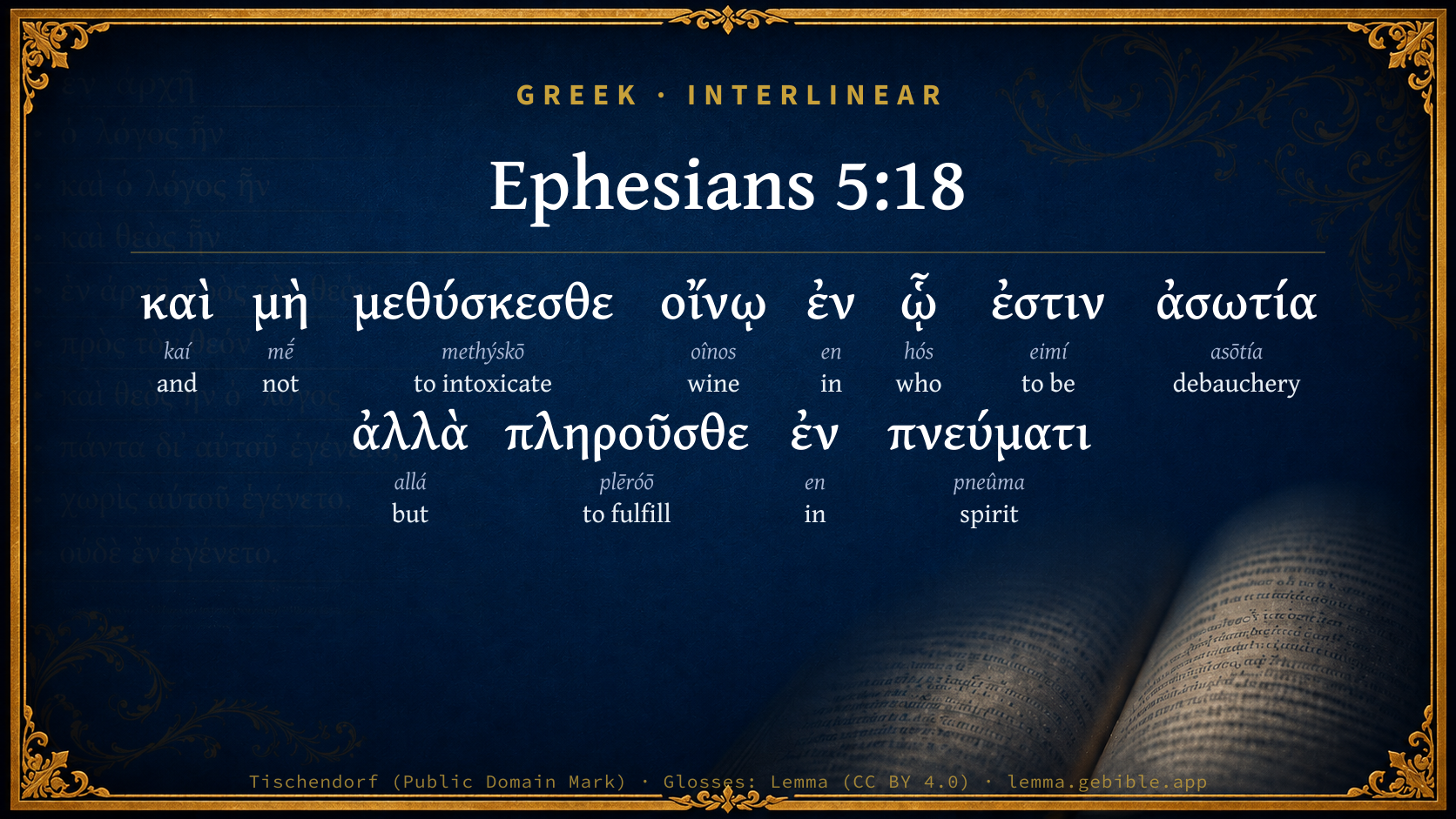
Don't be drunken with wine, in which is dissipation, but be filled with the Spirit,
Download a study sheet
One document with this verse’s original text, its word-by-word gloss line, the meaning frame, cross-references with their text, attributed commentary, and full source and license credits — printable, and it pastes into notes with its structure intact.
This verse Autodidact and up
A passage Seminary Student
Up to 50 verses in one chapter. A passage sheet keeps up to 6 commentary sources and 12 cross-references per verse, in the order this page ranks them, and says so on the sheet whenever that leaves anything out. Ask for a single verse and you get the Autodidact verse sheet above.
Everything on this page stays free to read, with no account — the sheet is a download of what is already on screen, not access to it.
Compare translations 3
The same verse in 3 English versions, stacked beneath the original-language interlinear above. Click any original word for its lexicon entry.
Each is an independent rendering of the whole verse — the interlinear is not word-aligned to these translations.
Highlighted words mark where these versions differ — a whole-verse word diff, not a word-by-word alignment.
-
World English Bible Public Domain
Don't be drunken with wine, in which is dissipation, but be filled with the Spirit,
-
King James Version Public Domain
And be not drunk with wine, wherein is excess; but be filled with the Spirit;
-
unfoldingWord Literal Text CC BY-SA 4.0
And do not get drunk with wine, in which is recklessness. Instead, be filled with the Spirit,
unfoldingWord Literal Text — © unfoldingWord, licensed CC BY-SA 4.0. Word-aligned USFM3 via Door43 (git.door43.org/unfoldingWord/en_ult).
Show all 19 translations
Every available English version of this verse, each an independent rendering of the whole verse.
-
World English Bible Public Domain
Don't be drunken with wine, in which is dissipation, but be filled with the Spirit,
-
Berean Standard Bible Public Domain
Do not get drunk on wine, which leads to reckless indiscretion. Instead, be filled with the Spirit.
-
Majority Standard Bible Public Domain
Do not get drunk on wine, which leads to reckless indiscretion. Instead, be filled with the Spirit.
-
King James Version Public Domain
And be not drunk with wine, wherein is excess; but be filled with the Spirit;
-
American Standard Version (1901) Public Domain
And be not drunken with wine, wherein is riot, but be filled with the Spirit;
-
Revised Version (1885) Public Domain
And be not drunken with wine, wherein is riot, but be filled with the Spirit;
-
Geneva Bible (1599) Public Domain
And be not drunke with wine, wherein is excesse: but be fulfilled with the Spirit,
-
Douay-Rheims (1899) Public Domain
And be not drunk with wine, wherein is luxury; but be ye filled with the holy Spirit,
-
Young's Literal Translation Public Domain
and be not drunk with wine, in which is dissoluteness, but be filled in the Spirit,
-
Literal Standard Version CC BY-SA 4.0
and do not be drunk with wine, in which is wastefulness, but be filled in the Spirit,
-
Unlocked Literal Bible CC BY-SA 4.0
And do not get drunk with wine, for that leads to reckless behavior. Instead, be filled with the Holy Spirit,
-
unfoldingWord Literal Text CC BY-SA 4.0
And do not get drunk with wine, in which is recklessness. Instead, be filled with the Spirit,
-
Darby Bible Public Domain
And be not drunk with wine, in which is debauchery; but be filled with the Spirit,
-
World Messianic Bible Public Domain
Don’t be drunken with wine, in which is dissipation, but be filled with the Spirit,
-
Webster's Bible Public Domain
And be not drunk with wine, in which is excess; but be filled with the Spirit;
-
Free Bible Version CC BY-SA 4.0
Don't get drunk on wine which will wreck your life, but be filled with the Spirit.
-
Bible in Basic English Public Domain
And do not take overmuch wine by which one may be overcome, but be full of the Spirit;
-
Text-Critical English NT CC BY 4.0
Do not be drunk with wine, which leads to debauchery, but be filled with the Spirit,
-
Tyndale New Testament (1534) Public Domain
and be not dronke with wyne wherin is excesse: but be fulfilled with the sprete
Literal Standard Version (2020), Covenant Press — licensed CC BY-SA 4.0. Text via the HelloAO Bible API (eBible.org). Unlocked Literal Bible (unfoldingWord) — licensed CC BY-SA 4.0. Text via the HelloAO Bible API (eBible.org). unfoldingWord Literal Text — © unfoldingWord, licensed CC BY-SA 4.0. Word-aligned USFM3 via Door43 (git.door43.org/unfoldingWord/en_ult). Free Bible Version, Dr. Jonathan Gallagher — licensed CC BY-SA 4.0. Text via the HelloAO Bible API (eBible.org).
Word by word
More ways to search: Search by grammar → Find every occurrence → Compare this word →
Practice this passage: Drill this verse → Learn its vocabulary →
- Appears 3× in the Greek New Testament
- First appears here
- Part of Speech
- Noun
- Case
- Nominative
- Number
- Singular
- Gender
- Feminine
Full Thayer's Definition
- καὶ kaí G2532 “and” Conjunction
- μὴ mḗ G3361 “not” Particle, Negative
- μεθύσκεσθε methýskō G3182 “to intoxicate” Verb, Present, Passive, Imperative, 2nd person, Plural
- οἴνῳ oînos G3631 “wine” Noun, Dative, Singular, Masculine
- ἐν en G1722 “in” Preposition
- ᾧ hós G3739 “who” Relative pronoun, Dative, Singular, Masculine
- ἐστιν eimí G1510 “to be” Verb, Present, Active, Indicative, 3rd person, Singular
- ἀσωτία asōtía G810 “debauchery” Noun, Nominative, Singular, Feminine
- ἀλλὰ allá G235 “but” Conjunction
- πληροῦσθε plēróō G4137 “to fulfill” Verb, Present, Passive, Imperative, 2nd person, Plural
- ἐν en G1722 “in” Preposition
- πνεύματι pneûma G4151 “spirit” Noun, Dative, Singular, Neuter
About this verse
These counts appear in no published source. They are computed here, from the morphology-tagged text and Lemma’s own curated glosses. What Lemma adds →
- 12
- words
- 11
- distinct lemmas
- Pauline Epistles
- section
Notable vocabulary
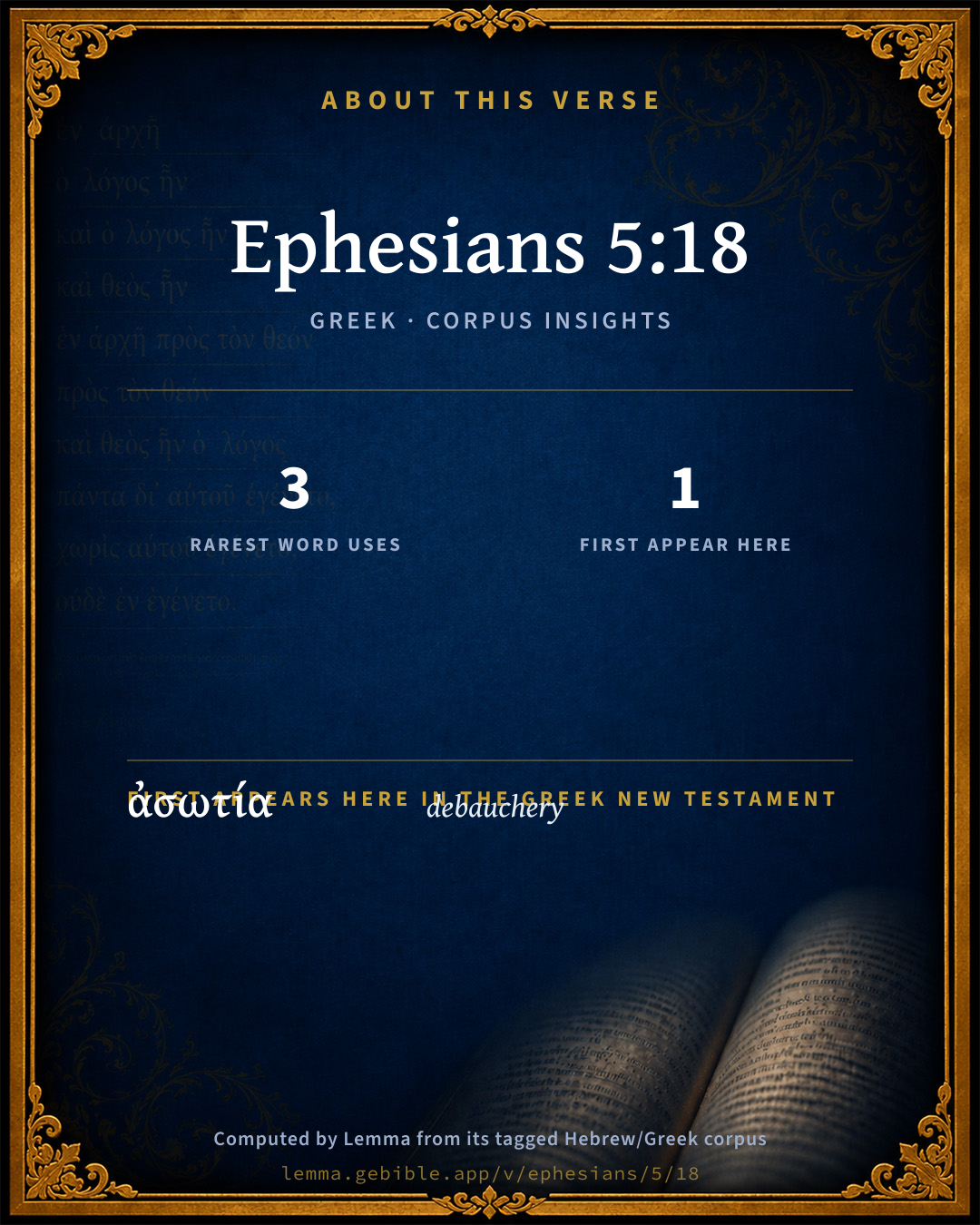
The rarest word here is ἀσωτία debauchery G810 — appearing just 3 times in the whole Greek New Testament.
First appearance in Scripture
This word makes its first canonical appearance in the Greek New Testament here:
- ἀσωτία debauchery G810
Shared distinctive vocabulary
ἀσωτία debauchery G810 occurs in 3 verses of the Greek New Testament. Also found in:
Repetition
A word recurs within this verse:
- ἐν in G1722 ×2
Cross-references
29Topical passages linked to Ephesians 5:18 in the Treasury of Scripture Knowledge — connected by theme and wording, ordered by reader-vote popularity; previews shown in the World English Bible.
- Proverbs 20:1 Wine is a mocker, and beer is a brawler; Whoever is led astray by them is not wise.
- Luke 1:15 For he will be great in the sight of the Lord, and he will drink no wine nor strong drink. He will be filled with the Holy Spirit, even from his mother's womb.
- Romans 13:13 Let us walk properly, as in the day; not in reveling and drunkenness, not in sexual promiscuity and lustful acts, and not in strife and jealousy.
- Galatians 5:21–25 envyings, murders, drunkenness, orgies, and things like these; of which I forewarn you, even as I also forewarned you, that those who practice such things will not inherit the Kingdom of God.
- Acts 11:24 For he was a good man, and full of the Holy Spirit and of faith, and many people were added to the Lord.
- Isaiah 5:22 Woe to those who are mighty to drink wine, And champions at mixing strong drink;
- 1 Corinthians 5:11 But as it is, I wrote to you not to associate with anyone who is called a brother who is a sexual sinner, or covetous, or an idolater, or a slanderer, or a drunkard, or an extortioner. Don't even eat with such a person.
- Proverbs 23:29–35 Who has woe? Who has sorrow? Who has strife? Who has complaints? Who has needless bruises? Who has bloodshot eyes?
- Luke 11:13 If you then, being evil, know how to give good gifts to your children, how much more will your heavenly Father give the Holy Spirit to those who ask him?"
- Proverbs 23:20–21 Don't be among ones drinking too much wine, Or those who gorge themselves on meat:
- Isaiah 5:11–13 Woe to those who rise up early in the morning, that they may follow strong drink; Who stay late into the night, until wine inflames them!
- Luke 12:45 But if that servant says in his heart, 'My lord delays his coming,' and begins to beat the menservants and the maidservants, and to eat and drink, and to be drunken,
- 1 Thessalonians 5:7 For those who sleep, sleep in the night, and those who are drunken are drunken in the night.
- Zechariah 9:15–17 Yahweh of Hosts will defend them; And they will destroy and overcome with sling-stones; And they will drink, and roar as through wine; And they will be filled like bowls, Like the corners of the altar.
- Acts 2:13–18 Others, mocking, said, "They are filled with new wine."
- 1 Corinthians 6:10 nor thieves, nor covetous, nor drunkards, nor slanderers, nor extortioners, will inherit the Kingdom of God.
- 1 Peter 4:3–4 For we have spent enough of our past time doing the desire of the Gentiles, and having walked in lewdness, lusts, drunken binges, orgies, carousings, and abominable idolatries.
- Luke 21:34 "So be careful, or your hearts will be loaded down with carousing, drunkenness, and cares of this life, and that day will come on you suddenly.
- Titus 1:6 if anyone is blameless, the husband of one wife, having children who believe, who are not accused of loose or unruly behavior.
- Deuteronomy 21:20 and they shall tell the elders of his city, This our son is stubborn and rebellious, he will not obey our voice; he is a glutton, and a drunkard.
- Isaiah 55:1 Ho, everyone who thirsts, come you to the waters, and he who has no money; come you, buy, and eat; yes, come, buy wine and milk without money and without price.
- 1 Corinthians 11:21 For in your eating each one takes his own supper before others. One is hungry, and another is drunken.
- Genesis 9:21 He drank of the wine, and got drunk. He was uncovered within his tent.
- Psalms 63:3–5 Because your loving kindness is better than life, My lips shall praise you.
- Song of Solomon 1:4 Take me away with you. Let us hurry. The king has brought me into his chambers. Friends We will be glad and rejoice in you. We will praise your love more than wine! Beloved They are right to love you.
- Genesis 19:32–35 Come, let's make our father drink wine, and we will lie with him, that we may preserve our father's seed."
- Psalms 69:12 Those who sit in the gate talk about me. I am the song of the drunkards.
- Isaiah 25:6 In this mountain will Yahweh of Hosts make to all peoples a feast of fat things, a feast of wines on the lees, of fat things full of marrow, of wines on the lees well refined.
- Matthew 23:25 "Woe to you, scribes and Pharisees, hypocrites! For you clean the outside of the cup and of the platter, but within they are full of extortion and unrighteousness.
Cross-references courtesy of OpenBible.info (CC BY 4.0).
Lesson kit
Teaching starters — assembled from the data on this page, not authored interpretation. Every prompt links to the verse data it draws on. Edit before teaching.
Ephesians, in the Pauline Epistles, opens this verse with 12 words (11 distinct Greek lemmas). Its most distinctive word is asōtía (“debauchery”). A historical commentator’s framing appears above. Read the whole chapter for the surrounding context.
Discussion questions
- The word asōtía carries the sense “debauchery.” How does it shape the verse?
- The word “debauchery” first appears here in Scripture. What is being introduced at this debut?
- Titus 1:6 shares the word «debauchery» with this verse. How do the two illuminate each other?
- “in” occurs 2× in this one verse. What is the effect of the repetition?
- The translations on this page render this verse differently — a whole-verse word diff, not a word-by-word alignment. What might account for the different wordings?
- Reading how The Biblical Illustrator and Joseph Benson's Commentary read this verse, where do the two commentators agree and where do they part?
Things to notice
- 1 word makes its first canonical appearance in Scripture here.
- These translations choose different wording for 11 words in this verse.
- “in” occurs 2× in this single verse.
- 11 distinct Greek lemmas span 12 words in this verse.
Commentary
Notes on Ephesians 5:18 from classic Christian and Jewish commentators (each source and its license shown beneath its notes). The classic Christian expositions comment on the surrounding passage and are grouped to its opening verse, so a note may address several verses; the Jewish commentaries on the Tanakh (Rashi and others) are per-verse, so they appear only where the commentator wrote on this verse.
Lemma curates 59 commentaries, every one of them public domain or Creative Commons licensed, each selected and text-cleaned for this edition rather than reprinted as found. About our sources →
The Biblical Illustrator
Joseph S. Exell
The Biblical Illustrator, edited by Joseph S. Exell (c. 1880s–1900s) — public domain. Text from a community e-Sword module.
Joseph Benson's Commentary
Joseph Benson's Commentary on the Old and New Testaments (1811–1818) — public domain. Text from a community e-Sword module.
Whedon's Commentary on the Bible
Daniel D. Whedon
Daniel D. Whedon (gen. ed.), Commentary on the Old and New Testaments (1874–1909) — public domain. Text from a community e-Sword module.
Tyndale Open Study Notes
Tyndale Open Resources
Tyndale Open Study Notes — © Tyndale Open Resources, licensed CC BY-SA 4.0. Text via the HelloAO Bible API.
Bengel's Gnomon
Johann Albrecht Bengel
Bengel's Gnomon of the New Testament — English translation (T&T Clark, Edinburgh, 1860) — public domain. Text from a community e-Sword module.
Meyer's Critical & Exegetical Commentary
Heinrich August Wilhelm Meyer
Meyer — Critical and Exegetical Commentary on the New Testament — English translation by Peter Christie, edited by Frederick Crombie (T&T Clark, 1880) — public domain. Text from a community e-Sword module.
Expositor's Greek Testament
ed. W. Robertson Nicoll
The Expositor's Greek Testament, edited by W. Robertson Nicoll (1897–1910) — public domain. Text from a community e-Sword module.
Hodge's Commentary on Romans, Ephesians & First Corinthians
Charles Hodge
Charles Hodge — Commentary on Romans (1835), First Corinthians (1857), and Ephesians (1856) — public domain. Text from a community e-Sword module.
Geneva Bible (1599)
Geneva Bible translators
Geneva Bible (1599) marginal notes — public domain. Text via Bolls.life.
Jamieson, Fausset & Brown
Robert Jamieson, A. R. Fausset & David Brown
Jamieson, Fausset & Brown — Commentary Critical and Explanatory on the Whole Bible (1871) — public domain (CC PDM 1.0). Text via the HelloAO Bible API.
Adam Clarke's Commentary
Adam Clarke's Commentary on the Bible (1810–1826) — public domain. Text from a community e-Sword/MySword module.
John Calvin's Commentaries
John Calvin's Commentaries (1540-1563) — public domain. Text from the Calvin Translation Society English edition (1840s-50s) via the Christian Classics Ethereal Library (ccel.org). Calvin's coverage is partial (roughly two-thirds of the Bible); uncommented books and verses are honest gaps, never fabricated. The 19th-century editor's footnotes and remarks are omitted so the notes are faithfully Calvin's own voice.
Ellicott's Commentary for English Readers
A Bible Commentary for English Readers, edited by Charles John Ellicott (1878–1897) — public domain. Text from a community e-Sword module.
The Cambridge Bible for Schools and Colleges
gen. ed. J. J. S. Perowne
The Cambridge Bible for Schools and Colleges (gen. ed. J. J. S. Perowne; Cambridge University Press, 1878–1918) — public domain. Text from a community e-Sword module.
John Gill's Exposition
John Gill's Exposition of the Whole Bible (1746–1763) — public domain (CC PDM 1.0). Text via the HelloAO Bible API.
Trapp's Complete Commentary
John Trapp
John Trapp, A Commentary or Exposition upon All the Books of the Old and New Testament (1647–1656) — public domain. Text from a community e-Sword module.
Albert Barnes' Notes on the Bible
Albert Barnes' Notes on the Bible (1834–1885) — public domain. Text from a community e-Sword/MySword module.
Matthew Poole's English Annotations
Matthew Poole's English Annotations on the Holy Bible (1683–1685) — public domain. Text from a community e-Sword/MySword module.
The Pulpit Commentary
The Pulpit Commentary (1880–1919), ed. H.D.M. Spence-Jones & Joseph S. Exell — public domain. Text from a community e-Sword module.
John Wesley's Explanatory Notes
John Wesley, Explanatory Notes Upon the Whole Bible (1754–1765) — public domain. Text via the GEBible commentary corpus.
Burkitt's Expository Notes on the New Testament
William Burkitt
William Burkitt's Expository Notes on the New Testament (1700–1703) — public domain. Text from a community e-Sword module.
Godbey's Commentary on the New Testament
William B. Godbey
William B. Godbey, Commentary on the New Testament (1896–1900) — public domain. Text from a community e-Sword module.
The People's New Testament
B. W. Johnson
B. W. Johnson's The People's New Testament with Notes (1889–1891) — public domain. Electronic text from the Christian Classics Ethereal Library (CCEL) ThML edition.
unfoldingWord translationNotes
Door43 World Missions Community
unfoldingWord translationNotes — © Distant Shores Media and the Door43 World Missions Community, licensed CC BY-SA 4.0. Source: git.door43.org/Door43/en_tn.
Cambridge Greek Testament for Schools and Colleges
Cambridge Greek Testament for Schools and Colleges (Cambridge University Press, 1896; 21 vols, various authors incl. Carr, Maclear, Plummer, Farrar, Lumby, Moule, M. R. James, Simcox) — public domain. Text from a community e-Sword module.
Alford’s Greek Testament
Henry Alford
Henry Alford, The Greek Testament (1849–1861) — public domain. Text from a community e-Sword module.
International Critical Commentary
International Critical Commentary — older volumes (1896–1929), various authors — public domain. Text from a community e-Sword module.
Vincent's Word Studies in the New Testament
Marvin R. Vincent
Marvin R. Vincent, Word Studies in the New Testament (1887–1900) — public domain. Text from a community e-Sword/MySword module.