Micah 7:6

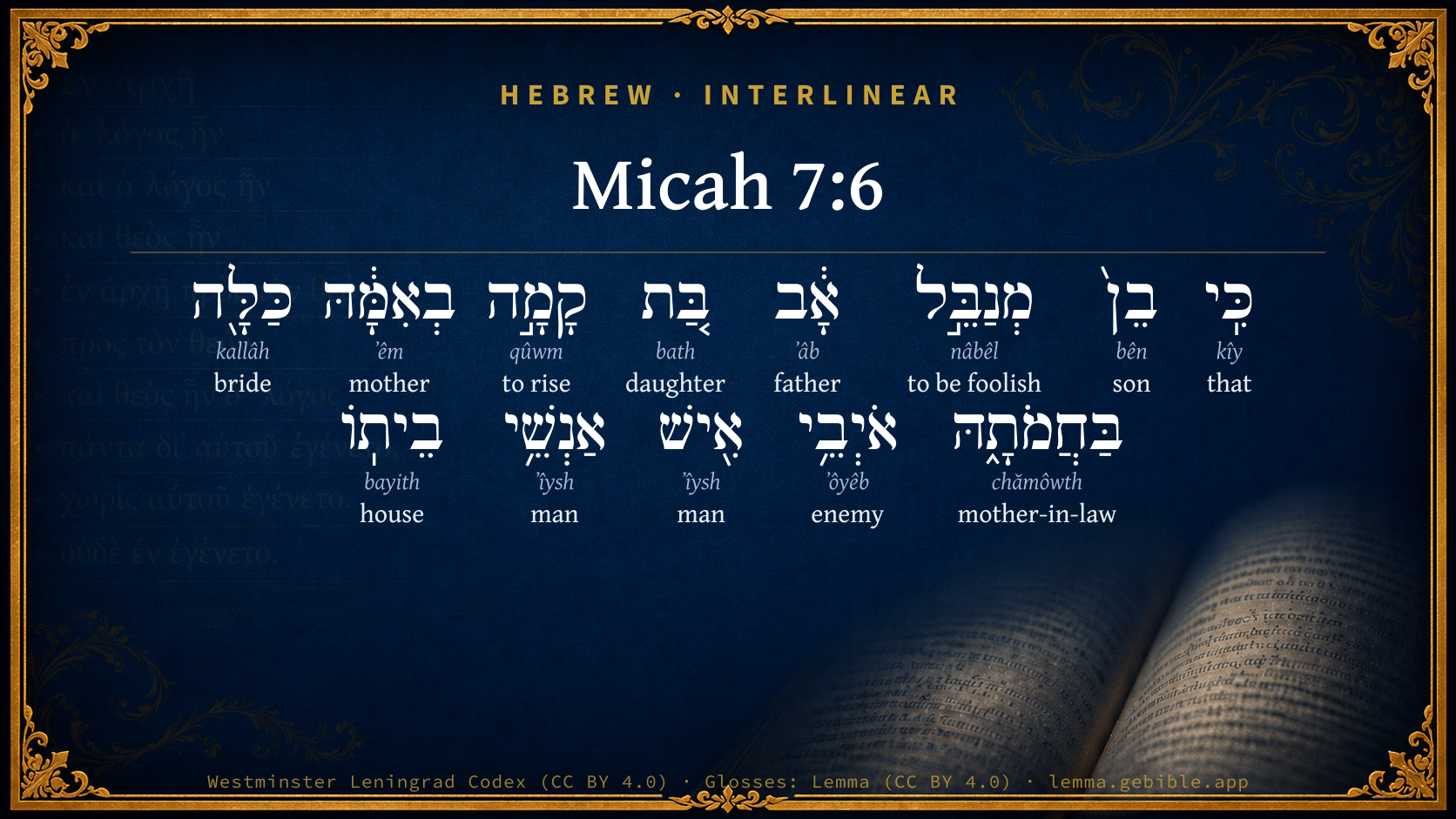
Hebrew (Westminster Leningrad Codex) Micah 7:6 appears in the Hebrew Old Testament. The text above is from the Westminster Leningrad Codex. Each word links to its Strong’s number, a concise gloss, and parsing drawn from the Open Scriptures Hebrew Bible morphology. Click any word for its full Brown-Driver-Briggs (BDB) entry.
Download image
Cite this verse

Micah 7:6 (World English Bible). Public Domain. Lemma interlinear Bible study tool, https://lemma.gebible.app/v/micah/7/6.

Show BibTeX & RIS
BibTeX
RIS
English Translation
For the son dishonors the father, The daughter rises up against her mother, The daughter-in-law against her mother-in-law; A man's enemies are the men of his own house.
World English Bible · Public Domain
Download a study sheet

One document with this verse’s original text, its word-by-word gloss line, the meaning frame, cross-references with their text, attributed commentary, and full source and license credits — printable, and it pastes into notes with its structure intact.

This verse Autodidact and up

Study sheet (.html) Plain text (.txt)

A passage Seminary Student

Up to 50 verses in one chapter. A passage sheet keeps up to 6 commentary sources and 12 cross-references per verse, in the order this page ranks them, and says so on the sheet whenever that leaves anything out. Ask for a single verse and you get the Autodidact verse sheet above.

Everything on this page stays free to read, with no account — the sheet is a download of what is already on screen, not access to it.

Want to remove ads? Support Godless Engineer
Compare translations 3

The same verse in 3 English versions, stacked beneath the original-language interlinear above. Click any original word for its lexicon entry.

Each is an independent rendering of the whole verse — the interlinear is not word-aligned to these translations.

Highlighted words mark where these versions differ — a whole-verse word diff, not a word-by-word alignment.

  • World English Bible Public Domain
    For the son dishonors the father, The daughter rises up against her mother, The daughter-in-law against her mother-in-law; A man's enemies are the men of his own house.
  • King James Version Public Domain
    For the son dishonoureth the father, the daughter riseth up against her mother, the daughter in law against her mother in law; a man's enemies are the men of his own house.
  • unfoldingWord Literal Text CC BY-SA 4.0
    For a son dishonors his father, a daughter rises up against her mother, and a daughter-in-law against her mother-in-law. A man’s enemies are the people of his own house.

unfoldingWord Literal Text — © unfoldingWord, licensed CC BY-SA 4.0. Word-aligned USFM3 via Door43 (git.door43.org/unfoldingWord/en_ult).

Versions to compare (up to 4)

3 of 4 selected

Show all 18 translations

Every available English version of this verse, each an independent rendering of the whole verse.

  • World English Bible Public Domain
    For the son dishonors the father, The daughter rises up against her mother, The daughter-in-law against her mother-in-law; A man's enemies are the men of his own house.
  • Berean Standard Bible Public Domain
    For a son dishonors his father, a daughter rises against her mother, and a daughter-in-law against her mother-in-law. A man’s enemies are the members of his own household.
  • Majority Standard Bible Public Domain
    For a son dishonors his father, a daughter rises against her mother, and a daughter-in-law against her mother-in-law. A man’s enemies are the members of his own household.
  • King James Version Public Domain
    For the son dishonoureth the father, the daughter riseth up against her mother, the daughter in law against her mother in law; a man's enemies are the men of his own house.
  • American Standard Version (1901) Public Domain
    For the son dishonoreth the father, the daughter riseth up against her mother, the daughter-in-law against her mother-in-law; a man's enemies are the men of his own house.
  • Revised Version (1885) Public Domain
    For the son dishonoureth the father, the daughter riseth up against her mother, the daughter in law against her mother in law; a man’s enemies are the men of his own house.
  • Geneva Bible (1599) Public Domain
    For the sonne reuileth the father: ye daughter riseth vp against her mother: the daughter in lawe against her mother in lawe, and a mans enemies are the men of his owne house.
  • Douay-Rheims (1899) Public Domain
    For the son dishonoureth the father, and the daughter riseth up against her mother, the daughter in law against her mother in law: and a man's enemies are they of his own household.
  • Young's Literal Translation Public Domain
    For a son is dishonouring a father, A daughter hath stood against her mother, A daughter-in-law against her mother-in-law, The enemies of each `are' the men of his house.
  • Literal Standard Version CC BY-SA 4.0
    For a son is dishonoring a father, || A daughter has stood against her mother, || A daughter-in-law against her mother-in-law, || The enemies of each [are] the men of his house.
  • Unlocked Literal Bible CC BY-SA 4.0
    For a son dishonors his father, a daughter rises up against her mother, and a daughter-in-law against her mother-in-law. A man's enemies are the people of his own house.
  • unfoldingWord Literal Text CC BY-SA 4.0
    For a son dishonors his father, a daughter rises up against her mother, and a daughter-in-law against her mother-in-law. A man’s enemies are the people of his own house.
  • Darby Bible Public Domain
    For the son dishonoureth the father, the daughter riseth up against her mother, the daughter-in-law against her mother-in-law: a man's enemies are the men of his own household.
  • World Messianic Bible Public Domain
    For the son dishonors the father, the daughter rises up against her mother, the daughter-in-law against her mother-in-law; a man’s enemies are the men of his own house.
  • Webster's Bible Public Domain
    For the son dishonoreth the father, the daughter riseth up against her mother, the daughter-in-law against her mother-in-law; a man's enemies are the men of his own house.
  • Free Bible Version CC BY-SA 4.0
    For a son treats his father with contempt; a daughter opposes her mother, and a daughter-in-law her mother-in-law. Your enemies are members of your own family.
  • Bible in Basic English Public Domain
    For the son puts shame on his father, the daughter goes against her mother and the daughter-in-law against her mother-in-law; and a man's haters are those of his family.
  • JPS Tanakh (1917) Public Domain
    For the son dishonoureth the father, the daughter riseth up against her mother, the daughter-in-law against her mother-in-law; a man's enemies are the men of his own house.

Literal Standard Version (2020), Covenant Press — licensed CC BY-SA 4.0. Text via the HelloAO Bible API (eBible.org). Unlocked Literal Bible (unfoldingWord) — licensed CC BY-SA 4.0. Text via the HelloAO Bible API (eBible.org). unfoldingWord Literal Text — © unfoldingWord, licensed CC BY-SA 4.0. Word-aligned USFM3 via Door43 (git.door43.org/unfoldingWord/en_ult). Free Bible Version, Dr. Jonathan Gallagher — licensed CC BY-SA 4.0. Text via the HelloAO Bible API (eBible.org).

Word by word

More ways to search: Search by grammar → Find every occurrence → Compare this word →

Practice this passage: Drill this verse → Learn its vocabulary →

בַּחֲמֹתָ֑הּ
chămôwth
H2545
“in/at · mother-in-law · her”
Preposition + Noun, Common, Feminine, Singular, Construct + Suffix, Personal, 3rd Person, Feminine, Singular
Part of Speech
Preposition + Noun
Type
Common
Gender
Feminine
Number
Singular
State
Construct
Full BDB Definition

Origin: from H2524

TWOT: 674b

mother-in-law, husband's mother
  1. כִּֽי kîy H3588 “that” Conjunction
  2. בֵן֙ bên H1121 “son” Noun, Common, Masculine, Singular, Absolute
  3. מְנַבֵּ֣ל nâbêl H5034 “being foolish” Verb, Piel, Participle Active, Masculine, Singular, Absolute
  4. אָ֔ב ʼâb H1 “father” Noun, Common, Masculine, Singular, Absolute
  5. בַּ֚ת bath H1323 “daughter” Noun, Common, Feminine, Singular, Absolute
  6. קָמָ֣ה qûwm H6965 “rising” Verb, Qal, Participle Active, Feminine, Singular, Absolute
  7. בְאִמָּ֔הּ ʼêm H517 “in/at · mother · her” Preposition + Noun, Common, Feminine, Singular, Construct + Suffix, Personal, 3rd Person, Feminine, Singular
  8. כַּלָּ֖ה kallâh H3618 “bride” Noun, Common, Feminine, Singular, Absolute
  9. אֹיְבֵ֥י ʼôyêb H341 “enemy” Verb, Qal, Participle Active, Masculine, Plural, Construct
  10. אִ֖ישׁ ʼîysh H376 “man” Noun, Common, Masculine, Singular, Absolute
  11. אַנְשֵׁ֥י ʼîysh H376 “men of” Noun, Common, Masculine, Plural, Construct
  12. בֵיתֽוֹ bayith H1004 “house · his” Noun, Common, Masculine, Singular, Construct + Suffix, Personal, 3rd Person, Masculine, Singular

About this verse

These counts appear in no published source. They are computed here, from the morphology-tagged text and Lemma’s own curated glosses. What Lemma adds →

13
words
12
distinct lemmas
Prophets
section

Notable vocabulary

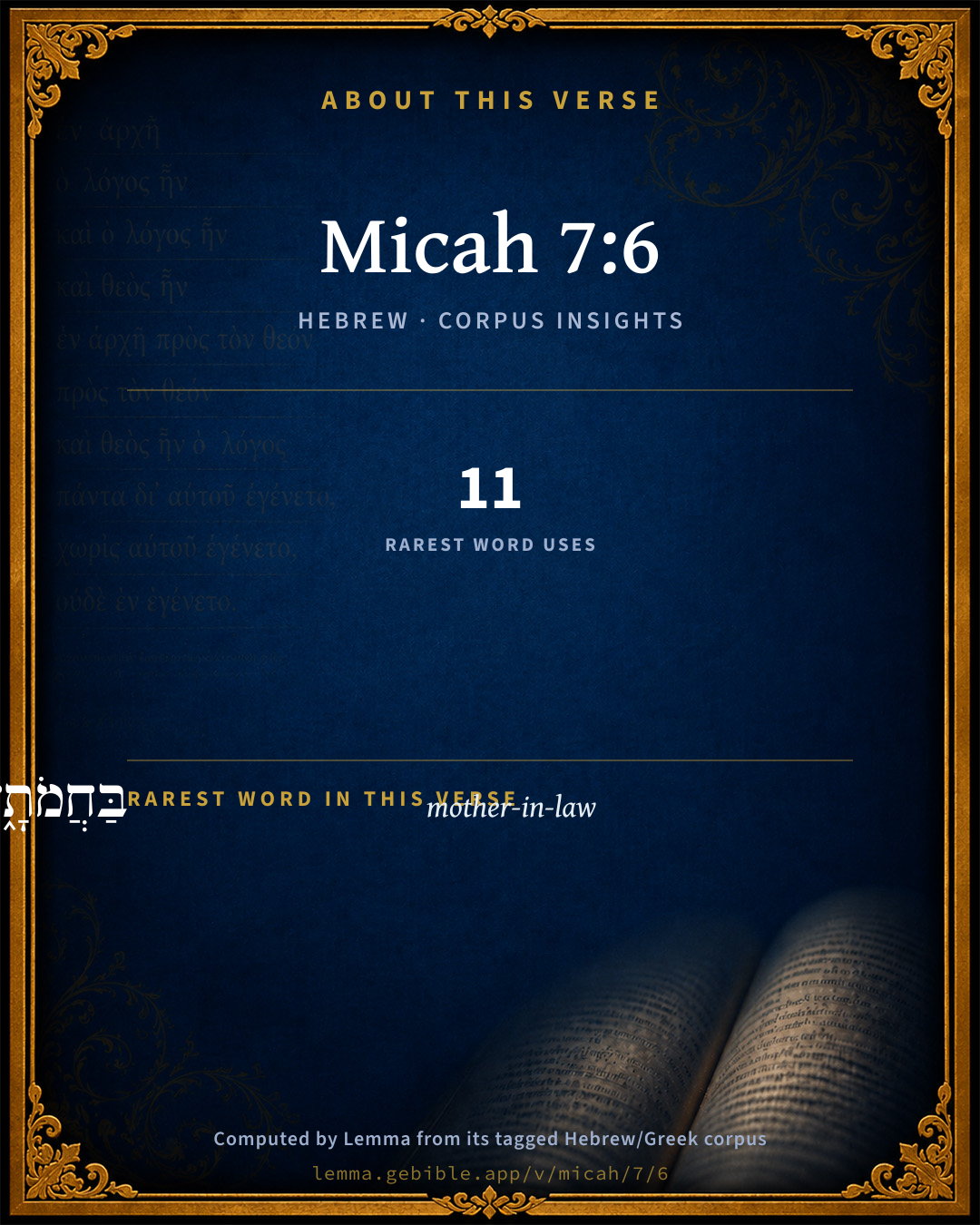
The rarest word here is בַּחֲמֹתָ֑הּ mother-in-law H2545 — appearing just 11 times in the whole Hebrew Bible.

Shared distinctive vocabulary

בַּחֲמֹתָ֑הּ mother-in-law H2545 occurs in 10 verses of the Hebrew Bible. Also found in:

Grammatical profile

  • 3 verbs
  • 9 nouns
  • 1 conjunction

Verb forms

  • מְנַבֵּ֣ל Piel · Participle Active
  • קָמָ֣ה Qal · Participle Active
  • אֹיְבֵ֥י Qal · Participle Active

Repetition

A word recurs within this verse — often emphatic in Hebrew:

  • אִ֖ישׁ man H376 ×2

Hebrew & Septuagint length

In English translation the verse runs 28 words from the Hebrew and 29 from the Septuagint (LXX English) — closely comparable.

A rough comparison of the two English renderings, which tokenize alike — not a word-level alignment.

Word counts can differ between the Hebrew and the Greek without any difference in meaning — e.g. the Hebrew direct-object marker אֵת has no separate Greek word, and Greek often adds the article ὁ.

Cross-references

21

Topical passages linked to Micah 7:6 in the Treasury of Scripture Knowledge — connected by theme and wording, ordered by reader-vote popularity; previews shown in the World English Bible.

  • Matthew 10:35–36 For I came to set a man at odds against his father, and a daughter against her mother, and a daughter-in-law against her mother-in-law.
  • Luke 12:53 They will be divided, father against son, and son against father; mother against daughter, and daughter against her mother; mother-in-law against her daughter-in-law, and daughter-in-law against her mother-in-law."
  • Matthew 10:21 "Brother will deliver up brother to death, and the father his child. Children will rise up against parents, and cause them to be put to death.
  • Psalms 41:9 Yes, my own familiar friend, in whom I trusted, Who ate bread with me, Has lifted up his heel against me.
  • Psalms 55:12–14 For it was not an enemy who insulted me, Then I could have endured it. Neither was it he who hated me who raised himself up against me, Then I would have hid myself from him.
  • Ezekiel 22:7 In you have they set light by father and mother; in the midst of you have they dealt by oppression with the foreigner; in you have they wronged the fatherless and the widow.
  • 2 Timothy 3:2–3 For men will be lovers of self, lovers of money, boastful, arrogant, blasphemers, disobedient to parents, unthankful, unholy,
  • Matthew 26:23 He answered, "He who dipped his hand with me in the dish, the same will betray me.
  • Matthew 26:49–50 Immediately he came to Jesus, and said, "Hail, Rabbi!" and kissed him.
  • Luke 21:16 You will be handed over even by parents, brothers, relatives, and friends. Some of you they will cause to be put to death.
  • Proverbs 30:11 There is a generation that curses their father, And doesn't bless their mother.
  • Jeremiah 12:6 For even your brothers, and the house of your father, even they have dealt treacherously with you; even they have cried aloud after you: don't believe them, though they speak beautiful words to you.
  • Obadiah 1:7 All the men of your alliance have brought you on your way, even to the border. The men who were at peace with you have deceived you, and prevailed against you. Friends who eat your bread lay a snare under you. There is no understanding in him.
  • John 13:18 I don't speak concerning all of you. I know whom I have chosen. But that the Scripture may be fulfilled, 'He who eats bread with me has lifted up his heel against me.'
  • Genesis 9:22–24 Ham, the father of Canaan, saw the nakedness of his father, and told his two brothers outside.
  • 2 Samuel 16:21–23 Ahithophel said to Absalom, Go in to your father's concubines, that he has left to keep the house; and all Israel will hear that you are abhorred of your father: then will the hands of all who are with you be strong.
  • Genesis 49:4 Boiling over as water, you shall not have the pre-eminence; Because you went up to your father's bed; Then defiled it. He went up to my couch.
  • 2 Samuel 15:10–12 But Absalom sent spies throughout all the tribes of Israel, saying, As soon as you hear the sound of the trumpet, then you shall say, Absalom is king in Hebron.
  • 2 Samuel 16:11 David said to Abishai, and to all his servants, Behold, my son, who came forth from my bowels, seeks my life: how much more [may] this Benjamite now [do it]? let him alone, and let him curse; for Yahweh has invited him.
  • Proverbs 30:17 The eye that mocks at his father, And scorns obedience to his mother: The ravens of the valley shall pick it out, The young eagles shall eat it.
  • Jeremiah 20:10 For I have heard the defaming of many, terror on every side. Denounce, and we will denounce him, [say] all my familiar friends, those who watch for my fall; peradventure he will be persuaded, and we shall prevail against him, and we shall take our revenge on him.

Cross-references courtesy of OpenBible.info (CC BY 4.0).

Hebrew and Greek witnesses Masoretic Hebrew ↔ Greek Septuagint

The same verse in the two great witnesses to the Old Testament, shown verse-for-verse.

These are two independent witnesses, not word-aligned to each other, and the Septuagint is shown in lemma (dictionary) form.

Hebrew Micah 7:6 Masoretic · Westminster Leningrad Codex

כִּֽי בֵן֙ מְנַבֵּ֣ל אָ֔ב בַּ֚ת קָמָ֣ה בְאִמָּ֔הּ כַּלָּ֖ה בַּחֲמֹתָ֑הּ אֹיְבֵ֥י אִ֖ישׁ אַנְשֵׁ֥י בֵיתֽוֹ

For the son dishonors the father, The daughter rises up against her mother, The daughter-in-law against her mother-in-law; A man's enemies are the men of his own house.

World English Bible · Public Domain

Greek LXX Micah 7:6 Septuagint · lemma form

διότι υἱός ἀτιμάζω πατήρ θυγάτηρ ἐπι ἀναἵστημι ἐπί ὁ μήτηρ αὐτός νύμφη ἐπί ὁ πενθερά αὐτός ἐχθρός ἀνήρ πᾶς ὁ ἀνήρ ὁ ἐν ὁ οἶκος αὐτός

For the son dishonors his father, the daughter will rise up against her mother, the daughter-in-law against her mother-in-law: those in his house shall be all a man's enemies.

LXX2012 (modern English Septuagint) · Public Domain

On this verse, The Pulpit Commentary discusses the Septuagint’s reading. Read the note in Commentary ↓

Hebrew: Westminster Leningrad Codex (CC BY 4.0). Greek: Septuagint (public domain); English from LXX2012 (modern English Septuagint) (Public Domain). How the Septuagint differs from the Hebrew →

Targum (Aramaic paraphrase)

1

The Targum is the ancient Jewish Aramaic paraphrase of the Hebrew Scriptures — an interpretive translation, not the Hebrew text itself. Onkelos (literal) and Pseudo-Jonathan (expansive) render the Torah, and Jonathan the Prophets. Coverage is partial: where no permissively-licensed English translation exists for a verse, only the Aramaic is shown. This is verse-level text, not a word-by-word alignment to the Hebrew.

  1. Targum Jonathan Prophets (Joshua–Malachi)
    אֲרֵי בְרָא מְנַבֵּל אַבָּא בְּרַתָּא מְנַצְיָא עִם אִמָהּ כַּלְתָא מְקִילָא בַּחֲמָתָהּ סָנְאוֹהִי דְגַבְרָא אֱנָשֵׁי בֵיתֵיהּ:

    (no public-domain English translation for this verse)

    Targum Jonathan — Aramaic: “Mikraot Gedolot” (public domain). English: “Sefaria Community Translation” (CC0 1.0 (public-domain dedication)); “London "Chaldee Paraphrase," 1871” (public domain). Text via Sefaria.

Commentary

Notes on Micah 7:6 from classic Christian and Jewish commentators (each source and its license shown beneath its notes). The classic Christian expositions comment on the surrounding passage and are grouped to its opening verse, so a note may address several verses; the Jewish commentaries on the Tanakh (Rashi and others) are per-verse, so they appear only where the commentator wrote on this verse.

Lemma curates 59 commentaries, every one of them public domain or Creative Commons licensed, each selected and text-cleaned for this edition rather than reprinted as found. About our sources →

Trapp's Complete Commentary

John Trapp

Mic 7:6 For the son dishonoureth the father, the daughter riseth up against her mother, the daughter in law against her mother in law; a man’s enemies [are] the men of his own house.

Ver. 6. For the son dishonoureth the father] Or, revileth the father (Menabbel), be-Nabals him, beknaves him (of Nabal comes Nebulo), turpitudine afficit, bepastles him, vilifleth him. This is monstrous wickedness, Mal 1:6, and a sure sign the devil hath set his limbs in a man that is thus unnatural, fierce, traitorous, heady, high-minded; which yet is foretold of these dregs of time, these last and worst days, both by our Saviour, Mat 10:21; Mat 10:35-36, and likewise by St Paul, 2Ti 3:3-4. Such a son was he who, when his father complained that never father had so undutiful a child as he had: Yes, said his son (with less grace than wit), my grandfather had. Such a son was Ham, and Absalom, and Amida, son of Muleasses, King of Tunis, who cast his father out of his kingdom, and put out his eyes; and Henry, eldest son to our Henry II, who rebelled against his father, and died before him of a fever and a flux, with excoriation of the bowels; and, lastly, Adolphus Egmondanus, who imprisoned his own father six years for no other cause but for living so long, and keeping him from the dukedom of Guelderland.

The daughter riseth up against her mother] As Mr Fox mentioneth some that witnessed against their own parents here in Queen Mary’s days, and were a means of their martyrdom.

A man’s enemies are the men of his own house] See Mat 10:36. {See Trapp on "Mat 10:36"} Take our Saviour’s counsel there; "Be ye wise as serpents, innocent as doves"; but beware of men, yea, of the men of your own house.

“ Fide Deo soli: mortali fidito nulli:

Fallunt mortales: fullere Iova nequit. ”

John Trapp, A Commentary or Exposition upon All the Books of the Old and New Testament (1647–1656) — public domain. Text from a community e-Sword module.

Jamieson, Fausset & Brown

Robert Jamieson, A. R. Fausset & David Brown

son dishonoureth the father--The state of unnatural lawlessness in all relations of life is here described which is to characterize the last times, before Messiah comes to punish the ungodly and save Israel (compare Luk 21:16; Ti2 3:1-3).

Jamieson, Fausset & Brown — Commentary Critical and Explanatory on the Whole Bible (1871) — public domain (CC PDM 1.0). Text via the HelloAO Bible API.

Adam Clarke's Commentary

Verse 6. For the son dishonoureth the father] See the use our Lord has made of these words, where he quotes them, Mt 10:21; Mt 10:25; Mt 10:36, and the notes there.

Adam Clarke's Commentary on the Bible (1810–1826) — public domain. Text from a community e-Sword/MySword module.

The Cambridge Bible for Schools and Colleges

gen. ed. J. J. S. Perowne

6. dishonoureth] Lit. ‘treateth as a fool.’ The same verb in the same form occurs in Deu_32:6. It is unsafe however to argue that Deuteronomy must have been already written in the time of Micah, for we also find the word in Jer_14:21, Nah_3:6.

Mic_7:7-20. Here the thread of thought is broken; the following verses appear to have been attached later. The speaker is, indeed, still the true Israel; but here she appears already overpowered by her enemies, whereas in Mic_7:1-6 the day of chastisement was still far off. Here, accordingly, consolation is the chief object of the prophetic writer; in the earlier passage, he had to warn his people of the still future calamity. In its tone this section reminds us of the Book of Israel’s Consolation which follows on chap. 37 of the Book of Isaiah.

The Cambridge Bible for Schools and Colleges (gen. ed. J. J. S. Perowne; Cambridge University Press, 1878–1918) — public domain. Text from a community e-Sword module.

John Gill's Exposition

For the son dishonoureth the father,.... Speaks contemptibly of him; behaves rudely towards him; shows him no respect and reverence; exposes his failings, and makes him the object of his banter and ridicule; who ought to have honoured, reverenced, and obeyed him, being the instrument of his being, by whom he was brought up, fed, clothed, and provided for; base ingratitude!

the daughter riseth up against her mother; by whom she has been used in the most tender and affectionate manner; this being still more unnatural, if possible, as being done by the female sex, usually more soft and pliable; but here, losing her natural affection, and forgetting both her relation and sex, replies to her mother, giving ill language; opposes and disobeys her, chides, wrangles, and scolds, and strives and litigates with her, as the Targum: or rises up as a witness against her, to her detriment, if not to the taking away of her life:

the daughter in law against her mother in law; this is not so much to be wondered at as, the former instances, which serve to encourage and embolden those that are in such a relation to speak pertly and saucily; to reproach and make, light of mothers in law, as the Targum; or slight and abuse them:

a man's enemies are the men of his own house; his sons and his servants, who should honour his person, defend his property, and promote his interest; but, instead of that, do everything that is injurious to him. These words are referred to by Christ, and used by him to describe the times in which he lived, Mat 10:35; and the prophet may be thought to have an eye to the same, while he is settling forth the badness of his own times; and the Jews seem to think be had a regard to them, since they say (y), that, when the Messiah comes, "the son shall dishonour his father", &c. plainly having this passage in view; and the; whole agrees with the times of Christ, in which there were few good men; it was a wicked age, an adulterous generation of men, he lived among; great corruption there was in princes, priests, and people; in the civil and ecclesiastical rulers, and in all ranks and degrees of men; and he that ate bread with Christ, even Judas, lifted up his heel against him. The times in which Micah the prophet here speaks of seem to he the times of Ahaz, who was a wicked prince; and the former part of Hezekiah's reign, before a reformation was started, or at least brought about, in whose reigns he prophesied; though some have thought he here predicts the sad times in the reign of Manasseh, which is not so probable.

(y) Misn. Sotah, c. 9. sect. 15.

John Gill's Exposition of the Whole Bible (1746–1763) — public domain (CC PDM 1.0). Text via the HelloAO Bible API.

Matthew Poole's English Annotations

For: the prophet here gives us a reason of his advice to be wary how and whom they trust.

The son; who received his being, maintenance, education, and inherits the honour as well as estate of his father; the son, obliged by most inviolable laws to please, preserve, and honour his father,

dishonoureth, seeks to accuse, vilify, endanger, and ruin

the father; whose dishonour and loss, or ruin, is also the son’s dishonour and ruin; yet unnatural treachery will be so rife in those times, that the father had need keep his guard upon his very son.

The daughter, whose love and affection are usually more tender than the sons’ towards parents, yet will forget their duty.

Riseth up against her mother, that bare them, that nursed them, that, more than fathers, tend, indulge, and bear with them. So monstrous shall the perfidiousness of that age be.

The daughter-in-law against her mother-in-law: in consanguinity there was not any faithfulness, in affinity much less may you expect it.

A man’s enemies, the worst and most perilous enemies, who will be most ready and most able to do them mischief,

are the men of his own house; among relations and retainers, who by law of God and nature should have been faithfullest friends. So it fell out through the civil wars of the Jews, in their seditious and in their calamitous days. Much like to this is that of Christ, Mat 10:21,35,36.

Matthew Poole's English Annotations on the Holy Bible (1683–1685) — public domain. Text from a community e-Sword/MySword module.

The Pulpit Commentary

For the son dishonoureth; Septuagint, atimazei : Vulgate, contumeliam facit; literally, treats as a fool, despises. (Deu_32:6, Deu_32:15) (For the rest of the verse, see Mat_10:21, Mat_10:35, etc.) Men of his own house. His domestic servants. (Gen_17:27) Henderson, referring to this dissolution of every natural tie, compares Ovid, "Metamorph.," 1:144, etc. "Vivitur ex rapto; non hospes ab hespite tutus, Non socer a genero; fratrum quoque gratia rara est; Imminet exitio vir conjugis, illa mariti; Lurida terribiles miscent aconita novercae; Filius ante diem patrios iuquirit in annos; Victa jacet pietas.

The Pulpit Commentary (1880–1919), ed. H.D.M. Spence-Jones & Joseph S. Exell — public domain. Text from a community e-Sword module.

Lesson kit

Teaching starters — assembled from the data on this page, not authored interpretation. Every prompt links to the verse data it draws on. Edit before teaching.

Micah, in the Prophets, opens this verse with 13 words (12 distinct Hebrew lemmas). Its most distinctive word is chămôwth (“mother-in-law”). A historical commentator’s framing appears above. Read the whole chapter for the surrounding context.

Discussion questions

  1. The word chămôwth carries the sense “mother-in-law.” How does it shape the verse?
  2. How does Ruth 1:14, which shares the word «mother-in-law», read alongside this verse?
  3. What does the repetition of “man” (2× in this one verse) do in this verse?
  4. These translations render this verse differently. What is at stake in choosing one wording over another?
  5. «מְנַבֵּ֣ל» is a Piel Participle Active verb. How does that grammatical form shape the action described?
  6. Compare how Trapp's Complete Commentary and Jamieson, Fausset & Brown read this verse. Where do they agree or differ?

Things to notice

Reading settings

Reading text

Shown beneath each verse's original-language words.

Old Testament
Old Testament edition

Read the OT as the Masoretic Hebrew (MT) or the Greek Septuagint (LXX).

English shown for the Greek Septuagint (in the Hebrew ↔ Greek comparison).

Comparing translations? Open the Compare panel on any verse page to stack up to four side by side.