
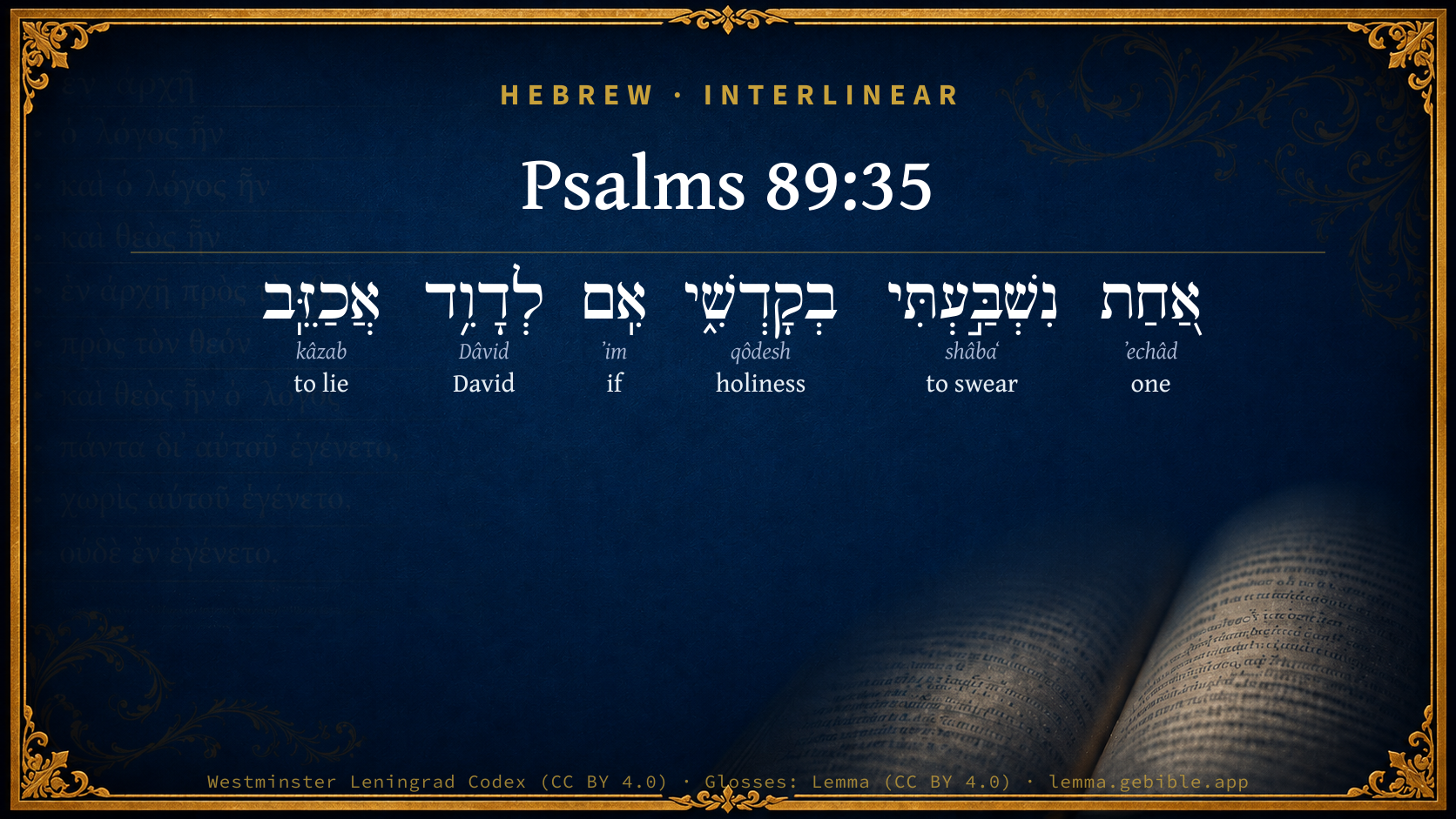
Psalms 89:35

Hebrew (Westminster Leningrad Codex) Psalms 89:35 appears in the Hebrew Old Testament. The text above is from the Westminster Leningrad Codex. Each word links to its Strong’s number, a concise gloss, and parsing drawn from the Open Scriptures Hebrew Bible morphology. Click any word for its full Brown-Driver-Briggs (BDB) entry.
Download image
Cite this verse

Psalms 89:35 (World English Bible). Public Domain. Lemma interlinear Bible study tool, https://lemma.gebible.app/v/psalms/89/35.

Show BibTeX & RIS
BibTeX
RIS
English Translation
Once have I sworn by my holiness, I will not lie to David.
World English Bible · Public Domain
Download a study sheet

One document with this verse’s original text, its word-by-word gloss line, the meaning frame, cross-references with their text, attributed commentary, and full source and license credits — printable, and it pastes into notes with its structure intact.

This verse Autodidact and up

Study sheet (.html) Plain text (.txt)

A passage Seminary Student

Up to 50 verses in one chapter. A passage sheet keeps up to 6 commentary sources and 12 cross-references per verse, in the order this page ranks them, and says so on the sheet whenever that leaves anything out. Ask for a single verse and you get the Autodidact verse sheet above.

Everything on this page stays free to read, with no account — the sheet is a download of what is already on screen, not access to it.

Want to remove ads? Support Godless Engineer
Compare translations 3

The same verse in 3 English versions, stacked beneath the original-language interlinear above. Click any original word for its lexicon entry.

Each is an independent rendering of the whole verse — the interlinear is not word-aligned to these translations.

Highlighted words mark where these versions differ — a whole-verse word diff, not a word-by-word alignment.

  • World English Bible Public Domain
    Once have I sworn by my holiness, I will not lie to David.
  • King James Version Public Domain
    Once have I sworn by my holiness that I will not lie unto David.
  • unfoldingWord Literal Text CC BY-SA 4.0
    Once I have sworn by my holiness, ‘If I should lie to David!

unfoldingWord Literal Text — © unfoldingWord, licensed CC BY-SA 4.0. Word-aligned USFM3 via Door43 (git.door43.org/unfoldingWord/en_ult).

Versions to compare (up to 4)

3 of 4 selected

Show all 18 translations

Every available English version of this verse, each an independent rendering of the whole verse.

  • World English Bible Public Domain
    Once have I sworn by my holiness, I will not lie to David.
  • Berean Standard Bible Public Domain
    Once and for all I have sworn by My holiness—I will not lie to David—
  • Majority Standard Bible Public Domain
    Once and for all I have sworn by My holiness—I will not lie to David—
  • King James Version Public Domain
    Once have I sworn by my holiness that I will not lie unto David.
  • American Standard Version (1901) Public Domain
    Once have I sworn by my holiness: I will not lie unto David:
  • Revised Version (1885) Public Domain
    Once have I sworn by my holiness; I will not lie unto David;
  • Geneva Bible (1599) Public Domain
    I haue sworne once by mine holines, that I will not fayle Dauid, saying,
  • Douay-Rheims (1899) Public Domain
    Neither will I profane my covenant: and the words that proceed from my mouth I will not make void.
  • Young's Literal Translation Public Domain
    Once I have sworn by My holiness, I lie not to David,
  • Literal Standard Version CC BY-SA 4.0
    Once I have sworn by My holiness, || I do not lie to David,
  • Unlocked Literal Bible CC BY-SA 4.0
    Once and for all I have sworn by my holiness— I will not lie to David:
  • unfoldingWord Literal Text CC BY-SA 4.0
    Once I have sworn by my holiness, ‘If I should lie to David!
  • Darby Bible Public Domain
    Once have I sworn by my holiness; I will not lie unto David:
  • World Messianic Bible Public Domain
    Once I have sworn by my holiness, I will not lie to David.
  • Webster's Bible Public Domain
    \\89:34\\My covenant will I not break, nor alter the thing that hath gone out of my lips.
  • Free Bible Version CC BY-SA 4.0
    By my holy character I have made a vow to David that I will not lie to him.
  • Bible in Basic English Public Domain
    I have made an oath once by my holy name, that I will not be false to David.
  • JPS Tanakh (1917) Public Domain
    (89-36) Once have I sworn by My holiness: Surely I will not be false unto David;

Literal Standard Version (2020), Covenant Press — licensed CC BY-SA 4.0. Text via the HelloAO Bible API (eBible.org). Unlocked Literal Bible (unfoldingWord) — licensed CC BY-SA 4.0. Text via the HelloAO Bible API (eBible.org). unfoldingWord Literal Text — © unfoldingWord, licensed CC BY-SA 4.0. Word-aligned USFM3 via Door43 (git.door43.org/unfoldingWord/en_ult). Free Bible Version, Dr. Jonathan Gallagher — licensed CC BY-SA 4.0. Text via the HelloAO Bible API (eBible.org).

Word by word

More ways to search: Search by grammar → Find every occurrence → Compare this word →

Practice this passage: Drill this verse → Learn its vocabulary →

About this verse

These counts appear in no published source. They are computed here, from the morphology-tagged text and Lemma’s own curated glosses. What Lemma adds →

6
words
6
distinct lemmas
Wisdom
section

Notable vocabulary

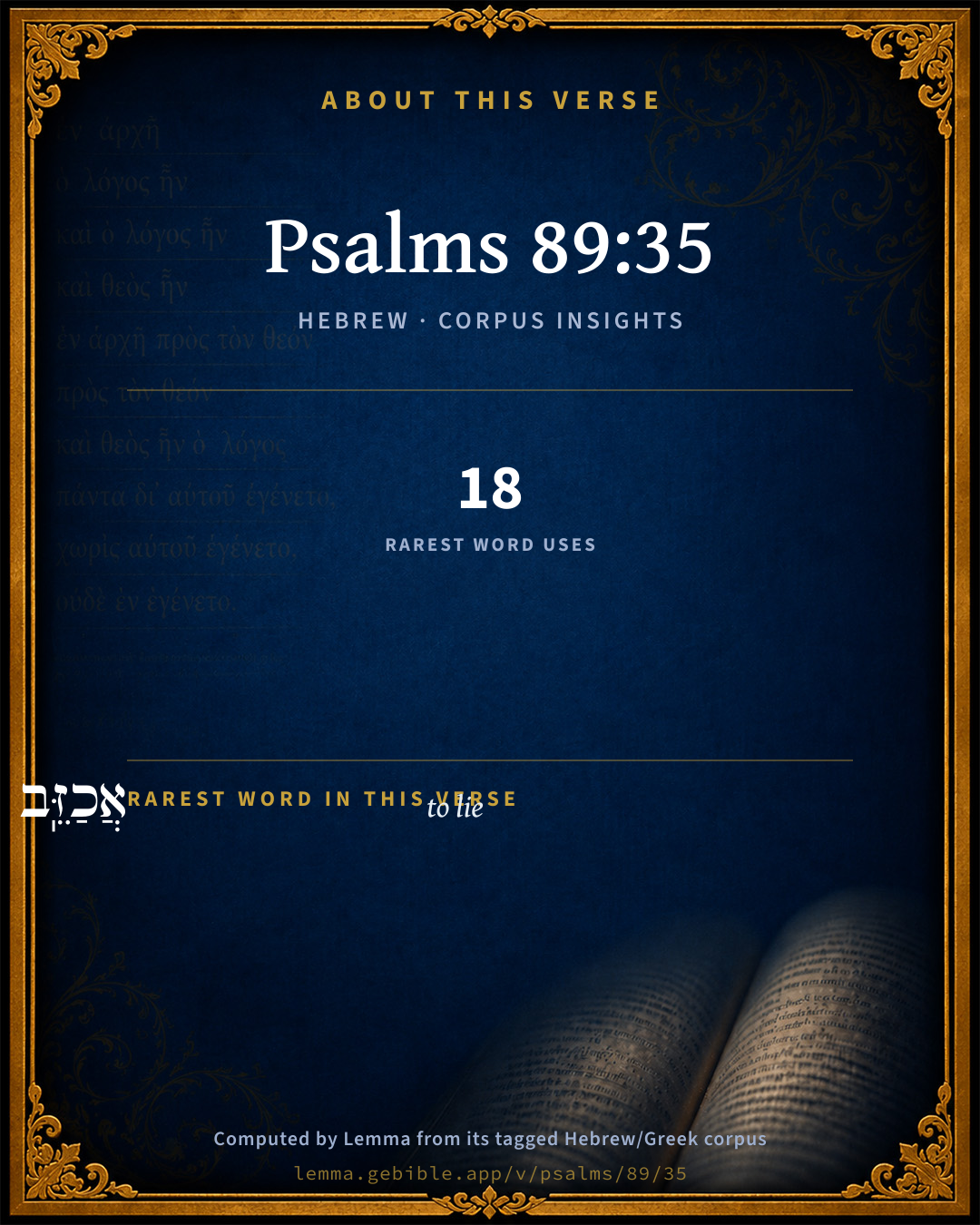
The rarest word here is אֲכַזֵּֽב to lie H3576 — appearing just 18 times in the whole Hebrew Bible.

Shared distinctive vocabulary

אֲכַזֵּֽב to lie H3576 occurs in 18 verses of the Hebrew Bible. Also found in:

Grammatical profile

  • 2 verbs
  • 2 nouns
  • 1 adjective
  • 1 conjunction

Verb forms

  • נִשְׁבַּ֣עְתִּי Niphal · Perfect
  • אֲכַזֵּֽב Piel · Imperfect

Hebrew & Septuagint length

In English translation the verse runs 13 words from the Hebrew and 14 from the Septuagint (LXX English) — closely comparable.

A rough comparison of the two English renderings, which tokenize alike — not a word-level alignment.

Word counts can differ between the Hebrew and the Greek without any difference in meaning — e.g. the Hebrew direct-object marker אֵת has no separate Greek word, and Greek often adds the article ὁ.

Cross-references

8

Topical passages linked to Psalms 89:35 in the Treasury of Scripture Knowledge — connected by theme and wording, ordered by reader-vote popularity; previews shown in the World English Bible.

  • Psalms 132:11 Yahweh has sworn to David in truth. He will not turn from it: "I will set the fruit of your body on your throne.
  • Titus 1:2 in hope of eternal life, which God, who can't lie, promised before eternal times;
  • Hebrews 6:13 For when God made a promise to Abraham, since he could swear by none greater, he swore by himself,
  • Hebrews 6:17 In this way God, being determined to show more abundantly to the heirs of the promise the immutability of his counsel, interposed with an oath;
  • Psalms 110:4 Yahweh has sworn, and will not change his mind: "You are a priest forever in the order of Melchizedek."
  • Amos 4:2 The Lord Yahweh has sworn by his holiness that behold, "The days shall come on you that they will take you away with hooks, And the last of you with fish hooks.
  • Amos 8:7 Yahweh has sworn by the pride of Jacob, "Surely I will never forget any of their works.
  • 2 Thessalonians 2:13 But we are bound to always give thanks to God for you, brothers loved by the Lord, because God chose you from the beginning for salvation through sanctification of the Spirit and belief in the truth;

Cross-references courtesy of OpenBible.info (CC BY 4.0).

Hebrew and Greek witnesses Masoretic Hebrew ↔ Greek Septuagint

The same verse in the two great witnesses to the Old Testament, shown verse-for-verse.

You’re reading Greek Psalm 88 (Hebrew Psalm 89). The Septuagint counts the superscription, so verse numbers can differ from the Hebrew — chapter-level alignment, not verse-by-verse. Numbering follows Rahlfs.

These are two independent witnesses, not word-aligned to each other, and the Septuagint is shown in lemma (dictionary) form.

Hebrew Psalms 89:35 Masoretic · Westminster Leningrad Codex

אַ֭חַת נִשְׁבַּ֣עְתִּי בְקָדְשִׁ֑י אִֽם לְדָוִ֥ד אֲכַזֵּֽב

Once have I sworn by my holiness, I will not lie to David.

World English Bible · Public Domain

Greek LXX Greek Psalm 88:35 Septuagint · lemma form

οὐδέ μή βεβηλόω ὁ διαθήκη ἐγώ καί ὁ ἐκπορεύομαι διά ὁ χεῖλος ἐγώ οὐ μή ἀθετέω

Once have I sworn by my holiness, that I will not lie to David.

LXX2012 (modern English Septuagint) · Public Domain

On this verse, The Cambridge Bible for Schools and Colleges discusses the Septuagint’s reading. Read the note in Commentary ↓

Hebrew: Westminster Leningrad Codex (CC BY 4.0). Greek: Septuagint (public domain); English from LXX2012 (modern English Septuagint) (Public Domain). How the Septuagint differs from the Hebrew →

Commentary

Notes on Psalms 89:35 from classic Christian and Jewish commentators (each source and its license shown beneath its notes). The classic Christian expositions comment on the surrounding passage and are grouped to its opening verse, so a note may address several verses; the Jewish commentaries on the Tanakh (Rashi and others) are per-verse, so they appear only where the commentator wrote on this verse.

Lemma curates 59 commentaries, every one of them public domain or Creative Commons licensed, each selected and text-cleaned for this edition rather than reprinted as found. About our sources →

Trapp's Complete Commentary

John Trapp

Psa 89:35 Once have I sworn by my holiness that I will not lie unto David.

Ver. 35. Once have I sworn by mine holiness] Which is as deep an oath as I know how to take; for my holiness is myself, who am most holy, and the fountain of all holiness. By this I have sworn once, that is, once for all, immobiliter, immutabiliter.

John Trapp, A Commentary or Exposition upon All the Books of the Old and New Testament (1647–1656) — public domain. Text from a community e-Sword module.

Joseph Benson's Commentary

Psa 89:35. Once have I sworn by my holiness, &c. — Here he assigns some reasons why he would not break his covenant with David, though he should have just cause so to do, and though he had, upon such just cause, broken his covenant made with others; 1st, Because this covenant was confirmed by his oath, which added, not only more solemnity, but more stability and certainty to it, according to the apostle’s reasoning, Heb 6:13-18, whereby he shows that God added an oath to his promise made to Abraham, to make and prove it to be immutable; and Heb 7:20, &c., where he proves the priesthood of Melchisedek to be unchangeable, because it was confirmed by an oath. And although judgments, simply threatened, have not always been executed, but sometimes prevented; yet those comminations, which were confirmed by oath, were thereby rendered and declared to be irrevocable, as we see Num 14:28-30; Jer 44:26. 2d, Because God sware by his holiness; in or by which he is but seldom said to speak or swear, and when he is, it constantly adds more weight and confirmation to what is declared, as Psa 60:6; Psa 108:7; Amo 4:2.

Joseph Benson's Commentary on the Old and New Testaments (1811–1818) — public domain. Text from a community e-Sword module.

J. A. Alexander on Psalms

Joseph Addison Alexander

36. (Psa 89:35) One (thing) have I sworn in my holiness, I will not lie unto David. The first word in Hebrew is not an adverb of time, but a numeral adjective in the feminine form, used as the neuter is in Greek and Latin. See above, on Psa 27:4. "Whatever else may fail, there is one thing that cannot, for I have sworn that it shall come to pass." In my holiness, as a holy God, including all divine perfection, but with special reference to moral rectitude. See above, on Psa 60:6. The last verb might be rendered, I cannot lie. See Num 23:19, 1Sa 15:29, and compare Heb 6:18; Heb 7:20-21. The form of the original is highly idiomatic, if I lie unto David. Compare the Hebrew of 1Sa 24:6, 2Sa 3:35.

Joseph Addison Alexander, The Psalms Translated and Explained (1850) — public domain. Text from a community e-Sword module.

Tyndale Open Study Notes

Tyndale Open Resources

89:35 holiness: The Lord is wholly distinct from the created order (22:3); his character is totally pure. He does as he pleases (115:3), and he chooses to be faithful (89:1; 115:1); therefore, he cannot lie.

Tyndale Open Study Notes — © Tyndale Open Resources, licensed CC BY-SA 4.0. Text via the HelloAO Bible API.

Geneva Bible (1599)

Geneva Bible translators

Hebrew, If I lie unto David, which is a manner of oath.

Geneva Bible (1599) marginal notes — public domain. Text via Bolls.life.

Adam Clarke's Commentary

Verse 35. Once have I sworn] I have made one determination on this head, and have bound myself by my holiness; it is impossible that I should change, and there needs no second oath, the one already made is of endless obligation.

Adam Clarke's Commentary on the Bible (1810–1826) — public domain. Text from a community e-Sword/MySword module.

John Calvin's Commentaries

35. Once have I sworn by my holiness. God now confirms by an oath what he previously stated he had promised to David; from which it appears that it was not a matter of small importance; it being certain that God would not interpose his holy name in reference to what was of no consequence. It is a token of singular loving-kindness for him, upon seeing us prone to distrust, to provide a remedy for it so compassionately. We have, therefore, so much the less excuse if we do not embrace, with true and unwavering faith, his promise which is so strongly ratified, since in his deep interest about our salvation, he does not withhold his oath, that we may yield entire credence to his word. If we do not reckon his simple promise sufficient, he adds his oath, as it were, for a pledge. The adverb once, denotes that the oath is irrevocable, and that therefore we have not the least reason to be apprehensive of any inconstancy. He affirms that he sware by his holiness, because a greater than himself is not to be found, by whom he could swear. In swearing by Him, we constitute him our judge, and place him as sovereign over us, even as he is our sovereign by nature. It is a more emphatic manner of expression for him to say, by my holiness, than if he had said, by myself, not only because it magnifies and exalts his glory, but also because it is far more fitted for the confirmation of faith, calling back, as it does, the faithful to the earthly habitation which he had chosen for himself, that they might not think it necessary for them to seek him at a distance; for by the term holiness, I have no doubt, he means the sanctuary. And yet he swears by himself, and by nothing else; for, in naming the temple which he had appointed as his seat, he does not depart from himself; but, merely accommodating his language to our rude understandings, swears by his holiness which dwells visibly upon earth. With respect to the elliptical form of the oath, we have seen, in a previous psalm, that this was a manner of swearing quite common among the Hebrews. Thus they were warned that the name of God was not to be used without due consideration, lest, by using it rashly and irreverently, they should draw down upon themselves the Divine vengeance. The abrupt and suspended form of expression was, as it were, a bridle to restrain them, and give them opportunity for reflection. It is no uncommon thing for God to borrow something from the common custom of men.

John Calvin's Commentaries (1540-1563) — public domain. Text from the Calvin Translation Society English edition (1840s-50s) via the Christian Classics Ethereal Library (ccel.org). Calvin's coverage is partial (roughly two-thirds of the Bible); uncommented books and verses are honest gaps, never fabricated. The 19th-century editor's footnotes and remarks are omitted so the notes are faithfully Calvin's own voice.

The Cambridge Bible for Schools and Colleges

gen. ed. J. J. S. Perowne

35. Once] Once for all (LXX ἅπαξ, Vulg. semel): or, one thing.

have I sworn] Cp. Psa_89:3. by my holiness] See note on Psa_60:6.

that I will not lie] R.V. omits that, and makes this clause parallel to, not dependent on, the preceding line.

35–37. The irreversible nature of a promise confirmed by God’s oath.

The Cambridge Bible for Schools and Colleges (gen. ed. J. J. S. Perowne; Cambridge University Press, 1878–1918) — public domain. Text from a community e-Sword module.

John Gill's Exposition

His seed shall endure for ever,.... This is a confirmation by his oath of what he had before said, Psa 89:29 which may be understood either of the perseverance of particular believers, of everyone of the spiritual seed of Christ; or of the duration of the church in general, throughout all ages, as before observed; and these being matters of moment and importance, and of which there are sometimes doubts in the minds of the Lord's people about them, and that they may be firmly believed by them, he confirms them with an oath; for God never swears to trivial things; and when he does swear, it is to remove the doubts of his people, and make their minds easy:

and his throne as the sun before me; that is, shall continue as long as it does; see Psa 89:29, or shall be bright, splendid, and glorious as the sun, so the Targum,

"and his throne light as the sun before me;''

meaning his church and kingdom, of which the throne is an emblem, and which became so in Gospel times, clear and lucid as the sun, Sol 6:10, when day was made by the rising of the sun of righteousness, and by the bright shining of the Gospel ministry; and at particular periods since, as in the times of Constantine, when the church was clothed with the sun, and at the Reformation, when Christ appeared with a rainbow on his head, and his face was as the sun, Rev 12:1 and especially this will be the case of the church in the latter day, when the light of the moon will be as the light of the sun, and the light of the sun seven fold, as the light of seven days; and when the city, the church, will stand in no need of the sun, nor of the moon; and also in the ultimate glory, when the saints will shine as the sun in the kingdom of God; see Isa 30:26. This passage is applied to the Messiah by the Jews (a).

(a) Zohar in Gen. fol. 30. 1.

John Gill's Exposition of the Whole Bible (1746–1763) — public domain (CC PDM 1.0). Text via the HelloAO Bible API.

Albert Barnes' Notes on the Bible

Once have I sworn by my holiness - That is, once for all; - a single oath - an oath once taken by me - makes it certain. To swear by his “holiness” is to pledge his own holy nature; to make it as certain as that he is holy; to stake the whole question of his holiness on that. That is, If this should not be accomplished - if he should fail in this - it would prove that he was not a holy God.

That I will not lie unto David - Margin, as in Hebrew, “if I lie.” The meaning is, He would be found faithful to the promise. See Psa 89:3-4; compare 2Sa 7:8-16.

Albert Barnes' Notes on the Bible (1834–1885) — public domain. Text from a community e-Sword/MySword module.

Matthew Poole's English Annotations

Here he gives some reasons why he would not break his covenant with David, though he should have just cause to do so, and though he had upon such just cause broke his covenant made with others; first, Because this covenant was confirmed by his oath, which adds not only more solemnity, but more stability and certainty to it, as is evident from Heb 6:17, wherein he showeth that God addeth an oath to his promise or covenant to make and prove it to be immutable; and from Heb 7:20, &c., where he proveth the priesthood of Melchisedec to be unchangeable, because it was confirmed by an oath. And though judgments simply threatened have not always been executed, but sometimes were prevented, yet those comminations which were confirmed by oath were thereby rendered and declared to be irrevocable, as we see, Num 14:28-30; Jer 44:26. Secondly, Because this is said to be sworn

once, which word and phrase sometimes implies the completeness, certainty, and irrevocableness of the thing said or done, as Pro 28:18, shall fall at once. Thus Christ is said to have died or suffered once, Rom 6:10; Heb 9:26,28. Thirdly, Because God sware by his

holiness; in or by which God is but seldom read to speak or swear, and when he is, it constantly adds more weight and confirmation to the speech, as Psa 60:6; 108:7; Amo 4:2.

Matthew Poole's English Annotations on the Holy Bible (1683–1685) — public domain. Text from a community e-Sword/MySword module.

The Treasury of David

Charles H. Spurgeon

Ver. 35. Once have I sworn by my holiness that I will not lie unto David. Because he could swear by no greater he swore by himself, and by that peculiar attribute which is his highest glory, being the subject of threefold adoration by all the hosts of heaven. God here pledges the crown of his kingdom, the excellent beauty of his person, the essence of his nature. He does as good as say that if he ceases to be true to his covenant he will have forfeited his holy character. What more can he say? In what stronger language can he express his unalterable adherence to the truth of his promise? An oath is the end of all strife; it ought to be the end of all doubt on our part. We cannot imagine that God could lie, yet he puts it sothat if the covenant were not kept by him, he would regard it as a lie. Here is ground for strong confidence; may our faith be of such a nature as these assurances will warrant.

Ver. 35. Once have I sworn by my holiness. He lays here his holiness to pledge for the assurance of his promise, as the attribute most dear to him, most valued by him, as though no other could give an assurance parallel to it, in this concern of an everlasting redemption, which is there spoken of. He that swears, swears by a greater than himself. God having no greater than himself, swears by himself; and swearing here by his holiness seems to equal that single to all his other attributes, as if he were more concerned in the honour of it than of all the rest. It is as if he should have said, Since I have not a more excellent perfection to swear by than that of my holiness, I lay this to pawn for your security, and bind myself by that which I will never part with, were it possible for me to be stripped of all the rest. It is a tacit imprecation of himself, If I lie unto David, let me never be counted holy, or thought righteous enough to be trusted by angels or men. This attribute he makes most of. Stephen Charnock.

Psalms 89:36*

Charles H. Spurgeon's The Treasury of David (1869–1885) — public domain. Psalms only. Text from a community e-Sword/MySword module.

Whedon's Commentary on the Bible

Daniel D. Whedon

35. Sworn by my holiness—In my holiness. The most awful sanction of the covenant.

I will not lie—Comp. Heb_6:17-18

Daniel D. Whedon (gen. ed.), Commentary on the Old and New Testaments (1874–1909) — public domain. Text from a community e-Sword module.

The Pulpit Commentary

Ones have I sworn by my holiness; rather, one thing have I sworn. (On God"s oath to David, see vers. 3, 49, and Psa_132:11) The present passage shows that it was sworn "by his holinessi.e. by his absolute moral perfection. That I will not lie unto David; i.e. that I will keep all my promises to him. God, no doubt, always and in every case "keepeth his promise forever"; (Psa_146:6) but in his mercy and loving kindness he condescended to give David a special guarantee of his faithfulness in respect of the promises made to him.

The Pulpit Commentary (1880–1919), ed. H.D.M. Spence-Jones & Joseph S. Exell — public domain. Text from a community e-Sword module.

unfoldingWord translationNotes

Door43 World Missions Community

I have sworn by my holiness

Yahweh uses his holiness as the basis for his oath. This is a way of guaranteeing that he definitely do what he promises to do.

his throne as long as the sun before me

The words "will continue" are understood. AT: "his throne will continue as long as the sun before me" (See: Ellipsis)

his throne

Here "throne" represents the power to rule as king. God is promising that one of David's descendants will always be king. (See: Metonymy)

as long as the sun before me

God compares David's rule as king to the sun to emphasize that someone from David's descendants will always rule as king. (See: Simile)

It will be established forever

Here "It" stands for David's throne or power to rule as king. This can be stated in active form. AT: "I will cause it to last forever" (See: Active or Passive)

forever like the moon

God compares David's rule as king to the moon to emphasize that someone from David's descendants will always rule as king. (See: Simile)

the moon, the faithful witness in the sky

The moon is spoken of as if it were a person who witnesses God making this promise to David. AT: "the moon, which is like a faithful witness in the sky" (See: Personification)

Selah

This may be a musical term that tells people how to sing or play their instruments here. Some translations write the Hebrew word, and some translations do not include it. See how you translated this in Psalms 3:2. (See: Copy or Borrow Words)

translationWords

oath

holy

David

descend

eternity

throne

faithful

testimony

heaven

selah

unfoldingWord translationNotes — © Distant Shores Media and the Door43 World Missions Community, licensed CC BY-SA 4.0. Source: git.door43.org/Door43/en_tn.

Lesson kit

Teaching starters — assembled from the data on this page, not authored interpretation. Every prompt links to the verse data it draws on. Edit before teaching.

Psalms, in the Wisdom, opens this verse with 6 words (6 distinct Hebrew lemmas). Its most distinctive word is kâzab (“to lie”). A historical commentator’s framing appears above. Read the whole chapter for the surrounding context.

Discussion questions

  1. What does “to lie” (kâzab) contribute to the verse as a whole?
  2. How does Numbers 23:19, which shares the word «to lie», read alongside this verse?
  3. These translations render this verse differently; the difference is in the English rendering, not the original. What questions does that raise?
  4. «נִשְׁבַּ֣עְתִּי» is a Niphal Perfect verb. How does that grammatical form shape the action described?
  5. Compare how Trapp's Complete Commentary and Joseph Benson's Commentary read this verse. Where do they agree or differ?

Things to notice

Reading settings

Reading text

Shown beneath each verse's original-language words.

Old Testament
Old Testament edition

Read the OT as the Masoretic Hebrew (MT) or the Greek Septuagint (LXX).

English shown for the Greek Septuagint (in the Hebrew ↔ Greek comparison).

Comparing translations? Open the Compare panel on any verse page to stack up to four side by side.