
Ephesians 5:32

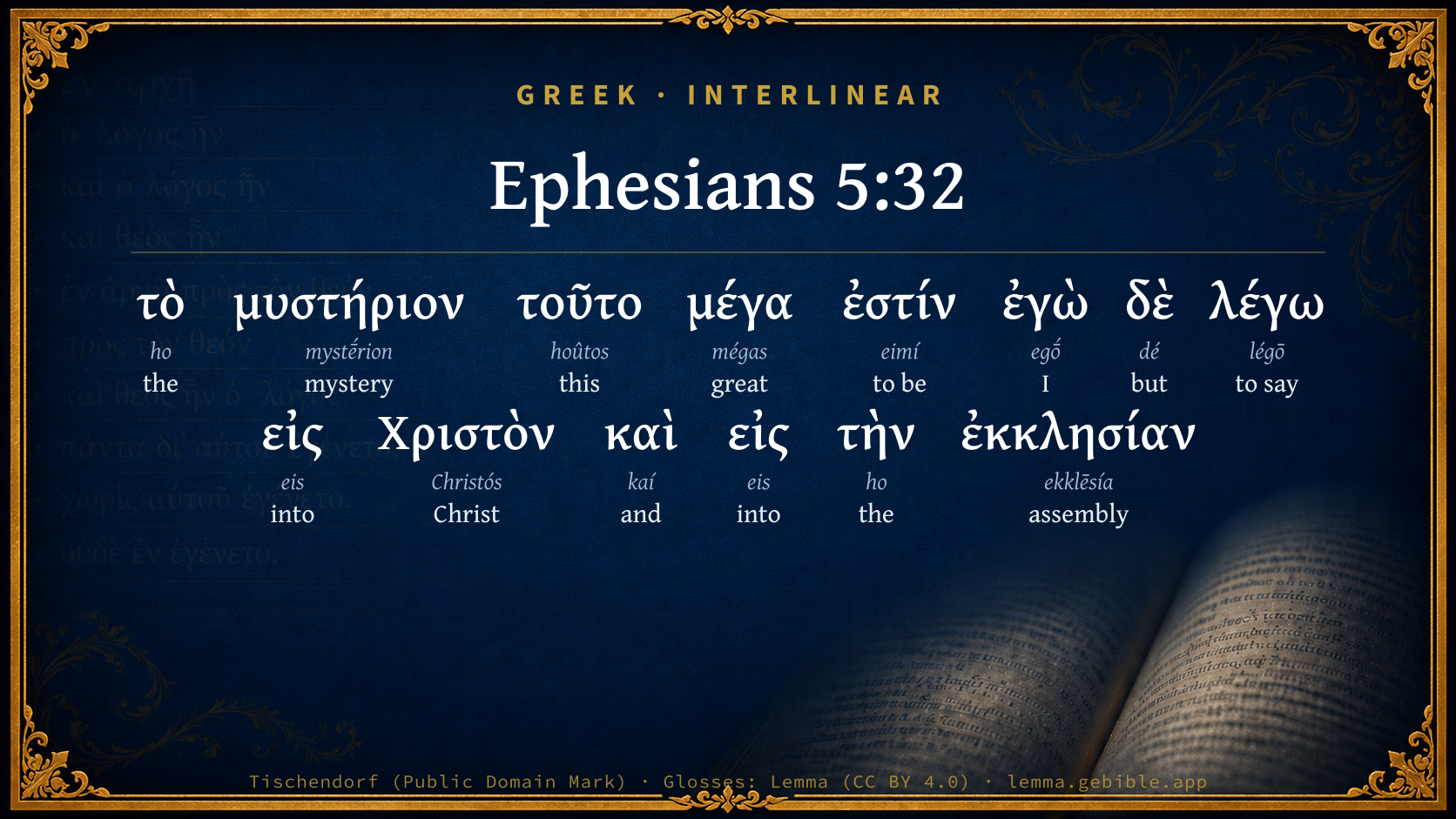
Greek (Tischendorf 8th ed.) Ephesians 5:32 appears in the Greek New Testament. The text above is from the Tischendorf 8th edition. Each word links to its Strong’s number and a concise gloss. Click any word for its full Thayer’s Greek Lexicon entry.
Download image
Cite this verse

Ephesians 5:32 (World English Bible). Public Domain. Lemma interlinear Bible study tool, https://lemma.gebible.app/v/ephesians/5/32.

Show BibTeX & RIS
BibTeX
RIS
English Translation
This mystery is great, but I speak concerning Christ and of the assembly.
World English Bible · Public Domain
Download a study sheet

One document with this verse’s original text, its word-by-word gloss line, the meaning frame, cross-references with their text, attributed commentary, and full source and license credits — printable, and it pastes into notes with its structure intact.

This verse Autodidact and up

Study sheet (.html) Plain text (.txt)

A passage Seminary Student

Up to 50 verses in one chapter. A passage sheet keeps up to 6 commentary sources and 12 cross-references per verse, in the order this page ranks them, and says so on the sheet whenever that leaves anything out. Ask for a single verse and you get the Autodidact verse sheet above.

Everything on this page stays free to read, with no account — the sheet is a download of what is already on screen, not access to it.

Want to remove ads? Support Godless Engineer
Compare translations 3

The same verse in 3 English versions, stacked beneath the original-language interlinear above. Click any original word for its lexicon entry.

Each is an independent rendering of the whole verse — the interlinear is not word-aligned to these translations.

Highlighted words mark where these versions differ — a whole-verse word diff, not a word-by-word alignment.

  • World English Bible Public Domain
    This mystery is great, but I speak concerning Christ and of the assembly.
  • King James Version Public Domain
    This is a great mystery: but I speak concerning Christ and the church.
  • unfoldingWord Literal Text CC BY-SA 4.0
    This mystery is great—but I am speaking about Christ and about the church.

unfoldingWord Literal Text — © unfoldingWord, licensed CC BY-SA 4.0. Word-aligned USFM3 via Door43 (git.door43.org/unfoldingWord/en_ult).

Versions to compare (up to 4)

3 of 4 selected

Show all 19 translations

Every available English version of this verse, each an independent rendering of the whole verse.

  • World English Bible Public Domain
    This mystery is great, but I speak concerning Christ and of the assembly.
  • Berean Standard Bible Public Domain
    This mystery is profound, but I am speaking about Christ and the church.
  • Majority Standard Bible Public Domain
    This mystery is profound, but I am speaking about Christ and the church.
  • King James Version Public Domain
    This is a great mystery: but I speak concerning Christ and the church.
  • American Standard Version (1901) Public Domain
    This mystery is great: but I speak in regard of Christ and of the church.
  • Revised Version (1885) Public Domain
    This mystery is great: but I speak in regard of Christ and of the church.
  • Geneva Bible (1599) Public Domain
    This is a great secrete, but I speake concerning Christ, and concerning the Church.
  • Douay-Rheims (1899) Public Domain
    This is a great sacrament; but I speak in Christ and in the church.
  • Young's Literal Translation Public Domain
    this secret is great, and I speak in regard to Christ and to the assembly;
  • Literal Standard Version CC BY-SA 4.0
    this secret is great, and I speak in regard to Christ and to the Assembly;
  • Unlocked Literal Bible CC BY-SA 4.0
    This hidden truth is great—but I am speaking about Christ and the church.
  • unfoldingWord Literal Text CC BY-SA 4.0
    This mystery is great—but I am speaking about Christ and about the church.
  • Darby Bible Public Domain
    This mystery is great, but *I* speak as to Christ, and as to the assembly.
  • World Messianic Bible Public Domain
    This mystery is great, but I speak concerning Messiah and the assembly.
  • Webster's Bible Public Domain
    This is a great mystery: but I speak concerning Christ and the church.
  • Free Bible Version CC BY-SA 4.0
    This is a deep hidden truth—but I'm talking about Christ and the church.
  • Bible in Basic English Public Domain
    This is a great secret: but my words are about Christ and the church.
  • Text-Critical English NT CC BY 4.0
    This is a profound mystery, but I am talking about Christ and the church.
  • Tyndale New Testament (1534) Public Domain
    This is a great secrete but I speake bitwene Christ and the congregacion.

Literal Standard Version (2020), Covenant Press — licensed CC BY-SA 4.0. Text via the HelloAO Bible API (eBible.org). Unlocked Literal Bible (unfoldingWord) — licensed CC BY-SA 4.0. Text via the HelloAO Bible API (eBible.org). unfoldingWord Literal Text — © unfoldingWord, licensed CC BY-SA 4.0. Word-aligned USFM3 via Door43 (git.door43.org/unfoldingWord/en_ult). Free Bible Version, Dr. Jonathan Gallagher — licensed CC BY-SA 4.0. Text via the HelloAO Bible API (eBible.org).

Word by word

More ways to search: Search by grammar → Find every occurrence → Compare this word →

Practice this passage: Drill this verse → Learn its vocabulary →

μυστήριον
mystḗrion
G3466
“mystery”
Noun, Nominative, Singular, Neuter
Part of Speech
Noun
Case
Nominative
Number
Singular
Gender
Neuter
Full Thayer's Definition

Origin: from a derivative of muo (to shut the mouth)

TDNT: 17:22,6

1. hidden thing, secret, mystery a. generally mysteries, religious secrets, confided only to the initiated and not to ordinary mortals b. a hidden or secret thing, not obvious to the understanding c. a hidden purpose or counsel 1. secret will 1c d. of men 1c e. of God: the secret counsels which govern God in dealing with the righteous, which are hidden from ungodly and wicked men but plain to the godly 2. in rabbinic writings, it denotes the mystic or hidden sense a. of an OT saying b. of an image or form seen in a vision c. of a dream
  1. τὸ ho G3588 “the” Article, Nominative, Singular, Neuter
  2. τοῦτο hoûtos G3778 “this” Demonstrative pronoun, Nominative, Singular, Neuter
  3. μέγα mégas G3173 “great” Adjective, Nominative, Singular, Neuter
  4. ἐστίν eimí G1510 “to be” Verb, Present, Active, Indicative, 3rd person, Singular
  5. ἐγὼ egṓ G1473 “I” Personal pronoun, 1st person, Nominative, Singular
  6. δὲ dé G1161 “but” Conjunction
  7. λέγω légō G3004 “to say” Verb, Present, Active, Indicative, 1st person, Singular
  8. εἰς eis G1519 “into” Preposition
  9. Χριστὸν Christós G5547 “Christ” Noun, Accusative, Singular, Masculine
  10. καὶ kaí G2532 “and” Conjunction
  11. εἰς eis G1519 “into” Preposition
  12. τὴν ho G3588 “the” Article, Accusative, Singular, Feminine
  13. ἐκκλησίαν ekklēsía G1577 “assembly” Noun, Accusative, Singular, Feminine

About this verse

These counts appear in no published source. They are computed here, from the morphology-tagged text and Lemma’s own curated glosses. What Lemma adds →

14
words
12
distinct lemmas
Pauline Epistles
section

Shared distinctive vocabulary

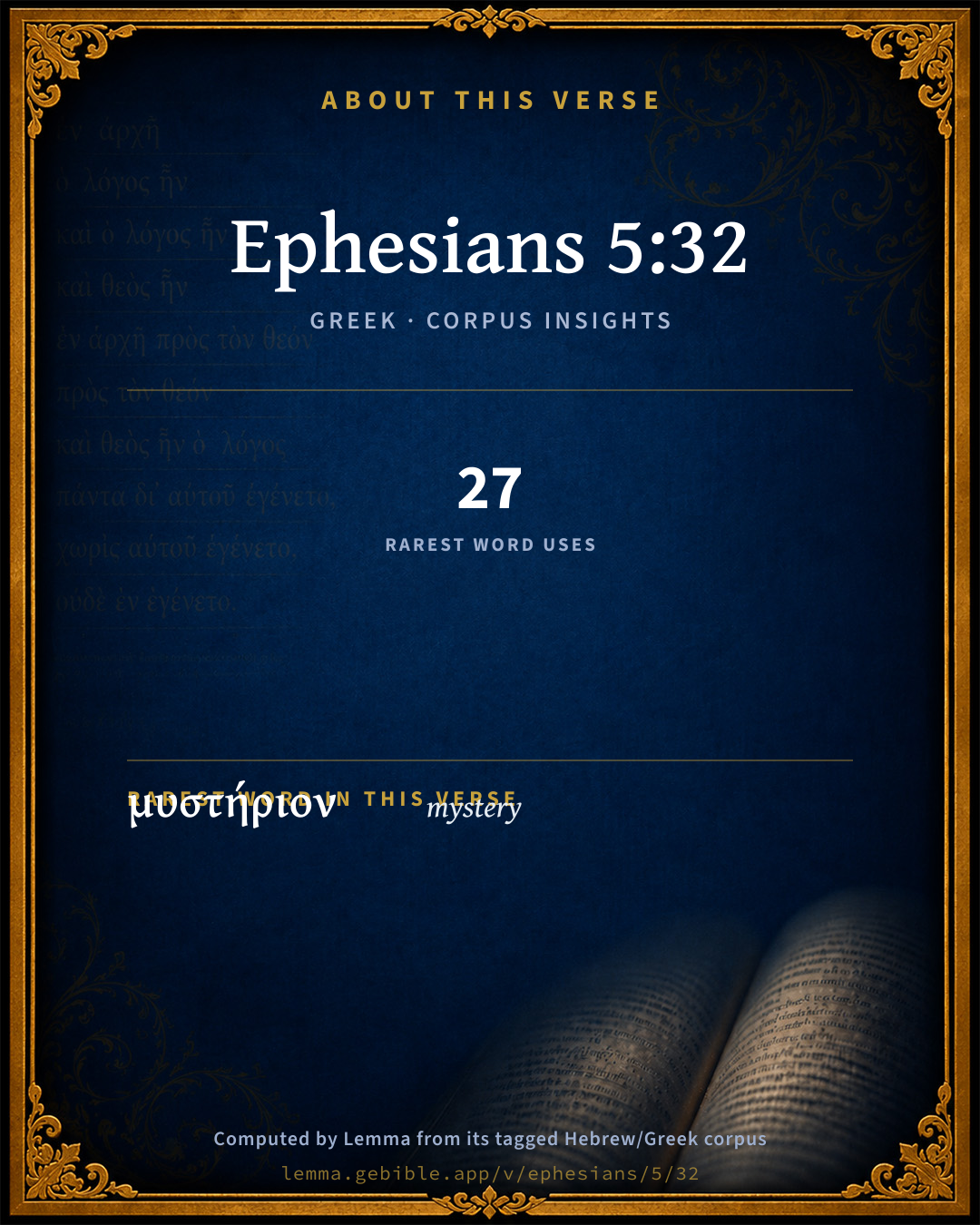
μυστήριον mystery G3466 occurs in 27 verses of the Greek New Testament. Also found in:
Repetition

Words recur within this verse:

Cross-references

11

Topical passages linked to Ephesians 5:32 in the Treasury of Scripture Knowledge — connected by theme and wording, ordered by reader-vote popularity; previews shown in the World English Bible.

  • 2 Corinthians 11:2 For I am jealous over you with a godly jealousy. For I married you to one husband, that I might present you as a pure virgin to Christ.
  • Revelation 21:2 I saw the holy city, New Jerusalem, coming down out of heaven from God, made ready like a bride adorned for her husband.
  • Isaiah 54:5 For your Maker is your husband; Yahweh of Hosts is his name: and the Holy One of Israel is your Redeemer; the God of the whole earth shall he be called.
  • Revelation 19:7–8 Let us rejoice and be exceedingly glad, and let us give the glory to him. For the marriage of the Lamb has come, and his wife has made herself ready."
  • Isaiah 62:4–5 You shall no more be termed Forsaken; neither shall your land any more be termed Desolate: but you shall be called Hephzibah, and your land Beulah; for Yahweh delights in you, and your land shall be married.
  • Colossians 2:2 that their hearts may be comforted, they being knit together in love, and gaining all riches of the full assurance of understanding, that they may know the mystery of God, both of the Father and of Christ,
  • 1 Timothy 3:16 Without controversy, the mystery of godliness is great: God was revealed in the flesh, Justified in the spirit, Seen by angels, Preached among the nations, Believed on in the world, And received up in glory.
  • John 3:29 He who has the bride is the bridegroom; but the friend of the bridegroom, who stands and hears him, rejoices greatly because of the bridegroom's voice. This, my joy, therefore is made full.
  • Song of Solomon 1:1–8 The Song of songs, which is Solomon's. Beloved
  • Psalms 45:9–17 Kings' daughters are among your honorable women. At your right hand the queen stands in gold of Ophir.
  • Ephesians 6:19 on my behalf, that utterance may be given to me in opening my mouth, to make known with boldness the mystery of the Gospel,

Cross-references courtesy of OpenBible.info (CC BY 4.0).

Commentary

Notes on Ephesians 5:32 from classic Christian and Jewish commentators (each source and its license shown beneath its notes). The classic Christian expositions comment on the surrounding passage and are grouped to its opening verse, so a note may address several verses; the Jewish commentaries on the Tanakh (Rashi and others) are per-verse, so they appear only where the commentator wrote on this verse.

Lemma curates 59 commentaries, every one of them public domain or Creative Commons licensed, each selected and text-cleaned for this edition rather than reprinted as found. About our sources →

The Biblical Illustrator

Joseph S. Exell

Eph_5:32

This is a great mystery.

The mysteriousness of religion

It is in a discourse upon marriage that the apostle introduces these remarkable words; but it is unnecessary that we connect them with the original context; they may be detached from it and treated by themselves as containing a great and interesting truth. Just observe. The Apostle Paul is brought to acknowledge that something which he had just been announcing was very mysterious; he does not attempt to deny or explain away the mystery; he leaves it in all its greatness, and in all its obscurity; but then he adds, I speak concerning Christ and the Church. As much as to say, There is no reason for any surprise at there being mystery. When discourse turns on such subjects as Christ and the Church, mystery is to be expected, mystery is not to be avoided. Here, then, opens before us a great and important subject of discourse. Do men object to us that there are mysterious things bard to be understood in Christianity? What course are we to take with these objectors? Are we to extenuate the mysteries, and try to make them seem less, as though we were ashamed of them, and felt that the gospel would be improved by their absence? Not so. We ought rather to glory in confessing and proclaiming them, considering it a sufficient answer to every objection that we are speaking concerning Christ and the Church. It is not for us to make Scripture less mysterious than the Almighty has made it.

I. Look, for instance, at Christ as born of a pure virgin in a stable at Bethlehem. The incarnation of the Son of God is not one of those facts which lose their mysteriousness through being examined and pondered. Familiarity may indeed make us less alive to its wonders; but the more we consider, the more must we be amazed.

II. But the apostle mentions the Church as well as Christ, and forasmuch as it is the union between Christ and the Church as typified by marriage which led him to express himself in the words of our text, we must briefly see whether there be not mystery--mystery to be thankfully acknowledged, not timidly concealed--in regard to true believers as well as their Divine Lord. Indeed there is mystery. That through such a system as the Christian there should be produced in believers that holiness without which there can be nothing of the oneness between Christ and the Church which marriage supposes--this indeed seems hardly to have been expected, and is not easily to be explained. We are nowise surprised that there should be so vehement an outcry as to the probable tendencies of the gospel; that those who preach as the alone mode of salvation the resting wholly on the merits of another, should often be regarded as advancing a tenet which strikes at the root of all moral energy. Now, in conclusion, we trust that you will thoroughly understand under what point of view the mysteries of the Bible should be regarded by the Christian. These mysteries are not to be shrunk from or concealed, as though Christianity would be the better for their removal; they should rather be gloried in and thankfully acknowledged, as though Christianity would fall to bits if they were taken away. It is the tone which we admire in our text, the frankness of the confession, the avoidance of all controversy. This is a great mystery. I do not attempt to deny it, says the apostle; I do not wish to evade it. How can there be other than mystery when I am speaking concerning Christ and the Church? But, my brethren, what is mystery now may not be mystery always. Now we see through a glass darkly, but then face to face. Now we know in part, but then we shall know, even as also we are known. It must be that with our present imperfect faculties and limited capacities we are incompetent to the understanding much of the revelation which God has given us of Himself, but we shall understand more hereafter if we persevere to the end in fighting the good fight of faith. (H. Melvill, B. D.)

Christ the husband of the Church

There is a story in Foxs Book of Martyrs of a woman who, when she came to be tried for her religion before the bishop, was threatened by him that he would take away her husband from her. Christ, was her reply, is my husband. I will take away thy child, said he. Christ, said she, is better to me than ten sons. I will strip thee, said he, of all outward comforts. And again came the answer, Yes, but Christ is mine, and you cannot strip me of Him. (Baxendales Anecdotes.)

The dignity of matrimony

Every blessing of Christianity springs from the union between the Son of God and mankind. This union was inaugurated when God took human nature and thus made it His own, when He became flesh for us, and dwelt among us; and it is continued in His intimate union with the Church, which is His body. It is by this union that Christ confers all graces.

1. In His union with the Church God gives Himself to men, and men give themselves to God. Matrimony should correspond with this idea (Gen_2:24).

2. In the relations between Christ and the Church we admire perfect unity. This ought also to characterize Christian matrimony.

3. Unity involves indissolubility (Mat_19:6).

4. Another consequence of unity is the reconciliation of authority and obedience.

5. Forbearance. Christ bears patiently all our imperfections, infirmities, and sins. In a similar manner married people should bear one anothers burdens, and so fulfil the law of Christ; as the members of the same body bear the infirmities of one another.

6. The objects to be attained by the union of Christ and His Church are the honour of God and the sanctification of men. The objects of matrimony are the same--the honour of God, the sanctification of the married couple, of the family, and of others who see their good works. (Bishop W. E. Ketteler)

.

Church life

The true Church of Christ is in intimate union with Christ Himself. It is indissolubly joined unto Him, vitally connected with Him, and, I must add, it is altogether His possession, His servant. When it is in sound and healthy condition, it is in profound and active sympathy with Christ in all His purposes and works; and when it appears in all its beauty and grace, it is in full conformity to the mind of Christ.

I. The mutual love of the Church. This is the grand characteristic of believers: love in active exercise, love expressed in word and deed. In order to love, there must be knowledge or acquaintance.

II. The worship of the Church. The seat of worship is the heart. And the believer cannot neglect the exercise of private or secret worship. Then, those whom God has set in families should have a home altar, around which morning and evening the whole household should gather. As to the worship of Gods house, it is your privilege to be partakers of it, and you are under a solemn obligation to observe the ordinances of the sanctuary.

III. The work of the Church. This work is two-fold--edifying believers, and converting sinners.

IV. The finances of the Church.

V. The spiritual tone and temper of the Church. (A. G. Maitland, M. A.)

The wife a helper

Dr. Payson, meeting an irreligious lady whose husband was trying to serve God, addressed her thus: Madam, I think your husband is looking upwards--making some effort to rise above the world towards God and heaven. You must not let him try alone. Whenever I see the husband struggling alone in such efforts, it makes me think of a dove endeavouring to fly upwards while it has one broken wing. It leaps and flutters, and perhaps rises a little way; and then it becomes wearied, and drops back again to the ground. If both wings cooperate, then it mounts easily.

A wifes kindness

It is related in the life of William Hutton that a countrywoman called upon him one day, and told him that her husband behaved unkindly to her, and sought other company, often passing his evenings from home, which made her feel very unhappy; and, knowing Mr. Hutton to be a wise man, she thought he might be able to tell her how she should manage to cure her husband. The remedy is a simple one, said he; but I have never known it to fail. Always treat your husband with a smile. The woman expressed her thanks, dropped a courtesy, and went away. A few months afterwards she waited on Mr. Hutton with a couple of fine fowls, which she begged him to accept. She told him, while a tear of joy and gratitude glistened in her eye, that she had followed his advice, and her husband was cured. He no longer sought she company of others, but treated her with constant love and kindness.

The Biblical Illustrator, edited by Joseph S. Exell (c. 1880s–1900s) — public domain. Text from a community e-Sword module.

Tyndale Open Study Notes

Tyndale Open Resources

5:32 it is an illustration: Both the unity of husband and wife and the unity of Christ and the church are a great mystery (see study note on 1:8-10).

Tyndale Open Study Notes — © Tyndale Open Resources, licensed CC BY-SA 4.0. Text via the HelloAO Bible API.

Bengel's Gnomon

Johann Albrecht Bengel

Eph 5:32. Μέγα, great) Paul felt more than those to whom he wrote could comprehend. It is not a marriage among men that is called a mystery,[92] Eph 5:33, but the union itself of Christ and the Church.[There are in all three kinds of duties which the Law prescribes to the husband, Exo 21:10. The apostle had mentioned the two former in a spiritual sense, Eph 5:29; now the order would lead him to the third, of which that expression of Hosea is a summary, Eph 2:20 (see Eph 5:19 also), Thou shalt know the Lord. But the apostle suddenly breaks off. Minds of the rarest character and capacity are required.[93]—V. g.]

[92] Or sacrament, as the Romanists argue from this passage.—ED.

[93] To appreciate spiritually the third of the three duties, “food, raiment, the duty of marriage,” requires a spiritual mind. A carnal mind cannot comprehend it save carnally.—ED.

Bengel's Gnomon of the New Testament — English translation (T&T Clark, Edinburgh, 1860) — public domain. Text from a community e-Sword module.

Meyer's Critical & Exegetical Commentary

Heinrich August Wilhelm Meyer

Eph_5:32. For the understanding of Eph_5:31 in the sense of the apostle an exegetical gloss was necessary, which is here given: This mystery is great, is important and exalted in its contents, but I say it, adduce it (namely, this mystery, by which is meant just the declaration of Gen_2:24), in reference to Christ and the church.

τὸ μυστήριον τοῦτο] So Paul terms those Old Testament words just employed by him, in so far as they have a hidden meaning not recognised without divine enlightenment. With the Rabbins, too, the formula mysterium magnum (Jalkut. Rub. f. 59, Ephesians 4 : דא רזא יקירא) is very common. See Schoettgen, Horae, p. 783 f.

ἐγὼ δέ] ἐγώ, which Holzhausen even declares to be superfluous, has emphasis: I, however (δέ metabatic), opposed to the possible interpretations which might be given to the mysterious utterance.[289]

εἰς Χριστὸν καὶ εἰς τὴν ἐκκλησίαν] so that we have thus under ἌΝΘΡΩΠΟς to understand Christ, and under ἡ γυνὴ αὐτοῦ the church. This has been rightly discerned already by the Fathers (see Chrysostom, Theodoret, Theophylact, Jerome), only they should not have thought of the coming of Christ in the flesh (in connection with which Jerome interpreted τὴν μητέρα of the heavenly Jerusalem; comp. Estius), but of the Parousia. See on Eph_5:31. Lastly, it is worthy of notice simply under a historical point of view, that Roman Catholics (but not Erasmus, Cajetanus, or Estius), on the ground of the Vulgate, which translates ΜΥΣΤΉΡΙΟΝ by sacramentum, proved from our passage[290] that marriage is a sacrament. It is not this that is conveyed in the passage, as indeed in general marriage non habet a Christo institutionem sacramentalem, non formam, non materiam, non finem sacramentalem (Calovius, and see the Apol. Conf. Aug. p. 202), but it is rather the sacredly ideal and deeply moral character, which is for ever assured to marriage by this typical significance in the Christian view. We may add that monogamy is presupposed as self-evident, but does not form the set purpose of the passage, which would be purely imported (in opposition to Schwegler, p. 387).

[289] Later Rabbinico-mystical interpretations of marriage may be seen in Schoettgen, Hor. p. 784. Philo, p. 1096, allegorizes those words in reference to reason, which forsakes wisdom and follows the senses.

[290] See also Catech. Rom_2:8; Rom_2:16 f.

Meyer — Critical and Exegetical Commentary on the New Testament — English translation by Peter Christie, edited by Frederick Crombie (T&T Clark, 1880) — public domain. Text from a community e-Sword module.

Expositor's Greek Testament

ed. W. Robertson Nicoll

Eph 5:32 . τὸ μυστήριον τοῦτο μέγα ἐστίν : this mystery is great . Not “this is a great mystery,” as it is rendered by the AV and Rhem.; nor “this is a great secret,” Tynd., Cran., gen. The term μυστήριον (on which see under Eph 1:9 above) cannot mean allegory or dark-saying , but must have its usual sense of something once hidden and now revealed, a secret disclosed. It cannot refer, therefore, as Mey. makes it do, to the quotation from Gen 2:24 as a passage with a hidden typical or mystical meaning, one deep ( μέγα ) and difficult to reach. Nor can it well refer to the spiritual union of Christ and the Church by itself (Beng.), or to the comparison between the union of husband and wife and that of Christ and the Church (Est.), as the ἐγὼ δὲ λέγω would then lose its point. It is simplest to take it as referring to Christian truth touching the relation between husband and wife as set forth in these verses. That truth is described by μέγα as great, i.e. , in the sense of grandeur and importance. The Vulg. rendering sacramentum (followed by Wicl. and the Rhem.) has induced many Roman Catholic theologians to found on this as a passage presenting marriage in the character of a sacrament a perverted interpretation which was disavowed indeed by distinguished scholars like Cajetan and Estius in the Roman Catholic Church itself. It may be added that Alford understands by the μυστήριον “the matter mystically alluded to in the Apostle’s application of the text just quoted; the mystery of the spiritual union of Christ with our humanity, typified by the close conjunction of the marriage state”. And Von Soden, taking the τοῦτο , as in 1Co 15:51 , to refer to what follows , supposes the sense to be “this secret, that is, what I am about to say as the secret sense of this sentence, is great”. Hatch, again, who regards μυστήριον as closely related in sense to τύπος , σύμβολον and παραβολή and interchangeable with them, gives μυστήριον the sense of “symbol” (which he thinks is its meaning also in Rev 1:20 ; Rev 17:7 ), and renders it “this symbol ( sc. of the joining of husband and wife into one flesh) is a great one” ( Essays in Biblical Greek , p. 61). ἐγὼ δὲ λέγω εἰς Χριστόν , καὶ [ εἰς ] τὴν ἐκκλησίαν : but I speak with reference to Christ and the Church . The second εἰς is omitted by LWH, as not found in [715] [716] , Iren., Tert., etc.; it is inserted, however, in [717] [718] [719] [720] [721] , Orig., Meth., Theodor., Cypr., Hil., etc. The formula λέγω δέ is used in various Pauline passages where an explanation of something previously said is in view ( e.g. , 1Co 1:12 ; Gal 3:17 ; Gal 4:1 ; Gal 5:16 ; cf. τοῦτο δέ φημι , 1Co 7:29 ; 1Co 15:50 ). Here too, the sense is not “I interpret it,” but simply “I say it,” “I mean it”. The δέ has here its disjunctive force, introducing an explanation and separating it from the thing explained (Thayer-Grimm, Greek-Engl. Lex. of N. T. , p. 125). The εἰς is the prep, of ethical direction , indicating that towards which the mind is looking (Thayer-Grimm, ut sup. , p. 184; and cf. Act 2:25 ), = “ with reference to Christ,” not “ of Christ,” far less “ in Christ” as the Vulg. unhappily renders it. The emphatic position of the ἐγώ gives it to be understood that what immediately follows is the writer’s own way of putting the matter just stated, or his own application of the words of Scripture. The sense, therefore, is this “the truth of which I have spoken, the relation of husband and wife as one flesh, is a revelation of profound importance; but let me explain that, in speaking of it as I have done, my meaning is to direct your minds to that higher relation between Christ and His Church, in its likeness to which lies its deepest significance.

[715] Codex Vaticanus (sæc. iv.), published in photographic facsimile in 1889 under the care of the Abbate Cozza-Luzi.

[716] Codex Mosquensis (sæc. ix.), edited by Matthæi in 1782.

[717] Codex Sinaiticus (sæc. iv.), now at St. Petersburg, published in facsimile type by its discoverer, Tischendorf, in 1862.

[718] Codex Alexandrinus (sæc. v.), at the British Museum, published in photographic facsimile by Sir E. M. Thompson (1879).

[719] Codex Claromontanus (sæc. vi.), a Græco-Latin MS. at Paris, edited by Tischendorf in 1852.

[720] Codex Augiensis (sæc. ix.), a Græco-Latin MS., at Trinity College, Cambridge, edited by Scrivener in 1859. Its Greek text is almost identical with that of G, and it is therefore not cited save where it differs from that MS. Its Latin version, f, presents the Vulgate text with some modifications.

[721] Codex Angelicus (sæc. ix.), at Rome, collated by Tischendorf and others.

The Expositor's Greek Testament, edited by W. Robertson Nicoll (1897–1910) — public domain. Text from a community e-Sword module.

Hodge's Commentary on Romans, Ephesians & First Corinthians

Charles Hodge

Eph_5:32

Τὸ μυστήριον τοῦτο μέγα ἐστίν, this mystery is great. The word mystery does not refer to the passage in Gen_2:24, as though the apostle intended to say that passage had a mystical sense which he had just unfolded by applying it to the relation between Christ and his church. It is the union between Christ and his people, the fact that they are one flesh, he declares to be a great mystery. The word μυστήριον, is used here, as it is everywhere else, for something hidden, something beyond the reach of human knowledge. Whether its, being thus hidden arises from its lying in the future, or because of being imperfectly revealed, or because it is in its own nature incomprehensible, must be determined by the connection. In this place the last is probably the idea intended. The thing itself is beyond our comprehension. The Vulgate renders this passage, sacramentum hoc magnum est. The Latin word sacramentum, besides its usual classical sense, a sacred deposit, was often used to signify anything sacred, or which had a hidden import. In this latter sense it agrees in meaning with the word μυστήριον, which also is used to designate something the meaning of which is hidden. Hence in the Vulgate it is often translated as it is here. In the Latin church the word sacramentum, however, gradually changed its meaning. Instead of being applied to every thing having a sacred or secret meaning, it was confined to those rites or acts which were assumed to have the power of conferring grace. This is the Romish idea of a sacrament. The Papal theologians taking the word in this sense here, and understanding the apostle to refer to marriage, quote this passage in proof that matrimony is a sacrament. The answer to this argument is obvious. In the first place, it is not marriage, but the union between Christ and his church, that Paul declares to be a μυστήριον, and the Vulgate a sacramentum. And in the second place, neither the Greek nor Latin term means a sacrament in the Romish sense of the word. The Vulgate translates 1Ti_3:16, magnum est pietatis sacramentum, which no Romanist understands as teaching that the manifestation of God in the flesh is a sacrament in the ecclesiastical meaning of the term.

Charles Hodge — Commentary on Romans (1835), First Corinthians (1857), and Ephesians (1856) — public domain. Text from a community e-Sword module.

Geneva Bible (1599)

Geneva Bible translators

That no man might dream of natural conjunction or knitting of Christ and his Church together (such as the husbands and the wives is) he showeth that it is secret, to wit, spiritual and such as far differeth from the common capacity of man: as which consisteth by the virtue of the Spirit, and not of the flesh by faith, and by no natural band.

Geneva Bible (1599) marginal notes — public domain. Text via Bolls.life.

Jamieson, Fausset & Brown

Robert Jamieson, A. R. Fausset & David Brown

Rather, "This mystery is a great one." This profound truth, beyond man's power of discovering, but now revealed, namely, of the spiritual union of Christ and the Church, represented by the marriage union, is a great one, of deep import. See on Eph 5:30. So "mystery" is used of a divine truth not to be discovered save by revelation of God (Rom 11:25; Co1 15:51). The Vulgate wrongly translates, "This is a great sacrament," which is made the plea by the Romish Church (in spite of the blunder having been long ago exposed by their own commentators, CAJETAN and ESTIUS) for making marriage a sacrament; it is plain not marriage in general, but that of Christ and the Church, is what is pronounced to be a "great mystery," as the words following prove, "I [emphatic] say it in regard to Christ and to the Church" (so the Greek is best translated). "I, while I quote these words out of Scripture, use them in a higher sense" [CONYBEARE and HOWSON].

Jamieson, Fausset & Brown — Commentary Critical and Explanatory on the Whole Bible (1871) — public domain (CC PDM 1.0). Text via the HelloAO Bible API.

Adam Clarke's Commentary

Verse 32. This is a great mystery] τομυστηριον τουτο μεγα εστιν. This mystery is great. Sacramentum hoc magnum est; this sacrament is great. - VULGATE. And on the evidence of this version the Church of Rome has made matrimony a sacrament, which, as they use it, is no meaning of the original. By mystery, here, we may understand a natural thing by which some spiritual matter is signified, which signification the Spirit of God alone can give. So, here, the creation and union of Adam and Eve, were intended, in the design of God, to point out the union of Christ and the Church: a union the most important that can be conceived; and therefore the apostle calls it a great mystery. See the observations at the end of this chapter.

Adam Clarke's Commentary on the Bible (1810–1826) — public domain. Text from a community e-Sword/MySword module.

John Calvin's Commentaries

32. This is a great mystery. He concludes by expressing his astonishment at the spiritual union between Christ and the church. This is a great mystery; by which he means, that no language can explain fully what it implies. It is to no purpose that men fret themselves to comprehend, by the judgment of the flesh, the manner and character of this union; for here the infinite power of the Divine Spirit is exerted. Those who refuse to admit anything on this subject beyond what their own capacity can reach, act an exceedingly foolish part. We tell them that the flesh and blood of Christ are exhibited to us in the Lord’s supper. “Explain to us the manner,” they reply, “or you will not convince us.” For my own part, I am overwhelmed by the depth of this mystery, and am not ashamed to join Paul in acknowledging at once my ignorance and my admiration. How much more satisfactory would this be than to follow my carnal judgment, in undervaluing what Paul declares to be a deep mystery! Reason itself teaches how we ought to act in such matters; for whatever is supernatural is clearly beyond our own comprehension. Let us therefore labor more to feel Christ living in us, than to discover the nature of that intercourse.

We cannot avoid admiring the acuteness of the Papists, who conclude from the word mystery (μυστήριον) that marriage is one of seven sacraments, as if they had the power of changing water into wine. They enumerate seven sacraments, while Christ has instituted no more than two; and, to prove that matrimony is one of the seven, they produce this passage. On what ground? Because the Vulgate has adopted the word Sacrament (sacramentum) as a translation of the word Mystery, which the apostle uses. As if Sacrament (sacramentum) did not frequently, among Latin writers, denote Mystery, or as if Mystery had not been the word employed by Paul in the same Epistle, when speaking of the calling of the Gentiles. But the present question is, Has marriage been appointed as a sacred symbol of the grace of God, to declare and represent to us something spiritual, such as Baptism or the Lord’s Supper? They have no ground for such an assertion, unless it be that they have been deceived by the doubtful signification of a Latin word, or rather by their ignorance of the Greek language. If the simple fact had been observed, that the word used by Paul is Mystery, no mistake would ever have occurred.

We see then the hammer and anvil with which they fabricated this sacrament. But they have given another proof of their indolence in not attending to the correction which is immediately added,

But I speak concerning Christ and the church. He intended to give express warning that no man should understand him as speaking of marriage; so that his meaning is more fully expressed than if he had uttered the former sentiment without any exception. The great mystery is, that Christ breathes into the church his own life and power. But who would discover here anything like a sacrament? This blunder arose from the grossest ignorance.

John Calvin's Commentaries (1540-1563) — public domain. Text from the Calvin Translation Society English edition (1840s-50s) via the Christian Classics Ethereal Library (ccel.org). Calvin's coverage is partial (roughly two-thirds of the Bible); uncommented books and verses are honest gaps, never fabricated. The 19th-century editor's footnotes and remarks are omitted so the notes are faithfully Calvin's own voice.

Ellicott's Commentary for English Readers

(32) This is a great mystery.—Rather, This mystery is a great one. The words apply to the type, as well as to the Antitype. (1) The indissoluble and paramount sacredness of marriage, as all history shows, is “a mystery”—that is (see Eph_1:9), a secret of God’s law, fully revealed in Christ alone. For in heathen, and, to some extent, even in Jewish thought, marriage was a contract far less sacred than the indissoluble tie of blood; and wherever Christian principle is renounced or obscured, that ancient idea recurs in modern times. It may be noted that from the translation here of the word “mystery,” by sacramentum in the Latin versions, the application of the word “sacrament” to marriage arose. (2) But the following words, “But I” (the word “I” being emphatic) “speak concerning Christ and the Church,” show—what indeed the whole passage has already shown—that St. Paul’s chief thought has passed from the type to the Antitype. He has constantly dwelt on points which suit only Christ’s relation to the Church, and to that relation he has, by an irresistible gravitation of thought, been brought back again and again. (3) Yet the two cannot be separate. The type brings out some features of the Antitype which no other comparison makes clear; and history shows that the sacredness of the type in the Church has depended on this great passage—bearing, as it does, emphatic witness against the ascetic tendency to look on marriage as simply a concession to weakness, and as leading to a life necessarily lower than the celibate life.

A Bible Commentary for English Readers, edited by Charles John Ellicott (1878–1897) — public domain. Text from a community e-Sword module.

The Cambridge Bible for Schools and Colleges

gen. ed. J. J. S. Perowne

32. This is, &c.] More precisely, This mystery is great. For the word “mystery” see above, Eph_1:9, Eph_3:3-4; Eph_3:9; and below Eph_6:19. The word tends to mean something of the sphere of spiritual truth not discoverable by observation or inference, but revealed. The thing answering to such a description in this context is, surely, “the mystical union and fellowship betwixt Christ and His Church.” It can scarcely be the marriage union of mortal man and wife. That, as this whole passage bears witness, is a thing most sacred, Divine in institution, and, in the popular sense of the word, “mysterious.” But it scarcely answers the idea of a revealed spiritual truth.

We paraphrase the verse, then; “This revealed mystery, the Union of Bridegroom and Bride, is great; but I say so in reference to the Bridal of Redemption, to which our thought has been drawn.”

The Vulgate Latin, which forms in its present shape the authoritative Romanist version, translates here, “sacramentum hoc magnum est, ego autem dico in Christo et in ecclesiâ”; from which the Roman theology deduces that “marriage is a great sacrament in Christ and in His Church” (see Alford here, and the Catechism of the Council of Trent, pars ii. qu. xv.—xvii). The “Old Latin” read “in ecclesiam,” “with reference to the Church.”

but I] The pronoun is emphatic, possibly as if to say, “I, as distinguished from the narrator of the marriage in Eden.”

On this whole passage Monod’s remarks are noteworthy. He declines to see, with Harless, a mere accommodation of the words of Genesis. For him, those words, narrating true facts, are also a Divinely planned type. “When St Paul quotes, by the Holy Spirit, a declaration of the Holy Spirit, it is the Holy Spirit’s thought and not his own that he gives us … The relation which he indicates between the two unions … is based in the depths of the Divine thought, and on the harmony established between things visible and invisible … The marriage instituted in Eden was really, in the plan of God, a type of the union of Christ with His Church.”

For a reference by the Lord Himself to the passage in Genesis, though with another purpose, see Mat_19:4-5; Mar_10:6-9. For Him, as for His Apostle, the passage was not a legend but an oracle.

The Cambridge Bible for Schools and Colleges (gen. ed. J. J. S. Perowne; Cambridge University Press, 1878–1918) — public domain. Text from a community e-Sword module.

Trapp's Complete Commentary

John Trapp

32 This is a great mystery: but I speak concerning Christ and the church.

Ver. 32. This is a great mystery] To wit, this mystical marriage with Christ. It passeth the capacity of man to understand it in the perfection of it. Preachers can make it known but in part, and hearers can but in part conceive it. Let us therefore wait for perfect understanding of it, till all things be perfected in Christ.

John Trapp, A Commentary or Exposition upon All the Books of the Old and New Testament (1647–1656) — public domain. Text from a community e-Sword module.

Albert Barnes' Notes on the Bible

This is a great mystery - The Latin Vulgate translates this, “sacramentum hoc magnum est” - “this is a great sacrament” - and this is the proof, I suppose, and the only proof adduced by the papists that marriage is a “sacrament.” But the original here conveys no such idea. The word “mystery” - μυστήριον mustērion - means something which is concealed, hidden, before unknown; something into which one must be “initiated” or instructed before he can understand it. It does not mean that it is “incomprehensible” when it is disclosed, but that hitherto it has been kept secret. When disclosed it may be as intelligible as any other truth; see the word explained in the notes on Eph 1:9. Here it means simply, that there was much about the union of the Redeemer with his people, resembling the marriage connection, which was not obvious, except to those who were instructed; which was obscure to those who were not initiated; which they did not understand who had not been “taught.” It does not mean that no one could understand it, but that it pertained to the class of truths into which it was necessary for one to be “initiated” in order to comprehend them. The truth that was so great a mystery was, that the eternal Son of God should form such an union with people; that he should take them into a connection with himself, implying an ardor of attachment, and a strength of affection superior to even that which exists in the marriage relation. This was a great and profound truth, to understand which, it was necessary to receive instruction. No one would have understood it without a revelation; no one understands it now except they who are taught of God.

But I speak concerning Christ and the church - This, it seems to me, is an explicit disclaimer of any intention to be understood as affirming that the marriage contract was designed to be a “type” of the union of the Redeemer and his people. The apostle says expressly, that his remarks do not refer to “marriage at all” when he speaks of the mystery. They refer “solely” to the union of the Redeemer and his people. How strange and unwarranted, therefore, are all the comments of expositors on this passage designed to explain marriage as “a mysterious type” of the union of Christ and the church! If people would allow the apostle to speak for himself, and not force on him sentiments which he expressly disclaims, the world would be saved from such insipid allegories as Macknight and others have derived from this passage. The Bible is a book of sense; and the time will come, it is hoped, when, freed from all such allegorizing expositions, it will commend itself to the good sense of mankind. Marriage is an important, a holy, a noble, a pure institution, altogether worthy of God; but it does not thence follow that marriage was designed to be a type of the union between Christ and the church, and it is certain that the apostle Paul meant; to teach no such thing.

Albert Barnes' Notes on the Bible (1834–1885) — public domain. Text from a community e-Sword/MySword module.

Haydock's Catholic Bible Commentary

This....sacrament, (or mystery)....in Christ, and in the Church. This sacrament, in construction, must be referred to what immediately went before, i.e. to the conjunction of marriage betwixt man and wife; and this is called a great sacrament, or mystery, as representing the union or spiritual nuptials of Christ with his spouse, the Church. (Witham)

George Leo Haydock (1774–1849), Haydock's Catholic Family Bible and Commentary, 1859 edition — public domain. Excludes Psalms (Douay-Rheims chapter numbering differs from Protestant) and Deuterocanonical books (Catholic canon only).

Matthew Poole's English Annotations

This is a great mystery; either, this that was spoken before of a marriage union between Christ and the church, and its being of his flesh and of his bones, is a great mystery, and so in the latter part of the verse the apostle explains himself. Or, this that was said of the conjunction of Adam and Eve was a great mystery, (i.e. a great secret in religion), as being a type of Christ’s marriage with his church; though not an instituted type appointed by God to signify this, yet a kind of natural type, as having a resemblance to it.

Matthew Poole's English Annotations on the Holy Bible (1683–1685) — public domain. Text from a community e-Sword/MySword module.

Whedon's Commentary on the Bible

Daniel D. Whedon

32. This—The instituted fact that a man shall form marital connexions closer than blood relationship.

Is a great mystery—One of the profoundest mysteries in all nature, lying at the roots of personal life and of race existence. But great as this marital mystery may be, it is not the main topic. I really speak, that is, am speaking, concerning a still sublimer mystery, namely, Christ and the Church. See note, Eph_5:26.

Daniel D. Whedon (gen. ed.), Commentary on the Old and New Testaments (1874–1909) — public domain. Text from a community e-Sword module.

The Pulpit Commentary

This mystery is a great one; but I am speaking with reference to Christ and the Church. The matter referred to is the typical relation between the marriage of man and wife, and the union of Christ and the Church. It is called a mystery, and it is not said, as is said of another mystery, referred to before, (Eph_3:5) that it has been completely explained. Some light has been thrown upon it, but that is all. It is implied that there is something of mystery in many of the relations between things natural and things spiritual, but that in the depth and grandeur of the sub-jeer, the mystery connected with the marriage relation is pre-eminent it is "a great mystery" The analogy of the wind to the Holy Spirit; the springing up of plants to the resurrection; the melancholy sounds of nature to the prevalence of sin; and many other analogies, present vague shadows of truth, the clear, full forms of which we cannot see. When the day breaks and "the shadows flee away," such things will appear in a clearer light.

The Pulpit Commentary (1880–1919), ed. H.D.M. Spence-Jones & Joseph S. Exell — public domain. Text from a community e-Sword module.

Scofield Reference Notes

C. I. Scofield

bride

Eph 5:30; Eph 5:31 are quoted from Gen 2:23; Gen 2:24 and exclude the interpretation that the reference is to the church merely as the body of Christ. Eve, taken from Adam’s body, was truly "bone of his bones, and flesh of his flesh," but she was also his wife, united to him in a relation which makes of "twain.. . one flesh" Mat 19:5; Mat 19:6 and so a clear type of the church as bride of Christ. 2Co 11:2; 2Co 11:3. The bride type are Eve Gen 2:23; Gen 2:24 Rebecca

(See Scofield "Gen 24:1").

Asenath (See Scofield "Gen 41:45")

(See Scofield "Gen 37:2")

Zipporah Exo 2:21. (See Scofield "Hos 2:2").

mystery (See Scofield "Mat 13:11").

The Scofield Reference Bible (1917 edition), notes by C. I. Scofield — public domain. Text from a community e-Sword module.

The People's New Testament

B. W. Johnson

32. This is a great mystery. The wonders of this marriage tie, but especially that the marriage of the first Adam should prefigure the relation between the second Adam and the church.

B. W. Johnson's The People's New Testament with Notes (1889–1891) — public domain. Electronic text from the Christian Classics Ethereal Library (CCEL) ThML edition.

Cambridge Greek Testament for Schools and Colleges

32. τὸ μυοτήριον τοῦτο μέγα ἐστίν. Cf. Hort Chr. Eccl. p. 151. ‘If we are to interpret ‘mystery’ in the difficult 32nd verse, as apparently we ought to do, by St Paul’s usage, i.e. take it as a Divine age-long secret only now at last disclosed, he wished to say that the meaning of that primary institution of human society, though proclaimed in dark words at the beginning of history, could not be truly known till its heavenly archetype was revealed, even the relation of Christ and the Ecclesia.”

μέγα ‘important’ is applied to μυστήριον also in 1Ti 3:16.

λέγω εἰς, Heb 7:14. ‘I speak with reference to.’

Cambridge Greek Testament for Schools and Colleges (Cambridge University Press, 1896; 21 vols, various authors incl. Carr, Maclear, Plummer, Farrar, Lumby, Moule, M. R. James, Simcox) — public domain. Text from a community e-Sword module.

Alford’s Greek Testament

Henry Alford

32.] This mystery is great (viz. the matter mystically alluded to in the Apostle’s application of the text just quoted: the mystery of the spiritual union of Christ with our humanity, typified by the close conjunction of the marriage state. This meaning of μυστήριον, which is strictly that in which St. Paul uses the word (see reff.),—as something passing human comprehension, but revealed as a portion of the divine dealings in Christ,—is, it seems to me, required by the next words. It is irksome, but necessary, to notice the ridiculous perversion of this text by the Romish church, which from the Vulgate rendering, ‘sacramentum hoc magnum est, ego autem dico in Christo et in Ecclesia,’ deduces that ‘marriage is a great sacrament in Christ and in His Church’ (Encyclical letter of 1832 cited by Eadie). It will be enough to say that this their blunder of ‘sacramentum’ for ‘mysterium,’ had long ago been exposed by their own Commentators, Cajetan and Estius): but I (emphatic) say (allege) it with reference to Christ, and [with reference to] the church (i.e. my meaning, in citing the above text, is to call your attention, not to mere human marriage, but to that high and mysterious relation between Christ and His Church, of which that other is but a faint resemblance).

Henry Alford, The Greek Testament (1849–1861) — public domain. Text from a community e-Sword module.

International Critical Commentary

32. τὸ μυστήριον τοῦτο μέγα ἐστίν, ἐγὼ δὲ λέγω εἰς χριστόν καὶ εἰς τὴν ἐκκλησίαν.

The second εἰς is om. by B K and some other authorities.

We must first determine the meaning of μυστήριον and of μέγα. On the former word see on 1:9. It does not mean “a mysterious thing or saying,” “a saying of which the meaning is hidden or unfathomable.” As Sanday and Headlam observe (Rom 11:25), with St. Paul it is a mystery revealed. Again, as to μέγα, the English versions—not only the incorrect AV., “this is a great mystery,” but the grammatically correct RV., “this mystery is great“—convey the idea that what is said is, that the mysteriousness is great, or, that the mystery is in a high degree a mystery. This is not only inconsistent with the meaning of μυστήριον, assuming, as it does, that “hiddenness” is the whole of its meaning (for to speak of a thing as in a high degree a revealed secret would be unintelligible), but it assigns to μέγα a meaning which does not belong to it. In English we may speak of great facility, great folly, simplicity, (πολλὴ μωρία, εὐηθεία); great ignorance (πολλὴ ἄγνοια); great perplexity (πολλὴ ἀπορία): but μέγας is not so used, for it properly expresses magnitude, not intensity. These linguistic facts are sufficient to set aside a large number, perhaps the majority, of interpretations of the clause. The sense must be of this kind: “This doctrine of revelation is an important or profound one.”

What, then, is the μυστήριον of which St. Paul thus speaks? Some suppose it to be this statement about marriage, which to the heathen would be new. But this requires us to take λέγω in the sense “I interpret,” or the like, which it does not admit. It is better to understand it as referring to the comparison of marriage with union of Christ with the Church. The latter clause, then, expressly points out that the former does not refer to marriage in itself, and λέγω has the same which it frequently has in St. Paul, “I mean.”

V. Soden takes τοῦτο to refer to what follows: “this secret, i.e. that which I am about to say as the secret sense of this sentence, is great, but I say it in reference to Christ and the Church,” comparing 1Co 15:51, μυστήριον ὑμῖν λέγω. This would be very elliptical.

Hatch translates: “this symbol (sc. of the joining of husband and wife into one flesh) is a great one. I interpret it as referring to Christ and to the Church” (Essays, p. 61).

The rendering of the Vulgate is: “Sacramentum hoc magnum est; ego autem dico in Christo et in ecclesia.” There are several other places in which μυστήριον is rendered “sacramentum,” viz. Eph 1:9, Eph 1:3:3, Eph 1:9; Col 1:27; 1Ti 3:16; Rev 1:20.

It was, however, no doubt, the rendering in this passage which led to marriage being entitled a sacrament. In an encyclical of 1832 (quoted by Eadie) occurs the statement, “Marriage is, according to St. Paul’s expression, a great sacrament in Christ and in the Church.” But the greatest scholars of the Church of Rome have rejected this view of the present passage. Cardinal Caietan says: “Non habes ex hoc loco, prudens lector, a Paulo conjugium esse sacramentum. Non enim dixit esse sacramentum, sed mysterium.” And to the same effect Estius. Erasmus also says: “Neque nego matrimonium esse sacramentum, sed an ex hoc loco doceri possit proprie dici sacramentum quemadmodum baptismus dicitur, excuti volo.” As to the question whether marriage is properly to be reckoned a sacrament or not, this is very much a matter of definition. If sacrament is defined as in the Catechism of the Churches of England and Ireland and by other Reformed Churches, it is not, for it was not instituted by Christ. Even if we take Augustine’s definition, “a visible sign of an invisible grace,” there would be a difficulty. But if every rite or ceremony which either is, or includes in it, a sign of something spiritual, is to be called a sacrament, then marriage is well entitled to the name, especially in view of the apostle’s exposition here. But to draw any inference of this kind from the present passage is doubly fallacious, for this is not the meaning of μυστήριον; and, secondly, St. Paul expressly states that it is not to marriage that he applies the term, but to his teaching about Christ and the Church; or, according to the interpretation first mentioned, to the meaning of the verse from Genesis.

International Critical Commentary — older volumes (1896–1929), various authors — public domain. Text from a community e-Sword module.

Vincent's Word Studies in the New Testament

Marvin R. Vincent

A great mystery. Great is predicative, not attributive. Rev., correctly, this mystery is great. The reference in this mystery is to the preceding statement of the conjugal relation of the Church with Christ, typified by the human marriage relation.

Concerning Christ and the Church. Rev., in regard of [εις] Not calling your attention to the mere human relationship, but to the mysterious relation between Christ and His Church, of which that is a mere semblance.

Marvin R. Vincent, Word Studies in the New Testament (1887–1900) — public domain. Text from a community e-Sword/MySword module.

Lesson kit

Teaching starters — assembled from the data on this page, not authored interpretation. Every prompt links to the verse data it draws on. Edit before teaching.

Ephesians, in the Pauline Epistles, opens this verse with 14 words (12 distinct Greek lemmas). Its most distinctive word is mystḗrion (“mystery”). A historical commentator’s framing appears above. Read the whole chapter for the surrounding context.

Discussion questions

  1. How does “mystery” (mystḗrion) shape what this verse is saying?
  2. Matthew 13:11 shares the word «mystery» with this verse. How do the two illuminate each other?
  3. “into” occurs 2× in this one verse. What is the effect of the repetition?
  4. The translations on this page render this verse differently — a whole-verse word diff, not a word-by-word alignment. What might account for the different wordings?
  5. Reading how The Biblical Illustrator and Tyndale Open Study Notes read this verse, where do the two commentators agree and where do they part?

Things to notice

  • These translations choose different wording for 9 words in this verse.
  • “into” occurs 2× in this single verse.
  • 12 distinct Greek lemmas span 14 words in this verse.

Reading settings

Reading text

Shown beneath each verse's original-language words.

Old Testament
Old Testament edition

Read the OT as the Masoretic Hebrew (MT) or the Greek Septuagint (LXX).

English shown for the Greek Septuagint (in the Hebrew ↔ Greek comparison).

Comparing translations? Open the Compare panel on any verse page to stack up to four side by side.