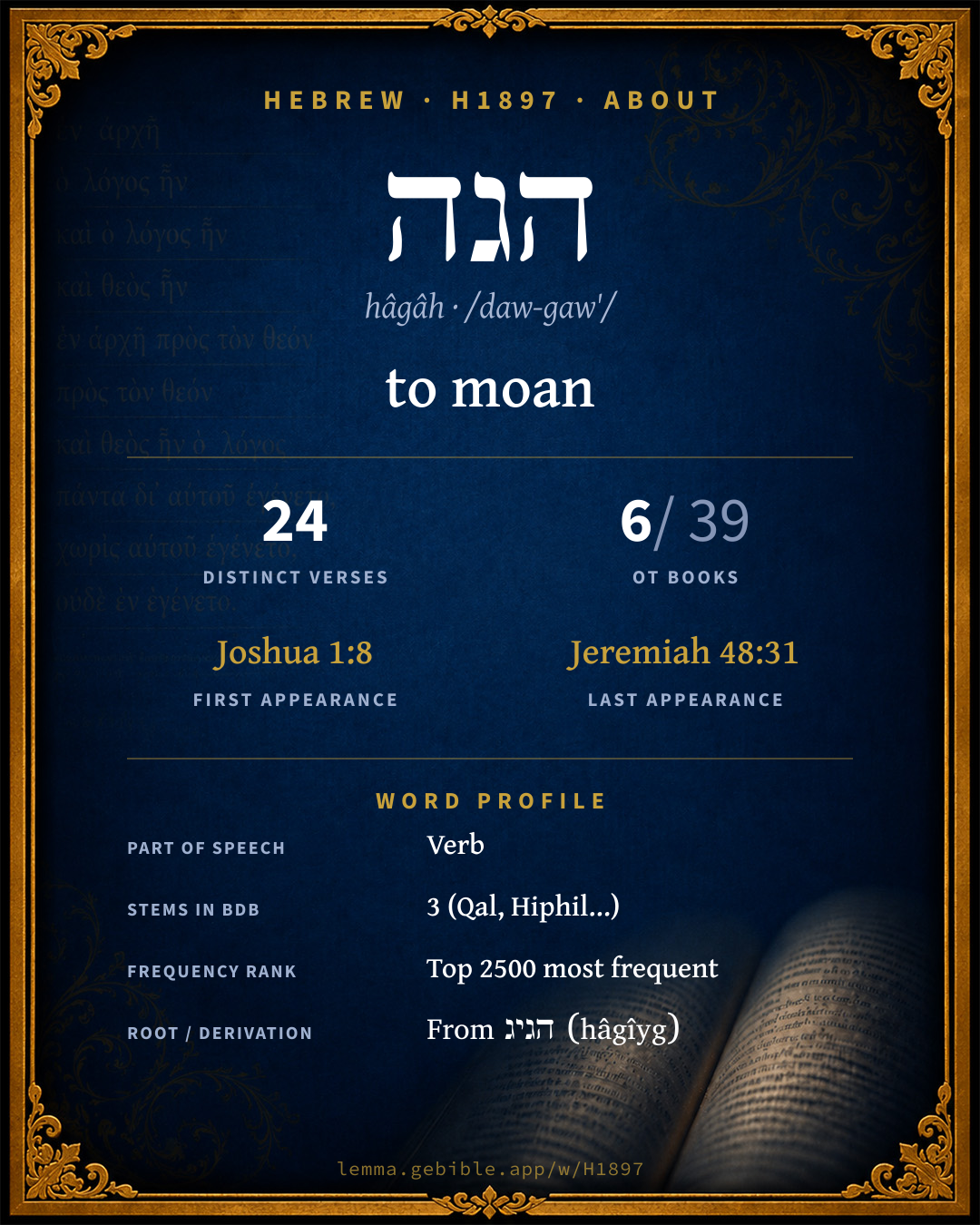
הָגָה
to moan
also: growl, utter, muse, mutter fuller range ↓
Full lexicon entry — Brown-Driver-Briggs (BDB)
From Brown-Driver-Briggs (BDB)
Where this word appears
See every Qal verb in the Hebrew Bible →
Grammar key — what these labels mean
Part of speech
- Verb
- An action or state-of-being word.
Stem
- Qal
- The basic, simple active stem — the plain form of the verb (“he wrote”). Here: ‘of inarticulate sounds’
- Hiphil
- The causative active stem (“he caused / brought about”). Here: ‘pl.’
Form
- Imperfect
- An incomplete, ongoing, or future action (“he will / would write”).
- Participle Active
- A verbal adjective expressing ongoing or characteristic action (“writing / one who writes”).
- Infinitive Absolute
- An unbound verbal noun, often intensifying or standing in for a finite verb.
- Sequential Perfect
- A perfect with prefixed waw continuing a preceding imperfect or command (waw-consecutive perfect).
- Perfect
- A completed action or state — Hebrew marks aspect (completeness) more than strict tense (“he wrote”).
State
- Absolute
- The independent form of a noun, not bound to a following word.
Person
- 3rd Person
- The one spoken about (“he / she / it / they”).
- 1st Person
- The speaker (“I / we”).
- 2nd Person
- The one addressed (“you”).
Gender
- Masculine
- Grammatically masculine.
- Feminine
- Grammatically feminine.
- Common
- Either gender — not distinguished for this form.
Number
- Singular
- One.
- Plural
- More than one (in Hebrew, generally three or more).
Grammatical forms 12 distinct
- Verb, Qal, Imperfect, 3rd Person, Masculine, Singular 9 times (36%)
- Verb, Qal, Imperfect, 3rd Person, Feminine, Singular 3 times (12%)
- Verb, Qal, Imperfect, 3rd Person, Masculine, Plural 3 times (12%)
- Verb, Qal, Imperfect, 1st Person, Common, Singular 2 times (8%)
- Verb, Hiphil, Participle Active, Masculine, Plural, Absolute 1 time (4%)
- Verb, Poel, Infinitive Absolute 1 time (4%)
- Verb, Qal, Sequential Perfect, 1st Person, Common, Singular 1 time (4%)
- Verb, Qal, Sequential Perfect, 2nd Person, Masculine, Singular 1 time (4%)
+4 more forms (4 occurrences)
Parsed forms decoded from the imported morphology (morphhb / Westminster Leningrad Codex — WLC text public domain, morphhb tagging CC BY 4.0), counted across 25 parsed occurrences — not distinct verses.
Every verse where H1897 appears — 24 distinct verses across 6 books. Click any verse to open its interlinear word-by-word view. Verse text shown in the World English Bible for context — . Each verse’s Hebrew form is shown with its reference; the English is not keyword-highlighted, since the data carries no word-level English alignment. Use “Compare translations” on any verse to read it across multiple English versions. This concordance covers the Hebrew Bible; Septuagint (Greek Old Testament) occurrences are not indexed here.
Joshua 1 verse
Job 1 verse
Psalms 10 verses
- Psalms 1:2 יֶהְגֶּ֗ה Qal impf 3ms But his delight is in Yahweh's law; On his law he meditates day and night.
- Psalms 2:1 יֶהְגּוּ Qal impf 3mp Why do the nations rage, And the peoples plot a vain thing?
- Psalms 35:28 תֶּהְגֶּ֣ה Qal impf 3fs My tongue shall talk about your righteousness and about your praise all day long.
- Psalms 37:30 יֶהְגֶּ֣ה Qal impf 3ms The mouth of the righteous talks of wisdom. His tongue speaks justice.
- Psalms 38:12 יֶהְגּֽוּ Qal impf 3mp They also who seek after my life lay snares. Those who seek my hurt speak mischievous things, And meditate deceits all day long.
- Psalms 63:6 אֶהְגֶּה Qal impf 1cs When I remember you on my bed, And think about you in the night watches.
- Psalms 71:24 תֶּהְגֶּ֣ה Qal impf 3fs My tongue will also talk about your righteousness all day long, For they are disappointed, and they are confounded, who want to harm me.
- Psalms 77:12 וְ/הָגִ֥יתִי conj + Qal wpf 1cs I will also meditate on all your work, And consider your doings.
- Psalms 115:7 יֶ֝הְגּ֗וּ Qal impf 3mp They have hands, but they don't feel; They have feet, but they don't walk; Neither do they speak through their throat.
- Psalms 143:5 הָגִ֥יתִי Qal pf 1cs I remember the days of old. I meditate on all your doings. I contemplate the work of your hands.
Proverbs 3 verses
- Proverbs 8:7 יֶהְגֶּ֣ה Qal impf 3ms For my mouth speaks truth. Wickedness is an abomination to my lips.
- Proverbs 15:28 יֶהְגֶּ֣ה Qal impf 3ms The heart of the righteous weighs answers, But the mouth of the wicked gushes out evil.
- Proverbs 24:2 יֶהְגֶּ֣ה Qal impf 3ms For their hearts plot violence, And their lips talk about mischief.
Isaiah 8 verses
- Isaiah 8:19 וְ/הַ/מַּהְגִּ֑ים conj + ptcl def.art + Hiphil ptcp.act mp When they shall tell you, "Consult with those who have familiar spirits and with the wizards, who chirp and who mutter:" shouldn't a people consult with their God? on behalf of the living [should they consult] with the dead?
- Isaiah 16:7 תֶּהְגּ֖וּ Qal impf 2mp Therefore shall Moab wail for Moab, everyone shall wail: for the raisin-cakes of Kir Hareseth shall you mourn, utterly stricken.
- Isaiah 31:4 יֶהְגֶּה֩ Qal impf 3ms For thus says Yahweh to me, As the lion and the young lion growling over his prey, if a multitude of shepherds are called forth against him, will not be dismayed at their voice, nor abase himself for the noise of them: so will Yahweh of Hosts come down to fight on Mount Zion, and on the hill of it.
- Isaiah 33:18 יֶהְגֶּ֣ה Qal impf 3ms Your heart shall muse on the terror: Where is he who counted, where is he who weighed [the tribute]? where is he who counted the towers?
- Isaiah 38:14 אֶהְגֶּ֖ה Qal impf 1cs Like a swallow [or] a crane, so did I chatter; I did moan as a dove; my eyes fail [with looking] upward: Lord, I am oppressed, be my collateral.
- Isaiah 59:3 תֶהְגֶּֽה Qal impf 3fs For your hands are defiled with blood, and your fingers with iniquity; your lips have spoken lies, your tongue mutters wickedness.
- Isaiah 59:11 הָגֹ֣ה נֶהְגֶּ֑ה Qal inf.abs Qal impf 1cp We roar all like bears, and moan sore like doves: we look for justice, but there is none; for salvation, but it is far off from us.
- Isaiah 59:13 וְ/הֹג֛וֹ conj + Poel inf.abs transgressing and denying Yahweh, and turning away from following our God, speaking oppression and revolt, conceiving and uttering from the heart words of falsehood.
Jeremiah 1 verse
About this entry
At a glance — auto-summarized from this page’s data, not written by a person. Every figure links to its source below. This summary describes the numbers; it doesn’t interpret them.
The Hebrew verb הגה centers on the idea of “to moan.” Its earliest occurrence is Joshua 1:8. It appears 24 verses across 6 books of the Hebrew Bible, among its uncommon vocabulary. The word gravitates to Psalms (42%), then Isaiah and Proverbs. As a verb its force shifts by stem, across 3 stems (Qal, Hiphil, and more). For the data behind this summary, explore the sense tree and the renderings breakdown below.
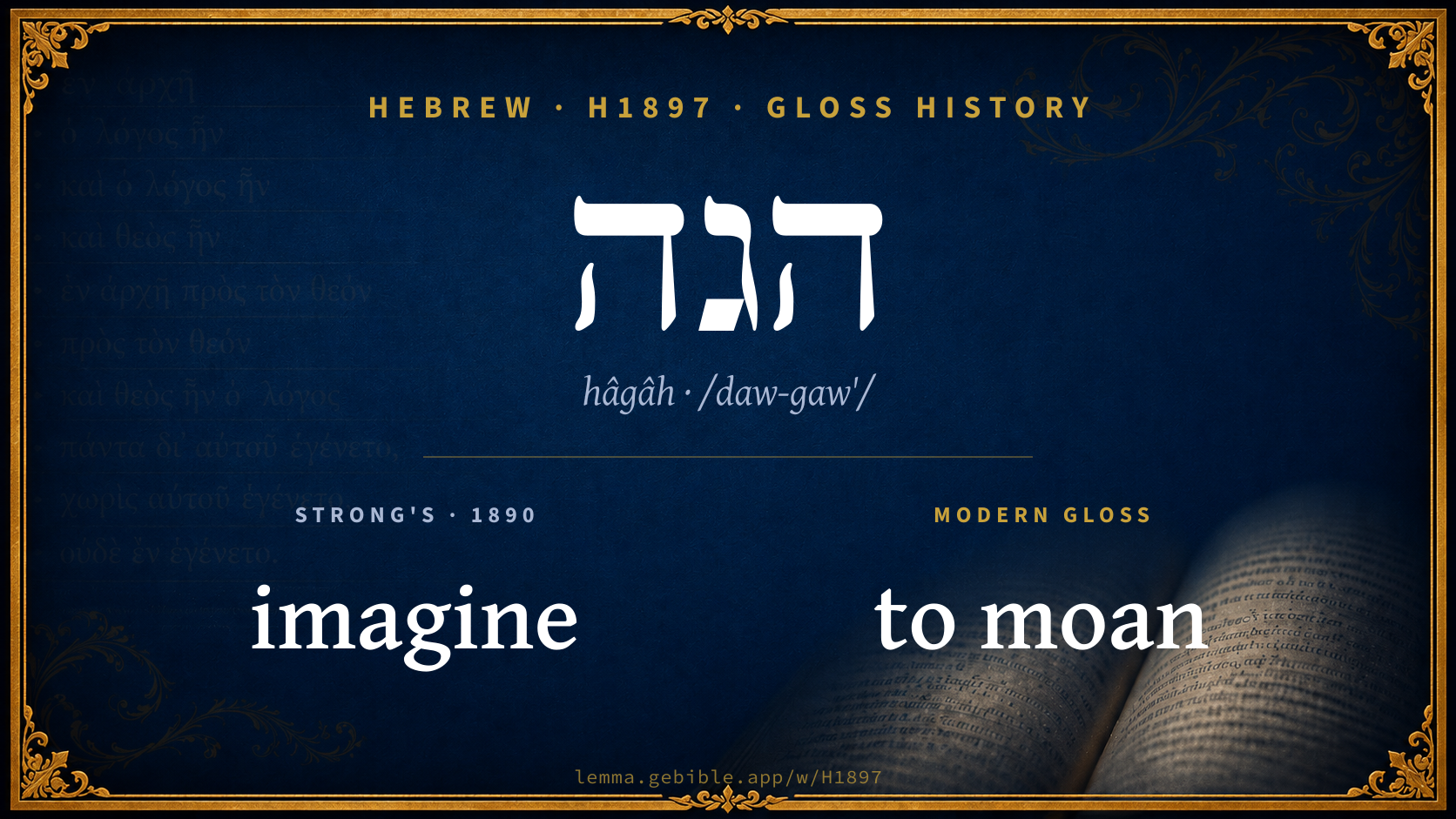
Gloss history
Strong's 1890 vs modern scholarship
About this word
Strong's H1897 catalogs a Hebrew word from the Hebrew Old Testament.
These counts are not copied from any lexicon or concordance. They are computed here, from the morphology-tagged Hebrew Old Testament. What Lemma adds →
- 24
- distinct verses
- The word appears in 24 distinct verses.
- 6 / 39
- OT books
- The word appears in 6 of 39 Old Testament books.
- #1,282
- by frequency
- Top 2500 most frequent Hebrew words (rank 1,282 of 8,640 Hebrew words by occurrence).
View all 24 occurrences in the concordance →
By section of the Old Testament
By traditional corpus
Conventional, traditional groupings — biblical authorship is debated, so this is a traditional corpus grouping, not an authorship claim. Each share is this word’s portion of its verses in that division of the Hebrew canon. Each figure is a share of the word’s 24 distinct verses.
- Writings (Ketuvim) 14 verses · 58%
- Prophets (Nevi'im) 10 verses · 42%
How translations render this word
Counts come from each version’s own published word-to-Strong’s tagging or interlinear alignment — an approximate guide to how each version renders this word, not a word-level alignment the data otherwise carries. Because each total is that version’s own tagged count, the per-version totals vary from one another and need not match the appearance or distinct-verse counts above. These counts may also differ from a printed concordance because Lemma counts each distinctly tagged rendering and does not collapse phrase taggings into a single head-word total. This is a fixed set of word-tagged versions (KJV, ASV, BSB, ULT) and does not change with the reading translation you choose elsewhere. Each version’s license is shown beside its name below (and on Sources).
BDB lists this Strong’s number as 2 distinct words (homographs). Each count above pools all of them and is not split by sense — see the Senses section below. A low-frequency rendering may belong to a different one of those words, not the primary meaning.
- King James Version†: Imagine 2×, Shall speak 2×, Studieth 2×
- American Standard Version†: Meditate 3×, Shall talk 2×, Studieth 2×
- Berean Standard Bible†: Moan 2×
- unfoldingWord Literal Text†: I meditate 2×, Murmuring 2×, Murmurs 2×
King James Version Public Domain
Renders H1897 across 25† tagged occurrences — most commonly:
Plus 19 renderings that appear only once — usually multi-word phrases or single function words the recovered tagging swept in, not distinct renderings.
American Standard Version Public Domain
Renders H1897 across 25† tagged occurrences — most commonly:
Plus 18 renderings that appear only once — usually multi-word phrases or single function words the recovered tagging swept in, not distinct renderings.
Berean Standard Bible Public Domain
Renders H1897 across 24† tagged occurrences — most commonly:
Plus 22 renderings that appear only once — usually multi-word phrases or single function words the recovered tagging swept in, not distinct renderings. Not rendered by a distinct English word in 1 further occurrence.
unfoldingWord Literal Text CC BY-SA 4.0
Renders H1897 across 26† tagged occurrences — most commonly:
Plus 18 renderings that appear only once — usually multi-word phrases or single function words the recovered tagging swept in, not distinct renderings.
10 senses and sub-senses in the full BDB
Hebrew verbs can shift meaning by stem (binyan): Qal is the basic action, Niphal is often passive or reflexive, Piel often intensifies or makes it factitive, and Hiphil is typically causative. The senses below are grouped under the stem BDB assigns to each. This entry also uses one or more reduplicated stems (the Pōlēl/Pilpēl type), which for hollow or geminate roots behave much like Piel — often intensive or iterative.
What do BDB’s symbols mean?
BDB uses these scholarly abbreviations:
| Symbol | Meaning |
|---|---|
| 𝔊 | the Septuagint (the ancient Greek translation, LXX) |
| 𝔙 | the Vulgate (the Latin translation) |
| 𝔖 | the Syriac version (the Peshitta) |
| 𝔗 | the Targum (the Aramaic translation) |
| ψ | the Psalms |
| √ | root (the underlying root or stem) |
| ‖ | parallel passage (a synonymous or contrasted parallel) |
| † | the dagger: every passage where the word occurs is cited |
The 10 senses and sub-senses the full Brown-Driver-Briggs lexicon distinguishes for this word, in lexicon order (not ranked by frequency), with BDB’s own verbatim wording and sub-sense lettering. Shown in Hebrew script with BDB’s own scholarly abbreviations. The condensed entry is in the Lexicon Entry tab. See also the Forms in the corpus table below.
הגה I moan, growl, utter, speak, muse (only poet.) (onomatop.
Qal
- Perf. 2 ms. וְהָגִ֫יתָ consec. Jos 1:8; 1 s. הָגִ֫יתִי ψ 143:5, וְהָגִיתִי consec. ψ 77:13; Impf. יֶהְגֶּה Jb 27:4 + 8 times; 3 fs. תֶּהְגֶּה ψ 35:28 + 2 times, אֶהְגֶּה ψ 63:7 Is 38:14, יֶהְגּוּ ψ 2:1 + 2 times, תֶּהְגּוּ Is 16:7; נֶהְגֶּ֑ה Is 59:11; Inf. abs. הָגֹה Is 59:11;— e.g. Joshua 1:8
- 1. of inarticulate sounds:
- a. growl, of lion growling over prey, sq. על Is 31:4. e.g. Isaiah 31:4
- b. groan, moan, in distress (like dove), abs., Is 38:14; 59:11 (הָגוֹ נֶהְגֶּה); sigh for (לְ) in sorrow, mourning, moan for Is 16:7 (‖ יְיֵלִיל לְ), so also Je 48:31. e.g. Isaiah 38:14
- 2. utter, sq. acc. rei, ψ 38:13; subj. לָשׁוֹן Jb 27:4 (‖ דִּבֶּר) ψ 35:28; 71:24 Is 59:3; subj. פֶּה ψ 37:30 Pr 8:7—cf. also sub Po. infr.; speak (abs.) ψ 115:7 (בְּ instr.) e.g. Psalms 38:13
- 3.
- a. (soliloquize) meditate, muse, c. בְּ rei, Jos 1:8 ψ 1:2; 63:7; 77:13; 143:5; c. acc. Is 33:18, subj. לֵב. e.g. Joshua 1:8
- b. imagine, devise, c. acc. ψ 2:1 Pr 24:2 (subj. לֵב); c. Inf. Pr 15:28 (subj. id.) e.g. Psalms 2:1
Po
- Inf. abs. only הֹרוֹ וְהֹגוֹ מִלֵּב דִּבְרֵי־שֶׁקֶר Is 59:13 a conceiving and an uttering, out of the heart, lying words (‖ דַּבֵּר עשֶׁק וְסָרָה);—on form cf. Köi 555; but read rather הָרוֹ וְהָגוֹ Qal Inf. abs. cf. Di; BaNB 77 retains MT & expl. as Qal Inf. pass. e.g. Isaiah 59:13
Hiphil
- Pt. pl. הַמְּצַפְצְפִים וְהַמַּהְגִּים Is 8:19 those that make chirpings and mutterings, of necromancers and wizards. e.g. Isaiah 8:19
הגה II remove (Thes comp. יגה)
Qal
- Pf. הָגָה Is 27:8 (Di reads הָגָהּ); Inf. abs. הָגוֹ Pr 25:4, 5;—הָגוֹ סִיגִים מִכָּ֑סֶף Pr 25:4 remove (lit. a removing) dross from silver; as sim. of following הָגוֹ רָשָׁע לִפְנֵי מֶלֶךְ Pr 25:5 remove (the) wicked before a king; הָגָה בְּרוּחוֹ הַקָּשָׁה Is 27:8, according to Di (v. supr.) he (י׳) hath removed her (i.e. sent into exile; his people under fig. of faithless wife) by his harsh wind; so transl. also Ew Che (he scared her away) Brd RV VB; De follows MT, regards as ellipt. rel. cl., and renders by ptcp., ‘sichtend (i.e. sifting, winnowing) heftigen Hauches,’ but conjectures הָגֹה (Inf. abs.) e.g. Isaiah 27:8
Senses from the full Brown-Driver-Briggs lexicon (Brown, Driver, Briggs; Oxford 1906 — public domain), digitized via Sefaria, supplemented by the OpenScriptures HebrewLexicon (CC BY 4.0). Full attribution on Sources.
Word origin
I. vb. moan, growl, utter, speak, muse (only poet.) (onomatop.; NH הָגָה muse, speak, spell a word, so Aramaic הֲגָא; ܗܓܳܐ muse, especially Ethpa.; Arabic هَجَا satirize, insult, scold, also spell (borrowed meaning))—
II. vb. remove (Thes comp. יגה)—
— Brown-Driver-Briggs (Oxford 1906, public domain), digitized via Sefaria, supplemented by the OpenScriptures HebrewLexicon (CC BY 4.0). See Sources.
Derived from הגיג (hâgîyg) (H1901) — murmuring.
Jastrow Dictionary
A second Hebrew/Aramaic lexicon for comparison, covering Aramaic and post-biblical (Talmudic, Targumic, Midrashic) usage that the biblical-Hebrew BDB does not. Matched by lemma rather than by Strong’s number, so a lemma may carry more than one Jastrow headword (shown separately below), and the entries cover usage well beyond the Bible.
הָגָה
- , v. הגי
הֶגֶה
- preced.) thought, study. Gen. R. s. 49 (ref. to Job XXXVII, 2) אין ה׳ אלא תורה hegeh (thought, speculation) means study of the Law. e.g. Job 37:2
הֵגֶה
- , v. הֵיגֶה
הגי
- v. אָגָא) [to point, pierce,]
- 1. to reason, argue, deduct. Koh. R. to I, 16 הלב הוֹגֶה the heart reasons (ref. to Ps. XLIX, 4 הָגוּת). Deut. R. s. 11 הוֹגֶיהָ those who study the Law, contrad. to עוֹשֶׂיהָ.—Y. Meg. I, 72ᵇ ה׳ נח תורה וכ׳ Noah deducted a new law from a given law. Gen. R. s. 49 שהוא הוגה בתורה וכ׳ who shall discuss the Law in seventy languages; a. fr. e.g. Psalms 49:4
- 2. to pronounce, recite, spell. Midr. Till. to Ps. XC, 9 (ref. to הֶגֶה, ib.) זה נער שהוא הוגה like a boy that spells (with difficulty). Snh. X (IX), 1 ההוגה וכ׳ he who pronounces the Divine Name as it is written, v. אָגָא. Koh. R. to XII, 12 (ref. to להג ib.) לֶהֱגוֹת ניתנו וכ׳ they are good for reading exercises but not for painful study; v. הִגָּיוֹן. Y. Meg. IV, 74ᵈ bot. לא יהא הוגה מפיו וקורא he must not spell (the letters of a Biblical book) from memory and dictate for writing a scroll.
- 3. to murmur a charm, v. Hif.
- to be spelled, read. Sabb. XII, 4; 5, נֶהֱגִין זה עם זה letters which can be read together (give sense).
- (also from יָגָה) to pierce, sting; ה׳ מכה to prickle, open a wound; trnsf. to lay bare a person’s disgrace. Lam. R. to I, 4 (interpret. נוגות, ib.) they assaulted her …, עד שהִגּוּ את מכתה and then laughed at her disgrace. Ib. to III, 33 (ref. to וַיַּגֶּה); Cant. R. to VII, 8.
- to murmur charms.—Part. מַהְגֶּה, pl. מַהְגִּים, מַהְגִּין. Sot. 12ᵇ (ref. to Is. VIII, 19) מַ׳ ואינן וכ׳ they murmur but know not what &c.; Ex. R. s. 1 הוֹגִין. Lev. R. s. 6 המ׳ אלו המנהמין hammahgin (Is. l. c.) that means the humming (sorcerers). e.g. Isaiah 8:19
A Dictionary of the Targumim, the Talmud Babli and Yerushalmi, and the Midrashic Literature (Marcus Jastrow; London, Luzac, 1903) — Public Domain. Digitized via Sefaria. Digitized via Sefaria. Full attribution on Sources.
Forms in the corpus
The 20 distinct written forms H1897 takes in the Hebrew Bible, most frequent first — each parse links to that stem’s occurrences in the concordance. Hebrew forms include their vowel points and cantillation, so a single lemma takes many written forms.
Same root — word family
Other BDB entries built from the same root as H1897, grouped by Strong’s listed origin. These share a root / origin per the lexicon — not necessarily a shared meaning. Each links to that word’s own entry.
Derives from
Derived from this word
- הגה hegeh H1899 moan
- הגות hâgûwth H1900 meditation
- הגיג hâgîyg H1901 murmuring
- הגיון higgâyôwn H1902 meditation
Compare all same-root words → Showing 4 of 5 — not the complete family. They share a root, not necessarily a meaning.
Septuagint verse parallels
This word appears in 20 verses that also exist in the Greek Old Testament (Septuagint), out of the 24 Hebrew verses it occurs in. You can read those verses in Greek by switching the Old Testament edition to the Septuagint.
Read these verses in the Septuagint
This is a verse-level parallel only — the same verses exist in both the Hebrew and Greek Old Testaments. No word-level Hebrew↔Greek correspondence is claimed: the data carries no such alignment, so no Greek word is shown as this Hebrew word’s translation. Coverage is not total — the Septuagint omits the deuterocanon and renumbers the Psalms, so some Hebrew verses have no direct Greek parallel.