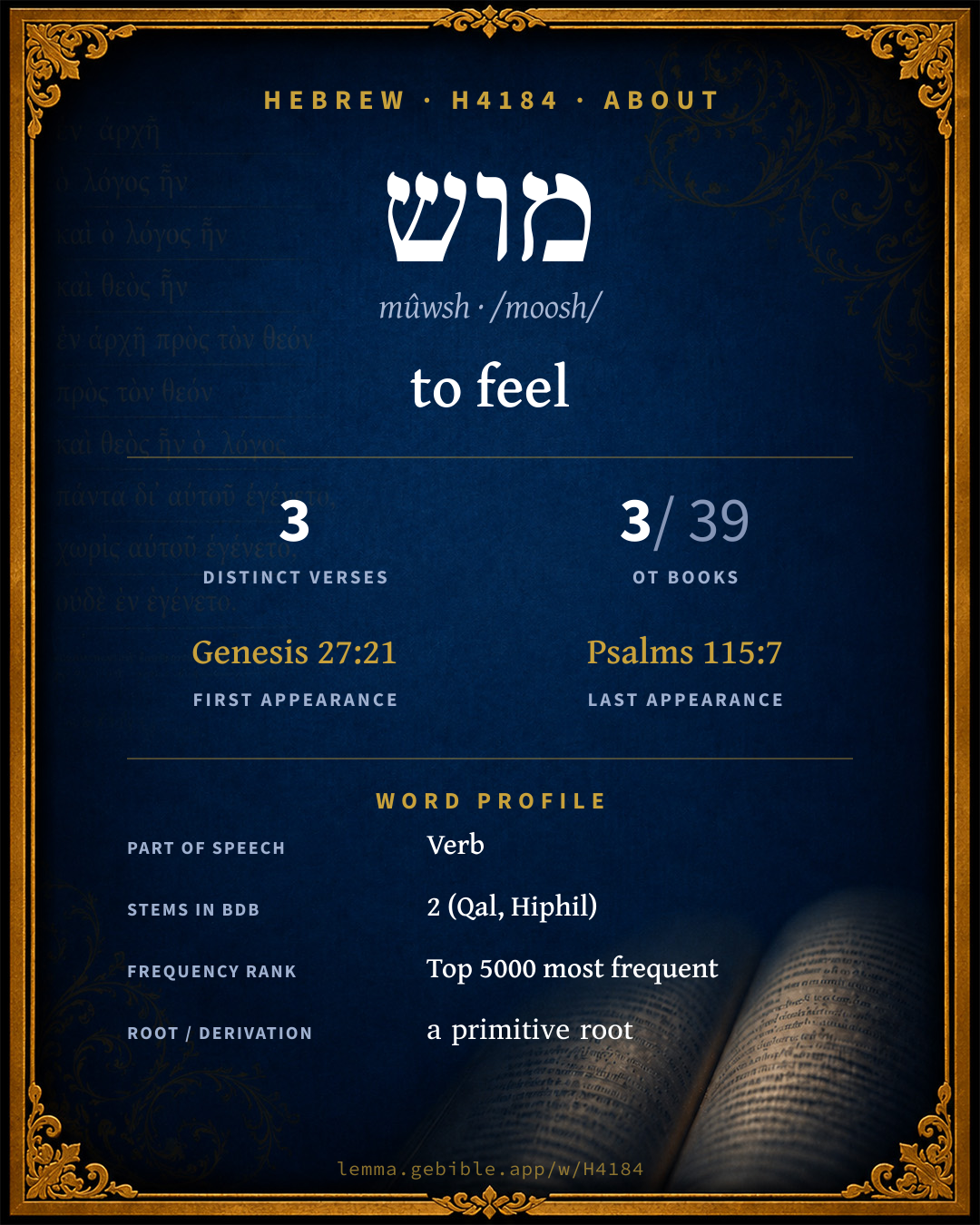
מוּשׁ
to feel
‘to feel’ is one of 3 main senses fuller range ↓
Full lexicon entry — Brown-Driver-Briggs (BDB)
From Brown-Driver-Briggs (BDB)
Where this word appears
See every Hiphil verb in the Hebrew Bible →
Grammar key — what these labels mean
Part of speech
- Verb
- An action or state-of-being word.
Stem
- Hiphil
- The causative active stem (“he caused / brought about”).
- Qal
- The basic, simple active stem — the plain form of the verb (“he wrote”). Here: ‘draw near that I may feel thee.’
Form
- Imperative
- A direct command (“write!”).
- Cohortative
- A first-person volitional form expressing wish or resolve (“let me / let us write”).
- Imperfect
- An incomplete, ongoing, or future action (“he will / would write”).
Person
- 2nd Person
- The one addressed (“you”).
- 1st Person
- The speaker (“I / we”).
- 3rd Person
- The one spoken about (“he / she / it / they”).
Gender
- Masculine
- Grammatically masculine.
- Common
- Either gender — not distinguished for this form.
Number
- Singular
- One.
- Plural
- More than one (in Hebrew, generally three or more).
Grammatical forms
- Verb, Hiphil, Imperative, 2nd Person, Masculine, Singular 1 time (33%)
- Verb, Qal, Cohortative, 1st Person, Common, Singular 1 time (33%)
- Verb, Hiphil, Imperfect, 3rd Person, Masculine, Plural 1 time (33%)
Parsed forms decoded from the imported morphology (morphhb / Westminster Leningrad Codex — WLC text public domain, morphhb tagging CC BY 4.0), counted across 3 parsed occurrences — not distinct verses.
Every verse where H4184 appears — 3 distinct verses across 3 books. Click any verse to open its interlinear word-by-word view. Verse text shown in the World English Bible for context — . Each verse’s Hebrew form is shown with its reference; the English is not keyword-highlighted, since the data carries no word-level English alignment. Use “Compare translations” on any verse to read it across multiple English versions. This concordance covers the Hebrew Bible; Septuagint (Greek Old Testament) occurrences are not indexed here.
Genesis 1 verse
Judges 1 verse
Psalms 1 verse
About this entry
At a glance — auto-summarized from this page’s data, not written by a person. Every figure links to its source below. This summary describes the numbers; it doesn’t interpret them.
“to feel” is the headline sense of the Hebrew verb מוש (mûwsh). A scarce word — 3 verses in all of the Hebrew Bible. More than a third of its appearances fall in Genesis. Its earliest occurrence is Genesis 27:21. As a verb its force shifts by stem, across 2 stems (Qal, Hiphil, and more). See the sense tree, 3-verse concordance, and the renderings breakdown below.
Gloss history
Strong's 1890 vs modern scholarship
About this word
Strong's H4184 catalogs a Hebrew word from the Hebrew Old Testament.
These counts are not copied from any lexicon or concordance. They are computed here, from the morphology-tagged Hebrew Old Testament. What Lemma adds →
- 3
- distinct verses
- The word appears in 3 distinct verses.
- 3 / 39
- OT books
- The word appears in 3 of 39 Old Testament books.
- #4,179
- by frequency
- Top 5000 most frequent Hebrew words (rank 4,179 of 8,640 Hebrew words by occurrence).
View all 3 occurrences in the concordance →
By section of the Old Testament
By traditional corpus
Conventional, traditional groupings — biblical authorship is debated, so this is a traditional corpus grouping, not an authorship claim. Each share is this word’s portion of its verses in that division of the Hebrew canon. Each figure is a share of the word’s 3 distinct verses.
- Torah (Pentateuch) 1 verse · 33%
- Prophets (Nevi'im) 1 verse · 33%
- Writings (Ketuvim) 1 verse · 33%
How translations render this word
Counts come from each version’s own published word-to-Strong’s tagging or interlinear alignment — an approximate guide to how each version renders this word, not a word-level alignment the data otherwise carries. Because each total is that version’s own tagged count, the per-version totals vary from one another and need not match the appearance or distinct-verse counts above. These counts may also differ from a printed concordance because Lemma counts each distinctly tagged rendering and does not collapse phrase taggings into a single head-word total. This is a fixed set of word-tagged versions (KJV, ASV, BSB, ULT) and does not change with the reading translation you choose elsewhere. Each version’s license is shown beside its name below (and on Sources).
- King James Version: I may feel 1×, I pray thee that i may feel 1×, They handle 1×
- American Standard Version: I may feel 1×, I pray thee 1×, They handle 1×
- Berean Standard Bible: Feel 1×, I can touch you 1×
- unfoldingWord Literal Text: Feel 1×, I can touch you 1×, They do 1×
King James Version Public Domain
Renders H4184 across 3 tagged occurrences — most commonly:
American Standard Version Public Domain
Renders H4184 across 3 tagged occurrences — most commonly:
Berean Standard Bible Public Domain
Renders H4184 across 2 tagged occurrences — most commonly:
unfoldingWord Literal Text CC BY-SA 4.0
Renders H4184 across 3 tagged occurrences — most commonly:
Senses in the full BDB
Hebrew verbs can shift meaning by stem (binyan): Qal is the basic action, Niphal is often passive or reflexive, Piel often intensifies or makes it factitive, and Hiphil is typically causative. The senses below are grouped under the stem BDB assigns to each.
What do BDB’s symbols mean?
BDB uses these scholarly abbreviations:
| Symbol | Meaning |
|---|---|
| 𝔊 | the Septuagint (the ancient Greek translation, LXX) |
| 𝔙 | the Vulgate (the Latin translation) |
| 𝔖 | the Syriac version (the Peshitta) |
| 𝔗 | the Targum (the Aramaic translation) |
| ψ | the Psalms |
| √ | root (the underlying root or stem) |
| ‖ | parallel passage (a synonymous or contrasted parallel) |
| † | the dagger: every passage where the word occurs is cited |
The 2 senses and sub-senses the full Brown-Driver-Briggs lexicon distinguishes for this word, in lexicon order (not ranked by frequency), with BDB’s own verbatim wording and sub-sense lettering. Shown in Hebrew script with BDB’s own scholarly abbreviations. The condensed entry is in the Lexicon Entry tab. See also the Forms in the corpus table below.
Qal
- draw near that I may feel thee.
Hiphil
- . as for their hands, they do not feel
Senses from the full Brown-Driver-Briggs lexicon (Brown, Driver, Briggs; Oxford 1906 — public domain), digitized via Sefaria, supplemented by the OpenScriptures HebrewLexicon (CC BY 4.0). Full attribution on Sources.
Word origin
Origin: a primitive root
Jastrow Dictionary
A second Hebrew/Aramaic lexicon for comparison, covering Aramaic and post-biblical (Talmudic, Targumic, Midrashic) usage that the biblical-Hebrew BDB does not. Matched by lemma rather than by Strong’s number, so a lemma may carry more than one Jastrow headword (shown separately below), and the entries cover usage well beyond the Bible.
מוּשׁ
- v. מָשַׁשׁ) to feel, touch.
- , part. pl. נְמוֹשׁוֹת [gropers, searchers,] the last troop of gleaners. Peah VIII, 1 משילכו הנ׳ from the time the last gleaners go. Y. ib. 20ᵈ למה נקרא שמן נ׳ … בסוף וכ׳ why are they called n’moshoth (searchers)? Because they come out last. Ib. אית תני׳ נ׳ וכ׳ (not נמושית) some read n’moshoth, others mashoshoth &c.; he who reads mash. calls them so, because they feel their way in walking (old people); B. Mets. 21ᵇ; Taan. 6ᵇ מאי נ׳ סבי וכ׳ what is meant by n’moshoth? Old men walking on a staff; (oth. opin.) לקוטי וכ׳, v. לָקוֹטָא. Y. Peah l. c. היה יוצא בין הנ׳ (not מן) used to go out among the last gleaners.
מוּשׁ ²
- 1. same. Targ. O. Gen. XXVII, 12; a. e.—2) (perh. fr. מְשַׁשׁ; cmp. משמש) to handle, attend to, prepare. M. Kat. 27ᵇ תֵּימוּשׁ האי איתתא וכ׳ (v. Rabb. D. S. a. l. note; ed. incorr.) let that woman have her shroud in readiness. B. Kam. 92ᵇ אוכפא לגביך מוֹשׁ prepare a saddle for thy back, v. אוּכָּפָא.
- to allow to touch. Targ. Jud. XVI, 26 ואֲמִישֵׁנִי (ed. Lag. ואמשני, v. מְשָׁא).
A Dictionary of the Targumim, the Talmud Babli and Yerushalmi, and the Midrashic Literature (Marcus Jastrow; London, Luzac, 1903) — Public Domain. Digitized via Sefaria. Digitized via Sefaria. Full attribution on Sources.
Forms in the corpus
The 3 distinct written forms H4184 takes in the Hebrew Bible, most frequent first — each parse links to that stem’s occurrences in the concordance. Hebrew forms include their vowel points and cantillation, so a single lemma takes many written forms.
| Form | Parsing | Example | Uses |
|---|---|---|---|
| וַ/אֲמֻֽשְׁ/ךָ֖ | Verb, Qal, Cohortative, 1st Person, Common, Singular | Genesis 27:21 | 1 |
| וַ/הֲמִשֵׁ֨/נִי֙ | Verb, Hiphil, Imperative, 2nd Person, Masculine, Singular | Judges 16:26 | 1 |
| יְמִישׁ֗וּ/ן | Verb, Hiphil, Imperfect, 3rd Person, Masculine, Plural | Psalms 115:7 | 1 |
Same root — word family
Other BDB entries built from the same root as H4184, grouped by Strong’s listed origin. These share a root / origin per the lexicon — not necessarily a shared meaning. Each links to that word’s own entry.
Derived from this word
Proper names from this root
People and places named from this root — a name, not an additional meaning of the word.
Compare all same-root words → 1 of the same-root words is a proper name (a person or place). They share a root, not necessarily a meaning.
Septuagint verse parallels
This word appears in 3 verses that also exist in the Greek Old Testament (Septuagint), out of the 3 Hebrew verses it occurs in. You can read those verses in Greek by switching the Old Testament edition to the Septuagint.
Read these verses in the Septuagint
This is a verse-level parallel only — the same verses exist in both the Hebrew and Greek Old Testaments. No word-level Hebrew↔Greek correspondence is claimed: the data carries no such alignment, so no Greek word is shown as this Hebrew word’s translation. Coverage is not total — the Septuagint omits the deuterocanon and renumbers the Psalms, so some Hebrew verses have no direct Greek parallel.