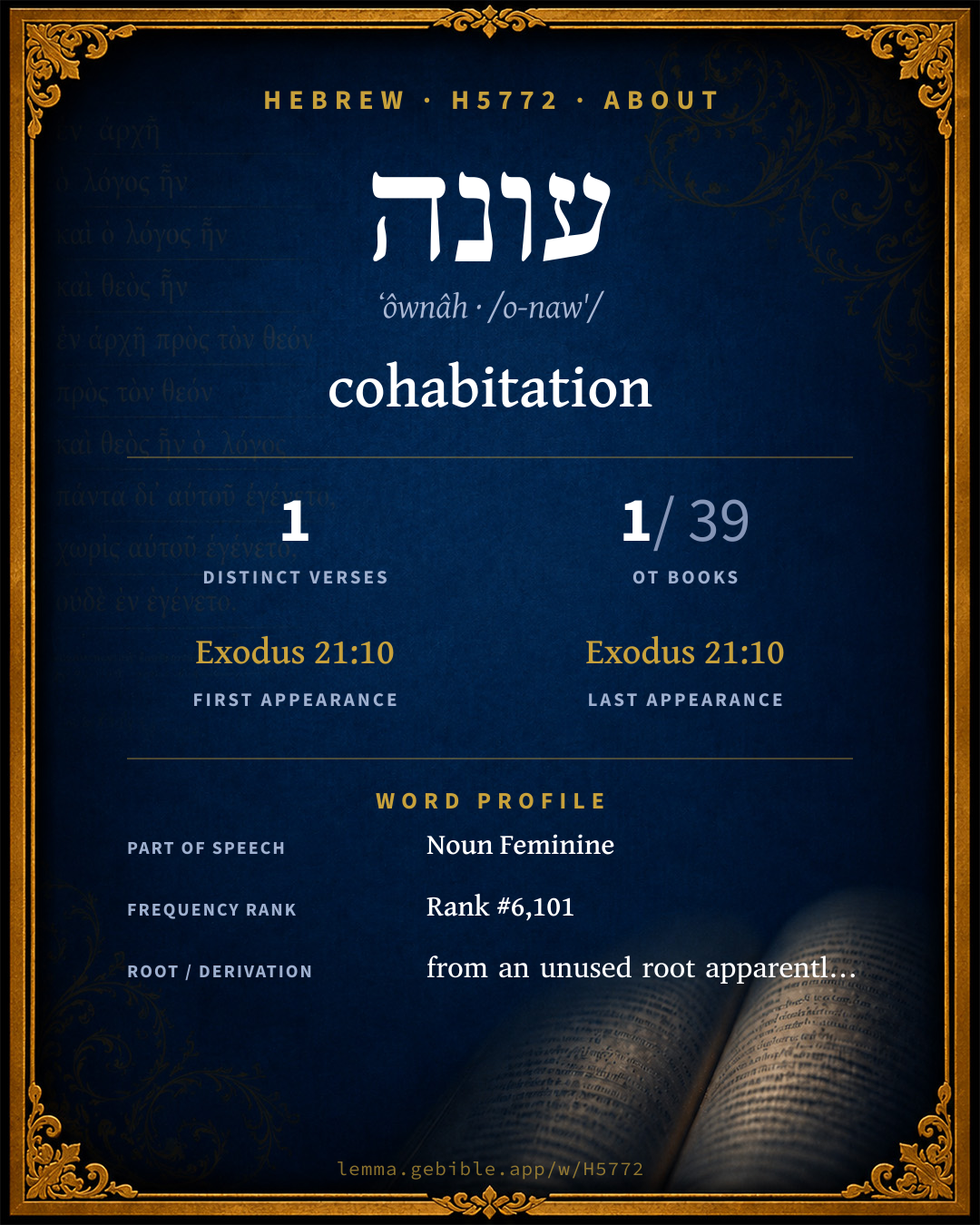
עֹנָה
cohabitation
Full lexicon entry — Brown-Driver-Briggs (BDB)
From Brown-Driver-Briggs (BDB)
Where this word appears
Grammar key — what these labels mean
Noun type
- Common
- A common noun — a general class of person, place, or thing (“king,” “city,” “water”), not a specific name.
State
- Construct
- A noun bound to a following noun in a possessive / “of” relationship (the construct chain).
Gender
- Feminine
- Grammatically feminine.
Number
- Singular
- One.
Every verse where H5772 appears — 1 distinct verse across 1 book. Click any verse to open its interlinear word-by-word view. Verse text shown in the World English Bible for context — . Each verse’s Hebrew form is shown with its reference; the English is not keyword-highlighted, since the data carries no word-level English alignment. Use “Compare translations” on any verse to read it across multiple English versions. This concordance covers the Hebrew Bible; Septuagint (Greek Old Testament) occurrences are not indexed here.
Exodus 1 verse
About this entry
At a glance — auto-summarized from this page’s data, not written by a person. Every figure links to its source below. This summary describes the numbers; it doesn’t interpret them.
“cohabitation” is the headline sense of the Hebrew noun עונה (ʻôwnâh). The Hebrew Bible uses it only 1 verse. It clusters heavily in Exodus, which alone accounts for 100% of its uses. Found nowhere else but Exodus 21:10. It clusters with מעון under a shared root. See the sense tree, 1-verse concordance, and the renderings breakdown below.
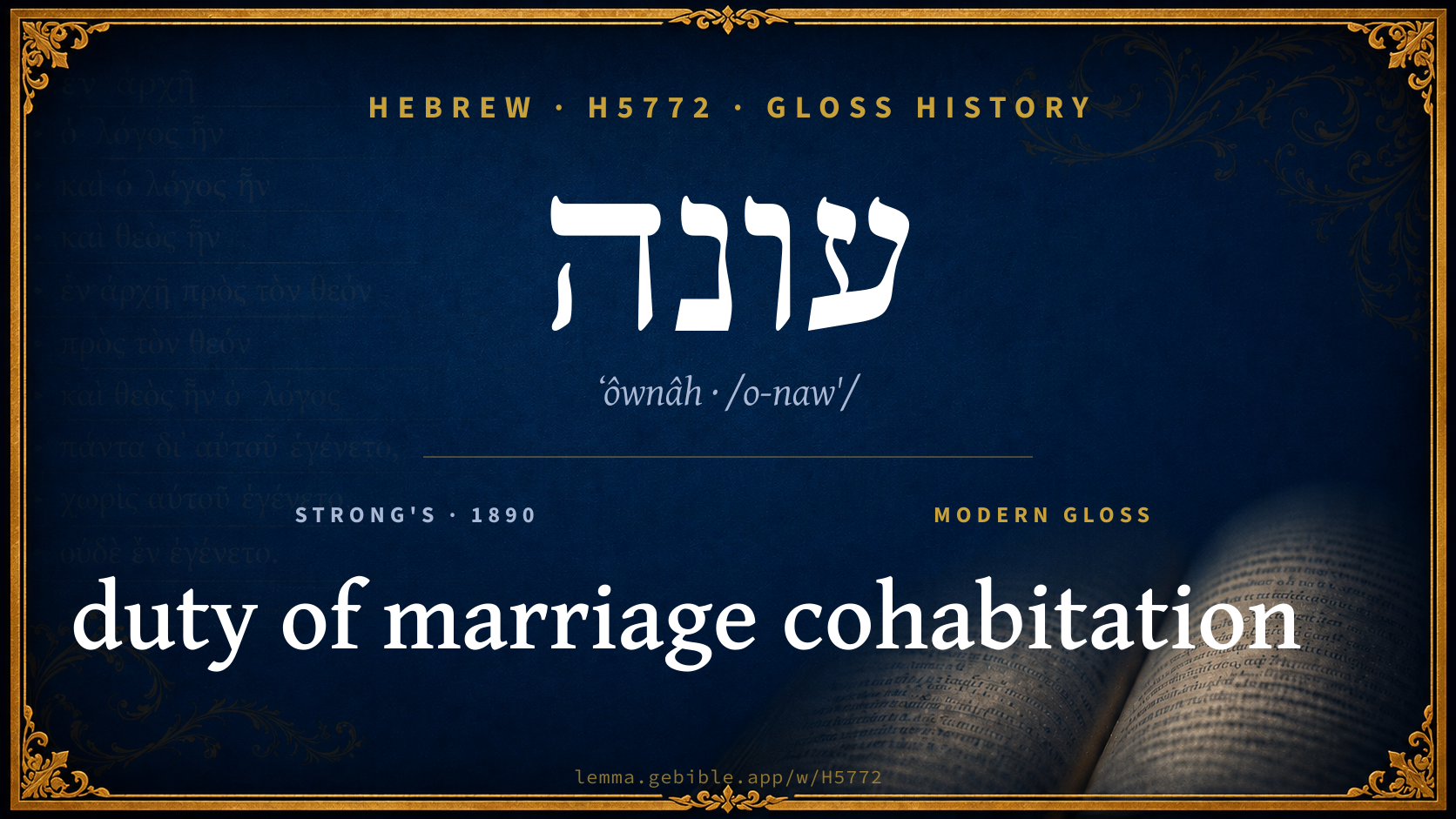
Gloss history
Strong's 1890 vs modern scholarship
About this word
Strong's H5772 catalogs a Hebrew word from the Hebrew Old Testament.
These counts are not copied from any lexicon or concordance. They are computed here, from the morphology-tagged Hebrew Old Testament. What Lemma adds →
- 1
- distinct verses
- The word appears in 1 distinct verse.
- 1 / 39
- OT books
- The word appears in 1 of 39 Old Testament books.
- #6,101
- by frequency
- Rank #6,101 (rank 6,101 of 8,640 Hebrew words by occurrence).
View all 1 occurrence in the concordance →
Most concentrated in
- Exodus 1 verse 100%
By section of the Old Testament
By traditional corpus
Conventional, traditional groupings — biblical authorship is debated, so this is a traditional corpus grouping, not an authorship claim. Each share is this word’s portion of its verses in that division of the Hebrew canon. Each figure is a share of the word’s 1 distinct verse.
- Torah (Pentateuch) 1 verse · 100%
How translations render this word
Counts come from each version’s own published word-to-Strong’s tagging or interlinear alignment — an approximate guide to how each version renders this word, not a word-level alignment the data otherwise carries. Because each total is that version’s own tagged count, the per-version totals vary from one another and need not match the appearance or distinct-verse counts above. These counts may also differ from a printed concordance because Lemma counts each distinctly tagged rendering and does not collapse phrase taggings into a single head-word total. This is a fixed set of word-tagged versions (KJV, ASV, BSB, ULT) and does not change with the reading translation you choose elsewhere. Each version’s license is shown beside its name below (and on Sources).
- King James Version: Duty of marriage 1×
- American Standard Version: Duty of marriage 1×
- Berean Standard Bible: Or marital rights 1×
- unfoldingWord Literal Text: Or her marital rights 1×
King James Version Public Domain
Renders H5772 across 1 tagged occurrence — most commonly:
American Standard Version Public Domain
Renders H5772 across 1 tagged occurrence — most commonly:
Berean Standard Bible Public Domain
Renders H5772 across 1 tagged occurrence — most commonly:
unfoldingWord Literal Text CC BY-SA 4.0
Renders H5772 across 1 tagged occurrence — most commonly:
Senses in BDB
The 1 sense BDB distinguishes for this word, in lexicon order (not ranked by frequency or importance). The full entry — with sub-senses — is in the Lexicon Entry tab.
- cohabitation, conjugal rights
Word origin
Origin: from an unused root apparently meaning to dwell together
Jastrow Dictionary
A second Hebrew/Aramaic lexicon for comparison, covering Aramaic and post-biblical (Talmudic, Targumic, Midrashic) usage that the biblical-Hebrew BDB does not. Matched by lemma rather than by Strong’s number, so a lemma may carry more than one Jastrow headword (shown separately below), and the entries cover usage well beyond the Bible.
עוֹנָה I
- (עָנָה I) [turn, circle, period,]
- 1. moment, esp. ‘Onah, the twenty-fourth part of an hour. Yalk. Deut. 942 ואין להרהר … אפי׳ ע׳ של כלום and you must not criticise God’s dealings with man even for a moment of the least duration; Sifré Deut. 307 (some ed. שנה, emended in ed. Fr. עוולה; corr. acc.). Tosef. Ber. I, 3 הע׳ … בשעה והעת … בע׳ an ‘Onah is the twenty-fourth part of an hour, and an ‘Eth the twenty-fourth part of an ‘Onah, and a Reg‘a. the twenty-fourth part of an ‘Eth; Y. ib. I, 2ᵈ top; Lam. R. to II, 18 (corr. acc.).
- 2. ‘Onah, a period of twelve astronomical hours, one half of the natural day and of the natural night, or (at solstice) natural day, or natural night. Y. Ab. Zar. V, end, 45ᵇ; Bab. Ab. Zar. 75ᵃ; Nidd. 65ᵇ. Y. Ab. Zar. l. c. כדי ע׳; Tosef. Toh. XI, 16 מלא ע׳ for the term of an ‘Onah; Ab. Zar. l. c. וכמה ע׳ how long? An ‘Onah. Yeb. 62ᵇ; Nidd. 63ᵇ וכמה … ע׳ and how long before?… An ‘Onah. Ib. ע׳ אחריתי an additional ‘O. (day or eventually night). Ib. 65ᵃ ע׳ שלמה a complete ‘O., expl. ib. לילה וחצי יום, expl. ib.ᵇ אי לילה וכ׳ either the space of one night at solstice, or half a day and half a night &c., in midsummer or midwinter; a. fr.—Pl. עוֹנוֹת. Mikv. VIII, 3; Tosef. ib. VI, 6; Sabb. 86ᵃ. Ib. 86ᵇ; Y. ib. IX, 12ᵃ top ע׳ שלמות full ‘Onahs (not counting fractions); a. fr.—4) due season, period, stage. Peah IV, 8 עד שלא באו לעוֹנַת המעשרות before the harvested products have arrived at the stage when they are subject to tithes; Maasr. V, 5. Y. M. Kat. III, 83ᵃ top עוֹנַת קרית שמע the time of the day for reading the Sh’m‘a. Y. Shek. I, beg. 45ᵈ כדי שיביאו … בעוֹנָתָן so that the Israelites might deliver their Shekels in due time. Y. Erub. VIII, end, 25ᵇ אם עונת הגשמים היא if it is during the rainy season; Y. Kil. IX, 32ᵃ. Y. Ber. II, 5ᶜ top בעל התאנה … עוֹנָתָהּ וכ׳ the owner of the fig tree knows when it is time for the figs to be picked; כך הקב"ה … עוֹנָתָן של וכ׳ so does the Lord know when it is time for the rightheous to be called away; Cant. R. to VI, 2. Y’lamd. to Num. XXIII, 10, quot. in Ar. עונת אשה marriageable age, v. עוֹפֶר; a. v. fr.—Esp. (b. h. עֹנָה) the duty of marital visits at certain intervals, marital duty. Keth. V, 6 הע׳ האמורה בתורה וכ׳ the time for marital duties intimated in the Law (Ex. XXI, 10) is: for men of leisure &c.; Gen. R. s. 76; Yalk. ib. 131. Sabb. 118ᵇ למימרא … מצות ע׳ לא קיים does this mean that R. J. neglected the regulations concerning the marital duty? Keth. 62ᵇ; a. fr.—Mekh. Mishp., s. 3 (ref. to Ex. l. c.) ועוֹנָתָהּ זו דרך ארץ her ‘onah refers to marital visits; [oth. opin.: ועונתה לא יתן וכ׳ her ‘onah means, he must not give her summer apparel in winter &c., but כל אחד ואחד בעונתה each in its due season; anoth. opin.: עונתה זו מזונה her ‘onah means her sustenance (with ref. to ויענך Deut. VIII, 3; v. next w.); Keth. 47ᵇ; Y. ib. V, 30ᵇ top.] e.g. Exodus 21:10
עוֹנָה II
- (עָנָה II; cmp. עִינּוּי) trouble, suffering. Sifra B’ḥuck., Par. 2, ch. VIII (play on יען וביען, Lev. XXVI, 43) ע׳ של מדבר (Yalk. Lev. 675 עוֹנוֹת) the privations in the desert; ע׳ של בעל פעור (Yalk. l. c. של פעור) the suffering attendant upon the worship of Baal (Num. XXV, 3, Ps. CVI, 28, sq.); ע׳ של מלכי האמורי the suffering from the Emorite kings (Jud. II, sq.).—Pl. עוֹנוֹת. Lev. R. s. 17 (play on ח̇ר̇צ̇ב̇ות, Ps. LXXIII, 4, v. הִרְהֵר) ולא צ̇ב̇יתים בע׳ I did not make them swell from sufferings; ib. אין להם ציבים של ע׳ וכ׳ they (the wicked) have no swellings (accumulations) of sufferings with which they die (so as to atone for their sins) &c.; Yalk. Ps. 808. e.g. Leviticus 26:43
עוֹנָה III
- (denom. of עַיִן)
- 1. sight or affliction of the eye. Men. 64ᵇ, v. next w.
- 2. shade of color, pattern (in weaving, v. Sm. Ant. s. v. Tela).—Pl. עוֹנוֹת. Lev. R. s. 17 [read:] אלו לציבים ולע׳ (v. Ar. s. v. אספריטין, where our w. reads: ולעֵינוֹת) these (the coarse threads) are used for tassels and for producing (raised) patterns; Yalk. Ps. 808 לצביתים ולעֵנוֹת.
עוֹנָה IV
- (denom. of עַיִן; cmp. Arab.‘âna manare) welling, flux. Men. 64ᵇ a woman said, I am offering a sacrifice לעוֹנָתִי after my recovery from flux, סבור מינה … לעוֹנָתָהּ ממש (v. Rabb. D. S. a. l.) which they understood to mean really for her flux, when the suggestion was offered, שמא בעינה סיכנה (v. preced.) perhaps she was in danger of losing her eye-sight; Y. Shek. V, 48ᵈ לעֵינָתִי, interpreted שופעת כמעיין, v. שָׁפַע.—[Rashi, ignoring Y. Shek. l. c., takes our w. in the sense of due season for a sacrifice, v. עוֹנָה.]—[Tosef. M. Kat. I, 2 עונתו של מים, v. עוּגָּה.]
צִיב
- (= צביב; צבב, cmp. צָבָה) l) swelling. —Pl. צִיבִּים, צִיבִּין. Lev. R. s. 17, v. עוֹנָה II; Yalk. Ps. 808 צוּבִּ׳.—2) tuft, tassel. Ḥull. IX, 4 צ׳ היוצא ממנו the tassel that proceeds from it (the tassel-like ends of a hide).—Pl. as ab. Lev. R. l. c., v. עוֹנָה III; Yalk. Ps. l. c. צביתים (corr. acc. or צְבִיבִים).
A Dictionary of the Targumim, the Talmud Babli and Yerushalmi, and the Midrashic Literature (Marcus Jastrow; London, Luzac, 1903) — Public Domain. Digitized via Sefaria. Digitized via Sefaria. Full attribution on Sources.
Same root — word family
Other BDB entries built from the same root as H5772, grouped by Strong’s listed origin. These share a root / origin per the lexicon — not necessarily a shared meaning. Each links to that word’s own entry.
Derived from this word
Compare all same-root words → They share a root, not necessarily a meaning.
Septuagint verse parallels
This word appears in 1 verse that also exists in the Greek Old Testament (Septuagint), out of the 1 Hebrew verse it occurs in. You can read those verses in Greek by switching the Old Testament edition to the Septuagint.
Read these verses in the Septuagint
This is a verse-level parallel only — the same verses exist in both the Hebrew and Greek Old Testaments. No word-level Hebrew↔Greek correspondence is claimed: the data carries no such alignment, so no Greek word is shown as this Hebrew word’s translation. Coverage is not total — the Septuagint omits the deuterocanon and renumbers the Psalms, so some Hebrew verses have no direct Greek parallel.