
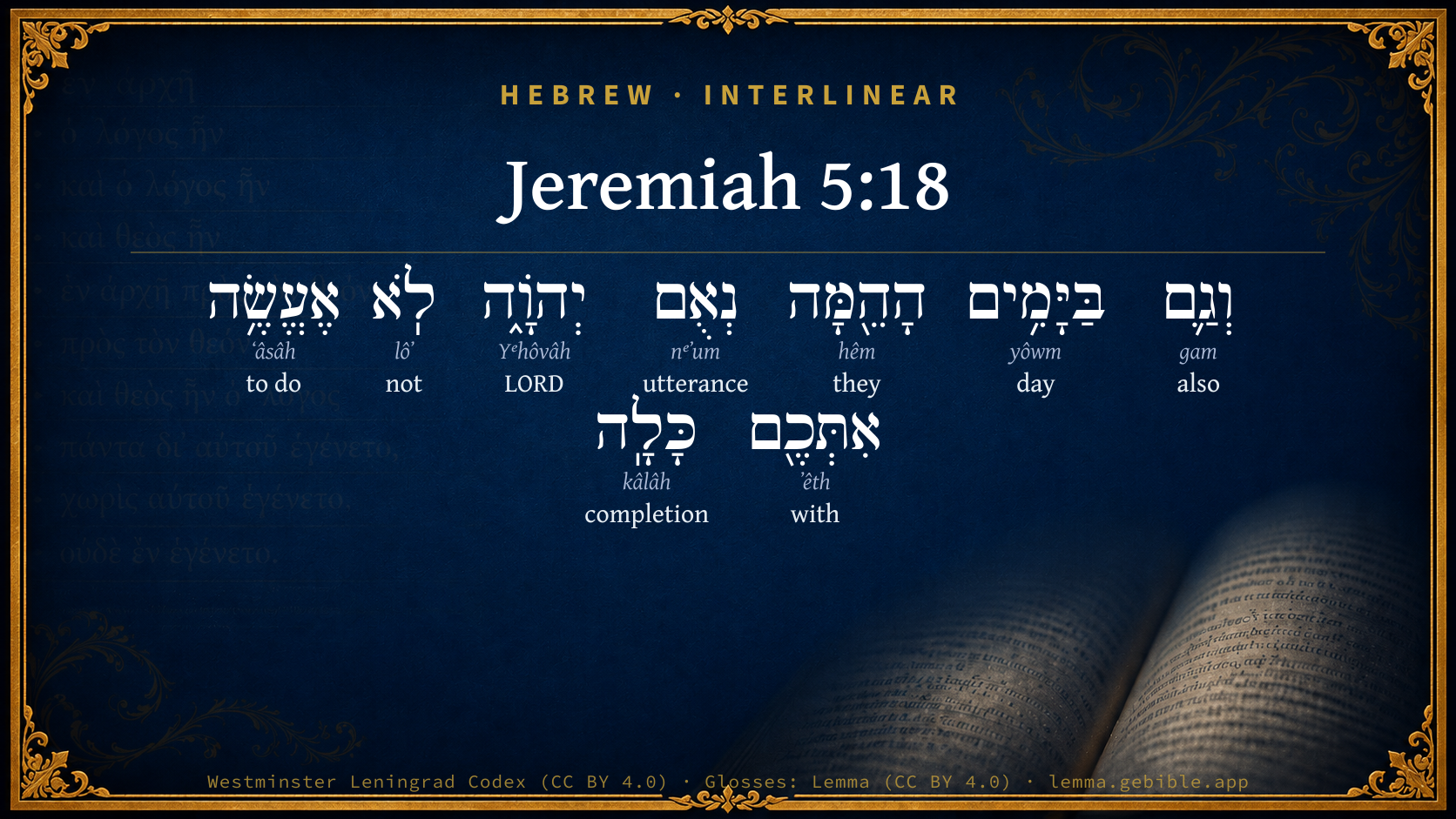
Jeremiah 5:18

Hebrew (Westminster Leningrad Codex) Jeremiah 5:18 appears in the Hebrew Old Testament. The text above is from the Westminster Leningrad Codex. Each word links to its Strong’s number, a concise gloss, and parsing drawn from the Open Scriptures Hebrew Bible morphology. Click any word for its full Brown-Driver-Briggs (BDB) entry.
Download image
Cite this verse

Jeremiah 5:18 (World English Bible). Public Domain. Lemma interlinear Bible study tool, https://lemma.gebible.app/v/jeremiah/5/18.

Show BibTeX & RIS
BibTeX
RIS
English Translation
But even in those days, says Yahweh, I will not make a full end with you.
World English Bible · Public Domain
Download a study sheet

One document with this verse’s original text, its word-by-word gloss line, the meaning frame, cross-references with their text, attributed commentary, and full source and license credits — printable, and it pastes into notes with its structure intact.

This verse Autodidact and up

Study sheet (.html) Plain text (.txt)

A passage Seminary Student

Up to 50 verses in one chapter. A passage sheet keeps up to 6 commentary sources and 12 cross-references per verse, in the order this page ranks them, and says so on the sheet whenever that leaves anything out. Ask for a single verse and you get the Autodidact verse sheet above.

Everything on this page stays free to read, with no account — the sheet is a download of what is already on screen, not access to it.

Want to remove ads? Support Godless Engineer
Compare translations 3

The same verse in 3 English versions, stacked beneath the original-language interlinear above. Click any original word for its lexicon entry.

Each is an independent rendering of the whole verse — the interlinear is not word-aligned to these translations.

Highlighted words mark where these versions differ — a whole-verse word diff, not a word-by-word alignment.

  • World English Bible Public Domain
    But even in those days, says Yahweh, I will not make a full end with you.
  • King James Version Public Domain
    Nevertheless in those days, saith the LORD, I will not make a full end with you.
  • unfoldingWord Literal Text CC BY-SA 4.0
    But even in those days—the declaration of Yahweh—I shall not make of you a complete end.

unfoldingWord Literal Text — © unfoldingWord, licensed CC BY-SA 4.0. Word-aligned USFM3 via Door43 (git.door43.org/unfoldingWord/en_ult).

Versions to compare (up to 4)

3 of 4 selected

Show all 18 translations

Every available English version of this verse, each an independent rendering of the whole verse.

  • World English Bible Public Domain
    But even in those days, says Yahweh, I will not make a full end with you.
  • Berean Standard Bible Public Domain
    “Yet even in those days,” declares the LORD, “I will not make a full end of you.
  • Majority Standard Bible Public Domain
    “Yet even in those days,” declares the LORD, “I will not make a full end of you.
  • King James Version Public Domain
    Nevertheless in those days, saith the LORD, I will not make a full end with you.
  • American Standard Version (1901) Public Domain
    But even in those days, saith Jehovah, I will not make a full end with you.
  • Revised Version (1885) Public Domain
    But even in those days, saith the LORD, I will not make a full end with you.
  • Geneva Bible (1599) Public Domain
    Neuerthelesse at those dayes, sayth the Lord, I will not make a full ende of you.
  • Douay-Rheims (1899) Public Domain
    Nevertheless in those days, saith the Lord, I will not bring you to utter destruction.
  • Young's Literal Translation Public Domain
    And even in those days, an affirmation of Jehovah, I do not make you a completion.
  • Literal Standard Version CC BY-SA 4.0
    And even in those days,” || A declaration of YHWH, || “I do not make you a completion.
  • Unlocked Literal Bible CC BY-SA 4.0
    But even in those days—this is Yahweh's declaration—I do not intend to destroy you completely.
  • unfoldingWord Literal Text CC BY-SA 4.0
    But even in those days—the declaration of Yahweh—I shall not make of you a complete end.
  • Darby Bible Public Domain
    Nevertheless in those days, saith Jehovah, I will not make a full end with you.
  • World Messianic Bible Public Domain
    “But even in those days,” says the LORD, “I will not make a full end of you.
  • Webster's Bible Public Domain
    Nevertheless in those days, saith the LORD, I will not make a full end with you.
  • Free Bible Version CC BY-SA 4.0
    But even at that time I won't completely destroy you, declares the Lord.
  • Bible in Basic English Public Domain
    But even in those days, says the Lord, I will not let your destruction be complete.
  • JPS Tanakh (1917) Public Domain
    But even in those days, saith the LORD, I will not make a full end with you.

Literal Standard Version (2020), Covenant Press — licensed CC BY-SA 4.0. Text via the HelloAO Bible API (eBible.org). Unlocked Literal Bible (unfoldingWord) — licensed CC BY-SA 4.0. Text via the HelloAO Bible API (eBible.org). unfoldingWord Literal Text — © unfoldingWord, licensed CC BY-SA 4.0. Word-aligned USFM3 via Door43 (git.door43.org/unfoldingWord/en_ult). Free Bible Version, Dr. Jonathan Gallagher — licensed CC BY-SA 4.0. Text via the HelloAO Bible API (eBible.org).

Word by word

More ways to search: Search by grammar → Find every occurrence → Compare this word →

Practice this passage: Drill this verse → Learn its vocabulary →

About this verse

These counts appear in no published source. They are computed here, from the morphology-tagged text and Lemma’s own curated glosses. What Lemma adds →

9
words
9
distinct lemmas
Prophets
section

Notable vocabulary

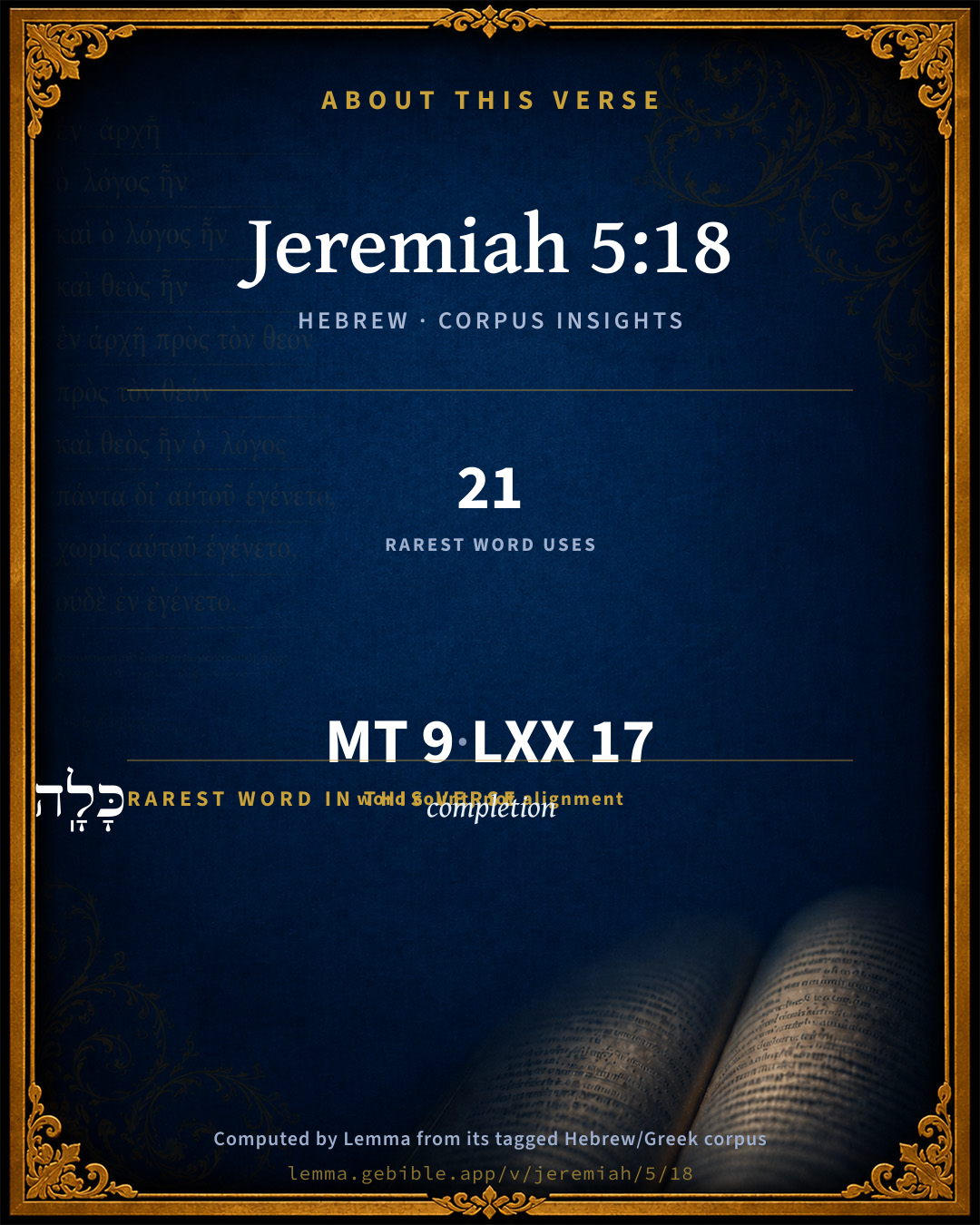
The rarest word here is כָּלָֽה completion H3617 — appearing just 21 times in the whole Hebrew Bible.

Shared distinctive vocabulary

כָּלָֽה completion H3617 occurs in 19 verses of the Hebrew Bible. Also found in:

Grammatical profile

  • 1 verb
  • 4 nouns
  • 1 pronoun
  • 1 preposition
  • 2 particles

Verb forms

  • אֶעֱשֶׂ֥ה Qal · Imperfect

Hebrew & Septuagint length

In the original languages it is 9 Hebrew tokens and 17 Greek tokens — but the two are counted differently (Hebrew bundles its prefixes and suffixes into one token; the Greek is in lemma form), so that isn’t a like-for-like length.

Cross-references

5

Topical passages linked to Jeremiah 5:18 in the Treasury of Scripture Knowledge — connected by theme and wording, ordered by reader-vote popularity; previews shown in the World English Bible.

  • Jeremiah 5:10 Go up on her walls, and destroy; but don't make a full end: take away her branches; for they are not Yahweh's.
  • Jeremiah 4:27 For thus says Yahweh, The whole land shall be a desolation; yet will I not make a full end.
  • Romans 11:1–5 I ask then, Did God reject his people? May it never be! For I also am an Israelite, a descendant of Abraham, of the tribe of Benjamin.
  • Ezekiel 9:8 It happened, while they were smiting, and I was left, that I fell on my face, and cried, and said, Ah Lord Yahweh! will you destroy all the residue of Israel in your pouring out of your wrath on Jerusalem?
  • Ezekiel 11:13 It happened, when I prophesied, that Pelatiah the son of Benaiah died. Then fell I down on my face, and cried with a loud voice, and said, Ah Lord Yahweh! will you make a full end of the remnant of Israel?

Cross-references courtesy of OpenBible.info (CC BY 4.0).

Hebrew and Greek witnesses Masoretic Hebrew ↔ Greek Septuagint

The same verse in the two great witnesses to the Old Testament, shown verse-for-verse.

These are two independent witnesses, not word-aligned to each other, and the Septuagint is shown in lemma (dictionary) form.

Hebrew Jeremiah 5:18 Masoretic · Westminster Leningrad Codex

וְגַ֛ם בַּיָּמִ֥ים הָהֵ֖מָּה נְאֻם יְהֹוָ֑ה לֹֽא אֶעֱשֶׂ֥ה אִתְּכֶ֖ם כָּלָֽה

But even in those days, says Yahweh, I will not make a full end with you.

World English Bible · Public Domain

Greek LXX Structure differs

In the Septuagint, Jeremiah is about an eighth shorter than the Hebrew and arranges its material differently — the Oracles Against the Nations (Hebrew chapters 46–51) appear in the middle of the Greek book, after 25:13. Because the chapter and verse boundaries do not line up, a verse-for-verse comparison with the Hebrew is not shown.

A verse-for-verse comparison isn’t shown here because the chapters and verses don’t line up. Switch to the LXX edition with the MT / LXX toggle above to read the Greek directly.

Hebrew: Westminster Leningrad Codex (CC BY 4.0). Greek: Septuagint (public domain); English from a public-domain English Septuagint. How the Septuagint differs from the Hebrew →

Targum (Aramaic paraphrase)

1

The Targum is the ancient Jewish Aramaic paraphrase of the Hebrew Scriptures — an interpretive translation, not the Hebrew text itself. Onkelos (literal) and Pseudo-Jonathan (expansive) render the Torah, and Jonathan the Prophets. Coverage is partial: where no permissively-licensed English translation exists for a verse, only the Aramaic is shown. This is verse-level text, not a word-by-word alignment to the Hebrew.

  1. Targum Jonathan Prophets (Joshua–Malachi)
    וְאַף בְּיוֹמַיָא הָאִינוּן אֲמַר יְיָ לָא אַעְבֵּיד עִמְכוֹן גְמִירָא:

    (no public-domain English translation for this verse)

    Targum Jonathan — Aramaic: “Mikraot Gedolot” (public domain). English: “Sefaria Community Translation” (CC0 1.0 (public-domain dedication)); “London "Chaldee Paraphrase," 1871” (public domain). Text via Sefaria.

Commentary

Notes on Jeremiah 5:18 from classic Christian and Jewish commentators (each source and its license shown beneath its notes). The classic Christian expositions comment on the surrounding passage and are grouped to its opening verse, so a note may address several verses; the Jewish commentaries on the Tanakh (Rashi and others) are per-verse, so they appear only where the commentator wrote on this verse.

Lemma curates 59 commentaries, every one of them public domain or Creative Commons licensed, each selected and text-cleaned for this edition rather than reprinted as found. About our sources →

Trapp's Complete Commentary

John Trapp

Jer 5:18 Nevertheless in those days, saith the LORD, I will not make a full end with you.

Ver. 18. I will not make a full end with thee.] In the midst of judgment, God remembereth mercy. See Jer 4:27; Jer 5:10. Howbeit, from this text some gather, that now in this last captivity of theirs, God hath made a full end with the Jews, and that "wrath is come upon them to the utmost," or to the end εις τελος, as the Greek hath it. {1Th 2:16}

John Trapp, A Commentary or Exposition upon All the Books of the Old and New Testament (1647–1656) — public domain. Text from a community e-Sword module.

Tyndale Open Study Notes

Tyndale Open Resources

5:18-19 The Lord comforted Jeremiah with the knowledge that the destruction would not be total, and he prepared the prophet to respond to those who wondered why the Lord would bring such severe judgment upon them.

Tyndale Open Study Notes — © Tyndale Open Resources, licensed CC BY-SA 4.0. Text via the HelloAO Bible API.

Geneva Bible (1599)

Geneva Bible translators

Here the Lord declareth his unspeakable favor toward his Church, as Jer. 4:27.

Geneva Bible (1599) marginal notes — public domain. Text via Bolls.life.

Jamieson, Fausset & Brown

Robert Jamieson, A. R. Fausset & David Brown

Not even in those days of judgments, will God utterly exterminate His people.

I will not make a full end with you-- (Jer 5:10; Jer 4:27).

Jamieson, Fausset & Brown — Commentary Critical and Explanatory on the Whole Bible (1871) — public domain (CC PDM 1.0). Text via the HelloAO Bible API.

Adam Clarke's Commentary

Verse 18. I will not make a full end] There are more evils in store for you. You shall not only be spoiled, and all your property destroyed, but ye shall be carried into captivity; and ye shall serve strangers in a land that is not yours, Jer 5:19.

Adam Clarke's Commentary on the Bible (1810–1826) — public domain. Text from a community e-Sword/MySword module.

John Calvin's Commentaries

Different views may be taken as to the meaning of this verse; but the greater part of interpreters think that a hope is here given to the faithful; yea, nearly all are of this opinion; indeed I know not any one who takes another view. They then think that God moderates here what he had previously said, and that he gives some ground of hope to his servants, lest they should imagine that the Church would be so reduced as to have no seed remaining: and כלה, cale, as it was said yesterday, is often taken in this sense. But when I now carefully consider the context, I feel constrained to take another view, even this — that God here enhances the severity of his vengeance. And the particle גם, gam, “also, “or even, favors this view; as though he had said, “Think not that it will be all over when your enemies shall thus plunder you of all your possessions, deprive you of your children, and reduce you to extreme want; for ye shall not by any means be thus freed from all evils, as I shall pursue my vengeance still further.” There will hereafter follow promises to moderate threatenings, that the hearts of the faithful may not despond: but in this place the Prophet, I have no doubt, introduces God as a Judge, executing vengeance, as though there was no place for mercy.

Then also, he says; for the particle גם, gam, is inhansive and emphatic; Then also, in those days; that is, “When your enemies shall strip your land of its produce, and of all its animals, and of its inhabitants, I shall not even then cease to pursue you: I will not make an end with you, for there will still remain scourges, when ye shall think that rest is given to you, and that the end of evils and of all calamities had come.” In this manner is God wont to deal with the impenitent; for such is their perverseness, that being smitten they become more and more hardened, and champ the bit, according to the old proverb. And hence is their hardness, because they think that God is, as it were, disarmed when he has punished them for their sins. He therefore declares that he has in his power different kinds of punishment and different ways of punishing. And to the same purpose is what follows —

John Calvin's Commentaries (1540-1563) — public domain. Text from the Calvin Translation Society English edition (1840s-50s) via the Christian Classics Ethereal Library (ccel.org). Calvin's coverage is partial (roughly two-thirds of the Bible); uncommented books and verses are honest gaps, never fabricated. The 19th-century editor's footnotes and remarks are omitted so the notes are faithfully Calvin's own voice.

Ellicott's Commentary for English Readers

(18) I will not make a full end.—As before, in Jer_4:27, and in this chapter, Jer_5:10, what seems the extremest sentence is tempered by the assurance that it is not absolutely final. It is intended to be reformatory, and not merely penal.

A Bible Commentary for English Readers, edited by Charles John Ellicott (1878–1897) — public domain. Text from a community e-Sword module.

The Cambridge Bible for Schools and Colleges

gen. ed. J. J. S. Perowne

18. Du. for metre and style excludes the whole remainder of the ch. from Jeremiah’s authorship. Without such drastic treatment of the text, we may yet hesitate to accept this v. as it seems an unwarranted interruption of the sequence of thought. See on Jer_4:27.

The Cambridge Bible for Schools and Colleges (gen. ed. J. J. S. Perowne; Cambridge University Press, 1878–1918) — public domain. Text from a community e-Sword module.

John Gill's Exposition

Nevertheless, in those days,.... When these things should be done by the king of Babylon and his army:

saith the Lord, I will not make a full end with you: this was to be done at another time, not now; See Gill on Jer 4:27, Jer 5:10, though some think that this is a threatening of more and greater calamities; that this would not be all he would do to them; he had not yet done; he had other evils and calamities, to bring upon them, particularly a long captivity.

John Gill's Exposition of the Whole Bible (1746–1763) — public domain (CC PDM 1.0). Text via the HelloAO Bible API.

Matthew Poole's English Annotations

See this verse explained Jer 4:27, save only that I think here it is taken in the first sense there mentioned; for it is not said only, as in that verse,

I will not make a full end, or a full end of you, but a full end with you: q.d. I have not done with you yet. See Lev 26:14-40.

Matthew Poole's English Annotations on the Holy Bible (1683–1685) — public domain. Text from a community e-Sword/MySword module.

Whedon's Commentary on the Bible

Daniel D. Whedon

18. Not make a full end — How often does this merciful refrain come in!

Daniel D. Whedon (gen. ed.), Commentary on the Old and New Testaments (1874–1909) — public domain. Text from a community e-Sword module.

The Pulpit Commentary

Sparing mercy.

The judgments described as about to be inflicted are very fearful, but they were amply deserved. The wickedness of the people was such as to justify their complete destruction. Yet they were spared ere they were totally extinct! Why this unlooked-for restraint?

I IT HAS CHARACTERIZED ALL GOD"S JUDGMENTS OF MANKIND ON EARTH. The Fall, the Flood, the Exodus, etc., the sparing of the remnant of Benjamin, etc.

II THERE IS BUT ONE EXPLANATION FOR IT. It is the possibility of some turning to him truly in the first instance; and, secondly, through them, of the race being saved in the future. God has never utterly cut off even the most sinful. Love, and not. mere vengeance, behaves in this way.

1. Has he not spared us?

2. He has never abandoned his purpose of saving "the whole world. M.

The Pulpit Commentary (1880–1919), ed. H.D.M. Spence-Jones & Joseph S. Exell — public domain. Text from a community e-Sword module.

John Wesley's Explanatory Notes

Nevertheless - I have not done with you yet.

John Wesley, Explanatory Notes Upon the Whole Bible (1754–1765) — public domain. Text via the GEBible commentary corpus.

unfoldingWord translationNotes

Door43 World Missions Community

Connecting Statement:

Yahweh continues to speak to the people of Israel and Jeremiah.

in those days

The phrase "those days" refers to the time when a distant nation will come and attack the people of Israel.

this is Yahweh's declaration

Yahweh speaks of himself by name to express the certainty of what he is declaring. See how you translated this in Jeremiah 1:8. AT: "this is what Yahweh has declared" or "this is what I, Yahweh, have declared" (See: First, Second, or Third Person)

do not intend to destroy

"will not destroy"

done all these things to us

The phrase "these things" refers to sending armies to attack them. AT: "done all these things to harm us" or "sent foreign armies to attack us" (See: Assumed Knowledge and Implicit Information)

Just as you ... served foreign gods in your land, so you must also serve strangers

Here "served foreign gods" represents worshiping foreign gods. God would punish them for serving foreign gods by making them serve foreign people. AT: "Because you ... worshiped foreign gods in your land, you will have to serve foreigners" (See: Metaphor)

translationWords

Yahweh

kingdom of Israel

kingdom of Judah

God

Jeremiah

worship

alien

false god

unfoldingWord translationNotes — © Distant Shores Media and the Door43 World Missions Community, licensed CC BY-SA 4.0. Source: git.door43.org/Door43/en_tn.

Lesson kit

Teaching starters — assembled from the data on this page, not authored interpretation. Every prompt links to the verse data it draws on. Edit before teaching.

Jeremiah, in the Prophets, opens this verse with 9 words (9 distinct Hebrew lemmas). Its most distinctive word is kâlâh (“completion”). A historical commentator’s framing appears above. Read the whole chapter for the surrounding context.

Discussion questions

  1. What does “completion” (kâlâh) contribute to the verse as a whole?
  2. How does Genesis 18:21, which shares the word «completion», read alongside this verse?
  3. These translations render this verse differently; the difference is in the English rendering, not the original. What questions does that raise?
  4. «אֶעֱשֶׂ֥ה» is a Qal Imperfect verb. How does that grammatical form shape the action described?
  5. Compare how Trapp's Complete Commentary and Tyndale Open Study Notes read this verse. Where do they agree or differ?

Things to notice

Reading settings

Reading text

Shown beneath each verse's original-language words.

Old Testament
Old Testament edition

Read the OT as the Masoretic Hebrew (MT) or the Greek Septuagint (LXX).

English shown for the Greek Septuagint (in the Hebrew ↔ Greek comparison).

Comparing translations? Open the Compare panel on any verse page to stack up to four side by side.