
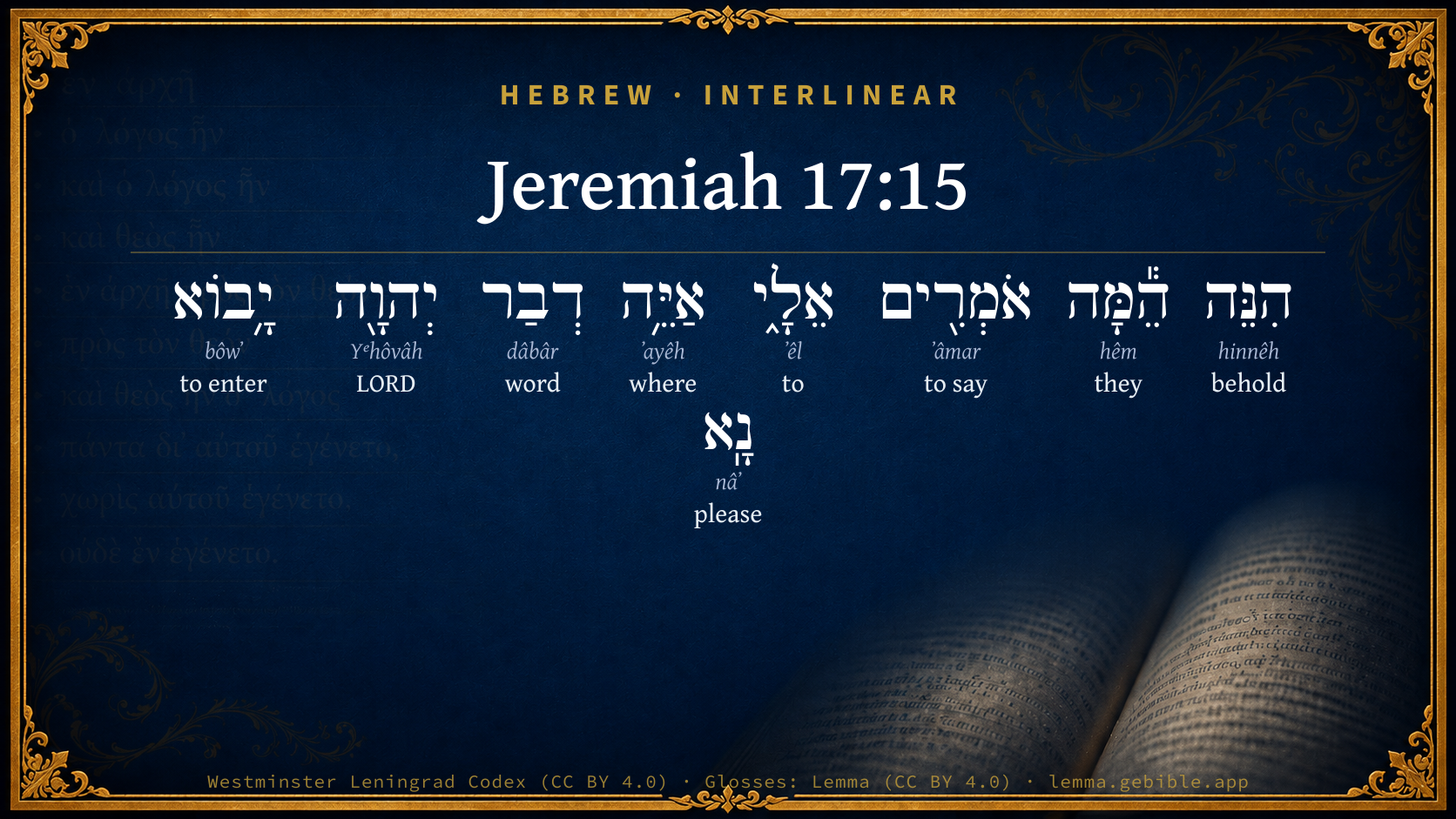
Jeremiah 17:15

Hebrew (Westminster Leningrad Codex) Jeremiah 17:15 appears in the Hebrew Old Testament. The text above is from the Westminster Leningrad Codex. Each word links to its Strong’s number, a concise gloss, and parsing drawn from the Open Scriptures Hebrew Bible morphology. Click any word for its full Brown-Driver-Briggs (BDB) entry.
Download image
Cite this verse

Jeremiah 17:15 (World English Bible). Public Domain. Lemma interlinear Bible study tool, https://lemma.gebible.app/v/jeremiah/17/15.

Show BibTeX & RIS
BibTeX
RIS
English Translation
Behold, they tell me, Where is the word of Yahweh? let it come now.
World English Bible · Public Domain
Download a study sheet

One document with this verse’s original text, its word-by-word gloss line, the meaning frame, cross-references with their text, attributed commentary, and full source and license credits — printable, and it pastes into notes with its structure intact.

This verse Autodidact and up

Study sheet (.html) Plain text (.txt)

A passage Seminary Student

Up to 50 verses in one chapter. A passage sheet keeps up to 6 commentary sources and 12 cross-references per verse, in the order this page ranks them, and says so on the sheet whenever that leaves anything out. Ask for a single verse and you get the Autodidact verse sheet above.

Everything on this page stays free to read, with no account — the sheet is a download of what is already on screen, not access to it.

Want to remove ads? Support Godless Engineer
Compare translations 3

The same verse in 3 English versions, stacked beneath the original-language interlinear above. Click any original word for its lexicon entry.

Each is an independent rendering of the whole verse — the interlinear is not word-aligned to these translations.

Highlighted words mark where these versions differ — a whole-verse word diff, not a word-by-word alignment.

  • World English Bible Public Domain
    Behold, they tell me, Where is the word of Yahweh? let it come now.
  • King James Version Public Domain
    Behold, they say unto me, Where is the word of the LORD? let it come now.
  • unfoldingWord Literal Text CC BY-SA 4.0
    Behold, they are saying to me, “Where the word of Yahweh? Let it come now”

unfoldingWord Literal Text — © unfoldingWord, licensed CC BY-SA 4.0. Word-aligned USFM3 via Door43 (git.door43.org/unfoldingWord/en_ult).

Versions to compare (up to 4)

3 of 4 selected

Show all 18 translations

Every available English version of this verse, each an independent rendering of the whole verse.

  • World English Bible Public Domain
    Behold, they tell me, Where is the word of Yahweh? let it come now.
  • Berean Standard Bible Public Domain
    Behold, they keep saying to me, “Where is the word of the LORD? Let it come now!”
  • Majority Standard Bible Public Domain
    Behold, they keep saying to me, “Where is the word of the LORD? Let it come now!”
  • King James Version Public Domain
    Behold, they say unto me, Where is the word of the LORD? let it come now.
  • American Standard Version (1901) Public Domain
    Behold, they say unto me, Where is the word of Jehovah? let it come now.
  • Revised Version (1885) Public Domain
    Behold, they say unto me, Where is the word of the LORD? let it come now.
  • Geneva Bible (1599) Public Domain
    Behold, they say vnto me, Where is the word of the Lord? let it come nowe.
  • Douay-Rheims (1899) Public Domain
    Behold they say to me: Where is the word of the Lord? let it come.
  • Young's Literal Translation Public Domain
    Lo, they are saying unto me: `Where `is' the word of Jehovah? pray, let it come.'
  • Literal Standard Version CC BY-SA 4.0
    Behold, they are saying to me: “Where [is] the word of YHWH? Pray, let it come.”
  • Unlocked Literal Bible CC BY-SA 4.0
    See, they are saying to me, 'Where is the word of Yahweh? Let it come!'
  • unfoldingWord Literal Text CC BY-SA 4.0
    Behold, they are saying to me, “Where the word of Yahweh? Let it come now”
  • Darby Bible Public Domain
    Behold, these say unto me, Where is the word of Jehovah? let it then come!
  • World Messianic Bible Public Domain
    Behold, they ask me, “Where is the LORD’s word? Let it be fulfilled now.”
  • Webster's Bible Public Domain
    Behold, they say to me, Where is the word of the LORD? let it come now.
  • Free Bible Version CC BY-SA 4.0
    See how they keep on saying to me, “Where is the disaster that the Lord's predicted? Is it ever going to happen?”
  • Bible in Basic English Public Domain
    See, they say to me, Where is the word of the Lord? let it come now.
  • JPS Tanakh (1917) Public Domain
    Behold, they say unto me: 'Where is the word of the LORD? let it come now.'

Literal Standard Version (2020), Covenant Press — licensed CC BY-SA 4.0. Text via the HelloAO Bible API (eBible.org). Unlocked Literal Bible (unfoldingWord) — licensed CC BY-SA 4.0. Text via the HelloAO Bible API (eBible.org). unfoldingWord Literal Text — © unfoldingWord, licensed CC BY-SA 4.0. Word-aligned USFM3 via Door43 (git.door43.org/unfoldingWord/en_ult). Free Bible Version, Dr. Jonathan Gallagher — licensed CC BY-SA 4.0. Text via the HelloAO Bible API (eBible.org).

Word by word

More ways to search: Search by grammar → Find every occurrence → Compare this word →

Practice this passage: Drill this verse → Learn its vocabulary →

About this verse

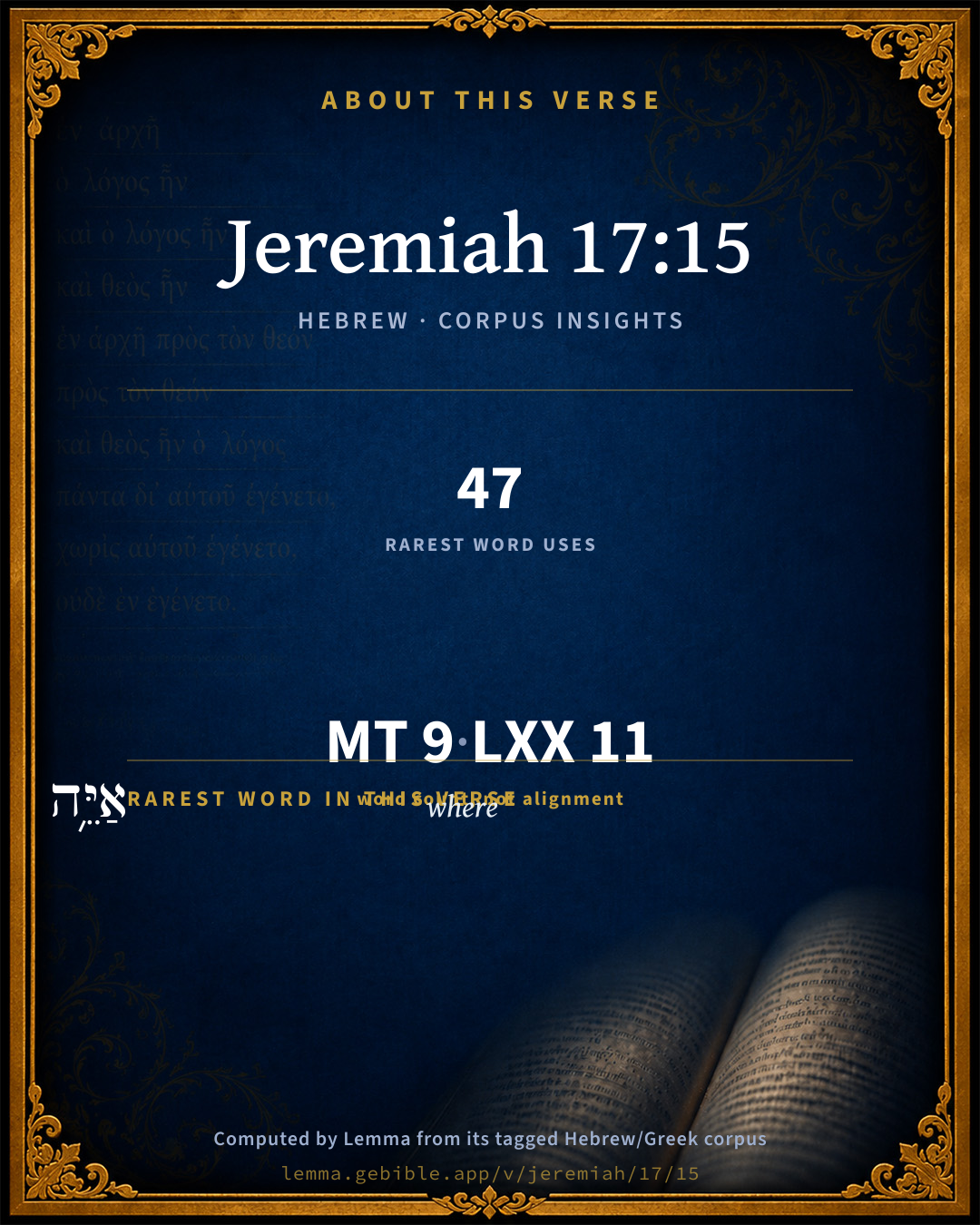
These counts appear in no published source. They are computed here, from the morphology-tagged text and Lemma’s own curated glosses. What Lemma adds →

9
words
9
distinct lemmas
Prophets
section

Shared distinctive vocabulary

אַיֵּ֥ה where H346 occurs in 40 verses of the Hebrew Bible. Also found in:

Grammatical profile

  • 2 verbs
  • 2 nouns
  • 1 pronoun
  • 1 preposition
  • 3 particles

Verb forms

  • אֹמְרִ֖ים Qal · Participle Active
  • יָ֥בוֹא Qal · Jussive

Hebrew & Septuagint length

In the original languages it is 9 Hebrew tokens and 11 Greek tokens — but the two are counted differently (Hebrew bundles its prefixes and suffixes into one token; the Greek is in lemma form), so that isn’t a like-for-like length.

Cross-references

6

Topical passages linked to Jeremiah 17:15 in the Treasury of Scripture Knowledge — connected by theme and wording, ordered by reader-vote popularity; previews shown in the World English Bible.

  • Isaiah 5:19 Who say, "Let him make speed, let him hasten his work, that we may see it; And let the counsel of the Holy One of Israel draw near and come, That we may know it!"
  • Ezekiel 12:22 Son of man, what is this proverb that you have in the land of Israel, saying, The days are prolonged, and every vision fails?
  • Jeremiah 20:7–8 Yahweh, you have persuaded me, and I was persuaded; you are stronger than I, and have prevailed: I am become a laughing-stock all the day, every one mocks me.
  • Ezekiel 12:27–28 Son of man, behold, they of the house of Israel say, The vision that he sees is for many day to come, and he prophesies of times that are far off.
  • Amos 5:18 "Woe to you who desire the day of Yahweh! Why do you long for the day of Yahweh? It is darkness, And not light.
  • 2 Peter 3:3–4 knowing this first, that in the last days mockers will come, walking after their own lusts,

Cross-references courtesy of OpenBible.info (CC BY 4.0).

Hebrew and Greek witnesses Masoretic Hebrew ↔ Greek Septuagint

The same verse in the two great witnesses to the Old Testament, shown verse-for-verse.

These are two independent witnesses, not word-aligned to each other, and the Septuagint is shown in lemma (dictionary) form.

Hebrew Jeremiah 17:15 Masoretic · Westminster Leningrad Codex

הִנֵּה הֵ֕מָּה אֹמְרִ֖ים אֵלָ֑י אַיֵּ֥ה דְבַר יְהוָ֖ה יָ֥בוֹא נָֽא

Behold, they tell me, Where is the word of Yahweh? let it come now.

World English Bible · Public Domain

Greek LXX Structure differs

In the Septuagint, Jeremiah is about an eighth shorter than the Hebrew and arranges its material differently — the Oracles Against the Nations (Hebrew chapters 46–51) appear in the middle of the Greek book, after 25:13. Because the chapter and verse boundaries do not line up, a verse-for-verse comparison with the Hebrew is not shown.

A verse-for-verse comparison isn’t shown here because the chapters and verses don’t line up. Switch to the LXX edition with the MT / LXX toggle above to read the Greek directly.

On this verse, Joseph Benson's Commentary discusses the Septuagint’s reading. Read the note in Commentary ↓

Hebrew: Westminster Leningrad Codex (CC BY 4.0). Greek: Septuagint (public domain); English from a public-domain English Septuagint. How the Septuagint differs from the Hebrew →

Targum (Aramaic paraphrase)

1

The Targum is the ancient Jewish Aramaic paraphrase of the Hebrew Scriptures — an interpretive translation, not the Hebrew text itself. Onkelos (literal) and Pseudo-Jonathan (expansive) render the Torah, and Jonathan the Prophets. Coverage is partial: where no permissively-licensed English translation exists for a verse, only the Aramaic is shown. This is verse-level text, not a word-by-word alignment to the Hebrew.

  1. Targum Jonathan Prophets (Joshua–Malachi)
    הָא אִינוּן אָמְרִין לִי אָן דְאִתְנַבֵּיתָא בִּשְׁמָא דַיָ יִתְקַיָם כְּעַן:

    (no public-domain English translation for this verse)

    Targum Jonathan — Aramaic: “Mikraot Gedolot” (public domain). English: “Sefaria Community Translation” (CC0 1.0 (public-domain dedication)); “London "Chaldee Paraphrase," 1871” (public domain). Text via Sefaria.

Commentary

Notes on Jeremiah 17:15 from classic Christian and Jewish commentators (each source and its license shown beneath its notes). The classic Christian expositions comment on the surrounding passage and are grouped to its opening verse, so a note may address several verses; the Jewish commentaries on the Tanakh (Rashi and others) are per-verse, so they appear only where the commentator wrote on this verse.

Lemma curates 59 commentaries, every one of them public domain or Creative Commons licensed, each selected and text-cleaned for this edition rather than reprinted as found. About our sources →

Trapp's Complete Commentary

John Trapp

Jer 17:15 Behold, they say unto me, Where [is] the word of the LORD? let it come now.

Ver. 15. Behold, they say unto me.] Heb., They are saying unto me; it is their daily dicterium, or jeer.

Where is the word of the Lord?] Whereby thou so oft threatenest us with desolation. {a} Thus profane persons flear, when they should fear. See 2Pe 3:4 Isa 5:19 Amo 5:18.

{a} Ubi est? It is where? i.e., Nusquam est. It is nowhere. - Piscat

John Trapp, A Commentary or Exposition upon All the Books of the Old and New Testament (1647–1656) — public domain. Text from a community e-Sword module.

Joseph Benson's Commentary

Jer 17:15-18. Behold, they say unto me — Scoffing at me, as if I had denounced threatenings in thy name, without any order or direction from thee: Where is the word of the Lord? — Like the scoffers, mentioned by St. Peter, 2Pe 3:4, saying, Where is the promise of his coming? This has been the practice of all wicked men, hardened in their sinful courses, and resolved to go on in them: they put the evil day far from them, and scoff at all denunciations of divine wrath. Let it come now — So said these scoffers, daring the vengeance of God, and challenging him to execute the judgments he had threatened. As for me, I have not hastened, &c. — Dr. Waterland translates this clause, “But as for me, I have not forced or intruded myself upon thee for a pastor.” To the same sense the Geneva translation interprets the words. According to which reading the prophet solemnly appeals to God that he had not intruded himself into the office of a prophet, nor had been desirous of an employment that foreboded so much evil to others, and brought a great deal of trouble upon himself. The words in the Hebrew, however, are literally as our translation expresses them, and may be paraphrased thus, “As I did not seek the office of a prophet, so when thou wast pleased to call me to it I did not decline it.” The LXX, render it, εγω δε ουκ εκοπιασα κατακολουθων οπισω σου, I have not been weary of following thee. Neither have I desired the woful day — Namely, the day of the accomplishment of his prophecies. Though, when it came, it would prove him to have been a true prophet, which they had questioned, and would be the avenging of him upon his persecutors, and therefore, on those accounts, he might have been tempted to desire it; yet, as it would be a woful day to Jerusalem, he deprecated it, and could appeal to God that he wished it might never come. That which came out of my lips was right before thee — That is, it exactly agreed with what I had received from thee. Be not a terror unto me — Amidst all the terrors, with which mine adversaries threaten me, let me still find comfort in thee; and let not any apprehension of being forsaken by thee be added to my other fears. Let them be confounded, &c. — See notes on Jer 11:20; Jer 16:18.

Joseph Benson's Commentary on the Old and New Testaments (1811–1818) — public domain. Text from a community e-Sword module.

Tyndale Open Study Notes

Tyndale Open Resources

17:15 Jeremiah’s predictions had not yet come true, so the people treated him with scorn; they might have even called him a false prophet (cp. Deut 18:21-22).

Tyndale Open Study Notes — © Tyndale Open Resources, licensed CC BY-SA 4.0. Text via the HelloAO Bible API.

Geneva Bible (1599)

Geneva Bible translators

The wicked say that my prophecy shall not come to pass, because thou deferrest the time of thy vengeance.

Geneva Bible (1599) marginal notes — public domain. Text via Bolls.life.

Jamieson, Fausset & Brown

Robert Jamieson, A. R. Fausset & David Brown

Where is the word?-- (Isa 5:19; Amo 5:18). Where is the fulfilment of the threats which thou didst utter as from God? A characteristic of the last stage of apostasy (Pe2 3:4).

Jamieson, Fausset & Brown — Commentary Critical and Explanatory on the Whole Bible (1871) — public domain (CC PDM 1.0). Text via the HelloAO Bible API.

Adam Clarke's Commentary

Verse 15. Where is the word of the Lord?] Where is the accomplishment of his threatenings? Thou hast said that the city and the temple should both be destroyed. No such events have yet taken place. But they did take place, and every tittle of the menace was strictly fulfilled.

Adam Clarke's Commentary on the Bible (1810–1826) — public domain. Text from a community e-Sword/MySword module.

John Calvin's Commentaries

Here Jeremiah complains of the obstinate contempt of the people; he found them not only uncourteous but even petulant towards God, so that they hesitated not to discredit all prophecies, to despise the promises, and boldly to reject all threatenings. The Prophet had often threatened them; and when God delayed the time, they made a wrong use of his forbearance, as it is commonly the case with the reprobate. Nor did they deem it enough even to add sins to sins, but they openly and petulantly provoked God, “Where is the word? many years have now elapsed since thou hast continually spoken of war, of famine, and of pestilence; but we still remain quiet, and God spares us; where then is the word of Jehovah, which thou hast announced?”

We now then see how great was the wilfulness of this people, for the teaching of Jeremiah became not only useless but was treated with ridicule. They had however heard much before from the mouth of Isaiah,

“Alas! when the Lord calls you to ashes and sackcloth, ye say, “Let us eat and drink, to-morrow we shall die.” “As I live, saith the Lord, not forgiven to you shall be this iniquity.” (Isaiah 22:12-14.)

God then had sworn by his own glory that their sin would be inexpiable, because they continued obstinately in their vices, and were in no degree terrified by the threatenings of the prophets. We however see that they ever became worse and worse. Isaiah was dead when they thus spoke in contempt and mockery, Where is the word of Jehovah? let it now come, as though they designedly provoked God, like one who despises his enemy, and says, “Oh! thou art indeed to be dreaded, if thou art to be believed; let us now see thy power, shew to us what thou canst do.” Thus contemptibly did they utter their scoffs, when God by his servants made known to them the approaching ruin which they deserved. We see, in short, that the Prophet shews here that they had come to a hopeless state. It follows —

John Calvin's Commentaries (1540-1563) — public domain. Text from the Calvin Translation Society English edition (1840s-50s) via the Christian Classics Ethereal Library (ccel.org). Calvin's coverage is partial (roughly two-thirds of the Bible); uncommented books and verses are honest gaps, never fabricated. The 19th-century editor's footnotes and remarks are omitted so the notes are faithfully Calvin's own voice.

Ellicott's Commentary for English Readers

(15) Behold, they say unto me.—The speakers are not named or defined, but they are clearly the mockers who questioned Jeremiah’s prophetic character, on the ground (comp. Deu_18:22) that his threats had received no fulfilment. Presumably, therefore, the words were written before the death of Jehoiakim and the capture of Jerusalem.

Let it come now.—The last word is the usual formula of request, and implies a mocking tone in the speakers: “Let it come, if you please.”

A Bible Commentary for English Readers, edited by Charles John Ellicott (1878–1897) — public domain. Text from a community e-Sword module.

The Cambridge Bible for Schools and Colleges

gen. ed. J. J. S. Perowne

15. The scoffs of his enemies suggested to him thoughts of such faithlessness as would never otherwise have occurred to him. For their derision of his predictions cp. Isa_5:19. The v. shews that the time is, at any rate, before the capture of Jerusalem at the end of Jehoiakim’s reign. If that event had occurred, the people would not, as here, challenge the prophet to point out a fulfilment of his prophecies of woe.

now] not denoting time, but in the sense of we pray thee.

The Cambridge Bible for Schools and Colleges (gen. ed. J. J. S. Perowne; Cambridge University Press, 1878–1918) — public domain. Text from a community e-Sword module.

John Gill's Exposition

Behold, they say unto me,.... Or, "they are saying unto me" (y), continually; these were their daily flouts and jeers:

Where is the word of the Lord? that thou hast so often talked of? thou hast for a long time threatened us with a siege, and famine, pestilence, and the sword, and captivity, but none of these come to pass; where is the accomplishment of them? thou hast pretended to have the word of the Lord for all this; but where is it, or the fulfilment of it? so the Targum,

"where is that which thou hast prophesied in the name of the Lord?''

the judgments, as punishments for sin, he prophesied of. This has been always usual in all ages, that when God's judgments threatened have not been immediately executed, scoffers and mockers have rose up, suggesting they would never come; see Mal 2:17;

let it come now; immediately, or we shall not believe it ever will; a very impudent, daring, and wicked expression: this is like that in Isa 5:19. The Targum is,

"let it now be confirmed;''

or fulfilled; declaring as their impiety, so their infidelity; not believing it ever would be fulfilled.

(y) "ecce illi sunt dicentes ad me", Schmidt.

John Gill's Exposition of the Whole Bible (1746–1763) — public domain (CC PDM 1.0). Text via the HelloAO Bible API.

Haydock's Catholic Bible Commentary

Come. We have several instances of such impious sarcasms, Isaias xxviii. 10., and xxxiv. 13., Amos ii. 12., and Micheas ii. 6. (Calmet) --- We fear not the Chaldeans. (Menochius)

George Leo Haydock (1774–1849), Haydock's Catholic Family Bible and Commentary, 1859 edition — public domain. Excludes Psalms (Douay-Rheims chapter numbering differs from Protestant) and Deuterocanonical books (Catholic canon only).

Matthew Poole's English Annotations

They say unto me, Where is the word of the Lord? scoffing at me, as if I had threatened them in thy name without any order or direction from thee, as the scoffers mentioned by Peter, 2Pe 3:4, said, Where is the promise of his coming? This hath been the practice of all wicked men hardened in their sinful courses, and resolved to go on, to put the evil day far from them, and to scoff at all denunciations of God’s judgments, Isa 5:19; Amo 5:18.

Let it come now; daring the vengeance of God, and challenging God to damn them, or to execute the vengeance with which he threateneth them.

Matthew Poole's English Annotations on the Holy Bible (1683–1685) — public domain. Text from a community e-Sword/MySword module.

The Pulpit Commentary

The occasion of this prayer is the hostility of his neighbors, and their mocking question, Where is the word of the Lord? The prophecy seems to be floating as it were in mid-air, unable to alight (Isa_9:8) and fulfill itself, so that Jeremiah could be plausibly treated as a false prophet. (Deu_18:22) Hence, as Keil remarks, the discourse of which this forms the conclusion must have been spoken before the first Babylonian invasion of Judah.

"Where is the word of the Lord?

I THE PRETEXT AND AIM OF THIS QUESTION. The prophet"s subsequent comment on the question shows with what bitter hatred to him it was asked. Sad, indeed, it is to reflect that these very words might be asked in a far different spirit; that they might come from the depths of an ignorant seeking heart, wandering long amid idolatries and human systems of philosophy, without hearing anything to serve as bread of heaven for the deep hunger within. There are people upon whom God"s Word has been pressed in every variety of appeal and representation. The Word has sought them out again and again; and yet in the end all they can do is to cast a scornful doubt on whether it is the Word of God at all. It may, indeed, be allowed that they did not mean to insult Jehovah; all they had in view was to express, in the most stinging way, their bitter hatred of this pertinacious, plain-spoken prophet this man who had come as a comparative youth from little Anathoth, rebuking those who were high in rank, old in years, and looked up to by the bulk of the people. No fallacy infecting the regions of practical life is more pernicious than that which, professing to admit the authority of him who sends, yet discredits the status of his professed messenger. It is thus very easy to evade unpleasant, humiliating messages. So the Jews of our Lord"s time were fanatically solicitous to honor their conception of Jehovah, and, as part of this devotion, they ended by crucifying Jesus as a blasphemer. The very people who asked, "Where is the word of Jehovah?" may have been the first to frame plausible repudiations of any wish to blaspheme him. Their great aim and purpose was to put this upstart Jeremiah in his proper place. They probably thought that these scornful speeches might become at last as a gag in his mouth. The lesson is plain: do not reject truth, or in any wise try to evade it because it comes through some one you do not like. What Jeremiah said here, respecting the character and work of these men, was true; and they do not deny the truth. They simply ignore the charges, and by one scornful question hint that the threatenings connected with the charges are but as empty words.

II THE WAYS IN WHICH THIS QUESTION MAY BE ANSWERED, Jeremiah, we perceive, has his own answer appropriate to his individual circumstances. He fails back on his integrity. God knows the fidelity and obedience of his heart. God had put into his mouth the words he had spoken. They did not rise out of his personal feeling; they were not the breathings of an egotist, a fanatic, a madman, an enemy of his country. But inasmuch as this question is ever being asked by a certain class who will not believe in a Divine plan of the world partly revealed in Scripture and the partial execution of which is shown in history it is well to remember how Jehovah has honored his servants who have had in any way to fill the office of prophets. He who has gone forth to threaten the persistently impenitent has never been without some achieved judgment of God which he might adduce as an illustration. The shadows cast forward into the future have their correspondences in the substances belonging to the past. If we could only summon out of the invisible world the generation which perished in the Flood, the dwellers in the cities of the plain, Pharaoh and his army, those who were destroyed in the gainsaying of Korah, and many others, they would be able to give no uncertain answer to the question, "Where is the word of Jehovah?" The kingdom of God is not in word only; it has in it a power which can be manifested in all needful abundance, with all needful rapidity, and in whatever aspect may be proper to the occasion. God"s Word becomes a complete and plainly perceptible deed exactly when the time is ripe. Shall man be able to arrange a time-piece so that when the hour hand and minute hand together point to twelve there shall be the striking which signifies noon has arrived; and shall not God be able to order the mysteries and complexities of the world so as to bring out the intended results just when he wants them? It is not for us to know times and seasons; but most emphatically it is for us to believe that every word of God is true. These very scorners of Jeremiah were about to add, in the course of a few short years at most, an illustration as forcible as any that what God has spoken may be taken as already done. God"s calm advancing of his kingdom should do much to make his people calm. It is our fault if the sarcasms of the unbelieving become anything more than words; and mere words are best met by a silent, patient, and believing continuance in well-doing. Y.

The Pulpit Commentary (1880–1919), ed. H.D.M. Spence-Jones & Joseph S. Exell — public domain. Text from a community e-Sword module.

John Wesley's Explanatory Notes

Where - Daring the vengeance of God.

John Wesley, Explanatory Notes Upon the Whole Bible (1754–1765) — public domain. Text via the GEBible commentary corpus.

unfoldingWord translationNotes

Door43 World Missions Community

See

"Look" or "Listen" or "Pay attention to what I am about to tell you."

they are saying to me

Here the word "me" refers to Jeremiah and the word "they" to his enemies.

Where is the word of Yahweh?

The people use this question to ridicule Jeremiah because the things that he said had not yet happened. It can also be translated as a statement. AT: "Where are the things that Yahweh told you would happen?" or "The things that Yahweh told you would happen have not happened." (See: Rhetorical Question and Assumed Knowledge and Implicit Information)

Let it come

"Let what Yahweh has said happen"

I did not run from being a shepherd following you

Jeremiah speaks of leading and caring for the people as if he were a shepherd caring for sheep. He speaks of his abandoning that work as if he were running away from it. (See: Metaphor)

I did not long for

"I did not desire"

the proclamations that came from my lips

Here the word "lips" represents Jeremiah who spoke. The word "proclamations" can be translated with a verbal phrase. AT: "the proclamations that I spoke" or "the things that I proclaimed" (See: Synecdoche and Abstract Nouns)

They were made

This can be stated in active form. AT: "I made them" (See: Active or Passive)

translationWords

word of God

shepherd

preach

unfoldingWord translationNotes — © Distant Shores Media and the Door43 World Missions Community, licensed CC BY-SA 4.0. Source: git.door43.org/Door43/en_tn.

Rashi

Rabbi Shlomo Yitzchaki (Rashi)

“Where is the word of the Lord? The retribution which you prophesy.

Rashi on the Tanakh — English translations: “The Judaica Press complete Tanach with Rashi, translated by A. J. Rosenberg” (CC BY 4.0); “Pentateuch with Rashi's commentary by M. Rosenbaum and A.M. Silbermann, 1929-1934” (public domain); “The Metsudah Tanach series, Lakewood, N.J” (CC BY 4.0); and “The Book of Joshua, Metsudah Publications, 1997” (CC BY 4.0). Text via Sefaria.

Lesson kit

Teaching starters — assembled from the data on this page, not authored interpretation. Every prompt links to the verse data it draws on. Edit before teaching.

Jeremiah, in the Prophets, opens this verse with 9 words (9 distinct Hebrew lemmas). Its most distinctive word is ʼayêh (“where”). A historical commentator’s framing appears above. Read the whole chapter for the surrounding context.

Discussion questions

  1. The word ʼayêh carries the sense “where.” How does it shape the verse?
  2. How does Genesis 18:9, which shares the word «where», read alongside this verse?
  3. The translations on this page render this verse differently — a whole-verse word diff, not a word-by-word alignment. What might account for the different wordings?
  4. «אֹמְרִ֖ים» is a Qal Participle Active verb. How does that grammatical form shape the action described?
  5. Compare how Trapp's Complete Commentary and Joseph Benson's Commentary read this verse. Where do they agree or differ?

Things to notice

Reading settings

Reading text

Shown beneath each verse's original-language words.

Old Testament
Old Testament edition

Read the OT as the Masoretic Hebrew (MT) or the Greek Septuagint (LXX).

English shown for the Greek Septuagint (in the Hebrew ↔ Greek comparison).

Comparing translations? Open the Compare panel on any verse page to stack up to four side by side.