
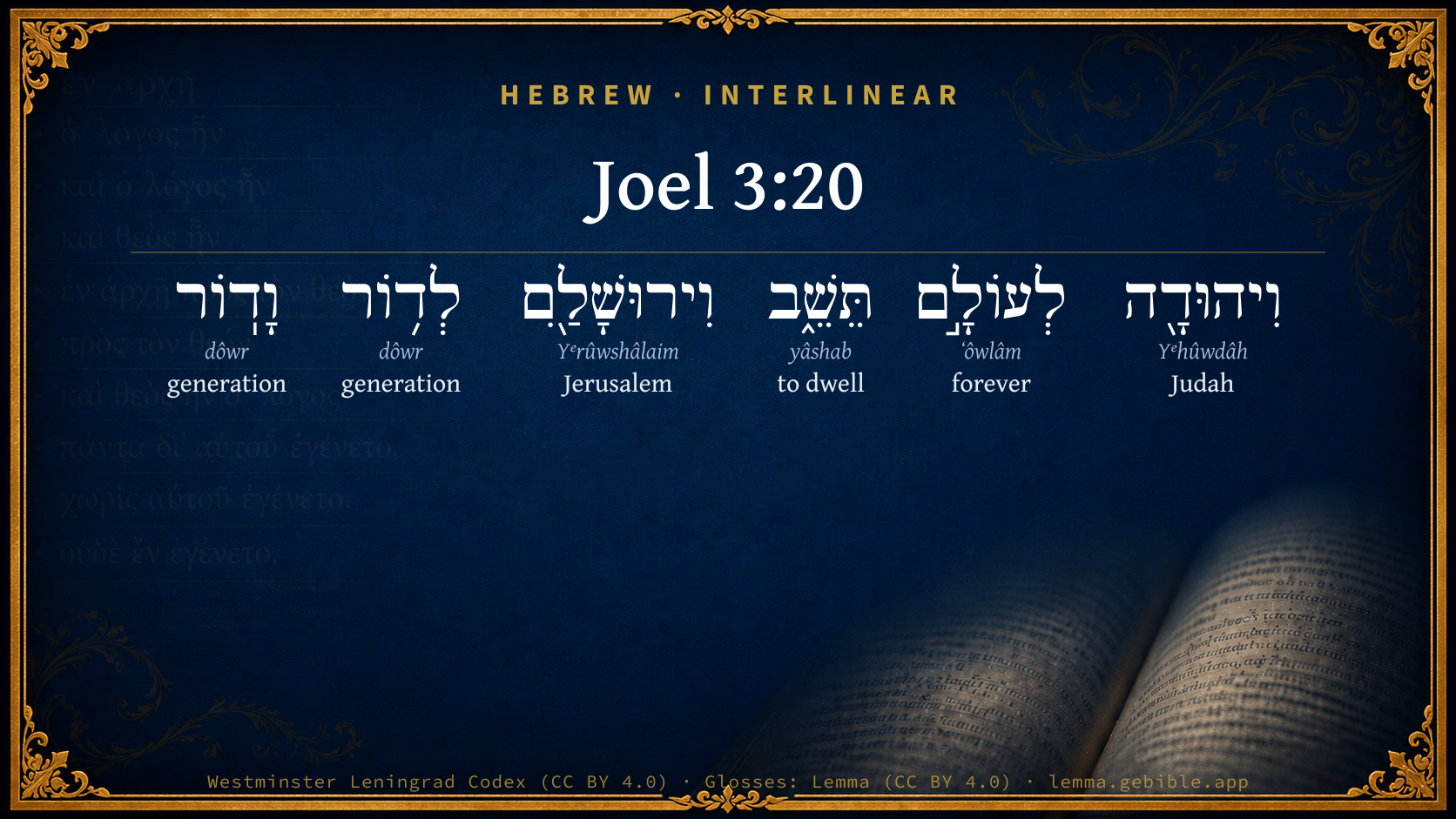
Joel 3:20

Hebrew (Westminster Leningrad Codex) Joel 3:20 appears in the Hebrew Old Testament. The text above is from the Westminster Leningrad Codex. Each word links to its Strong’s number, a concise gloss, and parsing drawn from the Open Scriptures Hebrew Bible morphology. Click any word for its full Brown-Driver-Briggs (BDB) entry.
Download image
Cite this verse

Joel 3:20 (World English Bible). Public Domain. Lemma interlinear Bible study tool, https://lemma.gebible.app/v/joel/3/20.

Show BibTeX & RIS
BibTeX
RIS
English Translation
But Judah will be inhabited forever, And Jerusalem from generation to generation.
World English Bible · Public Domain
Download a study sheet

One document with this verse’s original text, its word-by-word gloss line, the meaning frame, cross-references with their text, attributed commentary, and full source and license credits — printable, and it pastes into notes with its structure intact.

This verse Autodidact and up

Study sheet (.html) Plain text (.txt)

A passage Seminary Student

Up to 50 verses in one chapter. A passage sheet keeps up to 6 commentary sources and 12 cross-references per verse, in the order this page ranks them, and says so on the sheet whenever that leaves anything out. Ask for a single verse and you get the Autodidact verse sheet above.

Everything on this page stays free to read, with no account — the sheet is a download of what is already on screen, not access to it.

Want to remove ads? Support Godless Engineer
Compare translations 3

The same verse in 3 English versions, stacked beneath the original-language interlinear above. Click any original word for its lexicon entry.

Each is an independent rendering of the whole verse — the interlinear is not word-aligned to these translations.

Highlighted words mark where these versions differ — a whole-verse word diff, not a word-by-word alignment.

  • World English Bible Public Domain
    But Judah will be inhabited forever, And Jerusalem from generation to generation.
  • King James Version Public Domain
    But Judah shall dwell for ever, and Jerusalem from generation to generation.
  • unfoldingWord Literal Text CC BY-SA 4.0
    But Judah will dwell forever, and Jerusalem to generation and generation.

unfoldingWord Literal Text — © unfoldingWord, licensed CC BY-SA 4.0. Word-aligned USFM3 via Door43 (git.door43.org/unfoldingWord/en_ult).

Versions to compare (up to 4)

3 of 4 selected

Show all 18 translations

Every available English version of this verse, each an independent rendering of the whole verse.

  • World English Bible Public Domain
    But Judah will be inhabited forever, And Jerusalem from generation to generation.
  • Berean Standard Bible Public Domain
    But Judah will be inhabited forever, and Jerusalem from generation to generation.
  • Majority Standard Bible Public Domain
    But Judah will be inhabited forever, and Jerusalem from generation to generation.
  • King James Version Public Domain
    But Judah shall dwell for ever, and Jerusalem from generation to generation.
  • American Standard Version (1901) Public Domain
    But Judah shall abide for ever, and Jerusalem from generation to generation.
  • Revised Version (1885) Public Domain
    But Judah shall abide for ever, and Jerusalem from generation to generation.
  • Geneva Bible (1599) Public Domain
    But Iudah shall dwell for euer, and Ierusalem from generation to generation.
  • Douay-Rheims (1899) Public Domain
    And Judea shall be inhabited for ever, and Jerusalem to generation and generation.
  • Young's Literal Translation Public Domain
    And Judah to the age doth dwell, And Jerusalem to generation and generation.
  • Literal Standard Version CC BY-SA 4.0
    And Judah dwells for all time, || And Jerusalem to generation and generation.
  • Unlocked Literal Bible CC BY-SA 4.0
    But Judah will be inhabited forever, and Jerusalem will be inhabited from generation to generation.
  • unfoldingWord Literal Text CC BY-SA 4.0
    But Judah will dwell forever, and Jerusalem to generation and generation.
  • Darby Bible Public Domain
    But Judah shall abide for ever, and Jerusalem from generation to generation.
  • World Messianic Bible Public Domain
    But Judah will be inhabited forever, and Jerusalem from generation to generation.
  • Webster's Bible Public Domain
    \\3:15\\The sun and the moon shall be darkened, and the stars shall withdraw their shining.
  • Free Bible Version CC BY-SA 4.0
    Judah will be lived in forever, and Jerusalem for all generations.
  • Bible in Basic English Public Domain
    The sun and the moon have become dark, and the stars keep back their shining.
  • JPS Tanakh (1917) Public Domain
    (4-20) But Judah shall be inhabited for ever, and Jerusalem from generation to generation.

Literal Standard Version (2020), Covenant Press — licensed CC BY-SA 4.0. Text via the HelloAO Bible API (eBible.org). Unlocked Literal Bible (unfoldingWord) — licensed CC BY-SA 4.0. Text via the HelloAO Bible API (eBible.org). unfoldingWord Literal Text — © unfoldingWord, licensed CC BY-SA 4.0. Word-aligned USFM3 via Door43 (git.door43.org/unfoldingWord/en_ult). Free Bible Version, Dr. Jonathan Gallagher — licensed CC BY-SA 4.0. Text via the HelloAO Bible API (eBible.org).

Word by word

More ways to search: Search by grammar → Find every occurrence → Compare this word →

Practice this passage: Drill this verse → Learn its vocabulary →

About this verse

These counts appear in no published source. They are computed here, from the morphology-tagged text and Lemma’s own curated glosses. What Lemma adds →

6
words
5
distinct lemmas
Prophets
section

Grammatical profile

  • 1 verb
  • 5 nouns

Verb forms

  • תֵּשֵׁ֑ב Qal · Imperfect

Repetition

A word recurs within this verse — often emphatic in Hebrew:

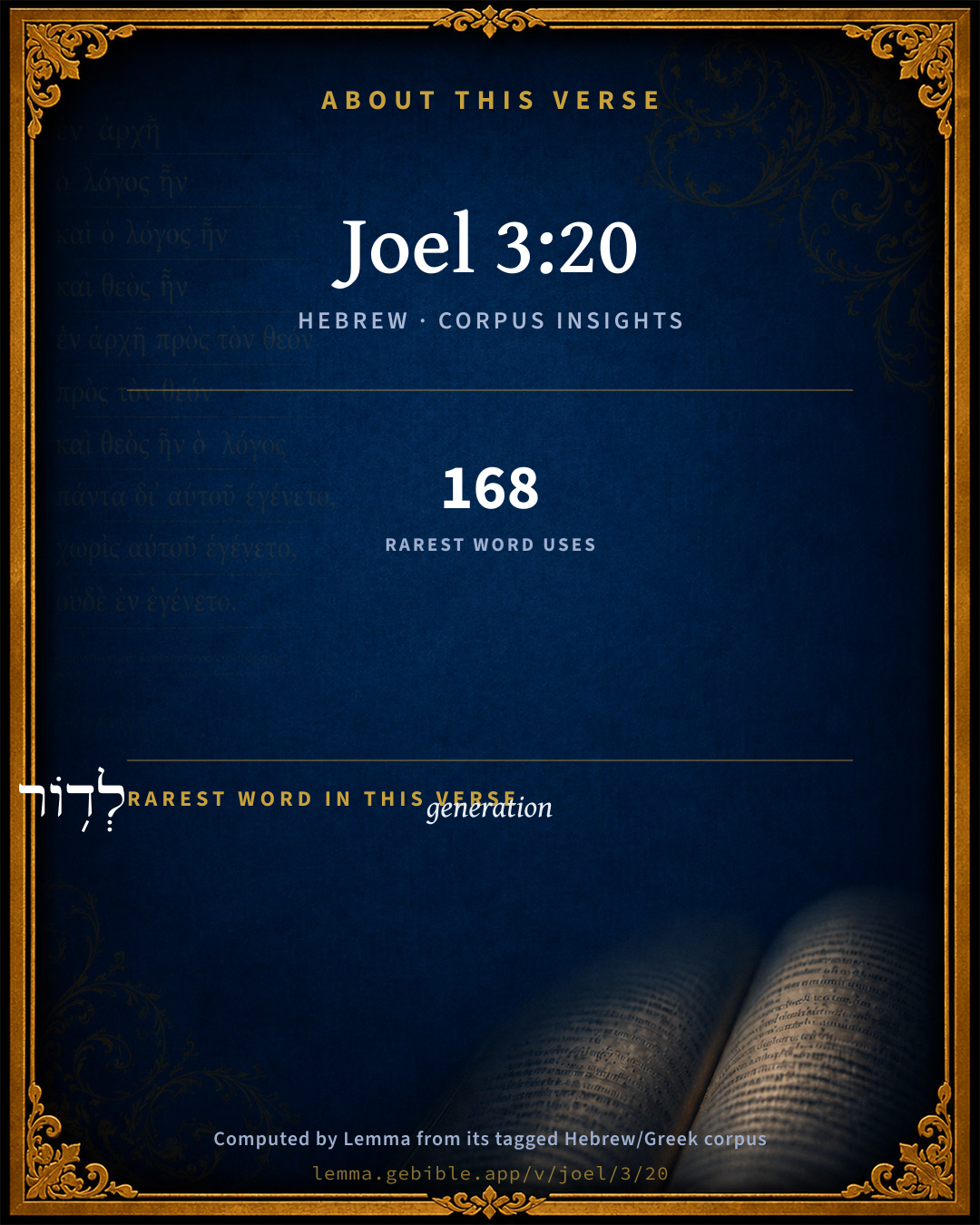
  • לְד֥וֹר generation H1755 ×2

Hebrew & Septuagint length

In English translation the verse runs 12 words from the Hebrew and 12 from the Septuagint (LXX English) — the same length.

A rough comparison of the two English renderings, which tokenize alike — not a word-level alignment.

Word counts can differ between the Hebrew and the Greek without any difference in meaning — e.g. the Hebrew direct-object marker אֵת has no separate Greek word, and Greek often adds the article ὁ.

Cross-references

3

Topical passages linked to Joel 3:20 in the Treasury of Scripture Knowledge — connected by theme and wording, ordered by reader-vote popularity; previews shown in the World English Bible.

  • Ezekiel 37:25 They shall dwell in the land that I have given to Jacob my servant, in which your fathers lived; and they shall dwell therein, they, and their children, and their children's children, forever: and David my servant shall be their prince for ever.
  • Isaiah 33:20 Look on Zion, the city of our solemnities: your eyes shall see Jerusalem a quiet habitation, a tent that shall not be removed, the stakes of it shall never be plucked up, neither shall any of the cords of it be broken.
  • Amos 9:15 I will plant them on their land, And they will no more be plucked up out of their land which I have given them," says Yahweh your God.

Cross-references courtesy of OpenBible.info (CC BY 4.0).

Hebrew and Greek witnesses Masoretic Hebrew ↔ Greek Septuagint

The same verse in the two great witnesses to the Old Testament, shown verse-for-verse.

These are two independent witnesses, not word-aligned to each other, and the Septuagint is shown in lemma (dictionary) form.

Hebrew Joel 3:20 Masoretic · Westminster Leningrad Codex

וִיהוּדָ֖ה לְעוֹלָ֣ם תֵּשֵׁ֑ב וִירוּשָׁלִַ֖ם לְד֥וֹר וָדֽוֹר

But Judah will be inhabited forever, And Jerusalem from generation to generation.

World English Bible · Public Domain

Greek LXX Joel 3:20 Septuagint · lemma form
But Judea shall be inhabited for ever, and Jerusalem to all generations.

LXX2012 (modern English Septuagint) · Public Domain

Hebrew: Westminster Leningrad Codex (CC BY 4.0). Greek: Septuagint (public domain); English from LXX2012 (modern English Septuagint) (Public Domain). How the Septuagint differs from the Hebrew →

Commentary

Notes on Joel 3:20 from classic Christian and Jewish commentators (each source and its license shown beneath its notes). The classic Christian expositions comment on the surrounding passage and are grouped to its opening verse, so a note may address several verses; the Jewish commentaries on the Tanakh (Rashi and others) are per-verse, so they appear only where the commentator wrote on this verse.

Lemma curates 59 commentaries, every one of them public domain or Creative Commons licensed, each selected and text-cleaned for this edition rather than reprinted as found. About our sources →

Trapp's Complete Commentary

John Trapp

Joe 3:20 But Judah shall dwell for ever, and Jerusalem from generation to generation.

Ver. 20. But Judah shall dwell for ever] Perpetuitas Ecclesiae declaratur, saith Mercer, the perpetuity of the Church is declared and assured. The blood of martyrs is the seed of the Church. Christ is with his to the end of the world; and those Roman persecutors who sought to root out Christian religion, and erected pillars in memory of what they had done, or rather attempted, that way, what got they thereby but perpetual ignominy, besides the irreparable loss of their souls, bodies, and fortunes?

“ Tu vero, Herodes sanguinolente, time. ”

The Church, as the palm tree, spreadeth and springeth up the more it is oppressed, as the bottle or bladder that may be dipped, not drowned; as the oak, that taketh heart to grace from the maims and wounds given it, and sprouts out thicker, Duris ut ilex tonsa bipennibus (Horat.); as fenugreek, which the worse it is handled the better it grows, as Pliny. saith. No fowl is more preyed upon than the pigeon; no creature more killed up than sheep; yet are there more pigeons than birds of prey, more sheep than slaughtermen.

John Trapp, A Commentary or Exposition upon All the Books of the Old and New Testament (1647–1656) — public domain. Text from a community e-Sword module.

Tyndale Open Study Notes

Tyndale Open Resources

3:20-21 The conclusion of Joel’s prophecy is the antithesis of its beginning. In 1:1-20, Judah’s future seemed in grave doubt. Plague and drought, the signs of divine judgment, threatened Judah’s existence. Now Joel ends with the divine assurance that Judah . . . and Jerusalem will endure through all generations. God’s people in every generation rest secure in the hope that his kingdom will reign over heaven and earth (see also Isa 9:6-7; Dan 2:44; 7:13-14).

Tyndale Open Study Notes — © Tyndale Open Resources, licensed CC BY-SA 4.0. Text via the HelloAO Bible API.

Jamieson, Fausset & Brown

Robert Jamieson, A. R. Fausset & David Brown

dwell for ever-- (Amo 9:15), that is, be established as a flourishing state.

Jamieson, Fausset & Brown — Commentary Critical and Explanatory on the Whole Bible (1871) — public domain (CC PDM 1.0). Text via the HelloAO Bible API.

Adam Clarke's Commentary

Verse 20. But Judah shall dwell for ever] The true Church of Christ shall be supported, while all false and persecuting Churches shall be annihilated. The promise may also belong to the full and final restoration of the Jews, when they shall dwell at Jerusalem as a distinct people professing the faith of our Lord Jesus Christ.

Adam Clarke's Commentary on the Bible (1810–1826) — public domain. Text from a community e-Sword/MySword module.

John Calvin's Commentaries

God here testifies that his redemption would not be for a short time, but that its fruit would be for a long, period, yea, perpetual: for it would be but a small thing for the Church to be redeemed, except God kept it safe under his own power. This second thing the Prophet now adds, — that Judah shall always remain safe, and that Jerusalem shall be for a continued succession of ages. The ungodly, we know, sometimes flourish for a time, though before God they are already doomed to destruction. But the Prophet here declares, that the fruit of the redemption he promises will be eternal: for God is not led to deliver his Church only for a moment, but he will follow it with perpetual favor, and remain constant in his purpose and ever like himself; he is therefore the eternal and faithful protector of his people. The last verse follows —

John Calvin's Commentaries (1540-1563) — public domain. Text from the Calvin Translation Society English edition (1840s-50s) via the Christian Classics Ethereal Library (ccel.org). Calvin's coverage is partial (roughly two-thirds of the Bible); uncommented books and verses are honest gaps, never fabricated. The 19th-century editor's footnotes and remarks are omitted so the notes are faithfully Calvin's own voice.

The Cambridge Bible for Schools and Colleges

gen. ed. J. J. S. Perowne

20. The prophet, continuing the thought of Joe_3:18, reverts again to the future lot of Judah.

shall sit for ever] i.e. remain inhabited. A city, or country, when it continues to flourish and be inhabited, is said in Heb., by a personification, to sit: so Isa_13:20 (A.V. be inhabited; in the parallel clause, lit. dwell [not be dwelt in]); Jer_17:6; Jer_17:25; Zec_9:5; Zec_12:6.

The Cambridge Bible for Schools and Colleges (gen. ed. J. J. S. Perowne; Cambridge University Press, 1878–1918) — public domain. Text from a community e-Sword module.

John Gill's Exposition

But Judah shall dwell for ever,.... The converted Jews shall dwell in their own land for ever, to the end of the, world and never more be carried captive, Eze 37:25; and the true professing people of God, as Judah signifies, shall continue in a church state, evermore, and never more be disturbed by any enemies, they shall dwell safely and peaceably to the end of time:

and Jerusalem from generation to generation; shall dwell so in like manner, age after age; that is, the inhabitants of Jerusalem, or the members of the true church of Christ, who shall see and enjoy peace and prosperity, both temporal and spiritual, as Jerusalem signifies.

John Gill's Exposition of the Whole Bible (1746–1763) — public domain (CC PDM 1.0). Text via the HelloAO Bible API.

Albert Barnes' Notes on the Bible

Judah shall dwell for ever - Not earthly Judah, nor earthly Jerusalem, for these must come to an end, together with the earth itself, of whose end the prophets well knew. It is then the one people of God, the true Judah, the people who praise God, the Israel, which is indeed Israel. Egypt and Edom and all the enemies of God should come to an end; but His people shall never come to an end. “The gates of hell shall not prevail against her.” The enemy shall not destroy her; time shall not consume her; she shall never decay. The people of God shall abide before Him and through Him here, and shall dwell with Him forever.

Albert Barnes' Notes on the Bible (1834–1885) — public domain. Text from a community e-Sword/MySword module.

Haydock's Catholic Bible Commentary

Judea and Jerusalem. That is, the spiritual Jerusalem, viz., the Church of Christ. (Challoner) --- Judea was unmolested for a considerable time.

George Leo Haydock (1774–1849), Haydock's Catholic Family Bible and Commentary, 1859 edition — public domain. Excludes Psalms (Douay-Rheims chapter numbering differs from Protestant) and Deuterocanonical books (Catholic canon only).

Matthew Poole's English Annotations

But and or yet

Judah the chosen peculiar redeemed of the Lord, his church.

shall dwell for ever; no more be captivated and driven from home, but in their own land and houses abide safely and perpetually. This typifieth the eternal peace and rest to which God’s people are redeemed.

Jerusalem; city of God. From generation to generation; through many generations on earth, through eternity in heaven. Some shadow of this possibly we may find in the days of the Maccabees, but the fulness of this we expect when that day, great, dreadful, and finally decisive day, to which interpreters refer this chapter, shall destroy all the wicked and put the godly into possession of eternal mansions of glory.

Matthew Poole's English Annotations on the Holy Bible (1683–1685) — public domain. Text from a community e-Sword/MySword module.

Whedon's Commentary on the Bible

Daniel D. Whedon

20. While the surrounding nations become desolate, Judah and Jerusalem, the dwelling place of Jehovah and of his saints, shall flourish forever.

Dwell — Margin, “abide”; literally, sit. A poetical expression of the idea of continued habitation and prosperity (margin R.V.; Isa_13:20; Jer_17:6; Jer_17:25).

Forever — Hebrews ‘olam. An endless period only in so far as the speaker cannot see the end; the actual extent may be long or short, and must be determined by other considerations. Here synonymous with from generation to generation.

Daniel D. Whedon (gen. ed.), Commentary on the Old and New Testaments (1874–1909) — public domain. Text from a community e-Sword module.

The Pulpit Commentary

Vers. 20, 21. The contrast which these verses present to what precedes is very striking. While Egypt and Edom are devoted to desolation and destruction, Judah, personified, shall dwell (margin, abide), and Jerusalem, or rather, as we think, Judah shall be dwelt in, as also its capital, from generation to generation. In the concluding verse a reason is assigned. For I will cleanse their blood that I have not cleansed. The blood shed by the Egyptians and Edomites is proved by Jehovah to be innocent blood, because he promises to avenge it in the end, though for wise and good reasons he had delayed to do so. This closing thought is well explained by Keil in the words, "The eternal desolation of the world-kingdoms mentioned here will wipe out all the wrong which they have done to the people of God, and which has hitherto remained un-punished." When Jehovah thus wipes out the blood-guiltiness of the enemies of Judah by punishing them with destruction for their cruelties, while he exalts gloriously, finally, and for ever his people, he proves his sovereignty over them and his dwelling-place in Zion. The Hebrew interpreters, with the exception of Abarbanel, understand this passage

(1) literally; thus Kimchi: "At that time (the day of the Lord), after making an end of the nations there, great goodness shall accrue to Israel;" the same is seen in the exposition of the last verse of the chapter. Rashi says, "Even if I shall cleanse them of the remaining transgression which is in their hands, and the evil-doing which they have done to me, the blood of the children of Judah I will not cleanse from them;" also in commenting on the same, Kimchi says, For their silver and their gold which they took I will cleanse the nations, for Israel also shall take from them in the future, and they shall become their spoil; but for their blood which they have shed I will not cleanse them, but life shall be for life the life of those that shed it, or of their children after them; for for all the silver and the gold that is in the world which they shall give as a ransom of their souls they shall not be cleansed of the blood which they have shed;" also, "For the ages of eternity shall his dwelling-place be in Zion, after that it shall return there in the days of the Messiah.

(2) Some refer the passage to millennial times.

(3) Others to the time of the consummation of all things. Thus Keil, comparing Eze 47 Zec 14 Re 21 and Re 22, says, "This passage does not teach the earthly glorification of Palestine, and desolation of Egypt and Idumaea, but that Judah and Jerusalem are types of the kingdom of God, whilst Egypt and Edom are types of the world-powers that are at enmity against God; in other words, that this description is not to be understood literally, but spiritually;" he had previously intimated that spiritual sense, "For Zion or Jerusalem is, of course, not the Jerusalem of the earthly Palestine, but the sanctified and glorified city of the living God, in which the Lord will be eternally united with his redeemed, sanctified, anti glorified Church."

The Pulpit Commentary (1880–1919), ed. H.D.M. Spence-Jones & Joseph S. Exell — public domain. Text from a community e-Sword module.

John Wesley's Explanatory Notes

Judah - The redeemed of the Lord, his church.

John Wesley, Explanatory Notes Upon the Whole Bible (1754–1765) — public domain. Text via the GEBible commentary corpus.

unfoldingWord translationNotes

Door43 World Missions Community

General Information:

Yahweh continues to speak about the day of the Lord.

Judah will be inhabited forever

This can be stated in active form. AT: "people will live in Judah forever" (See: Active or Passive)

Jerusalem will be inhabited from generation to generation

This can be stated in active form. AT: "generation after generation, people will live in Jerusalem" (See: Active or Passive)

I will avenge their blood that I have not yet avenged

Blood is a metonym for death. AT: "I will punish the enemies who killed the people of Israel and still have not been punished" (See: Metonymy)

translationWords

eternity

generation

avenge

blood

Yahweh

Zion

unfoldingWord translationNotes — © Distant Shores Media and the Door43 World Missions Community, licensed CC BY-SA 4.0. Source: git.door43.org/Door43/en_tn.

Lesson kit

Teaching starters — assembled from the data on this page, not authored interpretation. Every prompt links to the verse data it draws on. Edit before teaching.

Joel, in the Prophets, opens this verse with 6 words (5 distinct Hebrew lemmas). Its most distinctive word is dôwr (“generation”). A historical commentator’s framing appears above. Read the whole chapter for the surrounding context.

Discussion questions

  1. How does “generation” (dôwr) shape what this verse is saying?
  2. How does Ezekiel 37:25, which shares this passage’s theme, read alongside this verse?
  3. What does the repetition of “generation” (2× in this one verse) do in this verse?
  4. These translations render this verse differently; the difference is in the English rendering, not the original. What questions does that raise?
  5. «תֵּשֵׁ֑ב» is a Qal Imperfect verb. How does that grammatical form shape the action described?
  6. Compare how Trapp's Complete Commentary and Tyndale Open Study Notes read this verse. Where do they agree or differ?

Things to notice

  • These translations choose different wording for 6 words in this verse.
  • “generation” occurs 2× in this single verse.
  • 5 distinct Hebrew lemmas span 6 words in this verse.

Reading settings

Reading text

Shown beneath each verse's original-language words.

Old Testament
Old Testament edition

Read the OT as the Masoretic Hebrew (MT) or the Greek Septuagint (LXX).

English shown for the Greek Septuagint (in the Hebrew ↔ Greek comparison).

Comparing translations? Open the Compare panel on any verse page to stack up to four side by side.