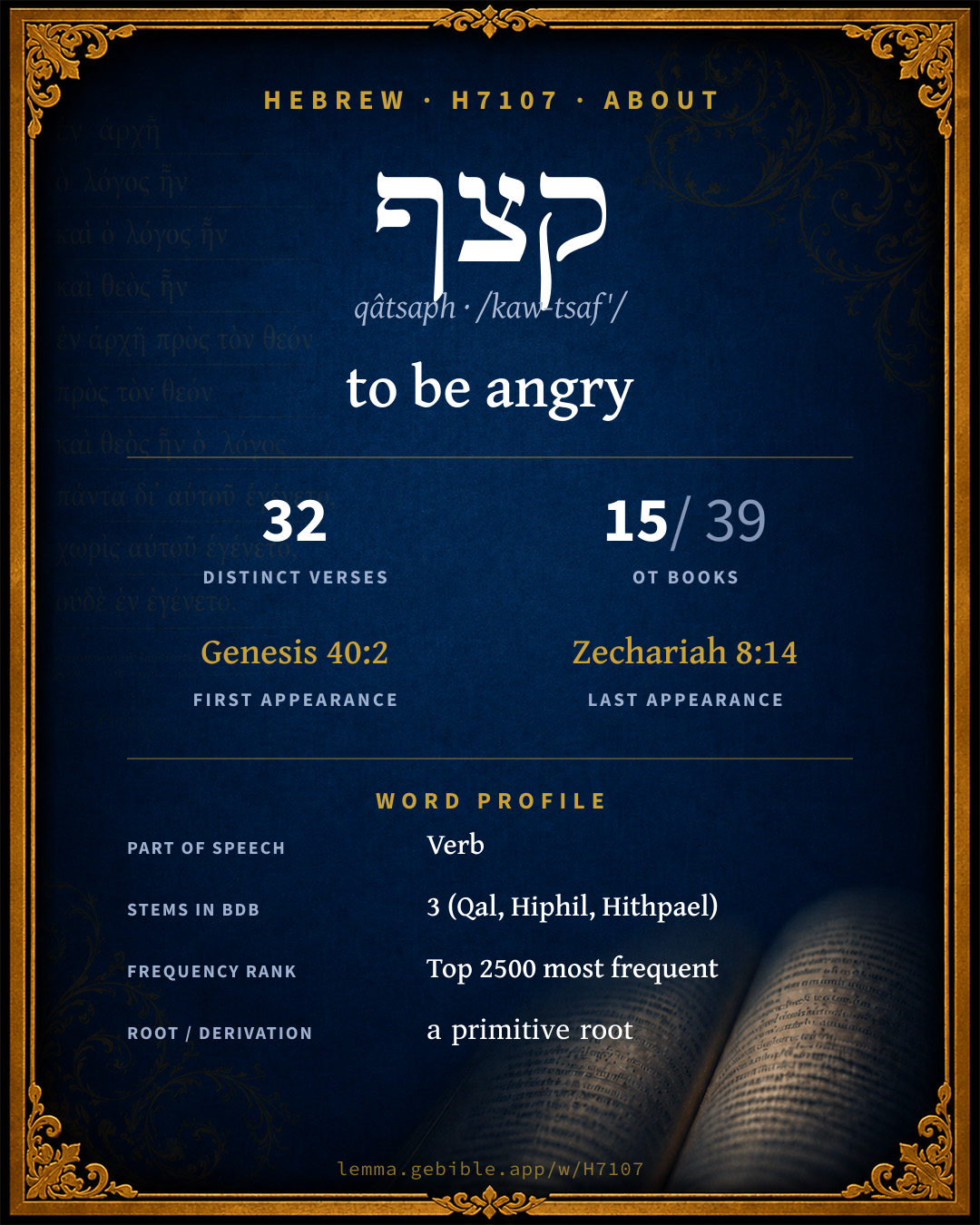
קָצַף
to be angry
‘to be angry’ is one of 4 main senses fuller range ↓
Full lexicon entry — Brown-Driver-Briggs (BDB)
From Brown-Driver-Briggs (BDB)
Where this word appears
See every Qal verb in the Hebrew Bible →
Grammar key — what these labels mean
Part of speech
- Verb
- An action or state-of-being word.
Stem
- Qal
- The basic, simple active stem — the plain form of the verb (“he wrote”). Here: ‘of God’
- Hiphil
- The causative active stem (“he caused / brought about”).
- Hithpael
- The reflexive or reciprocal stem (the subject acts on itself). Here: ‘put oneself in a rage’
Form
- Sequential Imperfect
- An imperfect with prefixed waw — the standard past-narrative form (waw-consecutive imperfect).
- Perfect
- A completed action or state — Hebrew marks aspect (completeness) more than strict tense (“he wrote”).
- Imperfect
- An incomplete, ongoing, or future action (“he will / would write”).
- Sequential Perfect
- A perfect with prefixed waw continuing a preceding imperfect or command (waw-consecutive perfect).
- Infinitive Construct
- A bound verbal noun, frequently with prepositions (“to write / in writing”).
- Participle Active
- A verbal adjective expressing ongoing or characteristic action (“writing / one who writes”).
- Jussive
- A third- or second-person volitional form expressing wish or command (“let him write”).
State
- Absolute
- The independent form of a noun, not bound to a following word.
Person
- 3rd Person
- The one spoken about (“he / she / it / they”).
- 1st Person
- The speaker (“I / we”).
- 2nd Person
- The one addressed (“you”).
Gender
- Masculine
- Grammatically masculine.
- Common
- Either gender — not distinguished for this form.
Number
- Singular
- One.
- Plural
- More than one (in Hebrew, generally three or more).
Grammatical forms 17 distinct
- Verb, Qal, Sequential Imperfect, 3rd Person, Masculine, Singular 8 times (24%)
- Verb, Qal, Perfect, 3rd Person, Masculine, Singular 4 times (12%)
- Verb, Qal, Imperfect, 3rd Person, Masculine, Singular 3 times (9%)
- Verb, Qal, Perfect, 1st Person, Common, Singular 3 times (9%)
- Verb, Qal, Sequential Imperfect, 3rd Person, Masculine, Plural 2 times (6%)
- Verb, Qal, Perfect, 2nd Person, Masculine, Singular 2 times (6%)
- Verb, Qal, Imperfect, 1st Person, Common, Singular 2 times (6%)
- Verb, Hiphil, Sequential Imperfect, 3rd Person, Masculine, Plural 1 time (3%)
+9 more forms (9 occurrences)
Parsed forms decoded from the imported morphology (morphhb / Westminster Leningrad Codex — WLC text public domain, morphhb tagging CC BY 4.0), counted across 34 parsed occurrences — not distinct verses.
Every verse where H7107 appears — 32 distinct verses across 15 books. Click any verse to open its interlinear word-by-word view. Verse text shown in the World English Bible for context — . Each verse’s Hebrew form is shown with its reference; the English is not keyword-highlighted, since the data carries no word-level English alignment. Use “Compare translations” on any verse to read it across multiple English versions. This concordance covers the Hebrew Bible; Septuagint (Greek Old Testament) occurrences are not indexed here.
Genesis 2 verses
Exodus 1 verse
Leviticus 2 verses
- Leviticus 10:6 יִקְצֹ֑ף Qal impf 3ms Moses said to Aaron, and to Eleazar and to Ithamar, his sons, "Don't let the hair of your heads go loose, neither tear your clothes; that you don't die, and that he not be angry with all the congregation: but let your brothers, the whole house of Israel, bewail the burning which Yahweh has kindled.
- Leviticus 10:16 וַ֠/יִּקְצֹף conj + Qal wimpf 3ms Moses diligently inquired about the goat of the sin offering, and, behold, it was burned: and he was angry with Eleazar and with Ithamar, the sons of Aaron who were left, saying,
Numbers 2 verses
- Numbers 16:22 תִּקְצֹֽף Qal impf 2ms They fell on their faces, and said, God, the God of the spirits of all flesh, shall one man sin, and will you be angry with all the congregation?
- Numbers 31:14 וַ/יִּקְצֹ֣ף conj + Qal wimpf 3ms Moses was angry with the officers of the host, the captains of thousands and the captains of hundreds, who came from the service of the war.
Deuteronomy 5 verses
- Deuteronomy 1:34 וַ/יִּקְצֹ֖ף conj + Qal wimpf 3ms Yahweh heard the voice of your words, and was angry, and swore, saying,
- Deuteronomy 9:7 הִקְצַ֛פְתָּ Hiphil pf 2ms Remember, don't forget, how you provoked Yahweh your God to wrath in the wilderness: from the day that you went forth out of the land of Egypt, until you came to this place, you have been rebellious against Yahweh.
- Deuteronomy 9:8 הִקְצַפְתֶּ֖ם Hiphil pf 2mp Also in Horeb you provoked Yahweh to wrath, and Yahweh was angry with you to destroy you.
- Deuteronomy 9:19 קָצַ֧ף Qal pf 3ms For I was afraid of the anger and hot displeasure, with which Yahweh was angry against you to destroy you. But Yahweh listened to me that time also.
- Deuteronomy 9:22 מַקְצִפִ֥ים Hiphil ptcp.act mp At Taberah, and at Massah, and at Kibroth-hattaavah, you provoked Yahweh to wrath.
Joshua 1 verse
1 Samuel 1 verse
2 Kings 2 verses
- 2 Kings 5:11 וַ/יִּקְצֹ֥ף conj + Qal wimpf 3ms But Naaman was angry, and went away, and said, Behold, I thought, He will surely come out to me, and stand, and call on the name of Yahweh his God, and wave his hand over the place, and recover the leper.
- 2 Kings 13:19 וַ/יִּקְצֹ֨ף conj + Qal wimpf 3ms The man of God was angry with him, and said, You should have struck five or six times: then had you struck Syria until you had consumed it, whereas now you shall strike Syria but thrice.
Esther 2 verses
- Esther 1:12 וַ/יִּקְצֹ֤ף conj + Qal wimpf 3ms But the queen Vashti refused to come at the king's commandment by the chamberlains: therefore was the king very angry, and his anger burned in him.
- Esther 2:21 קָצַף֩ Qal pf 3ms In those days, while Mordecai was sitting in the king's gate, two of the king's chamberlains, Bigthan and Teresh, of those who kept the threshold, were angry, and sought to lay hands on the king Ahasuerus.
Psalms 1 verse
Ecclesiastes 1 verse
Isaiah 7 verses
- Isaiah 8:21 וְ/הִתְקַצַּ֗ף conj + Hithpael wpf 3ms They shall pass through it, sore distressed and hungry; and it shall happen that when they shall be hungry, they shall fret themselves, and curse by their king and by their God, and turn their faces upward:
- Isaiah 47:6 קָצַ֣פְתִּי Qal pf 1cs I was angry with my people, I profaned my inheritance, and gave them into your hand: you did show them no mercy; on the aged have you very heavily laid your yoke.
- Isaiah 54:9 מִ/קְּצֹ֥ף prep + Qal inf.cs For this is [as] the waters of Noah to me; for as I have sworn that the waters of Noah shall no more go over the earth, so have I sworn that I will not be angry with you, nor rebuke you.
- Isaiah 57:16 אֶקְּצ֑וֹף Qal impf 1cs For I will not contend forever, neither will I be always angry; for the spirit would faint before me, and the souls who I have made.
- Isaiah 57:17 קָצַ֥פְתִּי וְ/אֶקְצֹ֑ף Qal pf 1cs conj + Qal impf 1cs For the iniquity of his covetousness was I angry, and struck him; I hid [my face] and was angry; and he went on backsliding in the way of his heart.
- Isaiah 64:5 קָצַ֨פְתָּ֙ Qal pf 2ms You meet him who rejoices and works righteousness, those who remember you in your ways: behold, you were angry, and we sinned: in them [have we been] of long time; and shall we be saved?
- Isaiah 64:9 תִּקְצֹ֤ף Qal juss 2ms Don't be angry very sore, Yahweh, neither remember iniquity forever: see, look, we beg you, we are all your people.
Jeremiah 1 verse
Lamentations 1 verse
Zechariah 3 verses
- Zechariah 1:2 קָצַ֧ף Qal pf 3ms "Yahweh was very displeased with your fathers.
- Zechariah 1:15 קֹצֵ֔ף קָצַ֣פְתִּי Qal ptcp.act ms Qal pf 1cs I am very angry with the nations that are at ease; for I was but a little displeased, but they added to the calamity."
- Zechariah 8:14 בְּ/הַקְצִ֤יף prep + Hiphil inf.cs For thus says Yahweh of hosts: "As I thought to do evil to you, when your fathers provoked me to wrath," says Yahweh of Hosts, "and I didn't repent;
About this entry
At a glance — auto-summarized from this page’s data, not written by a person. Every figure links to its source below. This summary describes the numbers; it doesn’t interpret them.
“to be angry” is the headline sense of the Hebrew verb קצף (qâtsaph). Older and newer Bibles part ways — “was wroth” in the King James Version, “and” (unfoldingWord Literal Text) in modern versions. See the renderings breakdown. It turns up in 32 verses across 15 books, a moderately common footprint. Its earliest occurrence is Genesis 40:2. Different stems carry different senses — BDB groups them under 3 stems, among them Qal and Hiphil. See the sense tree, 32-verse concordance, and the renderings breakdown below.
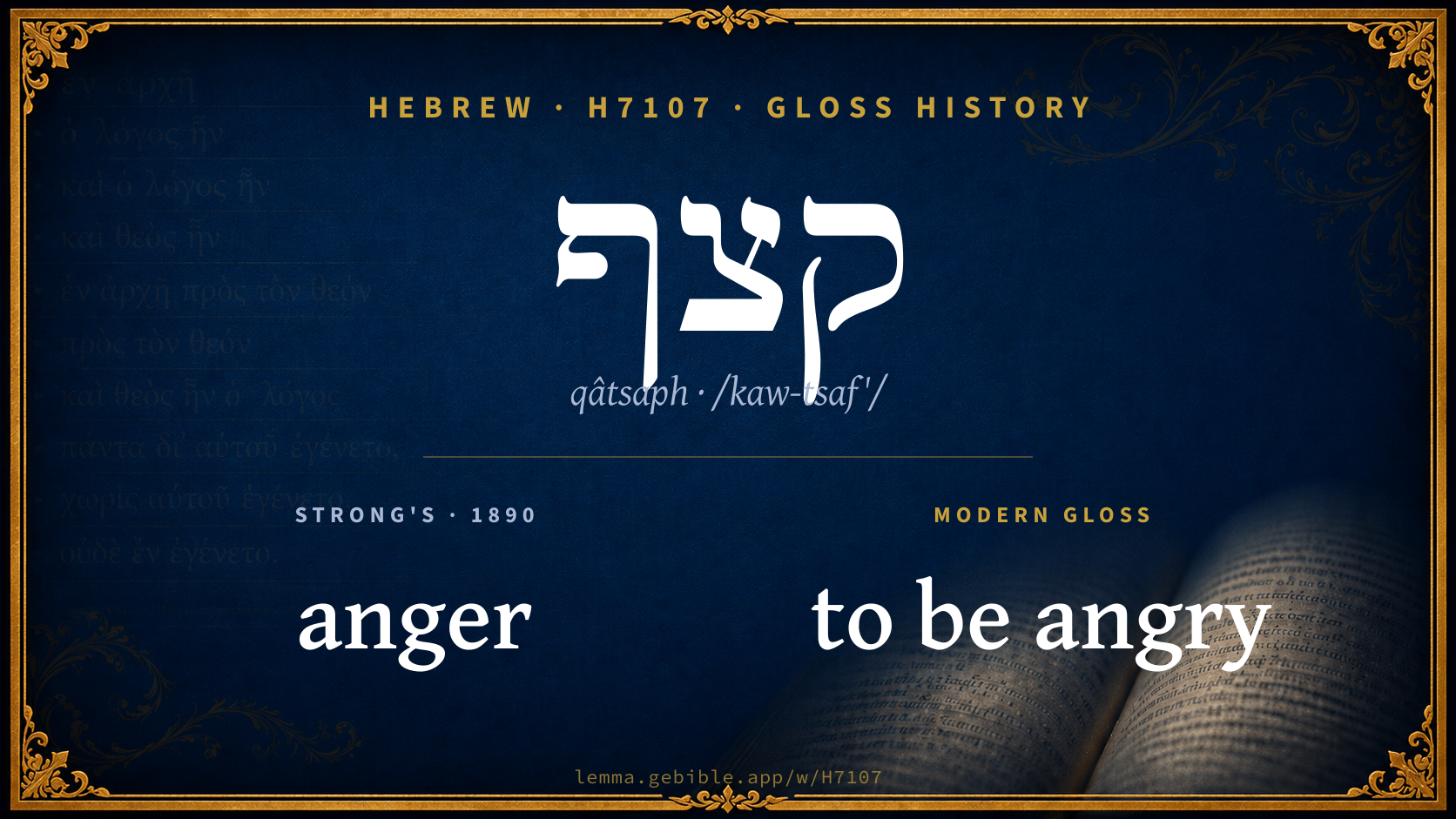
Gloss history
Strong's 1890 vs modern scholarship
About this word
Strong's H7107 catalogs a Hebrew word from the Hebrew Old Testament.
These counts are not copied from any lexicon or concordance. They are computed here, from the morphology-tagged Hebrew Old Testament. What Lemma adds →
- 32
- distinct verses
- The word appears in 32 distinct verses.
- 15 / 39
- OT books
- The word appears in 15 of 39 Old Testament books.
- #1,041
- by frequency
- Top 2500 most frequent Hebrew words (rank 1,041 of 8,640 Hebrew words by occurrence).
View all 32 occurrences in the concordance →
Most concentrated in
- Isaiah 7 verses 22%
- Deuteronomy 5 verses 16%
- Zechariah 3 verses 9%
By section of the Old Testament
By traditional corpus
Conventional, traditional groupings — biblical authorship is debated, so this is a traditional corpus grouping, not an authorship claim. Each share is this word’s portion of its verses in that division of the Hebrew canon. Each figure is a share of the word’s 32 distinct verses.
- Prophets (Nevi'im) 15 verses · 47%
- Torah (Pentateuch) 12 verses · 38%
- Writings (Ketuvim) 5 verses · 16%
How translations render this word
Counts come from each version’s own published word-to-Strong’s tagging or interlinear alignment — an approximate guide to how each version renders this word, not a word-level alignment the data otherwise carries. Because each total is that version’s own tagged count, the per-version totals vary from one another and need not match the appearance or distinct-verse counts above. These counts may also differ from a printed concordance because Lemma counts each distinctly tagged rendering and does not collapse phrase taggings into a single head-word total. This is a fixed set of word-tagged versions (KJV, ASV, BSB, ULT) and does not change with the reading translation you choose elsewhere. Each version’s license is shown beside its name below (and on Sources).
- King James Version: Was wroth 9×, Displeased 3×, Were wroth 3×
- American Standard Version: Was wroth 7×, Displeased 3×, Were wroth 3×
- Berean Standard Bible: Was angry 4×, Angry 3×, Be angry 3×
- unfoldingWord Literal Text: And 5×, Be angry 5×, Became angry 4×
King James Version Public Domain
Renders H7107 across 35 tagged occurrences — most commonly:
Plus 14 renderings that appear only once — usually multi-word phrases or single function words the recovered tagging swept in, not distinct renderings.
American Standard Version Public Domain
Renders H7107 across 35 tagged occurrences — most commonly:
Plus 17 renderings that appear only once — usually multi-word phrases or single function words the recovered tagging swept in, not distinct renderings.
Berean Standard Bible Public Domain
Renders H7107 across 33 tagged occurrences — most commonly:
Plus 18 renderings that appear only once — usually multi-word phrases or single function words the recovered tagging swept in, not distinct renderings. Not rendered by a distinct English word in 1 further occurrence.
unfoldingWord Literal Text CC BY-SA 4.0
Renders H7107 across 48 tagged occurrences — most commonly:
Plus 20 renderings that appear only once — usually multi-word phrases or single function words the recovered tagging swept in, not distinct renderings.
Senses in the full BDB
Hebrew verbs can shift meaning by stem (binyan): Qal is the basic action, Niphal is often passive or reflexive, Piel often intensifies or makes it factitive, and Hiphil is typically causative. The senses below are grouped under the stem BDB assigns to each. This entry also uses Hithpael (reflexive or reciprocal).
What do BDB’s symbols mean?
BDB uses these scholarly abbreviations:
| Symbol | Meaning |
|---|---|
| 𝔊 | the Septuagint (the ancient Greek translation, LXX) |
| 𝔙 | the Vulgate (the Latin translation) |
| 𝔖 | the Syriac version (the Peshitta) |
| 𝔗 | the Targum (the Aramaic translation) |
| ψ | the Psalms |
| √ | root (the underlying root or stem) |
| ‖ | parallel passage (a synonymous or contrasted parallel) |
| † | the dagger: every passage where the word occurs is cited |
The 5 senses and sub-senses the full Brown-Driver-Briggs lexicon distinguishes for this word, in lexicon order (not ranked by frequency), with BDB’s own verbatim wording and sub-sense lettering. Shown in Hebrew script with BDB’s own scholarly abbreviations. The condensed entry is in the Lexicon Entry tab. See also the Forms in the corpus table below.
Qal
- Pf. 3 ms. ק׳ Gn 41:10 +, etc.; Impf. 3 ms. יִקְצֹף Lv 10:6 +, etc.; Inf. cstr. קְצֹף Is 54:9; Pt. קֹצֵף Zc 1:15;—be wroth: e.g. Genesis 41:10
- 1. of God; abs. Dt 1:34 Is 57:16, 17(×2); 64:4, 8; Zc 1:15; c. עַל against, Lv 10:6; Nu 16:22 (P), Dt 9:19; Is 47:6; 54:9; La 5:22; Zc 1:2, 15; Ec 5:5; c. אֶל Jos 22:18 (P). e.g. Deuteronomy 1:34
- 2. of man; abs. Est 1:12; 2:21; 2 K 5:11; c. עַל Gn 40:2; 41:10 (E), Ex 16:20; Lv 10:16; Nu 31:14 (P), Je 37:15; 1 S 29:4; 2 K 13:19. e.g. Esther 1:12
Hiphil
- Pf. 2 ms. הִקְצַפְתָּ Dt 9:7; 2 mpl. הִקְצַפְתֶּם v 8; Impf. 3 mpl. יַקְצִיפוּ ψ 106:32; Inf. cstr. הַקְצִיף Zc 8:14; Pt. pl. מַקְצִפִים Dt 9:22;—provoke to wrath, c. acc. י׳ Dt 9:7, 8, 22; Zc 8:14; so (acc. om.) ψ 106:32. e.g. Deuteronomy 9:7
Hithpael
- put oneself in a rage: Pf. 3 ms. consec. וְהִתְקַצַּף Is 8:21, of hard-pressed people. e.g. Isaiah 8:21
Senses from the full Brown-Driver-Briggs lexicon (Brown, Driver, Briggs; Oxford 1906 — public domain), digitized via Sefaria, supplemented by the OpenScriptures HebrewLexicon (CC BY 4.0). Full attribution on Sources.
Word origin
vb. be wroth (NH id., Hiph. make wrathful (rare); Syriac ܩܨܰܦ be wrathful, also be anxious, fearful);—
— Brown-Driver-Briggs (Oxford 1906, public domain), digitized via Sefaria, supplemented by the OpenScriptures HebrewLexicon (CC BY 4.0). See Sources.
Origin: a primitive root
Jastrow Dictionary
A second Hebrew/Aramaic lexicon for comparison, covering Aramaic and post-biblical (Talmudic, Targumic, Midrashic) usage that the biblical-Hebrew BDB does not. Matched by lemma rather than by Strong’s number, so a lemma may carry more than one Jastrow headword (shown separately below), and the entries cover usage well beyond the Bible.
קָצַף
- (b. h.) [to be rough, excited,] to be angry. Esth. R. to I, 18, v. קִצָּפוֹן. Midr. Till. to Ps. XXXVIII אנו … ואתה קוֹצֵף we sin, and thou art angry. Yalk. Esth. 1053 קָצְפוּ ואמרו וכ׳ they grew excited and said &c.; a. fr.
- to arouse to anger, excite, incite. Meg. 13ᵇ (ref. to Gen. XL, 2 a. Esth. II, 21) ה׳ הקב"ה אדון על עבדיו וכ׳ the Lord incited a master against his servants, in order to satisfy the desire of a righteous man …, servants against their master, in order to perform wonders for a righteous man; Gen. R. s. 88; Esth. R. to II, 21; Yalk. Gen. 146 מַקְצִיף; a. e. e.g. Genesis 40:2
קצף
- , Targ. Lam. II, 3 ed. Vien., v. קְצַץ
קֶצֶף
- preced. art.)
- 1. anger. Num. R. s. 1, end שלא יהא ק׳ עליהן that the divine anger be not on them. Midr. Till. to Ps. XXXVIII; a. fr.—Esp. Ḳetsef name of an angel of destruction. Targ. Y. Num. XVII, 11, sq.—Sabb. 55ᵃ (ref. to Ez. IX, 2) ‘six men’, they are ק׳ אף וחימה וכ׳ Ḳ. (Wrath), Af (Anger) &c. Ex. R. s. 41; a. fr.—2) destruction, harm. Deut. R. s. 11 איך … לעשות לו ק׳ how can I do harm to him (Moses)?; Yalk. ib. 940. e.g. Ezekiel 9:2
A Dictionary of the Targumim, the Talmud Babli and Yerushalmi, and the Midrashic Literature (Marcus Jastrow; London, Luzac, 1903) — Public Domain. Digitized via Sefaria. Digitized via Sefaria. Full attribution on Sources.
Forms in the corpus
The 30 distinct written forms H7107 takes in the Hebrew Bible, most frequent first — each parse links to that stem’s occurrences in the concordance. Hebrew forms include their vowel points and cantillation, so a single lemma takes many written forms.
Same root — word family
Other BDB entries built from the same root as H7107, grouped by Strong’s listed origin. These share a root / origin per the lexicon — not necessarily a shared meaning. Each links to that word’s own entry.
Derived from this word
Compare all same-root words → They share a root, not necessarily a meaning.
Septuagint verse parallels
This word appears in 31 verses that also exist in the Greek Old Testament (Septuagint), out of the 32 Hebrew verses it occurs in. You can read those verses in Greek by switching the Old Testament edition to the Septuagint.
Read these verses in the Septuagint
- Genesis 40:2
- Exodus 16:20
- Leviticus 10:6
- Numbers 16:22
- Deuteronomy 1:34
- Joshua 22:18
- 1 Samuel 29:4
- 2 Kings 5:11
- Esther 1:12
- Psalms 106:32
- Ecclesiastes 5:6
- Isaiah 8:21
This is a verse-level parallel only — the same verses exist in both the Hebrew and Greek Old Testaments. No word-level Hebrew↔Greek correspondence is claimed: the data carries no such alignment, so no Greek word is shown as this Hebrew word’s translation. Coverage is not total — the Septuagint omits the deuterocanon and renumbers the Psalms, so some Hebrew verses have no direct Greek parallel.