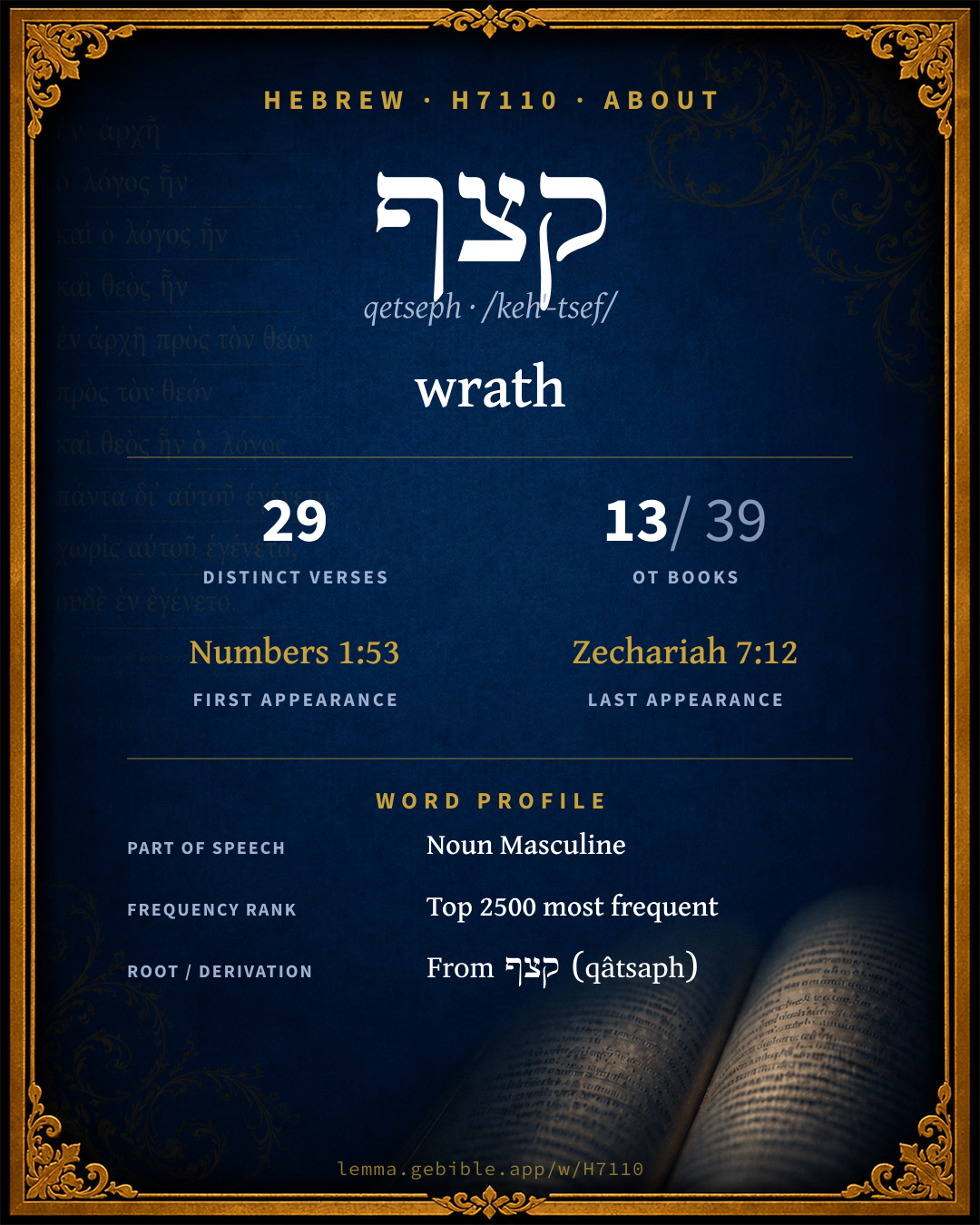
קֶ֫צֶף
wrath
‘wrath’ is one of 2 main senses fuller range ↓
Full lexicon entry — Brown-Driver-Briggs (BDB)
From Brown-Driver-Briggs (BDB)
Where this word appears
See every Absolute-state word in the Hebrew Bible →
Grammar key — what these labels mean
Part of speech
- Noun
- A naming word — a person, place, thing, or idea.
Noun type
- Common
- A common noun — a general class of person, place, or thing (“king,” “city,” “water”), not a specific name.
State
- Absolute
- The independent form of a noun, not bound to a following word.
- Construct
- A noun bound to a following noun in a possessive / “of” relationship (the construct chain).
Gender
- Masculine
- Grammatically masculine.
Number
- Singular
- One.
Grammatical forms
- Noun, Common, Masculine, Singular, Absolute 22 times (76%)
- Noun, Common, Masculine, Singular, Construct 7 times (24%)
Parsed forms decoded from the imported morphology (morphhb / Westminster Leningrad Codex — WLC text public domain, morphhb tagging CC BY 4.0), counted across 29 parsed occurrences — not distinct verses.
Every verse where H7110 appears — 29 distinct verses across 13 books. Click any verse to open its interlinear word-by-word view. Verse text shown in the World English Bible for context — . Each verse’s Hebrew form is shown with its reference; the English is not keyword-highlighted, since the data carries no word-level English alignment. Use “Compare translations” on any verse to read it across multiple English versions. This concordance covers the Hebrew Bible; Septuagint (Greek Old Testament) occurrences are not indexed here.
Numbers 3 verses
- Numbers 1:53 קֶ֔צֶף n c ms But the Levites shall encamp around the Tabernacle of the Testimony, that there may be no wrath on the congregation of the children of Israel: and the Levites shall be responsible for the Tabernacle of the Testimony."
- Numbers 16:46 הַ/קֶּ֛צֶף ptcl def.art + n c ms Moses said to Aaron, Take your censer, and put fire therein from off the altar, and lay incense thereon, and carry it quickly to the congregation, and make atonement for them: for there is wrath gone out from Yahweh; the plague is begun.
- Numbers 18:5 קֶ֖צֶף n c ms You shall keep the charge of the sanctuary, and the charge of the altar; that there be wrath no more on the children of Israel.
Deuteronomy 1 verse
Joshua 2 verses
- Joshua 9:20 קֶ֔צֶף n c ms This we will do to them, and let them live; lest wrath be on us, because of the oath which we swore to them.
- Joshua 22:20 קָ֑צֶף n c ms Didn't Achan the son of Zerah commit a trespass in the devoted thing, and wrath fell on all the congregation of Israel? and that man didn't perish alone in his iniquity.
2 Kings 1 verse
1 Chronicles 1 verse
2 Chronicles 6 verses
- 2 Chronicles 19:2 קֶּ֔צֶף n c ms Jehu the son of Hanani the seer went out to meet him, and said to king Jehoshaphat, Should you help the wicked, and love those who hate Yahweh? for this thing wrath is on you from before Yahweh.
- 2 Chronicles 19:10 קֶ֥צֶף n c ms Whenever any controversy shall come to you from your brothers who dwell in their cities, between blood and blood, between law and commandment, statutes and ordinances, you shall warn them, that they not be guilty towards Yahweh, and so wrath come on you and on your brothers: this do, and you shall not be guilty.
- 2 Chronicles 24:18 קֶ֗צֶף n c ms They forsook the house of Yahweh, the God of their fathers, and served the Asherim and the idols: and wrath came on Judah and Jerusalem for this their guiltiness.
- 2 Chronicles 29:8 קֶ֣צֶף n c ms cs Therefore the wrath of Yahweh was on Judah and Jerusalem, and he has delivered them to be tossed back and forth, to be an astonishment, and a hissing, as you see with your eyes.
- 2 Chronicles 32:25 קֶ֔צֶף n c ms But Hezekiah didn't render again according to the benefit done to him; for his heart was lifted up: therefore there was wrath on him, and on Judah and Jerusalem.
- 2 Chronicles 32:26 קֶ֣צֶף n c ms cs Notwithstanding Hezekiah humbled himself for the pride of his heart, both he and the inhabitants of Jerusalem, so that the wrath of Yahweh didn't come on them in the days of Hezekiah.
Esther 1 verse
Psalms 2 verses
Ecclesiastes 1 verse
Isaiah 3 verses
- Isaiah 34:2 קֶ֤צֶף n c ms For Yahweh has indignation against all the nations, and wrath against all their host: he has utterly destroyed them, he has delivered them to the slaughter.
- Isaiah 54:8 קֶ֗צֶף n c ms In overflowing wrath I hid my face from you for a moment; but with everlasting loving kindness will I have mercy on you, says Yahweh your Redeemer.
- Isaiah 60:10 בְ/קִצְפִּ/י֙ prep + n c ms cs + sfx pers 1cs Foreigners shall build up your walls, and their kings shall minister to you: for in my wrath I struck you, but in my favor have I had mercy on you.
Jeremiah 4 verses
- Jeremiah 10:10 מִ/קִּצְפּ/וֹ֙ prep + n c ms cs + sfx pers 3ms But Yahweh is the true God; he is the living God, and an everlasting King: at his wrath the earth trembles, and the nations are not able to abide his indignation.
- Jeremiah 21:5 וּ/בְ/קֶ֥צֶף conj + prep + n c ms I myself will fight against you with an outstretched hand and with a strong arm, even in anger, and in wrath, and in great indignation.
- Jeremiah 32:37 וּ/בְ/קֶ֣צֶף conj + prep + n c ms Behold, I will gather them out of all the countries, where I have driven them in my anger, and in my wrath, and in great indignation; and I will bring them again to this place, and I will cause them to dwell safely:
- Jeremiah 50:13 מִ/קֶּ֤צֶף prep + n c ms cs Because of the wrath of Yahweh she shall not be inhabited, but she shall be wholly desolate: everyone who goes by Babylon shall be astonished, and hiss at all her plagues.
Hosea 1 verse
Zechariah 3 verses
- Zechariah 1:2 קָֽצֶף n c ms "Yahweh was very displeased with your fathers.
- Zechariah 1:15 וְ/קֶ֤צֶף conj + n c ms I am very angry with the nations that are at ease; for I was but a little displeased, but they added to the calamity."
- Zechariah 7:12 קֶ֣צֶף n c ms Yes, they made their hearts as hard as flint, lest they might hear the law, and the words which Yahweh of Hosts had sent by his Spirit by the former prophets. Therefore great wrath came from Yahweh of Hosts.
About this entry
At a glance — auto-summarized from this page’s data, not written by a person. Every figure links to its source below. This summary describes the numbers; it doesn’t interpret them.
“wrath” is the headline sense of the Hebrew noun קצף (qetseph). Its earliest occurrence is Numbers 1:53. It turns up in 29 verses across 13 books, a moderately common footprint. Its meaning spans more than one sense — see its full sense range. It clusters with קצף, קצף and קצפה under a shared root. The sections below give every sense, occurrence, and version rendering.
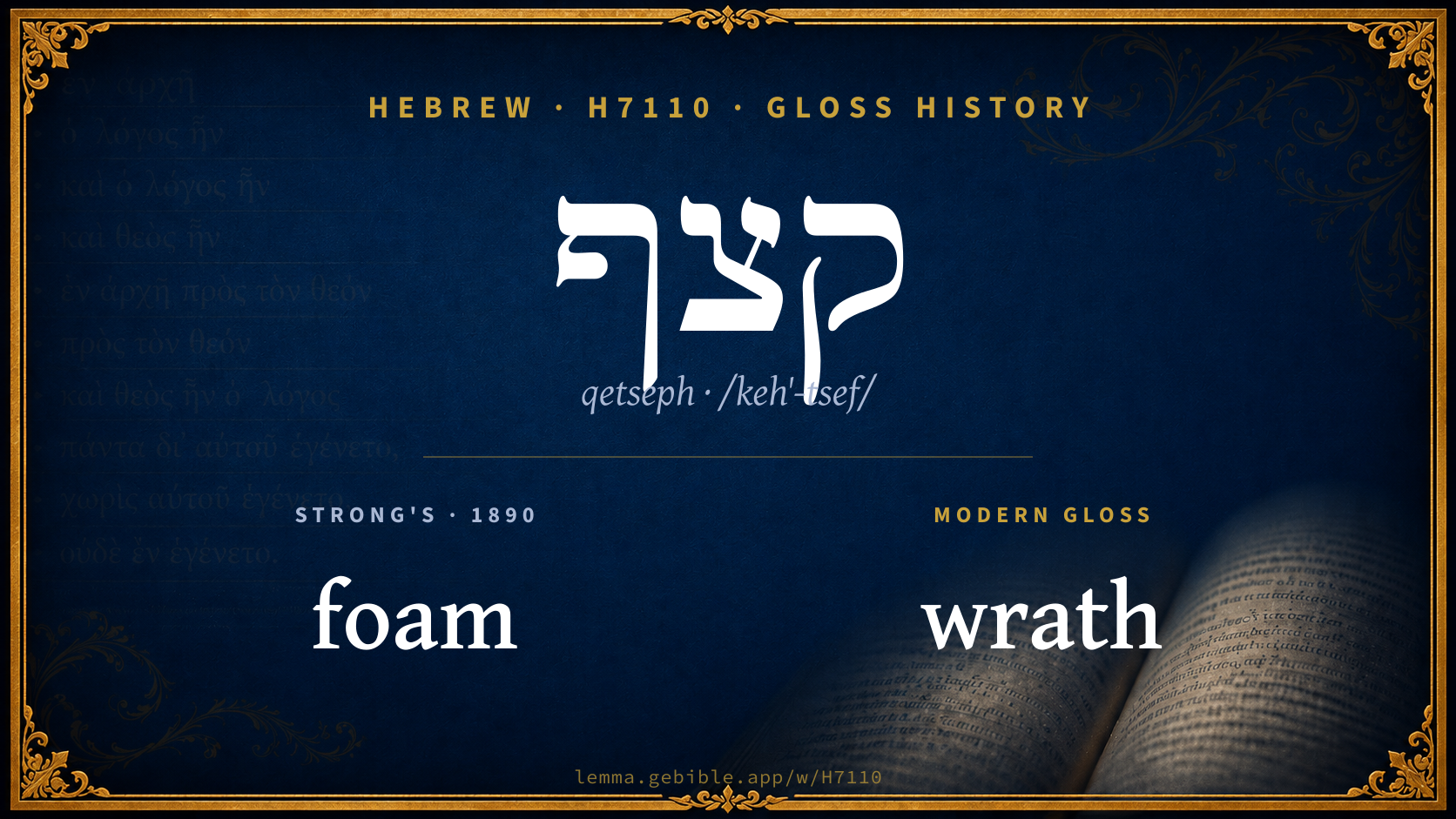
Gloss history
Strong's 1890 vs modern scholarship
About this word
Strong's H7110 catalogs a Hebrew word from the Hebrew Old Testament.
These counts are not copied from any lexicon or concordance. They are computed here, from the morphology-tagged Hebrew Old Testament. What Lemma adds →
- 29
- distinct verses
- The word appears in 29 distinct verses.
- 13 / 39
- OT books
- The word appears in 13 of 39 Old Testament books.
- #1,160
- by frequency
- Top 2500 most frequent Hebrew words (rank 1,160 of 8,640 Hebrew words by occurrence).
View all 29 occurrences in the concordance →
Most concentrated in
- 2 Chronicles 6 verses 21%
- Jeremiah 4 verses 14%
- Numbers 3 verses 10%
By section of the Old Testament
By traditional corpus
Conventional, traditional groupings — biblical authorship is debated, so this is a traditional corpus grouping, not an authorship claim. Each share is this word’s portion of its verses in that division of the Hebrew canon. Each figure is a share of the word’s 29 distinct verses.
- Prophets (Nevi'im) 14 verses · 48%
- Writings (Ketuvim) 11 verses · 38%
- Torah (Pentateuch) 4 verses · 14%
How translations render this word
Counts come from each version’s own published word-to-Strong’s tagging or interlinear alignment — an approximate guide to how each version renders this word, not a word-level alignment the data otherwise carries. Because each total is that version’s own tagged count, the per-version totals vary from one another and need not match the appearance or distinct-verse counts above. These counts may also differ from a printed concordance because Lemma counts each distinctly tagged rendering and does not collapse phrase taggings into a single head-word total. This is a fixed set of word-tagged versions (KJV, ASV, BSB, ULT) and does not change with the reading translation you choose elsewhere. Each version’s license is shown beside its name below (and on Sources).
BDB lists this Strong’s number as 2 distinct words (homographs). Each count above pools all of them and is not split by sense — see the Senses section below. A low-frequency rendering may belong to a different one of those words, not the primary meaning.
- King James Version†: Wrath 14×, Indignation 3×, Be no wrath 2×
- American Standard Version†: Wrath 12×, Indignation 3×
- Berean Standard Bible†: Wrath 16×, Anger 5×
- unfoldingWord Literal Text†: Wrath 13×, Anger 5×, Fury 4×
King James Version Public Domain
Renders H7110 across 29† tagged occurrences — most commonly:
Plus 8 renderings that appear only once — usually multi-word phrases or single function words the recovered tagging swept in, not distinct renderings.
American Standard Version Public Domain
Renders H7110 across 28† tagged occurrences — most commonly:
Plus 13 renderings that appear only once — usually multi-word phrases or single function words the recovered tagging swept in, not distinct renderings.
Berean Standard Bible Public Domain
Renders H7110 across 29† tagged occurrences — most commonly:
Plus 8 renderings that appear only once — usually multi-word phrases or single function words the recovered tagging swept in, not distinct renderings.
unfoldingWord Literal Text CC BY-SA 4.0
Renders H7110 across 31† tagged occurrences — most commonly:
Plus 5 renderings that appear only once — usually multi-word phrases or single function words the recovered tagging swept in, not distinct renderings.
Senses in the full BDB
What do BDB’s symbols mean?
BDB uses these scholarly abbreviations:
| Symbol | Meaning |
|---|---|
| 𝔊 | the Septuagint (the ancient Greek translation, LXX) |
| 𝔙 | the Vulgate (the Latin translation) |
| 𝔖 | the Syriac version (the Peshitta) |
| 𝔗 | the Targum (the Aramaic translation) |
| ψ | the Psalms |
| √ | root (the underlying root or stem) |
| ‖ | parallel passage (a synonymous or contrasted parallel) |
| † | the dagger: every passage where the word occurs is cited |
The 2 senses and sub-senses the full Brown-Driver-Briggs lexicon distinguishes for this word, in lexicon order (not ranked by frequency), with BDB’s own verbatim wording and sub-sense lettering. Shown in Hebrew script with BDB’s own scholarly abbreviations. The condensed entry is in the Lexicon Entry tab. See also the Forms in the corpus table below.
קצף I
- 1. of God: abs. Nu 17:11 (P), Dt 29:27 Is 60:10 Je 10:10; 21:5; 32:37; 50:13 ψ 38:2; 102:11 Zc 7:12; c. עַל against Nu 1:53; 18:5 Jos 9:20; 22:20 (P), 2 K 3:27 1 Ch 27:24 2 Ch 19:2, 10; 24:18; 29:8; 32:25, 26 Is 34:2 Zc 1:2, 15; בְּשֶׁצֶף ק׳ Is 54:8. e.g. Numbers 17:11
- 2. of man (late), Est 1:18 Ec 5:16.—Ho 10:7 v. ii. קֶצֶף. e.g. Esther 1:18
קצף II [m.] prob. splinter
Senses from the full Brown-Driver-Briggs lexicon (Brown, Driver, Briggs; Oxford 1906 — public domain), digitized via Sefaria, supplemented by the OpenScriptures HebrewLexicon (CC BY 4.0). Full attribution on Sources.
Word origin
I. n.m. 2 K 3:27 wrath;—abs. ק׳ Nu 1:53 +; קָ֑צֶף Jos 22:20 +; cstr. קֶצֶף Je 50:13 +; sf. קִצְפִּי Is 60:10; קֶצְפְּךָ ψ 38:2, קִצְפֶּ֑ךָ 102:11, קִצְפּוֹ Je 10:10;—
II. n.[m.] prob. splinter;—only כְּק׳ עַל־פְּנֵי־מָ֑יִם Ho 10:7 (sim. of helpless king).
— Brown-Driver-Briggs (Oxford 1906, public domain), digitized via Sefaria, supplemented by the OpenScriptures HebrewLexicon (CC BY 4.0). See Sources.
Derived from קצף (qâtsaph) (H7107) — to be angry.
Jastrow Dictionary
A second Hebrew/Aramaic lexicon for comparison, covering Aramaic and post-biblical (Talmudic, Targumic, Midrashic) usage that the biblical-Hebrew BDB does not. Matched by lemma rather than by Strong’s number, so a lemma may carry more than one Jastrow headword (shown separately below), and the entries cover usage well beyond the Bible.
קָצַף
- (b. h.) [to be rough, excited,] to be angry. Esth. R. to I, 18, v. קִצָּפוֹן. Midr. Till. to Ps. XXXVIII אנו … ואתה קוֹצֵף we sin, and thou art angry. Yalk. Esth. 1053 קָצְפוּ ואמרו וכ׳ they grew excited and said &c.; a. fr.
- to arouse to anger, excite, incite. Meg. 13ᵇ (ref. to Gen. XL, 2 a. Esth. II, 21) ה׳ הקב"ה אדון על עבדיו וכ׳ the Lord incited a master against his servants, in order to satisfy the desire of a righteous man …, servants against their master, in order to perform wonders for a righteous man; Gen. R. s. 88; Esth. R. to II, 21; Yalk. Gen. 146 מַקְצִיף; a. e. e.g. Genesis 40:2
קצף
- , Targ. Lam. II, 3 ed. Vien., v. קְצַץ
קֶצֶף
- preced. art.)
- 1. anger. Num. R. s. 1, end שלא יהא ק׳ עליהן that the divine anger be not on them. Midr. Till. to Ps. XXXVIII; a. fr.—Esp. Ḳetsef name of an angel of destruction. Targ. Y. Num. XVII, 11, sq.—Sabb. 55ᵃ (ref. to Ez. IX, 2) ‘six men’, they are ק׳ אף וחימה וכ׳ Ḳ. (Wrath), Af (Anger) &c. Ex. R. s. 41; a. fr.—2) destruction, harm. Deut. R. s. 11 איך … לעשות לו ק׳ how can I do harm to him (Moses)?; Yalk. ib. 940. e.g. Ezekiel 9:2
A Dictionary of the Targumim, the Talmud Babli and Yerushalmi, and the Midrashic Literature (Marcus Jastrow; London, Luzac, 1903) — Public Domain. Digitized via Sefaria. Digitized via Sefaria. Full attribution on Sources.
Forms in the corpus
The 21 distinct written forms H7110 takes in the Hebrew Bible, most frequent first — each parse links to that state’s occurrences in the concordance. Hebrew forms include their vowel points and cantillation, so a single lemma takes many written forms.
Same root — word family
Other BDB entries built from the same root as H7110, grouped by Strong’s listed origin. These share a root / origin per the lexicon — not necessarily a shared meaning. Each links to that word’s own entry.
Derives from
Shares the same root
Compare all same-root words → They share a root, not necessarily a meaning.
Septuagint verse parallels
This word appears in 27 verses that also exist in the Greek Old Testament (Septuagint), out of the 29 Hebrew verses it occurs in. You can read those verses in Greek by switching the Old Testament edition to the Septuagint.
Read these verses in the Septuagint
- Numbers 1:53
- Deuteronomy 29:28
- Joshua 9:20
- 2 Kings 3:27
- 1 Chronicles 27:24
- 2 Chronicles 19:2
- Esther 1:18
- Psalms 38:1
- Ecclesiastes 5:17
- Isaiah 34:2
- Jeremiah 10:10
- Hosea 10:7
This is a verse-level parallel only — the same verses exist in both the Hebrew and Greek Old Testaments. No word-level Hebrew↔Greek correspondence is claimed: the data carries no such alignment, so no Greek word is shown as this Hebrew word’s translation. Coverage is not total — the Septuagint omits the deuterocanon and renumbers the Psalms, so some Hebrew verses have no direct Greek parallel.