

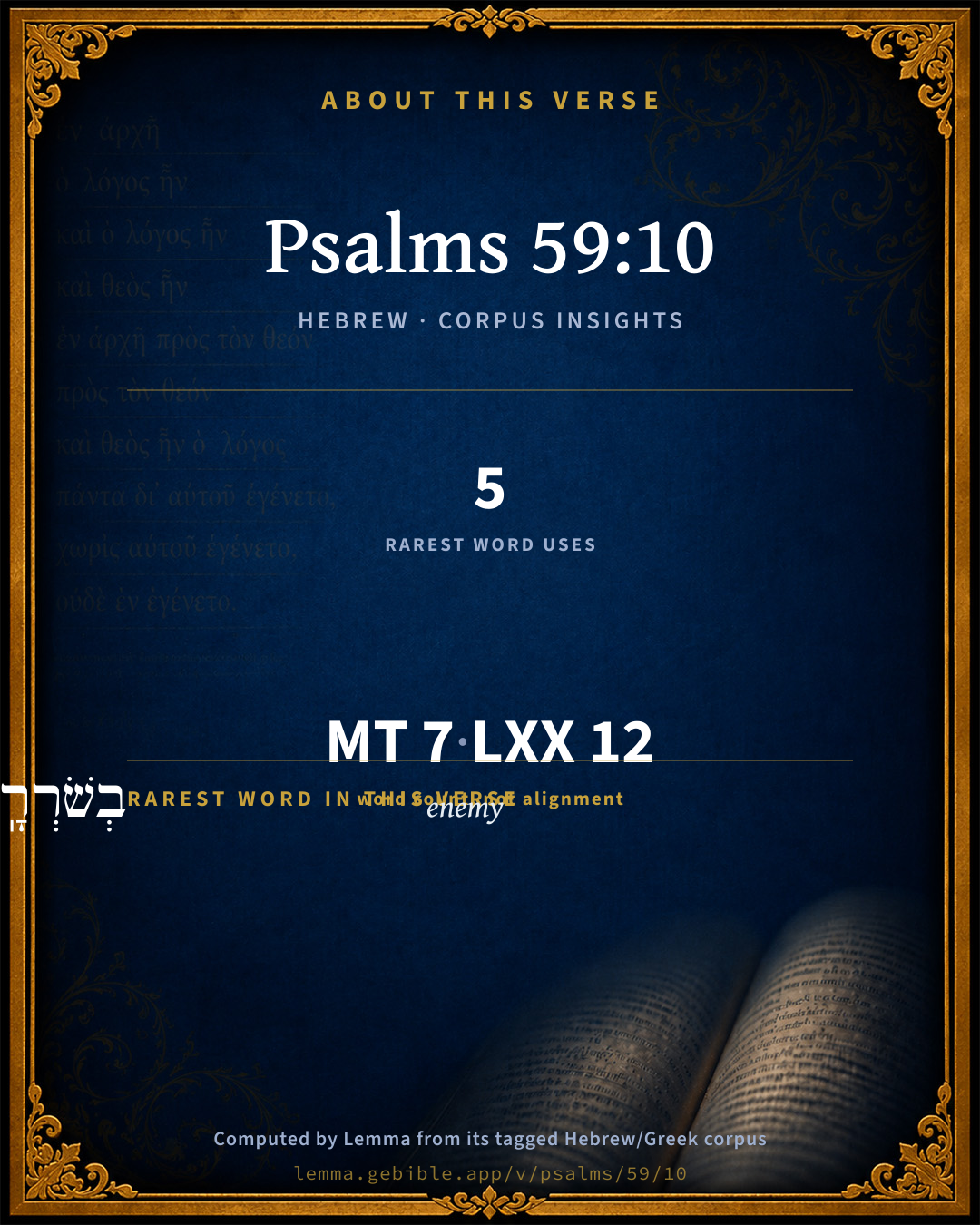
Psalms 59:10

Hebrew (Westminster Leningrad Codex) Psalms 59:10 appears in the Hebrew Old Testament. The text above is from the Westminster Leningrad Codex. Each word links to its Strong’s number, a concise gloss, and parsing drawn from the Open Scriptures Hebrew Bible morphology. Click any word for its full Brown-Driver-Briggs (BDB) entry.
Download image
Cite this verse

Psalms 59:10 (World English Bible). Public Domain. Lemma interlinear Bible study tool, https://lemma.gebible.app/v/psalms/59/10.

Show BibTeX & RIS
BibTeX
RIS
English Translation
My God will go before me with his loving kindness. God will let me look at my enemies in triumph.
World English Bible · Public Domain
Download a study sheet

One document with this verse’s original text, its word-by-word gloss line, the meaning frame, cross-references with their text, attributed commentary, and full source and license credits — printable, and it pastes into notes with its structure intact.

This verse Autodidact and up

Study sheet (.html) Plain text (.txt)

A passage Seminary Student

Up to 50 verses in one chapter. A passage sheet keeps up to 6 commentary sources and 12 cross-references per verse, in the order this page ranks them, and says so on the sheet whenever that leaves anything out. Ask for a single verse and you get the Autodidact verse sheet above.

Everything on this page stays free to read, with no account — the sheet is a download of what is already on screen, not access to it.

Want to remove ads? Support Godless Engineer
Compare translations 3

The same verse in 3 English versions, stacked beneath the original-language interlinear above. Click any original word for its lexicon entry.

Each is an independent rendering of the whole verse — the interlinear is not word-aligned to these translations.

Highlighted words mark where these versions differ — a whole-verse word diff, not a word-by-word alignment.

  • World English Bible Public Domain
    My God will go before me with his loving kindness. God will let me look at my enemies in triumph.
  • King James Version Public Domain
    The God of my mercy shall prevent me: God shall let me see my desire upon mine enemies.
  • unfoldingWord Literal Text CC BY-SA 4.0
    The God of my covenant faithfulness will meet me. God will make me look upon my enemies.

unfoldingWord Literal Text — © unfoldingWord, licensed CC BY-SA 4.0. Word-aligned USFM3 via Door43 (git.door43.org/unfoldingWord/en_ult).

Versions to compare (up to 4)

3 of 4 selected

Show all 18 translations

Every available English version of this verse, each an independent rendering of the whole verse.

  • World English Bible Public Domain
    My God will go before me with his loving kindness. God will let me look at my enemies in triumph.
  • Berean Standard Bible Public Domain
    My God of loving devotion will come to meet me; God will let me stare down my foes.
  • Majority Standard Bible Public Domain
    My God of loving devotion will come to meet me; God will let me stare down my foes.
  • King James Version Public Domain
    The God of my mercy shall prevent me: God shall let me see my desire upon mine enemies.
  • American Standard Version (1901) Public Domain
    My God with his lovingkindness will meet me: God will let me see `my desire' upon mine enemies.
  • Revised Version (1885) Public Domain
    The God of my mercy shall prevent me: God shall let me see my desire upon mine enemies.
  • Geneva Bible (1599) Public Domain
    My mercifull God will preuent me: God wil let me see my desire vpon mine enemies.
  • Douay-Rheims (1899) Public Domain
    I will keep my strength to thee: for thou art my protector:
  • Young's Literal Translation Public Domain
    God doth go before me, He causeth me to look on mine enemies.
  • Literal Standard Version CC BY-SA 4.0
    God goes before me, || He causes me to look on my enemies.
  • Unlocked Literal Bible CC BY-SA 4.0
    My God will meet me with his covenant faithfulness; God will let me see my desire on my enemies.
  • unfoldingWord Literal Text CC BY-SA 4.0
    The God of my covenant faithfulness will meet me. God will make me look upon my enemies.
  • Darby Bible Public Domain
    God, whose loving-kindness will come to meet me, -- God shall let me see [my desire] upon mine enemies.
  • World Messianic Bible Public Domain
    My God will go before me with his loving kindness. God will let me look at my enemies in triumph.
  • Webster's Bible Public Domain
    \\59:9\\Because of his strength will I wait upon thee: for God is my defense.
  • Free Bible Version CC BY-SA 4.0
    In his trustworthy love, God will come and save me. He will show me how my enemies are defeated.
  • Bible in Basic English Public Domain
    The God of my mercy will go before me: God will let me see my desire effected on my haters.
  • JPS Tanakh (1917) Public Domain
    (59-11) The God of my mercy will come to meet me; God will let me gaze upon mine adversaries.

Literal Standard Version (2020), Covenant Press — licensed CC BY-SA 4.0. Text via the HelloAO Bible API (eBible.org). Unlocked Literal Bible (unfoldingWord) — licensed CC BY-SA 4.0. Text via the HelloAO Bible API (eBible.org). unfoldingWord Literal Text — © unfoldingWord, licensed CC BY-SA 4.0. Word-aligned USFM3 via Door43 (git.door43.org/unfoldingWord/en_ult). Free Bible Version, Dr. Jonathan Gallagher — licensed CC BY-SA 4.0. Text via the HelloAO Bible API (eBible.org).

Word by word

More ways to search: Search by grammar → Find every occurrence → Compare this word →

Practice this passage: Drill this verse → Learn its vocabulary →

בְשֹׁרְרָֽי
shârar
H8324
“in/at · enemies · my”
Preposition + Noun, Common, Masculine, Plural, Construct + Suffix, Personal, 1st Person, Common, Singular
Part of Speech
Preposition + Noun
Type
Common
Gender
Masculine
Number
Plural
State
Construct
Full BDB Definition

Origin: a primitive root

TWOT: 2469

(Qal) to be an enemy
  1. אֱלֹהֵ֣י ʼĕlôhîym H430 “God(s) of” Noun, Common, Masculine, Plural, Construct
  2. חסדו chêçêd H2617 “kindness · his” Noun, Common, Masculine, Singular, Construct + Suffix, Personal, 3rd Person, Masculine, Singular
  3. חַסְדִּ֣י chêçêd H2617 “kindness · my” Noun, Common, Masculine, Singular, Construct + Suffix, Personal, 1st Person, Common, Singular
  4. יְקַדְּמֵ֑נִי qâdam H6923 “to meet · me” Verb, Piel, Imperfect, 3rd Person, Masculine, Singular + Suffix, Personal, 1st Person, Common, Singular
  5. אֱ֝לֹהִ֗ים ʼĕlôhîym H430 “God(s)” Noun, Common, Masculine, Plural, Absolute
  6. יַרְאֵ֥נִי râʼâh H7200 “to see · me” Verb, Hiphil, Imperfect, 3rd Person, Masculine, Singular + Suffix, Personal, 1st Person, Common, Singular

About this verse

These counts appear in no published source. They are computed here, from the morphology-tagged text and Lemma’s own curated glosses. What Lemma adds →

7
words
5
distinct lemmas
Wisdom
section

Notable vocabulary

The rarest word here is בְשֹׁרְרָֽי enemy H8324 — appearing just 5 times in the whole Hebrew Bible.

Shared distinctive vocabulary

בְשֹׁרְרָֽי enemy H8324 occurs in 5 verses of the Hebrew Bible. Also found in:

Grammatical profile

  • 2 verbs
  • 5 nouns

Verb forms

  • יְקַדְּמֵ֑נִי Piel · Imperfect
  • יַרְאֵ֥נִי Hiphil · Imperfect

Repetition

Words recur within this verse — often emphatic in Hebrew:

  • אֱלֹהֵ֣י God H430 ×2
  • חסדו kindness H2617 ×2

Hebrew & Septuagint length

In English translation the verse runs 20 words from the Hebrew and 19 from the Septuagint (LXX English) — closely comparable.

A rough comparison of the two English renderings, which tokenize alike — not a word-level alignment.

Word counts can differ between the Hebrew and the Greek without any difference in meaning — e.g. the Hebrew direct-object marker אֵת has no separate Greek word, and Greek often adds the article ὁ.

In the original languages it is 7 Hebrew tokens and 12 Greek tokens — but the two are counted differently (Hebrew bundles its prefixes and suffixes into one token; the Greek is in lemma form), so that isn’t a like-for-like length.

Cross-references

22

Topical passages linked to Psalms 59:10 in the Treasury of Scripture Knowledge — connected by theme and wording, ordered by reader-vote popularity; previews shown in the World English Bible.

  • 1 Peter 5:10 But may the God of all grace, who called you to his eternal glory by Christ Jesus, after you have suffered a little while, perfect, establish, strengthen, and settle you.
  • Psalms 54:7 For he has delivered me out of all trouble. My eye has seen triumph over my enemies.
  • Psalms 59:17 To you, my strength, I will sing praises. For God is my high tower, the God of my mercy.
  • Psalms 21:3 For you meet him with the blessings of goodness; You set a crown of fine gold on his head.
  • Psalms 54:5 He will repay the evil to my enemies. Destroy them in your truth.
  • Psalms 92:11 My eye has also seen my enemies. My ears have heard of the wicked enemies who rise up against me.
  • Ephesians 2:4–5 But God, being rich in mercy, for his great love with which he loved us,
  • 2 Samuel 1:11–12 Then David took hold on his clothes, and tore them; and likewise all the men who were with him:
  • 2 Samuel 1:17 David lamented with this lamentation over Saul and over Jonathan his son
  • Psalms 5:8 Lead me, Yahweh, in your righteousness because of my enemies. Make your way straight before my face.
  • Psalms 56:2 My enemies want to swallow me up all day long, For they are many who fight proudly against me.
  • Psalms 56:6 They conspire and lurk, Watching my steps, they are eager to take my life.
  • Psalms 79:8 Don't hold the iniquities of our forefathers against us. Let your tender mercies speedily meet us, For we are in desperate need.
  • Psalms 91:8 You will only look with your eyes, And see the recompense of the wicked.
  • Psalms 112:8 His heart is established. He will not be afraid in the end when he sees his adversaries.
  • Isaiah 65:24 It shall happen that, before they call, I will answer; and while they are yet speaking, I will hear.
  • Jeremiah 17:16 As for me, I have not hurried from being a shepherd after you; neither have I desired the woeful day; you know: that which came out of my lips was before your face.
  • Luke 19:41–44 When he drew near, he saw the city and wept over it,
  • 2 Corinthians 1:3 Blessed be the God and Father of our Lord Jesus Christ, the Father of mercies and God of all comfort;
  • 1 Samuel 26:10 David said, As Yahweh lives, Yahweh will strike him; or his day shall come to die; or he shall go down into battle and perish.
  • Romans 10:2–3 For I testify about them that they have a zeal for God, but not according to knowledge.
  • 1 Thessalonians 4:15 For this we tell you by the word of the Lord, that we who are alive, who are left to the coming of the Lord, will in no way precede those who have fallen asleep.

Cross-references courtesy of OpenBible.info (CC BY 4.0).

Hebrew and Greek witnesses Masoretic Hebrew ↔ Greek Septuagint

The same verse in the two great witnesses to the Old Testament, shown verse-for-verse.

You’re reading Greek Psalm 58 (Hebrew Psalm 59). The Septuagint counts the superscription, so verse numbers can differ from the Hebrew — chapter-level alignment, not verse-by-verse. Numbering follows Rahlfs.

These are two independent witnesses, not word-aligned to each other, and the Septuagint is shown in lemma (dictionary) form.

Hebrew Psalms 59:10 Masoretic · Westminster Leningrad Codex

אֱלֹהֵ֣י חסדו חַסְדִּ֣י יְקַדְּמֵ֑נִי אֱ֝לֹהִ֗ים יַרְאֵ֥נִי בְשֹׁרְרָֽי

My God will go before me with his loving kindness. God will let me look at my enemies in triumph.

World English Bible · Public Domain

Greek LXX Greek Psalm 58:10 Septuagint · lemma form

ὁ κράτος ἐγώ πρός σύ φυλάσσω ὅτι ὁ θεός ἀντιλήμπτωρ ἐγώ εἰμί

As for my God, his mercy shall go before me: my God will show me vengeance on my enemies.

LXX2012 (modern English Septuagint) · Public Domain

On this verse, The Cambridge Bible for Schools and Colleges discusses the Septuagint’s reading. Read the note in Commentary ↓

Hebrew: Westminster Leningrad Codex (CC BY 4.0). Greek: Septuagint (public domain); English from LXX2012 (modern English Septuagint) (Public Domain). How the Septuagint differs from the Hebrew →

Commentary

Notes on Psalms 59:10 from classic Christian and Jewish commentators (each source and its license shown beneath its notes). The classic Christian expositions comment on the surrounding passage and are grouped to its opening verse, so a note may address several verses; the Jewish commentaries on the Tanakh (Rashi and others) are per-verse, so they appear only where the commentator wrote on this verse.

Lemma curates 59 commentaries, every one of them public domain or Creative Commons licensed, each selected and text-cleaned for this edition rather than reprinted as found. About our sources →

The Cambridge Bible for Schools and Colleges

gen. ed. J. J. S. Perowne

10. The Kthîbh, with which the LXX agrees, has My God shall meet me with His lovingkindness: but the Qrç is, The God of my lovingkindness shall meet me. This variety of reading possibly points to an original text, in which Psa_59:9 ended with the words, the God of my lovingkindness, and Psa_59:10 began, His lovingkindness (or, My God with his lovingkindness) shall meet me. Cp. Psa_79:8. The loss of the words would be easily accounted for by the similarity between the end of Psa_59:9 and the beginning of Psa_59:10. Cp. note on Psa_42:5-6.

shall prevent me] shall come to meet me; in answer to the prayer of Psa_59:4. For the archaism prevent cp. Psa_21:3.

shall let me see my desire] Cp. Psa_54:7, note. The same phrase occurs on the Moabite Stone, where Mesha says that he erected the high place to Chemosh, “because he let me see my desire upon all that hated me.”

upon mine enemies] Upon them that lie in wait for me. See note on Psa_54:5.

10–13. His enemies will be punished: yet let them not be utterly destroyed forthwith, but kept awhile for a warning, till they perish through their own iniquity, an evidence of the sovereignty of God.

The Cambridge Bible for Schools and Colleges (gen. ed. J. J. S. Perowne; Cambridge University Press, 1878–1918) — public domain. Text from a community e-Sword module.

Trapp's Complete Commentary

John Trapp

Psa 59:10 The God of my mercy shall prevent me: God shall let me see [my desire] upon mine enemies.

Ver. 10. The God of my mercy shall prevent me] Or, God will prevent me with his mercy, sc. before I ask or think; howsoever, in the opportunity of time he will not fail me.

God shall let me see, &c.] See Psa 54:7.

John Trapp, A Commentary or Exposition upon All the Books of the Old and New Testament (1647–1656) — public domain. Text from a community e-Sword module.

The Biblical Illustrator

Joseph S. Exell

Psa_59:10

The God of my mercy shall prevent me.

A singular title and a special favour

Our trials and troubles, while they test and develop us, do also by Divine grace strengthen and improve us, and ever have we great cause to bless God for them when grace sanctifies them to our highest good. Had not David been a man of many afflictions he would never have penned such a verse as our text, a confident utterance of unstaggering faith, full of meaning, rich with consolation, the very cream of assured hope in God.

I. Davids looking to his God. The God of mercy, saith he. Note that this psalm was composed by him upon the occasion of his being shut up in the house of Michal, Sauls daughter, and surrounded by his adversaries. The messengers of the bloodthirsty king watched the house all night long, to kill him, and when they had not effected their purpose, Saul demanded that he should be brought, on his bed, into his presence, that he might slay him. It was not easy for a man, when his enemies were watching the house, to escape out of their hands. David, however, does not appear to have been at all disturbed, but with perfect confidence in God he expected that a way of escape would be made for him.

1. David looked to God on this occasion because he had before this habitually waited upon Him. His faith had realized the existence of God, and his soul had felt the power of that realized truth. This is a thing unknown to the unconverted, and unfelt to any high degree by large numbers of those who profess to know the Lord.

2. David was driven more closely to his God by the peculiar trouble with which he was environed. It is a blessed thing when the waves of affliction wash us upon the rock of confidence in God alone, when darkness below gives us an eye to the light above. The psalmist says in the verse preceding the text, Because of his strength--that is, the strength of the foe--will I wait upon Thee, for God is my defence. Because the enemy is too strong for me, therefore will I turn to my God, and invoke His omnipotence as my defence. To come to the end of yourself is to get to the beginning of your God. Blessed is that extremity which is Gods opportunity.

3. As soon as David had looked alone to his God his trials grew small. In his own esteem they grew to be nothing, for he says, Thou, O Lord, shalt laugh at them, Thou shalt have all the heathen in derision; and methinks something of the laughter of God penetrated Davids spirit; and in that house wherein he was enclosed as a prisoner he smiled in his heart at the disappointment which awaited his foes. Faith laughs at that which fear weeps over; it leaps over mountains at whose feet mere mortal strength lies down to die.

II. Davids appropriation of the Divine mercy. The God of my mercy. Notice that the pith of the title lies in the appropriating word my. Luther used to say that the very soul of divinity lay in the possessive pronouns; another divine said that all the stir there ever has been in the world has been caused by meum and tuum, mine and thine. It is mine, says one man; It is mine, cries another man, and then comes a conflict. It is mine, says one king; Nay, says another, it is not thine, and then fierce war begins. Nothing influences a man so much as that which he calls his own. The God of my mercy.

1. David appropriated to himself a portion of Divine mercy as being peculiarly his; and we shall never advance in the divine life unless we do the same, for the mercy which is in common to all men, of what avail is it to any man? But the mercy which any one man by faith grasps for himself, this is the mercy which will bless him and which he will prize above all things.

2. I think he meant, too, that there was a portion of mercy which he had already received, which was, therefore, altogether his own. The God of my mercy--he meant the God of the mercy he had already experienced. Well may it bring the tears into your eyes to think of it. The mercy which nursed you in your infancy; the mercy which watched over you in your youth and kept you when you were apt to stray; the mercy which restrained you from many a deadly sin, etc.

3. And, remember, that all the mercy you have had is little compared with the mercy you have yet to receive. As the rich father thinks, This will I give to my eldest son, and that to the second, and that to the third, and so he puts by a portion for each of his children; so has God mapped out and allotted for each one of us some choice and special mercy fitted for our peculiar case, which no one can receive but ourselves, but which we must and shall obtain.

4. But I think David made a larger grasp than this, for when he said, The God of my mercy, he felt as if all the mercy in the heart of God belonged to him. If any one saint should have all the wants of all the saints in the world put upon him, and if his necessities should be so great that nothing would supply them but the whole of the infinite mercy which fills the heart of God, that child of God should have all the mercy which the Lord Himself can dispense.

III. David confining in God. The God of my mercy shall prevent me, or anticipate me by His mercy. Now, it so happens that the Hebrew word may be read in all three tenses, and some have said it should be understood, The God of my mercy has prevented me; others, does prevent me; and a third party, like our translators, read it, shall prevent me. Whichever tense you choose is true, and the whole three put together may be viewed as the full meaning of the passage.

1. The Lord has prevented me. This is one of the grand doctrines of the Gospel, the doctrine of eternal love, spontaneous, self-generated, having no cause but itself. God loved us before we loved Him--he prevented us with love. Before His people were born God had elected and redeemed them, and prepared the Gospel, by which in due time they are called. He is before us in all good things. O Lord, Thou hast the first hand with Thy people; they seek Thee early, but Thou art up before them, Thou hast distanced them in the race of affection; Alpha art Thou, indeed!

2. The Lord hast prevented us, but the meaning of the passage is that He does still prevent us. Is He not daily doing so? Before you can feel the pinch of want the mercy is given. God goes before you day by day, and His paths drop fatness. Even in the common acceptation of the word prevent God has often so gone before us that He has prevented us from the commission of many sins, into which otherwise we should have fallen to our sorrow and damage. Again, how often has He prevented our prayers! Before we have asked, we have had; while we were yet calling, we have received. The desire of the righteous is granted oftentimes as soon as it takes shape, and before it is expressed.

3. It will always be so. God will prevent us. A good captain, when he is marching an army through a country, takes care to make provision for every emergency. It is time for the soldier, to camp, and they need tents. Bring up the baggage wagons, here are the tents which you ask for! The men must have their rations. Here they are! Serve them out! The meat needs cooking. See, there are the portable kitchens and the fuel! The army comes to a river by and by, how will they pass it? Why, the engineers are ready, and pontoons are very soon thrown across. It is wonderful how the well-skilled commander foresees every possible emergency, and has everything ready just at the nick of time. Much more is it so with our God. So let us close with these three practical reflections. If He prevents us with mercy, let us not hesitate to come to Him. Loiter not, O soul, if thou wouldst have the mercy of God. Is God so quick? Wilt thou be slow? Does He go first, and wilt thou not follow?

4. Is God so quick in mercy? Let us who are His be very quick in service. Say in your heart, My God, since Thou dost prevent me, I cannot hope to keep pace with Thy mercy, but at any rate I will not lag further behind Thee than I must. When I have done all I can for Thee, how little it is, but that little shall be done. George Herbert once described the good man as resolved to build a spital, or mend common ways, and in his day these were acts of charity which piety delighted in; other good deeds are more fitting for these days. Houses for worship are wanted in many a populous district, and orphan children need to be fed. He who can buy no sweet cane with money, can bring time and zeal and effort, and these are precious. What, then, will you do?

5. And now finally, believer, cast yourself into your Lords arms. Have done with fretting; have done with anxiety and doubt. Mount like the lark to your God, and sing as you mount. (C. H. Spurgeon.)

The Biblical Illustrator, edited by Joseph S. Exell (c. 1880s–1900s) — public domain. Text from a community e-Sword module.

Joseph Benson's Commentary

Psa 59:10. The God of my mercy — The giver of all that mercy and comfort which I have or hope for; shall prevent me — With the blessings of his goodness, Psa 21:3. Thou shalt help me seasonably, before it be too late, and sooner than I expect. God shall let me see my desire upon mine enemies — Namely, in their disappointment and overthrow, as it follows; which was very desirable to David, no less for the public good than for his own safety and happiness. Dr. Waterland renders the clause, God shall make me look upon mine enemies. “The word rendered enemies,” שׁוררי, shorerai, “properly signifies insidious men, who craftily observed and lay in wait for him. David says, God will cause me to see them, or, see among them; that is, to discover their plots and contrivances to ruin me, that they may not prove fatal to me; or to see them fall by the destruction which they intend me.”

Joseph Benson's Commentary on the Old and New Testaments (1811–1818) — public domain. Text from a community e-Sword module.

Keil & Delitzsch

C. F. Keil & F. Delitzsch

In this second half of the Psalm the cry of fear is hushed. Hope reigns, and anger burns more fiercely. The Ker says that Psa 59:11 is to be read: אלהי חסדּי יקדּמני, my gracious God will anticipate me, - but with what? This question altogether disappears if we retain the Chethb and point אלהי הסדּו: my God will anticipate me with His mercy (cf. Psa 21:4), i.e., will meet me bringing His mercy without any effort of mine. Even the old translators have felt that chcdw must belong to the verb as a second object. The lxx is perfectly correct in its rendering, ὁ Θεὸς μου τὸ ἔλεος αὐτοῦ προφθάσει με. The Ker has come into existence in looking to v. 18, according to which it seems as though אלהי הסדּי ought to be added to the refrain, Psa 59:10 (cf. a similar instance in Psa 42:6-7). But Psa 59:11 would be stunted by doing this, and it accords with Biblical poetic usage that the refrain in v. 18 should be climactic in comparison with Psa 59:10 (just as it also does not altogether harmonize in its first half); so that Olshausen's proposal to close Psa 59:10 with אלהי חסדי and to begin Psa 59:11 with חסדו (cf. Psa 79:8) is only just to be put on record. The prayer "slay them not" does not contradict the prayer that follows for their destruction. The poet wishes that those who lie in wait for him, before they are totally swept away, may remain for a season before the eyes of this people as an example of punishment. In accordance with this, הניעמו, by a comparison of the Hiph. in Num 32:13, and of the Kal in Psa 59:16, Psa 109:10, is to be rendered: cause them to wander about (Targum, cf. Genesis Rabba, ch. 38 init., טלטלמו); and in connection with בחילך one is involuntarily reminded of Psa 10:10, Psa 10:14, and is tempted to read בחלך or בחלך: cause them to wander about in adversity or wretchedness, = Arab. ‛umr ḥâlik, vita caliginosa h. e. misera), and more especially since בחילך occurs nowhere else instead of בּזרעך or בּימינך. But the Jod in בחילך is unfavourable to this supposition; and since the martial apostrophe of God by "our shield" follows, the choice of the word is explained by the consideration that the poet conceives of the power of God as an army (Joe 2:25), and perhaps thinks directly of the heavenly host (Joe 3:11), over which the Lord of Hosts holds command (Hitzig). By means of this He is first of all to cause them to go astray (נע ונד, Gen 4:12), then utterly to cast them down (Psa 56:8). The Lord (אדני) is to do this, as truly as He is Israel's shield against all the heathen and all pseudo-Israelites who have become as heathen. The first member of Psa 59:13 is undoubtedly meant descriptively: "the sin of their mouth (the sin of the tongue) is the word of their lips" (with the dull-toned suffix mo, in the use of which Ps 59 associates itself with the Psalms of the time of Saul, Psa 56:1-13, Psa 11:1-7, Psa 17:1-15, 22, 35, Psa 64:1-10). The combination ולילּכדוּ בגאונם, however, more readily suggests parallel passages like Pro 11:6 than Pro 6:2; and moreover the מן of the expression וּמאלה וּמכּחשׁ, which is without example in connection with ספּר, and, taken as expressing the motive (Hupfeld), ought to be joined with some designations of the disposition of mind, is best explained as an appended statement of the reason for which they are to be ensnared, so that consequently יספּרוּ (cf. Psa 69:27; Psa 64:6) is an attributive clause; nor is this contrary to the accentuation, if one admits the Munach to be a transformation of Mugrash. It is therefore to be rendered: "let them, then, be taken in their pride, and on account of the curse and deceit which they wilfully utter." If, by virtue of the righteousness of the Ruler of the world, their sin has thus become their fall, then, after they have been as it were a warning example to Israel, God is utterly to remove them out of the way, in order that they (it is unnecessary to suppose any change of subject), while perishing, may perceive that Elohim is Ruler in Jacob (בּ, used elsewhere of the object, e.g., Mic 5:1, is here used of the place of dominion), and as in Jacob, so from thence unto the ends of the earth (ל like על, Psa 48:11) wields the sceptre. Just like the first group of the first part, this first group of the second part also closes with Sela.

The second group opens like the second group in the first part, but with this exception, that here we read וישׁבוּ, which loosely connects it with what precedes, whereas there it is ישׁוּבוּ. The poet's gaze is again turned towards his present straitened condition, and again the pack of dogs by which Saul is hunting him present themselves to his mind. המּה points towards an antithesis that follows, and which finds its expression in ואני. ויּלינוּ and לבּקר stand in direct contrast to one another, and in addition to this לערב has preceded. The reading of the lxx (Vulgate, Luther, [and authorized version]), καὶ γογγύσουσιν = ויּלּינוּ or ויּלּנוּ, is thereby proved to be erroneous. But if ויּלינוּ is the correct reading, then it follows that we have to take Psa 59:16 not as foretelling what will take place, but as describing that which is present; so that consequently the fut. consec. (as is frequently the case apart from any historical connection) is only a consecutive continuation of ינוּעוּן (for which the Ker has יניעוּן; the form that was required in Psa 59:12, but is inadmissible here): they wander up and down (נוּע as in Psa 109:10, cf. נוּד, Job 15:23) to eat (that is to say, seeking after food); and if they are not satisfied, they pass the night, i.e., remain, eager for food and expecting it, over night on the spot. This interpretation is the most natural, the simplest, and the one that harmonizes best not only with the text before us (the punctuation ישׂבּעוּ, not ישׂבּעוּ, gives the member of the clause the impress of being a protasis), but also with the situation. The poet describes the activity of his enemies, and that by completing or retouching the picture of their comparison to dogs: he himself is the food or prey for which they are so eager, and which they would not willingly allow to escape them, and which they nevertheless cannot get within their grasp. Their morbid desire remains unsatisfied: he, however, in the morning, is able to sing of the power of God, which protects him, and exultantly to praise God's loving-kindness, which satiates and satisfies him (Psa 90:14); for in the day of fear, which to him is now past, God was his inaccessible stronghold, his unapproachable asylum. To this God, then, even further the play of his harp shall be directed (אזמּרה), just as was his waiting or hoping (אשׁמרה, Psa 59:10).

Keil & Delitzsch — Biblical Commentary on the Old Testament (1861–1891) — public domain (CC PDM 1.0). Text via the HelloAO Bible API. (Old Testament only.)

J. A. Alexander on Psalms

Joseph Addison Alexander

11. (Psa 59:10). My God (with) his mercy will meet me; God will make me to gaze upon my enemies. This translation of the first clause follows the reading in the text of the Hebrew Bible. The common version exhibits the marginal or masoretic emendation, the God of my mercy, i. e. my merciful God, or the God who shews me mercy, shall prevent me, in the primrary and proper sense of coming before me. The idea here is that of coming to meet one in a friendly manner. See above, on Psa 21:3, and compare the unfavourable meaning of the same verb in Psalms 13, Psa 18:5; Psa 18:18. To gaze, i. e. with joy and triumph. See above, on Psa 54:7. This is equivalent to saying, he will give me the victory. The word for enemies is the same as in Psa 5:8.

Joseph Addison Alexander, The Psalms Translated and Explained (1850) — public domain. Text from a community e-Sword module.

Geneva Bible (1599)

Geneva Bible translators

He will not fail to succor me when need requireth.

Geneva Bible (1599) marginal notes — public domain. Text via Bolls.life.

Jamieson, Fausset & Brown

Robert Jamieson, A. R. Fausset & David Brown

prevent me-- (Psa 21:3).

see my desire--in their overthrow (Psa 54:7).

enemies--as in Psa 5:8.

Jamieson, Fausset & Brown — Commentary Critical and Explanatory on the Whole Bible (1871) — public domain (CC PDM 1.0). Text via the HelloAO Bible API.

Adam Clarke's Commentary

Verse 10. The God of my mercy shall prevent me] The mercy of God shall go before me, and thus help me in all my doings.

God shall let me see my desire] The sentence is short. God will let me see concerning my enemies, i.e., how he will treat them.

Adam Clarke's Commentary on the Bible (1810–1826) — public domain. Text from a community e-Sword/MySword module.

John Calvin's Commentaries

10. The God of my mercy will prevent me In the Hebrew, there is the affix of the third person, but we have the point which denotes the first. The Septuagint has adopted the third person, and Augustine too ingeniously, though with a good design, has repeatedly quoted the passage against the Pelagians, in proof that the grace of God is antecedent to all human merit. In the same manner, he has again and again cited the preceding verse, to refute the arrogancy of those who boast of the power of free-will. “I will put in trust my strength with thee,” he says; “that is, men must subject themselves with all modesty and humility to God, as having no strength but that with which he supplies them.” Now, it may be said with great plausibility, that the man puts his strength in trust with God, who declares that he has no strength but what comes from him, and who depends entirely upon his help. The sentiment inculcated is also, without all doubt, a pious and instructive one; but we must be ever on our guard against wresting Scripture from its natural meaning. The Hebrew word קדמ, kidem, means no more than to come forward seasonably; and David simply intimates that the divine assistance would be promptly and opportunely extended. The scope of the words is, that God will interpose at the very moment when it is required, however much he may retard or defer his assistance. Were it not that we are hurried on by the excessive eagerness of our own wishes, we would sufficiently recognize the promptness with which God hastens to our help, but our own precipitance makes us imagine that he is dilatory. To confirm his faith, he calls him the God of his mercy, having often proved him to be merciful; and the experience of the past afforded him good hopes of what he might expect in the future. The idea of some, that David uses the word in an active sense, and praises his own mercy, is poor and unnatural. Its passive use is quite common.

John Calvin's Commentaries (1540-1563) — public domain. Text from the Calvin Translation Society English edition (1840s-50s) via the Christian Classics Ethereal Library (ccel.org). Calvin's coverage is partial (roughly two-thirds of the Bible); uncommented books and verses are honest gaps, never fabricated. The 19th-century editor's footnotes and remarks are omitted so the notes are faithfully Calvin's own voice.

Ellicott's Commentary for English Readers

(10) Prevent—i.e., come to meet. (See Psa_21:3, Note.)

See my desire.—See Note, Psa_54:7. (Comp. Psa_92:11.)

A Bible Commentary for English Readers, edited by Charles John Ellicott (1878–1897) — public domain. Text from a community e-Sword module.

John Gill's Exposition

The God of my mercy shall prevent me,.... Or "of my grace", or "goodness", as the Targum; see Pe1 5:10. God is gracious in himself, and he has treasured up a fulness of grace in Christ: he is the donor of all the blessings of grace in the covenant; and the author of all internal grace in the hearts of his people; and who supplies them with more grace as they want it; and he is the Father of all temporal and spiritual mercies. The "Cetib", or writing, is "his mercy"; the "Keri", or reading, is "my mercy"; grace or mercy is the Lord's; it is his own, which he disposes of as he pleases; being given and applied, it is the believer's; all the grace and mercy in the heart of God, in his Son, and in his covenant, is the saints', which he keeps for them with Christ for evermore; "the God of my mercy", or "grace", is the same with "my merciful", or "my gracious God"; who goes before his people, as he does the Messiah, with the blessings of his goodness, Psa 21:3. It may be rendered, "hath came before me"; and denote the antiquity of his love, being before his people's to him, and the early provisions of his grace and mercy for them: or "doth prevent me": expressing the freeness of it; he not waiting for any duties, services, or conditions to be performed, but bestows his grace and mercy, notwithstanding much unworthiness: or "shall come before me"; designing the seasonable and timely application of mercy come before his fears, as it sometimes does the prayers of his people, Isa 65:24;

God shall let me see my desire upon mine enemies; expressed in the following verses, Psa 59:11; or "vengeance upon them"; as the Targum paraphrases it; see Psa 58:10.

John Gill's Exposition of the Whole Bible (1746–1763) — public domain (CC PDM 1.0). Text via the HelloAO Bible API.

Albert Barnes' Notes on the Bible

The God of my mercy shall prevent me - Or rather, “My God - his mercy shall prevent me.” This is in accordance with the present reading of the Hebrew text, and is probably correct. The psalmist looks to God as his God, and then the feeling at once springs up that his mercy - favor - his loving-kindness - “would” “prevent” him. On the word “prevent” see the notes at Psa 21:3; compare Psa 17:13; Psa 18:5. The meaning here is, that God would “go before him,” or would “anticipate” his necessities.

God shall let me see my desire upon mine enemies - That is, He will let me see them discomfited, and disappointed in their plans. This is equivalent to saying that God would give him the victory, or would not suffer them to triumph over him. See the notes at Psa 54:7.

Albert Barnes' Notes on the Bible (1834–1885) — public domain. Text from a community e-Sword/MySword module.

Matthew Poole's English Annotations

The God of my mercy, i.e. the giver of all that mercy and comfort which I either have, or hope for. Heb. of his mercy. But here also there is (as appears by comparing this with Psa 59:17) a change of the person, as there was in the foregoing verse.

Shall prevent me, to wit, with the blessings of goodness, as it is more fully expressed, Psa 21:3. Thou shalt help me, and that seasonably, before it be too late, and sooner than I expect.

My desire in their disappointment and overthrow, as it follows; which was very desirable to David, no less for the public good, than for his own safety and happiness.

Matthew Poole's English Annotations on the Holy Bible (1683–1685) — public domain. Text from a community e-Sword/MySword module.

The Treasury of David

Charles H. Spurgeon

Ver. 10. The God of my mercy shall prevent me. God who is the giver and fountain of all the undeserved goodness I have received, will go before me and lead my way as I march onward. He will meet me in my time of need. Not alone shall I have to confront my foes, but he whose goodness I have long tried and proved will gently clear my way, and be my faithful protector. How frequently have we met with preventing mercy--the supply prepared before the need occurred, the refuge built before the danger arose. Far ahead into the future the foreseeing grace of heaven has projected itself, and forestalled every difficulty.

God shall let me see my desire upon mine enemies. Observe that the words, my desire, are not in the original. From the Hebrew we are taught that David expected to see his enemies without fear. God will enable his servant to gaze steadily upon the foe without trepidation; he shall be calm, and self possessed, in the hour of peril; and ere long he shall look down on the same foes discomfited, overthrown, destroyed. When Jehovah leads the way victory follows at his heels. See God, and you need not fear to see your enemies. Thus the hunted David, besieged in his own house by traitors, looks only to God, and exults over his enemies.

Ver. 10. The God of my mercy shall prevent me. Oh, how the saints sing of the love of Christ! Oh, how they sing that this love was not moved by worthiness, and it disdains all hire and price, but loves us because he loves us! De 7:8. O sing of his wonderful love, and of the prevention of this love of Christ: The God of my mercy shall prevent me. How,

1. It prevents thy love to him. 1Jo 4:19. We love God, because he first loved us.

2. It prevents our sins, as in Paul's case. Ac 4:3: And as he journeyed, he came near Damascus: and suddenly there shined round about him a light from heaven.

3. It prevents our calamities. Ps 79:8; Let thy tender mercies speedily prevent us. And,

4. It prevents our endeavours. The God of my mercy shall prevent me. John Spalding, in "Synaxis Sacra, "1703.

Ver. 10. (first clause). The psalmist was sure of mercy upon these grounds, he knew he was safe, because God was his God, and the God of his mercy: The God of my mercy shall prevent me. Some read it, hath prevented me; others, doth prevent me; and others, as in my text, shall prevent me. Each of these senses is exceedingly sweet and full. Take it in the first sense, hath prevented me; and it implies thus much, that the psalmist never was in any difficulty, temptation, or fear, but God was beforehand with him; having always the mercy ready which he stood in need of; and had given it in due season, and that when he least expected it, and it may be was least prepared for it. Take it in the second sense, doth prevent, it argues the psalmist's ground of confidence when all present appearances were gone; as if he had said, "God is of one mind, his thoughts are thoughts of peace, and not of evil; he may vary his providence, but his heart is the same as ever; why should I fear, why should I not hope and rejoice? for my God is a tried God, he is working for me even now. He prevents my fears, and he will prevent my falling." Take the words as they lie in my text, and it comes to the same thing. "God sees all my enemies' designs, and he is ready for them; my prayer is heard, and sure I am deliverance will come, though I know not the time of it." My design, under the Spirit's influence, is to look into my own heart and yours, and show you what wonders of providence and grace God, as the God of our mercy, has caused to pass before us. In discoursing on these words, I shall enquire,

I. In what sense, or in what respects, God is the God

of our mercy.

II. How, as the God of our mercy, he doth prevent us.

III. Apply.

I am to enquire in what respects God is said to be the God of his people's mercy, and it seems to include in it these three things.

1. That all the mercy which is in God's nature, is for his saints. It is a great word that (1Pe 5:10), the God of all grace. God has in him all sorts of grace for his saints. He hath pardoning, quickening, strengthening, comforting, and preserving grace. His mercy is rich mercy, abundant mercy, inexhaustible mercy, sure mercy. A man's riches are his glory; God glories in his mercy; it is his delight, he rests in it; and so may we, because there is an infinite inconceivable fulness of it in him. "With thee is the fountain of life." God distributes and parcels out this mercy, that we may conceive of it the better; hence he is called by the apostle, The Father of mercies, and the God of all comfort. 2Co 1:3. God is not called the author of our mercies, but the Father of them; to show how freely they come from him; they are his bowels; he is pleased with them, as the father is with his own child; dwell on the name, it is a sweet one, the Father of mercies. In my text, David grasps all this mercy, lays hold of it as his own mercy: The God of my mercy shall prevent me. That is one sense.

2. It supposes, farther, that there is a portion of mercy laid by, in the purpose of God, for every saint; a portion of mercy which he may call his own. This some understand to be Christ's meaning to Paul (2Co 12:9): My grace is sufficient for thee; i.e., that grace which I have allotted for thee thou wilt find sufficient. I knew what thou wouldst need in my eternal counsels; I have made provision beforehand; I have taken care thou shouldest have enough.

3. The words suppose, farther, that God has taken it upon him as his charge, to keep this portion of his mercy for his people. Whatever it be, soul, it is in trust for thee with him. Every saint may apply to God, as the God of every mercy which he needs. Condensed from John Hill's Sermon.

Ver. 10. God shall let me see my desire upon mine enemies. The words, my desire, are not in the original, and would be better omitted. The sense is--God will enable me to look down calmly upon my enemies. So Christ looked upon his murderers. So Stephen was enabled to do when they "gnashed upon him with their teeth." "All that sat in the council looking steadfastly upon him saw his face as it had been the face of an angel." Ac 6:15. Christopher Wordsworth.

Ver. 10. (first clause). The divine forwardness to bless.

Psalms 59:11*

Charles H. Spurgeon's The Treasury of David (1869–1885) — public domain. Psalms only. Text from a community e-Sword/MySword module.

Whedon's Commentary on the Bible

Daniel D. Whedon

10. God… shall prevent me—Shall go before me.

Shall let me see my desire upon mine enemies—God will cause me to look upon their overthrow. The word “enemies,” here, signifies those who lie in wait, my spies, my watchers.

Daniel D. Whedon (gen. ed.), Commentary on the Old and New Testaments (1874–1909) — public domain. Text from a community e-Sword module.

The Pulpit Commentary

Vers. 10-13. The enemies are still the main subject. Their pride, their cursing, their lying, are denounced (ver. 12). The psalmist trusts to "see his desire" upon them (ver. 10). First he begs that they may not be slain, but only "scattered abroad," so that they may remain as examples of God"s vengeance for the warning of others (ver. 11). Then, forgetting this wish, he pleads for their capture and their utter destruction, without which God"s glory will not be fully vindicated (vers. 12, 13).

The God of my mercy shall prevent me; or, according to another reading, God with his mercy shall prevent (i.e. anticipate) me. God shall let me see my desire upon mine enemies. (comp. Psa_54:7)

The Pulpit Commentary (1880–1919), ed. H.D.M. Spence-Jones & Joseph S. Exell — public domain. Text from a community e-Sword module.

John Wesley's Explanatory Notes

Prevent - Thou wilt help me sooner than I expect.

John Wesley, Explanatory Notes Upon the Whole Bible (1754–1765) — public domain. Text via the GEBible commentary corpus.

unfoldingWord translationNotes

Door43 World Missions Community

My God will meet me with his covenant faithfulness

This phrase implies that God will come to him in order to save him. The abstract noun "faithfulness" can be translated with an adjective. AT: "My God, who is faithful to his covenant, will come to save me" or "My God will come to save me because he is faithful to his covenant" (See: Assumed Knowledge and Implicit Information and Abstract Nouns)

my desire on my enemies

The abstract noun "desire" can be expressed with the verb "want." AT: "what I want to happen to my enemies" (See: Abstract Nouns)

Scatter them

"Cause them to wander around"

our shield

God's protecting the righteous is spoken of as if God were a shield. AT: "our protector" or "the one who protects us like a shield" (See: Metonymy)

translationWords

covenant faithfulness

adversary

power

lord

shield

unfoldingWord translationNotes — © Distant Shores Media and the Door43 World Missions Community, licensed CC BY-SA 4.0. Source: git.door43.org/Door43/en_tn.

Rashi

Rabbi Shlomo Yitzchaki (Rashi)

[Because of] his strength The strength and might of my enemy, who is stronger than I. I hope for You and I wait [for You] to rescue me from him.

Rashi on the Tanakh — English translations: “The Judaica Press complete Tanach with Rashi, translated by A. J. Rosenberg” (CC BY 4.0); “Pentateuch with Rashi's commentary by M. Rosenbaum and A.M. Silbermann, 1929-1934” (public domain); “The Metsudah Tanach series, Lakewood, N.J” (CC BY 4.0); and “The Book of Joshua, Metsudah Publications, 1997” (CC BY 4.0). Text via Sefaria.

Lesson kit

Teaching starters — assembled from the data on this page, not authored interpretation. Every prompt links to the verse data it draws on. Edit before teaching.

Psalms, in the Wisdom, opens this verse with 7 words (5 distinct Hebrew lemmas). Its most distinctive word is shârar (“enemy”). A historical commentator’s framing appears above. Read the whole chapter for the surrounding context.

Discussion questions

  1. The word shârar carries the sense “enemy.” How does it shape the verse?
  2. How does Psalms 5:8, which shares the word «enemy», read alongside this verse?
  3. What does the repetition of “God” (2× in this one verse) do in this verse?
  4. These translations render this verse differently. What is at stake in choosing one wording over another?
  5. «יְקַדְּמֵ֑נִי» is a Piel Imperfect verb. How does that grammatical form shape the action described?
  6. Compare how The Cambridge Bible for Schools and Colleges and Trapp's Complete Commentary read this verse. Where do they agree or differ?

Things to notice

Reading settings

Reading text

Shown beneath each verse's original-language words.

Old Testament
Old Testament edition

Read the OT as the Masoretic Hebrew (MT) or the Greek Septuagint (LXX).

English shown for the Greek Septuagint (in the Hebrew ↔ Greek comparison).

Comparing translations? Open the Compare panel on any verse page to stack up to four side by side.