
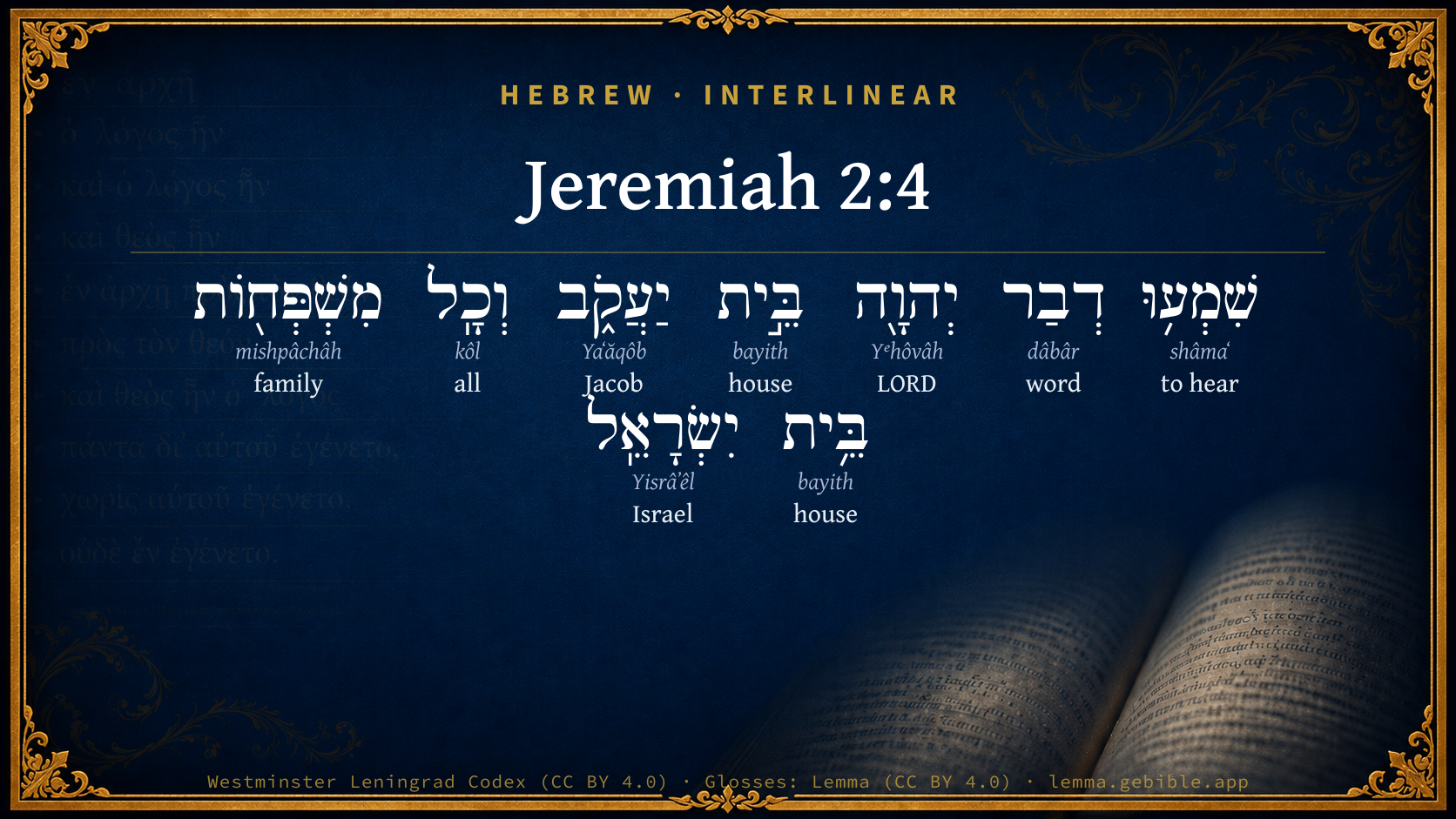
Jeremiah 2:4

Hebrew (Westminster Leningrad Codex) Jeremiah 2:4 appears in the Hebrew Old Testament. The text above is from the Westminster Leningrad Codex. Each word links to its Strong’s number, a concise gloss, and parsing drawn from the Open Scriptures Hebrew Bible morphology. Click any word for its full Brown-Driver-Briggs (BDB) entry.
Download image
Cite this verse

Jeremiah 2:4 (World English Bible). Public Domain. Lemma interlinear Bible study tool, https://lemma.gebible.app/v/jeremiah/2/4.

Show BibTeX & RIS
BibTeX
RIS
English Translation
Hear you the word of Yahweh, O house of Jacob, and all the families of the house of Israel:
World English Bible · Public Domain
Download a study sheet

One document with this verse’s original text, its word-by-word gloss line, the meaning frame, cross-references with their text, attributed commentary, and full source and license credits — printable, and it pastes into notes with its structure intact.

This verse Autodidact and up

Study sheet (.html) Plain text (.txt)

A passage Seminary Student

Up to 50 verses in one chapter. A passage sheet keeps up to 6 commentary sources and 12 cross-references per verse, in the order this page ranks them, and says so on the sheet whenever that leaves anything out. Ask for a single verse and you get the Autodidact verse sheet above.

Everything on this page stays free to read, with no account — the sheet is a download of what is already on screen, not access to it.

Want to remove ads? Support Godless Engineer
Compare translations 3

The same verse in 3 English versions, stacked beneath the original-language interlinear above. Click any original word for its lexicon entry.

Each is an independent rendering of the whole verse — the interlinear is not word-aligned to these translations.

Highlighted words mark where these versions differ — a whole-verse word diff, not a word-by-word alignment.

  • World English Bible Public Domain
    Hear you the word of Yahweh, O house of Jacob, and all the families of the house of Israel:
  • King James Version Public Domain
    Hear ye the word of the LORD, O house of Jacob, and all the families of the house of Israel:
  • unfoldingWord Literal Text CC BY-SA 4.0
    Hear the word of Yahweh, house of Jacob, and all clans of the house of Israel.

unfoldingWord Literal Text — © unfoldingWord, licensed CC BY-SA 4.0. Word-aligned USFM3 via Door43 (git.door43.org/unfoldingWord/en_ult).

Versions to compare (up to 4)

3 of 4 selected

Show all 18 translations

Every available English version of this verse, each an independent rendering of the whole verse.

  • World English Bible Public Domain
    Hear you the word of Yahweh, O house of Jacob, and all the families of the house of Israel:
  • Berean Standard Bible Public Domain
    Hear the word of the LORD, O house of Jacob, and all you families of the house of Israel.
  • Majority Standard Bible Public Domain
    Hear the word of the LORD, O house of Jacob, and all you families of the house of Israel.
  • King James Version Public Domain
    Hear ye the word of the LORD, O house of Jacob, and all the families of the house of Israel:
  • American Standard Version (1901) Public Domain
    Hear ye the word of Jehovah, O house of Jacob, and all the families of the house of Israel:
  • Revised Version (1885) Public Domain
    Hear ye the word of the LORD, O house of Jacob, and all the families of the house of Israel:
  • Geneva Bible (1599) Public Domain
    Heare ye the word of the Lord, O house of Iaakob, and all the families of the house of Israel.
  • Douay-Rheims (1899) Public Domain
    Hear ye the word of the Lord, O house of Jacob, and all ye families of the house of Israel.
  • Young's Literal Translation Public Domain
    Hear a word of Jehovah, O house of Jacob, And all ye families of the house of Israel.
  • Literal Standard Version CC BY-SA 4.0
    Hear a word of YHWH, O house of Jacob, || And all you families of the house of Israel—
  • Unlocked Literal Bible CC BY-SA 4.0
    Hear the word of Yahweh, house of Jacob, all you clans of the house of Israel.
  • unfoldingWord Literal Text CC BY-SA 4.0
    Hear the word of Yahweh, house of Jacob, and all clans of the house of Israel.
  • Darby Bible Public Domain
    Hear the word of Jehovah, house of Jacob, and all the families of the house of Israel.
  • World Messianic Bible Public Domain
    Hear the LORD’s word, O house of Jacob, and all the families of the house of Israel!
  • Webster's Bible Public Domain
    Hear ye the word of the LORD, O house of Jacob, and all the families of the house of Israel:
  • Free Bible Version CC BY-SA 4.0
    Listen to the Lord's message, descendants of Jacob, all you Israelites.
  • Bible in Basic English Public Domain
    Give ear to the words of the Lord, O sons of Jacob and all the families of Israel:
  • JPS Tanakh (1917) Public Domain
    Hear ye the word of the LORD, O house of Jacob, and all the families of the house of Israel;

Literal Standard Version (2020), Covenant Press — licensed CC BY-SA 4.0. Text via the HelloAO Bible API (eBible.org). Unlocked Literal Bible (unfoldingWord) — licensed CC BY-SA 4.0. Text via the HelloAO Bible API (eBible.org). unfoldingWord Literal Text — © unfoldingWord, licensed CC BY-SA 4.0. Word-aligned USFM3 via Door43 (git.door43.org/unfoldingWord/en_ult). Free Bible Version, Dr. Jonathan Gallagher — licensed CC BY-SA 4.0. Text via the HelloAO Bible API (eBible.org).

Word by word

More ways to search: Search by grammar → Find every occurrence → Compare this word →

Practice this passage: Drill this verse → Learn its vocabulary →

About this verse

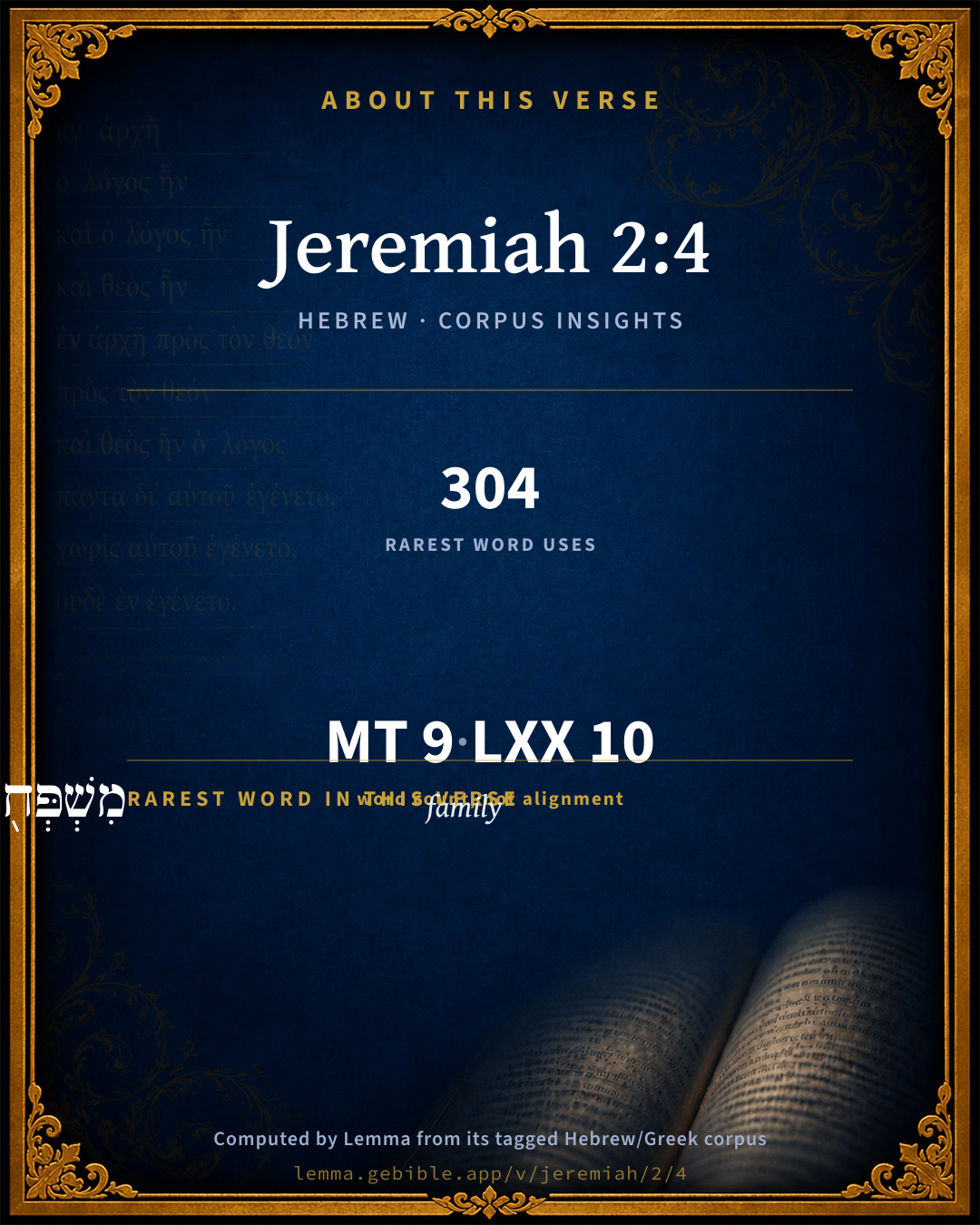
These counts appear in no published source. They are computed here, from the morphology-tagged text and Lemma’s own curated glosses. What Lemma adds →

9
words
8
distinct lemmas
Prophets
section

Grammatical profile

  • 1 verb
  • 8 nouns

Verb forms

  • שִׁמְע֥וּ Qal · Imperative

Repetition

A word recurs within this verse — often emphatic in Hebrew:

  • בֵּ֣ית house H1004 ×2

Hebrew & Septuagint length

In the original languages it is 9 Hebrew tokens and 10 Greek tokens — but the two are counted differently (Hebrew bundles its prefixes and suffixes into one token; the Greek is in lemma form), so that isn’t a like-for-like length.

Cross-references

11

Topical passages linked to Jeremiah 2:4 in the Treasury of Scripture Knowledge — connected by theme and wording, ordered by reader-vote popularity; previews shown in the World English Bible.

  • Isaiah 51:1–4 Listen to me, you who follow after righteousness, you who seek Yahweh: look to the rock whence you were hewn, and to the hold of the pit whence you were dug.
  • Jeremiah 5:21 Hear now this, foolish people, and without understanding; who have eyes, and don't see; who have ears, and don't hear:
  • Jeremiah 7:2 Stand in the gate of Yahweh's house, and proclaim there this word, and say, Hear the word of Yahweh, all you of Judah, who enter in at these gates to worship Yahweh.
  • Jeremiah 13:15 Hear you, and give ear; don't be proud; for Yahweh has spoken.
  • Jeremiah 19:3 and say, Hear you the word of Yahweh, kings of Judah, and inhabitants of Jerusalem: thus says Yahweh of Hosts, the God of Israel, Behold, I will bring evil on this place, which whoever hears, his ears shall tingle.
  • Jeremiah 31:1 At that time, says Yahweh, will I be the God of all the families of Israel, and they shall be my people.
  • Jeremiah 33:24 Don't you consider what this people has spoken, saying, The two families which Yahweh did choose, he has cast them off? thus do they despise my people, that they should be no more a nation before them.
  • Jeremiah 34:4 Yet hear the word of Yahweh, O Zedekiah king of Judah: thus says Yahweh concerning you, You shall not die by the sword;
  • Jeremiah 44:24–26 Moreover Jeremiah said to all the people, and to all the women, Hear the word of Yahweh, all Judah who are in the land of Egypt:
  • Hosea 4:1 Hear the word of Yahweh, you children of Israel; For Yahweh has a charge against the inhabitants of the land: "Indeed there is no truth, Nor goodness, Nor knowledge of God in the land.
  • Micah 6:1 Listen now to what Yahweh says: "Arise, plead your case before the mountains, And let the hills hear what you have to say.

Cross-references courtesy of OpenBible.info (CC BY 4.0).

Hebrew and Greek witnesses Masoretic Hebrew ↔ Greek Septuagint

The same verse in the two great witnesses to the Old Testament, shown verse-for-verse.

These are two independent witnesses, not word-aligned to each other, and the Septuagint is shown in lemma (dictionary) form.

Hebrew Jeremiah 2:4 Masoretic · Westminster Leningrad Codex

שִׁמְע֥וּ דְבַר יְהוָ֖ה בֵּ֣ית יַעֲקֹ֑ב וְכָֽל מִשְׁפְּח֖וֹת בֵּ֥ית יִשְׂרָאֵֽל

Hear you the word of Yahweh, O house of Jacob, and all the families of the house of Israel:

World English Bible · Public Domain

Greek LXX Structure differs

In the Septuagint, Jeremiah is about an eighth shorter than the Hebrew and arranges its material differently — the Oracles Against the Nations (Hebrew chapters 46–51) appear in the middle of the Greek book, after 25:13. Because the chapter and verse boundaries do not line up, a verse-for-verse comparison with the Hebrew is not shown.

A verse-for-verse comparison isn’t shown here because the chapters and verses don’t line up. Switch to the LXX edition with the MT / LXX toggle above to read the Greek directly.

Hebrew: Westminster Leningrad Codex (CC BY 4.0). Greek: Septuagint (public domain); English from a public-domain English Septuagint. How the Septuagint differs from the Hebrew →

Targum (Aramaic paraphrase)

1

The Targum is the ancient Jewish Aramaic paraphrase of the Hebrew Scriptures — an interpretive translation, not the Hebrew text itself. Onkelos (literal) and Pseudo-Jonathan (expansive) render the Torah, and Jonathan the Prophets. Coverage is partial: where no permissively-licensed English translation exists for a verse, only the Aramaic is shown. This is verse-level text, not a word-by-word alignment to the Hebrew.

  1. Targum Jonathan Prophets (Joshua–Malachi)
    קַבִּילוּ פִּתְגָמָא דַייָ בֵּית יַעֲקֹב וְכָל זַרְעִית בֵּית יִשְׂרָאֵל:

    (no public-domain English translation for this verse)

    Targum Jonathan — Aramaic: “Mikraot Gedolot” (public domain). English: “Sefaria Community Translation” (CC0 1.0 (public-domain dedication)); “London "Chaldee Paraphrase," 1871” (public domain). Text via Sefaria.

Commentary

Notes on Jeremiah 2:4 from classic Christian and Jewish commentators (each source and its license shown beneath its notes). The classic Christian expositions comment on the surrounding passage and are grouped to its opening verse, so a note may address several verses; the Jewish commentaries on the Tanakh (Rashi and others) are per-verse, so they appear only where the commentator wrote on this verse.

Lemma curates 59 commentaries, every one of them public domain or Creative Commons licensed, each selected and text-cleaned for this edition rather than reprinted as found. About our sources →

Trapp's Complete Commentary

John Trapp

Jer 2:4 Hear ye the word of the LORD, O house of Jacob, and all the families of the house of Israel:

Ver. 4. Hear ye the word of the Lord.] This is often inculcated in both Testaments, to procure attention. "I received of the Lord, that which also I delivered unto you." {1Co 11:23} "This we say unto you by the word of the Lord." {1Th 4:15} Thus to preach, is to preach cum privilegio, with authority.

John Trapp, A Commentary or Exposition upon All the Books of the Old and New Testament (1647–1656) — public domain. Text from a community e-Sword module.

The Biblical Illustrator

Joseph S. Exell

Jer_2:4-8

What iniquity have your fathers found in Me.

The evil nature of sin committed after conversion

I. Violation of solemn vows and covenant engagements. At that time we took Christs cause for our cause, His people for ours, His will for our law, His glory for our end, and Himself for our portion. Did we love Him too well then?

II. Without any provocation whatever on Gods part.

1. Was He wanting in forbearance when we were in rebellion?

2. Did He act unfeelingly when we were ruined, in that He gave His own Son to die for us?

3. Has He been a hard master since we entered His service?

4. Has He ever been a churlish father to us?

5. When we have returned to Him with our whole heart, has He not always been ready to receive us, and bury all in forgetfulness? (Dan_9:7.)

III. Peculiar and horrible ingratitude.

1. He has given, not Egypt or Ethiopia for our ransom, but His own blood.

2. He has redeemed us, not from Egyptian thraldom, but from the Power of darkness, etc.

3. We never were supported by miracles in lonesome deserts of Arabia, but having obtained help of God, we continue.

4. We did not possess Canaan, but God hath provided some better thing for us.

IV. Extreme and singular folly.

1. It is a foolish exchange--of liberty for drudgery, peace for remorse, joyfulness for anguish, abundance for penury and misery.

2. It is singular folly. The people of the only true God alone prove untrue! (Andrew Fuller.)

Heavens appeal to the sinner

1. The sinner is divinely described.

1. Sin is departure from God. Alienation of sympathy and soul.

2. Sin is a progress of vanity. A going from the real to the unreal.

(1) The pleasures he seeks are unsatisfactory; all empty, and outside him.

(2) The honours he aspires to are unreal; neither enrich nor ennoble the soul.

II. The sinner is divinely challenged.

1. If iniquity were found in God, there would be some justification for apostasy.

2. The discovery of such iniquity is an absolute impossibility. (Homilist.)

Gods mercies should evoke gratitude

Selim, a poor Turk, had been brought up from his youth with care and kindness by his master, Mustapha. When the latter lay at the point of death Selim was tempted by his fellow servants to join them in stealing a part of Mustaphas treasures. No, said he, Selim is no robber! I fear not to offend my master for the evil he can do me now, but for the good he has done me all my life long. May not many Christians learn a lesson from Selim?

Neither said they, Where is the Lord, that brought us up?--

Three shameful possibilities in human life

I. The possibility of dishonouring the great memories of life. Neither said they, Where is the Lord? etc. The dark night was forgotten, and Israel did not know who had lifted upon it the brightness and hope of morning.

1. The great memories of life are dishonoured--

(1) When the vividness of their recollection fades.

(2) When their moral purpose is over looked or misunderstood.

(3) When their strengthening and stimulating function is suspended.

2. What would human life be without its hallowed memories? Man must have facts as well as hopes,--something to which he can go back with confidence; back to some place where he met God. There is, however, a possibility of forgetting sacred scenes, and of cheating the soul of reminiscences which ought be a perpetual inspiration. Let each man find the proofs in his own history: Sickness, poverty, danger, etc.

II. The possibility of underestimating the interpositions of God.

1. Look at the case in the text,--through the wilderness, through a land of deserts and pits, through a land of drought and of the shadow of death, through a land that no man passed through, and where no man dwelt. Viewed prospectively, men shrink from such difficulties; viewed retrospectively, a good many of the terrors are forgotten. Granted that we have not the same outward difficulties, will any man deny that his moral pilgrimage is beset by many perils, and that the grave is constantly open at his feet? Not only was the dark side of history forgotten, but the bright side was overlooked. I brought you into a plentiful country, to eat the fruit thereof and the goodness thereof. What was the result? Did they erect the altar, and bow in long-continued prayer, and unite in the loud, sweet psalm of thankfulness? Ye defiled My land, and made Mine heritage an abomination.

2. If we try our own lives by these historical disclosures, shall we shame Israel by our purity and love? Remember the Deliverer! Remember the Giver!

III. The possibility of the leading minds of the Church being darkened and perverted (Jer_2:8). The priests, the pastors, and the prophets, all out of the way!

1. In all ages there have, of necessity, been foremost men; men whose capacity, culture, and Divine election have entitled them to leadership; men whom God Himself has acknowledged as the guides of the people. How easy it is for such men to succumb in periods of general corruption is too evident from universal history. What then?

(1) Such men should watch themselves with constant jealousy.

(2) Such men should never be forgotten by those who pray.

2. The most affecting of all subjects to contemplate is,--God grieved, God complaining! Would He complain without reason? Would He startle the universe for some trifling cause? It is as the cry of one whose heart is breaking; His great deliverances have been forgotten; His heritage has been defiled; His power has been despised, and His mercy been treated as an empty sentiment; what if the throb of His great sorrow should send a shudder of distress through the heavens and the earth! Look at Calvary for the full expression of all this Divine emotion. Seeing that such pain was inflicted by sin, let us avoid it as the abominable thing which God hates. (J. Parker, D. D.)

The priests said not, Where is the Lord?. . .the rulers also transgressed . . . and the prophets, etc.

The three ruling classes accused

1. The priests, part of whose duty was to handle the law, i.e., explain the Torah, to instruct the people in the requirements of Jehovah, by oral tradition and out of the sacred law books, gave no sign of spiritual aspiration; like the reprobate sons of Eli, they knew not Jehovah, that is to say, paid no heed to Him and His will as revealed in the book of the law.

2. The secular authorities, the king and his counsellors, not only sinned thus negatively, but positively revolted against the King of kings, and resisted His will.

3. The prophets went further yet in the path of guilt, apostatising altogether from the God of Israel, and seeking inspiration from the Phoenician Baal, and following worthless idols that could give no help. (C. J. Ball, M. A.)

The corruption and ignorance of the priests and prophets

Two centuries ago the religious state of the English-speaking world was bad, and was rapidly becoming worse. Infidelity was fast spreading among the people, and, consequently, there was an open and professed disregard of religion and morals. The secret of this sad state was simple. The clergy, though their lives in general might not be scandalous, were, as a rule, ignorant of all spiritual truth, and in too many cases even devoid of a sound intellectual apprehension of scriptural teaching. As Cowper, referring to those clergy, tersely put it--

Except a few with Elis spirit blest,

Hophni and Phinehas may describe the rest.

The Biblical Illustrator, edited by Joseph S. Exell (c. 1880s–1900s) — public domain. Text from a community e-Sword module.

Joseph Benson's Commentary

Jer 2:4-6. Hear, O house of Jacob, &c. — The prophet here directs his discourse to the twelve tribes, as he does afterward, Jer 3:14, &c. For the captivity of the ten tribes was not so total but that there were some Israelites still remaining in the land among the Assyrian colonists. What iniquity have your fathers found in me? — That is, what injustice or unfaithfulness in not performing my part of the Sinai covenant? That they are gone far from me — Far from the love and fear of me, and from obedience to my laws; far from my worship and service; and have walked after vanity — Have followed after vain idols, incapable of affording them either protection or help. And are become vain — In their imaginations, Rom 1:21-22; fools, as senseless as the stocks or stones, of which they made their idols. Neither said they, Where is the Lord? — They made no inquiry after him, took no thought about their duty to him, nor expressed any desire to recover his favour; that brought us up out of the land of Egypt? — Working such a deliverance for us as had never been wrought for any people. That led us through the wilderness — Conducting and sustaining our whole nation in that barren desert for the space of forty years, by almost incessant miracles; through a land of deserts and pits — Through desolate and dangerous places; through a land of drought — Where we had no water but by a miracle; and of the shadow of death — Houbigant renders it, where death threatened us. A barren and deadly land, where no man could live; bringing forth nothing that could support life, and therefore where nothing but death could be expected; and, besides, possessed by great numbers of venomous and destructive creatures, such as scorpions, serpents, &c., and where we were exposed to the attacks of many enemies. A land that no man passed through — As having in it no accommodation for travellers, much less for habitation.

Joseph Benson's Commentary on the Old and New Testaments (1811–1818) — public domain. Text from a community e-Sword module.

Whedon's Commentary on the Bible

Daniel D. Whedon

JEHOVAH’S FAITHFULNESS AND ISRAEL’S APOSTASY, Jer_2:4-13.

4. Hear… O house of Jacob — God’s reproof for their ungrateful and wicked apostasy is directed against the whole nation.

All the families of the house of Israel — Though the kingdoms of Judah and Israel were separated and alienated from each other, they are joined in a direful unity of apostasy and ruin.

Daniel D. Whedon (gen. ed.), Commentary on the Old and New Testaments (1874–1909) — public domain. Text from a community e-Sword module.

Keil & Delitzsch

C. F. Keil & F. Delitzsch

But Israel did not remain true to its first love; it has forgotten the benefits and blessings of its God, and has fallen away from Him in rebellion.

Jer 2:4-5

"Hear the word of Jahveh, house of Jacob, and all families of the house of Israel. Jer 2:5. Thus saith Jahveh, What have your fathers found in me of wrongfulness, that they are gone far from me, and have gone after vanity, and are become vain? Jer 2:6. And they said not, Where is Jahveh that brought us up out of the land of Egypt, that led us in the wilderness, in the land of steppes and of pits, in the land of drought and of the shadow of death, in a land that no one passes through and where no man dwells? Jer 2:7. And I brought you into a land of fruitful fields, to eat its fruit and its goodness: and ye came and defiled my land, and my heritage ye have made an abomination. Jer 2:8. The priests said not, Where is Jahveh? and they that handled the law knew me not: the shepherds fell away from me, and the prophets prophesied by Baal, and after them that profit not are they gone." The rebuke for ungrateful, faithless apostasy is directed against the whole people. The "house of Jacob" is the people of the twelve tribes, and the parallel member, "all families of the house of Israel," is an elucidative apposition. The "fathers" in Jer 2:5 are the ancestors of the now living race onwards from the days of the Judges, when the generation arising after the death of Joshua and his contemporaries forsook the Lord and served the Baals (Jdg 2:10.). עול, perversity, wrongfulness, used also of a single wicked deed in Psa 7:4, the opposite to acting in truth and good faith. Jahveh is a God of faithfulness (אמוּנה); in Him is no iniquity (אין עול), Deu 32:4. The question, what have they found...? is answered in the negative by Jer 2:6. To remove far from me and follow after vanity, is tantamount to forsaking Jahveh and serving the false gods (Baals), Jdg 2:11. הבל, lit., breath, thence emptiness, vanity, is applied so early as the song of Moses, Deu 32:21, to the false gods, as being nonentities. Here, however, the word means not the gods, but the worship of them, as being groundless and vain; bringing no return to him who devotes himself to it, but making him foolish and useless in thought and deed. By the apostle in Rom 1:21 יהבּלוּ is expressed by ἐματαιώ́θησαν. Cf. Kg2 17:15, where the second hemistich of our verse is applied to the ten tribes.

Jer 2:6

They said not, Where is Jahveh? i.e., they have no longer taken any thought of Jahveh; have not recalled His benefits, though they owed to Him all they had become and all they possessed. He has brought them out of Egypt, freed them from the house of bondage (Mic 6:4), and saved them from the oppression of the Pharaohs, meant to extirpate them (Exo 3:7.). He has led them through pathless and inhospitable deserts, miraculously furnished them with bread and water, and protected them from all dangers (Deu 8:15). To show the greatness of His benefits, the wilderness is described as parched unfruitful land, as a land of deadly terrors and dangers. ,ארץ ערבה land of steppes or heaths, corresponds to the land unsown of Jer 2:2. "And of pits," i.e., full of dangerous pits and chasms into which one may stumble unawares. Land of drought, where one may have to pine through thirst. And of the shadow of death: so Sheol is named in Job 10:21 as being a place of deep darkness; here, the wilderness, as a land of the terrors of death, which surround the traveller with darkness as of death: Isa 8:22; Isa 9:1; Job 16:16. A land through which no one passes, etc., i.e., which offers the traveller neither path nor shelter. Through his frightful desert God has brought His people in safety.

Jer 2:7-8

And He has done yet more. He has brought them into a fruitful and well-cultivated land. כּרמל, fruitful fields, the opposite of wilderness, Jer 4:26; Isa 29:17. To eat up its fruit and its good; cf. the enumeration of the fruits and useful products of the land of Canaan, Deu 8:7-9. And this rich and splendid land the ungrateful people have defiled by their sins and vices (cf. Lev 18:24), and idolatry (cf. Eze 36:18); and the heritage of Jahveh they have thus made an abomination, an object of horror. The land of Canaan is called "my heritage," the especial domain of Jahveh, inasmuch as, being the Lord of the earth, He is the possessor of the land and has given it to the Israelites for a possession, yet dwells in the midst of it as its real lord, Num. 25:34. - In Jer 2:8 the complaint briefly given in Jer 2:6 is expanded by an account of the conduct of the higher classes, those who gave its tone to the spirit of the people. The priests, whom God had chosen to be the ministers of His sanctuary, asked not after Him, i.e., sought neither Him nor His sanctuary. They who occupy themselves with the law, who administer the law: these too are the priests as teachers of the law (Mic 3:11), who should instruct the people as to the Lord's claims on them and commandments (Lev 10:11; Deu 33:10). They knew not Jahveh, i.e., they took no note of Him, did not seek to discover what His will and just claims were, so as to instruct the people therein, and press them to keep the law. The shepherds are the civil authorities, princes and kings (cf. Jer 23:1.): those who by their lives set the example to the people, fell away from the Lord; and the prophets, who should have preached God's word, prophesied בּבּעל, by Baal, i.e., inspired by Baal. Baal is here a generic name for all false gods; cf. Jer 23:13. ,לא those who profit not, are the Baals as unreal gods; cf. Isa 44:9; Sa1 12:21. The utterances as to the various ranks form a climax, as Hitz. rightly remarks. The ministers of public worship manifested no desire towards me; those learned in the law took no knowledge of me, of my will, of the contents of the book of the law; the civil powers went the length of rising up against my law; and the prophets fairly fell away to false gods, took inspiration from Baal, the incarnation of the lying spirit.

Keil & Delitzsch — Biblical Commentary on the Old Testament (1861–1891) — public domain (CC PDM 1.0). Text via the HelloAO Bible API. (Old Testament only.)

Jamieson, Fausset & Brown

Robert Jamieson, A. R. Fausset & David Brown

Jacob . . . Israel--the whole nation.

families--(See on Jer 1:15). Hear God's word not only collectively, but individually (Zac 12:12-14).

Jamieson, Fausset & Brown — Commentary Critical and Explanatory on the Whole Bible (1871) — public domain (CC PDM 1.0). Text via the HelloAO Bible API.

John Calvin's Commentaries

Here God explains why he had referred to what we have noticed, — that he had consecrated Israel to himself as a peculiar people, and as the first — fruits. God often mentions his favors to us, in order to encourage our hope, that we may be fully persuaded that whatever may happen we are ever safe, because we are under his protection, since he has chosen us. But in this place, and in many other places, God recounts the obligations under which the Israelites were to him, that thence their ingratitude might become more apparent.

Hence he says, Hear ye the word of Jehovah By this preface he seeks to gain attention; for he intimates that he was going to address them on no common subject. Hear ye, then, O house of Jacob; hear all ye families of the house of Israel; as though Jeremiah had said, “Here I come forth boldly in the name of God, for I fear not that any defense can be brought forward by you to disprove the justice of God’s reproof; and I confidently wait for what ye may say, for I know you will be silent. I then loudly cry like a trumpet and with a clear voice, that I am come to condemn you; if there is anything which ye can answer, I give you full liberty to do so; but the truth will constrain you to be mute, for your guilt is extremely odious and capable of the fullest proof.” Hence it was that he exhorted them to hear attentively.

John Calvin's Commentaries (1540-1563) — public domain. Text from the Calvin Translation Society English edition (1840s-50s) via the Christian Classics Ethereal Library (ccel.org). Calvin's coverage is partial (roughly two-thirds of the Bible); uncommented books and verses are honest gaps, never fabricated. The 19th-century editor's footnotes and remarks are omitted so the notes are faithfully Calvin's own voice.

The Cambridge Bible for Schools and Colleges

gen. ed. J. J. S. Perowne

4. all the families of the house of Israel] addressed not to the ten tribes only, but to the nation as a whole.

The Cambridge Bible for Schools and Colleges (gen. ed. J. J. S. Perowne; Cambridge University Press, 1878–1918) — public domain. Text from a community e-Sword module.

John Gill's Exposition

Hear ye the word of the Lord, O house of Jacob, and all the families of the house of Israel. The Lord, by the prophet, having observed his great kindness to this people, what they were unto him, and what a regard he had for them, proceeds to upbraid them with their ingratitude, and requires an attention to what he was about to say; all are called upon, because, all were guilty. This respects the two tribes of Judah and Benjamin, and the several families in them. The ten tribes had been long carried captive.

Hear ye the word of the Lord, O house of Jacob, and all the families of the house of Israel. The Lord, by the prophet, having observed his great kindness to this people, what they were unto him, and what a regard he had for them, proceeds to upbraid them with their ingratitude, and requires an attention to what he was about to say; all are called upon, because, all were guilty. This respects the two tribes of Judah and Benjamin, and the several families in them. The ten tribes had been long carried captive.

Jeremiah 2:5

jer 2:5

jer 2:5

jer 2:5Thus saith the Lord, what iniquity have your fathers found in me,.... What injustice or injury has been done them? there is no unrighteousness in God, nor can any be done by him; or what unfaithfulness, or want of truth and integrity in performing promises, had they found in him? he never suffers his faithfulness to fail, or any of the good things he has promised. So the Targum,

"what falsehood have your fathers found in my word?''

none at all; God is a covenant keeping God:

that they are gone far from me; from my fear, as the Chaldee paraphrase; from the word and worship, and ways of God:

and have walked after vanity; after idols, the vanities of the Gentiles, Jer 14:22,

and are become vain? in their imaginations and in their actions, in their knowledge and in their practice, worshipping idols, as well as guilty of many other sins.

John Gill's Exposition of the Whole Bible (1746–1763) — public domain (CC PDM 1.0). Text via the HelloAO Bible API.

Matthew Poole's English Annotations

Hear ye the word of the Lord: he bespeaks their attention to what he is about to speak, as unto the word of the Lord, telling them that he deliver’s God’s message, and vents not his own passions: the like Isa 1:10, and elsewhere frequently, both in the Old and New Testament, as 1Co 11:23; 1Th 4:15.

Jacob, i.e. his posterity; Jacob and Israel here being the same, as it is Isa 43:1. The families, viz. tribes, Jer 31:1.

Matthew Poole's English Annotations on the Holy Bible (1683–1685) — public domain. Text from a community e-Sword/MySword module.

The Pulpit Commentary

Vers. 4-9. The indictment of Israel.

The chosen nation is arraigned in all its generations and in all its orders. It is a universal and continuous crime; and it ran parallel with a succession of unheard-of mercies, deliverances, and favors. In these respects it corresponds to the sin of God"s people in every age forgetfulness of past mercy, abuse of present blessings, the corruption and perverseness of those who were entrusted with Divine mysteries and sacred offices.

I JEHOVAH APPEALS TO HIS CHARACTER AND DEALINGS IN THE PAST IN DISPROOF OF THERE BEING ANY EXCUSE IN THEM FOR THE SIN OF HIS PEOPLE. Inquiry is challenged. History is rehearsed. So it always has been. The reason for the sins, etc., of God"s people is in themselves and not in God. God is just, and all the allegations and murmurs of unbelieving and disobedient Israel are lies. So the excuses Christians often give for their faults and offences are already answered in advance. We have received from him nothing but good. His help and protection were at our disposal; but we forsook him, and sinned against both him and ourselves.

II THE ENORMITY OF THE OFFENCE IS THEN SET FORTH. The recital is marked by simplicity, symmetry, force, and point. It contains the undeniable commonplaces of history and experience, but the artist"s power is shown in the grouping and perspective.

1. It is ancient and hereditary. The fathers, the children, and the children"s children. Just as they could not go back to a time when God had not cared for them and blessed them, so they could not discover a time when they or their forefathers had not shown unbelief and ingratitude. It is pertinent to ask in such a case, Must there not be some hereditary and original taint in the sinners themselves?" What will men do with the actual existence of depravity? How will they explain its miserable entail? Human history in every age is marked by persistent wickedness; Christianity suggests an explanation of this. It is for objectors to substitute a better.

2. It consists in ingratitude, unbelief, and the service of false gods. The Exodus with all its marvels and mercies, the blessings that surrounded them in the present, go for naught. They are forgotten or ignored. And idols, which are but vanity, are sought after to such an extent that their worshippers "are like unto them." This is the history of religious defection in every age. Forgetfulness of God, ingratitude, and the overwhelming influence of worldly interests and concerns, and the lusts of our own sinful nature, work the same ruin in us. How many idols does the modern world, the modern Church not set up?

3. It is marked by the abuse of blessings and the breach of sacred trusts. When men are rendered worthless by their sinful practices, they cannot appreciate the good things of God. Divine bounty is wasted, and blessings are abused. Sacred things are desecrated. Those who ought to be leaders and examples are worse than others. The priest who, if any one, ought to know the secret place," the holy of holies," of the Most High, is asking where he is. The lawyers are the greatest law-breakers. The pastors, who ought to guide and feed, are become "blind mouths." And the prophets are false. Corruptio optimi pessima. How hard is the heart that has once known God! "If the light that is in you be darkness, how great is that darkness!" The backslider, the child of holy parents, etc., who shall estimate their wickedness?

III FOR ALL THESE THINGS MEN WILL BE BROUGHT INTO JUDGMENT. The assurance is very terrible: "I will yet plead with" (i.e. reckon with or plead against) "you... and with your children"s children will I plead." This is the same Jehovah who "keepeth mercy for thousands" but "visiteth the iniquity of the fathers upon the children." There is a solidarity in Israel, Christendom, and the race, which will be brought to light in that day. "It is a fearful thing to fall into the hands of the living God," and to bear our offences in the company of transgressors and the universal connection of the world"s sin. "But as in Adam all have died, so in Christ shall all be made alive." Jesus is set forth as the Head and Representative of the humanity he redeems. Let us seek oneness with him through faith. M.

The Pulpit Commentary (1880–1919), ed. H.D.M. Spence-Jones & Joseph S. Exell — public domain. Text from a community e-Sword module.

unfoldingWord translationNotes

Door43 World Missions Community

house of Jacob, all you clans of the house of Israel

Jacob and Israel were two names for one man, and these two phrases refer to the same group of people. AT: "all you descendants of Jacob" (See: Parallelism)

house of Jacob

The word "house" is a metonym for the family that lives in the house. In this case it refers to Jacob's descendants. AT: "descendants of Jacob" (See: Metonymy)

the house of Israel

The word "house" is a metonym for the family that lives in the house. In this case it refers to Israel's descendants, who had become the nation of Israel. AT: "the Israelites" or "the Israelite people group" (See: Metonymy)

What did your fathers find wrong with me, that they went far from following me? That they went after useless idols and became useless themselves?

Yahweh uses these questions to say that since he has done no wrong, his people should not have rejected him and worshiped idols. AT: "I did nothing wrong to your forefathers, so they should not have gone far from following me, and they should not have gone after useless idols. By doing that they themselves have become useless!" (See: Rhetorical Question)

they went far from following me

This represents rejecting God and refusing to be loyal to him. AT: "they rejected me" (See: Metaphor)

they went after useless idols

This represents choosing to be loyal to idols and worship them. AT: "they worshiped useless idols" (See: Metaphor)

useless idols

idols that people can use for nothing good. The translation should not make people think that there are some idols that are useful.

They did not say

It is implied that they should have said what follows. AT: "They should have said" (See: Assumed Knowledge and Implicit Information)

Where is Yahweh, who brought us ... Egypt?

This rhetorical question would have been used to show the people's need of Yahweh. AT: "We need Yahweh. He is the one who brought us ... Egypt." (See: Rhetorical Question)

Where is Yahweh, who led us ... lives?

This rhetorical question would have been used to show the people's need of Yahweh. AT: "We need Yahweh. He is the one who led us ... lives." (See: Rhetorical Question)

a land of drought and deep darkness

A "land of drought" is a land that does not have enough water. Here "deep darkness" is a metaphor for danger. AT: "a dangerous land where there is not enough water" (See: Metaphor)

translationWords

word of God

house

Jacob

family

ancestor

false god

Egypt

desert

Arabah

pit

darkness

life

unfoldingWord translationNotes — © Distant Shores Media and the Door43 World Missions Community, licensed CC BY-SA 4.0. Source: git.door43.org/Door43/en_tn.

Lesson kit

Teaching starters — assembled from the data on this page, not authored interpretation. Every prompt links to the verse data it draws on. Edit before teaching.

Jeremiah, in the Prophets, opens this verse with 9 words (8 distinct Hebrew lemmas). Its most distinctive word is mishpâchâh (“family”). A historical commentator’s framing appears above. Read the whole chapter for the surrounding context.

Discussion questions

  1. What does “family” (mishpâchâh) contribute to the verse as a whole?
  2. How does Isaiah 51:1–4, which shares this passage’s theme, read alongside this verse?
  3. What does the repetition of “house” (2× in this one verse) do in this verse?
  4. These translations render this verse differently; the difference is in the English rendering, not the original. What questions does that raise?
  5. «שִׁמְע֥וּ» is a Qal Imperative verb. How does that grammatical form shape the action described?
  6. Compare how Trapp's Complete Commentary and The Biblical Illustrator read this verse. Where do they agree or differ?

Things to notice

Reading settings

Reading text

Shown beneath each verse's original-language words.

Old Testament
Old Testament edition

Read the OT as the Masoretic Hebrew (MT) or the Greek Septuagint (LXX).

English shown for the Greek Septuagint (in the Hebrew ↔ Greek comparison).

Comparing translations? Open the Compare panel on any verse page to stack up to four side by side.