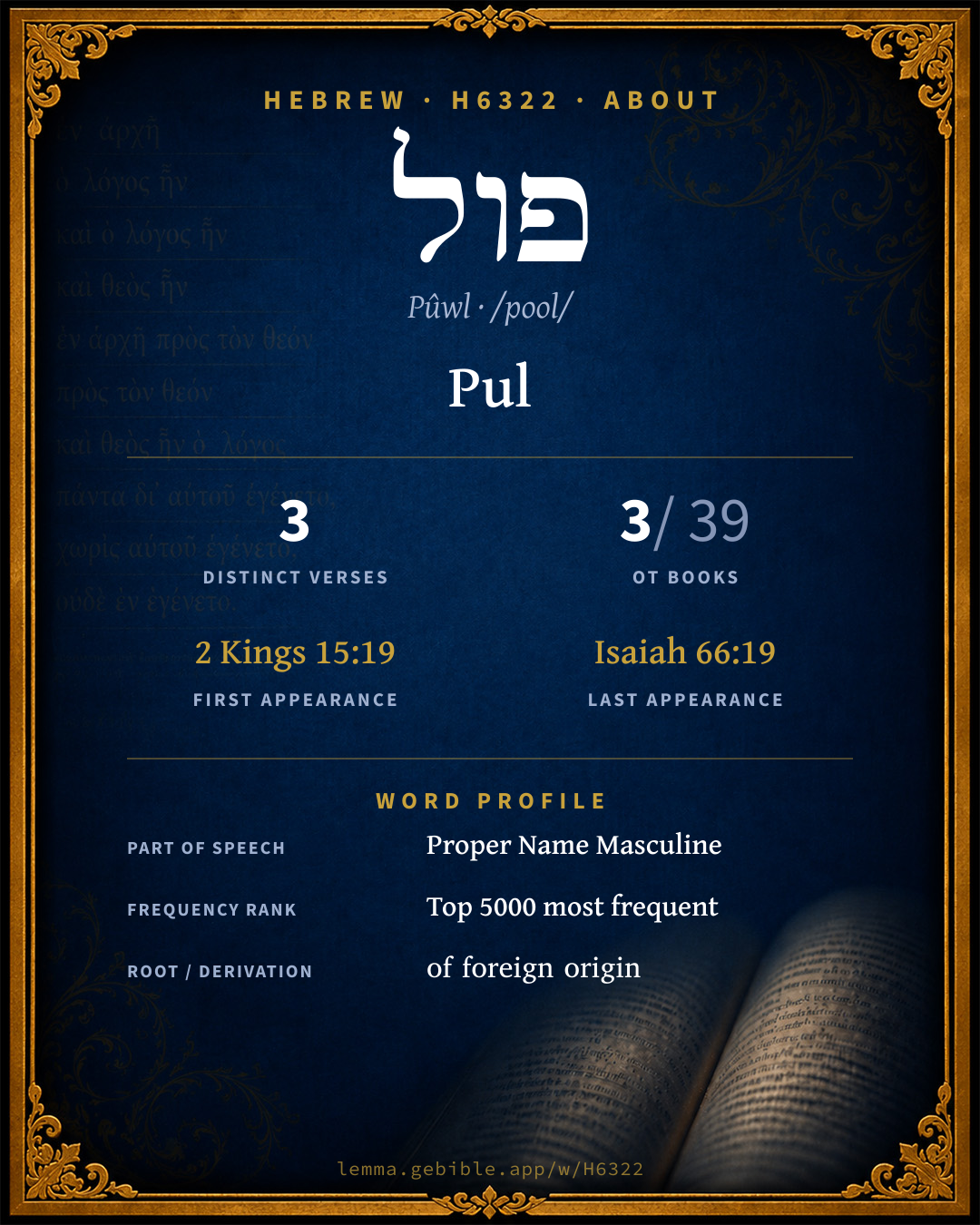
פּוּל
Pul
BDB lists 2 entries for ‘Pul’ fuller range ↓
Full lexicon entry — Brown-Driver-Briggs (BDB)
From Brown-Driver-Briggs (BDB)
Where this word appears
Grammar key — what these labels mean
Part of speech
- Noun
- A naming word — a person, place, thing, or idea.
Noun type
- Proper
- A name of a specific person, place, or people (e.g. Abraham, Zion, Israel).
Every verse where H6322 appears — 3 distinct verses across 3 books. Click any verse to open its interlinear word-by-word view. Verse text shown in the World English Bible for context — . Each verse’s Hebrew form is shown with its reference; the English is not keyword-highlighted, since the data carries no word-level English alignment. Use “Compare translations” on any verse to read it across multiple English versions. This concordance covers the Hebrew Bible; Septuagint (Greek Old Testament) occurrences are not indexed here.
2 Kings 1 verse
1 Chronicles 1 verse
Isaiah 1 verse
About this entry
At a glance — auto-summarized from this page’s data, not written by a person. Every figure links to its source below. This summary describes the numbers; it doesn’t interpret them.
פול (Pûwl) is a Hebrew name most often rendered “Pul.” It is rare — just 3 verses in the entire Hebrew Bible. It concentrates in 2 Kings, which alone accounts for 33% of its uses. Scripture first uses it in 2 Kings 15:19. The sections below give every occurrence and version rendering.
Gloss history
Strong's 1890 vs modern scholarship
About this word
Strong's H6322 catalogs a Hebrew word from the Hebrew Old Testament.
These counts are not copied from any lexicon or concordance. They are computed here, from the morphology-tagged Hebrew Old Testament. What Lemma adds →
- 3
- distinct verses
- The word appears in 3 distinct verses.
- 3 / 39
- OT books
- The word appears in 3 of 39 Old Testament books.
- #3,696
- by frequency
- Top 5000 most frequent Hebrew words (rank 3,696 of 8,640 Hebrew words by occurrence).
View all 3 occurrences in the concordance →
Most concentrated in
- 2 Kings 1 verse 33%
- 1 Chronicles 1 verse 33%
- Isaiah 1 verse 33%
By section of the Old Testament
By traditional corpus
Conventional, traditional groupings — biblical authorship is debated, so this is a traditional corpus grouping, not an authorship claim. Each share is this word’s portion of its verses in that division of the Hebrew canon. Each figure is a share of the word’s 3 distinct verses.
- Prophets (Nevi'im) 2 verses · 67%
- Writings (Ketuvim) 1 verse · 33%
How translations render this word
Counts come from each version’s own published word-to-Strong’s tagging or interlinear alignment — an approximate guide to how each version renders this word, not a word-level alignment the data otherwise carries. Because each total is that version’s own tagged count, the per-version totals vary from one another and need not match the appearance or distinct-verse counts above. These counts may also differ from a printed concordance because Lemma counts each distinctly tagged rendering and does not collapse phrase taggings into a single head-word total. This is a fixed set of word-tagged versions (KJV, ASV, BSB, ULT) and does not change with the reading translation you choose elsewhere. Each version’s license is shown beside its name below (and on Sources).
- King James Version: Pul 4×
- American Standard Version: Pul 4×
- Berean Standard Bible: Pul 3×
- unfoldingWord Literal Text: Pul 4×
King James Version Public Domain
Renders H6322 across 4 tagged occurrences — most commonly:
American Standard Version Public Domain
Renders H6322 across 4 tagged occurrences — most commonly:
Berean Standard Bible Public Domain
Renders H6322 across 4 tagged occurrences — most commonly:
Plus 1 rendering that appears only once — usually multi-word phrases or single function words the recovered tagging swept in, not distinct renderings.
unfoldingWord Literal Text CC BY-SA 4.0
Renders H6322 across 4 tagged occurrences — most commonly:
Senses in BDB
The 2 senses BDB distinguishes for this word, in lexicon order (not ranked by frequency or importance). The full entry — with sub-senses — is in the Lexicon Entry tab.
- Pul = "distinguishing"
- the Babylonian name for Tiglath-pileser III, king of Assyria
Word origin
n.pr.m. = תִּגְלַת פְּלֶאסֶר (q.v.) (Assyrian Pulu; Babylonian name of TP, SchrSBAk 1887, 592; KB ii, 287, cf. 277 TieleGesch. 266f.; cf. (through Pers. trad., EMeyEntstehung, 30) Πῶρος, Canon of Ptol. KAT2, 490); 2 K 15:19(×2); 1 Ch 5:26, Φουα[λ].—Is 66:19, v. פוט.
— Brown-Driver-Briggs (Oxford 1906, public domain), digitized via Sefaria, supplemented by the OpenScriptures HebrewLexicon (CC BY 4.0). See Sources.
Origin: of foreign origin
Jastrow Dictionary
A second Hebrew/Aramaic lexicon for comparison, covering Aramaic and post-biblical (Talmudic, Targumic, Midrashic) usage that the biblical-Hebrew BDB does not. Matched by lemma rather than by Strong’s number, so a lemma may carry more than one Jastrow headword (shown separately below), and the entries cover usage well beyond the Bible.
פּוֹל
- , imperat. of נָפַל.
פּוֹל ²
- פלל or פול to split) bean. Kil. I, 1 פ׳ הלבן the white bean. Ib. 2 פ׳ מצרי the Egyptian bean (Colocasia); a. fr.—Pl. פּוֹלִין. Tosef. ib. II, 8, v. גַּמְלוֹן. Tosef. T’bul Yom I, 1; a. fr.
*פּוּל
- (פָּלַל; cmp. פָּלָה) decision, search; בּעַל הַפּ׳ a superintendent of the Temple, guardsman. Tosef. Kel. B. Kam. I, 6 (R. S. to Kel. I, 9 הפיל).
A Dictionary of the Targumim, the Talmud Babli and Yerushalmi, and the Midrashic Literature (Marcus Jastrow; London, Luzac, 1903) — Public Domain. Digitized via Sefaria. Digitized via Sefaria. Full attribution on Sources.
Forms in the corpus
The 4 distinct written forms H6322 takes in the Hebrew Bible, most frequent first — each parse links to that state’s occurrences in the concordance. Hebrew forms include their vowel points and cantillation, so a single lemma takes many written forms.
| Form | Parsing | Example | Uses |
|---|---|---|---|
| לְ/פ֔וּל | Noun, Proper | 2 Kings 15:19 | 1 |
| פ֤וּל | Noun, Proper | 2 Kings 15:19 | 1 |
| פּ֣וּל | Noun, Proper | 1 Chronicles 5:26 | 1 |
| פּ֥וּל | Noun, Proper | Isaiah 66:19 | 1 |
Bible dictionary
Public-domain dictionary articles matched to this entry by name (Pul). A biblical name can be shared by more than one person or place, so an article may treat several.
Easton's Bible Dictionary · M. G. Easton, 1897
(1.) An Assyrian king. It has been a question whether he was identical with Tiglath-pileser III. (q.v.), or was his predecessor. The weight of evidence is certainly in favour of their identity. Pul was the throne-name he bore in Babylonia as king of Babylon, and Tiglath-pileser the throne-name he bore as king of Assyria. He was the founder of what is called the second Assyrian empire. He consolidated and organized his conquests on a large scale. He subdued Northern Syria and Hamath, and the kings of Syria rendered him homage and paid him tribute. His ambition was to found in Western Asia a kingdom which should embrace the whole civilized world, having Nineveh as its centre. Menahem, king of Israel, gave him the enormous tribute of a thousand talents of silver, "that his hand might be with him" (2 Kings 15:19; 1 Chr. 5:26). The fact that this tribute could be paid showed the wealthy condition of the little kingdom of Israel even in this age of disorder and misgovernment. Having reduced Syria, he turned his arms against Babylon, which he subdued. The Babylonian king was slain, and Babylon and other Chaldean cities were taken, and Pul assumed the title of "King of Sumer [i.e., Shinar] and Accad." He was succeeded by Shalmanezer IV.
(2.) A geographical name in Isa. 66:19. Probably = Phut (Gen. 10:6; Jer. 46:9, R.V. "Put;" Ezek. 27:10).
Smith's Bible Dictionary · William Smith, 1863
an Assyrian king, and the first Assyrian monarch mentioned in Scripture. He made an expedition against Menahem, king of Israel, about B.C. 770. (2 Kings 15:19)
(lord), a country or nation mentioned in (Isaiah 66:19) It is spoken of with distant nations, and is supposed by some to represent the island Philae in Egypt, and by others Libya.
Hitchcock's Bible Names Dictionary · Roswell D. Hitchcock, 1869
bean; destruction
Classic public-domain reference works; full attribution on Sources.
Septuagint verse parallels
This word appears in 3 verses that also exist in the Greek Old Testament (Septuagint), out of the 3 Hebrew verses it occurs in. You can read those verses in Greek by switching the Old Testament edition to the Septuagint.
Read these verses in the Septuagint
This is a verse-level parallel only — the same verses exist in both the Hebrew and Greek Old Testaments. No word-level Hebrew↔Greek correspondence is claimed: the data carries no such alignment, so no Greek word is shown as this Hebrew word’s translation. Coverage is not total — the Septuagint omits the deuterocanon and renumbers the Psalms, so some Hebrew verses have no direct Greek parallel.