Isaiah 66:11

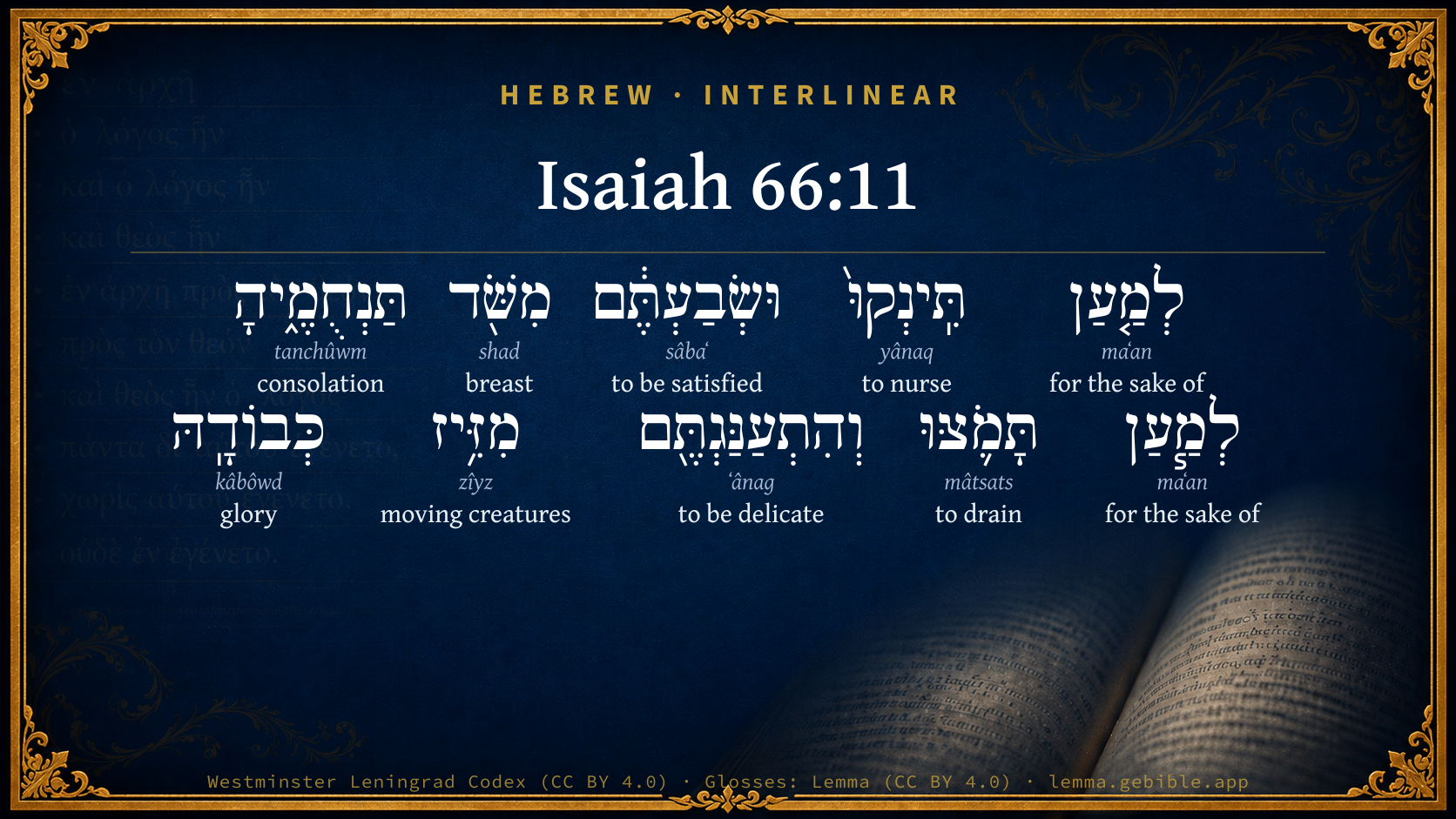
Hebrew (Westminster Leningrad Codex) Isaiah 66:11 appears in the Hebrew Old Testament. The text above is from the Westminster Leningrad Codex. Each word links to its Strong’s number, a concise gloss, and parsing drawn from the Open Scriptures Hebrew Bible morphology. Click any word for its full Brown-Driver-Briggs (BDB) entry.
Download image
Cite this verse

Isaiah 66:11 (World English Bible). Public Domain. Lemma interlinear Bible study tool, https://lemma.gebible.app/v/isaiah/66/11.

Show BibTeX & RIS
BibTeX
RIS
English Translation
that you may suck and be satisfied with the breasts of her consolations; that you may milk out, and be delighted with the abundance of her glory.
World English Bible · Public Domain
Highlights
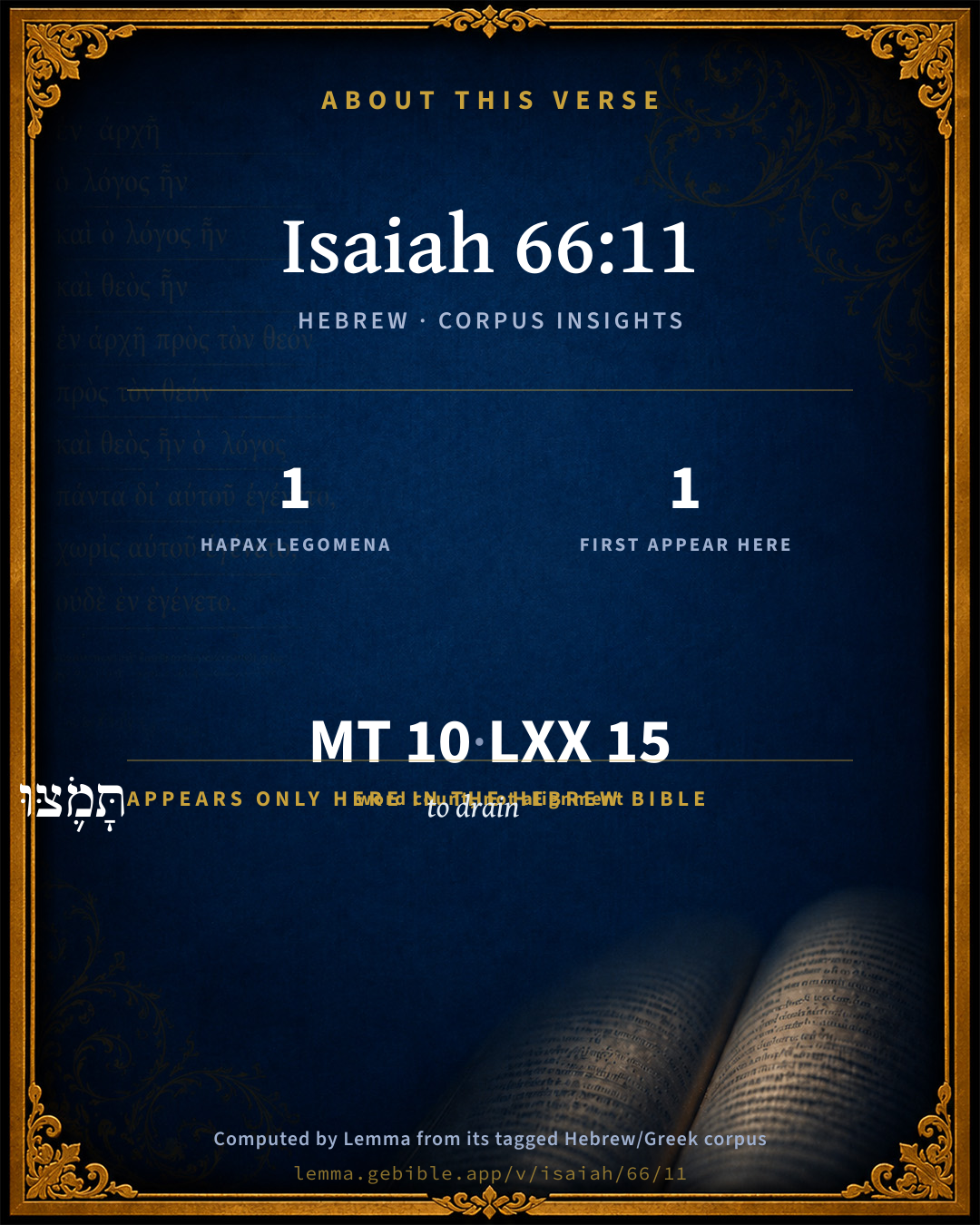
  • 1 hapax legomenon — only here in the Hebrew Bible
  • 1 first appearance in the Hebrew Bible
Full analysis ↓
Download a study sheet

One document with this verse’s original text, its word-by-word gloss line, the meaning frame, cross-references with their text, attributed commentary, and full source and license credits — printable, and it pastes into notes with its structure intact.

This verse Autodidact and up

Study sheet (.html) Plain text (.txt)

A passage Seminary Student

Up to 50 verses in one chapter. A passage sheet keeps up to 6 commentary sources and 12 cross-references per verse, in the order this page ranks them, and says so on the sheet whenever that leaves anything out. Ask for a single verse and you get the Autodidact verse sheet above.

Everything on this page stays free to read, with no account — the sheet is a download of what is already on screen, not access to it.

Want to remove ads? Support Godless Engineer
Compare translations 3

The same verse in 3 English versions, stacked beneath the original-language interlinear above. Click any original word for its lexicon entry.

Each is an independent rendering of the whole verse — the interlinear is not word-aligned to these translations.

Highlighted words mark where these versions differ — a whole-verse word diff, not a word-by-word alignment.

  • World English Bible Public Domain
    that you may suck and be satisfied with the breasts of her consolations; that you may milk out, and be delighted with the abundance of her glory.
  • King James Version Public Domain
    That ye may suck, and be satisfied with the breasts of her consolations; that ye may milk out, and be delighted with the abundance of her glory.
  • unfoldingWord Literal Text CC BY-SA 4.0
    so that you may nurse and have satisfaction from the breast of her consolations, so that you may suck and be refreshed from the abundance of her glory.

unfoldingWord Literal Text — © unfoldingWord, licensed CC BY-SA 4.0. Word-aligned USFM3 via Door43 (git.door43.org/unfoldingWord/en_ult).

Versions to compare (up to 4)

3 of 4 selected

Show all 18 translations

Every available English version of this verse, each an independent rendering of the whole verse.

  • World English Bible Public Domain
    that you may suck and be satisfied with the breasts of her consolations; that you may milk out, and be delighted with the abundance of her glory.
  • Berean Standard Bible Public Domain
    so that you may nurse and be satisfied at her comforting breasts; you may drink deeply and delight yourselves in her glorious abundance.
  • Majority Standard Bible Public Domain
    so that you may nurse and be satisfied at her comforting breasts; you may drink deeply and delight yourselves in her glorious abundance.
  • King James Version Public Domain
    That ye may suck, and be satisfied with the breasts of her consolations; that ye may milk out, and be delighted with the abundance of her glory.
  • American Standard Version (1901) Public Domain
    that ye may suck and be satisfied with the breasts of her consolations; that ye may milk out, and be delighted with the abundance of her glory.
  • Revised Version (1885) Public Domain
    that ye may suck and be satisfied with the breasts of her consolations; that ye may milk out, and be delighted with the abundance of her glory.
  • Geneva Bible (1599) Public Domain
    That ye may sucke and be satisfied with the brestes of her consolation: that ye may milke out and be delited with ye brightnes of her glorie.
  • Douay-Rheims (1899) Public Domain
    That you may suck, and be filled with the breasts of her consolations: that you may milk out, and flow with delights, from the abundance of her glory.
  • Young's Literal Translation Public Domain
    So that ye suck, and have been satisfied, From the breast of her consolations, So that ye wring out, and have delighted yourselves From the abundance of her honour.
  • Literal Standard Version CC BY-SA 4.0
    So that you suckle, and have been satisfied, || From the breast of her consolations, || So that you wring out, and have delighted yourselves || From the abundance of her glory.”
  • Unlocked Literal Bible CC BY-SA 4.0
    For you will nurse and be satisfied; with her breasts you will be comforted; for you will drink them to the full and be delighted with the abundance of her glory.
  • unfoldingWord Literal Text CC BY-SA 4.0
    so that you may nurse and have satisfaction from the breast of her consolations, so that you may suck and be refreshed from the abundance of her glory.
  • Darby Bible Public Domain
    because ye shall suck, and be satisfied with the breasts of her consolations; because ye shall drink out, and be delighted with the abundance of her glory.
  • World Messianic Bible Public Domain
    that you may nurse and be satisfied at the comforting breasts; that you may drink deeply, and be delighted with the abundance of her glory.”
  • Webster's Bible Public Domain
    That ye may suck, and be satisfied with the breasts of her consolations; that ye may draw milk, and be delighted with the abundance of her glory.
  • Free Bible Version CC BY-SA 4.0
    Like a baby you can nurse at her breasts that bring comfort, drinking deeply and being satisfied by all she has to give.
  • Bible in Basic English Public Domain
    So that you may take of the comfort flowing from her breasts, and be delighted with the full measure of her glory.
  • JPS Tanakh (1917) Public Domain
    That ye may suck, and be satisfied with the breast of her consolations; that ye may drink deeply with delight of the abundance of her glory.

Literal Standard Version (2020), Covenant Press — licensed CC BY-SA 4.0. Text via the HelloAO Bible API (eBible.org). Unlocked Literal Bible (unfoldingWord) — licensed CC BY-SA 4.0. Text via the HelloAO Bible API (eBible.org). unfoldingWord Literal Text — © unfoldingWord, licensed CC BY-SA 4.0. Word-aligned USFM3 via Door43 (git.door43.org/unfoldingWord/en_ult). Free Bible Version, Dr. Jonathan Gallagher — licensed CC BY-SA 4.0. Text via the HelloAO Bible API (eBible.org).

Word by word

More ways to search: Search by grammar → Find every occurrence → Compare this word →

Practice this passage: Drill this verse → Learn its vocabulary →

תָּמֹ֛צּוּ
mâtsats
H4711
“to drain”
Verb, Qal, Imperfect, 2nd Person, Masculine, Plural
Part of Speech
Verb
Stem
Qal
Form
Imperfect
Person
2nd Person
Gender
Masculine
Number
Plural
Full BDB Definition

Origin: a primitive root

TWOT: 1234

(Qal) to drain out, suck
  1. לְמַ֤עַן maʻan H4616 “for the sake of” Preposition
  2. תִּֽינְקוּ֙ yânaq H3243 “to nurse” Verb, Qal, Imperfect, 2nd Person, Masculine, Plural
  3. וּשְׂבַעְתֶּ֔ם sâbaʻ H7646 “and · to be satisfied” Conjunction + Verb, Qal, Sequential Perfect, 2nd Person, Masculine, Plural
  4. מִשֹּׁ֖ד shad H7699 “from · breast of” Preposition + Noun, Common, Masculine, Singular, Construct
  5. תַּנְחֻמֶ֑יהָ tanchûwm H8575 “consolations · her” Noun, Common, Both, Plural, Construct + Suffix, Personal, 3rd Person, Feminine, Singular
  6. לְמַ֧עַן maʻan H4616 “for the sake of” Preposition
  7. וְהִתְעַנַּגְתֶּ֖ם ʻânag H6026 “and · to be delicate” Conjunction + Verb, Hithpael, Sequential Perfect, 2nd Person, Masculine, Plural
  8. מִזִּ֥יז zîyz H2123 “from · moving creatures of” Preposition + Noun, Common, Masculine, Singular, Construct
  9. כְּבוֹדָֽהּ kâbôwd H3519 “glory · her” Noun, Common, Both, Singular, Construct + Suffix, Personal, 3rd Person, Feminine, Singular

About this verse

These counts appear in no published source. They are computed here, from the morphology-tagged text and Lemma’s own curated glosses. What Lemma adds →

10
words
9
distinct lemmas
Prophets
section

Notable vocabulary

1 hapax legomenon — a word that appears only here in the entire Hebrew Bible:

  • תָּמֹ֛צּוּ to drain H4711

First appearance in Scripture

This word makes its first canonical appearance in the Hebrew Bible here:

  • תָּמֹ֛צּוּ to drain H4711

Shared distinctive vocabulary

מִזִּ֥יז moving creatures H2123 occurs in 3 verses of the Hebrew Bible. Also found in:

Grammatical profile

  • 4 verbs
  • 4 nouns
  • 2 prepositions

Verb forms

  • תִּֽינְקוּ֙ Qal · Imperfect
  • וּשְׂבַעְתֶּ֔ם Qal · Sequential Perfect
  • תָּמֹ֛צּוּ Qal · Imperfect
  • וְהִתְעַנַּגְתֶּ֖ם Hithpael · Sequential Perfect

Repetition

A word recurs within this verse — often emphatic in Hebrew:

  • לְמַ֤עַן for the sake of H4616 ×2

Hebrew & Septuagint length

In English translation the verse runs 27 words from the Hebrew and 27 from the Septuagint (LXX English) — the same length.

A rough comparison of the two English renderings, which tokenize alike — not a word-level alignment.

Word counts can differ between the Hebrew and the Greek without any difference in meaning — e.g. the Hebrew direct-object marker אֵת has no separate Greek word, and Greek often adds the article ὁ.

In the original languages it is 10 Hebrew tokens and 15 Greek tokens — but the two are counted differently (Hebrew bundles its prefixes and suffixes into one token; the Greek is in lemma form), so that isn’t a like-for-like length.

Cross-references

5

Topical passages linked to Isaiah 66:11 in the Treasury of Scripture Knowledge — connected by theme and wording, ordered by reader-vote popularity; previews shown in the World English Bible.

  • Isaiah 60:16 You shall also suck the milk of the nations, and shall suck the breast of kings; and you shall know that I, Yahweh, am your Savior, and your Redeemer, the Mighty One of Jacob.
  • Joel 3:18 It will happen in that day, That the mountains will drop down sweet wine, The hills will flow with milk, All the brooks of Judah will flow with waters; And a fountain will come forth from the house of Yahweh, And will water the valley of Shittim.
  • Psalms 36:8 They shall be abundantly satisfied with the abundance of your house. You will make them drink of the river of your pleasures.
  • Isaiah 60:5 Then you shall see and be radiant, and your heart shall thrill and be enlarged; because the abundance of the sea shall be turned to you, the wealth of the nations shall come to you.
  • 1 Peter 2:2 as newborn babes, long for the pure milk of the Word, that you may grow thereby,

Cross-references courtesy of OpenBible.info (CC BY 4.0).

Hebrew and Greek witnesses Masoretic Hebrew ↔ Greek Septuagint

The same verse in the two great witnesses to the Old Testament, shown verse-for-verse.

These are two independent witnesses, not word-aligned to each other, and the Septuagint is shown in lemma (dictionary) form.

Hebrew Isaiah 66:11 Masoretic · Westminster Leningrad Codex

לְמַ֤עַן תִּֽינְקוּ֙ וּשְׂבַעְתֶּ֔ם מִשֹּׁ֖ד תַּנְחֻמֶ֑יהָ לְמַ֧עַן תָּמֹ֛צּוּ וְהִתְעַנַּגְתֶּ֖ם מִזִּ֥יז כְּבוֹדָֽהּ

that you may suck and be satisfied with the breasts of her consolations; that you may milk out, and be delighted with the abundance of her glory.

World English Bible · Public Domain

Greek LXX Isaiah 66:11 Septuagint · lemma form

ἵνα θηλάζω καί ἐνπίμπλημι ἀπό μαστός παρακλήσις αὐτός ἵνα ἐκθηλάζω τρυφάω ἀπό εἴσοδος δόξα αὐτός

that you⌃ may suck, and be satisfied with the breast of her consolation; that you⌃ may milk out, and delight yourselves with the influx of her glory.

LXX2012 (modern English Septuagint) · Public Domain

On this verse, Albert Barnes' Notes on the Bible discusses the Septuagint’s reading. Read the note in Commentary ↓

Hebrew: Westminster Leningrad Codex (CC BY 4.0). Greek: Septuagint (public domain); English from LXX2012 (modern English Septuagint) (Public Domain). How the Septuagint differs from the Hebrew →

Targum (Aramaic paraphrase)

1

The Targum is the ancient Jewish Aramaic paraphrase of the Hebrew Scriptures — an interpretive translation, not the Hebrew text itself. Onkelos (literal) and Pseudo-Jonathan (expansive) render the Torah, and Jonathan the Prophets. Coverage is partial: where no permissively-licensed English translation exists for a verse, only the Aramaic is shown. This is verse-level text, not a word-by-word alignment to the Hebrew.

  1. Targum Jonathan Prophets (Joshua–Malachi)
    בְּדִיל דְתִתְפַּנְקוּן וְתִשְׂבְּעוּן מִבִּזַת תַּנְחוּמָתָהָא בְּדִיל דְתִשְׁתּוּן וְתִתְרַווֹן מַחֲמַד יְקָרָהּ:

    In order that ye may delight yourselves and be satisfied with the food of her consolations, in order that ye may drink and overflow with the wine of her glory.

    Targum Jonathan — Aramaic: “Mikraot Gedolot” (public domain). English: “Sefaria Community Translation” (CC0 1.0 (public-domain dedication)); “London "Chaldee Paraphrase," 1871” (public domain). Text via Sefaria.

Commentary

Notes on Isaiah 66:11 from classic Christian and Jewish commentators (each source and its license shown beneath its notes). The classic Christian expositions comment on the surrounding passage and are grouped to its opening verse, so a note may address several verses; the Jewish commentaries on the Tanakh (Rashi and others) are per-verse, so they appear only where the commentator wrote on this verse.

Lemma curates 59 commentaries, every one of them public domain or Creative Commons licensed, each selected and text-cleaned for this edition rather than reprinted as found. About our sources →

Trapp's Complete Commentary

John Trapp

Isa 66:11 That ye may suck, and be satisfied with the breasts of her consolations; that ye may milk out, and be delighted with the abundance of her glory.

Ver. 11. That ye may suck, and be satisfied with the breasts of her consolations.] Zion is not only a fruitful mother, but a joyful nurse. God giveth her the blessings both of the belly and of the breasts; and these breasts of hers are full strutting with the sincere milk of the word, that rational milk, {1Pe 2:2} the sweet and precious promises of the gospel. These "breasts of consolation" we must suck, as the babe doth the mother’s dug, as long as he can get a drop out of it, and then sucks still till more cometh. Let us suck the blood of the promises, saith one, as a dog that hath got the blood of the bear - he hangs on, and will hardly be beaten off. Let us extort and oppress the promises, saith another, descanting upon this text, as a rich man oppresseth a poor man, and getteth out of him all that he hath; so deal thou with the promises, for they are rich - there is a price in them; consider it to the utmost, wring it out. The world layeth forth her two breasts, or botches rather, of profit and pleasure, and hath enough to suck them, though they can never thereby be satisfied. And shall alma mater Ecclesia, the nourishing mother of thye Church want those that shall milk out and be delighted with the abundance of her glory?

John Trapp, A Commentary or Exposition upon All the Books of the Old and New Testament (1647–1656) — public domain. Text from a community e-Sword module.

Geneva Bible (1599)

Geneva Bible translators

That is, may rejoice for all the benefits that God bestoweth upon his Church.

Geneva Bible (1599) marginal notes — public domain. Text via Bolls.life.

Jamieson, Fausset & Brown

Robert Jamieson, A. R. Fausset & David Brown

suck-- (Isa 60:5, Isa 60:16; Isa 61:6; Isa 49:23).

abundance--Hebrew, "the ray-like flow of her opulence," that is, with the milk spouting out from her full breasts (answering to the parallel, "breast of her consolations") in ray-like streams [GESENIUS].

Jamieson, Fausset & Brown — Commentary Critical and Explanatory on the Whole Bible (1871) — public domain (CC PDM 1.0). Text via the HelloAO Bible API.

Adam Clarke's Commentary

Verse 11. With the abundance of her glory - "From her abundant stores."] For מזיז mizziz, from the splendour, two MSS. and the old edition of 1488, have מזיו mizziv; and the latter ז zain is upon a rasure in three other MSS. It is remarkable that Kimchi and Sal. ben Melec, not being able to make any thing of the word as it stands in the text, say it means the same with מזיו mizziv; that is, in effect, they admit of a various reading, or an error in the text. But as Vitringa observes, what sense is there in sucking nourishment from the splendour of her glory? He therefore endeavours to deduce another sense of the word זיז ziz; but, as far as it appears to me, without any authority. I am more inclined to accede to the opinion of those learned rabbins, and to think that there is some mistake in the word; for that in truth is their opinion, though they disguise it by saying that the corrupted word means the very same with that which they believe to be genuine. So in Isa 41:24 they say that אפע apha, a viper, means the same with אפס ephes, nothing; instead of acknowledging that one is written by mistake instead of the other. I would propose to read in this place מזין mizzin or מזן mizzen, which is the reading of one of De Rossi's MS., (instead of מזיז meziz,) from the stores, from זון zun, to nourish, to feed; see Ge 45:23; 2Ch 11:23; Ps 144:13. And this perhaps may be meant by Aquila, who renders the word by απο παντοδαπιας with which that of the Vulgate, ab omnimoda gloria, and of Symmachus and Theodotion, nearly agree. The Chaldee follows a different reading, without improving the sense; מיין meyin, from the wine. - L.

Adam Clarke's Commentary on the Bible (1810–1826) — public domain. Text from a community e-Sword/MySword module.

Ellicott's Commentary for English Readers

(11) That ye may suck . . .—The figure takes a new and bolder form. The friends who visit the rejoicing mother are invited to take their place with the new-born child, and to share his nurture. The underlying thought is, of course, that the heathen nations who had been friendly to Zion were to become converts, and be incorporated with her citizens.

A Bible Commentary for English Readers, edited by Charles John Ellicott (1878–1897) — public domain. Text from a community e-Sword module.

The Cambridge Bible for Schools and Colleges

gen. ed. J. J. S. Perowne

11. Comp. ch. Isa_60:16.

abundance] The Heb. word (zîz) is of uncertain interpretation. It is found again only in Psa_50:11; Psa_80:13 in the phrase “beast of the field” (zîz sâday). It is doubtful, however, if the word there be identical with that in this verse. A perfect parallelism (with “breast”) would be obtained if we might translate by “udder.” Ewald and Cheyne adopt this translation, Ewald without remark, Cheyne with a reference to the Assyrian and the vulgar Arabic, where a word zîzâh is said to mean “udder” (see his Comm. p. 174, and Origin of the Psalter, pp. 472 f.).

The Cambridge Bible for Schools and Colleges (gen. ed. J. J. S. Perowne; Cambridge University Press, 1878–1918) — public domain. Text from a community e-Sword module.

John Gill's Exposition

That ye may suck, and be satisfied with the breast of her consolations,.... This, according to our version, expresses the end of the church's friends being called together to rejoice with her, that they might partake of her joys and comforts, delights and pleasures: but the words may be better rendered, either, according to Kimchi's sense, "therefore shall ye suck" (t), &c.; because ye have mourned for her, and because ye have rejoiced with her; or rather, as Noldius (u), "because ye suck", &c.; partake of her privileges and ordinances, so give a reason why they should rejoice with her. "Breast" is put for "breasts", as Jarchi observes; for as the church is represented as a woman, and as a teeming woman, she has two breasts as such, grown and fashioned, and full of milk of consolation; for "breast of her consolations" is the same as "her breasts of consolation"; see Sol 4:5, these are either Christ and his Spirit. Christ is a full breast of comfort to his people, in the greatness of his person, and the riches of his grace; in his precious blood, perfect righteousness, atoning sacrifice, and great salvation; if there be any comfort it is in him, and abounds by him. The Holy Spirit is another breast of consolation, another Comforter, by giving knowledge of the free grace gifts of God; by showing the things of Christ; by opening and applying the precious promises of the Gospel; by shedding the love of God in the heart; by witnessing to the saints their adoption, and by sealing them up unto the day of redemption. Or the covenant, and its blessings and promises: the covenant is a full breast of comfort, yields much both in life and at death; its blessings are sure mercies, blessings indeed, spiritual ones, and he that has an interest in them has enough, has all things; the promises of it are great, precious, sure, and unconditional, and afford strong consolation to the heirs of them. Or the Holy Scripture, and its two Testaments, the Old and New, which are exactly alike as two breasts; agree in the person and offices of Christ, and in all the doctrines of grace, and are full of the sincere milk of the word, and of spiritual consolation. Or the two ordinances of baptism and the Lord's supper; which agree with each other; come from the same author; relate to the same things, the sufferings and death of Christ; and to be partook of by the same persons: baptism leads to the blood of Christ for cleansing and pardon; to the burial of Christ it represents, there to behold all sins buried with him; and to the resurrection of Christ for justification, and so is a means of much spiritual comfort; as it was to the eunuch, who from thence went on his way rejoicing: the Lord's supper is another breast of consolation, it is a feast of fat things; it represents the broken body and bloodshed of Christ, whose flesh is meat indeed, and his blood drink indeed, and so is a means of spiritual nourishment and comfort. These breasts are to be "sucked"; the mouth of faith is to be laid unto them; Christ is to be applied unto for fresh supplies of grace and comfort; the covenant and its promises are to be laid hold upon, and all the goodness in them to be pressed and got out; the Scriptures are to be diligently read and searched, and the ordinances to be frequently attended on, and fervent prayer to be incessantly used, and not restrained till the blessing is given; and such who do so are sooner or later "satisfied", filled to the full. How satisfying are Christ and his grace! the covenant of grace, its blessing and promises! the doctrine of the Gospel, and the ordinances of it! these are the goodness of God's house, with which his people are satisfied, even as with marrow and fatness, Psa 36:8,

that ye may milk out, and be delighted with the abundance of her glory; or, "for" or "because ye milk out", "may" or "shall milk out" (w); that is, press with the hand of faith the above breasts of consolation, and get out from them all the comfort that is laid up in them: and so

be delighted with the abundance of her glory; or, "the brightness of it" (x); Christ is the glory of his church; it is his presence with her, his grace and righteousness bestowed on her, which give her abundance of glory; and he it is in whom she glories: the Spirit of God, as a spirit of glory, rests upon her, and his grace makes her all glorious within; it is her glory to be interested in the covenant of grace, its promises and blessings, and to have the word and ordinances; her breasts are her glory, and she will have abundance of it in the latter day; see Isa 66:12, all which greatly "delight" the lovers and friends of Zion; a sight of Christ and his fulness, and a view of God as their Covenant God, are exceeding delightful; the doctrines of the Gospel are pleasant words, and the ways or ordinances of Christ are ways of pleasantness; and particularly the church in the latter day, enjoying all these to the full, and having the glory of God upon her, will be very delightful to behold.

(t) "pro eo quod, vel quia sugetis", Gataker. (u) "Quia sugitis", Concord. Ebr. Part. p. 521. (w) . (x) "propter splendorem gloriae ejus", Pagninus; "a splendore", Munster, Montanus. So R. Sol. Urbin. Ohel Moed, fol. 36. 2.

John Gill's Exposition of the Whole Bible (1746–1763) — public domain (CC PDM 1.0). Text via the HelloAO Bible API.

Albert Barnes' Notes on the Bible

That ye may suck - The same figure occurs in Isa 60:16; and substantidally in Isa 49:23. See the note at those places.

That ye may milk out - The image is an obvious one. It means that they who sympathized with Zion would be nourished by the same truth, and comforted with the same sources of consolation.

And be delighted with the abundance of her glory - Margin, ‘Brightness.’ Lowth renders this, ‘From her abundant stores.’ Noyes, ‘From the fullness of her glory.’ Jerome (the Vulgate), ‘And that you may abound with delights from every kind of her glory.’ The Septuagint, ‘That sucking ye may be nourished from the commencement’ (Thompson); ‘or the entrance of her glory’ (ἀπὸ εἰσόδου δόξης αὐτῆς apo eisodou doxēs autēs). This variety of interpretation has arisen from the uncertain meaning of the word זיז zı̂yz, rendered ‘abundance.’ Gesenius supposes that it is derived from זוּז zûz, meaning:

1. To move;

2. To glance, to sparkle, to radiate, from the idea of rapid motion; hence, to flow out like rays, to spout like milk; and hence, the noun זיז zı̂yz, means a breast.

This derivation may be regarded as somewhat fanciful; but it will show why the word ‘brightness’ was inserted in the margin, since one of the usual significations of the verb relates to brightness, or to sparkling rays. Aquila renders it, Ἀπὸ παντοδαπίας Apo pantodapias - ‘From every kind of abundance.’ Symmachus, Ἀπὸ πλήθους Apo plēthou - ‘From the multitude.’ The word probably refers to the abundance of the consolations which Zion possessed. Lowth proposes to change the text; but without any authority. The Chaldee renders it, ‘That ye may drink of the wine of her glory;’ where they probably read יין yayin (“wine”), instead of the present reading.

Of her glory - The abundant favors or blessings conferred on Zion. The glory that should be manifested to her would be the knowledge of divine truth, and the provisions made for the salvation of people.

Albert Barnes' Notes on the Bible (1834–1885) — public domain. Text from a community e-Sword/MySword module.

Matthew Poole's English Annotations

Jerusalem is here set out as the mother of us all, as indeed she was; for out of Zion went forth the law, and the word of the Lord from Jerusalem, Isa 2:3. Christ was of the seed of Abraham, he was sent to the lost sheep of the house of Israel, and is called, Rom 15:8, the minister of the circumcision: they were the olive, the branches; the Gentiles but a wild olive, grafted in amongst them, Rom 11:17; we sucked at their breasts; Christ was first preached to them; the twelve, the seventy, were all of them. The breasts of her consolations: the gospel doctrine was their breasts of consolation. Christ was in the first place.

Her glory; the glory of the people Israel, though he was also a light to lighten the Gentiles, Luk 2:32; we are required to rejoice with Jerusalem. That ye may suck, and be satisfied, &c.; intimating that our joy should not be a mere act of charity to them, but a proper expression of our sense of God’s goodness to ourselves, who should suck and be satisfied from the glad tidings of the gospel first published unto them, and ourselves be enlightened from what was at first the glory of Israel.

Matthew Poole's English Annotations on the Holy Bible (1683–1685) — public domain. Text from a community e-Sword/MySword module.

The Pulpit Commentary

That ye may suck. Restored Jerusalem will be as a mother to all who love her, to all who have mourned for her when she lay as it were. (1Sa_15:35 2Sa_14:2) She will have "milk" to give to all sincere milk of the Word" (1Pe_2:2) and from her both Jew and Gentile will "suck out no small advantage". (Psa_73:10) She will also impart to them from the abundance of her glory.

The Pulpit Commentary (1880–1919), ed. H.D.M. Spence-Jones & Joseph S. Exell — public domain. Text from a community e-Sword module.

John Wesley's Explanatory Notes

Consolations - The gospel doctrine was their breasts of consolation. Her glory - Christ was the glory of the people of Israel, though he was also a light to the Gentiles.

John Wesley, Explanatory Notes Upon the Whole Bible (1754–1765) — public domain. Text via the GEBible commentary corpus.

J. A. Alexander on Isaiah

Joseph Addison Alexander

“That ye may suck and be satisfied from the breast of her consolations, that ye may milk out and enjoy yourselves from the fullness (or the full breast) of her glory.” Those who have sympathized with Zion in her joys and sorrows shall partake of her abundance and her glory. The figure of a mother is continued, but beautifully varied. ‘Suck and be satisfied, milk out and enjoy yourselves’, may be regarded as examples of hendiadys, meaning ‘suck to satiety and milk out with delight’; but no such change in the form of the translation is required or admissible. Glory includes wealth or abundance, but much more, viz. all visible superiority or excellence.

Joseph Addison Alexander, The Prophecies of Isaiah (1846–1847; New York: Scribner, 1870–1878) — public domain. Text from a community e-Sword module.

Rashi

Rabbi Shlomo Yitzchaki (Rashi)

from the breast Heb. מִשֹּׁד, an expression of breasts (שָׁדַיִם).

you drink deeply Heb. תָּמֹצּוּ, sucer in French, to suck.

from her approaching glory Heb. מִזִּיז. From the great glory that is moving and coming nearer to her.

זִיז means esmoviment in O.F., movement.

Rashi on the Tanakh — English translations: “The Judaica Press complete Tanach with Rashi, translated by A. J. Rosenberg” (CC BY 4.0); “Pentateuch with Rashi's commentary by M. Rosenbaum and A.M. Silbermann, 1929-1934” (public domain); “The Metsudah Tanach series, Lakewood, N.J” (CC BY 4.0); and “The Book of Joshua, Metsudah Publications, 1997” (CC BY 4.0). Text via Sefaria.

Ibn Ezra

Rabbi Abraham ibn Ezra

With the breast of her consolations. Comp. Thou shalt suck the breast of kings (60:16). A fulness of joy is meant by this expression; for consolations are here the opposite of mournings.

תמצו That you may milk out. Comp. מיץ the churning (Prov. 30:33), though of a different root.

מזיז R. Jonathan b. Uziel translates it מחמד from the best; R. Moses Hakkohen compares it with וזיז שדי the wild beasts of the field (Ps. 1. 11); but this explanation is forced. I explain the word to be hap. leg.

Ibn Ezra on the Tanakh — English translations: “Sefaria Community Translation” (CC0 1.0 (public-domain dedication)); “Yalkut, Sifsei Chachomim Chumash, Metsudah Publications, 2009” (CC BY 4.0); and “Commentary of Ibn Ezra on Isaiah - trans. by M. Friedlander, 1873” (public domain). Text via Sefaria.

Lesson kit

Teaching starters — assembled from the data on this page, not authored interpretation. Every prompt links to the verse data it draws on. Edit before teaching.

Isaiah, in the Prophets, opens this verse with 10 words (9 distinct Hebrew lemmas). Its most distinctive word is mâtsats (“to drain”). A historical commentator’s framing appears above. Read the whole chapter for the surrounding context.

Discussion questions

  1. How does “to drain” (mâtsats) shape what this verse is saying?
  2. 1 word here appears nowhere else in the Hebrew Bible. Why might the author reach for such rare wording?
  3. This is the first place “to drain” appears in Scripture (first appears here). What does its debut here establish?
  4. How does Psalms 50:11, which shares the word «moving creatures», read alongside this verse?
  5. What does the repetition of “for the sake of” (2× in this one verse) do in this verse?
  6. These translations render this verse differently; the difference is in the English rendering, not the original. What questions does that raise?
  7. «תִּֽינְקוּ֙» is a Qal Imperfect verb. How does that grammatical form shape the action described?
  8. Compare how Trapp's Complete Commentary and Geneva Bible (1599) read this verse. Where do they agree or differ?

Things to notice

  • 1 word in this verse appears nowhere else in the Hebrew Bible.
  • 1 word makes its first canonical appearance in Scripture here.
  • This verse counts 10 Hebrew ↔ 15 Greek words.
  • These translations choose different wording for 11 words in this verse.
  • “for the sake of” occurs 2× in this single verse.

Reading settings

Reading text

Shown beneath each verse's original-language words.

Old Testament
Old Testament edition

Read the OT as the Masoretic Hebrew (MT) or the Greek Septuagint (LXX).

English shown for the Greek Septuagint (in the Hebrew ↔ Greek comparison).

Comparing translations? Open the Compare panel on any verse page to stack up to four side by side.