Colossians 3:6

Greek (Tischendorf 8th ed.) Colossians 3:6 appears in the Greek New Testament. The text above is from the Tischendorf 8th edition. Each word links to its Strong’s number and a concise gloss. Click any word for its full Thayer’s Greek Lexicon entry.
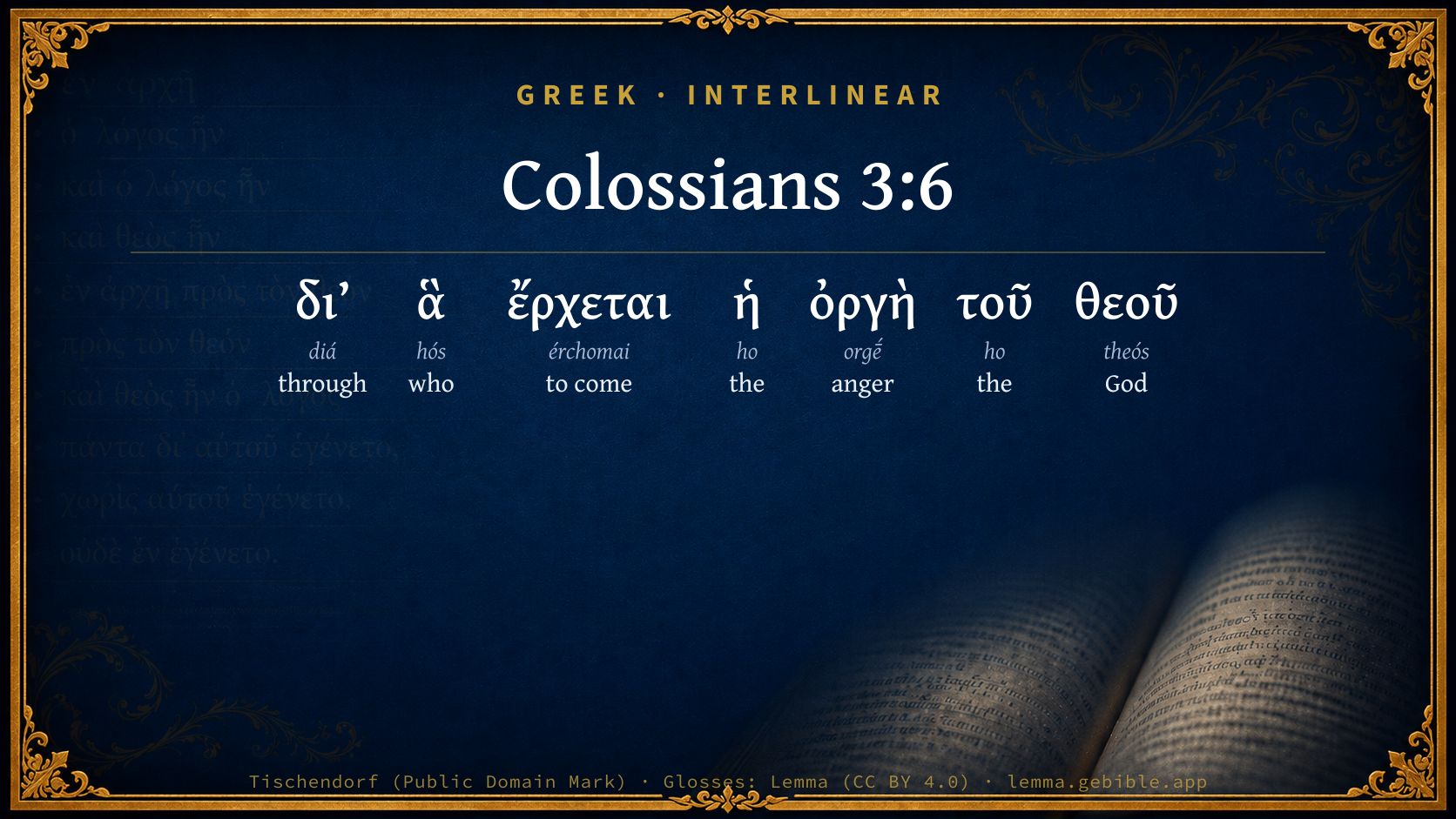
Download image
Cite this verse

Colossians 3:6 (World English Bible). Public Domain. Lemma interlinear Bible study tool, https://lemma.gebible.app/v/colossians/3/6.

Show BibTeX & RIS
BibTeX
RIS
English Translation
for which things' sake the wrath of God comes on the children of disobedience.
World English Bible · Public Domain
Download a study sheet

One document with this verse’s original text, its word-by-word gloss line, the meaning frame, cross-references with their text, attributed commentary, and full source and license credits — printable, and it pastes into notes with its structure intact.

This verse Autodidact and up

Study sheet (.html) Plain text (.txt)

A passage Seminary Student

Up to 50 verses in one chapter. A passage sheet keeps up to 6 commentary sources and 12 cross-references per verse, in the order this page ranks them, and says so on the sheet whenever that leaves anything out. Ask for a single verse and you get the Autodidact verse sheet above.

Everything on this page stays free to read, with no account — the sheet is a download of what is already on screen, not access to it.

Want to remove ads? Support Godless Engineer
Compare translations 3

The same verse in 3 English versions, stacked beneath the original-language interlinear above. Click any original word for its lexicon entry.

Each is an independent rendering of the whole verse — the interlinear is not word-aligned to these translations.

Highlighted words mark where these versions differ — a whole-verse word diff, not a word-by-word alignment.

  • World English Bible Public Domain
    for which things' sake the wrath of God comes on the children of disobedience.
  • King James Version Public Domain
    For which things' sake the wrath of God cometh on the children of disobedience:
  • unfoldingWord Literal Text CC BY-SA 4.0
    because of which the wrath of God is coming,

unfoldingWord Literal Text — © unfoldingWord, licensed CC BY-SA 4.0. Word-aligned USFM3 via Door43 (git.door43.org/unfoldingWord/en_ult).

Versions to compare (up to 4)

3 of 4 selected

Show all 19 translations

Every available English version of this verse, each an independent rendering of the whole verse.

  • World English Bible Public Domain
    for which things' sake the wrath of God comes on the children of disobedience.
  • Berean Standard Bible Public Domain
    Because of these, the wrath of God is coming on the sons of disobedience.
  • Majority Standard Bible Public Domain
    Because of these, the wrath of God is coming on the sons of disobedience.
  • King James Version Public Domain
    For which things' sake the wrath of God cometh on the children of disobedience:
  • American Standard Version (1901) Public Domain
    for which things' sake cometh the wrath of God upon the sons of disobedience:
  • Revised Version (1885) Public Domain
    for which things’ sake cometh the wrath of God upon the sons of disobedience;
  • Geneva Bible (1599) Public Domain
    For the which things sake ye wrath of God commeth on the children of disobedience.
  • Douay-Rheims (1899) Public Domain
    For which things the wrath of God cometh upon the children of unbelief,
  • Young's Literal Translation Public Domain
    because of which things cometh the anger of God upon the sons of the disobedience,
  • Literal Standard Version CC BY-SA 4.0
    because of which things comes the anger of God on the sons of the disobedience,
  • Unlocked Literal Bible CC BY-SA 4.0
    It is for these things that the wrath of God is coming on the sons of disobedience.
  • unfoldingWord Literal Text CC BY-SA 4.0
    because of which the wrath of God is coming,
  • Darby Bible Public Domain
    On account of which things the wrath of God comes upon the sons of disobedience.
  • World Messianic Bible Public Domain
    For these things’ sake the wrath of God comes on the children of disobedience.
  • Webster's Bible Public Domain
    For which things the wrath of God cometh on the children of disobedience:
  • Free Bible Version CC BY-SA 4.0
    Because of such things, those who disobey experience God's judgment.
  • Bible in Basic English Public Domain
    Because of which the wrath of God comes on those who go against his orders;
  • Text-Critical English NT CC BY 4.0
    On account of these things the wrath of God is coming upon the sons of disobedience.
  • Tyndale New Testament (1534) Public Domain
    for which thynges sakes the wrath of God cometh on the chyldren of vnbeleve.

Literal Standard Version (2020), Covenant Press — licensed CC BY-SA 4.0. Text via the HelloAO Bible API (eBible.org). Unlocked Literal Bible (unfoldingWord) — licensed CC BY-SA 4.0. Text via the HelloAO Bible API (eBible.org). unfoldingWord Literal Text — © unfoldingWord, licensed CC BY-SA 4.0. Word-aligned USFM3 via Door43 (git.door43.org/unfoldingWord/en_ult). Free Bible Version, Dr. Jonathan Gallagher — licensed CC BY-SA 4.0. Text via the HelloAO Bible API (eBible.org).

Word by word

More ways to search: Search by grammar → Find every occurrence → Compare this word →

Practice this passage: Drill this verse → Learn its vocabulary →

About this verse

These counts appear in no published source. They are computed here, from the morphology-tagged text and Lemma’s own curated glosses. What Lemma adds →

7
words
6
distinct lemmas
Pauline Epistles
section

Shared distinctive vocabulary

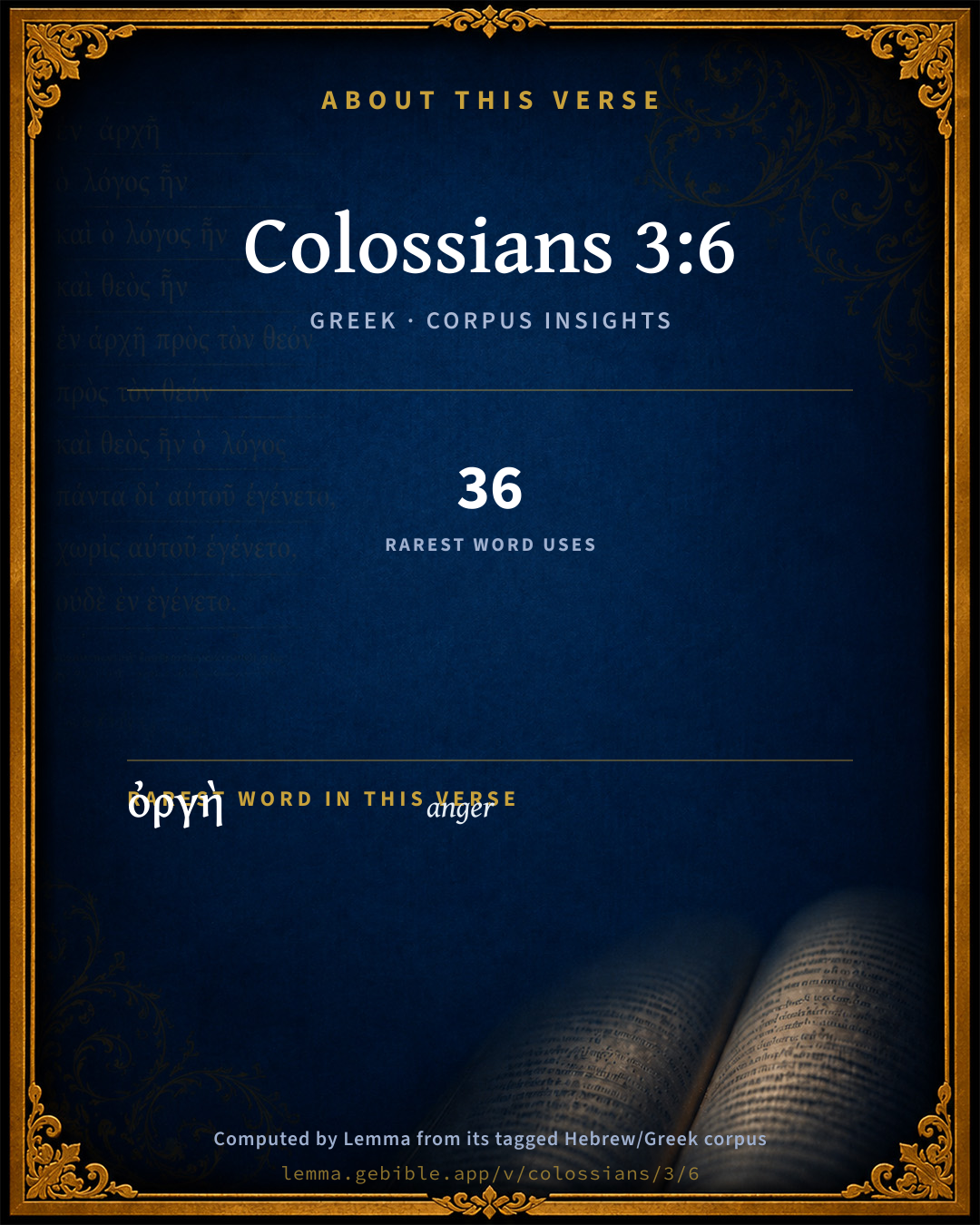
ὀργὴ anger G3709 occurs in 34 verses of the Greek New Testament. Also found in:

Repetition

A word recurs within this verse:

Cross-references

7

Topical passages linked to Colossians 3:6 in the Treasury of Scripture Knowledge — connected by theme and wording, ordered by reader-vote popularity; previews shown in the World English Bible.

  • Ephesians 5:6 Let no one deceive you with empty words. For because of these things, the wrath of God comes on the children of disobedience.
  • Romans 1:18 For the wrath of God is revealed from heaven against all ungodliness and unrighteousness of men, who suppress the truth in unrighteousness,
  • 1 Peter 1:14 as children of obedience, not conforming yourselves according to your former lusts as in your ignorance,
  • Ezekiel 16:45–46 You are the daughter of your mother, who loathes her husband and her children; and you are the sister of your sisters, who loathed their husbands and their children: your mother was a Hittite, and your father an Amorite.
  • Isaiah 57:4 Against whom do you sport yourselves? against whom make you a wide mouth, and put out the tongue? Aren't you children of disobedience, a seed of falsehood,
  • Revelation 22:15 Outside are the dogs, the sorcerers, the sexually immoral, the murderers, the idolaters, and everyone who loves and practices falsehood.
  • 2 Peter 2:14 having eyes full of adultery, and who can't cease from sin; enticing unsettled souls; having a heart trained in greed; children of cursing;

Cross-references courtesy of OpenBible.info (CC BY 4.0).

Commentary

Notes on Colossians 3:6 from classic Christian and Jewish commentators (each source and its license shown beneath its notes). The classic Christian expositions comment on the surrounding passage and are grouped to its opening verse, so a note may address several verses; the Jewish commentaries on the Tanakh (Rashi and others) are per-verse, so they appear only where the commentator wrote on this verse.

Lemma curates 59 commentaries, every one of them public domain or Creative Commons licensed, each selected and text-cleaned for this edition rather than reprinted as found. About our sources →

Tyndale Open Study Notes

Tyndale Open Resources

3:6 coming: Some manuscripts read coming on all who disobey him. In the Greek text, these words occur verbatim in Eph 5:6, so it is possible that an early scribe added them here, either intentionally or accidentally.

Tyndale Open Study Notes — © Tyndale Open Resources, licensed CC BY-SA 4.0. Text via the HelloAO Bible API.

Bengel's Gnomon

Johann Albrecht Bengel

Col 3:6. Διʼ ἅ, for which things) Eph 5:6.

Bengel's Gnomon of the New Testament — English translation (T&T Clark, Edinburgh, 1860) — public domain. Text from a community e-Sword module.

Meyer's Critical & Exegetical Commentary

Heinrich August Wilhelm Meyer

Col_3:6. This relative affirmation stands in a confirmatory reference to the νεκρώσατε κ.τ.λ. above, the omission of which would draw down upon the readers, instead of the φανερωθῆναι ἐν δόξῃ of Col_3:4, a fate such as is here described.

διʼ ὅ (see the critical remarks) has the significant stress of the relative clause: on account of this immorality mentioned in Col_3:5. The Recepta διʼ ἅ is to be taken just in the same way, and not to be referred to the μέλη (Bähr), since it is not the latter themselves, but their life activities specified by πορνείαν κ.τ.λ., which call forth the wrath of God.

ἔρχεται] namely, at the judgment. Comp. Eph_5:6; 1Th_1:10 : ἡ ὀργὴ ἡ ἐρχομένη; Mat_3:7 : ἡ μέλλουσα ὀργή. Hence: ἡμέρα ὀργῆς in Rom_2:5; Rev_6:17. Chrysostom well says: Paul warns διὰ τῶν μελλόντων ἐξ ὧν ἀπηλλάγημεν κακῶν. See also on Eph_5:6. The frequent reference to the manifestation of the divine wrath (comp. Rom_1:18 ff.) in the course of this temporal life (Huther and many others) overlooks the correlation with Col_3:4, and the apostles conception of the nearness of the Parousia. Hence, also, the combination of the two references (Theophylact and others, also Flatt) is to be rejected.

Respecting the υἱοὺς τῆς ἀπειθ. (the Jews and Gentiles, who reject the gospel and thereby disobey God), comp. on Eph_5:6, and as to this mode of expression generally, Steiger on 1Pe_1:14.

Meyer — Critical and Exegetical Commentary on the New Testament — English translation by Peter Christie, edited by Frederick Crombie (T&T Clark, 1880) — public domain. Text from a community e-Sword module.

Expositor's Greek Testament

ed. W. Robertson Nicoll

Col 3:6 . Parallel to Eph 5:6 , from which ἐπὶ τοὺς υἱοὺς τῆς ἀπειθείας has been added in most MSS. The sentence is abrupt without them, and Col 3:7 is more easily explained if they are retained (as by Mey., Kl [17] , Ol.), yet their omission in [18] , combined with their presence in the parallel Eph 5:6 , is too strong to admit of their retention. The verse may refer to a general principle which acts in human life, or the reference may be eschatological. The latter seems to be more in accordance with Paul’s usage. ὀργὴ is here the outward manifestation of the anger which God even now feels at sin.

[17] Klöpper.

[18] Codex Vaticanus (sæc. iv.), published in photographic facsimile in 1889 under the care of the Abbate Cozza-Luzi.

The Expositor's Greek Testament, edited by W. Robertson Nicoll (1897–1910) — public domain. Text from a community e-Sword module.

Geneva Bible (1599)

Geneva Bible translators

Useth to come.

Geneva Bible (1599) marginal notes — public domain. Text via Bolls.life.

Jamieson, Fausset & Brown

Robert Jamieson, A. R. Fausset & David Brown

(See on Eph 5:6.)

Jamieson, Fausset & Brown — Commentary Critical and Explanatory on the Whole Bible (1871) — public domain (CC PDM 1.0). Text via the HelloAO Bible API.

Adam Clarke's Commentary

Verse 6. The wrath of God cometh] God is angry with such persons, and he inflicts on them the punishment which they deserve.

Adam Clarke's Commentary on the Bible (1810–1826) — public domain. Text from a community e-Sword/MySword module.

John Calvin's Commentaries

6. On account of which things the wrath of God cometh. I do not find fault with the rendering of Erasmus — solet venire — (is wont to come,) but as the present tense is often taken in Scripture instead of the future, according to the idiom of the Hebrew language, I have preferred to leave the rendering undecided, so that it might be accommodated to either meaning. He warns the Colossians, then, either of the ordinary judgments of God, which are seen daily, or of the vengeance which he has once denounced upon the wicked, and which impends over them, but will not be manifested until the last day. I willingly, however, admit the former meaning — that God, who is the perpetual Judge of the world, is accustomed to punish the crimes in question.

He says, however, expressly, that the wrath of God will come, or is wont to come, upon the unbelieving or disobedient, instead of threatening them with anything of this nature. For God would rather that we should see his wrath upon the reprobate, than feel it in ourselves. It is true, that when the promises of grace are set before us, every one of the pious ought to embrace them equally as though they were designed for himself particularly; but, on the other hand, let us dread the threatenings of wrath and destruction in such a manner, that those things which are suitable for the reprobate, may serve as a lesson to us. God, it is true, is often said to be angry even with his children, and sometimes chastens their sins with severity. Paul speaks here, however, of eternal destruction, of which a mirror is to be seen only in the reprobate. In short, whenever God threatens, he shews, as it were, indirectly the punishment, that, beholding it in the reprobate, we may be deterred from sinning.

John Calvin's Commentaries (1540-1563) — public domain. Text from the Calvin Translation Society English edition (1840s-50s) via the Christian Classics Ethereal Library (ccel.org). Calvin's coverage is partial (roughly two-thirds of the Bible); uncommented books and verses are honest gaps, never fabricated. The 19th-century editor's footnotes and remarks are omitted so the notes are faithfully Calvin's own voice.

The Cambridge Bible for Schools and Colleges

gen. ed. J. J. S. Perowne

6. For which things’ sake, &c.] See Eph_5:6 for an almost verbal parallel, only observing that the words “on the children of disobedience” should perhaps be omitted from the reading here; they are possibly an early insertion from Ephesians.

“The wrath of God”:—the eternal personal antagonism of the Holy One, as such, to sin. It is no impulsive “passion,” but it is also no figure of speech, however it may be ignored or explained away.—Cp. Joh_3:36; Rom_1:18; Rom_2:5; Rom_2:8; Rom_5:9; Rom_9:22; 1Th_1:10; Rev_6:16; Rev_19:15, &c.; and see Eph_2:3, with our note.

“Cometh”:—is coming; is on its way, till in “the day of wrath” (Rom_2:5) it falls.

on the children of disobedience] So Eph_5:6.—Documentary evidence is in favour of the retention of these words, but some important documents omit them. Lightfoot pronounces them an interpolation from Eph., but R. V. text retains them.

The Cambridge Bible for Schools and Colleges (gen. ed. J. J. S. Perowne; Cambridge University Press, 1878–1918) — public domain. Text from a community e-Sword module.

John Gill's Exposition

For which things' sake,.... Those sins above mentioned, Col 3:5,

the wrath of God; the effects of it in temporal judgments, and eternal ruin and destruction, the wrath to come, which all are deserving of, and there is only deliverance from by Christ:

cometh upon the children of disobedience: who are disobedient both to the law of God, and Gospel of Christ: who are unbelievers in him, are rebellious and gainsaying, reject his calls, the persuasions of his ministers, set at nought his counsel, and will have none of his reproof. There have been already instances of God's displeasure at sin, his indignation against it, and his judgments on account of it: his wrath is revealed from heaven, and it will come down from thence on disobedient and rebellious sinners, and that suddenly, and with great power, like a mighty torrent, that there will be no standing before it. This is a reason why such who have life in Christ should mortify, repress, and abstain from the above sins; for though this regards sinners, and ungodly persons, yet the effects of God's wrath on such show how much such sins are displeasing to him, and detested by him, and therefore to be avoided by the saints.

John Gill's Exposition of the Whole Bible (1746–1763) — public domain (CC PDM 1.0). Text via the HelloAO Bible API.

Trapp's Complete Commentary

John Trapp

6 For which things’ sake the wrath of God cometh on the children of disobedience:

Ver. 6. On the children of disobedience] Unpersuadable, uncounsellable persons, that regard not good courses or discourses.

John Trapp, A Commentary or Exposition upon All the Books of the Old and New Testament (1647–1656) — public domain. Text from a community e-Sword module.

Albert Barnes' Notes on the Bible

For which things’ sake ... - See the notes at Eph 5:6, where the same expression occurs.

Albert Barnes' Notes on the Bible (1834–1885) — public domain. Text from a community e-Sword/MySword module.

Haydock's Catholic Bible Commentary

The children of unbelief are either those who perished in Noe’s [Noah’s] flood, for St. Peter in his epistle give them this title, or they are the inhabitants of Chanaan [Canaan], whom Josue [Joshua] exterminated; for these also are called children of unbelief, in the epistle to the Hebrews, and their crimes were the same as those mentioned here. (Calmet)

George Leo Haydock (1774–1849), Haydock's Catholic Family Bible and Commentary, 1859 edition — public domain. Excludes Psalms (Douay-Rheims chapter numbering differs from Protestant) and Deuterocanonical books (Catholic canon only).

Matthew Poole's English Annotations

Especially remembering how the indulging or sparing any of them will be of dreadful consequence; see Eph 5:6; for however they may by carnal men be looked upon as little faults, which God will overlook of course, yet they do certainly incur Divine displeasure, and will bring most inevitable judgments upon those unpersuadable, rebellious, and contumacious ones, who would be thought God’s children and yet remain incorrigible, Mat 24:38,39; 1Co 6:9; Gal 5:21.

Matthew Poole's English Annotations on the Holy Bible (1683–1685) — public domain. Text from a community e-Sword/MySword module.

Whedon's Commentary on the Bible

Daniel D. Whedon

6. Wrath of God—Both in this world and the world to come. See on Eph_5:6, where the same expression occurs.

Daniel D. Whedon (gen. ed.), Commentary on the Old and New Testaments (1874–1909) — public domain. Text from a community e-Sword module.

The Pulpit Commentary

Because of which (things) the anger of God cometh upon the sons of disobedience (Eph_2:2, 3 5:6; Gal_5:21; Rom_1:18 Rom_2:5-9 Rom_5:9; 1Th_1:10 1Th_2:16; 2Th_1:5-10; Joh_3:36; Rev_6:17; Mal_3:2) The latter phrase is cancelled by Tischendorf, Tregelles, Alford, Lightfoot, Westcott and Hort; but retained by Ellicott and, preferentially, by the Revisers. The witnesses against it, though numerically few, are varied and select, and the parallel (Eph_5:6) would suggest insertion of the words if originally absent. "The anger of God is coming" is a sentence complete in itself. (Rom_1:18) God"s "anger" (ojrgh) is his settled punitive indignation against sin, of which his "wrath" (qumov) is the terrible outflaming; (Rev_16:1 Rev_14:10) see Trench"s "Synonyms." "Cometh" implies a continuing fact or fixed principle (see Winer, p. 332); or rather, perhaps, signifies that this "anger" is in course of manifestation, is "on the way:" comp. rcomai 1Th_1:10, "the anger that is coming," not "to come," also the use of e in Joh_14:3, Joh_14:18; Heb_10:37. The objects of this anger ("children of wrath," (Eph_2:2, Eph_2:3) are "the sons of disobedience." The expressive Hebraism by which a man is said to be s child or son of the dominant quality or influence of his life is frequent in the New Testament.

The Pulpit Commentary (1880–1919), ed. H.D.M. Spence-Jones & Joseph S. Exell — public domain. Text from a community e-Sword module.

John Wesley's Explanatory Notes

For which - Though the heathens lightly regarded them.

John Wesley, Explanatory Notes Upon the Whole Bible (1754–1765) — public domain. Text via the GEBible commentary corpus.

Burkitt's Expository Notes on the New Testament

William Burkitt

Here our apostle backs his exhortation to mortify sin, with strong arguments and motives; the first is taken from the wrath of God, which, in its dismal effects, falls upon those who continue in, and under the power of those sins: For which things sake, that is, for the committing of which things, and for continuing impenitent after the commission of them, the wrath of God cometh upon them.

Here note, 1. God’s wrath is the due desert of man’s sin; yet it is not so much sin, as obduration and impenitency in sin, that draws down wrath.

Note, 2. That believers themselves do stand in need of arguments drawn from the wrath of God, to make them afraid of sin, and to excite them to mortify and subdue it; for here the apostle propounded the terrors of divine wrath to these believing Colossians.

The second argument is taken from their former continuance, yea, long continuance in these sins; in which ye also walked some time, when ye lived in them; that is, in the forementioned sins ye yourselves also walked before your conversion, when ye lived in them, and took delight in the practice of them.

Learn hence, That no argument will prevail more with a Christian to follow on the work of mortification closely for time to come, than the remembrance of his long continuance in sin in time past; in which sins ye walked some time, when ye lived in them; Now mortify therefore &c.

William Burkitt's Expository Notes on the New Testament (1700–1703) — public domain. Text from a community e-Sword module.

The People's New Testament

B. W. Johnson

6. For which things' sake. Because these things are practiced by those who live in disobedience, God's wrath is coming upon them.

B. W. Johnson's The People's New Testament with Notes (1889–1891) — public domain. Electronic text from the Christian Classics Ethereal Library (CCEL) ThML edition.

Cambridge Greek Testament for Schools and Colleges

6. At the end of the verse Text. Rec. adds ἐπὶ τοὺς υἱοὺς τῆς ἀπειθείας (from Eph 5:6) with אAC(D), etc. “In D, however, they are written (though by the first hand) in smaller letters and extend beyond the line (in both Greek and Latin), whence we may infer that they were not found in a copy which was before the transcriber” (Lightfoot). The additional words are omitted by B, Sahid. Clem.-Alex.-MSS. Cyprian (Ambrst.).

6. διʼ ἅ, cf. Eph 5:6.

ἔρχεται ἡ ὀργὴ τοῦ θεοῦ. See notes on Textual Criticism. Not His feeling or attitude towards sin, but the external manifestation of that attitude; cf. Rom 1:18; Rom 5:9. This is regarded as coming with certainty on the ungodly (1Th 1:10), in the final day of wrath (Rom 2:5).

St Paul frequently appends a similar saying to his lists of sins, Eph 5:6; Gal 5:21; 1Co 6:10. Here it is the more needed in contrast to the hope of the godly in Col 3:4. Chrys. says, διὰ πολλῶν ἀπήγαγεν αὐτούς· διὰ τῶν εὐεργεσιῶν τῶν ὑπαρξασῶν, διὰ τῶν μελλόντων ἐξ ὧν ἀπηλλάγημεν κακῶν.

Cambridge Greek Testament for Schools and Colleges (Cambridge University Press, 1896; 21 vols, various authors incl. Carr, Maclear, Plummer, Farrar, Lumby, Moule, M. R. James, Simcox) — public domain. Text from a community e-Sword module.

International Critical Commentary

6. διʼ ἅ. This is undoubtedly the correct reading, but a few authorities (C* D* G) read διʼ ὅ.

ἔρχεται ἡ ὀργὴ τοῦ Θεοῦ. After Θεοῦ, Rec. adds: ἐπὶ τοὺς υἱοὺς τῆς ἀπειθείας, as in Eph. v. 6.

The evidence for the addition is extremely strong, as they are contained in all manuscripts except B. In D, however, the words are written in a smaller character at the end of the line, an indication apparently that they were not present in its archetype. Of Versions the Sahidic omits them, and the Roman ed. of the Ethiopic. Clement 294 (MSS.) and 531 quotes from νεκρώσατε to Θεοῦ: but it would be unsafe to infer that his copy did not contain the addition; he may well have stopped short of it as not necessary for his purpose.

Ambrosiaster omits them in his text, but his comment appears to recognise them.

With these exceptions the addition is supported by all MSS., Versions, and Fathers. Its genuineness would be certain were it not that the same words occur in the parallel passage Eph 5:6. It is very credible that they were added from that place at a very early period. On the other hand, they seem required to complete the sense; certainly without them the thought is not the same as in the parallel in Eph. In the one case the words are a general warning as to the consequence of these sins; in the other a lesson is drawn from the example of others. The καὶ ὑμεῖς, ver. 7, seems to assume a previous mention of the unbelieving Gentiles.

The evidence in favour of the omission being so slight, it may be considered equally probable that the omission was accidental. The words are omitted by Tischndorf, Tregelles, WH., Alford, Weiss, and bracketed by Lachm. They are retained by Ellicott, Meyer, RV. (om. marg.).

International Critical Commentary — older volumes (1896–1929), various authors — public domain. Text from a community e-Sword module.

Vincent's Word Studies in the New Testament

Marvin R. Vincent

Wrath - cometh. Compare Rom 1:18. The present tense denotes the certainty of the future event, as Mt 17:11; Joh 4:21. The best texts omit upon the children of disobedience.

Marvin R. Vincent, Word Studies in the New Testament (1887–1900) — public domain. Text from a community e-Sword/MySword module.

Lightfoot's Colossians and Philemon

J. B. Lightfoot

ἥτις κ.τ.λ.] ‘for it is idolatry’: comp. Ephes. v. 5 πλεονέκτης, ὅ (or ὅς) ἐστιν εἰδωλολάτρης, Polyc. Phil. 11 ‘Si quis non abstinuerit se ab avaritia, ab idololatria coinquinabitur’ (see Philippians p. 63 on the misunderstanding of this passage). The covetous man sets up another object of worship besides God. There is a sort of religious purpose, a devotion of the soul, to greed, which makes the sin of the miser so hateful. The idea of avarice as a religion may have been suggested to St Paul by our Lord’s words, Matt. vi. 24 οὐ δύνασθε Θεῷ δουλεύειν καὶ μαμωνᾷ, though it is a mistake to suppose that Mammon was the name of a Syrian deity. It appears however elsewhere in Jewish writers of this and later ages: e.g. Philo de Mon. i. 2 (II. p. 214 sq.) πανταχόθεν μὲν ἀργύριον καὶ χρυσίον ἐκπορίζουσι, τὸ δὲ πορισθὲν ὡς ἄγαλμα θεῖον ἐν ἀδύτοις θησαυροφυλακοῦσιν (with the whole context), and Shemoth Rabba fol. 121. 3 ‘Qui opes suas multiplicat per fœnus, ille est idololatra’ (with other passages quoted by Wetstein and Schöttgen on Ephes. v. 5). St Chrysostom, Hom. in Johann. lxv (VIII. p. 392 sq.), enlarges on the cult of wealth—the consecration of it, the worship paid to it, the sacrifices demanded by it: ἡ δὲ φιλαργυρία λέγει, Θῦσόν μοι τὴν σαυτοῦ ψυχήν, καὶ πείθει· ὁρᾷς ὅιους ἔχει βωμούς, οἷα δέχεται θύματα (p. 393). The passage in Test. xii Patr. Jud. 18 ἡ φιλαργυρία πρὸς ἔιδωλα ὁδηγεῖ is no real parallel to St Paul’s language, though at first sight it seems to resemble it. For ἥτις, ‘seeing that it’, see the note on Phil. iv. 3.

6, 7. δι’ ἅ κ.τ.λ.] The received text requires correction in two points. (1) It inserts the words ἐπὶ τοὺς ὑιοὺς τῆς ἀπειθείας after τοῦ Θεοῦ. Though this insertion has preponderating support, yet the words are evidently interpolated from the parallel passage, Ephes. v. 6 διὰ ταῦτα γὰρ ἐρχεται ἡ ὀργὴ τοῦ Θεοῦ ἐπὶ τοὺς ὑιοὺς τῆς ἀπειθείας. We are therefore justified in rejecting them with other authorities, few in number but excellent in character. See the detached note on various readings. When the sentence is thus corrected, the parallelism of δι’ ἅ ... εν οἷς καί ... may be compared with Ephes. i. 11 ἐν hῷ καὶ ἐκληρώθημεν ... ἐν hῷ καὶ ὑμεῖς ... ἐν hῷ καὶ πιστεύσαντες ἐσφραγίσθητε, and ii. 21, 22 ἐν hῷ πᾶσα [ἡ] οἰκοδομὴ ... ἐν ᾧ καὶ ὑμεῖς συνοικοδομεῖσθε. (2) The vast preponderance of authority obliges us to substitute τούτοις for αὐτοῖς.

6. ἐρχεται] This may refer either to the present and continuous dispensation, or to the future and final judgment. The present ἐρχεσθαι is frequently used to denote the certainty of a future event, e.g. Matt. xvii. 11, Joh. iv. 21, xiv. 3, whence ὁ ἐρχόμενος is a designation of the Messiah: see Winer § xl. p. 332.

J. B. Lightfoot, St Paul's Epistles to the Colossians and Philemon: a revised text with introductions, notes and dissertations (London: Macmillan, 1875) — public domain. Electronic text from Project Gutenberg (ebook #50857). Covers Colossians and Philemon only (the verse-by-verse notes; introductions and dissertations are omitted); Lightfoot's companion Galatians and Philippians volumes are not included, as the available public-domain scans carry garbled Greek that cannot be faithfully reproduced.

Lesson kit

Teaching starters — assembled from the data on this page, not authored interpretation. Every prompt links to the verse data it draws on. Edit before teaching.

Colossians, in the Pauline Epistles, opens this verse with 7 words (6 distinct Greek lemmas). Its most distinctive word is orgḗ (“anger”). A historical commentator’s framing appears above. Read the whole chapter for the surrounding context.

Discussion questions

  1. What does “anger” (orgḗ) contribute to the verse as a whole?
  2. How does Matthew 3:7, which shares the word «anger», read alongside this verse?
  3. What does the repetition of “the” (2× in this one verse) do in this verse?
  4. These translations render this verse differently; the difference is in the English rendering, not the original. What questions does that raise?
  5. Compare how Tyndale Open Study Notes and Bengel's Gnomon read this verse. Where do they agree or differ?

Things to notice

  • These translations choose different wording for 8 words in this verse.
  • “the” occurs 2× in this single verse.
  • 6 distinct Greek lemmas span 7 words in this verse.

Reading settings

Reading text

Shown beneath each verse's original-language words.

Old Testament
Old Testament edition

Read the OT as the Masoretic Hebrew (MT) or the Greek Septuagint (LXX).

English shown for the Greek Septuagint (in the Hebrew ↔ Greek comparison).

Comparing translations? Open the Compare panel on any verse page to stack up to four side by side.