
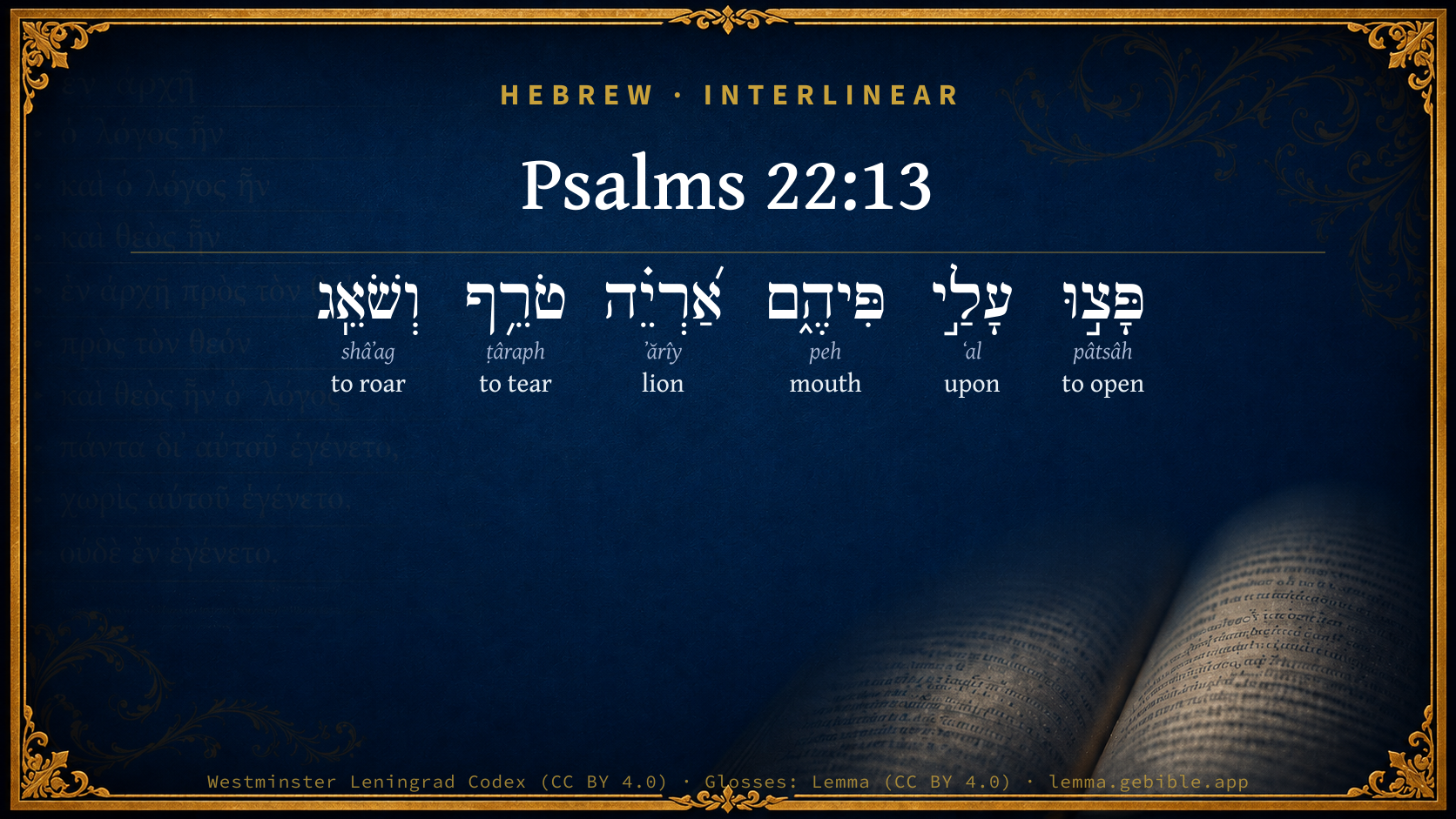
Psalms 22:13

Hebrew (Westminster Leningrad Codex) Psalms 22:13 appears in the Hebrew Old Testament. The text above is from the Westminster Leningrad Codex. Each word links to its Strong’s number, a concise gloss, and parsing drawn from the Open Scriptures Hebrew Bible morphology. Click any word for its full Brown-Driver-Briggs (BDB) entry.
Download image
Cite this verse

Psalms 22:13 (World English Bible). Public Domain. Lemma interlinear Bible study tool, https://lemma.gebible.app/v/psalms/22/13.

Show BibTeX & RIS
BibTeX
RIS
English Translation
They open their mouths wide against me, Lions tearing prey and roaring.
World English Bible · Public Domain
Download a study sheet

One document with this verse’s original text, its word-by-word gloss line, the meaning frame, cross-references with their text, attributed commentary, and full source and license credits — printable, and it pastes into notes with its structure intact.

This verse Autodidact and up

Study sheet (.html) Plain text (.txt)

A passage Seminary Student

Up to 50 verses in one chapter. A passage sheet keeps up to 6 commentary sources and 12 cross-references per verse, in the order this page ranks them, and says so on the sheet whenever that leaves anything out. Ask for a single verse and you get the Autodidact verse sheet above.

Everything on this page stays free to read, with no account — the sheet is a download of what is already on screen, not access to it.

Want to remove ads? Support Godless Engineer
Compare translations 3

The same verse in 3 English versions, stacked beneath the original-language interlinear above. Click any original word for its lexicon entry.

Each is an independent rendering of the whole verse — the interlinear is not word-aligned to these translations.

Highlighted words mark where these versions differ — a whole-verse word diff, not a word-by-word alignment.

  • World English Bible Public Domain
    They open their mouths wide against me, Lions tearing prey and roaring.
  • King James Version Public Domain
    They gaped upon me with their mouths, as a ravening and a roaring lion.
  • unfoldingWord Literal Text CC BY-SA 4.0
    They open their mouths against me, a tearing and roaring lion.

unfoldingWord Literal Text — © unfoldingWord, licensed CC BY-SA 4.0. Word-aligned USFM3 via Door43 (git.door43.org/unfoldingWord/en_ult).

Versions to compare (up to 4)

3 of 4 selected

Show all 18 translations

Every available English version of this verse, each an independent rendering of the whole verse.

  • World English Bible Public Domain
    They open their mouths wide against me, Lions tearing prey and roaring.
  • Berean Standard Bible Public Domain
    They open their jaws against me like lions that roar and maul.
  • Majority Standard Bible Public Domain
    They open their jaws against me like lions that roar and maul.
  • King James Version Public Domain
    They gaped upon me with their mouths, as a ravening and a roaring lion.
  • American Standard Version (1901) Public Domain
    They gape upon me with their mouth, `As' a ravening and a roaring lion.
  • Revised Version (1885) Public Domain
    They gape upon me with their mouth, as a ravening and a roaring lion.
  • Geneva Bible (1599) Public Domain
    They gape vpon me with their mouthes, as a ramping and roaring lyon.
  • Douay-Rheims (1899) Public Domain
    Many calves have surrounded me: fat bulls have besieged me.
  • Young's Literal Translation Public Domain
    They have opened against me their mouth, A lion tearing and roaring.
  • Literal Standard Version CC BY-SA 4.0
    They have opened their mouth against Me, || A lion tearing and roaring.
  • Unlocked Literal Bible CC BY-SA 4.0
    They open their mouths wide against me like a roaring lion ripping its victim.
  • unfoldingWord Literal Text CC BY-SA 4.0
    They open their mouths against me, a tearing and roaring lion.
  • Darby Bible Public Domain
    They gape upon me with their mouth, [as] a ravening and a roaring lion.
  • World Messianic Bible Public Domain
    They open their mouths wide against me, lions tearing prey and roaring.
  • Webster's Bible Public Domain
    \\22:12\\Many bulls have compassed me: strong bulls of Bashan have beset me round.
  • Free Bible Version CC BY-SA 4.0
    Like roaring lions tearing at their prey they open their mouths wide against me.
  • Bible in Basic English Public Domain
    I saw their mouths wide open, like lions crying after food.
  • JPS Tanakh (1917) Public Domain
    (22-14) They open wide their mouth against me, as a ravening and a roaring lion.

Literal Standard Version (2020), Covenant Press — licensed CC BY-SA 4.0. Text via the HelloAO Bible API (eBible.org). Unlocked Literal Bible (unfoldingWord) — licensed CC BY-SA 4.0. Text via the HelloAO Bible API (eBible.org). unfoldingWord Literal Text — © unfoldingWord, licensed CC BY-SA 4.0. Word-aligned USFM3 via Door43 (git.door43.org/unfoldingWord/en_ult). Free Bible Version, Dr. Jonathan Gallagher — licensed CC BY-SA 4.0. Text via the HelloAO Bible API (eBible.org).

Word by word

More ways to search: Search by grammar → Find every occurrence → Compare this word →

Practice this passage: Drill this verse → Learn its vocabulary →

About this verse

These counts appear in no published source. They are computed here, from the morphology-tagged text and Lemma’s own curated glosses. What Lemma adds →

6
words
6
distinct lemmas
Wisdom
section

Notable vocabulary

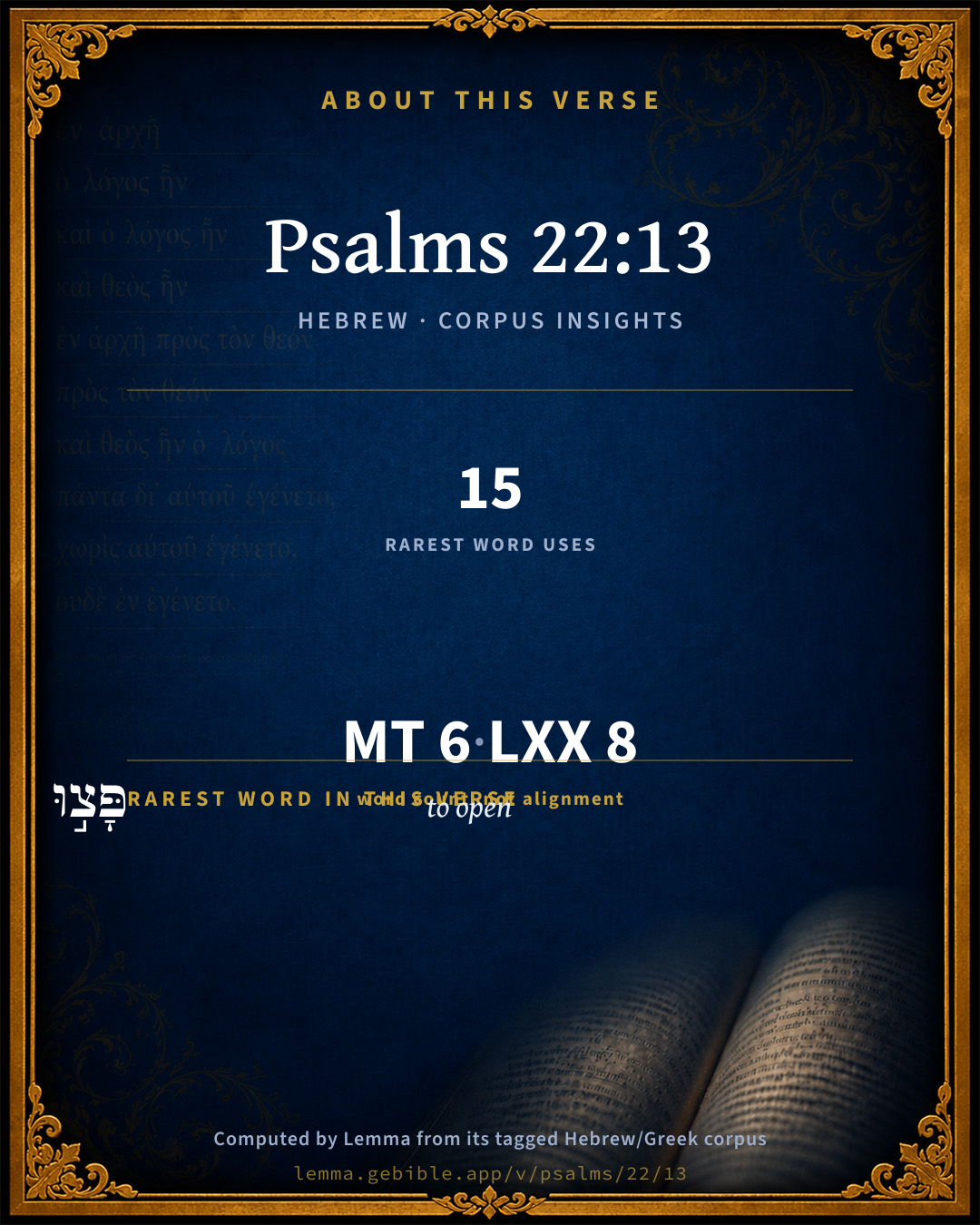
The rarest word here is פָּצ֣וּ to open H6475 — appearing just 15 times in the whole Hebrew Bible.

Shared distinctive vocabulary

פָּצ֣וּ to open H6475 occurs in 15 verses of the Hebrew Bible. Also found in:

Grammatical profile

  • 3 verbs
  • 2 nouns
  • 1 preposition

Verb forms

  • פָּצ֣וּ Qal · Perfect
  • טֹרֵ֥ף Qal · Participle Active
  • וְשֹׁאֵֽג Qal · Participle Active

Hebrew & Septuagint length

In English translation the verse runs 12 words from the Hebrew and 13 from the Septuagint (LXX English) — closely comparable.

A rough comparison of the two English renderings, which tokenize alike — not a word-level alignment.

Word counts can differ between the Hebrew and the Greek without any difference in meaning — e.g. the Hebrew direct-object marker אֵת has no separate Greek word, and Greek often adds the article ὁ.

In the original languages it is 6 Hebrew tokens and 8 Greek tokens — but the two are counted differently (Hebrew bundles its prefixes and suffixes into one token; the Greek is in lemma form), so that isn’t a like-for-like length.

Cross-references

13

Topical passages linked to Psalms 22:13 in the Treasury of Scripture Knowledge — connected by theme and wording, ordered by reader-vote popularity; previews shown in the World English Bible.

  • 1 Peter 5:8 Be sober and self-controlled. Be watchful. Your adversary the devil, walks around like a roaring lion, seeking whom he may devour.
  • Psalms 35:21 Yes, they opened their mouth wide against me. They said, "Aha! Aha! Our eye has seen it!"
  • Job 16:10 They have gaped on me with their mouth; They have struck me on the cheek reproachfully. They gather themselves together against me.
  • Psalms 17:12 He is like a lion that is greedy of his prey, As it were a young lion lurking in secret places.
  • Lamentations 2:16 All your enemies have opened their mouth wide against you; They hiss and gnash the teeth; they say, We have swallowed her up; Certainly this is the day that we looked for; we have found, we have seen it.
  • Lamentations 3:46 All our enemies have opened their mouth wide against us.
  • Matthew 26:3–4 Then the chief priests, the scribes, and the elders of the people were gathered together in the court of the high priest, who was called Caiaphas.
  • Matthew 26:59–65 Now the chief priests, the elders, and the whole council sought false testimony against Jesus, that they might put him to death;
  • Psalms 7:2 Lest they tear apart my soul like a lion, Ripping it in pieces, while there is none to deliver.
  • Psalms 22:7 All those who see me mock me. They insult me with their lips. They shake their heads, saying,
  • Psalms 22:21 Save me from the lion's mouth; Yes, from the horns of the wild oxen you have answered me.
  • Psalms 35:17 Lord, how long will you look on? Rescue my soul from their destruction, My precious life from the lions.
  • Ezekiel 22:27–28 Her princes in the midst of it are like wolves ravening the prey, to shed blood, [and] to destroy souls, that they may get dishonest gain.

Cross-references courtesy of OpenBible.info (CC BY 4.0).

Hebrew and Greek witnesses Masoretic Hebrew ↔ Greek Septuagint

The same verse in the two great witnesses to the Old Testament, shown verse-for-verse.

You’re reading Greek Psalm 21 (Hebrew Psalm 22). The Septuagint counts the superscription, so verse numbers can differ from the Hebrew — chapter-level alignment, not verse-by-verse. Numbering follows Rahlfs.

These are two independent witnesses, not word-aligned to each other, and the Septuagint is shown in lemma (dictionary) form.

Hebrew Psalms 22:13 Masoretic · Westminster Leningrad Codex

פָּצ֣וּ עָלַ֣י פִּיהֶ֑ם אַ֝רְיֵ֗ה טֹרֵ֥ף וְשֹׁאֵֽג

They open their mouths wide against me, Lions tearing prey and roaring.

World English Bible · Public Domain

Greek LXX Greek Psalm 21:13 Septuagint · lemma form

περικυκλόω ἐγώ μόσχος πολύς ταῦρος πίων περιἔχω ἐγώ

They have opened their mouth against me, as a ravening and roaring lion.

LXX2012 (modern English Septuagint) · Public Domain

Hebrew: Westminster Leningrad Codex (CC BY 4.0). Greek: Septuagint (public domain); English from LXX2012 (modern English Septuagint) (Public Domain). How the Septuagint differs from the Hebrew →

Commentary

Notes on Psalms 22:13 from classic Christian and Jewish commentators (each source and its license shown beneath its notes). The classic Christian expositions comment on the surrounding passage and are grouped to its opening verse, so a note may address several verses; the Jewish commentaries on the Tanakh (Rashi and others) are per-verse, so they appear only where the commentator wrote on this verse.

Lemma curates 59 commentaries, every one of them public domain or Creative Commons licensed, each selected and text-cleaned for this edition rather than reprinted as found. About our sources →

Trapp's Complete Commentary

John Trapp

Psa 22:13 They gaped upon me [with] their mouths, [as] a ravening and a roaring lion.

Ver. 13. They gaped upon me with their mouths] As if they would have swallowed me up at a bit, like so many lycanthropi, or savage cannibals.

As a ravening and a roaring lion] Rapiens et rugiens leo, licet non sit mos boum rapere, Bulls do not use to raven though they roar (Kimchi); but the malignities of all fierce and fell creatures are to be found in cruel persecutors. Would any man take the Church’s picture? saith Luther; then let him paint a silly poor maid sitting in a wood or wilderness, compassed about with hungry lions, wolves, bulls, boars, and bears, and with all manner of cruel and harmful beasts, and in the midst of a great many furious men, or rather monsters, assaulting her every moment and minute; for this is her condition in the world.

John Trapp, A Commentary or Exposition upon All the Books of the Old and New Testament (1647–1656) — public domain. Text from a community e-Sword module.

J. A. Alexander on Psalms

Joseph Addison Alexander

14. (Psa 22:13). They have opened upon me their mouth, a lion tearing and roaring. The tropical nature of the language is evinced by the entire change of figure in this verse. The same persons who before were bulls of Bashan now appear as a ravening and roaring lion. There is no need of supplying a particle of comparison, the absence of which in both these verses, by substituting metaphor for simile, adds greatly to the life of the description.

Joseph Addison Alexander, The Psalms Translated and Explained (1850) — public domain. Text from a community e-Sword module.

Adam Clarke's Commentary

Verse 13. They gaped upon me] They were fiercely and madly beat on my destruction.

Adam Clarke's Commentary on the Bible (1810–1826) — public domain. Text from a community e-Sword/MySword module.

Ellicott's Commentary for English Readers

(13) Ravening.—Literally, tearing in pieces. (Comp. Lam_2:15-16; Lam_3:10.)

Roaring.—Comp. Amo_3:4.

A Bible Commentary for English Readers, edited by Charles John Ellicott (1878–1897) — public domain. Text from a community e-Sword module.

The Cambridge Bible for Schools and Colleges

gen. ed. J. J. S. Perowne

13. They gaped &c.] R.V., they gape upon me with their mouths (Lam_2:16; Lam_3:46); like a lion roaring as it prepares to spring upon its prey (Psa_7:2).

The Cambridge Bible for Schools and Colleges (gen. ed. J. J. S. Perowne; Cambridge University Press, 1878–1918) — public domain. Text from a community e-Sword module.

John Gill's Exposition

They gaped upon me with their mouths,.... Either by way of derision and contempt, Job 16:10; or belching out blasphemy against him, or rather, with the greatest vehemency, crying out "Crucify him, crucify him", Luk 23:21; and this they did

as a ravening and roaring lion, when it has got its prey and rejoices, Amo 3:4; and being in such hands, and encompassed about with such enemies, as Christ was in the garden, in the high priest's hall, and in Pilate's judgment hall, is a third reason or argument used by him with God his Father, to be near to him and not far from him.

John Gill's Exposition of the Whole Bible (1746–1763) — public domain (CC PDM 1.0). Text via the HelloAO Bible API.

Albert Barnes' Notes on the Bible

They gaped upon me with their mouths - Margin, as in Hebrew, “opened their mouths against me.” That is, they opened their mouths wide as if they would devour me, as a lion does when he seizes upon his prey. In Psa 22:7 they are represented as “opening” the mouth for another purpose - that of derision or scorn; here they are described as if they were fierce and wild beasts ready to fall upon their prey.

As a ravening and roaring lion - The word “ravening” means “voraciously devouring,” and the allusion in the Hebrew word is to the lion as he tears his prey - טרף ṭâraph - rending it in pieces to devour it. All this is designed to denote the greediness with which the enemies of the Redeemer sought his life.

Albert Barnes' Notes on the Bible (1834–1885) — public domain. Text from a community e-Sword/MySword module.

Matthew Poole's English Annotations

Partly to affright me, and principally to tear and devour me, as the following metaphor explains it. Otherwise it might be understood of their crying out with loud and earnest voices, that he might be condemned and put to death.

Matthew Poole's English Annotations on the Holy Bible (1683–1685) — public domain. Text from a community e-Sword/MySword module.

The Treasury of David

Charles H. Spurgeon

Ver. 13. They gaped upon me with their mouths, as a ravening and a roaring lion. Like hungry cannibals they opened their blasphemous mouths as if they were about to swallow the man whom they abhorred. They could not vomit forth their anger fast enough through the ordinary aperture of their mouths, and therefore set the doors of their lips wide open like those who gape. Like roaring lions they howled out their fury, and longed to tear the Saviour in pieces, as wild beasts raven over their prey. Our Lord's faith must have passed through a most severe conflict while he found himself abandoned to the tender mercies of the wicked, but he came off victorious by prayer; the very dangers to which he was exposed being used to add prevalence to his entreaties.

Ver. 13. A helpless infant, or a harmless lamb, surrounded by furious bulls, and hungry lions, aptly represented the Saviour encompassed by his insulting and bloody persecutors. Thomas Scott, 1747-1821.

Charles H. Spurgeon's The Treasury of David (1869–1885) — public domain. Psalms only. Text from a community e-Sword/MySword module.

Whedon's Commentary on the Bible

Daniel D. Whedon

13. They gaped upon—This was not in scorn, like the shooting “out the lip” of Psa_22:7; but an act simply of brutal ferocity, the parallel to which is the rending and roaring lion of the next line.

Daniel D. Whedon (gen. ed.), Commentary on the Old and New Testaments (1874–1909) — public domain. Text from a community e-Sword module.

The Pulpit Commentary

They gaped upon me with their mouths. One metaphor is superseded by another. Fierce and threatening as bulls, the adversaries are ravenous as lions. They "gape with their mouths," eager to devour, ready to spring on the prey and crush it in their monstrous jaws. As a ravening and a roaring lion. The tumult and noise made by those who demanded our Lord"s death are noted by the evangelist, perisswv ekrazon yorubov ginetai . (Mat_27:23, Mat_27:24)

The Pulpit Commentary (1880–1919), ed. H.D.M. Spence-Jones & Joseph S. Exell — public domain. Text from a community e-Sword module.

Rashi

Rabbi Shlomo Yitzchaki (Rashi)

Great bulls Mighty kingdoms.

the mighty ones of Bashan That too is an expression of the bulls of Bashan, which are fat.

encompassed me Heb. כתרוני. They encompassed me like a crown (כתר), which encompasses the head.

Rashi on the Tanakh — English translations: “The Judaica Press complete Tanach with Rashi, translated by A. J. Rosenberg” (CC BY 4.0); “Pentateuch with Rashi's commentary by M. Rosenbaum and A.M. Silbermann, 1929-1934” (public domain); “The Metsudah Tanach series, Lakewood, N.J” (CC BY 4.0); and “The Book of Joshua, Metsudah Publications, 1997” (CC BY 4.0). Text via Sefaria.

Radak

Rabbi David Kimhi (Radak)

Bulls have surrounded me: – This is the trouble that is near at hand, that bulls have compassed me – a figure for lusty and powerful and wicked enemies. The interpretation of (רבים is)

mighty (ones): – that is, great in strength. So also

strong ones of Bashan: – Bashan is a district in the land of Israel, a district of fat and rich pasture, and the cattle that feed there are fat and strong. He compares the wicked enemies with them. And so it says (Amos 4:1) in a figure “kine of Bashan” with reference to the women who oppress the poor, who crush the needy.

have beset me around (כתרוני): – equivalent to have surrounded me; just as the crown (כתר) surrounds (encircles) the head. And so we have (Judges 20:43): “they beset (כתרו) Benjamin around.”

Radak on the Tanakh — English translations: “Sefaria Community Translation” (CC0 1.0 (public-domain dedication)); “Eliyahu Munk, HaChut Hameshulash” (CC BY 4.0); “Rabbi Mike Feuer, Jerusalem Anthology” (CC BY 4.0); and “R. David Kimhi on the first book of Psalms, Translated by R.G. Finch, London, 1919” (public domain). Text via Sefaria.

Lesson kit

Teaching starters — assembled from the data on this page, not authored interpretation. Every prompt links to the verse data it draws on. Edit before teaching.

Psalms, in the Wisdom, opens this verse with 6 words (6 distinct Hebrew lemmas). Its most distinctive word is pâtsâh (“to open”). A historical commentator’s framing appears above. Read the whole chapter for the surrounding context.

Discussion questions

  1. What does “to open” (pâtsâh) contribute to the verse as a whole?
  2. Genesis 4:11 shares the word «to open» with this verse. How do the two illuminate each other?
  3. The translations on this page render this verse differently — a whole-verse word diff, not a word-by-word alignment. What might account for the different wordings?
  4. The verb «פָּצ֣וּ» is Qal Perfect. How does its form color the action?
  5. Reading how Trapp's Complete Commentary and J. A. Alexander on Psalms read this verse, where do the two commentators agree and where do they part?

Things to notice

Reading settings

Reading text

Shown beneath each verse's original-language words.

Old Testament
Old Testament edition

Read the OT as the Masoretic Hebrew (MT) or the Greek Septuagint (LXX).

English shown for the Greek Septuagint (in the Hebrew ↔ Greek comparison).

Comparing translations? Open the Compare panel on any verse page to stack up to four side by side.