
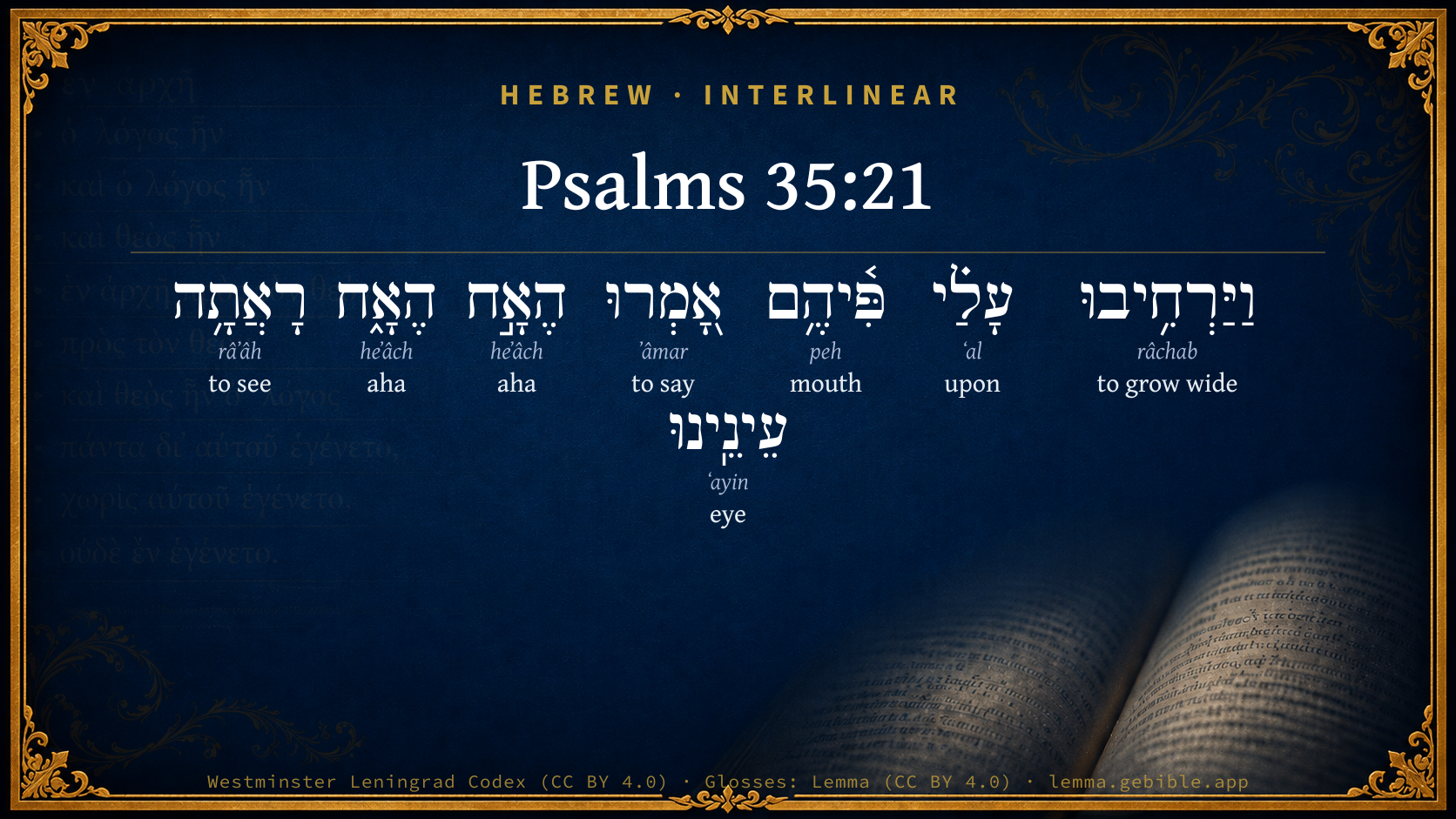
Psalms 35:21

Hebrew (Westminster Leningrad Codex) Psalms 35:21 appears in the Hebrew Old Testament. The text above is from the Westminster Leningrad Codex. Each word links to its Strong’s number, a concise gloss, and parsing drawn from the Open Scriptures Hebrew Bible morphology. Click any word for its full Brown-Driver-Briggs (BDB) entry.
Download image
Cite this verse

Psalms 35:21 (World English Bible). Public Domain. Lemma interlinear Bible study tool, https://lemma.gebible.app/v/psalms/35/21.

Show BibTeX & RIS
BibTeX
RIS
English Translation
Yes, they opened their mouth wide against me. They said, "Aha! Aha! Our eye has seen it!"
World English Bible · Public Domain
Download a study sheet

One document with this verse’s original text, its word-by-word gloss line, the meaning frame, cross-references with their text, attributed commentary, and full source and license credits — printable, and it pastes into notes with its structure intact.

This verse Autodidact and up

Study sheet (.html) Plain text (.txt)

A passage Seminary Student

Up to 50 verses in one chapter. A passage sheet keeps up to 6 commentary sources and 12 cross-references per verse, in the order this page ranks them, and says so on the sheet whenever that leaves anything out. Ask for a single verse and you get the Autodidact verse sheet above.

Everything on this page stays free to read, with no account — the sheet is a download of what is already on screen, not access to it.

Want to remove ads? Support Godless Engineer
Compare translations 3

The same verse in 3 English versions, stacked beneath the original-language interlinear above. Click any original word for its lexicon entry.

Each is an independent rendering of the whole verse — the interlinear is not word-aligned to these translations.

Highlighted words mark where these versions differ — a whole-verse word diff, not a word-by-word alignment.

  • World English Bible Public Domain
    Yes, they opened their mouth wide against me. They said, "Aha! Aha! Our eye has seen it!"
  • King James Version Public Domain
    Yea, they opened their mouth wide against me, and said, Aha, aha, our eye hath seen it.
  • unfoldingWord Literal Text CC BY-SA 4.0
    They open their mouth wide against me; they say, “Aha, Aha, our eyes have seen.”

unfoldingWord Literal Text — © unfoldingWord, licensed CC BY-SA 4.0. Word-aligned USFM3 via Door43 (git.door43.org/unfoldingWord/en_ult).

Versions to compare (up to 4)

3 of 4 selected

Show all 18 translations

Every available English version of this verse, each an independent rendering of the whole verse.

  • World English Bible Public Domain
    Yes, they opened their mouth wide against me. They said, "Aha! Aha! Our eye has seen it!"
  • Berean Standard Bible Public Domain
    They gape at me and say, “Aha, aha! Our eyes have seen!”
  • Majority Standard Bible Public Domain
    They gape at me and say, “Aha, aha! Our eyes have seen!”
  • King James Version Public Domain
    Yea, they opened their mouth wide against me, and said, Aha, aha, our eye hath seen it.
  • American Standard Version (1901) Public Domain
    Yea, they opened their mouth wide against me; They said, Aha, aha, our eye hath seen it.
  • Revised Version (1885) Public Domain
    Yea, they opened their mouth wide against me; they said, Aha, aha, our eye hath seen it.
  • Geneva Bible (1599) Public Domain
    And they gaped on mee with their mouthes, saying, Aha, aha, our eye hath seene.
  • Douay-Rheims (1899) Public Domain
    And they opened their mouth wide against me; they said: Well done, well done, our eyes have seen it.
  • Young's Literal Translation Public Domain
    And they enlarge against me their mouth, They said, `Aha, aha, our eye hath seen.'
  • Literal Standard Version CC BY-SA 4.0
    And they enlarge their mouth against me, || They said, “Aha, aha, our eye has seen.”
  • Unlocked Literal Bible CC BY-SA 4.0
    They open their mouths wide against me; they said, “Aha, Aha, our eyes have seen it.”
  • unfoldingWord Literal Text CC BY-SA 4.0
    They open their mouth wide against me; they say, “Aha, Aha, our eyes have seen.”
  • Darby Bible Public Domain
    And they opened their mouth wide against me; they said, Aha! aha! our eye hath seen [it].
  • World Messianic Bible Public Domain
    Yes, they opened their mouth wide against me. They said, “Aha! Aha! Our eye has seen it!”
  • Webster's Bible Public Domain
    Yes, they opened their mouth wide against me, and said, Aha, aha, our eye hath seen it.
  • Free Bible Version CC BY-SA 4.0
    They open their mouths wide to make accusations against me, saying, “Look! Look! We saw it with our own eyes!”
  • Bible in Basic English Public Domain
    Their mouths were open wide against me, and they said, Aha, aha, our eyes have seen it.
  • JPS Tanakh (1917) Public Domain
    Yea, they open their mouth wide against me; they say: 'Aha, aha, our eye hath seen it.'

Literal Standard Version (2020), Covenant Press — licensed CC BY-SA 4.0. Text via the HelloAO Bible API (eBible.org). Unlocked Literal Bible (unfoldingWord) — licensed CC BY-SA 4.0. Text via the HelloAO Bible API (eBible.org). unfoldingWord Literal Text — © unfoldingWord, licensed CC BY-SA 4.0. Word-aligned USFM3 via Door43 (git.door43.org/unfoldingWord/en_ult). Free Bible Version, Dr. Jonathan Gallagher — licensed CC BY-SA 4.0. Text via the HelloAO Bible API (eBible.org).

Word by word

More ways to search: Search by grammar → Find every occurrence → Compare this word →

Practice this passage: Drill this verse → Learn its vocabulary →

About this verse

These counts appear in no published source. They are computed here, from the morphology-tagged text and Lemma’s own curated glosses. What Lemma adds →

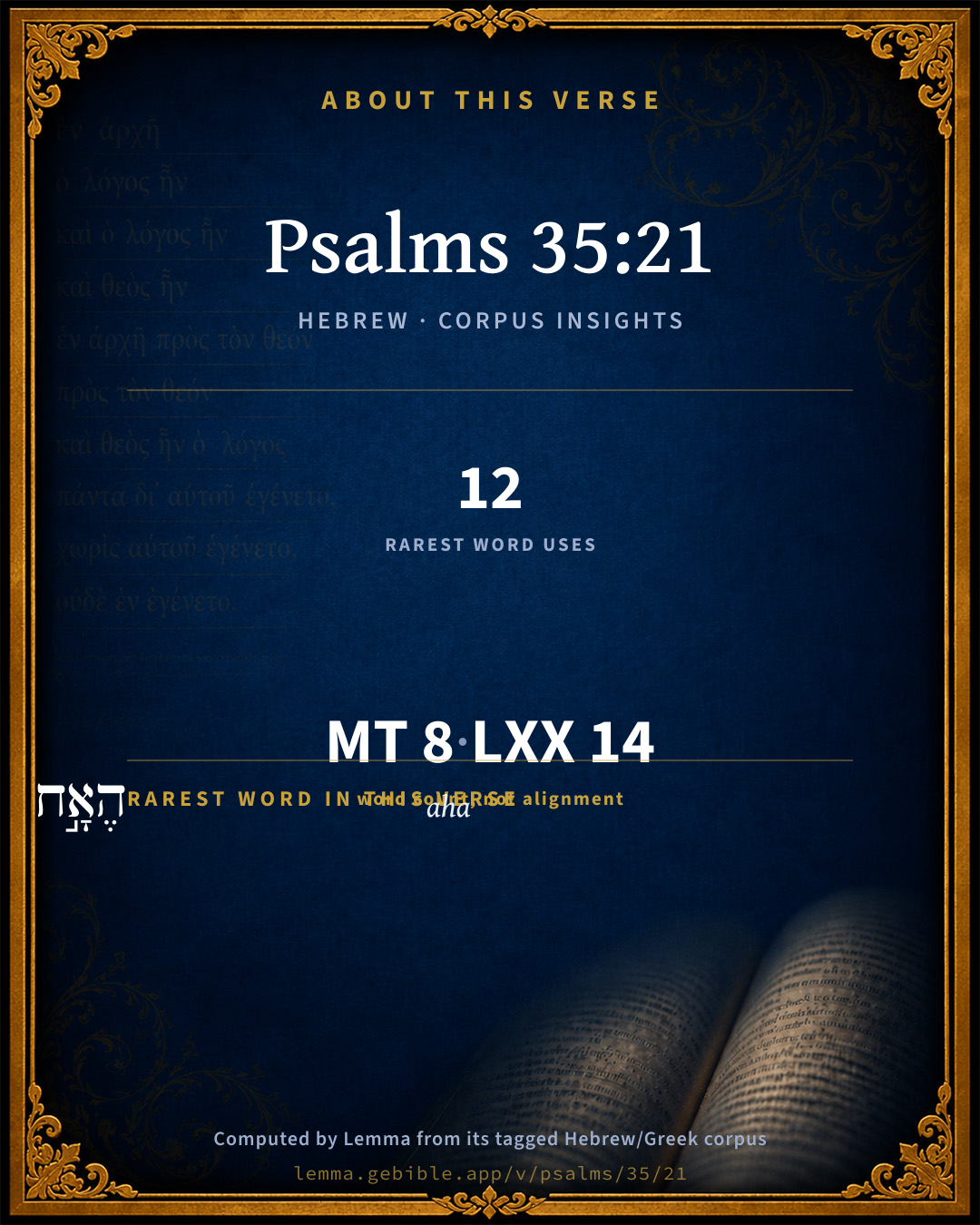
8
words
7
distinct lemmas
Wisdom
section

Notable vocabulary

The rarest word here is הֶאָ֣ח aha H1889 — appearing just 12 times in the whole Hebrew Bible.

Shared distinctive vocabulary

הֶאָ֣ח aha H1889 occurs in 9 verses of the Hebrew Bible. Also found in:

Grammatical profile

  • 3 verbs
  • 2 nouns
  • 1 preposition
  • 2 particles

Verb forms

  • וַיַּרְחִ֥יבוּ Hiphil · Sequential Imperfect
  • אָ֭מְרוּ Qal · Perfect
  • רָאֲתָ֥ה Qal · Perfect

Repetition

A word recurs within this verse — often emphatic in Hebrew:

  • הֶאָ֣ח aha H1889 ×2

Hebrew & Septuagint length

In English translation the verse runs 17 words from the Hebrew and 17 from the Septuagint (LXX English) — the same length.

A rough comparison of the two English renderings, which tokenize alike — not a word-level alignment.

Word counts can differ between the Hebrew and the Greek without any difference in meaning — e.g. the Hebrew direct-object marker אֵת has no separate Greek word, and Greek often adds the article ὁ.

In the original languages it is 8 Hebrew tokens and 14 Greek tokens — but the two are counted differently (Hebrew bundles its prefixes and suffixes into one token; the Greek is in lemma form), so that isn’t a like-for-like length.

Cross-references

6

Topical passages linked to Psalms 35:21 in the Treasury of Scripture Knowledge — connected by theme and wording, ordered by reader-vote popularity; previews shown in the World English Bible.

  • Psalms 22:13 They open their mouths wide against me, Lions tearing prey and roaring.
  • Psalms 40:15 Let them be desolate by reason of their shame that tell me, "Aha! Aha!"
  • Luke 11:53–54 As he said these things to them, the scribes and the Pharisees began to be terribly angry, and to draw many things out of him;
  • Psalms 70:3 Let them be turned because of their shame Who say, "Aha! Aha!"
  • Psalms 54:7 For he has delivered me out of all trouble. My eye has seen triumph over my enemies.
  • Isaiah 9:12 the Syrians before, and the Philistines behind; and they shall devour Israel with open mouth. For all this his anger is not turned away, but his hand is stretched out still.

Cross-references courtesy of OpenBible.info (CC BY 4.0).

Hebrew and Greek witnesses Masoretic Hebrew ↔ Greek Septuagint

The same verse in the two great witnesses to the Old Testament, shown verse-for-verse.

You’re reading Greek Psalm 34 (Hebrew Psalm 35). The Septuagint counts the superscription, so verse numbers can differ from the Hebrew — chapter-level alignment, not verse-by-verse. Numbering follows Rahlfs.

These are two independent witnesses, not word-aligned to each other, and the Septuagint is shown in lemma (dictionary) form.

Hebrew Psalms 35:21 Masoretic · Westminster Leningrad Codex

וַיַּרְחִ֥יבוּ עָלַ֗י פִּ֫יהֶ֥ם אָ֭מְרוּ הֶאָ֣ח הֶאָ֑ח רָאֲתָ֥ה עֵינֵֽינוּ

Yes, they opened their mouth wide against me. They said, "Aha! Aha! Our eye has seen it!"

World English Bible · Public Domain

Greek LXX Greek Psalm 34:21 Septuagint · lemma form

καί πλατύνω ἐπί ἐγώ ὁ στόμα αὐτός εἶπον εὖγε εὖγε ὁράω ὁ ὀφθαλμός ἐγώ

And they opened wide their mouth upon me; they said Aha, aha, our eyes have seen it.

LXX2012 (modern English Septuagint) · Public Domain

Hebrew: Westminster Leningrad Codex (CC BY 4.0). Greek: Septuagint (public domain); English from LXX2012 (modern English Septuagint) (Public Domain). How the Septuagint differs from the Hebrew →

Commentary

Notes on Psalms 35:21 from classic Christian and Jewish commentators (each source and its license shown beneath its notes). The classic Christian expositions comment on the surrounding passage and are grouped to its opening verse, so a note may address several verses; the Jewish commentaries on the Tanakh (Rashi and others) are per-verse, so they appear only where the commentator wrote on this verse.

Lemma curates 59 commentaries, every one of them public domain or Creative Commons licensed, each selected and text-cleaned for this edition rather than reprinted as found. About our sources →

Trapp's Complete Commentary

John Trapp

Psa 35:21 Yea, they opened their mouth wide against me, [and] said, Aha, aha, our eye hath seen [it].

Ver. 21. They opened their mouth] As if the very banks of blasphemy had been broken down.

Our eye hath seen] Eye for eyes, unless we would say that all the wicked are so conjoined, that they may seem to have but one eye, heart, head, &c., and then they say, as Hannibal did, when he saw a ditch full of man’s blood, O formosum spectaculum! O gallant sight! O rem regiam! as Valesus said, when he had slain three hundred Protestants.

John Trapp, A Commentary or Exposition upon All the Books of the Old and New Testament (1647–1656) — public domain. Text from a community e-Sword module.

J. A. Alexander on Psalms

Joseph Addison Alexander

21. (Psa 35:21) And have widened against me their mouth; they have said, Aha, aha, our eye has seen. "They have mocked at my distress with contemptuous grimaces, and rejoiced in the fulfilment of their spiteful wishes." With the first clause compare Psa 22:8 (7) above. The Hebrew interjection in the last clause seems to be a natural expression of joyful surprise. Their success was almost too great to be real, yet attested by their senses. The verse ends with a kind of aposiopesis: "our own eyes have seen"—what we could not have believed on the report of another, to wit, the gratification of our warmest wishes. See below, Psa 35:25.

Joseph Addison Alexander, The Psalms Translated and Explained (1850) — public domain. Text from a community e-Sword module.

Tyndale Open Study Notes

Tyndale Open Resources

35:21, 25 Aha! . . . Look: Both words translate the same expression of glee (Hebrew he’akh).

Tyndale Open Study Notes — © Tyndale Open Resources, licensed CC BY-SA 4.0. Text via the HelloAO Bible API.

Geneva Bible (1599)

Geneva Bible translators

They rejoiced as though they had now seen David overthrown.

Geneva Bible (1599) marginal notes — public domain. Text via Bolls.life.

Jamieson, Fausset & Brown

Robert Jamieson, A. R. Fausset & David Brown

On the gesture compare Psa 22:7; and on the expressions of malicious triumph, compare Psa 10:13; Psa 28:3.

Jamieson, Fausset & Brown — Commentary Critical and Explanatory on the Whole Bible (1871) — public domain (CC PDM 1.0). Text via the HelloAO Bible API.

Adam Clarke's Commentary

Verse 21. They opened their mouth wide] Gaped upon me to express their contempt.

And said, Aha, aha, our eye hath seen it.] They said, האח האח heach, heach, the last syllable in each word being a protracted strongly guttural sound, marking insult and triumph at the same time. It is the word which we translate Ah, Ps 35:25.

Adam Clarke's Commentary on the Bible (1810–1826) — public domain. Text from a community e-Sword/MySword module.

The Cambridge Bible for Schools and Colleges

gen. ed. J. J. S. Perowne

21. And they open … a gesture of contempt (Isa_57:4), rather than of murderous intent (Psa_35:25): they say, Aha, aha, our eye hath seen: seen its desire, seen the fall of the man whose rise excited our envy.

The Cambridge Bible for Schools and Colleges (gen. ed. J. J. S. Perowne; Cambridge University Press, 1878–1918) — public domain. Text from a community e-Sword module.

John Gill's Exposition

Yea, they opened their mouth wide against me,.... In laughter, scorn, and derision; see Psa 22:7;

and said, Aha, aha: a word expressive of joy; and the doubling it shows the greatness of it;

our eye hath seen it; what their heart wished for; namely, the distress of him, whose enemies they were.

John Gill's Exposition of the Whole Bible (1746–1763) — public domain (CC PDM 1.0). Text via the HelloAO Bible API.

Albert Barnes' Notes on the Bible

Yea, they opened their mouth wide against me - See the notes at Psa 22:13.

And said, Aha, aha! - See Psa 40:15; Psa 70:3. The language is that which we use when we “detect” another in doing wrong - in doing what he meant to conceal.

Our eye hath seen it - We are not dependent on the reports of others. We have seen it with our own eyes. We have found you out. We cannot be mistaken in regard to it. The reference is to some supposed “detection” of misconduct on the part of David, and the joy and triumph of such a supposed detection.

Albert Barnes' Notes on the Bible (1834–1885) — public domain. Text from a community e-Sword/MySword module.

Matthew Poole's English Annotations

They opened their mouth wide against me; either,

1. To devour me. It is a metaphor taken from wild beasts, when they come within reach of their prey. Or;

2. To pour forth whole floods of scoffs, and slanders, and contumelies. Aha, aha; an expression of joy and triumph. See Poole "Job 39:25; Psa 40:15". Hath seen it, Heb. hath seen, to wit, what we have long desired and hoped for. See the same or like ellipsis Psa 54:7; 59:10; 112:8.

Matthew Poole's English Annotations on the Holy Bible (1683–1685) — public domain. Text from a community e-Sword/MySword module.

The Treasury of David

Charles H. Spurgeon

Verse 21. ["Yea, they opened their mouth wide against me."] As if they would swallow him. Uttering great lies which needed wide mouths. They set no bounds to their infamous charges, but poured out wholesale abuse, trusting that if all did not stick, some of it would. ["And said, Aha, aha, our eye hath seen it."] Glad to find out a fault or a misfortune, or to swear they had seen evil where there was none. Malice has but one eye; it is blind to all virtue in its enemy. Eyes can generally see what hearts wish. A man with a mote in his eye sees a spot in the sun. How like a man is to an ass when he brays over another's misfortunes! how like to a devil when he laughs a hyna-laugh over a good man's slip! Malice is folly, and when it holds a festival its tones and gestures far exceed all the freaks and mummeries of the lord of misrule.

[Verse] 21. ["Our eye hath seen."] [Eye] for [eyes], unless we would say that all the wicked are so conjoined, that they may seem to have but one eye, heart, head. [John Trapp.]

[Verse] 21. Yet, O ye saints, divulge not these things to wicked men; whisper them softly one to another, with fear and trembling, lest some profane wretch or other overhear you, and take that for encouragement that was only meant for caution. What is more common than for the vilest sinners to plead for their excuse, or warrant rather, the foul miscarriages of God's dearest saints? Thus the drunkard looks upon holy Noah as a pot-companion, whereby he discovers his nakedness in a worse sense than ever Cham did; and thus the unclean sensualist quotes David, and calls him in to be the patron of his debauchery. Certainly, if their be any grief that can overcast the perfect joys of the saints in heaven, it is that their names and examples should, to the great dishonour of God, be produced by wicked and sinful men, to countenance their grossest sins and wickednesses. But let such know, that God hath set up these in his church to be monuments of his mercy, to declare to humble and penitent sinners how great sins he can pardon; yet if any hereupon embolden themselves in sin, instead of being set up as monuments of mercy, God will set them up as pillars of salt. [Ezekiel Hopkins (Bishop).]

[Verse] 21. He who rejoices in another's fall rejoices in the devil's victory. [Ambrose, quoted in Nichol's Proverbs.]

[Verses] 21, 22: ---

They gape and drawe their mouthes in scornful wise.

And crie, fie, fie, wee sawe it with our eyes.

But thou their deed, (O Lord!) dost also see;

Then bee not silent soe, nor farr from mee.

None.

Charles H. Spurgeon's The Treasury of David (1869–1885) — public domain. Psalms only. Text from a community e-Sword/MySword module.

Whedon's Commentary on the Bible

Daniel D. Whedon

21. Aha, aha—An expression of joyful surprise.

Our eye hath seen it— “What we could not have believed on the testimony of another our eyes now see.”—Alexander. Compare this with the trial of our Lord, and Psa_22:7; Mat_27:39

Daniel D. Whedon (gen. ed.), Commentary on the Old and New Testaments (1874–1909) — public domain. Text from a community e-Sword module.

The Pulpit Commentary

Yea, they opened their mouth wide against me, and said, Aha, aha! our eye hath seen it. They "opened their mouth wide" in scornful derision; and shouted triumphantly, "Ha, ha! our eye hath seen his downfall!"

The Pulpit Commentary (1880–1919), ed. H.D.M. Spence-Jones & Joseph S. Exell — public domain. Text from a community e-Sword module.

John Wesley's Explanatory Notes

Wide - To pour forth whole floods of scoffs and slanders. \Aha - An expression of joy and triumph. Our eye - What we have long desired and hoped for.

John Wesley, Explanatory Notes Upon the Whole Bible (1754–1765) — public domain. Text via the GEBible commentary corpus.

unfoldingWord translationNotes

Door43 World Missions Community

They open their mouths wide against me

The reason they open their mouths is to accuse the writer. AT: "They shout at me in order to accuse me" (See: Assumed Knowledge and Implicit Information)

Aha, Aha

This is an exclamation that is used when something is suddenly seen or understood. It emphasizes the statement that follows. (See: Exclamations)

our eyes have seen it

Here "our eyes" refers to the enemies' eyes. It is implied that they are saying they saw the writer do something wrong. AT: "we have seen it" or "we saw the wrong things that you did" (See: Synecdoche and Assumed Knowledge and Implicit Information)

You have seen it

Here "it" refers to the false accusations of the writer's enemies. AT: "You have seen how they falsely accused me" (See: Assumed Knowledge and Implicit Information)

do not be silent

"do not ignore what they did" This can be stated in positive form. AT: "judge them because of what they did" (See: Litotes)

do not be far from me

This can be stated in positive form. AT: "be very close to me" (See: Litotes)

Arouse yourself and awake

This does not mean that God is actually asleep. The writer wants God to intervene. Both words mean basically the same thing and emphasize the urgency of this request. AT: "I feel like you are sleeping! Wake up" (See: Metaphor and Doublet)

to my defense

This abstract noun "defense" can be stated as "defend." AT: "to defend me" (See: Abstract Nouns)

my cause

This refers to the writer. AT: "me" (See: Metonymy)

translationWords

Yahweh

lord

God

unfoldingWord translationNotes — © Distant Shores Media and the Door43 World Missions Community, licensed CC BY-SA 4.0. Source: git.door43.org/Door43/en_tn.

Rashi

Rabbi Shlomo Yitzchaki (Rashi)

Aha! Aha! Heb. האח, an expression of joy of one who boasts with the lust of his heart, out of their [sic] great joy, that they see their lust gratified.

Rashi on the Tanakh — English translations: “The Judaica Press complete Tanach with Rashi, translated by A. J. Rosenberg” (CC BY 4.0); “Pentateuch with Rashi's commentary by M. Rosenbaum and A.M. Silbermann, 1929-1934” (public domain); “The Metsudah Tanach series, Lakewood, N.J” (CC BY 4.0); and “The Book of Joshua, Metsudah Publications, 1997” (CC BY 4.0). Text via Sefaria.

Lesson kit

Teaching starters — assembled from the data on this page, not authored interpretation. Every prompt links to the verse data it draws on. Edit before teaching.

Psalms, in the Wisdom, opens this verse with 8 words (7 distinct Hebrew lemmas). Its most distinctive word is heʼâch (“aha”). A historical commentator’s framing appears above. Read the whole chapter for the surrounding context.

Discussion questions

  1. The word heʼâch carries the sense “aha.” How does it shape the verse?
  2. How does Job 39:25, which shares the word «aha», read alongside this verse?
  3. What does the repetition of “aha” (2× in this one verse) do in this verse?
  4. These translations render this verse differently; the difference is in the English rendering, not the original. What questions does that raise?
  5. «וַיַּרְחִ֥יבוּ» is a Hiphil Sequential Imperfect verb. How does that grammatical form shape the action described?
  6. Compare how Trapp's Complete Commentary and J. A. Alexander on Psalms read this verse. Where do they agree or differ?

Things to notice

Reading settings

Reading text

Shown beneath each verse's original-language words.

Old Testament
Old Testament edition

Read the OT as the Masoretic Hebrew (MT) or the Greek Septuagint (LXX).

English shown for the Greek Septuagint (in the Hebrew ↔ Greek comparison).

Comparing translations? Open the Compare panel on any verse page to stack up to four side by side.