
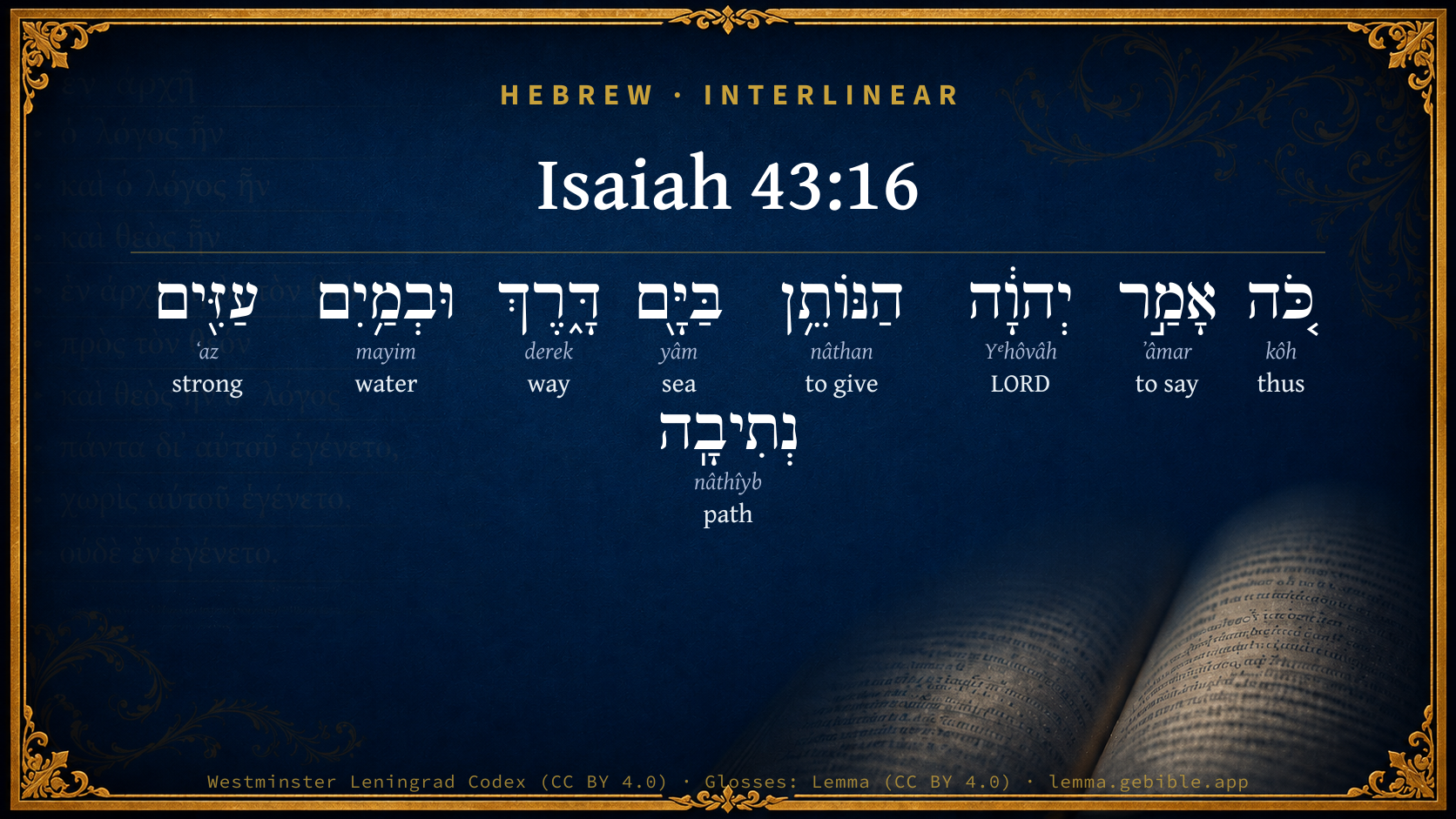
Isaiah 43:16

Hebrew (Westminster Leningrad Codex) Isaiah 43:16 appears in the Hebrew Old Testament. The text above is from the Westminster Leningrad Codex. Each word links to its Strong’s number, a concise gloss, and parsing drawn from the Open Scriptures Hebrew Bible morphology. Click any word for its full Brown-Driver-Briggs (BDB) entry.
Download image
Cite this verse

Isaiah 43:16 (World English Bible). Public Domain. Lemma interlinear Bible study tool, https://lemma.gebible.app/v/isaiah/43/16.

Show BibTeX & RIS
BibTeX
RIS
English Translation
Thus says Yahweh, who makes a way in the sea, and a path in the mighty waters;
World English Bible · Public Domain
Download a study sheet

One document with this verse’s original text, its word-by-word gloss line, the meaning frame, cross-references with their text, attributed commentary, and full source and license credits — printable, and it pastes into notes with its structure intact.

This verse Autodidact and up

Study sheet (.html) Plain text (.txt)

A passage Seminary Student

Up to 50 verses in one chapter. A passage sheet keeps up to 6 commentary sources and 12 cross-references per verse, in the order this page ranks them, and says so on the sheet whenever that leaves anything out. Ask for a single verse and you get the Autodidact verse sheet above.

Everything on this page stays free to read, with no account — the sheet is a download of what is already on screen, not access to it.

Want to remove ads? Support Godless Engineer
Compare translations 3

The same verse in 3 English versions, stacked beneath the original-language interlinear above. Click any original word for its lexicon entry.

Each is an independent rendering of the whole verse — the interlinear is not word-aligned to these translations.

Highlighted words mark where these versions differ — a whole-verse word diff, not a word-by-word alignment.

  • World English Bible Public Domain
    Thus says Yahweh, who makes a way in the sea, and a path in the mighty waters;
  • King James Version Public Domain
    Thus saith the LORD, which maketh a way in the sea, and a path in the mighty waters;
  • unfoldingWord Literal Text CC BY-SA 4.0
    Thus says Yahweh, the one having made a way in the sea and a path in the mighty waters,

unfoldingWord Literal Text — © unfoldingWord, licensed CC BY-SA 4.0. Word-aligned USFM3 via Door43 (git.door43.org/unfoldingWord/en_ult).

Versions to compare (up to 4)

3 of 4 selected

Show all 18 translations

Every available English version of this verse, each an independent rendering of the whole verse.

  • World English Bible Public Domain
    Thus says Yahweh, who makes a way in the sea, and a path in the mighty waters;
  • Berean Standard Bible Public Domain
    Thus says the LORD, who makes a way in the sea and a path through the surging waters,
  • Majority Standard Bible Public Domain
    Thus says the LORD, who makes a way in the sea and a path through the surging waters,
  • King James Version Public Domain
    Thus saith the LORD, which maketh a way in the sea, and a path in the mighty waters;
  • American Standard Version (1901) Public Domain
    Thus saith Jehovah, who maketh a way in the sea, and a path in the mighty waters;
  • Revised Version (1885) Public Domain
    Thus saith the LORD, which maketh a way in the sea, and a path in the mighty waters;
  • Geneva Bible (1599) Public Domain
    Thus sayeth the Lord which maketh a way in the Sea, and a path in the mighty waters.
  • Douay-Rheims (1899) Public Domain
    Thus saith the Lord, who made a way in the sea, and a path in the mighty waters.
  • Young's Literal Translation Public Domain
    Thus said Jehovah, Who is giving in the sea a way, And in the strong waters a path.
  • Literal Standard Version CC BY-SA 4.0
    Thus said YHWH, || Who is giving a way in the sea, || And a path in the strong waters.
  • Unlocked Literal Bible CC BY-SA 4.0
    This is what Yahweh says (who opened a way through the sea and a path in the mighty waters,
  • unfoldingWord Literal Text CC BY-SA 4.0
    Thus says Yahweh, the one having made a way in the sea and a path in the mighty waters,
  • Darby Bible Public Domain
    Thus saith Jehovah, who maketh a way in the sea, and a path in the mighty waters,
  • World Messianic Bible Public Domain
    The LORD, who makes a way in the sea, and a path in the mighty waters,
  • Webster's Bible Public Domain
    Thus saith the LORD, who maketh a way in the sea, and a path in the mighty waters;
  • Free Bible Version CC BY-SA 4.0
    This is what the Lord says, the one who makes a way through the sea, a path through the mighty waters;
  • Bible in Basic English Public Domain
    This is the word of the Lord, who makes a way in the sea, and a road through the deep waters;
  • JPS Tanakh (1917) Public Domain
    Thus saith the LORD, who maketh a way in the sea, and a path in the mighty waters;

Literal Standard Version (2020), Covenant Press — licensed CC BY-SA 4.0. Text via the HelloAO Bible API (eBible.org). Unlocked Literal Bible (unfoldingWord) — licensed CC BY-SA 4.0. Text via the HelloAO Bible API (eBible.org). unfoldingWord Literal Text — © unfoldingWord, licensed CC BY-SA 4.0. Word-aligned USFM3 via Door43 (git.door43.org/unfoldingWord/en_ult). Free Bible Version, Dr. Jonathan Gallagher — licensed CC BY-SA 4.0. Text via the HelloAO Bible API (eBible.org).

Word by word

More ways to search: Search by grammar → Find every occurrence → Compare this word →

Practice this passage: Drill this verse → Learn its vocabulary →

About this verse

These counts appear in no published source. They are computed here, from the morphology-tagged text and Lemma’s own curated glosses. What Lemma adds →

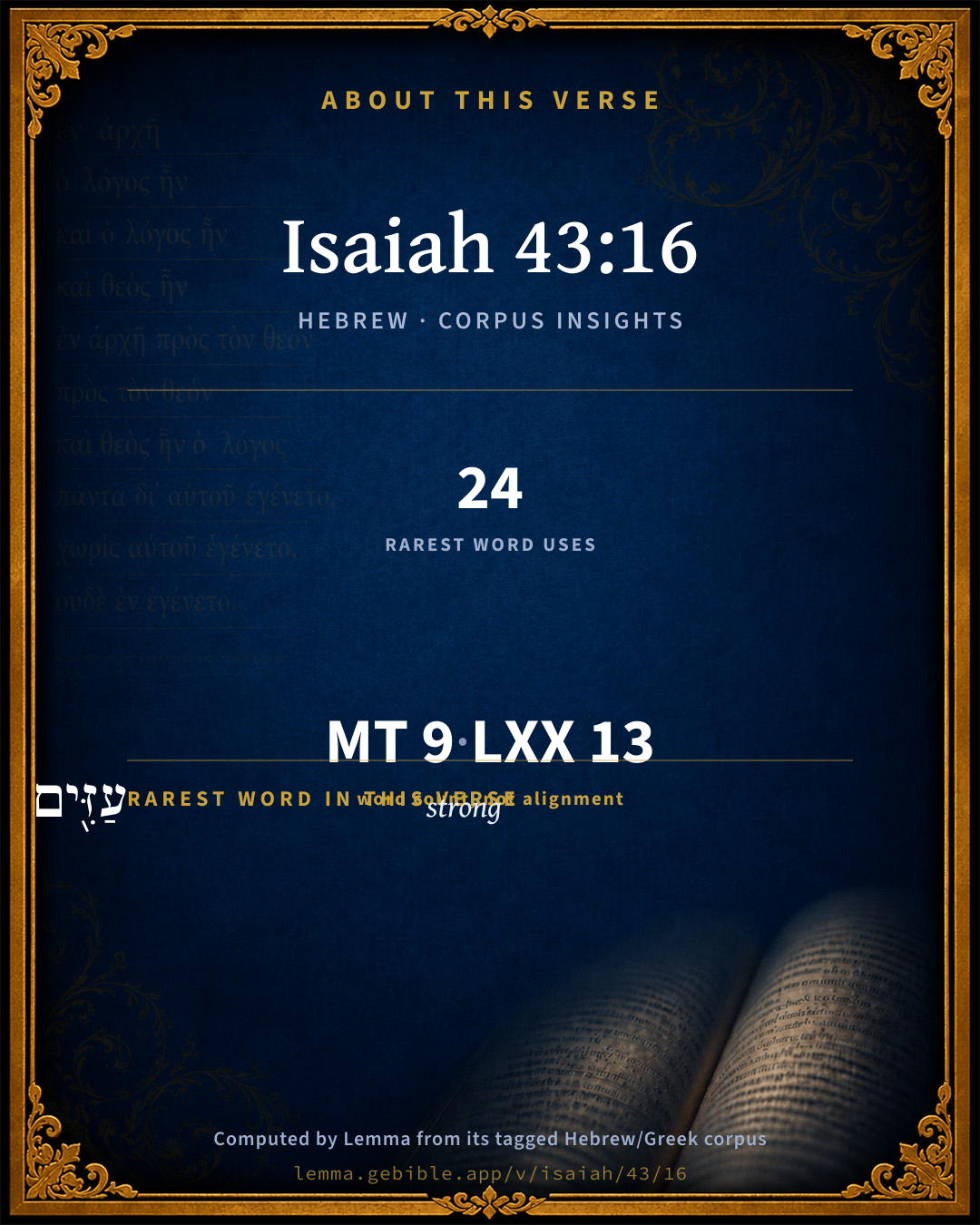
9
words
9
distinct lemmas
Prophets
section

Notable vocabulary

The rarest word here is עַזִּ֖ים strong H5794 — appearing just 24 times in the whole Hebrew Bible.

Shared distinctive vocabulary

עַזִּ֖ים strong H5794 occurs in 24 verses of the Hebrew Bible. Also found in:

Grammatical profile

  • 2 verbs
  • 5 nouns
  • 1 adjective
  • 1 adverb

Verb forms

  • אָמַ֣ר Qal · Perfect
  • הַנּוֹתֵ֥ן Qal · Participle Active

Hebrew & Septuagint length

In English translation the verse runs 17 words from the Hebrew and 18 from the Septuagint (LXX English) — closely comparable.

A rough comparison of the two English renderings, which tokenize alike — not a word-level alignment.

Word counts can differ between the Hebrew and the Greek without any difference in meaning — e.g. the Hebrew direct-object marker אֵת has no separate Greek word, and Greek often adds the article ὁ.

In the original languages it is 9 Hebrew tokens and 13 Greek tokens — but the two are counted differently (Hebrew bundles its prefixes and suffixes into one token; the Greek is in lemma form), so that isn’t a like-for-like length.

Cross-references

18

Topical passages linked to Isaiah 43:16 in the Treasury of Scripture Knowledge — connected by theme and wording, ordered by reader-vote popularity; previews shown in the World English Bible.

  • Psalms 77:19 Your way was through the sea; Your paths through the great waters. Your footsteps were not known.
  • Isaiah 43:2 When you pass through the waters, I will be with you; and through the rivers, they shall not overflow you: when you walk through the fire, you shall not be burned, neither shall the flame kindle on you.
  • Isaiah 51:10 Isn't it you who dried up the sea, the waters of the great deep; who made the depths of the sea a way for the redeemed to pass over?
  • Jeremiah 31:35 Thus says Yahweh, who gives the sun for a light by day, and the ordinances of the moon and of the stars for a light by night, who stirs up the sea, so that the waves of it roar; Yahweh of hosts is his name:
  • Nehemiah 9:11 You divided the sea before them, so that they went through the midst of the sea on the dry land; and their pursuers you did cast into the depths, as a stone into the mighty waters.
  • Psalms 78:13 He split the sea, and caused them to pass through; He made the waters stand as a heap.
  • Psalms 106:9 He rebuked the Red Sea also, and it was dried up; So he led them through the depths, as through a desert.
  • Isaiah 51:15 For I am Yahweh your God, who stirs up the sea, so that the waves of it roar: Yahweh of Hosts is his name.
  • Isaiah 63:11–13 Then he remembered the days of old, Moses [and] his people, [saying], Where is he who brought them up out of the sea with the shepherds of his flock? where is he who put his holy Spirit in the midst of them?
  • Exodus 14:21–22 Moses stretched out his hand over the sea, and Yahweh caused the sea to go back by a strong east wind all the night, and made the sea dry land, and the waters were divided.
  • Exodus 14:29 But the children of Israel walked on dry land in the midst of the sea, and the waters were a wall to them on their right hand, and on their left.
  • Psalms 74:13–14 You divided the sea by your strength. You broke the heads of the sea monsters in the waters.
  • Psalms 114:3–5 The sea saw it, and fled. The Jordan was driven back.
  • Psalms 136:13–15 To him who divided the Red Sea apart; For his loving kindness endures forever;
  • Isaiah 11:15–16 Yahweh will utterly destroy the tongue of the Egyptian sea; and with his scorching wind will he wave his hand over the River, and will strike it into seven streams, and cause men to march over in sandals.
  • Revelation 16:12 The sixth poured out his bowl on the great river, the Euphrates. Its water was dried up, that the way might be made ready for the kings that come from the sunrise.
  • Exodus 14:16 Lift up your rod, and stretch out your hand over the sea, and divide it: and the children of Israel shall go into the midst of the sea on dry ground.
  • Joshua 3:13–16 It shall come to pass, when the soles of the feet of the priests who bear the ark of Yahweh, the Lord of all the earth, shall rest in the waters of the Jordan, that the waters of the Jordan shall be cut off, even the waters that come down from above; and they shall stand in one heap.

Cross-references courtesy of OpenBible.info (CC BY 4.0).

Hebrew and Greek witnesses Masoretic Hebrew ↔ Greek Septuagint

The same verse in the two great witnesses to the Old Testament, shown verse-for-verse.

These are two independent witnesses, not word-aligned to each other, and the Septuagint is shown in lemma (dictionary) form.

Hebrew Isaiah 43:16 Masoretic · Westminster Leningrad Codex

כֹּ֚ה אָמַ֣ר יְהוָ֔ה הַנּוֹתֵ֥ן בַּיָּ֖ם דָּ֑רֶךְ וּבְמַ֥יִם עַזִּ֖ים נְתִיבָֽה

Thus says Yahweh, who makes a way in the sea, and a path in the mighty waters;

World English Bible · Public Domain

Greek LXX Isaiah 43:16 Septuagint · lemma form

οὕτως λέγω κύριος ὁ δίδωμι ὁδός ἐν θάλασσα καί ἐν ὕδωρ ἰσχυρός τρίβος

Thus says the Lord, who makes a way in the sea, and a path in the mighty water;

LXX2012 (modern English Septuagint) · Public Domain

Hebrew: Westminster Leningrad Codex (CC BY 4.0). Greek: Septuagint (public domain); English from LXX2012 (modern English Septuagint) (Public Domain). How the Septuagint differs from the Hebrew →

Targum (Aramaic paraphrase)

1

The Targum is the ancient Jewish Aramaic paraphrase of the Hebrew Scriptures — an interpretive translation, not the Hebrew text itself. Onkelos (literal) and Pseudo-Jonathan (expansive) render the Torah, and Jonathan the Prophets. Coverage is partial: where no permissively-licensed English translation exists for a verse, only the Aramaic is shown. This is verse-level text, not a word-by-word alignment to the Hebrew.

  1. Targum Jonathan Prophets (Joshua–Malachi)
    כִּדְנַן אֲמַר יְיָ דְאַתְקֵין בְּיַמָא אוֹרְחָא וּבְמַיִין תַּקִיפִין שְׁבִילָא:

    Thus saith the Lord, I am He who prepared a way in the sea, and a path in mighty waters.

    Targum Jonathan — Aramaic: “Mikraot Gedolot” (public domain). English: “Sefaria Community Translation” (CC0 1.0 (public-domain dedication)); “London "Chaldee Paraphrase," 1871” (public domain). Text via Sefaria.

Commentary

Notes on Isaiah 43:16 from classic Christian and Jewish commentators (each source and its license shown beneath its notes). The classic Christian expositions comment on the surrounding passage and are grouped to its opening verse, so a note may address several verses; the Jewish commentaries on the Tanakh (Rashi and others) are per-verse, so they appear only where the commentator wrote on this verse.

Lemma curates 59 commentaries, every one of them public domain or Creative Commons licensed, each selected and text-cleaned for this edition rather than reprinted as found. About our sources →

The Cambridge Bible for Schools and Colleges

gen. ed. J. J. S. Perowne

16. Thus saith the Lord] The oracle itself begins at Isa_43:18; it is prefaced in Isa_43:16 f. by a vivid description of the mighty power of Jehovah, as illustrated once for all at the crossing of the Red Sea (Exodus 14 f.).

in the mighty waters] Cf. Neh_9:11.

16–21. The sequel to the overthrow of Babylon is the deliverance of Israel, the method of which is compared with the greatest miracle in Israel’s past history, the exodus from Egypt.

The Cambridge Bible for Schools and Colleges (gen. ed. J. J. S. Perowne; Cambridge University Press, 1878–1918) — public domain. Text from a community e-Sword module.

Trapp's Complete Commentary

John Trapp

Isa 43:16 Thus saith the LORD, which maketh a way in the sea, and a path in the mighty waters;

Ver. 16. Which maketh a way in the sea.] Or, That made a way in the sea, &c. - sc., When your fathers came out of Egypt. Why, then, should you doubt about deliverance?

John Trapp, A Commentary or Exposition upon All the Books of the Old and New Testament (1647–1656) — public domain. Text from a community e-Sword module.

Joseph Benson's Commentary

Isa 43:16-17. Which maketh a way in the sea, &c. — Who, as he formerly made a way for Israel through the Red sea, will, in a no less wonderful manner, remove all impediments out of the way of his people when they return from Babylon. Which bringeth forth — Or, rather, who brought forth, the chariots, &c. — That is, Pharaoh and his chariots, horses, and army. They shall lie down, &c. They lay down together — In the bottom of the sea, whence they never rose again to molest the Israelites. They are quenched as tow — As the wick of a candle is extinguished when it is put into water.

Joseph Benson's Commentary on the Old and New Testaments (1811–1818) — public domain. Text from a community e-Sword module.

Keil & Delitzsch

C. F. Keil & F. Delitzsch

There now follows a second field of the picture of redemption; and the expression "for your sake" is expounded in Isa 43:16-21 : "Thus saith Jehovah, who giveth a road through the sea, and a path through tumultuous waters; who bringeth out chariot and horse, army and hero; they lie down together, they never rise: they have flickered away, extinguished like a wick. Remember not things of olden time, nor meditate upon those of earlier times! Behold, I work out a new thing: will ye not live to see it? Yea, I make a road through the desert, and streams through solitudes. The beast of the field will praise me, wild dogs and ostriches: for I give water in the desert, streams in solitude, to give drink to my people, my chosen. The people that I formed for myself, they shall show forth my praise." What Jehovah really says commences in Isa 43:18. Then in between He is described as Redeemer out of Egypt; for the redemption out of Egypt was a type and pledge of the deliverance to be looked for out of Babylon. The participles must not be rendered qui dedit, eduxit; but from the mighty act of Jehovah in olden time general attributes are deduced: He who makes a road in the sea, as He once showed. The sea with the tumultuous waters is the Red Sea (Neh 9:11); ‛izzūz, which rhymes with vâsūs, is a concrete, as in Psa 24:8, the army with the heroes at its head. The expression "bringeth out," etc., is not followed by "and suddenly destroys them," but we are transported at once into the very midst of the scenes of destruction. ישׁכּבוּ shows them to us entering upon the sleep of death, in which they lie without hope (Isa 26:14). The close (kappishtâh khâbhū) is iambic, as in Jdg 5:27. The admonition in Isa 43:18 does not commend utter forgetfulness and disregard (see Isa 66:9); but that henceforth they are to look forwards rather than backward. The new thing which Jehovah is in the process of working out eclipses the old, and deserves a more undivided and prolonged attention. Of this new thing it is affirmed, "even now it sprouts up;" whereas in Isa 42:9, even in the domain of the future, a distinction was drawn between "the former things" and "new things," and it could be affirmed of the latter that they were not yet sprouting up. In the passage before us the entire work of God in the new time is called chădâshâh (new), and is placed in contrast with the ri'shōnōth, or occurrences of the olden time; so that as the first part of this new thing had already taken place (Isa 42:9), and there was only the last part still to come, it might very well be affirmed of the latter, that it was even now sprouting up (not already, which עתה may indeed also mean, but as in Isa 48:7). In connection with this, תדעוּה הלוא (a verbal form with the suffix, as in Jer 13:17, with kametz in the syllable before the tone, as in Isa 6:9; Isa 47:11, in pause) does not mean, "Will ye then not regard it," as Ewald, Umbreit, and others render it; but, "shall ye not, i.e., assuredly ye will, experience it." The substance of the chădâshâh (the new thing) is unfolded in Isa 43:19. It enfolds a rich fulness of wonders: אף affirming that, among other things, Jehovah will do this one very especially. He transforms the pathless, waterless desert, that His chosen one, the people of God, may be able to go through in safety, and without fainting. And the benefits of this miracle of divine grace reach the animal world as well, so that their joyful cries are an unconscious praise of Jehovah. (On the names of the animals, see Khler on Mal 1:3.) In this we can recognise the prophet, who, as we have several times observed since chapter 11 (compare especially Isa 30:23-24; Isa 35:7), has not only a sympathizing heart for the woes of the human race, but also an open ear for the sighs of all creation. He knows that when the sufferings of the people of God shall be brought to an end, the sufferings of creation will also terminate; for humanity is the heart of the universe, and the people of God (understanding by this the people of God according to the Spirit) are the heart of humanity. In v. 21 the promise is brought to a general close: the people that (zū personal and relative, as in Isa 42:24)

(Note: The pointing connects עם־זוּ with makkeph, so that the rendering would be, "The people there I have formed for myself;" but according to our view, עם should be accented with yethib, and zū with munach. In just the same way, zū is connected with the previous noun as a demonstrative, by means of makkeph, in Exo 15:13, Exo 15:16; Psa 9:16; Psa 62:12; Psa 142:4; Psa 143:8, and by means of a subsidiary accent in Psa 10:2; Psa 12:8. The idea which underlies Isa 42:24 appears to be, "This is the retribution that we have met with from him."' But in none of these can we be bound by the punctuation.)

I have formed for myself will have richly to relate how I glorified myself in them.

Keil & Delitzsch — Biblical Commentary on the Old Testament (1861–1891) — public domain (CC PDM 1.0). Text via the HelloAO Bible API. (Old Testament only.)

Geneva Bible (1599)

Geneva Bible translators

When he delivered Israel from Pharaoh, Exod. 14:22.

When the Israelites passed through Jordan, Josh. 3:17.

Geneva Bible (1599) marginal notes — public domain. Text via Bolls.life.

Jamieson, Fausset & Brown

Robert Jamieson, A. R. Fausset & David Brown

Allusion to the deliverance of Israel and overthrow of Pharaoh in the Red Sea, the standing illustration of God's unchanging character towards His people (Exo 14:21-22, Exo 14:27-28).

Jamieson, Fausset & Brown — Commentary Critical and Explanatory on the Whole Bible (1871) — public domain (CC PDM 1.0). Text via the HelloAO Bible API.

Ellicott's Commentary for English Readers

(16) Which maketh a way in the sea . . .—A distinct echo of Exo_14:16 and Psa_77:19. The return from Babylon is to be as a second Exodus from another house of bondage. In the one, as in the other, the “horse and his rider” are to be thrown into the sea.

A Bible Commentary for English Readers, edited by Charles John Ellicott (1878–1897) — public domain. Text from a community e-Sword module.

John Gill's Exposition

Which bringeth forth the chariot and the horse, the army and the power,.... Who brought forth the chariots and horses, and the mighty army of Pharaoh, out of Egypt, to pursue the Israelites into the Red sea, where they were drowned. The present tense is put for the future, as in the preceding verse; the future is put for the past tense in the next clause:

they shall lie down together, they shall not rise; they lay down in the Red sea, where they sunk to the bottom, and perished, and never rose more, at least to life, nor never will, till the general resurrection:

they are extinct, they are quenched as tow; or flax, or as the wick of a candle (p), when put into water, is quenched at once; so the Egyptian, became extinct in the Red sea. Some observe an allusion to the commodity of flax, for which Egypt was famous. Kimchi interprets the whole of the army of Sennacherib, which was brought out of their own land to Jerusalem, and was destroyed in one night by an angel. Aben Ezra of the Chaldeans being brought out to fight with the Persians. But others rather of the army of the Medes and Persians being brought against them, by whom they became extinct as tow or flax.

(p) "ut ellychnium" Junius & Tremellius, Piscator, Gataker, Vitringa.

John Gill's Exposition of the Whole Bible (1746–1763) — public domain (CC PDM 1.0). Text via the HelloAO Bible API.

Albert Barnes' Notes on the Bible

Thus saith the Lord - This verse contains a reference to the deliverance from Egyptian servitude - the great storehouse of argument and illustration with the sacred writers; the standing demonstration of God’s merciful interposition in behalf of their nation, and proof that he was their God.

Which maketh - Whose characteristic it is to open a path of safety for his people even when deep and rapid floods are before them The standing roof of this which undoubtedly the prophet had in his eye, was the deliverance from Egypt. Still, I think, he did not mean to refer to that alone, but to that as an illustration of what God was, and had ever been to his people.

A way in the sea - Referring to the path made through the waters of the Red Sea when the children of Israel were permitted to go on dry ground.

Albert Barnes' Notes on the Bible (1834–1885) — public domain. Text from a community e-Sword/MySword module.

Haydock's Catholic Bible Commentary

Waters. of the Jordan and the Red Sea, in the latter of which Pharao perished, ver. 17.

George Leo Haydock (1774–1849), Haydock's Catholic Family Bible and Commentary, 1859 edition — public domain. Excludes Psalms (Douay-Rheims chapter numbering differs from Protestant) and Deuterocanonical books (Catholic canon only).

Matthew Poole's English Annotations

Who as he formerly made a pathway for his people through the Red Sea, so he will in no less wonderful manner remove all impediments or difficulties out of the way of his people, when they return from Babylon.

Matthew Poole's English Annotations on the Holy Bible (1683–1685) — public domain. Text from a community e-Sword/MySword module.

Whedon's Commentary on the Bible

Daniel D. Whedon

16, 17. A way in the sea… a path in the mighty waters — The Lord is to do here similarly to his doing at the Red Sea, in the exodus. And a similar destruction as at the Red Sea is likely to occur in the case of fleeing ones from Babylon. Then the pursuers were, here the pursued are, destroyed.

Daniel D. Whedon (gen. ed.), Commentary on the Old and New Testaments (1874–1909) — public domain. Text from a community e-Sword module.

The Pulpit Commentary

The Lord, which maketh a way in the sea. The deliverance out of Egypt is glanced at, to prepare the way for the announcement of deliverance from the hand of Babylon. Then "a way was made in the sea", (Exo_14:21-29) "and a path in the mighty waters;" now it will be necessary to make "a way in the wilderness" (ver. 19).

Vers. 16-21. Three deliverances.

In the past, Israel had had one great and unparalleled deliverance, that, namely

I FROM THE POWER OF EGYPT. With a "mighty hand and a stretched-out arm" God had saved them from the miserable fate of being bondservants, bound to task-work, and compelled to labour under the lash. He had effected their deliverance by a series of miracles, culminating in the death of the firstborn, and the passage of the Red Sea, whereby it might have been hoped that the nation would have been so impressed as to turn heartily to God, and become "a praise upon earth." But the result had not followed. Even in the wilderness they had set up idols. (Exo_32:1 Act_7:43) In the Holy Land they had gone from bad to worse, "walked in the statutes of the heathen; built them high places in all their cities, set them up images and groves, wrought wicked things to provoke the Lord to anger, hardened their hearts, followed vanity and become vain"; (2Ki_17:8-15) "transgressed very much after all the abominations of the heathen, polluted the house of the Lord, mocked his messengers, and misused his prophets"; (2Ch_36:14-16) "shed innocent blood, which the Lord would not pardon"; (2Ki_24:4) and thus rendered their first deliverance of no avail, since it was an outward deliverance only from an earthly oppressor, and not an inward deliverance from the bondage of sin. Now Israel is promised in the future a second and a third deliverance

II FROM THE OPPRESSION OF BABYLON. God will once more show forth his power, will chastise Babylon by the sword of Cyrus, will cause Cyrus to "perform all his pleasure", (Isa_44:28) will bring his people from the four winds of heaven (vers. 5, 6) and plant them again in their own land. (Isa_51:11) "The ransomed of the Lord will return, and come to Zion." This deliverance is, so far, a sort of duplicate of the deliverance from Egypt, only that it is effected by new means, without miracle, by God"s ordinary and secret action on the course of human affairs.

III FROM THE TYRANNY OF SIN. The second deliverance is to lead on to the third. Israel, redeemed from Babylon, and replanted in its own laud, is to "show forth God"s praise" (ver. 21). The unimpressible people is to be, to a certain extent, impressed. In point of fact, after the return to Palestine idolatry disappeared. The pest-Captivity Jews were faithful to Jehovah. Though not free from certain minor sins, (Ezr_9:1 Neh_13:1-25 Mal_1:7-14 Mal_2:8-17 Mal_3:8-15) they were never apostates. In the Maccabaean times large numbers showed a noble contempt for death, and were martyrs and confessors for the truth. When our Lord came, there was still a sound and healthy element in the nation. He was able to gather to himself a "little flock." The "little flock" expanded, and became the nucleus of the Christian Church. This Church, holy by its calling, holy by its profession, holy by the sanctified lives of so many of its members, is but an enlargement of that early "flock." Thus the final deliverance begun here, but not to be completed till the consummation of all things is a deliverance from sin. The final "Israel of God" will be "a glorious Church, not having spot, or wrinkle, or any such thing". (Eph_5:27)

The Pulpit Commentary (1880–1919), ed. H.D.M. Spence-Jones & Joseph S. Exell — public domain. Text from a community e-Sword module.

J. A. Alexander on Isaiah

Joseph Addison Alexander

“Thus saith Jehovah, the (one) giving in the sea a way, and in mighty waters a path.” As the participle is very commonly employed in Hebrew to denote continued and habitual action, this verse might be regarded as a general description of God’s usual control of the elements and conquest of all difficulties. But the terms of the next verse, and the subsequent contrast between old and new deliverances, have led most interpreters to understand this likewise as an allusion to the passage of the Red Sea.

Joseph Addison Alexander, The Prophecies of Isaiah (1846–1847; New York: Scribner, 1870–1878) — public domain. Text from a community e-Sword module.

unfoldingWord translationNotes

Door43 World Missions Community

who opened a way ... like a burning wick

In these verses, Isaiah speaks of the events following the exodus from Egypt, when Yahweh divided the sea to let the Israelites walk through on dry ground but then drowned the Egyptian army. The full meaning of this statement can be made clear. (See: Assumed Knowledge and Implicit Information)

They fell down together; they will never rise again

Dying is spoken of as if it were falling down to the ground. AT: "They all died together; they will never live again" (See: Metaphor and Euphemism)

they are extinguished, quenched like a burning wick

The people dying is spoken of as if they were burning candle wicks that someone has extinguished. This can be stated in active form. AT: "their lives have ended, like a person extinguishes the flame of a burning candle" (See: Metaphor and Active or Passive)

translationWords

Yahweh

might

water

chariot

horse

raise

quench

unfoldingWord translationNotes — © Distant Shores Media and the Door43 World Missions Community, licensed CC BY-SA 4.0. Source: git.door43.org/Door43/en_tn.

Rashi

Rabbi Shlomo Yitzchaki (Rashi)

Who made a way in the sea in the Sea of Reeds, and there I drew the Egyptians out to pursue you, with chariots and horses, and an army and power, and all of them lay together dead on the seashore, not to rise.

Rashi on the Tanakh — English translations: “The Judaica Press complete Tanach with Rashi, translated by A. J. Rosenberg” (CC BY 4.0); “Pentateuch with Rashi's commentary by M. Rosenbaum and A.M. Silbermann, 1929-1934” (public domain); “The Metsudah Tanach series, Lakewood, N.J” (CC BY 4.0); and “The Book of Joshua, Metsudah Publications, 1997” (CC BY 4.0). Text via Sefaria.

Ibn Ezra

Rabbi Abraham ibn Ezra

Which maketh away in the sea. This shows, that the fleet of the enemy will arrive and defeat the Babylonian fleet.

Ibn Ezra on the Tanakh — English translations: “Sefaria Community Translation” (CC0 1.0 (public-domain dedication)); “Yalkut, Sifsei Chachomim Chumash, Metsudah Publications, 2009” (CC BY 4.0); and “Commentary of Ibn Ezra on Isaiah - trans. by M. Friedlander, 1873” (public domain). Text via Sefaria.

Lesson kit

Teaching starters — assembled from the data on this page, not authored interpretation. Every prompt links to the verse data it draws on. Edit before teaching.

Isaiah, in the Prophets, opens this verse with 9 words (9 distinct Hebrew lemmas). Its most distinctive word is ʻaz (“strong”). A historical commentator’s framing appears above. Read the whole chapter for the surrounding context.

Discussion questions

  1. How does “strong” (ʻaz) shape what this verse is saying?
  2. How does Genesis 49:3, which shares the word «strong», read alongside this verse?
  3. The translations on this page render this verse differently — a whole-verse word diff, not a word-by-word alignment. What might account for the different wordings?
  4. «אָמַ֣ר» is a Qal Perfect verb. How does that grammatical form shape the action described?
  5. Compare how The Cambridge Bible for Schools and Colleges and Trapp's Complete Commentary read this verse. Where do they agree or differ?

Things to notice

Reading settings

Reading text

Shown beneath each verse's original-language words.

Old Testament
Old Testament edition

Read the OT as the Masoretic Hebrew (MT) or the Greek Septuagint (LXX).

English shown for the Greek Septuagint (in the Hebrew ↔ Greek comparison).

Comparing translations? Open the Compare panel on any verse page to stack up to four side by side.